

The Occult Movement
in the Nineteenth Century
and its Relationship to World Culture
GA 254
1 November 1915, Dornach
Translated by Steiner Online Library
Twelfth Lecture
[ 1 ] Yesterday I spoke about Krasinski’s great Polish drama *Comédie infernale* and emphasized the special significance of this play. One might say that it was truly brought into the world intentionally, as the result of a dialogue with the spirits of human evolution, who, in the mid-19th century, spoke to those who were willing to listen.
[ 2 ] Let us pause for a moment to reflect on the insights we have gained by observing how what lives at the very core of human evolution has found its way into external literary culture. We must say: both in the *Maha Guru* and in the *Comédie infernale*—we could cite many more such examples; I have chosen only two very striking ones—we see that, in a sense, behind the scenes of external world events, something significant is taking place within human culture. And we have had to deduce it time and again from so many sources—what is meant to direct our feelings toward the great moment in world development in which we stand, toward the moment that makes it necessary to listen to what must enter into human development anew, but must enter with the cooperation of human souls capable of understanding it. There are various ways to describe the importance of this moment; but perhaps one need only say this one thing, and this one thing alone suffices to characterize the significance of the moment.
[ 3 ] In ancient times, people received an age-old legacy of great wisdom, consisting of atavistic clairvoyance and insights acquired in an atavistic manner. But this heritage, I would say, has faded into the background, and in its place—especially over the past three centuries or so, reaching a climax in the 19th century—the materialistic tidal wave has risen. This wave cast a complete veil over all possibilities of glimpsing into the spiritual world, and a new path, a new way, is now emerging once more in Spiritual Science. I have often emphasized how this development then enters human souls in a natural way. Even today, the vast majority of souls still have to learn that there are repeated earthly lives. But this is precisely what I have often spoken of: that the souls living today, when they are reincarnated, will for the most part not merely know—on the basis of a theory—that there are repeated earthly lives, but that these souls will live into a time when a natural knowledge will spread to the effect that there are repeated earthly lives. Just as human souls now naturally recall events up to a certain point in their childhood—just as thoughts from childhood keep surfacing—so it will one day be natural for human souls to have the vivid impression welling up from within them: “We have been here many times before.” — Just as human souls have developed from the other, primitive stages of human life to the present stage, so too will they develop toward this. Nothing needs to happen for this; it will simply come to pass. But what must happen is the following.
[ 4 ] Those souls who have learned nothing from Spiritual Science today will inevitably die and return in a new life. They will have learned nothing from Spiritual Science and will then not know what to do with the impressions that will well up from within them as a result of their repeated earthly lives; or rather, they may be driven to despair by what surges up from within them in this way. For only through thoughts can one grasp what rises in the soul as an inner impression; and the thoughts necessary to understand what naturally wells up are the thoughts of Spiritual Science. For these thoughts of Spiritual Science are meant to make the entire process of the “I” understandable to us and to show us how this “I” is contained within the human being. Only when one possesses the power of these thoughts will one understand the impression that arises of its own accord—and of which a memory will, so to speak, remain.
[ 5 ] But an understanding of these memories will have to be established from now on through Spiritual Science; we will have to acquire an understanding of the context of the “I.” And those who have not acquired this understanding will be able to say only, when these memories arise within them: I don’t understand myself! — and that will be a terrible thing in the future, when people will have to cry out in despair: I don’t understand myself! — So let us try to understand correctly: What must come can only be elucidated in such a way that human souls gain insight into it, so that the human soul does not despair. So that when the “I,” which passes from incarnation to incarnation, makes itself known to the people of the future—that is, upon our reincarnation in the future—they will then also have the opportunity to understand this “I.” They will understand it if they have worked on their souls through the thoughts of Spiritual Science.
[ 6 ] The “I,” for whose complete understanding the Mystery of Golgotha was fulfilled—that “I” can never be understood by someone who cherishes in their soul—as I characterized it yesterday in the Polish count—the most sacred feelings, even if they are connected to the events of the Mystery of Golgotha: the feelings of the past. With such an attitude, one can historically take in the events of the Mystery of Golgotha, but one cannot truly understand the Mystery of Golgotha in this way. The Mystery of Golgotha can only be understood in its reality when the saying becomes true: “Not I, but Christ in me!” Then, however, it will be possible for Christ, through his living, ongoing work within the course of Earth’s development, not to remain inaudible to humanity. He is to be made audible through what Spiritual Science has to say under his inspiration. Humanity cannot be led toward the salvation of the future through any feelings that seek to cling to memories. Nor, however, can humanity’s future be advanced by the modern human being—the “man of violence”—whom we characterized yesterday; for although this “man of violence” asserts the “I,” he does not assert the Christ within the “I.” This is a profound mystery that confronts us so clearly in Polish poetry.
[ 7 ] Thus these two personalities stand in opposition to one another: one of them possesses Christ in tradition, in the handed-down teachings, and in history, but runs the risk of losing him. And that which manifests itself around him in the woman and the child falls back into the atavistic connection with the spiritual world. This poses a great danger for our time: that those who are unwilling to embrace, in a new way, the insights into humanity’s connection with the spiritual world—even if they nevertheless sense this connection within themselves—will lose their proper connection with the spiritual world, into which the members of humanity are placed. Humanity would have to split into those who must despair and die because of the past, like the count, and those who ascend into spiritual worlds in an atavistic manner, like the woman and the child, who—because they have not truly taken Christ into their inner being—enter the spiritual worlds without finding the proper human center within themselves. What have the Count’s family members failed to fully develop? They have failed to fully develop the “I.” They are, in essence, remnants from a time that has already passed in the regular course of human evolution since the Mystery of Golgotha, but especially in recent centuries. They are remnants from an ancient time when the “I” had not yet fully taken hold of human beings; selfless human beings who, because they cannot receive Christ into their “I”—which they have not been able to develop fully with the necessary intensity—lose Christ. And set in contrast to them is the man of violence, who has developed the “I,” who carries it within himself with all intensity, who, without receiving Christ into his “I,” wants to bring happiness to the world but cannot. Beautiful, magnificent—rising up before the violent man’s death, out of the vision—which he does not comprehend, just as he does not comprehend how one can surrender to death—comes the utterance: “Galilean, you have triumphed!” This means that for those who have conquered their “I” but have not received Christ into that “I,” there is only one moment when they can enter into a relationship with Christ: the moment when they pass from this world into the other world. But because Christ came from another world into this one to find human hearts in this world, they must lose him immediately upon arriving in the other world after the moment of death. All the deeper impulses of our time exist in such a sphere in which something truly magnificent is intended—I can only say, is intended.
[ 8 ] But now we must delve a little deeper into matters that, while familiar to us, must be considered within a certain context if we are to understand them fully in the spirit of our time. As we know, we must divide the evolution of the Earth into a time before the Mystery of Golgotha and a time after the Mystery of Golgotha. We know that before the Mystery of Golgotha, those spirits—which must be described as Luciferic and Ahrimanic spirits—also worked within the human soul. Precisely when we consider the times before the Mystery of Golgotha, we must realize quite clearly that the foolish talk of “We want nothing to do with Ahriman and Lucifer” is not sufficient. For Ahriman and Lucifer were permitted by the spiritual beings who are developing in an orderly manner, so that they might intervene in human earthly evolution in an appropriate way.
[ 9 ] We now know that these are spiritual beings who are, in essence, higher than human beings; they simply did not reach the level they could have attained during the lunar evolution, but they are nonetheless higher than human beings. So now, when we consider the connection between the Ahrimanic and Luciferic entities, we will also be better able to understand what is called the ancient wisdom of Earth’s evolution. For example, the ancient wisdom that was misused during the Lemurian epoch and perished along with the Lemurians; which was then misused during the Atlantean epoch, and whose misuse brought about the downfall of Atlantis. What was present among human beings at that time? What was actually there? We describe what was there in very abstract terms when we simply say: “There was a great wisdom that was misused in a black-magical way”—but this does not lead to a concrete mental image. Let us, for example, take a look at what this wisdom was like in the final days of the Lemurian era. Where had this wisdom come from?
[ 10 ] The evolution of humankind on Earth was also linked to spiritual beings who had not fully developed during the Lunar Age but who were nevertheless on a higher plane than humankind. Now humankind was there, but—as you can imagine—in its most primitive state. Everything that humans later developed during the Atlantean and post-Atlantean eras did not yet exist; humans developed those things only later. Back then, during the Lemurian epoch, humanity—as it appeared in human form—was entirely such that it was still unintelligent, for intelligence was to unfold only gradually during Earth’s evolution. Humanity was primitive in its will and actions, primitive in its soul development—completely like a child. If it had been the case that only the bodies of human beings had existed—with all their higher members, which had been developed by the steadily evolving spiritual beings of the higher hierarchies—then human beings would not have been able to develop anything special in the way of outstanding wisdom at that time. But that was not the case; rather, it was precisely during this Lemurian epoch that a higher wisdom—a truly extraordinary wisdom—was developed. For example, knowledge was quite widespread among these primitive Earth humans at that time regarding how to properly care for a child between birth and the age of seven in such a way that, through a certain transformation of its etheric body—which then had a retroactive effect on the brain—an exceptionally intelligent human being could emerge. Take note: Today, one must employ thorough pedagogical methods if one wishes to turn a child into an intelligent person, and everyone knows how often one fails to do so. But in any case, this art has been completely lost today—the ability to prepare the brain itself, through a certain influence on the brain’s etheric body, so that the person in question becomes an intelligent individual. This art, I should note right away, is no longer of any use today; it is completely useless, for even if only the most primitive form of this art were to spread, it would lead to terrible abuses.
[ 11 ] How, then, did such an art come to exist during the Lemurian period? It existed because certain beings—who had not reached the full height of their development on the Moon, but had developed only the first six of their seven limbs, not yet their seventh—incarnated as human beings who would otherwise have been quite primitive. These spiritual beings—who, although more highly developed than humans on the Moon, had not been able to rise to the full height of their development—assumed such human bodies. These beings thus took on human bodies and set to work with their art, which was far superior to all human earthly knowledge. And now you can imagine what such a being was capable of in a human body—such a being who had developed the sixth member, the Life-Spirit, in a way that was even higher than the human way, and who now entered these primitive human bodies, which were supple and soft. They were terrible sorcerers, utterly terrible sorcerers!
[ 12 ] And again, during the Atlantean era, what kinds of arts were prevalent there? Above all, there was the wisdom that must be applied to transmit the talents present in the ancestors to their descendants purely through heredity—and to further multiply them in the descendants. This art was also understood by the beings of the Lunar Age, who were not yet fully developed on the Moon but had evolved beyond earthly humans. They understood this art quite profoundly. Let me put it this way: it was as if one possessed a genius and, under certain conditions related to various star constellations and the like, imbued one’s descendants with the qualities of that genius, so that the spiritual qualities of genius were not only inherited but even enhanced. It must be said: These higher beings in human form were capable of tremendous feats back then. All of that has been swept away. Now, an infinite number of things are connected to these special arts. An infinite number of things are connected to them! Connected to all of this is the possibility of observing the course of spiritual development, the possibility, as it were, of directing the stream of the spiritual into the physical stream of heredity.
[ 13 ] Thus, back in the Atlantean era, there were communities whose leaders were the human-like beings I have spoken of, and who helped a certain individuality—which they wished to see return to Earth—to achieve a human incarnation by inducing certain characteristics through heredity and then repeatedly seeking out descendants. That is to say, the situation was as follows: Let us suppose that such a being had guided a certain individuality into a human body on Earth, so that it was present within that human body. Now this human body dies. The individuality is now in the spiritual world, and the task at hand was to create, within the human race through various means of influencing heredity, a human body in which this individuality could once again reside. This human body had to be created; in a sense, that same individuality was given a body. Thus, the same individuality was preserved on Earth from one incarnation to the next.
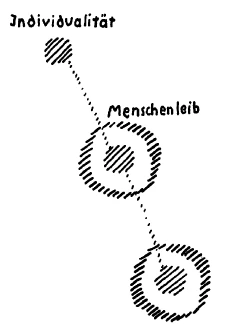
[ 14 ] All of this has been lost—it had to be lost—because humanity had to develop in the way that has often been described. But Ahriman has a great interest in preserving that which is meant to develop, that which is meant to make way for something else, and in keeping it firmly in the world.
[ 15 ] And so, in the course of human development, there are countless things—even a cursory glance will show you—that were justified in earlier times but are now preserved just as they are. This is true on both a small and a large scale.
[ 16 ] Gutzkow wanted to illustrate something like this on a grand scale in his novel *Maha Guru*. He wanted to show: What does it look like when something that once had significance in the ancient times of human development—in the ancient Atlantean era, when people still had the ability to regulate heredity—what does it look like when this is transposed into a time and a community that, while it had preserved the traditions, but knew nothing more of the past than a subordinate art known in occultism as occult chemistry? And there he showed that something of this kind existed in Tibet. This priesthood in Tibet, of course, no longer had any knowledge of how, through the hereditary relationships of the individual, it could create a body—a body it believed was meant to pass from one incarnation to the next—but it preserved the old customs. So here we have an example where what exists in outer reality contradicts, to the very highest degree, what it can be according to the conditions that simply exist in human evolution. How reality can be a maya in relation to its own conditions! — one feels tempted to exclaim this while reading *Maha Guru*.
[ 17 ] Or another example, my dear friends. You can surely imagine that the people of the Lemurian and Atlantean eras did not yet look like people do today, for what developed inwardly and spiritually at that time also shaped their outward form. Their entire physical form was different—it was soft and supple. Now, the physical form of the people of the Lemurian and Atlantean eras was by no means ape-like; the ancestors of humankind—the true ancestors of humankind—did not have an ape-like form. I have emphasized this many times. Unless, of course, an exception had been made in the course of world evolution precisely for those people who have written themselves that they can remember descending from apes! However, we need not examine that now. So humans did not look ape-like, but if you imagine our children—even more childlike, much, much more childlike—with a natural, elemental quality radiating throughout their entire bodies—then you might be able to form a mental image of what the human body was like back then. But as a result—read the essays “From the Akashic Records”—because beings such as I have described, who had remained behind from the Moon, incarnated in these softer bodies, the soft bodies became more animal-like than human-like. Distorted forms arose, even peculiar contortions of the limbs: And there you have the origin of the divine figures found among the various peoples. These strange figures, with inhuman faces and enormous limbs, stem from the fact that one had to take into account this interaction between the incarnating lunar beings and the human body.
[ 18 ] If there had been painters and sculptors during the Atlantean era, they would have been able to recreate or paint these beings—who lived in human form as incarnated lunar beings. But in Tibet, that was no longer the case. Therefore, one had to adhere to the canon; otherwise, the artists would have done whatever they pleased. If someone chose not to follow the canon but to create according to his own imagination, he was guilty of a capital offense. Of course, one might ask: Does it really make sense that someone who alters the form of a god even just a little bit—as I hinted at yesterday—should be punished with death? Does that make any sense? — Yes, in Tibet it no longer made sense. But at one time it did make sense, because, as you have heard, these figures once existed, and if one did not reproduce them exactly as they were, one deviated from what was there—one created a lie. But in those ancient times, a lie was something that held far greater power than it does today. If, in the present day, everyone who uttered a lie were to suffocate from it, then—no, I’d rather not speak on that subject, for I believe the fear of suffocation would be too great to let people lie! I don’t suppose people would suffocate from a lie now, but back then they really would have suffocated: For the thought, once put into words, had the power to reshape the air in the larynx, and thus suffocated the person. And anyone who had inaccurately depicted on Earth such a being—one that had not fully developed on the Moon—would have suffocated as a result: that is, he would have died as a result of a natural phenomenon.
[ 19 ] This is how things are connected. In other words, the evolution of humanity is quite complicated after all, and one really must delve into Spiritual Science if one wants to understand what is actually there. But now it is precisely necessary that, in order to face correctly the things that approach our soul in the course of world development, we truly engage fearlessly with what Spiritual Science has to proclaim from the spiritual worlds. For this Spiritual Science is, so to speak, an initial impulse to which more and more other impulses must be added so that humanity may move toward its appropriate development in the future. You have seen from what I have explained that we must navigate between Scylla and Charybdis, that we must take a very specific path in our Spiritual Science, and this must be taken very, very seriously. We have, after all, been practicing natural science using materialistic methods. I have tried, especially in recent weeks, to analyze and characterize its peculiarities for you. I have told you this in recent weeks in the sense that a materialistic method in natural science is indeed fully justifiable. But why must this materialistic method exist at all? We can characterize this materialistic method precisely by saying—as we have heard in recent weeks—that it is suited to obscuring and concealing what is actually spiritual and lies behind it. — Why, then, must this materialistic method exist? Why is it present today, especially in our time?
[ 20 ] You see, in our time, an earlier understanding of nature was to be replaced by a new one. An earlier understanding of nature was to be replaced by a new one. I have hinted at something of this earlier understanding of nature. Just think what kind of knowledge of nature that was! To shape a human head in a brilliant way through very specific measures—measures that were scientifically regulated in the old sense—so that it could serve as a vessel for a brilliant soul—that requires immense knowledge; or, conversely, to regulate heredity in such a way that brilliant qualities are passed on to one’s descendants. Indeed, such knowledge is even more profound. In thousands of cases, it surpassed what is now once again emerging in the fields of evolutionary theory, physics, chemistry, and so on.
[ 21 ] But it is precisely that ancient knowledge that was to be obscured and veiled by today’s materialistic method, which is fully justified and can remain within the purely physical realm. For in the time when that lofty knowledge of nature—which I have described—existed, human beings were not free beings; rather, they were only on the path to gradually developing freedom. They were guided and directed. They were not beings with free will, and the greater part of what took place to guide humanity was brought about by the higher hierarchies. And only a few individuals—those who strayed from the path, who were driven too far along the path of freedom—brought about the descent into the abyss and caused Atlantis to be swept away. But as the will became freer and freer, humanity would not have been able to bear possessing such knowledge.
[ 22 ] Today, it is unthinkable to possess the kind of knowledge that once existed on Earth, because human beings possess such a degree of free will that they could, of course, still abuse it today. How is this free will that human beings possess guided onto the right path? You can already gather from certain hints I have made in recent weeks that free will is steered in the right direction when people embrace the scientific method—the scientific method with its rigor and precision; on the other hand, it is a wonderful educational tool for the development of free will.
[ 23 ] We therefore have absolutely no reason to oppose in any way today’s scientific method, the validity of which we fully acknowledge for the present time. And if you go through everything in our lectures and books, you will in fact find that everything the individual slanderers claim—such as that we are opposed to the natural sciences—is refuted. One must sometimes take a stand against the pretensions of certain researchers and natural scientists; but nothing in our writings will ever be found that is directed against the achievements of the natural sciences. It would be a complete slander to claim that anything in our writings opposes natural science, and for us there can be no question whatsoever of turning against natural science in any way. One must simply be aware that one can be attacked from the so-called natural-scientific side. Then one must defend oneself against the attack when necessary. But it must become increasingly clear to the true adherents of Spiritual Science that we must fully understand the necessity of the scientific method, and that we must keep this scientific method free from all possible non-scientific concepts—for example, the atom and atomic motion, which I have spoken about recently. These are fantasies within natural science. One must recognize the difference.
[ 24 ] One must strive to understand clearly where true natural science exists, and where there are merely scientific fantasies. How often do we hear today that this or that has been established by science, when in fact nothing has been established at all, simply because people are following mere words. Never has blind acceptance of authority been greater than it is today in the scientific realm, where everyone essentially leaves it up to the person they trust to decide the matter. This is the meaning of the Mystery of Golgotha: that, in a certain way, what came into the world through Lucifer is gradually being corrected again—as is also symbolically hinted at in the Bible—: “Your eyes will be opened, and you will distinguish good from evil”—that is, distinguish good and evil from the outside. But when one perceives outwardly in the world of perceptions, it is impossible to receive anything from the world of perception other than perceptions themselves.
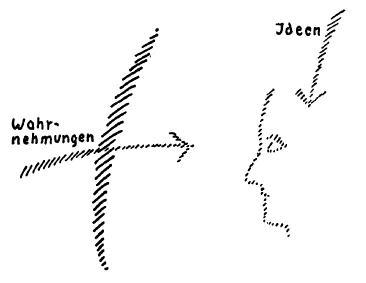
[ 25 ] As soon as one begins to reflect on perceptions, to speculate, and to derive all sorts of ideas from them, one is on the path to truly finding within them what has been instilled there by Ahriman and Lucifer. The ideas must come from the spiritual world, and we must first connect them with our perceptions: then these ideas are divine. Then these ideas are divine! In human life, a union must first be formed between the ideas given to the human being from the spiritual realm and what the human being sees outwardly through the senses. This must first be brought together in human life.
[ 26 ] You can look up the scientific meaning of this in my treatise “Truth and Science.” The idea that one could also discover ideas and thoughts scientifically from the outside—through perceptions—is based on deception, on the deception of Ahriman and Lucifer. But as long as, in a certain justified way, the powers were permitted to say: “Your eyes will be opened, and you will distinguish between good and evil”—that is, to seek ideas in the external world—as long as that was justified, that is, up to the Mystery of Golgotha, as long as Lucifer and Ahriman were justifiably permitted, there was nothing to object to. But now it is different; now they are even more unjustified within the outer realm of perception.
[ 27 ] This, too, emerged in the mid-19th century as a result of a particular crisis. This crisis manifested itself through great—indeed, quite extraordinary—achievements: for example, the emergence of spectral analysis, which thoroughly dispelled the notion within the scientific method that one was dealing with spiritual entities when looking up at the stars, and demonstrated that matter—the same kind found on Earth—extends everywhere. It is no longer possible to maintain the old conflation of ideas with perception, for such discoveries make it necessary for ideas to find their way back into our souls through the spiritual path. The same is true of Darwinism. If one merely combines what one finds in external perception—that is, if one seeks ideas in the external world—one arrives at a purely materialistic interpretation of the world. In short, the crisis is heralded everywhere, it is present everywhere, and everywhere there is also resistance to the fact that ideas must grow from the spiritual realm into the human soul if humanity is to progress. This means we must recognize the nature of Ahriman and Lucifer so that we may henceforth observe them when they seek to continue what is expressed in these words: “Your eyes will be opened, and you will be able to distinguish between good and evil.” — We must learn to observe them, both Ahriman and Lucifer. We will be able to do so when we truly permeate the “I,” as it has developed, with Christ, truly permeate it with Christ.
[ 28 ] But something else, too, resounded through the world in ancient times, and this came from another direction after humankind had gained the ability to distinguish between good and evil, after it had gained the ability to turn its eyes outward—that is, to use its senses and, through them, to receive sensory ideas. Then he also heard the word: “Humanity must leave the realm of the spirit in which it has lived until now, lest it also eat from the Tree of Life.” — But Christ will continually give humanity food from the Tree of Life, and the ideas that penetrate directly into human souls from the realm of the spirit must be experienced. But they can only be experienced if the human soul takes Christ into itself. And then we have something quite different from the concept of knowledge; we receive the concept of life. Whereas we must, so to speak, keep a close watch on Lucifer and Ahriman so that — when, in the distant future, knowledge from outside penetrates us — we observe that this comes from Ahriman and Lucifer; we must be clear that through the Mystery of Golgotha, it has been brought about in human existence that people receive ideas within themselves for life—not merely for knowledge, but for life. And when we view the various religions of the world from this perspective of life, we will be far, far removed from examining these religions to see whether or not they agree with our worldview. It is not at all our task to apply the concept of knowledge to them, but rather the concept of life.
[ 29 ] There are certain forms of religion among humankind. We should not focus on whether we consider them to be true, but rather on whether they are capable of providing spiritual nourishment to people through what is alive in their worship and of enlivening their souls. And so, of course, since there are different human souls, there can also be different forms of nourishment that sustain them. If we grasp this, then we will realize that we can never bring ourselves to oppose any religious form, but must strive to understand it, insofar as it is the sustenance of life for souls to whom it is given as life—not merely as knowledge, but as life itself. Then we will also realize that the perspective shifts entirely when religion begins to argue with a science about its content. Then we will also know how it is, in fact, only natural that religion takes an opposing stance toward the advancing natural and Spiritual Science. For these religions still do not want to break free from the old tempter; they still do not want to appeal solely to God, who told humankind: He wants to give them life; they are not to eat of the tree of life themselves. — The representatives of religion do not wish to appeal merely to God; rather, they wish to appeal to the Luciferic and Ahrimanic spirits as well, and through religion they seek to open their eyes to the distinction between good and evil. Religion wants to be “knowledge.” But it cannot be that, because it is the substance of life. And under this temptation, which still whispers in the ears of the individual representatives of religious communities, they believe they are imparting knowledge through their religions and fight against the advancing insights of science, whereas the question of knowledge cannot actually even be considered in the context of religion and science. We have not the slightest reason to oppose any religious community, and we can never be opposed to any religious community on the grounds that we question religious communities about their very essence of life and not about the content of their knowledge. But religious communities will always be tempted to ask advancing science whether it agrees with what they regard as knowledge. However, since life is in a state of development, advancing science will never be able to agree with religion, which tends toward conservatism.
[ 30 ] And now you can see the whole conflict, which, of course, will play out over and over again. I would like you to take a closer look at this conflict, to view it in the right way, and to learn to understand that, naturally, the representatives of religious communities—because they are overcome by temptation—will always oppose Spiritual Science from their own perspective. Just as natural science has been opposed, so too will Spiritual Science be opposed. But you must also be clear about this: those who oppose it do so out of ignorance. While this is no excuse for them—and they must, of course, be opposed in turn—one must nevertheless be clear about this: they fight out of ignorance; they are unable to adopt the correct point of view.
[ 31 ] I would like to place before your soul, like a landmark, a word spoken in the 14th century by a man who foresaw the coming of the age of natural science and scientific thinking, who foresaw the rise of humanism, and who heard from his friend: one should not concern oneself with what one can know that is not found in the Bible or preserved by church tradition. Things have changed in this regard since the 14th century. Dante’s *Divine Comedy* is a great, all-encompassing poem. But Dante lived precisely at the time when the era was drawing to a close in which people confined themselves to merely historical Christianity. For Dante, Virgil was simply the one banished to Hell. Dante knew little of anything other than the Christianity that appeared to him as a grand order. It was different for Petrarch. A century later, in the 14th century, Petrarch already read Virgil with greater faith. He turned back not only to the Christian but also to the pagan spiritual life. When one of Petrarch’s friends once wrote to him that a spiritual being had appeared to him in a dream and told him he should not concern himself with any literature that did not live within Christianity, he gave a meaningful reply. But that was the age of the natural sciences; now is the age of Spiritual Science. I want to emphasize this because even from the spiritual world, his friend—and through him, Petrarch—was admonished to concern himself only with what Christianity at that time regarded as Christian. He wrote those beautiful words, which at the time applied to the age that was dawning. They still apply today. Petrarch replied to his friend Boccaccio in serious, meaningful words and clearly explained his position to him—why he read these non-Christian works and what they meant to him:
[ 32 ] “Why, then, should we shun the pagan poets and writers who do not mention the name of Christ simply because they have never heard it? Surely the books of the unbelievers who mention Christ yet oppose him should seem far more dangerous—and yet the defenders of the true faith read them with the greatest zeal. Believe me: Much of what is motivated solely by laziness and cowardice is attributed to careful deliberation. People often despise what they cannot attain; and it is precisely the nature of ignorance to condemn what it cannot comprehend, and no one is willing to grant it a pursuit of which it is itself incapable.
[ 33 ] This is the source of biased judgments about unknown things, in which it is not so much the blindness of those who judge as their complacency that stands out. We, however, must not allow ourselves to be deterred from the sciences by any moral admonition or by references to the nearness of death. If the sciences are received with a good disposition, they inspire a love of virtue and remove the fear of death from us—or at least lessen it; if we abandon them, this would only arouse the suspicion of unbelief that has been attributed to knowledge. The sciences, therefore, do not hinder the one who possesses them in the right way from attaining perfection, but rather help him; they smooth the paths of life for him and do not hinder him. Just as certain foods may not agree with a sick and weak stomach, whereas a healthy person who is hungry can digest them without difficulty, so too what would be beneficial to a sound and vigorous mind might bring ruin to a weaker nature...
[ 34 ] I am well aware that some have attained sublime holiness without an education, but I also know that education has not excluded any of them... If I am to tell you my true opinion, it is this: The path to virtue through ignorance may be straightforward, but it is cowardly. All good people have but one goal, yet many paths lead to it, and those who journey together are very different from one another: one walks more slowly, another more quickly; one in secret, another in full view of all; this one humbly bowed, that one held high. Every journey is blessed; but most glorious of all is one that unfolds freely and nobly before everyone’s eyes. Knowledge that has struggled its way to faith is far better than simplicity, no matter how holy it may be, and none of the fools who have ever entered the Kingdom of Heaven stands as high as a man of knowledge who has attained the crown of bliss.” |
[ 35 ] The same is true of our Spiritual Science! And one could address the words above—which Petrarch wrote to his friend—not only to Pastor Riggenbach, but to all others who fight against us and oppose us: “Just as certain foods may not agree with a sick and weak stomach, whereas a healthy person who is hungry can digest them without difficulty, so too may that which would bring ruin to a feeble nature be a blessing to a sound and vigorous mind.”
[ 36 ] If one wants to dwell on the contradiction between the first and third Gospels, and refuses to see that the contradiction resolves itself as soon as one considers the two young Jesus figures, if one believes one must stick to the simple things and has no need for the fanciful nonsense of “those up there,” if one refuses to see that all forms of life have flowed into our structures but instead speaks of “distorted, fanciful forms,” then one must say: “Knowledge that has struggled its way to faith is far better than simplicity, however holy it may be, and none of the fools who have ever entered the Kingdom of Heaven stands as high as a man of knowledge who attains the crown of bliss.”
[ 37 ] Such reflections are necessary so that we are at least clear that it can never be our principle to oppose any religious community, and that it can only be slander when someone portrays us as enemies of religious movements. The very fact that someone does this proves that they do not want to understand us. We must at least be aware of this; and we must oppose any aggressive tendency directed against any religious community, just as we must refrain from any aggressive tendency directed against the natural sciences—for it will become clear of its own accord how these will interact with Spiritual Science! We have no need to fight any religious community. In truth, conflicts cannot originate from us at all, for it is not in our nature to attack. Attacking is entirely foreign to us. And it is absolutely necessary to understand that it is an axiom: if we do not have peace, it is because our malicious neighbor does not want it; for it is not in our nature to fight. Let them try it once and leave us in peace—let’s see if peace is not preserved. Let them try it! But we must, of course, be imbued with this spirit ourselves. For example, many sins are committed when, on our part as well, this or that dogma or matter of worship is challenged—often without even understanding them. We must understand them; but if we understand them correctly, then what has been stated applies as our principle. And so I would likewise appeal to your understanding of the principle of peace. Just as I had to urge you to be patient in the present time, so must I urge you to be vigilant, so that we may do what is necessary to truly preserve the sacred trust entrusted to us. For we will have to walk through the world with ever-increasing inner strength in order to stand firmly on the ground upon which Spiritual Science seeks to place us.
[ 38 ] The Mystery of Golgotha and the Christ Principle are intimately connected with the necessity of perceiving the spiritual in the world. Mere observation will never suffice, even if you wish only to come to understand the historical reality of the Mystery of Golgotha. The Mystery of Golgotha can be understood only spiritually, and anyone who wishes to devote themselves to a science that receives everything from the outside, and who does not wish to look to the new revelations that can always flow to us regarding the Mystery of Golgotha, will not comprehend what was sung in the mid-19th century, in 1838, by someone else—that which, ever-changing and yet eternally existing, has reigned over humanity on Earth since the Mystery of Golgotha. Let me read a passage that can illustrate how that which cannot comprehend the Mystery of Golgotha stands in opposition to this Mystery of Golgotha.
The Spell
Fourth Song
For the green feast of Easter with young palm branches
All of Jerusalem was already prepared
And struck up the harp to sing psalms of joy.A single house, the last in the row,
The door of Ahasver, the grumbling one,
Remained without festive adornment and without consecration.And thousands upon thousands of strangers
From near and far streamed together
Like ocean waves roaring beneath the wind.Then came down, to fulfill the final act,
To offer himself as a sacrifice, the Son of God
In his humility, riding a lowly colt;And all the people rush toward him, cheering
And spread their robes before him
And scatter green branches upon his path.Only one, indignant and furious with himself,
Only Ahasver sat silently, lost in thought,
A sultry day, a thunderstorm brewing secretly.And: “Hosanna!” he hears in a thousand voices.
But he cursed secretly within himself,
Yet he spoke not—his heart was too fierce.Silent now were the hordes of the Jewish people,
And everywhere it was night—oh, a night
That had become full of bitter suffering, harsh torment!There are indeed nights so mysterious,
When it seems as though nature
Wishes to keep watch in painful prayer.On such a night, no creature’s eye can close,
Whether pious or godless, no soul can
Enjoy the refreshing sleep.On such a night, God’s Son was betrayed
To the wickedness and evil of the world,
And abandoned to its misdeeds.On such a night, Ahasver felt a shudder,
A feverish chill ran through his bones,
And he began to speak and to mourn:“Where has any people endured such horror
As you, O Israel, from the very beginning?
With your fear of God, you have brought all this upon yourself.That is why you are so powerless, feeble, cowardly, and worthless;
For everyone serves mindlessly like a beast,
Each one bound first to the service of a master.Thus have we indulged in every path,
Thus in Egypt and in Babylon,
Thus have we served a god to excess!”And just as the sun sinks deep into misty seas
So now Ahasver sank back into himself
Into endless, immeasurably deep anguish;Yet just as subterranean forces
At times split the earth to its very core,
Splitting its quivering red heart in two,So suddenly he saw within himself
The cause of evil—oh, an eternal sorrow!
And he continued, lost in deep thought:“Poor Earth! For brief, blissful hours
She held a god in her arms,
Now she is cast out, and God has vanished.The Earth, betrayed by the faithless God,
With love and tears she faithfully
Raised her poor little child with sincerity; —Her child, mankind, whom she kindly nurtured,
Why does he press himself upon the proud God?
The bastard’s path to Him is barred.So I will cast his memory from me,
Tear from my breast the longing for him,
That paternal, meager legacy!Man is of the earth and on the earth
And lives by the earth, so that one day
He may, like his mother, become earth again.”Now he fell silent. Pale and mournful, like the flower,
That bears within itself the holy Passion,
Blooms on the day of the great martyrdom;And all the people, huddled together like a ball,
Had crowded noisily toward the courthouse,
Where above stood the Savior at the column.Upon his head the bloody crown of thorns,
In a purple cloak, a reed in his hand,
O, royally adorned for mockery and scorn.And Ahasver hears an endless cry:
“Crucify him! Crucify the king!”
And the call for murder grows ever louder.And ever more furiously he hears them shout:
“He has led the people astray! Away with him!”
Then he steps forward to the steps of his house.The people surged forward; it seemed as if
With mocking laughter, from the upper world
The devilish mob from the deepest hellWas pouring forth to mortally strike the betrayed God,
Who staggers along in their midst,
Who must bear his own cross as a torment.A jubilant cry resounds, ghastly and a thousand-voiced:
“He has led the people astray—away with him!
To the cross, to the cross—the King of Israel!”“Death to this Nazarene, to God and to all!”
Ahasver shouted; then there was dead silence
And before him, Christ had fallen beneath the cross.And as the servants took him down from the cross,
Christ implored Ahasver:
“Let me rest a little at your threshold!”But he hurled these words of scorn at him:
“Does your Father in heaven not help you
And yet you call yourself the Only-Begotten Son of God?I cast you away from my threshold,
Whether your words are true or whether you have lied;
No rest for you! None in this place!”“No rest for you, no—no peace!”
The Lord replied to him. “Then may you live the eternal
life restlessly here on earth!”No sooner had the Lord spoken these heavy words,
than Ahasver, seized by sudden terror,
fell face down; his spirit was broken.Mysterious, terrifying news,
Pass now by Ahasver, pass by me!
Pass, pass, mighty hour of sacrifice!
Canto V
A bitter wailing rang through earth and heaven;
As Christ was lifted up on the cross,
At that very moment, the sun ceased to shine.And when the Mediator, now in the throes of death, cried out:
“It is finished!” and thus passed away,
A sword’s edge pierced the heart of the earth.Then a dreadful cry of grief resounded through nature,
So piercing to the marrow and bones, unheard of,
So wretched, utterly strange, and immeasurable,As if she herself had been pierced through her soul
By the spear of death, alas! sudden and murderous
Shattering her warm mother’s breast!And a fear, an irresistible shudder,
And a heavy, great darkness
Sank upon the vast earth, impenetrable.And like a little bird in the vulture’s claws,
The ground now began, out of inner dread,
To tremble within itself and surge upward.Then all bonds seemed to dissolve,
The earth’s foundation wavered within,
And the dead awoke and rose again.“So he was still God and had to die?”
Ahasver spoke softly. “But I
Am I not to meet my death on earth?”Yet as if on a perilously wavering ladder
An enigmatic power drove him onward
Through all the horrors, ever farther,Until he found himself enclosed by the walls of a vast chamber
Wandering and staggering from one passage to the next,
Like a sleepwalker under the spell of a dream.He cannot find a single way out
In this desolate, immense tomb,
No matter where he may turn or wind his way.He cannot fathom how he entered,
Nor can he recall where he is
In such a moment of terror, lost and alone.And as he continues to grope along the walls,
He finally stumbles upon a table;
He holds a sacrificial knife in his hands.Then he cries out, almost timidly and anxiously:
“How did I come to be in Jehovah’s house,
Here in Solomon’s Temple?If he truly lived here on earth as Christ,
Choosing death in human form,
Then he gladly left the dead God in peace.A terrible mystery—if only someone could unravel it!
He has taken his seat in the Holy of Holies—
If only I could grant myself a glimpse inside?”In the violent agitation of his heart
He found the steps, which, almost as if alive,
Were moving, just like the floor itself.But as he laboriously struggled upward there,
The temple’s curtain was torn from top to bottom
With a clap of thunder;And terrifying, in the blinding light of a mighty flash of lightning,
The angel Michael, with a flaming sword,
Stood tall and glorious upon the holy spot.His feet rested upon clouds of fire,
In flames of fire he raised his arm,
And thus he spoke as if with the heat of a storm:“Whom do you seek here? The demon has been judged,
The wrathful demon of your people;
And the Son of God has destroyed his power!”“Jehovah?” cried Ahasver in terror.
The angel spoke: “He, too, was an idol!
The God of Truth must strike him down,Just as He has struck down all the idols of this earth,
So that from all people there may be but one people
And in Him, all creation may become one!You have staked your bet on earthly life,
May you receive what you desire,
So be chained to this life!May the ages pass you by without a trace,
Passing powerlessly by you,
Passing, yet as long as eternities!May the sweet peace of death be denied to you,
May man’s final comfort, sleep, be denied to you,
May all rest here below be denied to you from now on;Yet the arms of the Son of God in the Kingdom of Heaven
Are always open to grace,
So that He may have mercy on every being.Thus will He restore to you the solution
To the riddle of your own fate,
And three times over, the young lives of your children,Until you have found your path to salvation
With them to God’s fatherly bosom
And thus have been released from your earthly service!The first time, you may succeed,
The second time, implore God’s counsel,
The third time, you must accomplish it.Otherwise, woe to you! Until the Last Judgment
You must then wander the earth,
Until the end of all world history.”Suddenly the miraculous flames went out,
And the night, terrible, gruesome, and gloomy,
Swirls together once more in a wild vortex.
[ 39 ] Here is yet another example of how the human soul feels compelled to grapple with what has come to pass over time. And now, after we have allowed such images to pass through our souls, I would like to remind you of what I have said before from this very place: We must change our way of looking at things if we want to truly glimpse into the spiritual world. We must not believe that we can perceive it in the same way as the physical world. We must even accustom ourselves to different modes of expression. We see and perceive the trees, rivers, and mountains when we are in the physical world. But we experience spiritual beings in such a way that we must say: they see us; they perceive us. To truly understand the Mystery of Golgotha, however, it is necessary to know this, because it can only be properly understood in the spiritual realm. But this is how we want to understand the Mystery of Golgotha.
[ 40 ] There must come a time when, through a true understanding of the words, “Not I, but Christ in me,” it will be possible to ascend to the spiritual worlds in the proper way through knowledge. In 1838, this epic poem, “Ahasver,” by Julius Mosen was published, and it reveals this to us as well, since he was able to write this legend in such a way that Mosen could truly be moved by the tragic fate that befell him. He spent most of his life—almost his entire life—confined to bed, as his physical body was almost completely paralyzed. This very circumstance enabled him to rise to higher ideas. In this, he reminds us of that sinner I spoke of yesterday in the novel *Maha Guru*, who, when he was already insane, found his art; and he reminds us of the count’s wife from the Polish drama, who likewise had to fall into a state of illness in order to be in contact with the spiritual world. Today, the task of Spiritual Science is precisely to enable people in a healthy and normal state to ascend into the spiritual world. All of this points to the seriousness and dignity with which we must approach the task of the Spiritual Science movement. Today, when we reflect on what can inspire us as a force and distill it into a single word—a word of truth—we summarize it with the following: The Mystery of Golgotha shows us that spiritual understanding is necessary, that we must seek Christ as Spirit. — Then we must also say: Christ sees us, perceives us.
[ 41 ] Let us take this deeply to heart and always keep it in mind; and our spiritual and soulful conscience must be able to find satisfaction in it when we present our Spiritual Science insights in such a way that we can speak these words with a clear conscience: May Christ look upon what we do as our Spiritual Science. - That is our faith, but it can also inspire us just as people were once inspired by the words of Bernard of Clairvaux: “God wills it!”—words that became a reality through action. May it be the same for us, that we may believe we understand Christ correctly when we live under the impression of the words: “Christ knows us.” —- And if you understand it correctly, I could give you nothing more esoteric for the soul that perceives Spiritual Science in the right light and for the heart that feels Spiritual Science in the true sense than the words: “Christ sees us!”
[ 42 ] May these words live in our souls: Christ sees us! — for this is what we may believe if we understand Spiritual Science correctly: Christ sees us!