

Anthroposophical Community Building
GA 257
3 March 1923, Dornach
Translated by Steiner Online Library
Ninth Lecture
[ 1 ] Yesterday I tried to give you a sort of report on what happened in Stuttgart, and I said that I would essentially outline the content of the lectures I was to give there. So today I will first outline the content of those lectures here, and tomorrow I will try to say a few more things in connection with what I said yesterday.
[ 2 ] The first lecture on Tuesday arose from a very specific need that became clearly evident in the course of the discussions on Sunday, Monday, and Tuesday—discussions that I would say were at least described in terms of their general mood—that is, from a need that had emerged from these discussions. It was the need to consider the essence of community-building. This formation of human communities through the anthroposophical movement is, after all, something that has played a major role within our Anthroposophical Society in recent times. Young people in particular, but also others—including older people—have joined the Anthroposophical Society with a distinct longing to meet other people within this society with whom they could, in a sense, find what the current social order cannot provide for the individual. This points to a thoroughly understandable longing felt by many people in our time.
[ 3 ] With the advent of the Age of Consciousness, the situation is such that the old social bonds have lost their purely human substance and their purely human power. Human beings have always grown up within a certain community. They did not grow up to be solitary individuals, but rather grew up within a specific community. They grew up within the family community, the professional community, the estate-based community, and, in recent times, what is called the class community, and so on. These communities have always provided people with something that they cannot provide for themselves as individuals. In recent times, the class community has indeed been one of the strongest bonds connecting people to one another in social life.
[ 4 ] Class communities emerged from the old social formations—from estates, ethnic communities, and even racial communities. And in recent times, a certain cohesion has developed among the so-called higher classes—the nobility, the bourgeoisie, and the proletariat. Thus, class communities arose that extended across ethnic groups, even across racial characteristics, and so on. And much of what exists today in international social life can be traced back to such class communities.
[ 5 ] But now the age of the conscious soul—which has been heralding itself more and more since the beginning of the 15th century—has come to manifestation in recent times with a certain vehemence, with an inner strength arising from the human soul. People do feel, after all, that even within class communities they can no longer attain what is meant to carry them beyond the individual. Today, on the one hand, people feel strongly as individuals, and they wish to reject anything that in any way impairs their individual feelings, sensibilities, and thinking. They want to be a personality. And this stems from certain elemental depths. It has been present in people’s souls—if I may once again use the expression I employed yesterday—since the end of the Kali Yuga, that is, since the beginning of our century, however vague it may still be: something that today expresses itself in the words, “I want to be a self-contained personality.” - Certainly, many do not know how to put this into words. It then manifests itself in all sorts of dissatisfactions, in all sorts of instability in the life of the soul, but it is nevertheless this: the desire to be a personality, a self-contained personality.
[ 6 ] But in this earthly life, human beings simply cannot do without other people. Historical ties—not even the proletarian class community, for example—can provide what both satisfies the urge for individuality and, at the same time, brings people together. Today, people wish to connect with the purely human aspect of others through what is purely human in themselves. They do wish, in a sense, to have social bonds, but these should have an individual character, much like personal friendships.
[ 7 ] And so much of what takes place in human relationships today is a yearning for such human communities. This yearning for such human communities became particularly evident some time ago when several younger individuals approached me with the intention of bringing about a kind of renewal of Christianity, believing that this renewal of Christianity could only be brought about by revitalizing the Christ impulse in the way made possible by anthroposophy. Out of this longing on the part of younger theologians—some of whom were just completing their theological studies and thus faced the task of taking up the pastoral ministry, while others were still in the midst of their theological studies—out of this longing arose what, I would say, emerged as the most recent initiative of our Anthroposophical Society: the “Movement for Religious Renewal.”
[ 8 ] Of course, there was much to be done for this movement for religious renewal. Above all, the task was to bring the Christ impulse to life in the way that is possible today. To do this, it was necessary to take very seriously what I have often emphasized: that Christ did not speak to human souls only at the beginning of Christian development, but that He made real what is contained in the words: “ I am with you always, even to the end of the age,” that is, that he can be heard whenever a soul wishes to hear him, and that a continuous revelation of Christ is thus taking place. Thus, it was necessary to move from the written revelations of the Gospels to the immediately living revelations of the Christ impulse. That was, after all, one aspect of the tasks for religious renewal.
[ 9 ] The other side, however, was the one I had to point out immediately by saying: But a religious renewal must bring about the formation of communities—religious communities. A person can cultivate their knowledge as an individual only after first having received it through the community. But that immediate experience of the spiritual world—one based not so much on thought as on feeling, which can be described as religious—the experience of the spiritual world as divine—can only find its full expression in the formation of community. And so, I said, a revitalization of religious life must arise through the formation of healthy communities.
[ 10 ] It was, after all, Protestant theological figures who initially launched this movement for religious renewal. One could point out to them how, in recent times, the Protestant confessions in particular had increasingly leaned toward a special emphasis on preaching and had strayed from a ritualistic approach. But the sermon atomizes communities. The sermon—through which, after all, knowledge of the divine world is meant to permeate—calls upon individual souls to form their own opinions, a tendency that has manifested itself in the fact that the creed, the profession of faith, has been most vigorously challenged in recent times, with everyone, so to speak, wanting to have their own creed. A fragmentation, a shattering of the congregation, and a redirection of religious life toward the individual personality has taken place.
[ 11 ] This, however, would gradually lead to the complete dissolution of the social order in favor of the spiritual realm, were it not for the possibility of genuine community-building. But genuine community-building, as I said, is only possible within a form of worship that is truly derived from the present-day revelations of the spiritual world. And so this form of worship has also found its way into the movement for religious renewal, where it is now present. This form of worship takes full account of the historical development of humanity; therefore, in many of its details—and also in much of what appears in its totality—it embodies a continuation of history. But it also bears throughout the influences of that which can only now reveal itself to supersensible consciousness from the spiritual world.
[ 12 ] Worship binds together the people who unite in it. Worship creates communities. And Dr. Rittelmeyer quite rightly said in the course of the discussions: the Anthroposophical Society faces a certain strong—perhaps the strongest—danger within the movement for religious renewal precisely because of the community-building element of worship. What was he alluding to? He was pointing out that today, as I mentioned earlier, many people approach the Anthroposophical Society with a tendency to seek connection with others in the sense of forming such a free community—that this community life is found through the religious coloring provided by the cult—and that, therefore, those people who have this longing for community life will initially satisfy it within the movement for religious renewal. And the Anthroposophical Society, therefore, if it does not wish to face a danger in this regard, should strive to cultivate a community-building element as well.
[ 13 ] Well, this drew attention to something that is of particular significance precisely in light of the latest phase of our Anthroposophical Society. It was pointed out that anthroposophists must recognize the essence of community-building. The question must be answered: Is this community-building, which arises in religious renewal, the only one possible at the present time, or is there also another possibility for community-building within the Anthroposophical Society? This question can, of course, only be answered if one considers the nature of community-building a bit more closely. However, in people today there is not merely that tendency toward community-building—it is strongly present, but not merely present—which can be satisfied through worship; rather, there is also another kind of longing for community-building. And so it may well be that these two kinds of longing for community, which are present in every person today, can be taken into account for each individual, so that a community-building element is present not only in the movement for religious renewal but also in the Anthroposophical Society.
[ 14 ] Of course, when one speaks of such things, one must express them in ideas. But what I am now going to develop in ideas is actually present in the emotional experience of humanity today. We only make things clear to ourselves by expressing them in ideas; but what I now wish to express is something that is indeed present in the emotional life of people today.
[ 15 ] The first form of community-building—one that, I would say, comes to us right from the very beginning of our lives on Earth, which is, of course, something we take for granted and about which we usually do not reflect deeply or contemplate—is the community-building that arises through language. We learn language as children. And the mother tongue is a particularly powerful community-building element precisely because it approaches the child and is absorbed by the child at a time when the etheric body is still completely undifferentiated and integrated into the rest of the organism. As a result, the mother tongue becomes deeply intertwined with the entire being of the human being. But this language is something that spreads as a common bond among groups of people. People come together through the shared language. And if you recall what I have often stated here—that a spiritual element is indeed embodied in language, that the “genius of language” is not merely an abstraction of today’s scholars, but a real spiritual being— then you will sense how the community of language is based on the fact that those who communicate in the same language feel, within the circle in which they have come together, the active presence of the real genius of language. They feel, as it were, sheltered under the wings of a real spiritual being. And this is the case in all forms of community formation.
[ 16 ] Every process of community-building ultimately boils down to the fact that, among those who come together to form a community, a higher spiritual and essential force prevails—one that, in a sense, descends from spiritual realms and binds people together. But we can, I would say uniquely, find other individual elements that can act as community-forming factors in the most eminent sense among a group of people. A common language binds people together because what one person says can live within another—in other words, because something shared can exist simultaneously within several people. But let’s imagine the following: A group of people who spent their childhood and early school years together find themselves reunited after thirty years due to some circumstance—something like this could indeed happen, and has often happened and been brought about. They find themselves—now as a small group of forty- to fifty-year-olds, every one of whom spent their childhood with the others at school in the same neighborhood—talking about what they experienced together in their childhood and youth. Something very special comes alive within them, something that, even at this very moment, constitutes a community quite different from the one brought about merely by language. When a group of people who speak the same language comes together during a gathering precisely through the understanding of souls brought about by language, this coming together is nevertheless something relatively superficial compared to what occurs when one is deeply moved at the very center of one’s soul by living within shared memories. Every word takes on its own special flavor, its own particular hue, because it points to a childhood and youth lived together. What binds people to one another in those moments of such togetherness penetrates deeper into the soul. One feels bound, through deeper faculties, to those with whom one is gathered there.
[ 17 ] And in what are we together? We are united in memories—in what we once experienced together. We feel transported into a world that no longer exists, a world in which we lived together with those others with whom we are now gathered. This applies to earthly circumstances; it is merely meant to illustrate a point. But it illustrates precisely the essence of worship, for what is the aim of worship? Worship, whether it manifests itself through words or through actions, reflects in the sensory-physical world something that—in a sense entirely different from what we find in the external natural environment—is a direct reflection of the spiritual world, the supersensible world. Certainly, every plant, every process in the external natural world is a reflection of something spiritual, but not as directly as that which is revealed in a ritual ceremony or in a ritual word spoken in the proper manner. There, the supersensible world is directly embedded in word or action. This is, after all, the essence of ritual: that in the sensory world, words are spoken in such a way that the supersensible world is directly present in its very essence, and actions are performed in such a way that the forces of the supersensible world are present within them. A ritual ceremony is, after all, one in which something happens that does not merely signify what is being celebrated when viewed outwardly with the eyes, but rather, through ordinary physical forces, something takes place that is precisely spiritual forces, supersensible forces. A supersensible event takes place within the sensory representation.
[ 18 ] Through sensory speech and sensory action, the human being is thus directly united with the spiritual world. In true worship, the world that is, as it were, brought into the sensory realm through word and deed corresponds to the world from which we humans were drawn down from our pre-earthly life. Just as when three, four, or five people in their forties or fifties who spent their childhoods together come together, they feel transported back to the world in which they were together as children, so too does the person who participates in a proper ritual together with others—though they may not realize it, it remains in the subconscious, but through this it becomes all the more deeply embedded in their feelings and sensations—transferred to the world in which they were indeed together before they descended to Earth. For this is how the ritual is formed. The ritual is formed in such a way that, within it, a person truly experiences something that is indeed a memory, an image of what they experienced in their pre-earthly existence—that is, before they descended to Earth, And so those who belong to a religious community feel, to a greater degree, what I described earlier merely for the sake of clarity—when people come together in later life with a group and exchange childhood memories: they feel transported to a world they experienced together in the supersensible realm. That is what creates the bond within the worship community. That has always been the binding force in worship. And when it comes to religious life—which should not be fragmented, that is, which should not place the most essential element in the sermon but rather in the worship service—then the worship service leads precisely to the formation of a true community, to the formation of a congregation. And religious life cannot exist without the formation of a congregation. Therefore, the community—which in this way is a community of remembrance with regard to the transcendent—is also a sacramental community.
[ 19 ] However, it is not possible for this form of sacramental communion—that is, the worship community—to remain, for modern people, simply what it is. Certainly, for many it may still be so today; but the liturgical community itself would not have its value—its true value—and, above all, would not achieve its true purpose if it were to remain merely a community of remembrance of the supersensory experience. That is why the need to incorporate the sermon into the liturgy has arisen more and more. However, in the development of this sermon—as it has emerged in recent times within Protestant communities—the atomizing tendency has become so pronounced precisely because the real needs of the development of the conscious soul in the fifth post-Atlantean epoch have not been taken into account. The sermons of the older churches are entirely structured around the needs of the fourth post-Atlantean epoch. In the older confessions, the sermon takes shape out of the worldview of the Age of Reason or the Age of Sentiment. Modern people no longer really understand this. Consequently, the Protestant confessions have also shifted toward a presentation based more on human opinion and human conscious insight. On the one hand, this is entirely justified. On the other hand, however, the proper form for this has not yet been fully established. The sermon, which arises within the context of worship, is, after all, a stepping outside of worship—a turning from worship toward knowledge. Yet little account is taken of this in the form that the sermon has assumed within the context of humanity’s ongoing development. I need only remind you of one thing, and you will see this immediately. If you count the sermons of recent times that are not based on a biblical text as their theme, you will see how few remain. Everywhere—in Sunday sermons, in sermons for specific occasions—a biblical text is taken as the foundation, precisely because the immediate, living revelation that can also be present in the here and now is denied. But the connection is made exclusively to the historical. So while the individual sermon is sought, the condition for it is not found. And so the sermon simply flows into mere human opinion, into individual opinion. But that atomizes it.
[ 20 ] If, then, the recently founded movement for religious renewal—since it is essentially rooted in the groundwork laid by anthroposophy—expects an ongoing, ever-evolving revelation, that is, with the living spiritual experience arising from the supersensible world, then its very preaching leads it to realize that it needs something else—namely, that from which this ongoing, living knowledge of the spiritual world is directly possible. It therefore needs anthroposophical Spiritual Science; I would say: the sermon will always be the window through which the movement for religious renewal will have to take in what a continuing, living Anthroposophical Society will have to provide for it. But this requires—as I already told you in my last lecture over at the Goetheanum, which still stands, regarding religious renewal—that if this movement for religious renewal is to grow, the Anthroposophical Society must also be present alongside it in all its vitality; that is, the living reality of anthroposophy embodied by a number of people. The movement for religious renewal would soon cut off its own lifeline if it did not, in turn, have alongside it a number of people—it need not be everyone, but always a number of people—in whom anthroposophical knowledge lives on in a living way.
[ 21 ] But as I have told you, many people are now coming to the Anthroposophical Society, and they do not merely seek anthroposophical knowledge in the abstract; rather, driven by the needs of people in our age of consciousness, they also seek to form communities within it. One might say: the Anthroposophical Society could, after all, also cultivate a form of worship. Certainly, it could do that as well; but that now belongs to a different realm. I would now like to focus on the specifically anthroposophical formation of community. There is indeed something else in human life today besides that which, with regard to human community, can be based on a shared memory of the supersensible world experienced before earthly existence. There is something that is needed again today, precisely in the way that is possible only in the age of consciousness. Here we are compelled to speak of something that, with regard to modern human beings, is still completely overlooked by most people today. Certainly, people have spoken of idealism in every age, but today, when idealism is discussed—even among those with good intentions—it is for the most part nothing more than empty rhetoric, mere rhetoric. For what is lacking today, in this age where intellectualistic forces and elements have emerged particularly strongly within widespread civilization, is an understanding of the world that encompasses the whole human being. Certainly, as a longing, it is present especially among today’s youth. But precisely that vagueness with which it appears in today’s youth shows that something is alive in the souls of people today that has not yet become clear, that is still undifferentiated, and that does not become less naive when it is differentiated.
[ 22 ] Please consider the following just once: Transport yourself back to times when religious movements were spreading among humankind. You will see that in bygone eras, in earlier periods of humanity’s historical development, this or that message from the spiritual world was received by many people with tremendous enthusiasm. Indeed, it would not have been possible for the religious creeds that exist today to sustain people if, at the time of their proclamation, there had not been a much stronger affinity in people’s souls for something proclaimed from the spiritual world than is the case today. Looking at people today, one cannot even create a mental image of them being captivated by something in the way that the proclamation of religious truths often was in earlier times. Certainly, sects still form today; but compared to the fervor with which human souls responded to earlier proclamations, today’s sects have a rather philistine quality. The inner warmth of the soul needed to receive spiritual matters is lacking. This has even declined rapidly in the last third of the 19th century. Out of a sense of dissatisfaction, however, there are still people today who listen to this or that, and even come to a certain commitment to this or that; but that positive warmth that used to be present in people’s souls—and which alone made it possible for one to devote one’s entire being, one’s entire human being, to spiritual matters—has given way to a certain coolness, even coldness. And this coolness and this coldness are also present in people’s souls when they speak today of ideals and idealism. For today, the main thing is actually something that is, in essence, still far from being fulfilled, something that, in essence, will remain an expectation for a long time to come, but which already lives as an expectation in an immense number of people today. I can characterize this for you in the following way.
[ 23 ] Consider the two states of consciousness that are well known to everyone: the person who is dreaming and the person in ordinary waking consciousness. What is it like for the person who is dreaming? It is the same for the sleeping person who is not dreaming, for sleeping without dreams simply means that the dreams are so greatly subdued that one does not notice them. So what is it like for the person who is dreaming?
[ 24 ] He lives in his world of dream images. He lives in that world because it is often much more vivid for him, much more deeply moving—one can certainly say that—than what one experiences in everyday life with waking consciousness. But one experiences it in isolation. One experiences it as an individual human personality. Two people can sleep in one and the same room, yet they have two completely different worlds in their dream consciousness. They do not experience these worlds together. Each experiences them on their own; at most, they can recount the content to one another afterward.
[ 25 ] When a person awakens from dream consciousness into ordinary waking consciousness, he perceives through his senses the same things that the person standing closest to him also perceives. A shared world emerges. A person awakens to a shared world by transitioning from dream consciousness to waking daytime consciousness. Indeed, to what does a person awaken from dream consciousness into waking daytime consciousness? They awaken to light, to sound, to their natural surroundings—in this respect, other people are no exception—to waking daytime consciousness, to ordinary waking daytime consciousness. One awakens from the dream to the naturalness of another person—to their speech, to what they say to you, and so on—to the way their thoughts and feelings are clothed in language. One awakens to that through which the ordinary person, the other person, naturally expresses themselves. Thus, one awakens to ordinary waking consciousness through the natural environment. In all earlier ages, it was the case that human beings awoke from dream consciousness to waking daytime consciousness through their natural surroundings. And in their natural surroundings, they also found the gateway through which, if they chose to do so, they could enter the supersensible realm.
[ 26 ] With the awakening of the soul of consciousness, with the unfolding of the soul of consciousness, a new element has entered human life in this regard. For there must be a second awakening, and this second awakening will increasingly emerge as a need of humanity: this is the awakening to the soul and spirit of other human beings. In ordinary waking daily life, one is indeed only awakened to the nature of the other human being; but the human being who has become independent and personal through the age of consciousness wishes to awaken to the soul and spirit of the other human being. They wish to awaken to the soul and spirit of other human beings; they wish to encounter other human beings in such a way that the other person elicits within their own soul a jolt similar to that produced by external light, external sound, and so on in relation to the dream life.
[ 27 ] This need has been a fundamental one since the beginning of the 20th century and will only grow stronger. Throughout the entire 20th century, despite all its chaotic and tumultuous nature—which will permeate the whole of civilization—this will manifest as a need: there will arise a need for people to awaken to one another to a greater degree than they can awaken to their mere natural surroundings. Dream life awakens through the natural environment to waking daily life. Waking daily life, in turn, awakens through other human beings—through their souls and spirits—to a higher consciousness. Human beings must become more than they have ever been to one another. They must become beings who awaken one another. People must draw closer to one another than they have ever been before: every person who encounters another must become an awakening being. To this end, modern people—who have now entered life—have accumulated far too much karma to fail to feel their destinies intertwined, each with the other person they encounter in life. If one goes back to earlier ages, souls were younger then; they had fewer karmic connections. Now, however, the necessity arises that one be awakened not only by nature, but also by the people with whom one is karmically connected and whom one seeks.
[ 28 ] And so, in addition to that need to remember the supersensible homeland—which can be satisfied through worship—there is the other need: to be awakened to the spiritual-soul aspect through other human beings. And the emotional impulse that can be at work here is that of modern idealism. When the ideal ceases to be merely abstract, when it becomes once again vividly rooted in the human soul and spirit, then it will take on precisely this form: I want to be awakened by another human being. — This, after all, is the feeling—albeit still quite vague—that is emerging among young people today: I want to be awakened by another human being. And this is what can be cultivated as a special communal life within the Anthroposophical Society—something that arises there in the most natural way from the world. For when a group of people comes together to experience collectively that which can be revealed from the supersensible world through anthroposophy, this shared experience within a group is simply something different from solitary experience. The fact that one is awakened to the soul of the other at the very moment one is together creates an atmosphere that does not lead into the supersensible world in the way described in *How to Attain Knowledge of the Higher Worlds*, but rather fosters an understanding of the ideas conveyed by anthroposophical Spiritual Science from the supersensible world.
[ 29 ] When people who are driven by idealism come together in a group and share with one another—whether through reading aloud or by some other means—the essence of anthroposophy, a different kind of understanding emerges. Through the shared experience of the supersensible, the human soul is awakened most intensely in contact with another human soul; the soul awakens to a higher understanding, and when this attitude is present, something emerges that causes a common, true essence to descend upon people who are united in mutual sharing and in the shared experience of anthroposophical ideas. Just as the genius of language lives within language—under whose wings, as it were, human beings live—so do they live under the wings of a higher being when, with the right idealistic attitude, they experience anthroposophical ideas together. What then takes place?
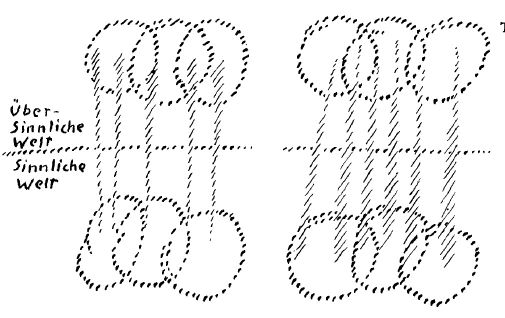
[ 30 ] Now, if this (as it is depicted) is the level at which the supersensible world is separated from the sensible world, then in the ritual we have the processes and essences of the higher world (above); we have projected them down into the physical world through the ritual, the ritual word, and the ritual action (below). When we have an anthroposophical branch, we have that which is experienced in the physical world within the anthroposophical group raised up into the spiritual world through the power of true idealism, which becomes spiritual. Through the ritual, the supersensible is brought down into the physical world in word and deed. Through the Anthroposophical Branch, the thoughts and feelings of the Anthroposophical group are raised up into the supersensible world. And when the Anthroposophical content is experienced by a group of people in the right spirit—whereby one human soul awakens another—this human soul is indeed elevated to a spiritual community. The point, however, is that this consciousness must truly exist. If this consciousness exists and such groups emerge within the Anthroposophical Society, then in this—if I may put it this way—reversed form of worship, at the other pole of worship, there is something that fosters community in the most eminent sense. One might say, to speak figuratively: The religious congregation seeks to induce the angels of heaven to descend into the place of worship so that they may be among the people. The anthroposophical community seeks to elevate human souls into the supersensible world so that they may come among the angels. This is the community-building element in both.
[ 31 ] But if anthroposophy is to be something that truly leads human beings into the supersensible world, then it must not be mere theory or abstraction. Then one must not merely speak of spiritual beings, but must seek out the nearest, most immediate opportunities to be in the presence of spiritual beings. The work of an anthroposophical group does not consist merely in a number of people discussing anthroposophical ideas, but in their feeling so united as human beings that one human soul awakens within another, and people are lifted up into the spiritual world, so that they are truly among spiritual beings, even if perhaps without seeing them. Even if this is not present in perception, it can be present in experience. And that is what is strengthening and invigorating—what can emerge from the groups that have arisen through genuine community-building within the Anthroposophical Society. It is indeed necessary that what already exists in many respects within the Anthroposophical Society become more widespread; and that is precisely what those who have joined in recent years have not found. They were actually looking for it, but did not find it. At most, they found: “Yes, if you want to be a true anthroposophist, then you must believe in the etheric body and reincarnation, and so on.”
[ 32 ] I have often emphasized this: A book such as my *Theosophy*, for example, can be read in two ways. One can read it in such a way that one reads: “Human beings consist of a physical body, an etheric body, an astral body, and so on; human beings have repeated earthly lives and karma”—in other words, you absorb concepts. Certainly, these are different concepts than those in another field, but the mental process that takes place is, under certain circumstances, exactly the same as when you read a cookbook. For that is precisely what I have often said: it is a matter of the mental process, not the absorption of ideas. It makes no difference at all whether you read that you should pour butter into a pan, add flour, stir it all together, and crack eggs into it, or whether you read: There is physical matter, etheric forces, and astral forces—they are all mixed together. As a soul process, it makes no difference at all whether you have mixed together butter, fat, eggs, and flour on some kind of stove, or whether you have a mental image of the human being as a mixture of physical body, etheric body, and astral body. But one can also read “Theosophy” in such a way that one knows: it contains concepts that relate to the ordinary conceptual world of the physical just as the conceptual world of the physical relates to the world of dreams. They belong to a world into which one must awaken from the ordinary physical world, just as one awakens from the world of dreams into the physical world. It is the attitude with which one reads that then gives things their proper context. And this attitude comes alive for people today—through various means, of course. The others, which a person can discover for themselves, are all described in *How Does One Attain Knowledge of the Higher Worlds?*. But for modern people, a transitional phase—completely distinct from the perception of the higher world—is also necessary: that they may awaken, through the soul-spiritual nature of another human being, to a life within the spiritual world, just as they awaken from the dream state through light, sound, and so on, into the physical world.
[ 33 ] To achieve this, we must gain an understanding. It is necessary to gain an understanding of what anthroposophy is meant to be within the Anthroposophical Society: it is meant to be a spiritual path. Then, if it is a spiritual path, community-building will naturally follow. But anthroposophy really must be brought into life. That is a necessity, my dear friends. I can illustrate to you that it is a necessity using a very obvious example. After we had held many smaller gatherings in both small and larger groups in Stuttgart, where much was discussed about what should now be done to consolidate the Anthroposophical Society, I was also once—it wasn’t that gathering I told you about yesterday, which took place later, but earlier, though it was also at night—together with the young people. They were university students. At first, we talked about how best to ensure the Society takes the right form, that everything is done correctly, and so on. But after a while, the conversation drifted toward anthroposophy itself. We were right in the thick of it, because the students felt the need to ask: How should we study in the future? How should we write our doctoral dissertations, and so on? — You couldn’t answer that from an external perspective; instead, you had to delve right into anthroposophy. That is to say, we started with the philistine aspects and immediately moved into the practical application of anthroposophy: How does one write a doctoral dissertation as an anthroposophist? How does one study chemistry and so on as an anthroposophist? So anthroposophy proved its viability in that a conversation naturally led into it.
[ 34 ] That is precisely the point: anthroposophy should not merely exist as an abstraction. Of course, one could organize things so that people are called together for a meeting to discuss how to establish the society and so on, and then include a discussion of anthroposophy as the second item on the agenda. That is an external development. I don’t mean that in an external sense, but rather in a deeply inner sense—that one simply arrives at this from the most everyday needs: one must organize history in an anthroposophical way. Precisely the fact that something like this came to light—that people spoke about the constitution of the Anthroposophical Society and, as a result—entirely out of necessity through inner, organic development—had to grapple with how one who is today a scientific philistine and one who is an anthroposophist should form a mental image of embryonic development—in this one sees the life-giving impulse of anthroposophy. That is precisely what must be incorporated—not a system of double standards, where on the one hand one philistinely establishes the “Anthroposophical Society” and the “League for a Free Spiritual Life” and so on, but where the living process actually takes place, without becoming an abstract thinker or a theorist, without grasping at straws to justify the anthroposophical and always saying: “In anthroposophy, people must find one another,” and so on. — These abstractions must not, of course, play a role; rather, the concrete essence of anthroposophy must be woven into the very heart of the matter at hand. Most of the time, people don’t even say, “This is anthroposophical or not anthroposophical”; rather, they usually don’t even utter the word “anthroposophy” at all. This, too, is something that is necessary—to ensure that the matter does not descend into a fanaticism over words.
[ 35 ] You see, my dear friends, it was no mere pretense: I gave twelve lectures at the last Vienna Congress on a wide variety of topics, and I had set myself the task of never uttering the word “anthroposophy” during those twelve lectures. I succeeded! Nowhere in the twelve lectures I gave in Vienna in June will you find the word “anthroposophy” or “anthroposophical.” I succeeded. After all, one can get to know another person without caring whether their name is Müller or whether they are a Kommerzienrat or the like; one simply accepts them as they are. If one approaches anthroposophy as it is lived, without paying too much attention to its name, then that is actually the best approach today.
[ 36 ] Well, I’d like to continue discussing these matters tomorrow, and then also present to you something that is supposed to be similar to a report.