

The History and Circumstances of the Anthroposophical Movement
in relation to the Anthroposophical Society
An Impulse Towards Self-reflection
GA 258
17 June 1923, Dornach
Translated by Steiner Online Library
Eighth Lecture
[ 1 ] Today we will have to bring our reflections to a sort of conclusion, and this conclusion—as is actually self-evident and was also mentioned yesterday—will have to address what now emerges as the necessary consequence for the future actions of the Anthroposophical Society. To help us characterize these actions, let us first clarify how anthroposophy has emerged from the entire civilization of modern times.
[ 2 ] You will have seen from the reflections we have been engaging in over the past eight days how, in a sense, the audience for anthroposophy initially had to be sought within those circles that had received a strong impetus toward spiritual deepening. This impetus came from a wide variety of sources. But here it was necessary, at first, to seek the principal impetus for these homeless souls in what Blavatsky presented—I might say—as the enigma of our time.
[ 3 ] Well, we have already considered that. But if we must go back to this impetus even for the Anthroposophical Society, it must also have become clear to us, on the other hand, that for anthroposophy itself, such an impetus—or precisely this impetus—was not the essential factor. For anthroposophy itself goes back to other sources. Even if—precisely because its audience came about in the manner described—words were used in the beginning to express the anthroposophical body of wisdom that were familiar to these rootless souls from the side associated with Blavatsky, these were, after all, merely forms of expression. If you go back to my own early writings, *Christianity as a Mystical Fact*, “Mysticism at the Dawn of Modern Spiritual Life,” you will see that these writings do not in any way trace back to anything that came from Blavatsky’s side or from that side in general, with the exception of the fact that the form of expression was initially chosen in such a way that understanding could be achieved.
[ 4 ] So one must distinguish between what has flowed through the anthroposophical movement as the actual spiritual substance, and what, given the circumstances of the time, had to be its form of expression. The fact that errors can arise in this area stems solely from the fact that people today are so little inclined to trace back from the outward form of expression to what is actually the essence of the matter. Anthroposophy leads in a straight line back to what is, albeit in a philosophical manner, set forth in my *Philosophy of Freedom* and in my writings on Goethe from the 1880s. If you take what is set forth as the most essential point in those writings on Goethe and in the *Philosophy of Freedom*, it is this: that human beings, in the innermost core of their being, are connected to a spiritual world; that is to say, if they look deep enough into their own being, they encounter something within themselves that conventional natural science—as it was then and as it still is today—cannot penetrate, something that can only be regarded as a direct link to a spiritual world order.
[ 5 ] Given the immense—I would say spiritual—confusion of language that this modern civilization has already brought about for all nations, it should actually be recognized as a necessity that one sometimes had to resort to expressions that sounded paradoxical. Thus, throughout Goethe’s writings, I have, so to speak, let it shine through that it is necessary, when one ascends from the contemplation of the world to the contemplation of the divine-spiritual, to modify the concept of love. I had already indicated in the Goethe writings that the Deity is to be conceived as having flowed into existence in infinite love, and that one must now seek the Deity in every single being—which offers something entirely different from a vague pantheism. Now, at that time, there was simply no possibility of gaining, so to speak, a philosophical point of reference. For as easy as it would have been to make inroads with such a spiritual worldview had the age possessed philosophical concepts to which one could have tied in, so difficult was it to find any point of reference in the face of what was then, more or less, a rehashed form of Kantianism in philosophy. Therefore, it was necessary to seek this point of connection in a richer, more intense life—in a spiritual life that is, so to speak, imbued with spiritual substance from within.
[ 6 ] Such a spiritual life was precisely what one encountered in Goethe’s persona. Therefore, when I first had to publish the ideas in question, I could not, for example, link them to the epistemology of the civilization of that time, but rather they had to be linked to Goethe’s worldview, and with the help of Goethe’s worldview, the first step into the spiritual world could be taken.
[ 7 ] In Goethe’s work, two gates open onto the spiritual world in a certain sense; one might say that, to a certain degree, they provide access to it. One gate is found where a consideration of Goethe’s scientific writings begins. For with this scientific perspective, which Goethe developed, he overcame within the plant world that very thing from which modern science as a whole still suffers. He succeeded in replacing dead ideas with dynamic, living ideas in the study of the plant world. Even though Goethe’s theory of metamorphosis failed when applied to the animal kingdom, it was still possible to point out that a similar—albeit heightened—approach, one that Goethe had not yet fully developed, could also be applied to the animal kingdom. In my *Epistemology of the Goethean Worldview*, I have attempted to show how one can penetrate—at least in outline form—all the way up to history, to historical life itself, through the life-giving ideas that have emerged there. That was one gateway.
[ 8 ] Now, in Goethe’s work, there is no straightforward progression into the true spiritual world from this starting point; rather, one can, so to speak, only work up to a certain level from this starting point. Then, while working in this way, one has the feeling of apprehending the sensory world in a spiritual way. By applying Goethe’s method, one is actually moving within a spiritual element. Even when applying this method to the sensory world of plants or animals, one apprehends through it that which lives and weaves as the spiritual within the plant and animal worlds.
[ 9 ] But Goethe also had another goal in mind. This became most evident when one considered something that Goethe was only able to hint at figuratively—one might say, in a semi-symbolic way— in his “Fairy Tale of the Green Snake and the Beautiful Lily,” through which he sought to illustrate how the intellectual and the spiritual are at work in the becoming of the world, how the individual spheres of the True, the Beautiful, and the Good interact, and how one must grasp actual spiritual beings—not mere abstract concepts—if one wishes to arrive at a true understanding of real spiritual life.
[ 10 ] So there was an opportunity to begin by building on this aspect of Goethe’s worldview. But then a certain necessity arose all the more. For what stands out most clearly to people today, when it comes to a worldview for homeless souls, is the moral and ethical—the moral life. In those ancient times, when people, through a primal clairvoyance, rose to a perception of the divine-spiritual, it was a matter of course that the moral impulses also came from this divine-spiritual realm, to whose perception one could ascend. When we look back to the very early stages of human development, the situation was such that, in his original, primitive clairvoyance—let us say, in the good old days—as he looked up toward the divine-spiritual, he gazed upon the essential forces that govern natural phenomena. And in natural phenomena—in the effects of wind and weather, in earthly forces, and in mechanical forces—this person of a primordial age could see the continuation of what he perceived as the divine-spiritual. But at the same time, he could receive from this divine-spiritual realm the impulses for his actions. This is indeed the distinctive feature of the ancient worldviews, which were still connected to primitive clairvoyance: that—to take the ancient Egyptian period as an example—people looked up to the stars in order to understand earthly phenomena; even to understand, for their own needs, the flood conditions of the Nile. From the course of the stars, from the laws governing the stars, they deduced what interested them regarding the natural order of the earthly world. But in the same way, these people calculated—if I may put it that way—what would become moral impulses. Moral impulses were also derived from the observation of the stars.
[ 11 ] If we then look at how the situation has developed in more recent times, we must say: Stargazing is now conducted solely from a mathematical perspective, resulting in nothing more than the extension of earthly mathematics into the starry sky. And on Earth, so-called laws of nature are sought and found. These laws of nature, which Goethe had already discovered and then transformed into living ideas, have—when it comes to worldviews—a certain peculiarity, and this peculiarity is that human beings are excluded from the world when they are expected to adhere to the laws of nature; that human beings, with their very essence, no longer stand within the world.
[ 12 ] If you create a mental image of this graphically, as it was in the ancient worldviews, on one side was the Divine-Spiritual (red). The divine-spiritual permeated natural phenomena. Laws governing these phenomena were discovered. However, these were recognized as a kind of reflection of the divine-spiritual activity in nature (yellow). In addition, human beings were present (light). The same divine-spiritual radiated into human beings (red). There, human beings stood within the world order. They derived their substance, so to speak, from the divine-spiritual, from which nature itself derived its substance. What happened? One must simply consider in all seriousness what actually took place. What happened was that, in a sense, natural science has severed the connection between nature and the divine. The divine has been removed from nature, and within nature itself, the reflections of the divine are identified as natural laws, and people speak of natural laws.
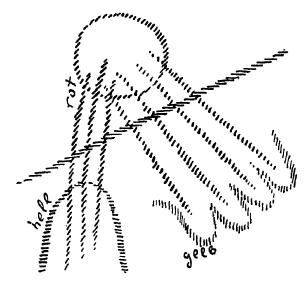
[ 13 ] To the ancients, these laws of nature were concepts of God. To modern thinkers, they are still concepts, for one must, after all, grasp them through thought. But this should be clarified in some way through the natural phenomena that lie at the heart of what the laws of nature are. People now speak of a law of gravity, of the laws of refraction of light, and of all such beautiful things. But this has no foundation—or rather, no depth—because it only makes sense to “speak” of all these laws if one can speak of them as reflections of divine-spiritual activity in nature.
[ 14 ] This is what the deeper human being—the homeless soul—feels amid all the talk about nature today. It feels that those who speak of nature must be described in Goethe’s words, or rather in Mephistophelean terms: they mock themselves without knowing how. People speak of the laws of nature, but these laws of nature are all that remains of the ancient worldviews. Only the ancient worldviews still possessed, in addition to these laws of nature, that which made these laws of nature possible.
[ 15 ] Just imagine you have a rosebush. You can always have roses on that rosebush. When the old ones wither, new ones grow. But if you pick the roses and let the rosebush die, you cannot keep having new roses. That is exactly what has happened with the natural sciences. There was a rosebush. Its roots were in the Divine. The laws found in nature were the individual roses. These laws were plucked. The roses were plucked. The rosebush was allowed to wither away. So now, in the laws of nature, we have something that is like roses without a rosebush. People gain nothing from this. They have no inkling of this in their minds, which have been so heavily burdened in recent times. But those who are homeless souls sense a great deal of this in their hearts, for they cannot make sense of the laws of nature. They feel: These laws of nature wither away when one, as a human being, tries to confront them.
[ 16 ] Thus, modern humanity—insofar as it is capable of feeling, insofar as it has a heart within its body—is unconsciously under the impression that we are being told something about nature that withers us and even causes us, as human beings, to wither. Humanity is now compelled, through a terrible belief in authority, to accept this as the pure truth. While it feels in its heart that the roses wither, it is forced to believe that these roses are the eternal beings of the world. People speak of the eternal laws of the world. Phenomena pass, but the laws remain forever. Because what human beings seek to shape from within themselves as their self-consciousness is anthroposophy, natural science is anti-anthroposophy.
[ 17 ] Let us now turn our attention to the other side, the ethical and moral side. The ethical and moral impulses sprang from the same source as divinity. But just as the laws of nature were turned into withered roses, so too were the moral impulses turned into withered roses. The root was missing everywhere, and so the moral impulses fluttered about in civilization as moral precepts whose roots were unknown. People could do nothing but feel: the moral precepts are there. But the divine origin was not there, and now the inevitable question arose: Where will this lead if the moral precepts are not followed? Chaos and anarchy ensue in human society.
[ 18 ] But on the other hand, there is this: How do these commandments actually work? Where do they have their roots? One sensed a withering there as well. That became the great question—the question that arose from Goetheanism but could not be answered within Goetheanism itself. Goethe established, I would say, two starting points that moved toward each other in a converging manner but never came together. What is necessary—what was necessary—is the Philosophy of Freedom.
[ 19 ] It had to be shown where the divine dwells within human beings themselves, in which they can ground both the spirituality of nature and, in particular, the spirituality of moral laws. This led to the intuitivism of *The Philosophy of Freedom*, to what people called ethical individualism. Ethical individualism, for the reason that within every single human individual, the source of moral impulses had to be demonstrated as lying in that divine element with which human beings are connected in the innermost core of their being. Once the age had dawned in which the vitality of both the laws of nature on the one hand and the moral precepts on the other had been lost—because the divine was no longer found in the external world—in the age of freedom, it could not be otherwise—it became necessary to find this divine-spiritual element within the human being, for the human being first appears to us as an individual. With this, however, a worldview was gained; if you only take the time to understand it clearly, you will see that its direct continuation is what we today call anthroposophy.
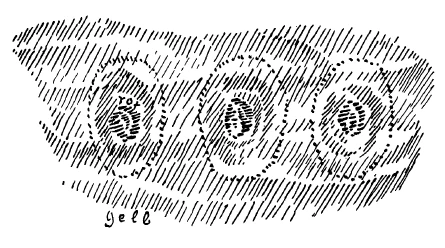
[ 20 ] Suppose—it’s a somewhat simplistic illustration, but it may still hold true—that we have human beings here. In their innermost being, human beings are connected to a divine-spiritual reality (red). This divine-spiritual reality forms a divine-spiritual world order (yellow). By observing the inner nature of all human beings in their interplay, one now penetrates into the divine-spiritual realm, just as in ancient times people penetrated into the divine-spiritual realm when they looked outward and, through primitive clairvoyance, found the divine-spiritual in external phenomena.
[ 21 ] The point is precisely to advance toward spirituality—based on what emerged, on the one hand, from Goethe’s worldview and, on the other hand, simply from the necessities of human development at the end of the 19th century—not in an outwardly materialistic way, but through a genuine grasp of the immediate human being.
[ 22 ] Well, viewed in the light of life rather than theory, this actually laid the foundation for anthroposophy. For if one were to think that the *Philosophy of Freedom* was not yet anthroposophy, it would seem just as if someone were to say: There was a Goethe; this Goethe wrote all kinds of works; today we understand Goethe to be the creator of his works. — But then another person replies: Yes, that is an inconsistency, for in 1749 there was a small child in Frankfurt am Main who was even born with a dark complexion, and people said he could not survive. If you look at everything surrounding that child, you certainly cannot logically deduce all of Goethe’s works from it. That is an inconsistency. You have to trace Goethe back to his origins. See if you can find Faust in that blue-black-skinned boy who was born in Frankfurt am Main in 1749!
[ 23 ] Isn’t it true that it isn’t particularly wise to say something like that? But it is no less wise to say that it is inconsistent for anthroposophy to have emerged from the *Philosophy of Freedom*. The black child in Frankfurt simply continued to live, and from his life emerged that which lives today as Goethe in the evolution of the world. The *Philosophy of Freedom* had to live on. Then anthroposophy emerged from it.
[ 24 ] Just imagine, if a philosophical logician were to step in place of life and say that what is found in *Faust*, in *Wilhelm Meister*, and so on must be logically deduced from the blue-black boy of 1749—do you think he would be deducing anything logically? No, he would point out contradictions—enormous contradictions. He would say: I cannot reconcile what someone once wrote as “Faust” with what the blue-black boy in Frankfurt am Main actually was; that does not follow logically from it.
[ 25 ] This is what those who deal not with life but with textbook logic say: Anthroposophy does not logically follow from the *Philosophy of Freedom*.
[ 26 ] If it were a logical consequence, then you would have seen how all those schoolmasters in 1894 would have deduced anthroposophy from *The Philosophy of Freedom*! They conveniently left that out. But in hindsight, they admit they cannot deduce it; they cannot reconcile the two, turning it into a contradiction between the later and the earlier. In this day and age, people simply lack the ability—even as they develop so-called logic, philosophy, and so on—to engage with life, with that which sprouts and grows, which is more than what logical pedantry can perceive in it.
[ 27 ] The task at hand was, furthermore, to first examine what was, in a sense, emerging from the immediate reality of the present as a further development of human civilization.
[ 28 ] As you know, I have tried to highlight two significant figures in order to examine them. The first was Nietzsche. You will have seen from the preceding remarks why this had to be the case, for in Nietzsche a personality emerged at the surface of modern civilization’s development who grew into the worldview of the present and who, unlike the others, was honest.
[ 29 ] What did the others say? What, one might ask, was the general consensus in the 1890s? The general consensus was this: Natural science is, of course, right. Natural science, as it stands, is the supreme authority. We stand on the ground of natural science and look up at the stars. Well, there was, of course, the well-known conversation between Napoleon and the great astronomer Laplace. Napoleon could not understand how, when looking at the stars through a telescope, one could find God. The astronomer told him: “I have no need of that hypothesis.” Of course, he did not need the hypothesis to gaze at the starry sky through a telescope. But he needed it at the very moment he wanted to be human. Yet the sight of the starry sky through a telescope gave nothing to his humanity—it gave him nothing. The sky was full of stars, but full of sensory stars, and otherwise empty.
[ 30 ] People looked through microscopes as far as the eye could see—into the tiniest living beings, into the smallest parts of a living being, and so on. Microscopes were made more and more perfect. But the soul was not found. No matter how long one peered into the microscope, it was empty of soul. There was nothing there of soul or spirit. There was nothing of soul or spirit in the stars, nor could soul or spirit be found under the microscope. And so it went on. This was what Nietzsche was confronted with. What did the others say? One looks through a telescope at the stars and sees only sensory worlds, nothing else. But we have a religious life, a religion that tells us there is, after all, a spirit. David Friedrich Strauss has a point when he draws the logical conclusion: Where, then, can this spirit be found by scientific means? We stand by the fact that the writings handed down to us do indeed speak of the Spirit. We may not find it anywhere, but we profess our faith in it. Science—which we are obligated to believe in, and which is what it is precisely because it demands reality—cannot find this Spirit anywhere. Were it otherwise, it would have no reality. Therefore, any research that proceeds differently finds no reality! Thus, we know of reality and believe in that which, although not found to be reality, is described by the ancients as being reality.
[ 31 ] That was precisely what drove a soul like Nietzsche’s—which was, after all, honest—to the brink. Nietzsche said one day: “A line must be drawn here.” How did he do that? He did it by saying: “So now we have reality.” Reality is explored by the natural sciences. The rest is nothing. Christianity has taught that Christ is not to be sought in the reality one investigates with a telescope or a microscope. But there is no other reality. Therefore, there is no justification for Christianity. So, said Nietzsche, I will write *The Antichrist*.
[ 32 ] If one looks through a microscope or a telescope, one finds no moral impulses. Yet people accept the old moral impulses as commandments—whether they are floating about or decreed by the authorities. But they cannot be found through scientific inquiry. So Nietzsche wanted to write his second book—after *The Antichrist*, which was supposed to be the first—as part of his *Revaluation of All Values*: a second book in which he showed that all ideals are actually nothing, since they cannot be found in reality, and that one must let them go.
[ 33 ] And he wanted to write his third book. Moralism certainly does not draw its inspiration from the telescope and the microscope: “Therefore,” said Nietzsche, “I establish immoralism.” Hence, the first three books should have been titled: *The Revaluation of All Values*, *The Antichrist*, Book One; *Nihilism, or the Abolition of All Ideals*, Book Two; *Immoralism, or the Abolition of the Entire Moral World Order*, Book Three.
[ 34 ] That was, of course, a terrible thing, but it was the ultimate, honest consequence of what the others had actually set in motion. One must present things in this way to the mind in order to see through the inner workings of modern civilization. This was something one had to grapple with. It had to be shown just how profoundly mistaken Nietzsche was and how he must be corrected, so that one takes up his starting points everywhere and demonstrates how these starting points must in fact be formulated in such a way that they lead not into nothingness but into spirituality. It was, therefore, a necessary engagement with Nietzsche.
[ 35 ] And likewise, a necessary engagement with Haeckelism had to be undertaken. This Haeckelism had, with a certain consistency, explored what natural science can make of the evolution of sentient beings. It was therefore necessary to proceed in the manner I described to you right at the very beginning of my reflections. I did this in the very first anthroposophical lectures I ever gave, with the help of Topinard’s book. When this approach was taken, entry into the concrete spiritual world arose naturally in the course of living progress. Then the details simply emerged through further research, through further living in the spiritual world.
[ 36 ] I have said all this for the purpose of illustrating the following: If we trace the origins of anthroposophy, we must go back to images of our modern civilized life. When tracing the history of the Anthroposophical Society, one must ask: Where were the people who initially had a certain inclination toward understanding spiritual matters? These were precisely the people who had received these inspirations from the Blavatsky camp, in accordance with the nature of their particularly rootless souls.
[ 37 ] What had simply coexisted at the beginning of the 20th century due to the circumstances of the time—the Theosophical Society and Anthroposophy—was completely overcome in the third epoch, which, as I have described, began around the year 1914. There was absolutely nothing left of what actually recalled the old theosophical era. Not even in the forms of expression was there really anything left. While, in any case, right at the beginning of anthroposophical work, the tendency had to arise to lead spiritual contemplation up to the Mystery of Golgotha, to the permeation of Christianity, on the other hand the tendency also had to arise to now apply spiritual means to the natural sciences. However, I would like to say that the mastery of those spiritual means through which true Christianity could once again be restored to its rightful place dates back to an earlier time. It begins as early as the first period and is particularly cultivated in the second period.
[ 38 ] What was meant to have an effect in various other ways actually emerged, in accordance with the description I have given over the past few days, only in the third epoch. It was then that those striving for scientific knowledge began to join the anthroposophical movement. For these scientifically minded individuals—so that ever new misunderstandings are not introduced into the anthroposophical movement—it is precisely necessary, indeed it is necessary in the most eminent sense, for them to thoroughly immerse themselves in what I mentioned here yesterday and again this morning: the working that emanates from the very heart of anthroposophy. It is truly necessary, therefore, to be clear about these matters.
[ 39 ] I believe it was in 1908 when I once said the following in Nuremberg to describe a very specific fact: We have witnessed significant scientific progress through experiments conducted in recent times. Research conducted through experimentation has brought an extraordinary amount to light. These experiments are beneficial in every respect, for within the process of experimentation, spirituality works in the form of spiritual beings. Most of the time, as I said back then, the situation is such that the scholar goes to the laboratory table and essentially fiddles around, just as the procedure dictates, just as the methods have mechanized it. But then, apart from him, a whole host—I might say—of spiritual beings is at work; they are the ones actually doing the work, for the one working at the laboratory bench merely provides the opportunities for things to gradually come to light. For if that were not the case, things would not have unfolded in such a peculiar way in recent times.
[ 40 ] You see, whenever anyone stumbled upon something—such as Julius Robert Mayer did on his journey—he first expressed it in extremely abstract formulas. But the others didn’t even understand that. When, over time, Philipp Reis was driven to invent the telephone, the others still didn’t understand it. There is actually a huge chasm between what people understand today and what is actually being experimented with all the time: because people do not have access to spiritual impulses at all.
[ 41 ] Here’s the story. Let’s return once more to that remarkable man, Julius Robert Mayer, who—as I mentioned, he is now a highly respected naturalist—was always at the bottom of his class when he was still in high school. When he attended the University of Tübingen, he was advised to drop out before graduating. He managed, with great difficulty, to become a doctor after all, then enlisted as a ship’s doctor and went on a voyage to India. The sea was stormy on that voyage; the crew fell ill, and upon arrival, he had to perform many bloodlettings.
[ 42 ] Of course, the doctor knows that there are two kinds of blood vessels: veins and arteries. Arterial blood spurts out red, while venous blood spurts out bluish. So when you perform a bloodletting—that is, when you pierce a vein—bluish blood must come out. Julius Robert Mayer had to perform many bloodlettings. But with all the sailors who had been on that voyage—who had endured those sickening upheavals at sea—something strange happened whenever he pierced them. “Good heavens,” he said to himself, “now I’ve missed the mark, because red blood is spurting out of the vein—so I must have hit an artery.” Then he tried again with the next person. He became completely confused, because he kept thinking he’d missed the mark, since this kept happening over and over. Finally, he realized that he had, in fact, made the puncture correctly; it was just that, under the influence of the sickening seas, something had happened to the people, causing the venous blood to gradually spurt out reddish rather than bluish—that is, at least approximately reddish, approximately the color of arterial blood.
[ 43 ] Thus, quite unexpectedly, during bloodletting, modern man—who had no guidance whatsoever to seek spiritual connections from a spiritual perspective—discovered a tremendous fact. But what did he say? The modern scholar said: “Now I must think about what is actually happening here.” Here, force is converted into heat and heat into force. It is just like with a steam engine. You apply heat, and motion is produced: work, work from heat—and so it is in the human being as well. And because the human being is placed in a different thermal environment in the tropical zone, where the ship had sailed, there is no need to carry out that conversion into blue blood. According to the law of transformation of natural forces, the process simply unfolds differently. The thermal conditions within the human organism are different: the blood does not turn blue, but remains red in the veins.
[ 44 ] The law that is recognized today—the law of the transformation of matter and energy—is derived from this observation.
[ 45 ] Let’s imagine for a moment that something similar had happened to a doctor—not in the 19th century, but, assuming conditions remained unchanged, say, in the 11th or 12th century. It would never have occurred to him to derive the mechanical heat equivalent from this observed fact. It would never have occurred to him to link something so abstract to such a phenomenon. You can even think of later times, for it certainly would not have occurred to Paracelsus—not even in his sleep—although Paracelsus was, of course, much wiser in his sleep than many others are when awake, but it would most certainly not have occurred to him. A physician who was something like Paracelsus—and for the 19th century, Julius Robert Mayer was to his era what Paracelsus was to his—a hypothetical physician who, let’s say for my sake, would have lived in the 10th, 11th, or 12th century—what would he have said?
[ 46 ] Well, even van Helmont speaks of the “Archäus,” what we today call the interacting etheric and astral bodies. We must rediscover it through anthroposophy, now that these terms have been forgotten. A 12th-century physician would have said: In the temperate zone within the human being, we find red and blue blood interacting strongly with one another. When we move with the human being into the hot zone, the venous blood no longer differs so markedly from the arterial blood; there, the blue venous blood takes on a reddish hue, and the red arterial blood becomes more bluish. There, they hardly differ from one another at all. Where does this come from? A physician of the 11th or 12th century would have said—he would have called it “Archäus” or something similar back then, what we today call the astral body—that in a person from the hot zone, the Archäus penetrates less deeply into the physical body than in a person from the temperate zone. People in the temperate zone are more thoroughly permeated by their astral body, more densely interwoven with it; for people in the hot zone, the astral body remains more on the outside, even when they are awake. The consequence of this is that this differentiation, which is brought about in the blood by the astral body, is more strongly manifested in people from the temperate zone and less strongly manifested in people from the hot zone. People from the hot zone therefore have a freer astral body. This is evident from their thinner blood. They thus live instinctively within their astral body because it is freer. Thus, he does not become a mechanistically minded European; he becomes a spiritually minded Indian who, at the height of his civilization—not now, when decadence prevails, but at the height of his civilization—must have a different, spiritual civilization, a Vedic civilization, whereas the European must have a Comtean, John Stuart Millian, or Darwinian civilization.
[ 47 ] Based on the practice of bloodletting, a physician of the 11th or 12th century would have arrived at such a view of the human being. He would have sailed right into anthroposophy. He would still have found his way into the spiritual, into the living spiritual. Julius Robert Mayer—the 19th-century equivalent of Paracelsus, in my view—still discovered the law: “Nothing comes from nothing; thus, forces are transformed”—an abstract formula.
[ 48 ] That which can be discovered through anthroposophy—the spiritual aspect of the human being—in turn leads back to morality. This connects with the search for moral principles in *The Philosophy of Freedom*. Through this, a spiritual dimension is once again opened up to the human being, so that there is no longer an abyss between nature and spirit, nature and morality, but rather a direct connection.
[ 49 ] But from what I have presented to you, you can see the following: The leading figures in modern science arrive at abstract formulas. These abstract formulas naturally swirl through the minds of those who have received a scientific education today. Those who provide this scientific education regard this tangle of abstract formulas as something that people today must believe in. They consider it sheer madness to suggest that one can ascend from the nature of red and blue blood all the way up to the spiritual realm of the human being.
[ 50 ] But from this you can see what is required if genuine scientists wish to find their way into anthroposophy. It takes more than mere good will. It truly requires an immense dedication to deep study—the kind to which people today are simply not accustomed, and to which those with a scientific education are least of all accustomed. What is needed here, above all, is courage, courage, and more courage. But with that, we have touched upon the element we need most of all for our souls if we are to come to terms with the conditions of life in the Anthroposophical Society. Today, in a certain sense, it stands in direct opposition to what is popular in the world. Therefore, if it seeks to make itself popular, it has no prospect of success. We must therefore, especially when we wish to spread anthroposophy into the various spheres of life—as has been undertaken since 1919— we must not succumb to the temptation to seek popularity; rather, we must follow the path that arises from spirituality itself, proceeding from the very core of our being—as I elaborated this morning here in this particular case in relation to the Goetheanum.
[ 51 ] But we must learn to think this way in every situation; otherwise, we will drift to the point where people—with some justification—will constantly confuse us with other movements and judge us from the outside. If we energetically establish a structure for ourselves, then we will follow the path that leads toward the conditions necessary for the anthroposophical movement. But we must cultivate the seriousness required for this, which will then give us the courage.
[ 52 ] And we must not overlook what is simply necessary given the fact that we, as anthroposophists, are a small group today. This small group hopes that what is being spread among them today will be spread among an ever-increasing number of people. Then there will be among these people a certain orientation toward knowledge, a certain moral orientation, an artistic orientation, and a religious orientation.
[ 53 ] But everything that will then come into being through the impulses of anthroposophy—and everything that will then be taken for granted—must be present to a much greater degree in those who today are but a small handful. They must feel that they are subject to the greatest possible obligations toward the spiritual world. One need only understand that this is actually expressed instinctively in the judgment of those around them.
[ 54 ] Nothing can harm the Anthroposophical Society more—harm it intensely—than if this Anthroposophical Society fails to establish among its members that configuration through which people on the outside take notice: in the strictest sense of the word, the Anthroposophists want this or that. So that people can distinguish them from all other sectarian or other movements.
[ 55 ] But as long as this is not the case, the judgment of those around us will continue to be challenged, just as it is today. People don’t really know what this Anthroposophical Society wants, and then they get to know individual people: in them, they see nothing of anthroposophy. Wouldn’t it be true that if, let’s say, the anthroposophists were to reveal themselves through such a finely developed sense of truth and reality that one could tell: “That is an anthroposophist”—one would notice that they have such a refined sense, indeed, that they never go beyond what reality allows in their assertions—well, that would certainly make an impression! But I don’t want to offer criticism today; I simply want to highlight the positive aspects. Does this happen? That must be the question.
[ 56 ] Or, on the other hand, one could say: Yes, these are anthroposophists; they do not indulge in bad taste; they have a certain artistic sensibility. The Goetheanum in Dornach must have had an effect. Once again, one would recognize: Yes, anthroposophy gives its members a sense of good taste. That is how one can distinguish them from other people.
[ 57 ] Such things, you see, are not what can be expressed in sharply defined terms; rather, they are part of what must develop within the Anthroposophical Society if it is to fulfill its purpose.
[ 58 ] Oh, there has been a lot of talk about such things! But the question must be raised again and again—and this should be a major focus of what is discussed among anthroposophists—namely, how to give the Anthroposophical Society a very distinct character, so that people know: This is something that sets them apart from others to such an extent that they can no longer be confused with anyone else.
[ 59 ] One simply has to hint at these things intuitively. For where life must reign, there can be no set programs. But ask yourself whether this has already been fully overcome within the Anthroposophical Society: ‘This is how it’s done,’ ‘that’s how you do it,’ ‘you must follow this or that’—and whether there is a strong impulse to ask everywhere: ‘What does anthroposophy itself say?’ It need not be stated in a lecture; but what is written in lectures or has been said penetrates into people’s hearts, and that provides certain directions.
[ 60 ] Not until—my dear friends, I must say this here as well—anthroposophy is regarded as a living being that walks invisibly among us and toward which we feel a sense of responsibility, will the small group of anthroposophists be able to move forward as a model group. And this small group of anthroposophists ought to move forward as an exemplary group.
[ 61 ] If one joined any of the theosophical societies—and there were many of them—they all adhered to the well-known three principles. I already spoke yesterday about how we should view them. The first principle was: the establishment of universal human brotherhood without distinction of race, nationality, and so on. Yesterday I pointed out that we should consider whether this should be presented as a dogma.
[ 62 ] But it is significant, after all, that one encounters something like this. It just has to become real; it must gradually become a reality. And it will become so when anthroposophy itself is regarded by anthroposophists as a living, supersensible, invisible being walking among them. Then perhaps there will be less talk of brotherhood, less talk of universal love for humanity, but it will live more deeply in people’s hearts, and one will already notice—from the tone with which people express what connects them to anthroposophy— one will already notice from the tone with which one person says this or that to another that it means something to him, that the other is also someone who, like him, is devoted to the invisible entity of anthroposophy.
[ 63 ] We could, of course, choose a different path. We could choose to form all sorts of cliques, to behave as is now customary in the world—gathering for five o’clock teas or other tea parties or the like, communicating among ourselves, and perhaps even coming together for lectures. We can do it that way, too. We can also form small cliques, small circles. But an anthroposophical movement, of course, cannot thrive in such a society. An anthroposophical movement can only exist within an Anthroposophical Society that is a reality. But then things must be taken with truly great seriousness. One must feel, at every moment of one’s life, that one is allied with the invisible essence of anthroposophy.
[ 64 ] If this were to become a mindset—a reality of mindset—even if not overnight, but over a longer period of time, then within, say, twenty-one years, an impulse would most certainly arise. The moment people hear something like what I heard again yesterday from our opponents, for example, the necessary impulse would take root in their hearts. I’m not saying that this must immediately result in concrete action, but the necessary impulse would take root in their hearts: then the actions would follow on their own.
[ 65 ] Where actions do not arise, but where only opponents take action and organize themselves, the right impulse must simply be absent; in such cases, one must prefer—well, to continue living comfortably and simply be present in the auditorium when anthroposophy is being discussed. But that is certainly not enough if the Anthroposophical Society is to flourish. If it is to flourish, then anthroposophy must truly be alive within the Anthroposophical Society. And if that is the case, then something significant can happen even within twenty-one years—or in an even shorter time. Let me do the math: The Society has already existed for twenty-one years!
[ 66 ] Well, since I do not wish to offer criticism, I would simply like to urge you to take your self-reflection a step further and ask: Has everyone, in every single place, truly done what is felt to be right from the heart of anthroposophy?
[ 67 ] If, for example, it should occur to you that one person or another has not felt this way until now, then I ask you to begin tomorrow, or even tonight, because it would not be good if the Anthroposophical Society were to fall apart. But it will certainly fall apart if, now that it is rebuilding the Goetheanum on top of all the external justifications it already has, that consciousness I have spoken of in these lectures does not arise, if that self-reflection is not present. But then, if it does fall apart, it will fall apart very quickly. But that depends entirely on the will of those who are within the Anthroposophical Society.
[ 68 ] Anthroposophy will certainly not be wiped out. But it could sink back into a latent state for decades or longer—I would say—and then be taken up again later. But an immense loss would result for the development of humanity. This must be borne in mind if one wishes to approach self-reflection in earnest—which is what I actually meant by these lectures. But I certainly did not mean that one should once again make grand statements, draw up programs here and there, or declare: “When it comes to this or that, we are entirely at your disposal.” After all, we have always done that. Rather, what is at stake is that we find within ourselves the inner center of our being. If we undertake this search for the inner center of our being with the spirit contained in the anthroposophical body of wisdom, then we will also find the anthroposophical impulse that the Anthroposophical Society needs as its condition for life.
[ 69 ] I have deliberately sought to offer less criticism in these lectures. There has been plenty of criticism lately, and much has been said on this or that occasion. I wanted instead, through a historical overview of certain matters—if I were to say everything, these lectures simply would not have been sufficient—and through a consideration of the anthroposophical cause, to merely encourage a proper approach to these matters. And I think these lectures in particular could serve as an occasion for reflection on them—for them to be, so to speak, pondered. There is always time for this, for it can be done between the lines of life—between the lines of that life which comes with the demands of the outside world.
[ 70 ] That is precisely what I wanted to impress upon you through these lectures—as a kind of self-reflection for the Anthroposophical Society. We certainly need such self-reflection today. We should not forget that when we return to the sources of anthroposophical life, much can be accomplished through them. If we do not do so, then we simply stray from the paths along which work can be done.
[ 71 ] We are facing tasks as immense as the reconstruction of the Goetheanum. In this context, our heartfelt considerations can truly stem only from truly great impulses; we must not proceed from a petty perspective. I said this this morning to those who were present, and I wanted to present it to you again this evening from a certain point of view.