

Esoteric Considerations of Karmic Connections
Volume II
GA 272
10 September 1916, Dornach
Translated by Steiner Online Library
14. Insights into the True Realities Sought by Goethe
[ 1 ] Today and tomorrow, drawing on the *Faust* epic, I will attempt to say a few words about certain relationships between human beings and the spiritual worlds. It may be assumed by anyone who truly delves into the *Faust* epic with the tools of Spiritual Science that Goethe actually intended, precisely in these final scenes, to express something of the deepest insights he had attained through his inner experience during his long earthly life—insights that constituted his worldview. “Worldview” in this case also means that Goethe—almost instinctively, I would say, as a matter of course—crafted these scenes in such a way that one can truly sense from them his stance toward the development of humanity and the impulses driving that development, to the extent that they were accessible to his understanding. If one applies ideas from the Spiritual Sciences to the characters Goethe created in his *Faust* poem, then this must, of course, be understood in a very specific way. It would be entirely wrong to believe that Goethe first laid down these ideas—the ones we are discussing here—and then, as it were, hung the characters’ speeches and their characteristics on them, much like one hangs clothes on a clothes rack. That is not the case. So when we speak—as we now intend to do—about these characters in Goethe’s *Faust*, we must understand this to mean that Goethe, so to speak, knew these characters face to face and characterized them as best he could; yet Spiritual Science is fully justified in delving even deeper into the matter. Isn’t it true that when you meet a person whom you are, so to speak, seeing for the first time, you won’t immediately grasp everything that lies within their soul? Nevertheless, it is there within their soul. If, after your first encounter with this person, you were to describe them, you might describe only a few aspects of them—perhaps something purely external. But it is still this person whom perhaps you yourself—if you have seen him often—or someone else who is able to look deeper into the soul, would then have to characterize with much deeper insights. So if I first pose the question—in order to be able to articulate today and tomorrow what is significant in connection with the *Faust* epic—if I first ask: What is this Mephistopheles in Goethe’s work? — this should not be conceived as though Goethe had, in his consciousness, also possessed the ideas that I must unfold for you when I speak of Mephistopheles. Goethe simply characterized Mephistopheles as he knew him, but even so, Mephistopheles, as he really is, remains a specific figure who can also be characterized through ideas from Spiritual Science; and what is significant is precisely that through this Spiritual Science characterization, one can gain a deeper insight into the individuality of Mephistopheles or other figures appearing in the *Faust* epic.
[ 2 ] From the perspective of Spiritual Science, one must in any case have in one's mental image a figure such as Mephistopheles as having, in a certain sense, remained behind in the old lunar evolution. This is, so to speak, the prerequisite—the prerequisite of Spiritual Science—that Mephistopheles is a being who did not participate, in the appropriate form, in the evolution he could have undergone from the Moon, or perhaps even from the Sun to Earth, or via the Moon to Earth. But even if he appears before us—albeit in a spiritual, visionary way—even if this Mephistopheles appears before us in the earthly human form, we would still be mistaken if we were to interpret him in such a way that we might say, for example: He has remained behind in relation to human evolution on the Moon. — Mephistopheles stands decidedly higher on Earth than human beings do, in terms of his development, of course, not in terms of his talent for evil. You may, if you wish, call it a sign of inferiority that Mephistopheles possesses this genius for evil. But he is, so to speak, a being of a higher hierarchical order than human beings are—that goes without saying, after all. So if we were to go back to the ancient lunar evolution, we would find there that human beings, in their lunar evolution, are clearly below the level of Mephistopheles—that being from whom Mephistopheles on Earth originated. So we must look for a higher being in Mephistopheles—a being who simply remained behind in the lunar evolution with higher abilities than human beings have ever possessed. How might we, I would say, use an analogy to clarify what such a being is actually like?
[ 3 ] Let us suppose we were to look at our current stage of Earth’s evolution. Even during this stage, we find that some people are further along in their development than others. There are people who are decidedly further along in their development than others; indeed, during Earth’s evolution, we speak of certain individuals who have undergone initiation and who—while this is not yet the case for the general population in the current Earth cycle—already glimpse the world that lies beyond the threshold. Of course, there is also a corresponding progressive development for such advanced individuals. But even these individuals can, in a certain sense, lag behind on the stages of their earthly evolution and transition to Jupiter in such a way that, when Jupiter’s evolution becomes imminent, they might say: If everything were to follow the course of regular world evolution, then we would now be going through this or that on Jupiter, but we do not want that; we remain at the stage we have attained during Earth evolution. — This stage is perhaps higher than what human beings could have attained during Earth evolution; it is one such that the Jupiter phase may already have been anticipated during Earth’s development. But these beings—in this case, human beings—nevertheless remain at the stage they had reached on Earth, and thus enter this Jupiter phase having already undergone a form of Jupiter development during their time on Earth. Thus, they have fallen behind in relation to their own standards, but not in relation to general evolution. They simply do not undergo the evolution in the same way that human beings will later undergo it on Jupiter; they remain earthly beings, earthly human beings, but they already carry the Jupiter evolution within them from their time on Earth.
[ 4 ] You must certainly be aware that the various evolutionary processes are indeed quite complicated, and that such evolutionary processes, as I have just described them, actually do exist. And if you now apply what I have said about Jupiter-Earth to Earth-Moon, you will get a rough mental image of what Mephistopheles—who appears in Goethe’s *Faust*—actually is. He belongs to the Ahrimanic hierarchies in that he had already anticipated the earthly development of the human being during the ancient Moon era, but now presents himself on Earth in such a way that he does not bring earthly reason, earthly intellect, or earthly individuality into earthly development as they are given by the Earth, but rather as he had previously taken them on the ancient Moon. This is why, in the “Prologue in Heaven,” he feels so extraordinarily superior to the human Faust. He is indeed superior to him, to the human Faust, for the human Faust is meant, in Goethe’s sense, to be a true earthly human being—one who has not remained behind in the realm of the dull-witted, but who relies entirely on earthly forces and earthly impulses to develop what he must in his soul. Faust is an earthly human, an earthly striver. Mephistopheles confronts him as the lunar being, who naturally feels immensely superior to him because, even in the spiritual regions of the Moon, he has already embraced reason and science—which earthly humans otherwise possess on Earth. Therefore, Mephistopheles can, of course, only be a spiritual being. If he were to take on human form like any other human, he would also have to adapt to earthly evolution. But he does not do that. So we see in Mephistopheles a being who can feel extraordinarily superior to the earthly human. But since the possibility of having moral impulses only arises during Earth’s evolution—remember the lectures we have just given in recent weeks— since human-moral impulses first arise during the Earth period—namely, everything that arises from the impulse of love—Mephistopheles, who has retained his lunar development, simply does not possess these impulses of love. He simply does not possess them. He is therefore a spiritual being who belongs to a hierarchy that, because it has exercised restraint and has also risen very high in earlier epochs of evolution, possesses a certain loftiness inherent in its entire being.
[ 5 ] Let us contrast this Mephistopheles with the higher angels. Let us suppose that such a present-day angel were standing next to Mephistopheles—that is, a being who is now an angel. What kind of being is this who is now an angel? It is a being that must descend during the Jupiter evolution in order to render to the Jupiter humanity, during that evolution, the services that other beings—let us say, for example, archangelic beings—render to today’s Earth humanity. This is therefore a being—such an angelic being—who, by nature, because he is spiritual, is less advanced in evolution than Mephistopheles himself—or rather, than the hierarchy to which he belongs—simply by standing next to Mephistopheles. In terms of intellectual capacity, the angelic beings will not be able to attain during the Jupiter evolution what Mephistopheles has already attained on the Moon through his hierarchy—even if not through himself, assuming we regard him as a Lunar human, a Lunar initiate. One could say that Mephistopheles’s immediate superior is in fact an extraordinarily high-ranking being, albeit one that has lagged behind in evolution—a being so high-ranking that a being of the rank of, say, the Archangel Michael feels himself to be of lower rank than Mephistopheles’s immediate superior. These evolutionary processes complicate the hierarchies of spiritual beings. A being such as Mephistopheles has developed very far during the Moon’s evolution. As a result, it is ahead of ordinary angelic development—normal angelic development. Yet a being such as Mephistopheles has remained a spirit. Because it is a spirit, it shares something in common with ordinary angelic development. Angels, after all, are also spirits. So we can say: From the Mephistophelean point of view, it is entirely correct when Mephistopheles speaks of the angels as an “immature people.” To him, they truly are an immature people—a people who, in the stage of development to which he attaches particular importance, have not progressed as far as he himself has.
[ 6 ] Of course, there are also all sorts of evolutionary stages within the hierarchy of the Angeloi. Here, too, we can assume—to put it in somewhat pedantic and philistine terms—a normal stage of evolution for the development of angels. But we must assume—and this is a fact—that certain angels have fallen behind, that they, if I may coin the term, have become “Luciferized.” Certain angels lag behind the normal course of development and become “Luciferized.” These are the ones who do not move forward but remain at earlier stages. The angels who became “Luciferized” in this way—who had already become “Luciferized” before the Lemurian epoch—now occupy a very special position. For how did they come to be able to become “Luciferized” back then? It was the case—if I am to express this in layman’s terms, albeit perhaps only approximately, since it cannot be otherwise—that at that time, the group of beings that was humanity was undergoing its lunar evolution. Now came what is called the Luciferic temptation, brought about by spiritual beings who had become Luciferized. This Luciferization led certain beings, during the Lemurian period, to bring about for humanity what you know from *Outlines of Esoteric Science*. Then, in turn, the Ahrimanic development led, during the Atlantean period, to the events you are also familiar with from *The Secret Science* and from lectures that have now been given. So we must say: From the Luciferic side, a certain impulse emanated during the ancient Lemurian period, in which all beings who had previously become Luciferized were involved on behalf of humanity. This impulse consists in the fact that, during the Earth’s evolution, human beings descended further into the material realm than they should have in the course of progressive development; that is, their desires, drives, and passions became, so to speak, entangled in material development. A counterbalance had to be provided. And this counterbalance was provided by the Ahrimanic development, so that humanity hovers in balance between the Luciferic and the Ahrimanic developments. But all of this—that human beings thus hover in balance between Luciferic and Ahrimanic development—is, in a certain higher sense, in a certain higher way, once again the plan of progressive evolution; it lies within the plan of progressive evolution.
[ 7 ] Now that I have summarized this for you, you can say to yourselves: Faust, the true earthly human being, will be confronted by Luciferic and Ahrimanic Powers. And Goethe reveals the Ahrimanic Powers that stand opposed to him particularly through Mephistopheles, whom he places at Faust’s side as the representative of the Ahrimanic Power. We have already discussed why Goethe refrained from clearly highlighting how the Luciferic impulses approach Faust. But everywhere—as I have hinted—it shines through that Goethe actually placed Faust in the middle between the Mephistophelean Powers and the Luciferic Powers. I have repeatedly and explicitly emphasized that, in his time—because Spiritual Science did not yet exist as it does today—Goethe could not yet be entirely clear about the relationship of the human being Faust to Ahriman-Mephistopheles and to Lucifer. But he had a certain instinctive recognition that Faust is confronted by these two kinds of impulses.
[ 8 ] Now let us ask ourselves: What exactly is it that Mephistopheles himself—or Mephistopheles’ relatives—wanted from human beings? - What Mephistopheles wanted from human beings is really nothing other than something that would have made human existence on Earth impossible—truly impossible. For what has come to pass on Earth is procreation through the human sexes—through the male and female. Mephistopheles, as a true lunar initiate who has simply remained behind, absolutely cannot stand this, and this is what he actually regards as his task: to eliminate from the world the possibility of having a human race on Earth through sexual reproduction. That is not to be on Earth. So let’s be clear about this: The normal development of humankind on Earth consists, after all, in the human race reproducing itself on Earth through the sexes. But Mephistopheles wanted to remain at the stage of lunar development. He therefore did not want love to lead to sexual love on Earth. Mephistopheles is the enemy of sexual love on Earth. He is its most determined enemy. He therefore feels—and Goethe characterizes this quite correctly—an extraordinary calling to reduce to absurdity everything that in any way leads to love between the sexes. As for what he seeks to bring about in the relationship between Faust and Gretchen—just read the Gretchen scenes carefully, and you will sense everywhere that he is pursuing all manner of things that are the very duty of Ahriman-Mephistopheles. But the love between Faust and Gretchen—true human earthly love—he does not want to allow it to arise; he does not actually want to tolerate it in either Faust or Gretchen. On the other hand, he is truly at work in the scene where the homunculus is created in the laboratory. And you know from earlier interpretations I have given of *Faust* that the homunculus is created to become, out of nature and without sexual love, a bringer of the human—Helena. Mephistopheles sets himself the task not of creating humanity in the sense of progressive development—which arises on Earth through sexual love—but of creating, by another means, through the powers assigned to Ahriman, a kind of being that is not in the sense of the human race intended for Earth. For just think of something other than this homunculus—think of Euphorion, think of the whole way in which Helena returns—Mephistopheles is at work everywhere. But nowhere is there to be any consideration of regular sexual love. So the role assigned to Mephistopheles is exceptionally well-chosen and can certainly be justified from the perspective of Spiritual Science. There is tremendous depth to it.
[ 9 ] And now take this strange word, just as the heavenly host begins to appear:
I hear discordant notes, a nasty clatter,
Coming from above on this unwelcome day;
It is that mischievous, girlish fumbling,
As pious tastes are wont to love.
You know how, in deeply wicked hours
, We plot the destruction of the human race:
[ 10 ] He believes the angels are certainly capable of knowing this, since they were watching back then when Mephistopheles and his cohorts were plotting the destruction of the human race. Now he goes on to say something else, adopting, as it were, the language of earthly humans:
The most shameful thing we've ever invented,
[ 11 ] — The most shameful thing is precisely this destruction of the human race. It is called the most shameful thing.
[ 12 ] To make further progress in understanding—it is, of course, extraordinarily difficult to approach these matters, for Goethe sought to express his deepest human and spiritual feelings, sensibilities, and insights in them—to make further progress, one needs to consider the following. You know, don’t you, that there is—at least for us—a Spiritual Science, even if it is still only in the early stages of its development today. You also know that something like this has always existed, even if in earlier times it was attained in a different way—as true knowledge of the world that goes beyond appearances and penetrates to reality. Now you also know that, in a certain sense, great care was taken—especially in earlier times—to safeguard the spiritual heritage preserved in the Mysteries, which was directed toward true knowledge of the world. This spiritual heritage was imparted only to those—as you know—who demonstrated the necessary maturity for it. If one now asks what kind this particular form of knowledge actually was—this particular form of spiritual heritage that was imparted in the Mysteries—one best comes to an understanding by attempting to compare our fifth post-Atlantean epoch with preceding epochs: the Greco-Latin, the Egyptian-Chaldean, and so on. And if, on the basis of this comparison, one asks how humanity’s entire conception of the world has changed from earlier epochs—from earlier cultural epochs—into our own cultural epoch? It is truly the case that important, significant developments have taken place in the evolution of humanity; it is a fable convenue to believe that all one needs to know about human development is what is conveyed by trivial history—that which is simply called “history” today. The earlier cultural epochs were quite different from the mental image of them based on conventional history, which is a fable convenue. Just recall for a moment the depth of a saying such as the one I have quoted:
O Sun, a king of this world,
The Moon sustains your lineage;
Mercury swiftly unites you.
Without Venus’s favor, you achieve nothing at all,
You who have chosen Mars as your husband.
Jupiter’s grace is not lost to you;
So that Saturn, old and aged,
May reveal himself in many colors.
[ 13 ] There is an immense depth hidden within such a saying, but that depth once existed. People once, albeit through the results of atavistic clairvoyance, glimpsed these realities, which were alluded to, for example, in such a saying. The fifth post-Atlantean epoch emerged from this knowledge of the foundation of existence. It has strayed in two directions. I have, in a sense, characterized one of these aspects for you through the initiation of the fifth post-Atlantean epoch, which I described through Bacon of Verulam, Lord Bacon. Here we find the longing to treat everything that goes beyond the sensually perceptible as mere idols. As you know, Bacon identified four types of idols. We have listed them: Idola tribus, Idola specus, Idola fori, Idola theatri—four types. Through this, Bacon’s spirit at the beginning of the fifth post-Atlantean epoch expresses the tendency to base everything—absolutely everything—solely on knowledge gained through sensory perception and through concepts that, in turn, arise from sensory perception. Everything that goes beyond sensory perception is an idol, the content of which is essentially exhausted in words. And we have already characterized this; it is, in a sense, the one current.
[ 14 ] Now, to put it schematically, take the current expressed by something like: “O Sun, a king of this world,” which reaches into the deepest foundations of existence; consider this current as it continues. If it were to develop on its own from the fourth into the fifth post-Atlantean epoch, we could say it would proceed as shown here (see diagram). The development that leads to idols descends below this evolution (blue line); it does not acknowledge that one actually encounters the spiritual directly, just as one encounters the sensory; it excludes the spiritual and regards it as contained only in verbal idols; this development is thus inaugurated by Bacon.
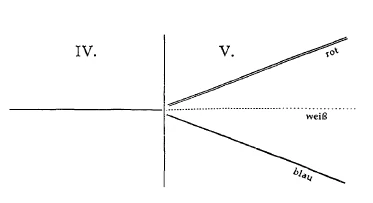
[ 15 ] What, then, would be the opposite of this? The opposite would be a line of thought that acknowledges only the existence of the spiritual—or the soul-spiritual—and does not acknowledge the physical-material. That would be the opposite. We might therefore ask: Does this line of development also exist? Is there—just as Bacon says, that “only sensory reality is reality; the rest are mere words”—an expression of the idea that there is only a spiritual reality and no material-physical reality that enters the senses? Indeed, this also exists. George Berkeley lived somewhat later than Bacon, and he represents this line of development (red line). Let us briefly clarify the essence of Berkeley’s worldview.
[ 16 ] Berkeley holds the view—which essentially arose from his theological worldview (he was, after all, a bishop)—that everything outside of human beings and perceived through the senses exists only as long as it is perceived by the senses. So Berkeley’s view is this—isn’t it true that the best way to characterize it is perhaps by contrast?—: You assume, based on what I would call a view that is naive in comparison to Berkeleyism, the following: When you walk in here, you see, say, Mr. Bauer sitting here, but you assume he was already sitting here before, and you see him afterward. — As I said, there is not the slightest proof that what you see sitting in this chair was also there before you saw it. And when you go back out, you believe that the gentleman remains seated here and continues to sit there while you turn your back on him and walk out. Berkeley takes the view that there is no proof that—let’s say—what you have seen here is still sitting there. It sits there as long as you look at it, for that is alive—the image in the eye—and how could the image in the eye be there if you were not looking? One can logically prove Bacon’s worldview in its entirety. One can also logically prove Berkeley’s worldview in its entirety, for there is no contradiction in Berkeleyism that could logically arise; it can be thoroughly substantiated logically, even if it does not correspond to naive consciousness. For Berkeley does not hold the view that, when you walk in, you create Mr. Bauer, and when you walk out, you make him vanish again—he certainly does not hold that view—but rather that what you see comes into being only with your looking and disappears again with your looking. *Esse est percipi*: To be is to be perceived. And there is no other form of being in the surrounding world than being perceived. Therefore, as you can now imagine, for Berkeley everything that constitutes the sensory world exists only in a state of becoming. You look at it, and there it is; you look away, and it is gone—it is no longer there. All of this, then, exists only in your perceptions. As I said: *Esse est percipi*—there is nothing except perception, except the process of perception. But behind this process of perception—which is, after all, nothing other than the process of perception itself—lies divine-spiritual Being. In addition to your perception, God also has a hand in Mr. Bauer, placing him wherever He wills. And this God, when you enter, creates within you the image of Mr. Bauer out of what exists only within Him. Then, when you leave, He causes it to disappear again. So this sensory world does not exist; only the spiritual-soul world exists. All of you, standing here before me as you are, are merely the creatures of my eyes. Apart from what is the creation of my eyes, there is also the divine-spiritual, soul-spiritual world, which, however, sustains and supports you in a completely different way than you exist here as the creation of my eyes.
[ 17 ] I have merely characterized this view. It can indeed be rigorously proven philosophically. But it is, one might say, the other half of the world as presented by Baconism. And the entire worldview of the fifth post-Atlantean epoch oscillates between these two directions, the red and the blue. Either this worldview becomes entangled in the mere recognition of the sensory-real and thereby declares itself incapable of perceiving a real spiritual aspect within the sensory-real, or it exhausts itself in the mere recognition of the spiritual-soul-realm, sees only God and divine thoughts everywhere, and declares itself incapable of descending from life in God and in divine thoughts to sensory reality. These two deviations certainly exist in the fifth post-Atlantean epoch. And anyone who observes spiritual life as it develops outside of esotericism will constantly find it following either one path or the other—the red line or the blue line. The outer, exoteric realm does not lie on what I have drawn here as the white line.
[ 18 ] One could say that human beings in the fifth post-Atlantean epoch find themselves caught in a certain tension between these two worldviews. And Goethe felt this tension intensely. I have presented to you here—I would say—the theoretical, more philosophical impulses, but it did not stop there. All life likewise wavers between the purely spiritual-soulful and the purely sensory-material. Goethe experienced this tension in the most profound way. You will not find it surprising that he perceived everything that lives in the external world—I would say under the influence of the current of the blue line—for this is how our essential development in the fifth post-Atlantean epoch proceeds in general: as much as possible toward the material and toward the mere recognition of the material.
[ 19 ] But Goethe was already aware of the other line as well. He felt it deeply; however, in Goethe’s time, it was not yet—I would say—truly problematic to call materialism “materialistic,” as it is today. Back then, it was not as problematic to point out the deviation of the blue line as it is today. Today, Spiritual Science must point out the aberrations of the blue line, and it will therefore have to endure all the assaults—all the terrible assaults—that are bound to come, because people always initially resist with prejudice, even with hatred, whatever seeks to enter the world as knowledge. And materialism will be canonized more and more—albeit in a secular sense. But one can still say that materialism will be canonized. How close is materialistic medicine today to declaring itself sacrosanct? How many other endeavors are today on the verge of declaring themselves sacrosanct in the sense of materialism, in the sense of the deviation indicated by the blue line, the deviation from the spiritual-soul aspect, which at the same time, however, contains within itself—as its revelation—the sensory-material aspect that belongs to it, is one with it, and must be asserted by what we call Spiritual Science. Those persecutions—which one might call inquisitorial persecutions—that have already occurred in other fields in the past are only now to come in the realm of materialism; they are, in fact, only now truly beginning, are now starting, are only now beginning to assert themselves, even if their forms will be different. The rebellion against the materialistic bias in knowledge will be no less subject to the Inquisition—the Inquisition of the future, which will take on somewhat different forms than the Inquisition of the past—than earlier endeavors were subject to the corresponding inquisitions. Let no one believe that everything which strays from the blue line will not become just as intolerant as endeavors in other fields have become intolerant.
[ 20 ] The red line did not stand out quite so clearly in earlier times. It did not emerge distinctly until the fifth post-Atlantic epoch, and even somewhat later than the blue line, but it was already present in earlier endeavors. It did not actually appear in a distinct form until then, and its most significant, its greatest philosophical representative is precisely Berkeley. Yet it has plenty of other representatives. It emerged in the fifth post-Atlantean epoch, but certain elements were missing from the forms it had already taken; and that is why, even in Goethe’s time, it was already risky to speak properly about the red line, whereas Goethe could still speak quite safely about the blue line. It was risky to speak about the red line. For what, in fact, is striving along the path of this red line? There strive all those worldviews that avoid extending their gaze across the world, across the entire breadth of the world, and that wish to revel in a general spiritual-psychic realm—a spiritual-psychic realm that seeks to be powerless in the face of sensory revelation; a worldview that, while it wishes to speak of the supersensible, actually wishes to recognize nothing. Here we have a vast realm toward which, little by little, almost all religious denominations and all sects have turned; for the peculiar thing is that these worldviews actually forgo understanding the world and merely wish to speak in general terms about something supersensory and to revel in that very act of speaking. They do not wish to acquire the positive, concrete power of cognition that would allow them to truly immerse themselves in the world of reality with what they attain and with what they speak of.
[ 21 ] You might understand me better if I try to express myself in the following way. Just think about how life might unfold for the average person today. Let’s say they spend six days a week in a factory, an office, or wherever. There they are, caught up in a purely material routine that is absorbed in mere sensory perception; nothing spiritual intervenes there today, and less and less of the spiritual is involved in it. On the contrary, anyone who wants to introduce something spiritual into this is regarded as a complete oddball. Yet it is precisely in this realm that all the forces are at work which modern science seeks to understand. It is here that all the human interrelationships are at work that knowledge seeks to unravel; in short, it is here that all the thoughts and concepts are developed that pertain to the reality unfolding before our eyes. And then let us assume—let us assume, for his sake, that this person, who has thus spent the week in the office or in the factory dealing with what is purely materially knowable, or who has taught what is purely materially knowable—after all, nothing other than what is materially knowable is taught in ordinary schools—that this person—let us assume, for his sake, out of a certain sincerity —goes to church on Sunday, and there he hears people speaking about what is being discussed in church today, discussed in light of the evolution that has taken place over the centuries. Try, if you can—I mean, if you have been to church often enough and listened to sermons with an open ear, if you have observed with open eyes what is going on there—ask yourself whether there is anything in what is being said that is capable of shedding light on the world that spreads out around us. It is true that they claim the God of whom they speak is the foundation of the world, but nowhere do they speak of the way in which He intervenes in the world through His powers and His impulses. They have one worldview for weekdays—the blue line—and another for Sundays—the red line. Nowhere, nowhere do we find a connection between the two, if we truly look things through. Just ask: What relationship does what is taught from the pulpit have to chemistry, physics, or biology? — No relationship is sought at all; it is even abhorred.
[ 22 ] Take Spiritual Science, on the other hand, and you will immediately see what matters. Spiritual Science does not speak of the sensory-material world in the same way as ordinary physics or ordinary chemistry; rather, it speaks of the physical-sensory world in such a way that what it says about the spiritual world can flow into every detail of what it says about the physical-sensory world. It does not have a “weekday” view and a “Sunday” view, but rather a view that extends over the spiritual world and flows down, as it were, into the details of the physical-sensory world. It does not admit, like Berkeleyism, that it is powerless to grasp the sensory world from the spiritual; nor does it admit, like Baconism, that it is powerless to find the spirit in the sensory world, but only to find idols. Where does this come from? Well, we have already understood that. It is natural for the fifth post-Atlantean epoch that the evolution, schematized by the blue line, should have arisen. We could, in a sense, call Bacon its inaugurator. Humanity had to immerse itself in matter at some point; I have explained this time and again—that Spiritual Science is by no means opposed to materialism, but understands why material development is recognized in the fifth post-Atlantean epoch. But it cannot be understood without being inspired by a spirit such as Ahriman. And no matter how long this materialism of the fifth post-Atlantean period is allowed to develop in its Ahrimanic sense, it will have to acknowledge for its part—you can be assured of this, and you will not be so merely because I tell you, but because you will understand it from the very spirit of Spiritual Science— this materialistic-Ahrimanic mindset will have to hold fast to what Ahriman-Mephistopheles vowed in moments of deep wickedness: to have nothing to do with the regular progression of the human race on Earth. Therefore, this science, which has grown out of this materialism, will never come to fathom the mystery of the Incarnation, the enigma of embryology, and so on—never! It might be able to arrive at an understanding of the origin of such entities as can form along the path of the homunculus. But this science will never reach that point. Now, this is only one evolutionary current. But much, much more is connected with this Ahrimanism. Knowledge is only one part. But this Ahrimanism pervades the entire culture.
[ 23 ] Goethe also felt deeply the other current, symbolized by the red line; however, he was unable—I would say—to portray the figures for this red line as clearly, as completely clearly, as he did for the blue line. For the blue line, he depicted Mephistopheles and his Fat and Skinny Devils and the Lemures. There they stand before us. He dared to do that. For those who speak of the lemurs and the fat and thin devils are slandered—especially in the present age—and are slandered more and more when they speak in the spirit of Spiritual Science. In Goethe’s time, this was, so to speak, less of a concern. But what was troubling—and Goethe saw through this quite clearly—was that he knew full well: if this red line were to appear in our present time, if there truly were a perspective that declares itself powerless—and will declare itself more and more powerless—to move from the recognition of the spiritual-soul aspect to the permeation of the real world, it is because certain Luciferic spirits prevent currents that were once justified from advancing. Luciferic forces prevent certain currents—religious and sectarian currents—from advancing. And so these cannot penetrate the world; they remain stuck in the mere recognition of the spiritual-soul realm. Berkeleyism is merely a particular expression of this. This is due to a Luciferic holding back. How does this manifest itself in Goethe, for example? Mephistopheles recalls himself and his siblings, those who once, in deeply wicked hours—which means something else in Mephistopheles’ language—swore to destroy the human race, that is, to want to know nothing of the way in which humanity populates the Earth. Mephistopheles recalls that it is, in fact, part of his very essence that, during the Ahrimanic era—figuratively speaking—he was present at the fateful gathering of his spirits, who decided at that time that no human being should ever be born on Earth in a natural way, but rather that the forces existing on Earth as sexual forces should be used for something entirely different. That is what these Ahrimanic beings decided in ancient times: not to allow love between the sexes to arise at all. But now Goethe says—though he does not, of course, identify with Mephistopheles, but rather puts himself in his place: There are others who are not inspired by Mephistopheles, but who are also inspired; well, they say nothing about the fact that the human race on Earth should not procreate in the ordinary human way, but they begin to pray, finding that only those lead the truly holy life who do nothing in the sense of the ordinary procreation of humanity—those who abstain from it, who want to know nothing of it: the ascetics, the saints, who pull those familiar long faces when it comes to love between the sexes, of whom we have spoken often before. — Mephistopheles suspects, sees, and observes such figures on the other side among the host of angels. There he sees the inspirers of these others, who, in essence, worship precisely what Mephistopheles and his siblings have decided upon:
... as we, in our darkest hours,
plotted the destruction of the human race:
The most shameful thing we have devised
is precisely what their devotion deserves.
[ 24 ] This is what devotion clings to. The Luciferized inspirers of the backward church communities, monastic orders, and sectarian movements—the Luciferized inspirers—stand among the other multitudes within them. It is not for nothing that Mephistopheles says to the one tall fellow who particularly pleases him:
That priestly look doesn't suit you at all.
[ 25 ] There Goethe has woven into the work much of what was on his mind regarding the worldview that goes hand in hand with a priestly demeanor, regarding the “Sunday” worldview, which he regarded as Luciferic in contrast to the Ahrimanic one. Mephistopheles feels a kinship with those who have incorporated into their devotion what Mephistopheles has incorporated into his science and into his will.
[ 26 ] We can certainly still discuss how we should think about all these matters from a purely Spiritual Science perspective. But now let us speak about these things in the Goethean sense. And what I have just “spoken” is indeed—if I may say so—a primal Goethean sensation. Thus, on the one hand, there is the Ahrimanic world—lemurs, the Fat Devil, the Skinny Devil—and, on the other, something initially imbued with a Luciferic quality. Goethe expresses this quite clearly. The Luciferic element stands in opposition to the Mephistophelean, as I said, concealed as much as possible by the very personality who expresses it—well, the one to whom so much is permitted: the Devil. He is allowed to speak of the “priestly air,” of the “dearest” boys, and so on. In reality, then, these two stand in opposition to one another. On the one hand, Mephistopheles, who has, so to speak, pledged Faust’s soul. How has he pledged it? By driving Faust through everything earthly that descends into the sphere that has entered into earthly becoming, and down into human becoming through sexual love. Through this, he has a claim to Faust’s soul, having introduced him to all that is Ahrimanic. Mephistopheles is truly not to blame for whatever entered into Faust’s love for Gretchen, and he has sufficiently turned that into its opposite. And afterward, things take a decidedly Ahrimanic turn. Only Ahrimanic arts are employed to evoke certain outward manifestations of the Greek world. What can be achieved through Ahrimanic arts is first achieved in the context of the state—let us say this very quietly. Then it is sought in human development, in connection with evolution—but with subhuman and subanimal evolution—in connection with the mechanized homunculus, the historically mechanized homunculus. Helen is brought forth in a way that is not part of humanity’s earthly existence. Then certain earthly actions are brought about—well, after all, these are not really earthly beings who are helping out, but rather Eilebeute and Habebald. All of this is already deeply compromised under the influence of Ahrimanic arts, and compromised through the very thing he can possess of humanity’s true earthly blessing. So, by leading him through shallow insignificance—for earthly existence it is merely shallow insignificance, but that does not mean it does not require immense reason and science, even if it is shallow insignificance—through this, the soul is pledged to him. Then it is pledged through the other thing: that he has received the true earthly blessing—well, what does he have? Man received his “I” on Earth—that is, first and foremost, his blood. Bones, tendons, ligaments—whatever this patchwork half-nature consists of—Mephistopheles can have, but the true earthly blessing—the blood, the representative, the physical-material representative of the earthly human—he would indeed like to have it, but he cannot have it; he has remained stuck on the moon. From it, he can only have the title written in blood—only that which, so to speak, can be incorporated into the abstract contract, which is not connected to the impulses that exist in reality, but which remains in the realm of abstraction, of contractuality. He can only extract that from the blood—not the impulse itself, but only that can Mephistopheles extract.
[ 27 ] His soul is pledged to him. Well, the way he puts it, it sounds as if the other group had simply smuggled it away from him, cunningly taken it away. But it’s not quite that simple. Right up until the death we described yesterday, Mephisto still had Faust firmly in his clutches. But if you understand death as we described it yesterday—not only when Faust falls, but as death gradually sets in—then what Faust experiences there, and in particular the blissful feeling I described at the end yesterday after the soul has detached itself from the body, is already something experienced within the spiritual world. There, Faust’s soul—or, as Goethe originally wrote, Faust’s entelechy (we will speak of this entelechy tomorrow)—glides over into the Luciferic sphere and would dissolve within it. Faust would gain just as little from this as if he were to fall prey to Mephistopheles. Just think of what threatens him there!
Turn, for clarity’s sake,
O loving flames!
Those who condemn themselves,
May the truth heal them;
So that they may joyfully
Free themselves from evil,
To be blessed
In the universal union.
[ 28 ] But this bliss would lead to dissolution into the cosmos, to a transition into the eighth sphere! This is precisely what Faust would gain: he would be dissolved into the cosmos, which would be identical to annihilation. And now turn to the final scene, which I have said is necessarily connected to the preceding scene, that it belongs there, that it must be there. There we see the action continue in an entirely different realm. There the angels come again and bring Faust’s entelechy, Faust’s immortality. But as they bring this entelechy, this immortal essence, they explain how they are able to bring it here. The younger angels, as it says in the final scene:
Those roses, from the hands
of loving, holy penitents,
helped us win the victory
and complete the noble work,
capturing this treasure of the soul.
[ 29 ] The angels thus lift the entelechy—the soul of Faust—out of the human sphere, or rather out of that realm into which human beings have grown, having lived through human earthly life and truly developed from that earthly life, not through their own nature, but by virtue of possessing the roses of the loving, holy penitent women. Goethe traces the entire evolution—from Mephisto and the angels—back to human evolution, in that the angels do not save the entelechy by their own power alone, but by having received the roses from the hands of loving, holy penitent women. This is the infinitely profound thought. Here Goethe brings in his conviction regarding the significance of ongoing human development and the significance of Earth’s evolution. And therefore he must find within the human being something that overcomes the mere Ahrimanic-Mephistophelean. Mephistopheles stands there, commanding the Lemures—half-beings cobbled together from bones, tendons, and ligaments—and commanding the fat devils and the skinny devils. I have explained what this means: the subhuman nature, which could never give rise to the human being, lies in all of this; the nature that forms a foundation from which the human being cannot grow out of lies within it. Everything that the worldview following the blue line can comprehend lies within it, but what surrounds us must not be understood in this way. From his time on the Moon, Mephistopheles has at his disposal only the forces commanded by the Lemures, the Fat and Skinny Devils; but what they draw out of nature—out of earthly nature—is only the Mephistophelean, and there is still something else that can be drawn out, which Mephistopheles cannot know because he has not participated in earthly evolution in his own way. This is drawn forth by seeking a connection with the earthly forces and elements through the now genuine sanctification of physical nature—the ennoblement of physical nature.
Eternal blaze of bliss,
Glowing bond of love,
Boiling pain in my chest,
Foaming divine ecstasy.
Arrows, pierce me,
Lances, subdue me,
Clubs, shatter me,
Lightning bolts, tear through me;
[ 30 ] —and so on. There you have the surging force of nature, which belongs to humankind, which is also connected to the Luciferic, to the devilish, but which ascends to a higher plane. There you have this nature. And the angels have the task on Earth—or the task for Earth—of taking on the care of the human race. Goethe regards the angels—who do not lag behind but advance to the point of caring for the human race as it should be on Earth—as the true saviors. Recall the mission the Lord gives to the true angels:
But you, the true sons of the gods,
Rejoice in the living, rich, and beautiful one!
That which is becoming, which eternally acts and lives,
May it enfold you within the sweet bounds of love
[ 31 ] —there they are to offer help, there they are to intervene, and they do so. Those angels who are concerned with the loving, holy penitent women and who receive the roses from them truly move forward within the host of angels. Just as human beings take in what is allotted to them in the course of Earth’s evolution, so do these angels—who do not lag behind in the lunar evolution but move forward with Earth’s evolution—receive the forces that come from such beings as are portrayed in the final act as the loving, holy penitent women. This carries them forward. This is Goethe’s conviction: that the angels evolve beyond the Luciferic. As I said, my intention in all this was to hint at Goethe’s thought—how Goethe was connected, in his own way, to all the great evolutionary ideas.
[ 32 ] Now let us continue our discussion tomorrow. I hope that from what we have discussed today, you have seen how Goethe explores the depths of becoming and the mysteries of the world in order to create his *Faust*, and how he sought to offer his judgment on the evolving currents of worldviews. Yes, truly, there is much in this “Faust”—very, very much lies in this “Faust”! And one must certainly say: Humanity could gain infinitely much if it were to try to make sense of all that is, to use Goethe’s own expression, “enigmatically concealed” in this “Faust” of Goethe’s. But we will talk more about all this tomorrow, and about some connections between these ideas in *Faust* and the ideas of Spiritual Science.