

Art in the Light of Mystery Wisdom
GA 275
2 January 1915, Dornach
Translated by Steiner Online Library
Sixth Lecture
[ 1 ] It is relatively easy for people today—I say, of course, “relatively”—to grasp, more or less theoretically, what we understand by the Spiritual Science worldview or anthroposophy. But it becomes difficult to permeate the entire being of the human being—life itself—with the impulses that come from Spiritual Science itself. To grasp the spiritual scientific worldview theoretically—so that one knows that the human being consists of the physical body, the etheric body, the astral body, and so on; that one knows that one sound or another has a certain frequency, or that oxygen combines with hydrogen to form water—knowing these things is, after all, what people are accustomed to from the scientific worldview that has gradually developed among humanity over the course of the last few centuries.
[ 2 ] But people are less accustomed to allowing what can be gained from the kind of insight that Spiritual Science seeks to offer to influence their emotional and spiritual lives. Essentially, the way Spiritual Science must affect people is the opposite of the way other sciences must affect them. It is a very common, often-emphasized feeling that dry science detaches people from a warm sense of life and its realities; that dry science has something cold and sober about it, as it were, stripping things of their freshness and a certain dreamlike quality. And one can say that this must be the case to a certain extent with external science. For what a tremendous difference there is between the impression made on us by the wondrous cloud formations of an evening or morning sky and the mere information that an astronomer or meteorologist, for example, can provide us about them. The rich abundance of natural existence around us appears to us as if imbued with a sense of warmth, embracing the whole person and permeating their very being. Science, with the concepts and ideas it conveys to us, seems dry and sober, cold, lifeless, and devoid of charm in comparison to that which otherwise makes a warm, vibrant impression on us. And with regard to external, scientific knowledge, it is certainly justified to feel and perceive things this way.
[ 3 ] There are good reasons why external, scientific knowledge must be as it is, but such knowledge should not be the same as knowledge derived from Spiritual Science. On the contrary, it should bring us closer and ever closer to the fullness and warmth of life in the external world—and indeed, in the entire world. However, we must still learn to awaken certain impulses within ourselves that modern people hardly possess at all. For modern people expect from what they call science something that, by its very nature, must affect us in a cold and sober manner—in Goethe’s sense, in a Wagnerian way. People expect from science that, once they have taken it in, the mysteries of nature will, as it were, be solved for them—that they will now know the nature of this or that thing—and they are satisfied once they know the nature of this or that thing.
[ 4 ] Even today, you can meet people who, for a very specific reason, find science unsettling. They say, in fact, that the full, vibrant life of the past lay precisely in the fact that people had not solved all the mysteries—that they were allowed to sense something that had not yet been unraveled. And now science comes along, people say, and gradually solves the mysteries of nature. And now imagine how boring it will be to live in the world of the future, when science will have solved all the mysteries, and one will no longer be able to sense anything or experience anything beyond science. A terrible desolation must descend upon humanity, and one can rightly be horrified by the prospect.
[ 5 ] But Spiritual Science will be able to awaken other feelings in human beings—feelings that, admittedly, are less convenient for the present than solving puzzles, but which at the same time point out to us just how life-awakening and life-creating Spiritual Science can be. For if we truly take in what Spiritual Science offers us—if we do not merely take out our little notebook and write down what is being said at the moment, in order to use it as we would in the external sense of science, and perhaps even create a diagram, a neat classification, so that we can get a clear overview of things, much like a diagram in physics— if, then, we do less of that and instead allow what the Spiritual Science perspective has to say to flow into our hearts, letting it truly permeate us, then we will notice that it comes to life within us, grows, and develops independence and self-activity within us; that it becomes like a new, living being within us, revealing ever-new aspects to us. When we then approach the external natural world with a soul thus filled by the worldview of Spiritual Science, we perceive not fewer mysteries in nature than before, but more mysteries than before. Everything becomes even more mysterious to us, and our emotional life is not impoverished but enriched; one might say that the world becomes more mysterious through knowledge of Spiritual Science.
[ 6 ] However, the world becomes a barren place for us when the physicist comes along and says, “The dawn—you see it,” and then leads us to the blackboard to show us the specific refractions the light rays undergo that cause the dawn to appear. Certainly, this is something dreadful—not to the human intellect, but to the human heart.
[ 7 ] It is different when Spiritual Science comes along and tells us—to give an example—that when you see the dawn, or hear this or that piece of music, it must seem to you as if the Elohim were sending their punishing wrath through the world. Then we perceive, behind the dawn, the mysterious, living weaving of the Elohim. By merely uttering the name of the Elohim and knowing where to place them in the nine-part schema we wrote down in our notebook, we have not yet recognized anything about the Elohim. But through the living sensation we experience as we lift our gaze toward the dawn, a rich abundance of living weaving and life will meet our eyes—just as we know that when we stand before a human being, we cannot exhaust their being through any concepts, that we cannot encompass the universal liveliness of their being. Thus we become aware that in what reveals itself to us as the dawn, the unfathomable living essence of the cosmos stands before us.
[ 8 ] Through Spiritual Science knowledge, the world becomes more enigmatic and mysterious—and thus evokes a richer experience within us. This is the kind of fundamental feeling that can take root in our souls when we bring Spiritual Science to life within ourselves and when we try to make ourselves at home in mental images such as the one just suggested. Then we will never be able to fall into the trap of complaining that Spiritual Science speaks only to our heads, that it does not engage our whole being. We need only have true patience until the word that Spiritual Science seeks to give us becomes a living reality within us, until it takes shape of its own accord, so that it fills us not only with its light but also with its warmth. Then it will touch our hearts, our whole being, and we will feel enriched, whereas, of course, if we approach Spiritual Science in exactly the same way as other sciences, we cannot help but feel impoverished.
[ 9 ] On the other hand, however, it is only natural that Spiritual Science initially makes a rather bleak impression on many people, because they are not yet able to find the inner vitality of the words of Spiritual Science that can touch the soul—because Spiritual Science does not yet affect them in the same way that, for example, the warm words of another person speaking to us do. But we must learn that Spiritual Science becomes so alive that it can instill courage and confidence in our souls in a way that otherwise only the human personality itself can.
[ 10 ] The reason this is so difficult for the hearts of our time is that the hearts of our time have lost the habit of living with things themselves; the feeling of immersing oneself in things has become so rare. It becomes infinitely difficult when one tries—I would say—in small doses to revive this living in harmony with things. This has been attempted in our four Mysteries. You need only turn your gaze to something like the scene in the Spirit Realm, in the fifth tableau of *The Awakening of the Soul*, where, on the left side of the stage—as seen from the audience—Felix Balde, who has been transported into Devachan, sits, and a spiritual being on the other side of the stage speaks to him of her “burdens.” There one is meant to feel the weight that hovers from above down into the distance. People today are accustomed, when something hovers from above down below, to seeing only the hovering, to seeing only how the thing first occupied an upper position, then a lower one, and so on. But they are completely unaccustomed to delving into things and sensing the burden, to sensing that the thing exerts pressure at every point. With such a word, right in the midst of the drama, one would like to draw the human soul out of its egoistic body and place it within the living essence of the things outside.
[ 11 ] If this cannot come to pass, then a true artistic sensibility will not be able to be revived. For example, in order for an architectural sensibility to be revived in the proper way, what we take up in terms of concepts from Spiritual Science must come to life. At first, there is something rather indifferent about the concepts we acquire from Spiritual Science and carry around with us in the world. But we will see, if we truly do this, how it enriches our entire inner life. Enrichment takes place, for example, when we try not merely to see this (see drawing on page 118), but to immerse ourselves in it and learn to feel what is there: namely, the load here and the support here.
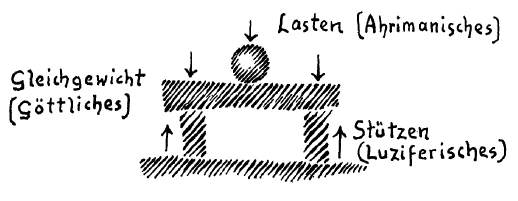
[ 12 ] Let’s take this a step further and not just look at it, but feel it: the beam must have a certain strength, otherwise it will be crushed by the load; the supports and columns must have a certain strength, otherwise they will be crushed. We must experience the load through the sphere at the top, the support through the columns, and the balance through the beam. Only then do we perceive architecture—that is, when we delve into the bearing of the load, the act of supporting, and the balance between bearing the load and providing support.
[ 13 ] But we will sense—not merely by following such a structure with our eyes, but by, as it were, crawling into it and sensing the weight-bearing, the supporting, and the balance—that our entire organism is engaged, that we must, as it were, appeal from our cerebral brain to an invisible brain to which the whole human being belongs. Then the awareness can come alive within us: Ah, now we are beginning to feel!—Let us take the simple case described: There we feel a supporting, an upward-striving, Luciferic force; a weighing down, downward-pressing Ahrimanic force; a balance between the Luciferic and the Ahrimanic: a Divine force. In this way, even lifeless nature comes alive within us through Lucifer and Ahriman and their higher ruler, who eternally maintains the balance between Lucifer and Ahriman.
[ 14 ] But we will come to this when we learn to sense within architecture the Luciferic, the Ahrimanic, and the Divine—when we are inwardly moved by architecture, when we become aware of how a richer perception of the world draws our soul out into the world, one might almost say, snatches us out into the world—and how, precisely through this, we gradually become aware that our soul is not merely confined within the skin of our body, but belongs to the cosmos. This is how we become aware of it. Through this, however, we also become aware that, while the architectural supports and bears weight and creates balance on the outside, we ourselves develop a musical sensibility in response to the architectural. Our inner being attunes itself musically to the architectural, and we see that, while the architectural and the musical seem to stand in such opposition to one another out there in the world, our experience of the architectural—in that it attunes us musically—brings about reconciliation itself, balance.
[ 15 ] Yet it is precisely here that the living evolution of art since the beginning of our earthly epoch lies: in learning to experience the reconciliation of the arts. Herein lies what was dimly sensed and felt in the Wagnerian movement, but which can truly come into being only when the world lives through Spiritual Science.
[ 16 ] Reconciliation of the arts: this is what we have attempted—for the first time, as a small, elementary beginning—to achieve with our building, in which such a reconciliation should not merely be spoken of in a cold and sober manner, but where the architecture of the building itself should bear an imprint, as it were a seal, of this reconciliation between musical mood and architectural form. If you study what is represented in our column arrangement and in what is connected to it, you will discover that an attempt has been made to bring the supporting, load-bearing, and balancing elements into lively motion. Our columns are not merely supports; our capitals are no longer merely “supporting devices”; and that which extends above the columns as an architrave no longer bears the character of something merely resting on the columns and closing them off at the top, but rather that of something living and growing, something living and weaving.
[ 17 ] An attempt was made to infuse architectural forms with musical flow, and the sensation one might experience from the interplay of our columns and everything associated with them can itself evoke a musical mood in the soul. An invisible music can be sensed as the soul of our columns and of our architectural and sculptural forms that belong to the columns. The spiritual is, so to speak, contained within them. And the interpenetration of the visual arts and their forms with musical moods must, in general, become the artistic ideal of the future. The music of the future will be more plastic than the music of the past. The architecture and sculpture of the future will be more musical than the architecture and sculpture of the past. That will be the essential point. Music will therefore not cease to be an independent art; on the contrary, it will only become richer and richer as it penetrates the mystery of tones—as was hinted at yesterday—and thereby creates musical forms drawn from the spiritual foundations of the cosmos.
[ 18 ] But since, in art, everything that is within must also be without—since that which lives there must also, as it were, be embodied in an organism—the world of the soul, which hovers within the order of the columns and within all that pertains to it, must also be embodied. This happens—or at least should happen—in the painting of the dome. Just as the columns and all that belongs to them are, as it were, the body of our building, so what will come to light in the domes when one is inside the building is the soul of the building; and just as the spirit appears to us as that which fills the entire world when the senses are directed outward, so our windows, with their new art of stained glass, are to represent the spiritual in our building. Body, soul, and spirit are to be expressed in our building: the body in the colonnade, the soul in all that pertains to the domes, and the spirit in what is created in the windows.
[ 19 ] In these matters, karma has brought about many things here that we can gratefully welcome, for in quite a few instances, karma has actually helped us with this very building. A person’s soul is such that we perceive it externally in their physiognomy; however, if we wish to get to know a person’s soul from within, so to speak, we must penetrate into their inner being through means that allow us to enter their soul—through love and friendship.
[ 20 ] When I traveled from Kristiania to Bergen during my last lecture series in Norway, I could see those slate quarries that had inspired me back then to strive to obtain slate from there. We succeeded in doing so; it is, in fact, what one might call a karmic coincidence. But when we look at the dome’s roof, now covered with that slate—with the distinctive quality that this particular slate possesses, which is unlike any other—we must say: it has something of the revealing and, at the same time, concealing nature of the soul life. And if we truly wish to make the dome a reflection of the life of the soul, we will have to develop a love for Spiritual Science. For what is to be painted inside the dome should truly confront us like a kind of mirror image in colors and forms—a kind of mirror image of what Spiritual Science can be for us. To achieve this, we must enter the interior. But no one will be able to enter the interior of the building—should it ever actually be completed—with true understanding unless they have developed a love for Spiritual Science; otherwise, what they see inside will likely remain something that may arouse a bit of sensation, but not something that speaks particularly to their heart. They will encounter something they will be easily inclined to deny, as an architectural creation, any emotional content—any content of feeling or sensation.
[ 21 ] If we have been able to see how we can find in the world that which is brought to life through Spiritual Science, we can now say: We can also enrich life through Spiritual Science in areas where it is easier for us to recognize that we need a revitalization of the soul, a warming of the soul. For it is not only those things that are artistic or scientific that should be enriched by Spiritual Science; rather, life as a whole must be enriched by Spiritual Science.
[ 22 ] Let me mention one more area as an example where we can see particularly clearly how concepts from the Spiritual Science can come to life in the outer world. I will choose as an example the field of pedagogy—the art of education in all its forms. Let us take as our starting point the education of the child by the adult. What kind of mental image does a materialistic era actually have when it speaks of the education of the child by the adult? This materialistic era essentially sees in both—the adult and the child—only what the materialistic worldview provides: an adult educates a child. But that is not how it is. Outwardly, the adult is merely maya, and outwardly, the child is also merely maya. In the adult, we have something that is not immediately contained within maya—the invisible human being who passes from incarnation to incarnation—and in the child, we also have the invisible human being who passes from incarnation to incarnation.
[ 23 ] We will talk more about such things later. But today I would still like to mention a few things that, over time—through meditative contemplation—will make clear to you what else exists in Spiritual Science, and I want to start from the premise that the human being we otherwise encounter in the outer world cannot educate at all, and that the human being we encounter as a child in the outer world cannot be educated at all. In fact, something invisible within the educator shapes something invisible within the child being educated. One can only truly understand this matter by focusing, in the child who is growing up and whom we are to educate, on the result of previous incarnations as it gradually unfolds. But once everything that stems from previous incarnations has run its course, the task of raising the child is already over; the child has already slipped beyond our reach, especially in the present. What we are actually educating is the invisible result of earlier incarnations. We cannot educate the visible child; we cannot influence it. In fact, we influence the invisible result of earlier incarnations. We cannot raise the visible child. That is how it is when we turn our gaze toward the child.
[ 24 ] Now let us turn our attention to the educator. During the first seven years, the educator can influence children only by setting an example that they can imitate and by establishing authority; during the second seven years, he gains influence through his authority; and finally, during the next seven years, he can exert an influence through what has an educational effect through free judgment. Everything that is at work in the educator is not at all present in the outer, physical human being. What we possess within ourselves as educators will not take on its physical form until our next incarnation. For all the qualities within us that are worthy of imitation, or those that establish our authority, exist within us in embryonic form and will shape our next incarnation. Our own next incarnation as an educator speaks to the pupil’s previous incarnations. This is maya—that we, as our present selves, speak to the child as he or she is now. We feel correctly only when we say to ourselves: The best within you—what your spirit can think, what your soul can feel, what is preparing within you to shape you into something in your next incarnation—can influence that which, from time immemorial, seeks to take shape within the child. Musically, it is only within us that what can have an educational effect exists. What is taking shape within the child is precisely what we are meant to influence.
[ 25 ] Consider what I have said in recent days about the musical, as it corresponds in its highest form to what approaches the human being in initiation. The musical relates to everything developmental, to the future; the plastic-architectural relates to the past. The most wonderful work of plastic art that we encounter is the child. What we as educators should possess is the musical mood, which can exist within us as a mood of the future. But to feel this—to feel it in the way that has just been suggested—in the field of education lends a certain special nuance to the educator’s encounter with the child, for it enables us to set the highest standards of duty for ourselves as educators and to evoke the greatest possible measure of understanding even in the face of the most serious misbehavior that pupils may direct toward us. In this state of mind truly lies the power of education.
[ 26 ] Once the world comes to see how this musical sensibility of the educator, combined with an appreciation of the student’s physical form, must set the pedagogical tone—once this sinks in, once it becomes what is expected of educational love, of pedagogical love—then pedagogy will be imbued with the right spirit, for then things will be spoken, thought, and felt in such a way that the future itself will come to love the past in the lessons the educator imparts. Then we will find that a wonderful karmic balance takes place between the educator and his pupil. A wonderful karmic balance.
[ 27 ] If the educator is selfish and seeks only to turn the pupil into a copy of himself, then the education is purely Luciferic. Education becomes Luciferic when we want to turn the pupil, as much as possible, into a carbon copy of our own views and feelings, and can only be pleased when we have said something to the pupil today and he parrots or imitates it tomorrow. That is a purely Luciferic education. Admittedly, an Ahrimanic education arises when, under our guidance, the student becomes as ill-mannered as possible and accepts as little as possible from us. But between these two extremes, just as between burdens and supports, there is a state of balance. This is brought about by the musical-plastic quality that I have discussed. Here we must learn to distinguish the educator’s intentions from what the pupil actually becomes. If we are in the right frame of mind, we will experience the greatest joys when we strive to instill something very specific in the pupil and can say to ourselves: Well, he did not become what you intended, but he has become something—admittedly not what we taught him—but he has become something. This is the peculiar thing: the educator can only shed his educational egotism by overcoming the desire that what he regards as good and right—and especially what he himself likes to think—should become a mere imitation in the student. When we, as educators, attain the serenity to accept that the student can become as unlike us as possible, then we have achieved the most beautiful thing.
[ 28 ] But one cannot simply say: “Please, give me a recipe for how to do it; write down a few rules for how to educate in this way.” — That is precisely what is unique about a spiritual worldview: you cannot approach it with individual rules, but must truly engage with and take in Spiritual Science, allow yourself to be permeated by it, and let it enrich the impulses of your feelings and will. Then, in each individual case—when you are faced with this or that task in life—the right thing will happen. The main thing is that we grasp it in a living way.
[ 29 ] One might now ask: What is the correct method of education from the perspective of Spiritual Science? The correct answer would be: The best method of education from Spiritual Science would consist in as many educators as possible immersing themselves actively in Spiritual Science and internalizing the feelings that arise from it. That, however, is more difficult than simply reading through a little handbook on the art of education based on Spiritual Science. Yet time and again, the question is posed to Spiritual Science: What is the spiritual-scientific standpoint regarding this or that? Yes, Spiritual Science has no single standpoint—or, if you will, as many standpoints as there are in life. But Spiritual Science must itself become life. One must take Spiritual Science into oneself and bring it to life within oneself; then it will be able to bear fruit in the various spheres of life. Then people will rise above what so drains life, what is so deadly to life—above the desire for uniformity, one might say. External science demands uniformity; Spiritual Science offers diversity—that very diversity which is also the diversity of life itself. Thus, Spiritual Science must also have a transformative effect on life in its broadest sense.
[ 30 ] For let’s take a look at life as it is today in various areas. One studies up to a certain age; one studies this subject up to one age and that subject up to another. But then comes the time when, as they say, one enters life and no longer wants to study; even if one has some kind of scientific profession, one is no longer eager to learn. Those who continue to learn and keep up with their field of study are already regarded as rare creatures in our time. But on the whole, life usually unfolds in such a way that one studies until a certain age and then spends one’s free time playing cards or engaging in other useless pursuits, or that one develops a mindset such as the one I once encountered. I was once invited by a circle—which included several ladies in need of education—to give a series of literary-historical lectures. Now, one might say that the ladies’ somewhat softer—or, if you will, more backward—minds have retained a bit more of those old times, when people sought to keep their minds malleable and continued learning throughout their lives. This is indeed more common among women than among men. But these women felt that they also had to bring the men along to this lecture series. So the men were there. Not all of them fell asleep; a few actually listened. But then there was conversation, tea was drunk, and cake was eaten—in other words, they did what is regarded in some circles as an absolutely necessary accompaniment if the lectures are not to be too dry. So there was conversation as well. After I had given a lecture on Goethe’s *Faust*, I heard some of the men express the following opinion: “Yes, seeing *Faust* on stage is not really an artistic pleasure; nor is it entertainment—it is a science.” - And by this they wanted to point out that when a person has worked all day in an office, or served customers, or stood before a court, cross-examined witnesses, and sentenced defendants, he can no longer listen to Goethe’s *Faust* in the evening, but needs something that is a pleasure and not a science.
[ 31 ] I am using this merely as an example to illustrate a general mindset of our time, one with which you are undoubtedly familiar. One need only bring it up, and everyone knows that it is very, very widespread—and that there are many people who will certainly find it strange that we gather here in such a scholarly manner and, even though some of us have already reached a ripe old age, still wish to absorb new knowledge during time that, in their opinion, could be put to much better use. But it is precisely in this regard that a complete turnaround will have to take place, so that people will not merely want to have an academic connection to Spiritual Science, but a living, ongoing connection. That is what is to come. Spiritual Science cannot be absorbed in the same way that other sciences can be absorbed from a compendium; rather, Spiritual Science must remain alive. It becomes dead if one has merely absorbed its content and does not remain united with it in living practice. It becomes dead; it withers away; yet it must always be kept alive. In this sense, Spiritual Science must have a life-giving effect; it must keep the human heart open to everything that can flow from the spiritual world into the human heart, so that we may be subject to a continuous evolution.
[ 32 ] Undoubtedly, humanity in our era has, on the whole, something that can be described as follows: it has grown old; it no longer possesses, on the whole, the youthfulness it had in mythical times. Spiritual Science must once again become a rejuvenating elixir for people, so that they can feel, throughout their entire lives, like students of existence. Here, too, we can experience remarkable things in the present. I know a man of lively intellect, a man who has spent his entire life engaging with all manner of elements of our contemporary spiritual culture. He recently celebrated his fiftieth birthday. On that occasion, he had expressed some peculiar views in a kind of feature column. For example, he said: “Yes, I was—I’d like to rephrase this a bit artistically so that no one guesses who it is—offered an artistic position that I had longed for many years.” But now that I’ve reached my fiftieth year—the years of old age—I can’t really want it anymore, because to fill such a position, to have that kind of effect on the people around you whom you must inspire, you have to be young; you have to be able to develop a fantastic illusion. And this illusion must consist in the belief that what one has to do there, and the people with whom one deals, are the whole world—and that everything else is worthless. What is truly valuable is what I have right here around me. I was at the age when I could have done that fifteen years ago. Now it’s over. One shouldn’t wait until people have grown old to place them in positions of influence, but rather appoint them, for example, as court counselors between the ages of thirty and forty. — That’s more or less what this “old” man said.
[ 33 ] It is a mood that, I would say, is very much in keeping with the tone—or the timbre—of our contemporary culture. It is a state of mind that a person can very easily arrive at when he or she grapples with what our materialistic contemporary culture can do to a person, for it lacks the power to fulfill the whole person; it lacks the power to shape the whole person’s inner life through the content he or she absorbs in such a way that it endures into old age. Spiritual Science, however, seeks to prove that even as a person grows old outwardly, they can remain young inwardly and spiritually, and that even if they have not achieved anything remarkable by the age of fifty, they can still—at fifty—avoid succumbing to the illusion that what they do is the most important thing and that everything else is doomed to oblivion. But he can be so young that he can devote all his energies to what he has to do. He can approach it with such youthful—and I would say childlike—enthusiasm that he concentrates all his energies on what is required of him, just as a child concentrates all his energies on his play. Spiritual Science must become a rejuvenating elixir, not merely a theory. This, too, is a transformative impulse. Tomorrow I will speak of other transformative impulses.