

The Artistic World-Mission
GA 276
20 May 1923, Oslo
Translate the original German text into any language:
Versions Available:
The Artistic World-Mission, tr. SOL
Anthroposophie und Dichtung II
Anthroposophy and Poetry II
[ 1 ] Vorgestern bemühte ich mich zu zeigen, wie anthroposophische Erkenntnis, die zu gleicher Zeit inneres Leben der Seele ist, nicht von der Kunst, dem künstlerischen Auffassen und dem künstlerischen Erschaffen wegführt, sondern wie derjenige, der in voller Lebendigkeit das anthroposophische Leben ergreift, in der Tat auch in sich den Quell des künstlerischen Auffassens und Schaffens eröffnet. Ich versuchte, für die verschiedenen Gebiete des Künstlerischen einiges anzudeuten, das darauf hinausging, das Leben in den verschiedenen Reichen der Kunst herauszulösen aus den Mitteln, deren sich die Kunst bedient.
[ 1 ] The day before yesterday, I endeavored to show how anthroposophical knowledge—which is at the same time the inner life of the soul—does not lead away from art, artistic perception, and artistic creation, but rather how the person who embraces the anthroposophical life with full vitality indeed opens up within themselves the source of artistic perception and creation. I attempted to suggest a few things regarding the various fields of art, aiming to extract life in the different realms of art from the means by which art makes use of them.
[ 2 ] Neben dem Architektonischen, dem - wenn ich wiederum das paradoxe Wort gebrauchen darf - Bekleidungskünstlerischen und dem Plastischen habe ich für das Malerische versucht, das wirkliche Erleben der Farbe zu zeigen, und ich habe mich bemüht zu zeigen, wie die Farbe tatsächlich nicht bloß etwas ist, was gewissermaßen an der Oberfläche der Dinge und Wesenheiten hinzieht, sondern was aus dem Inneren, aus dem wirklich Wesenhaften der Welt heraus leuchtet, dieses Wesen offenbart. Und da kam ich darauf zu zeigen, wie das Grün das wirkliche Bild des Lebens ist, so daß die Pflanzenwelt ihr eigenes Leben offenbart in dem Grün. Das Grün bezeichnete ich als herrührend von den mineralischen, also den toten Einschlüssen, den toten stofflichen Bestandteilen des Lebendigen. Das Lebendige zeigt sich uns in der Pflanze durch das Grün in einem toten Bilde. Das ist gerade das Reizvolle, daß sich das Lebendige in dem toten Bilde zeigt. Wir brauchen nur daran zu denken, wie uns die menschliche Gestalt in dem toten Bilde der Plastik erscheint, und wie das Reizvolle gerade darinnen besteht, daß im Plastischen ein totes Bild des Lebendigen erscheinen kann, daß in toten, starren Formen das Leben zum Ausdrucke gebracht werden kann. $o ist es auch im Farbigen mit dem Grün. Das Reizvolle des Naturgrüns besteht eben darinnen, daß das Grün, ohne selbst den Anspruch an das Leben zu machen, als totes Bild des Lebens erscheint.
[ 2 ] In addition to architecture—and, if I may once again use this paradoxical term— —the art of clothing and the sculptural—I have sought, in the realm of painting, to reveal the true experience of color, and I have endeavored to show how color is in fact not merely something that, so to speak, glides across the surface of things and beings, but rather something that shines forth from within, from the very essence of the world, revealing that essence. And so I came to show how green is the true image of life, so that the plant world reveals its own life through green. I described green as originating from the mineral—that is, the dead inclusions, the dead material components—of the living. The living reveals itself to us in the plant through green in a dead image. That is precisely what is so captivating: that the living reveals itself in a dead image. We need only think of how the human form appears to us in the dead image of sculpture, and how the appeal lies precisely in the fact that a dead image of the living can appear in sculpture, that life can be expressed in dead, rigid forms. $o It is the same with green in the realm of color. The appeal of natural green lies precisely in the fact that green, without itself laying claim to life, appears as a lifeless image of life.
[ 3 ] Ich wiederhole das aus dem letzten Vortrage, um zu zeigen, wie sich in der Tat der Weltenlauf wiederholt und dann in sich selbst zurückkehrt, indem er farbig seine verschiedenen Elemente, das Lebendige, das Seelische, das Geistige zeigt. Und ich sagte schon das letzte Mal, ich wolle Ihnen heute diesen in sich selbst geschlossenen Kreis des Kosmischen in der Farbenwelt aufzeichnen. Wir können also sagen: Das Grün erscheint als das tote Bild des Lebens. Im Grün verbirgt sich das Leben. - Wenn wir dagegen dasjenige Farbige anschauen, welches die Inkarnatfarbe des Menschen ist, die am ähnlichsten der Farbe der frischen Pfirsichblüte im Frühling ist, so bekommen wir in diesem Farbigen das lebendige Bild des Seelischen. Ich kann mich natürlich nur der Farben bedienen - annähernd -, wie sie hier vorhanden sind. Wir bekommen also in der Farbe des Inkarnats das lebendige Bild des Seelischen. In dem Weiß, dem wir uns künstlerisch hingeben, haben wir, wie ich vorgestern sagte, das seelische Bild des Geistes, der sich als solcher verbirgt. Und in dem Schwarz, wenn ich es künstlerisch erfasse, habe ich dann das geistige Bild des Toten. Der Kreis ist in sich geschlossen.
[ 3 ] I am repeating this from the last lecture to show how the course of the world does indeed repeat itself and then returns to itself, revealing its various elements—the living, the soul, and the spiritual—through color. And as I said last time, I would like to outline for you today this self-contained circle of the cosmic in the world of colors. We can therefore say: Green appears as the lifeless image of life. Life is hidden within the green. — When, on the other hand, we look at the color that is the human flesh tone—which most closely resembles the color of fresh peach blossoms in spring—we perceive in this color the living image of the soul. Of course, I can only make use of the colors—approximately—as they are available here. So in the color of the flesh tone, we find the living image of the soul. In the white to which we devote ourselves artistically, we have, as I said the day before yesterday, the soul image of the spirit, which is hidden as such. And in the black, when I grasp it artistically, I then have the spiritual image of the dead. The circle is complete.
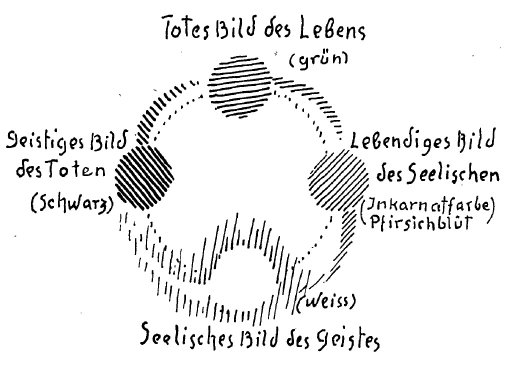
[ 4 ] Ich habe die vier Farben Grün, Inkarnatfarbe, Weiß und Schwarz in ihrem künstlerischen Sich-Offenbaren erfaßt, und es zeigt sich darin das in sich geschlossene Leben des Kosmos innerhalb der Welt des Farbigen. Wenn wir gerade diese Farben künstlerisch ins Auge fassen, die hier gewissermaßen zu einem geschlossenen Kreis sich formen, dann können wir aus unserer Empfindung gewahr werden, wie wir das Bedürfnis haben, diese Farben eigentlich immer im Bilde zu bekommen, im geschlossenen Bilde.
[ 4 ] I have grasped the four colors—green, incarnate red, white, and black—in their artistic manifestation, and in them the self-contained life of the cosmos within the world of color is revealed. When we contemplate these very colors artistically—which here, in a sense, form a closed circle—we can become aware, through our own perception, of our need to always capture these colors within the image, within a closed image.
[ 5 ] Natürlich muß ich auch immer, indem ich Künstlerisches behandle, nicht auf den abstrakten Verstand reflektieren, sondern auf die künstlerische Empfindung. Künstlerisches muß man künstlerisch erkennen. Daher kann ich nicht durch irgendeinen Begriffsbeweis Sie hier darauf aufmerksam machen, wie man bei Grün, Pfirsichblüt, Weiß und Schwarz das Bedürfnis hat, das geschlossene Bild zu haben. Man will eine Kontur haben und innerhalb der Kontur das geschlossene Bild. Es ist in diesen vier Farben immer etwas von Schatten enthalten. Das Weiß ist gewissermaßen der hellste Schatten, denn es ist das Weiß abgeschattetes Licht. Das Schwarz ist der dunkelste Schatten. Grün und Pfirsichblüt sind Bilder, das heißt in sich gesättigte Flächen, was der Fläche etwas Schattenhaftes gibt. So haben wir in diesen vier Farben Bildfarben oder Schattenfarben. Und wir wollen diese Farben als Bildfarben und Schattenfarben empfinden.
[ 5 ] Of course, whenever I discuss art, I must always focus not on abstract reason, but on artistic sensibility. Artistic matters must be recognized artistically. Therefore, I cannot use any conceptual argument here to draw your attention to how, with green, peach blossom, white, and black, one feels the need for a complete image. One wants a contour and, within that contour, a complete image. These four colors always contain an element of shadow. White is, in a sense, the lightest shadow, for it is light shaded to white. Black is the darkest shadow. Green and peach blossom are images—that is, surfaces saturated in themselves—which gives the surface a shadow-like quality. Thus, in these four colors, we have image colors or shadow colors. And we want to perceive these colors as image colors and shadow colors.
[ 6 ] Ganz anders wird das, wenn wir zu anderen Farben mit unseren Empfindungen übergehen. Diese anderen Farben sind, wenn ich drei Nuancen von ihnen nehme, Rot, Gelb und Blau. Bei diesen Farben, Rot, Gelb, Blau, haben wir nicht das Bedürfnis, wenn wir auf unser unbefangenes künstlerisches Empfinden zurückgehen, sie in geschlossenen Konturen zu haben, sondern wir haben das Bedürfnis, daß uns die Fläche erglänzt in diesen Farben, daß uns der Glanz des Roten von der Fläche entgegenleuchtet, oder daß uns das Matte des Blaus von der Fläche aus beruhigend entgegenwirkt, oder daß uns das Leuchtende des Gelben von der Fläche entgegenglänzt. Und so kann man die vier Farben Inkarnat, Grün, Schwarz, Weiß die Bildfarben oder Schattenfarben nennen; dagegen Blau, Gelb, Rot die Glanzfarben, die aus dem Bilde des Schattenhaften erglänzen. Und wir kommen wiederum, wenn wir mit unserer Empfindung verfolgen, wie die Welt in den drei Farben Rot, Gelb, Blau glänzend wird, dazu, uns zu sagen: In dem Aufleuchten des Roten wollen wir vorzugsweise das Lebendige schauen. Das Lebendige will sich uns offenbaren, wenn es uns rot, aktiv rot entgegenkommt, so daß wir das Rot nennen können den Glanz des Lebendigen. Will der Geist nicht bloß in seiner abstrakten Gleichheit als Weißes sich uns offenbaren, sondern zu uns innerlich intensiv sprechen, so will er — das heißt unsere Seele will das empfangen - gelb glänzen. Gelb ist der Glanz des Geistes. Will die Seele so recht innerlich sein und will dies zur künstlerischen Offenbarung in der Farbe kommen, dann will die Seele sich hinwegheben von den äußerlichen Erscheinungen, will in sich beschlossen sein. Das gibt den milden Schein des Blaus. Und so ist der milde Schein des Blaus der Glanz des Seelischen. Wir kommen dazu, die drei Glanzfarben so zu empfinden, daß wir das Rot als den Glanz des Lebendigen, das Blau als den Glanz des Seelischen und das Gelb als den Glanz des Geistigen empfinden.
[ 6 ] It’s quite different when we turn our attention to other colors. If I were to choose three shades of these other colors, they would be red, yellow, and blue. With these colors—red, yellow, and blue—when we return to our unbiased artistic sensibility, we do not feel the need to have them within closed contours; rather, we feel the need for the surface to shine in these colors—for the brilliance of red to radiate toward us from the surface, or for the matte quality of blue to soothe us from the surface, or for the luminosity of yellow to shine out toward us from the surface. And so one can call the four colors—flesh tone, green, black, and white—the picture colors or shadow colors; whereas blue, yellow, and red are the luminous colors that shine forth from the image of the shadow. And once again, as we follow with our perception how the world shines in the three colors—red, yellow, and blue—we find ourselves saying: In the radiance of red, we wish above all to behold the living. Life seeks to reveal itself to us when it comes toward us in red—active red—so that we can call red the radiance of life. If the spirit does not merely wish to reveal itself to us in its abstract sameness as white, but rather to speak to us intensely from within, then it—that is, our soul wishes to receive this—will shine in yellow. Yellow is the radiance of the spirit. If the soul wishes to be truly inner and if this is to find artistic expression in color, then the soul seeks to rise above external appearances and to be self-contained. This gives rise to the gentle radiance of blue. And so the gentle radiance of blue is the radiance of the soul. We come to perceive the three radiant colors in such a way that we experience red as the radiance of the living, blue as the radiance of the soul, and yellow as the radiance of the spiritual.
[ 7 ] Sehen Sie, dann leben wir in der Farbe, dann verstehen wir mit unserer Empfindung, mit unserem Gefühl die Farbe, wenn wir überall die Empfindung haben, wie sich eine Welt aus den Bildfarben Pfirsichblüt, Grün, Schwarz, Weiß zusammensetzt und aus den Glanzfarben, die wiederum den Bildfarben den entsprechenden Schein der Offenbarung geben: Rot, Gelb, Blau. Man wird, wenn man sich in dieser Weise in den Glanz und in die Bildhaftigkeit der Welt des Farbigen hineinlebt, dadurch innerlich vom Seelischen aus zum Maler, denn man lernt leben mit der Farbe. Man lernt zum Beispiel empfinden, was die einzelne Farbe uns selber sagen will. Blau ist der Glanz des Seelischen. Wenn wir eine Fläche blau bestreichen, so fühlen wir eigentlich uns nur dann befriedigt, wenn wir das Blau so auftragen, daß wir es am Rande stark auftragen und nach der Mitte zu schwächer werden lassen.
[ 7 ] You see, then we live in color; then we understand color through our perception, through our feelings, when we experience everywhere how a world is composed of the pictorial colors peach blossom, green, black, and white, and of the luminous colors, which in turn give the pictorial colors the corresponding radiance of revelation: red, yellow, blue. When one immerses oneself in this way in the radiance and pictorial quality of the world of color, one thereby becomes, from within the soul, a painter, for one learns to live with color. One learns, for example, to sense what each individual color is trying to tell us. Blue is the radiance of the soul. When we paint a surface blue, we actually feel satisfied only when we apply the blue in such a way that it is applied more heavily at the edges and becomes lighter toward the center.
[ 8 ] Tragen wir dagegen das Gelb auf und wollen uns von der Farbe selber etwas sagen lassen, dann wollen wir in der Mitte das gesättigte Gelb und am Rande das ungesättigte helle Gelb haben. Das fordert die Farbe selber. Dadurch wird, was in Farben lebt, allmählich sprechend. Wir kommen dazu, aus den Farben heraus die Form zu gebären, das heißt aus der Farbenwelt heraus empfindend zu malen.
[ 8 ] If, on the other hand, we apply the yellow and allow the color itself to speak to us, then we should have the saturated yellow in the center and the unsaturated light yellow at the edges. This is what the color itself demands. In this way, what lives within colors gradually comes to speak. We come to give birth to form out of the colors—that is, to paint intuitively from within the world of color.
[ 9 ] Es wird uns nicht einfallen, wenn wir in dieser Weise die Welt als Farbe erleben, wenn wir zum Beispiel eine Gestalt als leuchtende weiße Gestalt, also im Geist lebende Gestalt hingehen lassen wollen im Bilde, daß wir diese in einer anderen Farbe als in einer gelb und nach außen hellgelb verlaufenden Farbe zeigen. Es wird uns nicht einfallen, die empfindende Seele auf einem Bilde anders zu malen, wenn wir das auch vielleicht nur in der Gewandung ausdrücken können, als dadurch, daß wir das Blau verwenden, das nach innen zu sanft blau verläuft. Genießen Sie von diesem Gesichtspunkt aus noch die Maler der Renaissance, Raffael, Michelangelo, selbst noch Lionardo, so werden Sie überall finden, da lebte man noch in dieser Weise künstlerisch wirklich in der Farbe.
[ 9 ] It would never occur to us, when we experience the world as color in this way—when, for example, we want to allow a figure to appear in the image as a radiant white figure, that is, as a figure living in the spirit—to depict it in any color other than yellow, fading outward into a light yellow. It would not occur to us to paint the perceiving soul differently in a picture—even if we can perhaps express this only through its clothing—except by using a blue that fades inward into a soft blue. If you appreciate the Renaissance painters—Raphael, Michelangelo, and even Leonardo—from this perspective, you will find everywhere that they truly lived artistically within the color in this way.
[ 10 ] Vor allen Dingen war da eines noch vorhanden, vorhanden voll in der für unsere heutige Zeit fast ganz verglommenen Malerei, aber auch noch im Nachklang in der Renaissancemalerei: die innere Perspektive des Bildes, die in der Farbe lebt. Wer Rot zum Beispiel, den Glanz des Roten wirklich empfindet, der wird immer erleben, wie das Rot aus dem Bilde herauskommt, wie das Rot dasjenige, was es abbildet, im Bilde uns nahe bringt, während das Blau das, was es abbildet, in die Ferne trägt. Und wir malen auf der Fläche in Rot-Blau, indem wir zu gleicher Zeit perspektivisch malen: das Rote nahe, das Blaue ferne. Wir malen Farbenperspektive, innerliche Perspektive. Das ist diejenige Perspektive, die noch im Seelisch-Geistigen lebte.
[ 10 ] Above all, there was one thing that still existed—fully present in painting, which has almost entirely faded from view in our time, but also still echoing in Renaissance painting: the inner perspective of the image, which lives in the color. Anyone who truly senses red—the brilliance of red, for example—will always experience how the red seems to emerge from the picture, how the red brings what it depicts closer to us within the picture, while blue carries what it depicts into the distance. And we paint on the surface in red and blue, painting perspectively at the same time: red close, blue far. We paint color perspective, inner perspective. This is the perspective that still lived in the soul-spiritual realm.
[ 11 ] Im materialistischen Zeitalter kam erst — das berücksichtigt man so wenig — die Raumperspektive auf, die Perspektive, die nun mit Raumgrößen rechnet, das Ferne nicht in Blau taucht, sondern klein macht, das Nahe nicht in Rot erglänzen läßt, sondern groß macht. Diese Perspektive ist erst eine Beigabe des materialistischen Zeitalters, das im Räumlich-Materiellen lebte und auch im RäumlichMateriellen malen wollte.
[ 11 ] It was only in the materialistic age—a fact that is so rarely acknowledged—that spatial perspective emerged: the perspective that now calculates based on spatial dimensions, that does not bathe distant objects in blue but makes them appear small, and does not make nearby objects glow red but makes them appear large. This perspective is merely an addition of the materialistic age, which lived in the spatial-material realm and also sought to paint within that same spatial-material realm.
[ 12 ] Wir sind heute wiederum in der Zeit, wo wir zurückfinden müssen zum Naturgemäßen des Malens, denn zum Material des Malers gehört auch die Fläche. Zuerst hat man die Fläche. Und daß man auf der Fläche arbeitet, das zählt man zum Material des Malers. Der Künstler muß aber vor allen Dingen sein Materialgefühl haben. Er muß zum Beispiel ein so starkes Materialgefühl haben, daß er weiß, will er ein Plastisches aus dem Holze heraus arbeiten, dann muß er zum Beispiel die Augen des Menschen ausgraben aus dem Holz. Er muß dasjenige, was konkav ist, vor allen Dingen ins künstlerische Auge fassen und aushöhlen. Der in Holz arbeitende Bildhauer höhlt das Holz aus. Der in Marmor oder in einem anderen Material, in einem harten Material, arbeitende Bildhauer berücksichtigt nicht, wie das Auge hineingeht. Er höhlt nicht aus, sondern er berücksichtigt, wie die Stirne herausgeht aus dem Auge. Er trägt auf. Er berücksichtigt das Konvexe. Der in Marmor Arbeitende, schon wenn er in Plastilin oder einem anderen Material, in Tonmaterial, sich vorarbeitet, muß sich in sein Material hineinversetzen. Der für den Marmor Arbeitende trägt auf. Der für das Holz Arbeitende höhlt aus. Man muß mit seinem Materiale leben können. Das Material muß für einen, wenn man Künstler ist, eine lebendige Sprache führen,
[ 12 ] Today we find ourselves once again in an era where we must return to the natural essence of painting, for the painter’s materials also include the surface. First, there is the surface. And the fact that one works on the surface is considered part of the painter’s materials. Above all, however, the artist must have a sense of the material. For example, he must have such a strong sense of the material that he knows: if he wants to carve a three-dimensional form out of wood, then he must, for instance, hollow out the human eyes from the wood. He must, above all, perceive what is concave with his artistic eye and hollow it out. The sculptor working in wood hollows out the wood. The sculptor working in marble or another material—a hard material—does not consider how the eye recesses into the surface. He does not hollow out; rather, he considers how the forehead protrudes from the eye. He builds up. He takes the convex into account. The sculptor working in marble—even when he is preparing his work in plasticine or another material, such as clay—must immerse himself in his material. The sculptor working with marble builds up. The sculptor working with wood hollows out. One must be able to live with one’s material. For an artist, the material must speak a living language,
[ 13 ] So muß es durchaus auch sein mit dem Farbigen. Und es muß vor allen Dingen so sein mit der Tatsache, daß man als Maler die Fläche zum Material hat. Man empfindet die Fläche nur, wenn man die dritte Raumdimension ausgelöscht hat. Man hat sie ausgelöscht, wenn man das Qualitative auf der Fläche als Ausdruck der dritten Dimension empfindet, wenn man das Blau als das Zurückgehende, das Rot als das Hervortretende empfindet, wenn also in die Farbe hinein sich lebt die dritte Dimension. Dann hebt man das Materielle wirklich auf, während man in der Raumperspektive das Materielle nur nachahmt. Ich rede selbstverständlich nicht gegen die Raumperspektive. Sie war dem Zeitalter, das etwa in der Mitte des 15. Jahrhunderts herauftauchte, selbstverständlich und natürlich und hat etwas Gewaltiges zu dem alten Künstlerischen im Malen hinzugebracht. Aber das Wesentliche ist doch, daß, nachdem wir eine Zeitlang künstlerisch durch den Materialismus durchgegangen sind, der sich auch in der Raumperspektive ausdrückt, wir wiederum zu einer mehr spirituellen Auffassung auch des Malerischen zurückzukehren vermögen, so daß wir wiederum zur Farbenperspektive zurückkommen.
[ 13 ] This must certainly also be the case with color. And above all, it must be the case with regard to the fact that, as a painter, one uses the surface as one’s medium. One perceives the surface only when one has eliminated the third spatial dimension. One has eliminated it when one perceives the qualitative aspects on the surface as an expression of the third dimension—when one perceives blue as receding and red as protruding—that is, when the third dimension is embodied within the color itself. Then one truly transcends the material, whereas in spatial perspective one merely imitates the material. I am, of course, not speaking against spatial perspective. It was self-evident and natural to the era that emerged around the middle of the 15th century, and it contributed something powerful to the traditional artistic tradition in painting. But the essential point is that, after having gone through a period of artistic materialism—which is also expressed in spatial perspective—we are now able to return to a more spiritual conception of painting as well, so that we can once again return to color perspective.
[ 14 ] Sehen Sie, man kann nicht theoretisieren, wenn man über Kunst spricht. Man muß immer im Mittel der Kunst bleiben. Und dasjenige, was einem zur Verfügung stehen kann, wenn man über Kunst spricht, muß die Empfindung sein. Wenn man über Mathematik spricht, oder über Mechanik oder Physik, kann man nicht aus der Empfindung heraus sprechen, sondern da muß man aus dem Verstande heraus sprechen, aber man kann gar nicht aus dem Verstande heraus irgendwie die Kunst betrachten. Zwar haben dies die Ästhetiker des 19. Jahrhunderts getan. Da hat mir einmal ein Künstler in München erzählt, er und seine Kollegen seien auch einmal, als sie jung waren, um es zu probieren, in das Kolleg eines Ästhetikers gegangen, sogar eines sehr berühmten Ästhetikers in der damaligen Zeit, um zu sehen, ob sie etwas von dem theoretisierenden Ästhetiker lernen können. Aber sie sind alle nicht ein zweites Mal hingegangen und haben nur den Ausdruck «ästhetischer Wonnegrunzer» dafür übrig behalten. Sie als Maler haben ihn den «ästhetischen Wonnegrunzer» genannt. Vielleicht versteht man doch das künstlerisch-ironisch Absprechende über die Theoretik in diesem Ausdruck.
[ 14 ] You see, one cannot theorize when speaking about art. One must always remain within the realm of art. And what one can draw upon when speaking about art must be sensation. When speaking about mathematics, or mechanics, or physics, one cannot speak from sensation; rather, one must speak from reason. But one cannot in any way view art from the perspective of reason. Admittedly, the aestheticians of the 19th century did just that. An artist in Munich once told me that he and his colleagues, when they were young, went to the office of an aesthetician—even a very famous one at the time—just to try it out, to see if they could learn anything from the theorizing aesthetician. But none of them ever went back a second time, and all they were left with was the term “aesthetic grunts of delight.” As painters, they called him the “aesthetic grunts of delight.” Perhaps one can still discern the artistically ironic dismissal of theory in this expression.
[ 15 ] Nun, dasselbe, was man so im lebendigen Leben und Weben der Farben darstellen kann, kann man auch aus dem Weben und Leben in Tönen darstellen. Nur kommt man gerade da, wie ich schon vorgestern andeutete, mit der Ionwelt, mit dem musikalischen Elemente in das Innere des Menschen. Indem der Mensch Plastiker wird, Maler wird, geht er hinaus in den Raum, auch wenn er als Maler den Raum zum zweidimensionalen aufhebt, stellt er in ihm doch dasjenige dar, was sich im Raume farbig ätherisch darlebt und offenbart. Mit dem Musikalischen kommen wir in das unmittelbar Innere des Menschen, und es ist außerordentlich bedeutsam, wenn wir gerade das Musikalische innerhalb des Entwickelungsganges der Menschheit ins Auge fassen.
[ 15 ] Well, just as one can depict the living, dynamic interplay of colors, so too can one depict the interplay and life of sounds. But it is precisely here, as I hinted at the day before yesterday, that we enter the inner world of the human being through the world of ions and the musical element. As a person becomes a sculptor or a painter, they step out into space; even if, as a painter, they reduce space to two dimensions, they still depict within it that which lives and reveals itself in space in a colorful, ethereal way. Through music, we enter directly into the innermost being of the human being, and it is of extraordinary significance when we consider music specifically within the course of human development.
[ 16 ] Diejenigen der verehrten Anwesenden und Freunde, welche öfter meine Vorträge gehört haben oder die anthroposophische Literatur kennen, wissen, daß wir im Entwickelungsgang der Menschheit bis in diejenigen Zeiten zurückgehen, die wir die atlantische Epoche der Menschheitsentwickelung nennen, wo noch ein ganz anderes Menschengeschlecht auf Erden war, das mit einem ursprünglichen instinktiven Hellsehen begabt war, das im wachen Träumen das Geistige hinter dem Sinnlichen sah. In diesem Zeitalter, wo die Menschen noch ein instinktives Hellsehen hatten, instinktiv das Geistige hinter dem Sinnlichen sahen, ging parallel diesem Schauen auch ein andersartiges Empfinden des Musikalischen. Beim Erfassen des Musikalischen fühlte der Mensch instinktiv in uralten Zeiten sich heraus versetzt aus seinem Leibe. Daher gefielen diesen Leuten in uralten Zeitaltern vorzugsweise, so paradox das für den heutigen Menschen klingt, die Septimenakkorde. Sie musizierten und sangen in Septimen, etwas, was heute nicht mehr in vollem Maße als musikalisch empfunden wird. Aber die Leute fühlten sich auch im Genießen der Septimenakkorde ganz aus dem Menschlichen ins Göttliche herausversetzt.
[ 16 ] Those among you, esteemed guests and friends, who have often attended my lectures or are familiar with anthroposophical literature, know that in the course of human evolution we go back as far as the times we call the Atlantean epoch of human development, when a completely different race of human beings lived on Earth—one endowed with a primal, instinctive clairvoyance that enabled them to perceive the spiritual behind the physical in a state of waking dreams. In this age, when people still possessed instinctive clairvoyance and instinctively perceived the spiritual behind the physical, this perception was accompanied by a different kind of musical sensibility. When experiencing music, people in ancient times instinctively felt themselves transported out of their bodies. That is why, in ancient times—as paradoxical as it may sound to people today—these people particularly favored seventh chords. They played and sang in sevenths, something that is no longer fully perceived as musical today. But in enjoying the seventh chords, people also felt themselves transported entirely out of the human realm and into the divine.
[ 17 ] Das schwächte sich dann im Laufe der Zeit ab, indem der Übergang gefunden wurde von dem Septimenerleben zu den Quintenskalen. Im Wahrnehmen der Quinte, im Betonen des Quintenhaften im Musikalischen war noch immer eine Empfindung davon, daß der Mensch eigentlich mit dem Musikalischen das Göttliche in ihm loslöst vom Physischen. Aber der Mensch kam, während er bei den Septimen herauskam, völlig sich entrückt fühlte zum Geistigen, mit seinem Empfinden in den Quinten gerade bis an die Grenze seines Physischen. Er empfand sein Geistiges an der Grenze seiner Haut, eine Empfindung, die der Mensch heute gar nicht mehr mit dem gewöhnlichen Bewußtsein verwirklichen kann.
[ 17 ] This then weakened over time as the transition was made from the experience of the seventh to the scales of the fifth. In the perception of the fifth, in the emphasis on the “fifth-like” in music, there was still a sense that, through music, human beings actually detach the divine within themselves from the physical. But while the human being, through the experience of sevenths, felt completely transported into the spiritual realm, with his perception of fifths he reached precisely the boundary of his physical being. He sensed his spiritual nature at the very edge of his skin—a sensation that human beings today can no longer experience through ordinary consciousness.
[ 18 ] Dann trat, wie Sie aus der Geschichte der Musik wissen werden, die Terzzeit ein, die Zeit der großen und kleinen Terzen. Diese Terzzeit bedeutet, daß das Musikalische von dem Erlebtwerden außer dem Menschen, als eine Art von menschlicher Entrücktheit, in den Menschen ganz hineingenommen wurde. Die Terz, sowohl die große Terz wie die kleine Terz, und die dadurch bedingte Dur- und Molltonart, nehmen das Musikalische in den Menschen herein. Daher tritt in der neueren Zeit, als die Quintenzeit in die Terzzeit übergeht, das Phänomen ein, daß der Mensch das Musikalische auch ganz innerlich erlebt, gewissermaßen innerhalb seiner Haut erlebt.
[ 18 ] Then, as you will know from the history of music, the “Age of the Third” began—the era of major and minor thirds. This Age of the Third signifies that what is musical, having previously been experienced outside of human beings—as a kind of human detachment—was now fully absorbed into the human being. The third—both the major third and the minor third—and the major and minor keys that result from them, draw the musical into the human being. Therefore, in more recent times, as the Age of the Fifth gives way to the Age of the Third, the phenomenon arises whereby human beings experience the musical entirely inwardly, so to speak, within their own skin.
[ 19 ] Wir sehen den parallelen Übergang, auf der einen Seite die Raumperspektive, welche hinausdringen will malerisch in den Raum, auf der anderen Seite die Terzentonart, die hineindringt in den ätherisch-physischen Leib des Menschen, also nach beiden Seiten hin zum naturalistischen Auffassen. Auf der einen Seite in der Raumperspektive äußerer Naturalismus, auf der anderen Seite im musikalischen Erfassen der Terz innerer menschlicher Naturalismus. Überall, wo wir das wirkliche Wesen der Dinge erfassen, dringen wir durchaus auch zu einer Erkenntnis der ganzen Stellung des Menschen zum Kosmos vor. Und die nächste Entwickelung wird auch im Musikalischen eine Vergeistigung, eine Verspiritualisierung sein. Sie wird darinnen bestehen, daß wir den einzelnen Ton in seiner besonderen Eigenart kennenlernen werden. Den einzelnen Ton, den wir heute in die Harmonie oder in die Melodie hineinfügen, damit er mit dem anderen Ton zusammen das Geheimnis des Musikalischen enthülle, werden wir nicht mehr bloß in seinem Verhältnis zu anderen Tönen erkennen, also gewissermaßen nach der Ebenendimension erfassen, sondern wir werden ihn in seiner Tiefendimension erfassen, wir werden in den einzelnen Ton eindringen, dann wird im einzelnen Ton immer ein Ansatz zu verborgenen Nachbartönen erscheinen. Man wird fühlen lernen: Vertieft man sich, versenkt man sich in den Ton, dann offenbart der Ton drei oder fünf oder noch mehr Töne, und man dringt mit dem Ton, in den man sich vertieft, indem der. Ton selbst zur Melodie und zur Harmonie sich ausweitet, ins Spirituelle ein. — Bei einzelnen Musikern der Gegenwart sind Ansätze gemacht zu diesem Eindringen in die Tiefendimensionen des Tones, allein es ist heute im musikalischen Empfinden der Menschen gerade erst, man möchte sagen die Sehnsucht vorhanden, den Ton in seiner geistigen Tiefe zu erfassen und dadurch auch auf diesem Gebiete immer mehr und mehr aus dem Naturalistischen in das Spirituelle der Kunst hineinzudringen.
[ 19 ] We see a parallel transition: on the one hand, spatial perspective, which seeks to extend outward into space in a painterly manner; on the other hand, the key of the third, which penetrates the ethereal-physical body of the human being—thus moving in both directions toward a naturalistic understanding. On the one hand, external naturalism in spatial perspective; on the other, internal human naturalism in the musical perception of the third. Wherever we grasp the true essence of things, we also advance toward an understanding of humanity’s entire relationship to the cosmos. And the next stage of development, even in music, will be a spiritualization, a deepening of the spiritual dimension. It will consist in our coming to know the individual tone in its unique character. The individual tone, which we today incorporate into harmony or melody so that, together with other tones, it may reveal the mystery of music, we will no longer perceive merely in its relationship to other tones—that is, in a sense, in its two-dimensional plane—but we will grasp it in its depth dimension; we will penetrate the individual tone, and then a hint of hidden neighboring tones will always appear within it. We will learn to feel: If we immerse ourselves, if we sink into the tone, then the tone reveals three or five or even more tones, and we penetrate into the spiritual realm with the tone into which we immerse ourselves, as the tone itself expands into melody and harmony. — Some contemporary musicians have made attempts at this penetration into the deeper dimensions of sound, yet today, in people’s musical sensibility, there is only just—one might say—a longing to grasp the sound in its spiritual depth and thereby, in this realm as well, to penetrate ever more deeply from the naturalistic into the spiritual realm of art.
[ 20 ] Ganz besonders merkt man diese Tatsache, daß sich im Künstlerischen ein besonderes Verhältnis des Menschen zur Welt äußert, wenn man vordringt von den Künsten der Außenwelt, Architektur, Bekleidungskunst, Plastik, Malerei, durch die Künste des mehr Innerlichen, die musikalischen Künste, zu der dichterischen Kunst. Und da, meine sehr verehrten Anwesenden, muß ich leider bedauern, die ursprüngliche Absicht nicht ausführen zu können, daß dasjenige, was ich als Rest dieser künstlerischen Betrachtung über Dichterisches zu sagen habe, illustriert werden könnte durch die Deklamation und Rezitation von Frau Dr. Steiner. Sie ist leider noch immer nicht von einer wochenlang andauernden Erkältung so weit hergestellt, daß sie es heute wagen kann, rezitatorisch und deklamatorisch vor Ihnen aufzutreten. Es muß also diese Illustration desjenigen, was ich Ihnen zu sagen habe, zu meinem tiefen Leidwesen unterbleiben. Allein, wir wagten eben doch nicht, zu dem etwas unkünstlerischen Gekrächze, zu welchem ich während dieses norwegischen Kursus durch meine eigene Erkältung genötigt bin, auch die noch nicht ganz hergestellte Stimme von Frau Dr. Steiner hinzuzufügen, denn im Künstlerischen kann man eben weniger wagen, das Reden ins Krächzen zu verwandeln, als im gewöhnlichen Vortrage.
[ 20 ] One becomes particularly aware of the fact that art expresses a special relationship between human beings and the world when one moves from the arts of the external world—architecture, fashion, sculpture, and painting—through the more inward-looking arts, such as music, to the art of poetry. And here, ladies and gentlemen, I must unfortunately express my regret that I am unable to carry out my original intention: that what I have to say about poetry as the culmination of this artistic reflection might be illustrated by a recitation by Dr. Steiner. Unfortunately, she has still not recovered sufficiently from a cold that has lasted for weeks to dare to appear before you today as a reciter or declaimer. Therefore, to my deep regret, this illustration of what I have to say to you must be omitted. However, we simply did not dare to add Dr. Steiner’s voice—which has not yet fully recovered—to the somewhat unartistic croaking that my own cold has forced me to produce during this Norwegian course; for in the realm of art, one can afford to take even fewer risks in allowing speech to degenerate into croaking than in ordinary speech.
[ 21 ] Wenn wir heraufdringen in das Dichterische, fühlen wir so recht uns vor eine große Frage gestellt. Das Dichterische entspringt aus der Phantasie. Die Phantasie stellt für die Menschen gewöhnlich nur das Unwirkliche vor, das, was man sich einbildet, was nicht da ist. Aber welche Kraft äußert sich denn eigentlich in der Phantasie?
[ 21 ] When we venture into the realm of poetry, we truly feel confronted with a great question. Poetry springs from the imagination. For people, the imagination usually represents only the unreal—that which one imagines, that which is not there. But what force is actually expressed through the imagination?
[ 22 ] Schauen wir, um die Kraft der Phantasie zu verstehen, dazu einmal das kindliche Alter an. Das kindliche Alter hat noch nicht Phantasie. Es hat höchstens Träume. Die frei schöpferische Phantasie lebt noch nicht im Kinde. Sie lebt nicht offenbar. Aber sie ist nicht etwas, was plötzlich aus den Menschen in einem bestimmten Lebensalter aus dem Nichts hervorkommt. Die Phantasie ist doch, nämlich verborgen da im Kinde, obwohl sie sich nicht offenbart, und das Kind ist eigentlich voll von Phantasie. Aber was tut denn beim Kinde die Phantasie? Ja, dem, der mit unbefangenem Geistesauge die Menschenentwickelung betrachten kann, zeigt sich, wie im zarten Kindesalter noch unplastisch im Verhältnis zu der späteren Gestalt namentlich das Gehirn, aber auch der übrige Organismus ausgebildet ist. Das Kind ist innerlich der unglaublichste, bedeutende Plastiker in der Ausgestaltung seines eigenen Organismus. Kein Plastiker ist imstande, so wunderbar aus dem Kosmos heraus Weltenformen zu schaffen, als das Kind sie schafft, wenn es in der Zeit zwischen der Geburt und dem Zahnwechsel plastisch das Gehirn ausgestaltet und den übrigen Organismus. Das Kind ist ein wunderbarer Plastiker, nur arbeitet die plastische Kraft in den Organen als innerliche Wachstums- und Bildekraft. Und das Kind ist auch ein musikalischer Künstler, denn es stimmt seine Nervenstränge in musikalischer Weise. Wiederum ist die Phantasiekraft Wachstumskraft, Kraft der Abstimmung des Organismus selber.
[ 22 ] To understand the power of imagination, let’s take a look at childhood. Children do not yet possess imagination. At most, it has dreams. Free, creative imagination does not yet live within the child. It does not manifest itself openly. But it is not something that suddenly emerges out of nowhere in people at a certain age. Imagination is, in fact, hidden within the child, even though it does not reveal itself, and the child is actually full of imagination. But what, then, does the imagination do in the child? Indeed, to those who can observe human development with an unbiased spiritual eye, it becomes clear how, in early childhood, the brain in particular—but also the rest of the organism—is still undeveloped in comparison to its later form. The child is, inwardly, the most incredible and significant sculptor in the shaping of its own organism. No sculptor is capable of creating worldly forms so wonderfully out of the cosmos as the child does when, in the period between birth and the loss of baby teeth, it sculpts the brain and the rest of the organism. The child is a marvelous sculptor; it is just that this sculptural power works within the organs as an inner force of growth and formation. And the child is also a musical artist, for it tunes its nerve fibers in a musical way. Once again, the power of imagination is a force of growth, a force that harmonizes the organism itself.
[ 23 ] Sehen Sie, wenn wir nach und nach zu dem Zeitalter aufrücken, in dem der charakterisierte Zahnwechsel geschieht, um das siebente Jahr herum, und nachher aufrücken zu dem Zeitalter der Geschlechtsreife, da brauchen wir nicht mehr so viel plastisch-musikalische Kraft als Wachstumskraft, als Bildekraft in uns wie früher. Da bleibt etwas übrig. Da kann die Seele gewissermaßen etwas herausziehen aus der Wachstums- und Bildekraft. Was die Seele dann nach und nach, indem das Kind heranwächst, nicht mehr braucht, um den eigenen Körper als Wachstumskraft zu versorgen, das bleibt übrig als Phantasiekraft. Die Phantasiekraft ist nur die ins Seelische metamorphosierte natürliche Wachstumskraft. Wollen Sie kennenlernen, was die Phantasie ist, studieren Sie zunächst die lebendige Kraft im Formen der Pflanzengebilde, studieren Sie die lebendige Kraft im Formen der wunderbaren Innengebilde des Organismus, die das Ich zustande bringt, studieren Sie alles dasjenige, was im weiten Weltenall gestaltend ist, was in den unterbewußten Regionen des Kosmos gestaltend und bildend und wachsend wirkt, dann haben Sie auch einen Begriff von dem, was dann übrig bleibt, wenn der Mensch so weit in der Bildung seines eigenen Organismus vorgerückt ist, daß er nicht mehr das volle Maß seiner Wachstums- und Bildekraft braucht. Dann rückt ein Teil in die Seele herauf und wird Phantasiekraft. Und erst ganz zuletzt, das Letzte, was übrig bleibt, ich kann nicht sagen der Bodensatz, weil der Bodensatz unten ist, und das, was da übrig bleibt, geht nach oben, ist dann die Verstandeskraft. Das ist die ganz durchgesiebte Phantasiekraft, das Letzte, was übrig bleibt, ich kann nicht sagen der Bodensatz, sondern der Niveausatz, der oben herauskommt: der Verstand.
[ 23 ] You see, as we gradually approach the age when the characteristic change of teeth takes place—around the seventh year—and subsequently move on to the age of sexual maturity, we no longer need as much plastic-musical power within us—as a force of growth and formation—as we did before. Something remains. The soul can, so to speak, draw something out of this power of growth and formation. What the soul then gradually no longer needs—as the child grows—to supply its own body with the power of growth remains as the power of imagination. The power of imagination is simply the natural power of growth metamorphosed into the soul. If you wish to understand what imagination is, first study the living force at work in the formation of plant structures; study the living force at work in the formation of the organism’s marvelous internal structures, which the “I” brings into being; study everything that is formative in the vast universe, everything that works to shape, form, and grow in the subconscious regions of the cosmos; then you will also have a concept of what remains when a human being has advanced so far in the development of his own organism that he no longer needs the full measure of his power of growth and formation. Then a part rises into the soul and becomes the power of imagination. And only at the very end—the last thing that remains—I cannot call it the dregs, because the dregs are at the bottom, and what remains here rises upward—is the power of the intellect. This is the thoroughly sifted power of imagination, the last thing that remains; I cannot call it the dregs, but rather the “level” that emerges from above: the intellect.
[ 24 ] Der Verstand ist die durchgesiebte Phantasie. Das beachten die Leute nicht, deshalb halten sie den Verstand für ein so viel größeres Wirklichkeitselement, als die Phantasie es ist. Aber die Phantasie ist das erste Kind der natürlichen Wachstums- und Bildekräfte selbst. Daher drückt die Phantasie etwas unmittelbar Wirkliches nicht aus, denn solange die Wachstumskraft im Wirklichen arbeitet, kann sie nicht zur Phantasie werden. Es bleibt erst etwas übrig für die Seele als Phantasie, wenn das Wirkliche versorgt ist. Aber innerlich, der Qualität, der Wesenheit nach ist die Phantasie durchaus dasselbe wie die Wachstumskraft. Dasjenige, was unseren Arm von der Kleinheit größer werden läßt, ist dieselbe Kraft wie dasjenige, was in uns dichterisch in der Phantasie, überhaupt künstlerisch in der Phantasie tätig ist in der seelischen Umgestaltung. Das muß man wiederum nicht theoretisch verstehen, sondern man muß es innerlich gefühls- und willensmäßig verstehen. Dann bekommt man vor dem Walten der Phantasie auch die nötige Ehrfurcht, unter Umständen auch gegenüber diesem Walten der Phantasie den nötigen Humor. Kurz, es wird die Anregung für den Menschen geschaffen, in der Phantasie eine in der Welt waltende göttliche Kraft zu empfinden. Diese in der Welt waltende göttliche Kraft, die sich durch den Menschen ausdrückt, empfanden vor allen Dingen die Menschen in jenen alten Zeiten, auf die ich im vorhergehenden Vortrag hingedeutet habe, wo Kunst und Erkenntnis noch eins waren, wo in den alten Mysterien dasjenige, was man erkennen sollte, noch durch die schön, das heißt künstlerisch gefaßten Kultushandlungen vorgestellt wurde, nicht durch die Abstraktionen des Laboratoriums und der Klinik, wo der Arzt noch nicht in den Anatomiesaal ging, um den Menschen kennenzulernen, sondern wo er in die Mysterien ging und die Geheimnisse des gesunden und kranken menschlichen Lebens in dem Mysterienzeremoniell ihm enthüllt wurden und er auch dadurch innerlich den Einlaß in die menschliche Wesenheit erlangte.
[ 24 ] Reason is imagination that has been sifted through. People do not realize this, which is why they regard reason as a much greater element of reality than imagination is. But imagination is the first offspring of the natural forces of growth and formation themselves. Therefore, imagination does not express anything immediately real, for as long as the force of growth is at work in reality, it cannot become imagination. Only when the real world has been provided for does something remain for the soul as imagination. But inwardly, in terms of quality and essence, imagination is entirely the same as the power of growth. The very force that causes our arm to grow from smallness is the same force that is at work within us poetically in the imagination—and artistically in the imagination in general—in the soul’s transformation. This, however, must not be understood theoretically, but rather intuitively through feeling and will. Then one develops the necessary reverence for the workings of the imagination—and, under certain circumstances, the necessary sense of humor toward these very workings. In short, the stimulus is created for human beings to perceive in the imagination a divine force at work in the world. This divine power at work in the world, which expresses itself through human beings, was felt above all by the people of those ancient times to which I alluded in the previous lecture—when art and knowledge were still one, when, in the ancient mysteries, that which was to be known was still presented through beautiful, that is, artistically conceived, ritual acts, not through the abstractions of the laboratory and the clinic, where the physician did not yet go to the anatomy theater to learn about human beings, but rather went to the mysteries, where the secrets of healthy and diseased human life were revealed to him through the mystery rituals, and through this he also gained inner access to the human being.
[ 25 ] In dieser Zeit fühlte man, der Gott, der in einem webte und lebte, als man vom kleinen Kinde plastisch und musikalisch sich formend und bildend aufwuchs, lebte auch noch in der Phantasie fort. Daher war man sich in alten Zeiten klar, in denen die tiefe innerliche Verwandtschaft zwischen Religion, Kunst und Wissenschaft empfunden worden ist, daß man eigentlich die Phantasie nur dann nicht entheiligt, nicht profaniert, wenn man sich bewußt bleibt, daß man sich zum Göttlichen in irgendeiner Weise hinfinden müsse oder dem Göttlichen Einlaß geben müsse in den Menschen, wenn man dichterisch sich offenbaren will. Wenn in den ältesten Zeiten in dramatischen Gestaltungen niemals der äußere Mensch dargestellt worden ist, so ist es daher — das klingt wiederum paradox für die Menschen der Gegenwart, der anthroposophische Forscher weiß das natürlich, er muß das sagen, trotzdem es paradox klingt, er weiß die Einwände, die gemacht werden können, ebenso wie die Gegner sie wissen, aber es muß doch dieses Paradoxe gesagt werden -, weil die älteste dramatische Phantasie der Menschheit es als absurd empfunden hätte, gewöhnliche Menschen auf die Bühne zu stellen, die allerlei sich sagen, allerlei Gesten gegeneinander machen. Warum soll man denn das tun? - So würde noch ein Grieche der vorsophokleischen [Zeit], namentlich der Zeit vor dem Äschylos sich gesagt haben. Warum denn? Das ist ja im Leben ohnedies vorhanden. Da brauchen wir nur in die Straßen und Zimmer zu gehen, da sehen wir, wie die Menschen miteinander reden, wie die Menschen Gebärden gegeneinander machen. Wozu das? Das haben wir immer vor uns. Warum sollen wir das noch extra auf die Bühne hinstellen? - Närrisch wäre das noch den ältesten Griechen vorgekommen, gewöhnliche Menschen, die man in ihren Handlungen alltäglich sieht, noch extra auf die Bühne hinzustellen. Dasjenige, was man wollte, war, den Gott im Menschen zu ergreifen. Wenn man den Menschen auf die Bühne stellte, da sollte der Mensch den Gott im Menschen darstellen, namentlich den aus den Erdentiefen heraufsteigenden Gott, der den Menschen den Willen gibt. Die Willensbegabung sahen mit einem gewissen Recht unsere alten Vorfahren, noch die alten Griechen, als von dem Irdischen heraufkommend in die menschliche Natur. Die Götter der Tiefe, die in den Menschen hineinsteigen, um ihm den Willen zu geben, die dionysischen Götter wollten die Menschen der alten Zeiten auf der Bühne sehen. Der Mensch war gewissermaßen nur die Umhüllung der dionysischen Gottheit. Es war durchaus der den Gott in sich aufnehmende, der vom Gotte sich begeistern lassende Mensch, der in den ältesten dramatischen Darstellungen des Mysterienwesens auftrat. Der Mensch, der den Gott aufnahm, war derjenige, der als dramatische Person auftrat.
[ 25 ] In those days, people felt that the God who wove Himself into them and lived within them—as they grew up, taking shape and developing through art and music from childhood onward—continued to live on in their imagination. That is why, in ancient times—when the deep inner kinship between religion, art, and science was felt—it was clearly understood that one does not desecrate or profane the imagination unless one remains conscious of the fact that, in order to reveal oneself poetically, one must in some way find one’s way to the divine or allow the divine to enter into the human being. If, in the earliest times, dramatic works never depicted the outer human being, it is for this reason—and this, in turn, sounds paradoxical to people today, though the anthroposophical researcher knows this, of course, he must say this even though it sounds paradoxical; he is aware of the objections that can be raised, just as the opponents are, but this paradox must nevertheless be stated—because humanity’s earliest dramatic imagination would have found it absurd to put ordinary people on stage who say all sorts of things to one another and make all sorts of gestures toward one another. Why on earth should one do that?—That is what a Greek of the pre-Sophoclean [era], specifically the time before Aeschylus, would have asked himself. Why indeed? That is already present in life anyway. We need only go out into the streets and into rooms to see how people talk to one another, how people make gestures toward one another. What’s the point of that? We see it all the time. Why should we put that on stage as well?—Even the earliest Greeks would have thought it foolish to put ordinary people, whom one sees going about their daily lives, on stage as well. What they wanted was to capture the god within man. When a person was placed on stage, that person was meant to portray the divine within humanity—namely, the god rising from the depths of the earth who bestows will upon humanity. Our ancient ancestors—even the ancient Greeks—viewed the gift of will, with some justification, as something rising from the earthly realm into human nature. The gods of the depths, who descend into human beings to give them the will—the Dionysian gods—were the ones the people of ancient times wanted to see on stage. In a sense, the human being was merely the vessel of the Dionysian deity. It was indeed the human being who received the god within himself and allowed himself to be inspired by the god who appeared in the earliest dramatic representations of the mystery cults. The human being who received the god was the one who appeared as a dramatic character.
[ 26 ] Der Mensch, der sich zum Gott der Höhe erhob, besser gesagt zur Göttin der Höhe, weil man unten die männlichen Gottheiten in der alten Zeit erkannte, in den Höhen die weiblichen Gottheiten — derjenige, der sich zu den Höhen erhob, um das Göttliche zu erreichen, so daß es sich zu ihm herniedersenkte, wurde zum Epiker, der nicht selbst sprechen, sondern die Gottheit in sich spre‚chen lassen wollte. Der Mensch gab sich her, eine Hülle zu sein den Göttinnen der Höhe, damit sie durch ihn auf die Ereignisse der Welt schauen können, auf dasjenige, was Achill und Agamemnon und Odysseus und Ajax getan haben. Was Menschen darüber zu sagen haben, das wollten die alten Epiker nicht zum Ausdrucke bringen. Das hört man täglich auf dem Marktplatz, was Menschen über die Helden zu sagen haben. Was aber die Göttin zu sagen hat, wenn der Mensch sich ihr hingibt, über das Irdisch-Menschliche, das war epische Dichtkunst. «Singe, o Muse, vom Zorn mir des Peleiden Achilleus», so beginnt Homer die Ilias. «Singe, o Muse» — das heißt: o Göttin - «vom Manne, dem vielgereisten Odysseus», so beginnt Homer in der Odyssee. Das ist keine Phrase, das ist tief innerliches Bekenntnis des wahren Epikers, der die Göttin in sich sprechen läßt, der nicht selber sprechen will, der in seine Phantasie, die das Kind der kosmischen Wachstumskräfte ist, das Göttliche aufnimmt, damit das Göttliche in ihm spricht über die Ereignisse der Welt. Als dann.die Zeit immer naturalistischer und materialistischer wurde, aber, ich möchte sagen mit einem gewissen wirklichen künstlerischen Gefühl noch Klopstock seine «Messiade» dichtete, da getraute er sich nicht mehr, weil man nicht mehr so zu den Göttern hinsah wie in alten Zeiten, etwa zu sagen: Singe, o Muse, der sündigen Menschen Erlösung, die der Messias auf Erden in seiner Menschheit vollendet. — Das getraute sich Klopstock im 18. Jahrhundert nicht mehr zu sagen. Und so sagte er: «Sing, unsterbliche Seele, der sündigen Menschen Erlösung.» Er wollte aber auch noch im Anfange etwas über den Menschen Herausgehobenes haben. Das ist noch eine wenn auch schamhafte Empfindung für dasjenige, was in alten Zeiten vollgültig war: «Singe, o Muse, vom Zorn mir des Peleiden Achilleus.»
[ 26 ] The human being who elevated himself to the god of the heights—or rather, to the goddess of the heights, since in ancient times male deities were recognized below and female deities in the heights—the one who ascended to the heights to reach the divine, so that it might descend to him, became the epic poet, who did not speak for himself but let the deity speak through him . The human being offered himself as a vessel for the goddesses of the heights, so that through him they might look upon the events of the world—upon what Achilles, Agamemnon, Odysseus, and Ajax had done. The ancient epic poets did not wish to give voice to what people had to say about these matters. What people have to say about the heroes can be heard daily in the marketplace. But what the goddess has to say—when man surrenders himself to her—about the earthly and human realm: that was epic poetry. “Sing to me, O Muse, of the wrath of Achilles, son of Peleus”—thus Homer begins the Iliad. “Sing to me, O Muse”—that is to say, O Goddess—“of the man, the far-traveled Odysseus”—thus Homer begins the Odyssey. This is no mere phrase; it is the deeply heartfelt confession of the true epic poet, who allows the goddess to speak through him, who does not wish to speak for himself, who receives the divine into his imagination—which is the child of the cosmic forces of growth—so that the divine within him may speak of the events of the world. Then, as the times became increasingly naturalistic and materialistic—though, I might add, Klopstock still composed his Messiah with a certain genuine artistic sensibility—he no longer dared, because people no longer looked upon the gods as they had in ancient times, to say, for example: “Sing, O Muse, of the redemption of sinful mankind, which the Messiah accomplishes on earth in his humanity.” — Klopstock no longer dared to say that in the 18th century. And so he said: “Sing, immortal soul, of the redemption of sinful mankind.” But even at the beginning, he still wanted to include something that transcended humanity. This is still a—albeit timid—expression of what was fully valid in ancient times: “Sing, O Muse, of the wrath of Achilles, son of Peleus.”
[ 27 ] So fühlte sich der Dramatiker, wie wenn der Gott aus den Tiefen zu ihm heraufgestiegen wäre und er die Hülle des Gottes sein sollte. So fühlte sich der Epiker, wie wenn die Muse, die Göttin, zu ihm heruntergestiegen wäre und über die irdischen Verhältnisse urteilen würde. Daher wollte der Grieche in den alten Zeiten es auch vermeiden, als Schauspieler, als Verkörperer des Dramatischen, das individuell Menschliche unmittelbar hervortreten zu lassen. Er stand auf Erhöhungen seiner Beine, seiner Füße. Er hatte etwas wie eine Art leichten Musikinstrumentes, durch das sein 'Ion erklang. Denn er wollte dasjenige, was dramatisch dargestellt wurde, hinausheben über das individuell persönlich Menschliche. Ich spreche wiederum nicht etwa gegen den Naturalismus, der für ein gewisses Zeitalter selbstverständlich und natürlich war. Denn in der Zeit, als Shakespeare seine dramatischen Gestalten in ihrer übergroßen Vollkommenheit hinstellte, war man dazu gelangt, das Menschliche menschlich erfassen zu wollen, da war durchaus ein anderer Trieb, etwas anderes als künstlerische Empfindung da. Aber jetzt müssen wir wieder den Weg finden auch im Dichterischen zurück ins Spirituelle hinein, müssen wiederum den Weg finden, Gestalten darzustellen, in denen der Mensch selbst, der auch ein geistiges Wesen ist neben dem leiblichen, sich innerhalb der geistigen Ereignisse der Welt, die überall die Welt durchsetzen, zu bewegen vermag.
[ 27 ] The playwright felt as if a god had ascended to him from the depths and he were to be the god’s vessel. The epic poet felt as if the Muse, the goddess, had descended to him and were passing judgment on earthly affairs. That is why the ancient Greeks sought to avoid, as actors—as the embodiments of the dramatic—allowing the individual human aspect to come to the fore directly. They stood on platforms raised beneath their legs and feet. They used something like a light musical instrument through which their “Ion” resounded. For they wanted to elevate what was being portrayed dramatically above the individual, personal human aspect. I am not, however, speaking against naturalism, which was self-evident and natural for a certain era. For in the time when Shakespeare presented his dramatic figures in their superhuman perfection, people had come to seek a human understanding of the human; there was certainly a different impulse at work there, something other than artistic sensibility. But now we must once again find our way back to the spiritual, even in poetry; we must once again find a way to portray characters in whom the human being—who is also a spiritual being alongside the physical one—is able to move within the spiritual events of the world, which pervade the world everywhere.
[ 28 ] Ich habe das - ein erster, schwacher Versuch - in meinen Mysteriendramen versucht. Da treten Menschen auf, aber sie sagen sich nicht dasjenige, was gehört werden kann, wenn man auf den Marktplatz oder auf die Straße geht, sie sagen sich dasjenige, was zwischen Mensch und Mensch erlebt wird, wenn die höheren geistigen Impulse zwischen ihnen spielen, wenn das zwischen ihnen spielt, was nicht Instinkte, Triebe, Leidenschaften allein sind, sondern was in den 'Irieben und Leidenschaften als die Wege des Schicksals, die Wege des Karma, wie sie durch Jahrhunderte und Jahrtausende in den wiederholten Menschenleben spielen, hindurchgeht.
[ 28 ] I attempted this—a first, tentative attempt—in my Mystery Dramas. People appear there, but they do not say to one another what one might hear when walking through the marketplace or down the street; they say to one another what is experienced between one person and another when higher spiritual impulses are at work between them, when what is at work between them is not merely instincts, drives, or passions alone, but what passes through these ‘drives’ and ‘passions’ as the paths of destiny, the paths of karma, as they play out through centuries and millennia in repeated human lives.
[ 29 ] So handelt es sich darum, daß wir auf allen Gebieten wiederum zurückkommen zum Spirituellen. Wir müssen das, was uns der Naturalismus gebracht hat, gut verwerten können, wir müssen das, was wir uns angeeignet haben, dadurch daß wir in der Nachahmung des Natürlichen auch einmal durch Jahrhunderte ein Kunstideal gesucht haben, nicht verlieren. Das sind schlechte Künstler, geradeso wie schlechte Wissenschafter, die mit Spott und Hohn auf den Materialismus herabsehen. Der Materialismus mußte da sein. Es kommt nicht darauf an, daß wir die Mundwinkel verziehen über den niederen, bloß irdischen materiellen Menschen, die ganze materielle Welt. Es kommt darauf an, daß wir den Willen besitzen, in diese materielle Welt auch geistig wirklich einzudringen. Also wir müssen nicht dasjenige verachten, was uns wissenschaftlich der Materialismus, was uns künstlerisch der Naturalismus gebracht hat. Aber wir müssen den Weg wiederum zum Spirituellen zurückfinden, nicht indem wir einen trockenen Symbolismus ausbilden oder einen strohernen Allegorismus. Symbolismus wie Allegorismus sind unkünstlerisch. Einzig und allein die unmittelbare Anregung der künstlerischen Empfindung aus dem Quell heraus, aus dem die Ideen der Anthroposophie kommen, kann den Ausgangspunkt für ein neues Künstlerisches liefern. Künstler müssen wir werden, nicht Symboliker und Allegoriker, indem wir gerade durch eine geistige Erkenntnis immer mehr und mehr in die geistigen, in die spirituellen Welten auch aufsteigen. Das kann sich aber ganz besonders entwickeln, wenn wir auch in der Rezitations- und Deklamationskunst hinauskommen aus dem bloßen Naturalismus, wiederum zu einer Art von Geistigkeit kommen. Sehen Sie, da muß immer wieder und wiederum betont werden, daß solche echten Künstler wie zum Beispiel Schiller zuerst eine unbestimmte Melodie in der Seele hatten oder wie Goethe ein unbestimmtes Bild, ein plastisches, bevor sie das Wortwörtliche ausgestalteten. Heute legt man im Rezitieren und Deklamieren oftmals den Hauptwert auf die prosaische Pointierung. Aber daß wir uns der Prosa bedienen müssen, um das dichterische Wort auszudrücken, das ist nur ein Surrogat. Auf den Prosa-Inhalt kommt es bei der Dichtung gar nicht an. Es kommt nicht auf dasjenige an, was in der Dichtung in den Worten liegt, sondern es kommt in der Dichtung darauf an, wie es von dem wirklichen dichterischen Künstler gestaltet wird. Es ist nicht ein Prozent von denen, die dichten, wirklich Künstler, mehr als neunundneunzig Prozent sind gar keine Künstler von den Leuten, die dichten. Es kommt auf dasjenige an, was der Dichter durch das Musikalische erreicht, durch das Rhythmische, durch das Melodiöse, durch das Thematische, durch das Imaginative, durch das Lautgestaltende, nicht durch das Wortwörtliche. Durch das Wortwörtliche geben wir den Prosagehalt. Bei dem Prosagehalt handelt es sich erst darum, wie wir ihn behandeln, ob wir zum Beispiel einen Rhythmus, der schnell geht, wählen. Wenn wir einen schnellgehenden Rhythmus haben und etwas ausdrücken, so können wir freudige Erregung ausdrücken. Für die Dichtung ist es ganz gleichgültig, ob einer sagt: «Der Held war in freudiger Erregung.» — das ist Prosa, auch wenn es in der Dichtung auftritt. Aber das Wesentliche ist in der Dichtung, daß man dann den Rhythmus wählt, der schnell dahingleitet. Wenn ich sage: «Die Frau war tief in der Seele betrübt.» — es ist Prosa, auch wenn es in der Dichtung vorkommt. Wenn ich einen Rhythmus wähle, der in sanften, langsamen Wellen dahinfließt, drücke ich das Betrübtsein aus. Auf die Formgestaltung, auf den Rhythmus kommt es an. Oder wenn ich sage: «Der Held führte einen kräftigen Stoß.» — es ist Prosa. Wenn ich, während ich vorher die gewöhnliche Tonlage gehabt habe, dann den Ton voller nehme, hinaufgehe, wenn der Dichter das schon so veranlagt, daß er einen volleren u-Ion, einen volleren o-Ion nimmt, statt e-Tönen und i-Tönen, dann drückt er in der Sprachgestaltung, in der Sprachbehandlung dasjenige aus, was eigentlich ausgedrückt werden soll. Und auf diese Sprachgestaltung, auf diese Sprachbehandlung kommt es bei der wirklich dichterischen Kunst an.
[ 29 ] The point is that we must return to the spiritual in all areas. We must be able to make good use of what naturalism has given us; we must not lose what we have acquired by seeking an artistic ideal—even for centuries—through our imitation of nature. Those who look down on materialism with scorn and derision are just as bad as bad scientists. Materialism had to exist. It is not a matter of sneering at the base, purely earthly, material human being—or at the entire material world. What matters is that we possess the will to truly penetrate this material world spiritually as well. So we must not despise what materialism has brought us scientifically, or what naturalism has brought us artistically. But we must find our way back to the spiritual, not by developing a dry symbolism or a rigid allegorism. Both symbolism and allegorism are unartistic. Only the direct inspiration of artistic feeling from the very source from which the ideas of anthroposophy spring can provide the starting point for a new art. We must become artists—not symbolists or allegorists—by ascending more and more into the spiritual worlds through spiritual insight. This can develop particularly well, however, if we also move beyond mere naturalism in the art of recitation and declamation, returning once again to a kind of spirituality. You see, it must be emphasized again and again that such genuine artists as Schiller, for example, first had an indefinite melody in their souls, or, like Goethe, an indefinite image—a three-dimensional one—before they gave shape to the literal words. Today, in recitation and declamation, the main emphasis is often placed on prosaic emphasis. But the fact that we must make use of prose to express the poetic word is merely a substitute. The prose content is not what matters at all in poetry. What matters in poetry is not what lies in the words themselves, but rather how it is shaped by the true poetic artist. Not even one percent of those who write poetry are true artists; more than ninety-nine percent of the people who write poetry are not artists at all. What matters is what the poet achieves through musicality, through rhythm, through melody, through theme, through imagination, through the shaping of sound—not through the literal meaning of the words. Through the literal meaning, we convey the prose content. With regard to the prose content, the question is first and foremost how we treat it—for example, whether we choose a fast-paced rhythm. If we have a fast-paced rhythm and are expressing something, we can convey joyful excitement. In poetry, it makes no difference at all whether someone says, “The hero was in a state of joyful excitement”—that is prose, even if it appears in poetry. But what is essential in poetry is that one then chooses a rhythm that flows swiftly along. If I say, “The woman was deeply saddened in her soul,” — that is prose, even if it appears in poetry. If I choose a rhythm that flows along in gentle, slow waves, I am expressing that sorrow. It all comes down to the form and the rhythm. Or if I say: “The hero delivered a powerful blow.”—that is prose. If, having previously used the usual pitch, I then take a fuller tone, rising higher—if the poet is naturally inclined to use a fuller “u” sound, a fuller “o” sound, instead of “e” sounds and “i” sounds—then he expresses, through the shaping of language and the treatment of language, precisely what is meant to be expressed. And it is this shaping of language, this handling of language, that is what truly matters in the art of poetry.
[ 30 ] Beim Deklamieren und Rezitieren kommt es auch darauf an, daß man lernt die Sprache zu gestalten, das Melodiöse, das Rhythmische, das Taktmäßige herauszugestalten, nicht die prosaischen Pointierungen, oder auch daß man lernt, imaginativ die Wirkung des dumpfen Lautes auf den vorhergehenden hellen zu ermessen, des hellen Lautes auf den nachfolgenden dunklen zu ermessen und dadurch das innere Erleben der Seele in der Lautbehandlung zum Ausdrucke zu bringen. Die Worte sind nur die Leiter, an denen das Rezitatorische und Deklamatorische sich eigentlich entwickeln soll. Das ist die Rezitations- und Deklamationskunst, die wir versucht haben auszubilden. Frau Dr. Steiner hat sich jahrelang bemüht, gerade diese Rezitationskunst auszubilden. Sie wird heute noch wenig verstanden. Aber wenn man wiederum zu einem künstlerischen Empfinden auf einer höheren Stufe zurückkehren wird, dann wird man auch auf diesem Gebiete gegenüber dem heutigen prosaischen Pointieren - auf das kein Stein geworfen werden soll, gegen das nichts gesagt ist, das müssen wir beibehalten, wir haben es uns durch den Naturalismus errungen, wir sind dadurch menschlich geworden, aber wir müssen wiederum seelisch und geistig werden, indem wir durch den Inhalt der Worte, wodurch wir niemals Seelisches und Geistiges zum Ausdrucke bringen können — wiederum zu der Sprachbehandlung zurückkommen. Mit Recht sagt der Dichter: Spricht die Seele, so spricht, ach, schon die Seele nicht mehr. - Er meint, wenn die Seelenwelt übergeht, die Worte der Prosa zu prägen, wenn die Seele in Prosa spricht, ist es nicht mehr die Seele. Die Seele ist da, solange sie in Takt, in Rhythmus, im melodiösen Thema, im Bilde, das in der Lautgestaltung liegt, sich ausdrückt, ihre inneren Bewegungen ausdrückt, ihr inneres Aufund Absteigen ausdrückt.
[ 30 ] When declaiming and reciting, it is also important to learn how to shape the language, to bring out its melodiousness, its rhythm, and its meter—not merely the prosaic emphases—and also to learn to imaginatively gauge the effect of a dull sound on the preceding bright one, and of a bright sound on the following dull one, thereby expressing the soul’s inner experience through the treatment of sound. The words are merely the framework upon which the art of recitation and declamation is actually meant to develop. This is the art of recitation and declamation that we have sought to cultivate. Dr. Steiner devoted many years to cultivating precisely this art of recitation. It is still little understood today. But when we return to an artistic sensibility on a higher level, then in this field as well—in contrast to today’s prosaic emphasis—we must retain this: no stone should be cast at it, and nothing is to be said against it, we have achieved it through naturalism; we have become human through it—but we must once again become spiritual and intellectual by returning to the art of language through the content of words, through which we can never express the spiritual and intellectual. The poet rightly says: When the soul speaks, alas, the soul no longer speaks. - He means that when the world of the soul begins to shape the words of prose—when the soul speaks in prose—it is no longer the soul. The soul is present as long as it expresses itself—its inner movements, its inner ascents and descents—through meter, rhythm, a melodious theme, and the imagery inherent in the sound structure.
[ 31 ] Ich sage immer Deklamieren und Rezitieren, weil das zwei verschiedene Künste sind. Der Deklamator ist immer mehr im Norden zuhause gewesen. Bei ihm handelt es sich darum, vorzugsweise durch das Gewicht der Silben zu wirken - Hochton, Tiefton - und darinnen die Sprachgestaltung zu suchen. Der rezitierende Künstler ist immer mehr im Süden zuhause gewesen. Er drückt in seiner Rezitation das Maß aus, nicht so sehr das Gewicht als das Maß der Silben, lange, kurze Silben. Die scharf sich ausdrückenden griechischen Rezitatoren erlebten den Hexameter, den Pentameter, indem sie genau wußten, sie stellen sich mit ihrem Rezitieren in das Verhältnis zwischen Atmung und Blutzirkulation. Die Atmung verläuft so: achtzehn Atemzüge in der Minute; zweiundsiebzig Pulsschläge durchschnittlich, approximativ in der Minute. Atem, Pulsschlag klingen ineinander, daher der Hexameter: drei lange Silben, als vierte die Zäsur, da mißt ein Atemzug vier Pulsschläge. Dieses Verhältnis eins zu vier, das messend-skandierend im Hexameter zutage tritt - das Innerste des Menschen wird an die Oberfläche gebracht im Skandieren, das Geheimnis, das besteht zwischen Atem und Blutzirkulation.
[ 31 ] I always distinguish between “declamation” and “recitation” because they are two different arts. The declaimer has always been more at home in the north. For him, the focus is on creating an effect primarily through the weight of the syllables—high tones, low tones—and finding the proper intonation within that. The reciting artist has always been more at home in the south. In his recitation, he emphasizes the meter—not so much the weight as the meter of the syllables, long and short syllables. The sharply expressive Greek reciters experienced the hexameter and the pentameter, knowing full well that through their recitation they were establishing a relationship between breathing and blood circulation. Breathing proceeds as follows: eighteen breaths per minute; seventy-two heartbeats on average, approximately per minute. Breath and pulse resonate with one another, hence the hexameter: three long syllables, followed by a caesura as the fourth, where one breath spans four heartbeats. This one-to-four ratio, which manifests in the measured, scandent rhythm of the hexameter—the innermost essence of the human being is brought to the surface through recitation, the mystery that exists between breath and blood circulation.
[ 32 ] Das kann natürlich nicht verstandesmäßig theoretisch erlangt werden, das muß ganz instinktiv, intuitiv künstlerisch errungen werden. Aber man kann solche Sachen zum Beispiel schön anschaulich machen, wenn man — wie wir es öfter gemacht haben, wie es auch schon geschehen wäre, wenn Frau Dr. Steiner heute deklamieren und rezitieren könnte — die zwei Gestalten, in denen uns die Goethesche «Iphigenie» vorliegt, hintereinander künstlerisch spricht. Goethe hat, bevor er nach Italien gekommen ist, als nordischer Künstler, wie ihn Schiller später genannt hat, die «Iphigenie» hingeschrieben, so daß das Hingeschriebene nur durch Deklamationskunst wiedergegeben werden kann - Hochton, Tiefton - wo gewissermaßen überwiegt das Blutleben, denn das liegt im Hochton und Tiefton. So hat Goethe zuerst seine «Iphigenie» hingeschrieben. Als er nach Italien gekommen ist, hat er sie umgeschrieben. Man merkt es oftmals nicht, aber wenn man eine feinere künstlerische Empfindung hat, kann man genau die deutsche «Iphigenie» und die römische «Iphigenie » unterscheiden. Goethe suchte überall das Rezitative in seine nordische, deklamatorische «Iphigenie» hineinzubringen. Und da ist die italienische «Iphigenie», die römische «Iphigenie» so geworden, daß man sie nun rezitatorisch lesen muß. Wenn man das hintereinander macht, so findet man diesen wunderbaren Unterschied zwischen Deklamation und Rezitation. In Griechenland war die Rezitation zuhause, da maß der Atem die schnellere Blutzirkulation. Im Norden war mehr das Deklamatorische zuhause, da lebte der Mensch in seinem tiefsten Inneren. Blut ist ein ganz besonderer Saft, denn es ist der Saft, der das innerste Menschliche enthält. Da lebte der menschliche Charakter im Blute, in der Persönlichkeit. Da wurde der dichterische Künstler zum deklamatorischen Künstler.
[ 32 ] Of course, this cannot be attained through rational, theoretical means; it must be achieved entirely instinctively, intuitively, and artistically. But one can illustrate such things beautifully, for example, by—as we have often done, and as would have happened today if Dr. Steiner were able to declaim and recite—artistically presenting the two characters in Goethe’s Iphigenia one after the other. Before he came to Italy, Goethe—as a “Nordic artist,” as Schiller later called him—wrote “Iphigenia” in such a way that what he wrote down can only be rendered through the art of declamation—high tones, low tones—where, in a sense, the life of the blood predominates, for that lies in the high and low tones. So Goethe first wrote his “Iphigenia.” When he came to Italy, he rewrote it. One often does not notice it, but if one has a more refined artistic sensibility, one can clearly distinguish between the German “Iphigenia” and the Roman “Iphigenia.” Goethe sought everywhere to incorporate recitative into his Nordic, declamatory “Iphigenia.” And so the Italian “Iphigenia,” the Roman “Iphigenia,” has become such that one must now read it in a recitative manner. If one reads them one after the other, one discovers this wonderful difference between declamation and recitation. In Greece, recitation was at home; there, the breath measured the faster circulation of blood. In the North, declamation was more at home; there, people lived in their innermost being. Blood is a very special fluid, for it is the fluid that contains the innermost essence of humanity. There, the human character lived in the blood, in the personality. There, the poetic artist became the declamatory artist.
[ 33 ] Solange Goethe nur das Nordische kannte, war er deklamatorischer Künstler, schrieb die deklamatorische deutsche «Iphigenie». Er formte sie um, als er zum Maß besänftigt wurde im Anblicke der von ihm als griechisch empfundenen italienischen Renaissancekunst. Ich will nicht Theorien entwickeln, ich will Ihnen nur Empfindungen schildern, aber diejenigen Empfindungen, die für das Künstlerische eben angeregt werden, wenn man Anthroposoph wird. Und so kommen wir überhaupt wieder hinein in ein richtiges künstlerisches Empfinden von allem.
[ 33 ] As long as Goethe was familiar only with the Nordic tradition, he was a declamatory artist; he wrote the declamatory German “Iphigenia.” He reshaped it when he was brought back to moderation by the Italian Renaissance art, which he perceived as Greek. I do not wish to develop theories; I merely want to describe to you certain feelings—but those feelings that are precisely stirred within the artistic soul when one becomes an anthroposophist. And in this way, we return once again to a true artistic sensibility toward everything.
[ 34 ] Ich will nur noch zum Schlusse eines erwähnen. Wie verhalten wir uns denn heute auf der Bühne? Wir denken darüber nach, wenn wir heute im Fond, im Hintergrunde, in den hinteren Partien der Bühne stehen, wie man’s machen würde, wenn man draußen auf der Straße gehen würde und dasselbe tun würde. Man benimmt sich auf der Bühne geradeso, wie man sich auf der Straße oder im Salon benehmen würde. Aber das ist etwas, was ganz gut ist, wenn man’s kann, wenn man dieses Persönliche wieder hineinbringen kann. Aber das führt von der wirklichen Stilkunst ab, die nur im Erfassen des Geistes auch der Bühnenform, der Regieform bestehen kann. Sie müssen bedenken, auf der Bühne können Sie nicht eigentlich naturalistisch sein, denn vor der Bühne sitzt der Zuschauer. Das künstlerische Genießen ist im wesentlichen in das Unbewußte der Instinkte hinuntergetaucht. Es ist etwas ganz anderes, ob ich anfange, mit dem linken Auge etwas ins Auge zu fassen und das an mir vorübergeht, so daß es selbst von rechts nach links, das heißt für mich von links nach rechts geht, oder ob es die entgegengesetzte Richtung hat. Ich empfinde das ganz anders. Das sagt mir etwas ganz anderes. Ich muß wiederum lernen, welche innere geistige Bedeutung es hat, ob sich eine Person auf der Bühne von links nach rechts, oder von rechts nach links, oder vom Fond nach vorne oder nach dem Fond der Bühne bewegt. Ich werde mir eine Empfindung aneignen über das schlechterdings Untunliche, wenn ich mich zu einer längeren Rede auf der Bühne rüste, von vornherein ganz vorne beim Souffleurkasten zu stehen. Wenn ich mich zu einer Rede rüste, so sage ich die ersten Worte möglichst weit zurück auf der Bühne, schreite auf der Bühne vor, mache die Geste des Auseinandergehens der Zuhörer, zu denen ich nach links und rechts spreche. Jede einzelne Bewegung kann geistig erfaßt werden aus dem Gesamtbilde heraus, nicht bloß als naturalistische Nachahmung desjenigen, was man auch im Salon oder auf der Straße tun würde. Aber das heißt, daß man wiederum künstlerisch wird studieren müssen, was es bedeutet, auf der Bühne von rückwärts nach vorne, von rechts nach links, von links nach rechts zu gehen, was überhaupt jede einzelne Bewegung des Schauspielers für das Gesamtbild geistig bedeutet. Das will man heute nicht studieren. Man ist heute bequem geworden. Der Materialismus gestattet Bequemlichkeit. Ich habe mich nur immer gewundert, daß die Leute nicht darauf gekommen sind, wenn sie den vollen Naturalismus verlangt haben — solche Künstler gab es auch -, daß sie auch die vierte Wand gemacht hätten, denn beim vollen Naturalismus müßte man die vierte Wand machen; drei Wände hat kein Zimmer, man müßte die vierte Wand machen. Ich weiß nicht, wie viele Theaterbillette verkauft würden, wenn man die Schauspieler in vier Wänden spielen ließe und dann den Zuschauerraum davor hätte. Aber jedenfalls, ganz naturalistisch werden würde heißen, überhaupt wegschaffen auch diese offene Seite der vierten Wand.
[ 34 ] I’d just like to mention one more thing to conclude. How do we actually behave on stage today? When we stand in the back, in the background, or in the rear sections of the stage, we think about how we would act if we were walking down the street and doing the same thing. We behave on stage exactly as we would on the street or in a salon. But that is something that is quite good, if one can do it—if one can bring that personal touch back into it. But this leads away from true stylistic art, which can exist only in grasping the spirit of the stage form and the form of direction. You must bear in mind that on stage you cannot really be naturalistic, because the audience is sitting in front of the stage. Artistic enjoyment is essentially immersed in the unconscious realm of instincts. It makes a world of difference whether I begin to take in something with my left eye and it passes me by—so that it moves from right to left, which for me means from left to right—or whether it moves in the opposite direction. I perceive it quite differently. It conveys something entirely different to me. I must once again learn the inner, spiritual significance of whether a person on stage moves from left to right, or from right to left, or from the back to the front of the stage, or toward the back of the stage. I will develop a sense of how utterly impractical it is, when preparing for a longer speech on stage, to stand right at the front by the prompter’s box from the very beginning. When I prepare for a speech, I say the first words as far back on stage as possible, stride forward across the stage, and make the gesture of addressing the audience as they spread out to the left and right. Every single movement can be grasped mentally from the overall picture, not merely as a naturalistic imitation of what one would do in a living room or on the street. But that means one must once again study artistically what it means to move on stage from back to front, from right to left, from left to right—what every single movement of the actor mentally signifies for the overall picture. People don’t want to study that today. People have become complacent today. Materialism allows for complacency. I’ve always wondered why, when people demanded full naturalism—and there were such artists—they didn’t realize that they would also have to create the fourth wall, because with full naturalism, one would have to create the fourth wall; no room has only three walls—one would have to create the fourth wall. I don’t know how many theater tickets would be sold if the actors were allowed to perform within four walls and the audience were seated in front of them. But in any case, to be completely naturalistic would mean removing even this open side of the fourth wall.
[ 35 ] Nun, das klingt paradox, aber durch solche Paradoxa muß man auf dasjenige aufmerksam machen, was heute wieder als wahrhaft Künstlerisches gewonnen werden muß gegenüber den bloßen Imitationen, gegenüber dem bloßen Nachahmungsprinzip. Wir müssen schon, nachdem uns der Naturalismus — denn ich bin wahrhaftig kein Philister und nicht ein Pedant in dieser Beziehung, und kann auch dasjenige schätzen, was mir nicht gerade sympathisch ist, aber ich kann es schätzen — den grandiosen Weg gezeigt hat vom naturalistischen Bühnenbild zum Film, wiederum den Weg zurückfinden vom Film in die Darstellung des Geistigen, das im Grunde genommen die Darstellung des Echten, Wirklichen ist. Wir müssen in der Kunst das Göttlich-Menschliche wiederum finden. Das können wir aber nur finden, wenn wir auch erkenntnismäßig, das heißt anschaubar, wiederum den Weg zum Göttlich-Geistigen zurückfinden.
[ 35 ] Well, that sounds paradoxical, but it is through such paradoxes that one must draw attention to what must be reclaimed today as truly artistic, in contrast to mere imitations and the mere principle of imitation. Now that naturalism—for I am truly no philistine and no pedant in this regard, and I can appreciate even that which does not particularly appeal to me, though I can appreciate it—has shown us the magnificent path from naturalistic stage design to film, we must once again find our way back from film to the portrayal of the spiritual, which is, in essence, the portrayal of the genuine and the real. We must rediscover the divine-human in art. But we can only find this if we also, in terms of knowledge—that is, in a way that can be perceived—rediscover the path back to the divine-spiritual.
[ 36 ] In dieser Beziehung möchte Anthroposophie - sie hat das durch das leider uns genommene Kunstwerk des Goetheanum in Dornach gewollt - auf dem Felde der bildenden Künste den Weg ins Geistige finden. Sie will ihn auch auf dem Wege der eurythmischen Kunst finden, wie ich schon vorgestern erwähnt habe. Sie möchte aber auch zum Beispiel auf dem Gebiete des Deklamatorischen und Rezitatorischen diesen Weg gehen. Heute geht man naturalistisch vor, man stellt den Atem, man hantiert am menschlichen Organismus herum. Das wirklich Richtige ist, am gesprochenen Satze, der rhythmisch wirklich verläuft, indem man sich selber sprechen hört, auch den eigenen Organismus einzustellen, das heißt am Sprechenlernen das Atmenlernen zu üben. Diese Dinge bedürfen einer Neugestaltung. Aber sie können nicht aus theoretischen, proklamatorischen, agitatorischen Untergründen kommen, sondern einzig und allein aus wirklicher spirituell praktischer Einsicht in die wahren Tatsachen des Lebens, und zu diesen gehören nicht nur die materiellen, gehören durchaus auch die geistigen.
[ 36 ] In this regard, anthroposophy—as it sought to do through the Goetheanum in Dornach, a work of art that has, unfortunately, been taken from us—wishes to find the path to the spiritual in the field of the visual arts. It also seeks to find this path through the art of eurythmy, as I mentioned the day before yesterday. But it also seeks to follow this path, for example, in the realm of declamation and recitation. Today, the approach is naturalistic; one focuses on the breath and tinkers with the human organism. The truly correct approach is to attune one’s own organism to the spoken sentence—which flows rhythmically—by listening to oneself speak; that is, to practice learning to breathe while learning to speak. These things require a rethinking. But they cannot arise from theoretical, proclamatory, or agitational foundations; rather, they must come solely from a genuine, spiritually practical insight into the true facts of life—and these include not only the material but also, without a doubt, the spiritual aspects.
[ 37 ] Kunst ist immer eine Tochter des Göttlichen gewesen. Wenn sie wieder den Weg zurückfindet, nachdem sie sich einigermaßen entfremdet hat dem Göttlichen, daß sie wieder an Kindesstatt von dem Göttlichen angenommen werde, dann wird die Kunst wiederum für die ganze Menschheit dasjenige werden können, was sie in der Gesamtzivilisation und in der Gesamtkultur nicht nur sein soll, sondern sein muß.
[ 37 ] Art has always been a daughter of the Divine. If it finds its way back after having become somewhat estranged from the divine, so that it may once again be accepted by the divine as a child, then art will once more be able to become for all of humanity what it not only ought to be, but must be, in civilization and culture as a whole.
[ 38 ] Nur einige skizzenhafte Andeutungen konnte ich geben über dasjenige, was man aus Anthroposophie heraus für die Kunst will. Aber ich möchte gerade durch diese Andeutungen gezeigt haben, wie Anthroposophie auf jedem Boden das richtige Element entfalten will, wie sie nicht theoretisieren will auf dem Boden des Künstlerischen, weil Kunst nicht Theorie ist, sondern wie sie durchaus im Elemente des künstlerischen Empfindens leben will, auch wenn sie über die Kunst sich orientieren will. Und eine solche Orientierung kann nicht bloß zum Reden über die Kunst, sondern eben zum wirklich künstlerischen Genießen und zum künstlerischen Schaffen führen. Auf das kommt es an, wenn die Kunst eine Neubefruchtung von irgendeiner Weltanschauung heraus erleben soll. Aus Weltanschauung ist das Künstlerische immer hervorgegangen. Wenn die Leute etwa sagen: «Ja, wir konnten nicht verstehen, was in den Dornacher Formen uns entgegentrat» — da kann man ihnen erwidern: Können denn diejenigen, die niemals vom Christentum gehört haben, die Raffaelische Sixtinische Madonna verstehen? Aus dem inneren Welterleben ist immer die Kunst hervorgegangen. Wahre Kunst wird zu aller Zeit aus dem inneren Welterleben hervorgehen. Zu ehrlichem, aber geistigem Welterleben möchte Anthroposophie die menschliche Zivilisation und menschliche Kultur führen.
[ 38 ] I was able to offer only a few sketchy hints about what anthroposophy aims to achieve for art. But I hope to have shown, precisely through these hints, how anthroposophy seeks to unfold the right element in every context, how it does not wish to theorize on the basis of the artistic—because art is not theory—but rather how it seeks to live fully within the element of artistic feeling, even as it seeks to orient itself toward art. And such an orientation cannot lead merely to talk about art, but rather to genuine artistic enjoyment and artistic creation. This is what matters if art is to experience a renewal inspired by some worldview. Art has always emerged from a worldview. When people say, for example, “Well, we couldn’t understand what we encountered in the Dornach forms”— — one might reply: Can those who have never heard of Christianity understand Raphael’s Sistine Madonna? Art has always emerged from an inner experience of the world. True art will always emerge from an inner experience of the world. Anthroposophy seeks to guide human civilization and human culture toward an honest yet spiritual experience of the world.