

The Artistic World-Mission
GA 276
20 May 1923, Dornach
Translated by Steiner Online Library
Anthroposophy and Poetry II
[ 1 ] The day before yesterday, I endeavored to show how anthroposophical knowledge—which is at the same time the inner life of the soul—does not lead away from art, artistic perception, and artistic creation, but rather how the person who embraces the anthroposophical life with full vitality indeed opens up within themselves the source of artistic perception and creation. I attempted to suggest a few things regarding the various fields of art, aiming to extract life in the different realms of art from the means by which art makes use of them.
[ 2 ] In addition to architecture—and, if I may once again use this paradoxical term— —the art of clothing and the sculptural—I have sought, in the realm of painting, to reveal the true experience of color, and I have endeavored to show how color is in fact not merely something that, so to speak, glides across the surface of things and beings, but rather something that shines forth from within, from the very essence of the world, revealing that essence. And so I came to show how green is the true image of life, so that the plant world reveals its own life through green. I described green as originating from the mineral—that is, the dead inclusions, the dead material components—of the living. The living reveals itself to us in the plant through green in a dead image. That is precisely what is so captivating: that the living reveals itself in a dead image. We need only think of how the human form appears to us in the dead image of sculpture, and how the appeal lies precisely in the fact that a dead image of the living can appear in sculpture, that life can be expressed in dead, rigid forms. $o It is the same with green in the realm of color. The appeal of natural green lies precisely in the fact that green, without itself laying claim to life, appears as a lifeless image of life.
[ 3 ] I am repeating this from the last lecture to show how the course of the world does indeed repeat itself and then returns to itself, revealing its various elements—the living, the soul, and the spiritual—through color. And as I said last time, I would like to outline for you today this self-contained circle of the cosmic in the world of colors. We can therefore say: Green appears as the lifeless image of life. Life is hidden within the green. — When, on the other hand, we look at the color that is the human flesh tone—which most closely resembles the color of fresh peach blossoms in spring—we perceive in this color the living image of the soul. Of course, I can only make use of the colors—approximately—as they are available here. So in the color of the flesh tone, we find the living image of the soul. In the white to which we devote ourselves artistically, we have, as I said the day before yesterday, the soul image of the spirit, which is hidden as such. And in the black, when I grasp it artistically, I then have the spiritual image of the dead. The circle is complete.
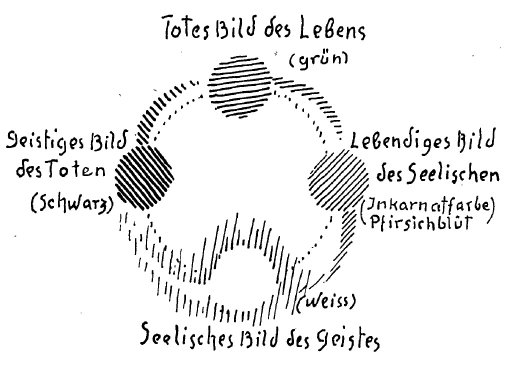
[ 4 ] I have grasped the four colors—green, incarnate red, white, and black—in their artistic manifestation, and in them the self-contained life of the cosmos within the world of color is revealed. When we contemplate these very colors artistically—which here, in a sense, form a closed circle—we can become aware, through our own perception, of our need to always capture these colors within the image, within a closed image.
[ 5 ] Of course, whenever I discuss art, I must always focus not on abstract reason, but on artistic sensibility. Artistic matters must be recognized artistically. Therefore, I cannot use any conceptual argument here to draw your attention to how, with green, peach blossom, white, and black, one feels the need for a complete image. One wants a contour and, within that contour, a complete image. These four colors always contain an element of shadow. White is, in a sense, the lightest shadow, for it is light shaded to white. Black is the darkest shadow. Green and peach blossom are images—that is, surfaces saturated in themselves—which gives the surface a shadow-like quality. Thus, in these four colors, we have image colors or shadow colors. And we want to perceive these colors as image colors and shadow colors.
[ 6 ] It’s quite different when we turn our attention to other colors. If I were to choose three shades of these other colors, they would be red, yellow, and blue. With these colors—red, yellow, and blue—when we return to our unbiased artistic sensibility, we do not feel the need to have them within closed contours; rather, we feel the need for the surface to shine in these colors—for the brilliance of red to radiate toward us from the surface, or for the matte quality of blue to soothe us from the surface, or for the luminosity of yellow to shine out toward us from the surface. And so one can call the four colors—flesh tone, green, black, and white—the picture colors or shadow colors; whereas blue, yellow, and red are the luminous colors that shine forth from the image of the shadow. And once again, as we follow with our perception how the world shines in the three colors—red, yellow, and blue—we find ourselves saying: In the radiance of red, we wish above all to behold the living. Life seeks to reveal itself to us when it comes toward us in red—active red—so that we can call red the radiance of life. If the spirit does not merely wish to reveal itself to us in its abstract sameness as white, but rather to speak to us intensely from within, then it—that is, our soul wishes to receive this—will shine in yellow. Yellow is the radiance of the spirit. If the soul wishes to be truly inner and if this is to find artistic expression in color, then the soul seeks to rise above external appearances and to be self-contained. This gives rise to the gentle radiance of blue. And so the gentle radiance of blue is the radiance of the soul. We come to perceive the three radiant colors in such a way that we experience red as the radiance of the living, blue as the radiance of the soul, and yellow as the radiance of the spiritual.
[ 7 ] You see, then we live in color; then we understand color through our perception, through our feelings, when we experience everywhere how a world is composed of the pictorial colors peach blossom, green, black, and white, and of the luminous colors, which in turn give the pictorial colors the corresponding radiance of revelation: red, yellow, blue. When one immerses oneself in this way in the radiance and pictorial quality of the world of color, one thereby becomes, from within the soul, a painter, for one learns to live with color. One learns, for example, to sense what each individual color is trying to tell us. Blue is the radiance of the soul. When we paint a surface blue, we actually feel satisfied only when we apply the blue in such a way that it is applied more heavily at the edges and becomes lighter toward the center.
[ 8 ] If, on the other hand, we apply the yellow and allow the color itself to speak to us, then we should have the saturated yellow in the center and the unsaturated light yellow at the edges. This is what the color itself demands. In this way, what lives within colors gradually comes to speak. We come to give birth to form out of the colors—that is, to paint intuitively from within the world of color.
[ 9 ] It would never occur to us, when we experience the world as color in this way—when, for example, we want to allow a figure to appear in the image as a radiant white figure, that is, as a figure living in the spirit—to depict it in any color other than yellow, fading outward into a light yellow. It would not occur to us to paint the perceiving soul differently in a picture—even if we can perhaps express this only through its clothing—except by using a blue that fades inward into a soft blue. If you appreciate the Renaissance painters—Raphael, Michelangelo, and even Leonardo—from this perspective, you will find everywhere that they truly lived artistically within the color in this way.
[ 10 ] Above all, there was one thing that still existed—fully present in painting, which has almost entirely faded from view in our time, but also still echoing in Renaissance painting: the inner perspective of the image, which lives in the color. Anyone who truly senses red—the brilliance of red, for example—will always experience how the red seems to emerge from the picture, how the red brings what it depicts closer to us within the picture, while blue carries what it depicts into the distance. And we paint on the surface in red and blue, painting perspectively at the same time: red close, blue far. We paint color perspective, inner perspective. This is the perspective that still lived in the soul-spiritual realm.
[ 11 ] It was only in the materialistic age—a fact that is so rarely acknowledged—that spatial perspective emerged: the perspective that now calculates based on spatial dimensions, that does not bathe distant objects in blue but makes them appear small, and does not make nearby objects glow red but makes them appear large. This perspective is merely an addition of the materialistic age, which lived in the spatial-material realm and also sought to paint within that same spatial-material realm.
[ 12 ] Today we find ourselves once again in an era where we must return to the natural essence of painting, for the painter’s materials also include the surface. First, there is the surface. And the fact that one works on the surface is considered part of the painter’s materials. Above all, however, the artist must have a sense of the material. For example, he must have such a strong sense of the material that he knows: if he wants to carve a three-dimensional form out of wood, then he must, for instance, hollow out the human eyes from the wood. He must, above all, perceive what is concave with his artistic eye and hollow it out. The sculptor working in wood hollows out the wood. The sculptor working in marble or another material—a hard material—does not consider how the eye recesses into the surface. He does not hollow out; rather, he considers how the forehead protrudes from the eye. He builds up. He takes the convex into account. The sculptor working in marble—even when he is preparing his work in plasticine or another material, such as clay—must immerse himself in his material. The sculptor working with marble builds up. The sculptor working with wood hollows out. One must be able to live with one’s material. For an artist, the material must speak a living language,
[ 13 ] This must certainly also be the case with color. And above all, it must be the case with regard to the fact that, as a painter, one uses the surface as one’s medium. One perceives the surface only when one has eliminated the third spatial dimension. One has eliminated it when one perceives the qualitative aspects on the surface as an expression of the third dimension—when one perceives blue as receding and red as protruding—that is, when the third dimension is embodied within the color itself. Then one truly transcends the material, whereas in spatial perspective one merely imitates the material. I am, of course, not speaking against spatial perspective. It was self-evident and natural to the era that emerged around the middle of the 15th century, and it contributed something powerful to the traditional artistic tradition in painting. But the essential point is that, after having gone through a period of artistic materialism—which is also expressed in spatial perspective—we are now able to return to a more spiritual conception of painting as well, so that we can once again return to color perspective.
[ 14 ] You see, one cannot theorize when speaking about art. One must always remain within the realm of art. And what one can draw upon when speaking about art must be sensation. When speaking about mathematics, or mechanics, or physics, one cannot speak from sensation; rather, one must speak from reason. But one cannot in any way view art from the perspective of reason. Admittedly, the aestheticians of the 19th century did just that. An artist in Munich once told me that he and his colleagues, when they were young, went to the office of an aesthetician—even a very famous one at the time—just to try it out, to see if they could learn anything from the theorizing aesthetician. But none of them ever went back a second time, and all they were left with was the term “aesthetic grunts of delight.” As painters, they called him the “aesthetic grunts of delight.” Perhaps one can still discern the artistically ironic dismissal of theory in this expression.
[ 15 ] Well, just as one can depict the living, dynamic interplay of colors, so too can one depict the interplay and life of sounds. But it is precisely here, as I hinted at the day before yesterday, that we enter the inner world of the human being through the world of ions and the musical element. As a person becomes a sculptor or a painter, they step out into space; even if, as a painter, they reduce space to two dimensions, they still depict within it that which lives and reveals itself in space in a colorful, ethereal way. Through music, we enter directly into the innermost being of the human being, and it is of extraordinary significance when we consider music specifically within the course of human development.
[ 16 ] Those among you, esteemed guests and friends, who have often attended my lectures or are familiar with anthroposophical literature, know that in the course of human evolution we go back as far as the times we call the Atlantean epoch of human development, when a completely different race of human beings lived on Earth—one endowed with a primal, instinctive clairvoyance that enabled them to perceive the spiritual behind the physical in a state of waking dreams. In this age, when people still possessed instinctive clairvoyance and instinctively perceived the spiritual behind the physical, this perception was accompanied by a different kind of musical sensibility. When experiencing music, people in ancient times instinctively felt themselves transported out of their bodies. That is why, in ancient times—as paradoxical as it may sound to people today—these people particularly favored seventh chords. They played and sang in sevenths, something that is no longer fully perceived as musical today. But in enjoying the seventh chords, people also felt themselves transported entirely out of the human realm and into the divine.
[ 17 ] This then weakened over time as the transition was made from the experience of the seventh to the scales of the fifth. In the perception of the fifth, in the emphasis on the “fifth-like” in music, there was still a sense that, through music, human beings actually detach the divine within themselves from the physical. But while the human being, through the experience of sevenths, felt completely transported into the spiritual realm, with his perception of fifths he reached precisely the boundary of his physical being. He sensed his spiritual nature at the very edge of his skin—a sensation that human beings today can no longer experience through ordinary consciousness.
[ 18 ] Then, as you will know from the history of music, the “Age of the Third” began—the era of major and minor thirds. This Age of the Third signifies that what is musical, having previously been experienced outside of human beings—as a kind of human detachment—was now fully absorbed into the human being. The third—both the major third and the minor third—and the major and minor keys that result from them, draw the musical into the human being. Therefore, in more recent times, as the Age of the Fifth gives way to the Age of the Third, the phenomenon arises whereby human beings experience the musical entirely inwardly, so to speak, within their own skin.
[ 19 ] We see a parallel transition: on the one hand, spatial perspective, which seeks to extend outward into space in a painterly manner; on the other hand, the key of the third, which penetrates the ethereal-physical body of the human being—thus moving in both directions toward a naturalistic understanding. On the one hand, external naturalism in spatial perspective; on the other, internal human naturalism in the musical perception of the third. Wherever we grasp the true essence of things, we also advance toward an understanding of humanity’s entire relationship to the cosmos. And the next stage of development, even in music, will be a spiritualization, a deepening of the spiritual dimension. It will consist in our coming to know the individual tone in its unique character. The individual tone, which we today incorporate into harmony or melody so that, together with other tones, it may reveal the mystery of music, we will no longer perceive merely in its relationship to other tones—that is, in a sense, in its two-dimensional plane—but we will grasp it in its depth dimension; we will penetrate the individual tone, and then a hint of hidden neighboring tones will always appear within it. We will learn to feel: If we immerse ourselves, if we sink into the tone, then the tone reveals three or five or even more tones, and we penetrate into the spiritual realm with the tone into which we immerse ourselves, as the tone itself expands into melody and harmony. — Some contemporary musicians have made attempts at this penetration into the deeper dimensions of sound, yet today, in people’s musical sensibility, there is only just—one might say—a longing to grasp the sound in its spiritual depth and thereby, in this realm as well, to penetrate ever more deeply from the naturalistic into the spiritual realm of art.
[ 20 ] One becomes particularly aware of the fact that art expresses a special relationship between human beings and the world when one moves from the arts of the external world—architecture, fashion, sculpture, and painting—through the more inward-looking arts, such as music, to the art of poetry. And here, ladies and gentlemen, I must unfortunately express my regret that I am unable to carry out my original intention: that what I have to say about poetry as the culmination of this artistic reflection might be illustrated by a recitation by Dr. Steiner. Unfortunately, she has still not recovered sufficiently from a cold that has lasted for weeks to dare to appear before you today as a reciter or declaimer. Therefore, to my deep regret, this illustration of what I have to say to you must be omitted. However, we simply did not dare to add Dr. Steiner’s voice—which has not yet fully recovered—to the somewhat unartistic croaking that my own cold has forced me to produce during this Norwegian course; for in the realm of art, one can afford to take even fewer risks in allowing speech to degenerate into croaking than in ordinary speech.
[ 21 ] When we venture into the realm of poetry, we truly feel confronted with a great question. Poetry springs from the imagination. For people, the imagination usually represents only the unreal—that which one imagines, that which is not there. But what force is actually expressed through the imagination?
[ 22 ] To understand the power of imagination, let’s take a look at childhood. Children do not yet possess imagination. At most, it has dreams. Free, creative imagination does not yet live within the child. It does not manifest itself openly. But it is not something that suddenly emerges out of nowhere in people at a certain age. Imagination is, in fact, hidden within the child, even though it does not reveal itself, and the child is actually full of imagination. But what, then, does the imagination do in the child? Indeed, to those who can observe human development with an unbiased spiritual eye, it becomes clear how, in early childhood, the brain in particular—but also the rest of the organism—is still undeveloped in comparison to its later form. The child is, inwardly, the most incredible and significant sculptor in the shaping of its own organism. No sculptor is capable of creating worldly forms so wonderfully out of the cosmos as the child does when, in the period between birth and the loss of baby teeth, it sculpts the brain and the rest of the organism. The child is a marvelous sculptor; it is just that this sculptural power works within the organs as an inner force of growth and formation. And the child is also a musical artist, for it tunes its nerve fibers in a musical way. Once again, the power of imagination is a force of growth, a force that harmonizes the organism itself.
[ 23 ] You see, as we gradually approach the age when the characteristic change of teeth takes place—around the seventh year—and subsequently move on to the age of sexual maturity, we no longer need as much plastic-musical power within us—as a force of growth and formation—as we did before. Something remains. The soul can, so to speak, draw something out of this power of growth and formation. What the soul then gradually no longer needs—as the child grows—to supply its own body with the power of growth remains as the power of imagination. The power of imagination is simply the natural power of growth metamorphosed into the soul. If you wish to understand what imagination is, first study the living force at work in the formation of plant structures; study the living force at work in the formation of the organism’s marvelous internal structures, which the “I” brings into being; study everything that is formative in the vast universe, everything that works to shape, form, and grow in the subconscious regions of the cosmos; then you will also have a concept of what remains when a human being has advanced so far in the development of his own organism that he no longer needs the full measure of his power of growth and formation. Then a part rises into the soul and becomes the power of imagination. And only at the very end—the last thing that remains—I cannot call it the dregs, because the dregs are at the bottom, and what remains here rises upward—is the power of the intellect. This is the thoroughly sifted power of imagination, the last thing that remains; I cannot call it the dregs, but rather the “level” that emerges from above: the intellect.
[ 24 ] Reason is imagination that has been sifted through. People do not realize this, which is why they regard reason as a much greater element of reality than imagination is. But imagination is the first offspring of the natural forces of growth and formation themselves. Therefore, imagination does not express anything immediately real, for as long as the force of growth is at work in reality, it cannot become imagination. Only when the real world has been provided for does something remain for the soul as imagination. But inwardly, in terms of quality and essence, imagination is entirely the same as the power of growth. The very force that causes our arm to grow from smallness is the same force that is at work within us poetically in the imagination—and artistically in the imagination in general—in the soul’s transformation. This, however, must not be understood theoretically, but rather intuitively through feeling and will. Then one develops the necessary reverence for the workings of the imagination—and, under certain circumstances, the necessary sense of humor toward these very workings. In short, the stimulus is created for human beings to perceive in the imagination a divine force at work in the world. This divine power at work in the world, which expresses itself through human beings, was felt above all by the people of those ancient times to which I alluded in the previous lecture—when art and knowledge were still one, when, in the ancient mysteries, that which was to be known was still presented through beautiful, that is, artistically conceived, ritual acts, not through the abstractions of the laboratory and the clinic, where the physician did not yet go to the anatomy theater to learn about human beings, but rather went to the mysteries, where the secrets of healthy and diseased human life were revealed to him through the mystery rituals, and through this he also gained inner access to the human being.
[ 25 ] In those days, people felt that the God who wove Himself into them and lived within them—as they grew up, taking shape and developing through art and music from childhood onward—continued to live on in their imagination. That is why, in ancient times—when the deep inner kinship between religion, art, and science was felt—it was clearly understood that one does not desecrate or profane the imagination unless one remains conscious of the fact that, in order to reveal oneself poetically, one must in some way find one’s way to the divine or allow the divine to enter into the human being. If, in the earliest times, dramatic works never depicted the outer human being, it is for this reason—and this, in turn, sounds paradoxical to people today, though the anthroposophical researcher knows this, of course, he must say this even though it sounds paradoxical; he is aware of the objections that can be raised, just as the opponents are, but this paradox must nevertheless be stated—because humanity’s earliest dramatic imagination would have found it absurd to put ordinary people on stage who say all sorts of things to one another and make all sorts of gestures toward one another. Why on earth should one do that?—That is what a Greek of the pre-Sophoclean [era], specifically the time before Aeschylus, would have asked himself. Why indeed? That is already present in life anyway. We need only go out into the streets and into rooms to see how people talk to one another, how people make gestures toward one another. What’s the point of that? We see it all the time. Why should we put that on stage as well?—Even the earliest Greeks would have thought it foolish to put ordinary people, whom one sees going about their daily lives, on stage as well. What they wanted was to capture the god within man. When a person was placed on stage, that person was meant to portray the divine within humanity—namely, the god rising from the depths of the earth who bestows will upon humanity. Our ancient ancestors—even the ancient Greeks—viewed the gift of will, with some justification, as something rising from the earthly realm into human nature. The gods of the depths, who descend into human beings to give them the will—the Dionysian gods—were the ones the people of ancient times wanted to see on stage. In a sense, the human being was merely the vessel of the Dionysian deity. It was indeed the human being who received the god within himself and allowed himself to be inspired by the god who appeared in the earliest dramatic representations of the mystery cults. The human being who received the god was the one who appeared as a dramatic character.
[ 26 ] The human being who elevated himself to the god of the heights—or rather, to the goddess of the heights, since in ancient times male deities were recognized below and female deities in the heights—the one who ascended to the heights to reach the divine, so that it might descend to him, became the epic poet, who did not speak for himself but let the deity speak through him . The human being offered himself as a vessel for the goddesses of the heights, so that through him they might look upon the events of the world—upon what Achilles, Agamemnon, Odysseus, and Ajax had done. The ancient epic poets did not wish to give voice to what people had to say about these matters. What people have to say about the heroes can be heard daily in the marketplace. But what the goddess has to say—when man surrenders himself to her—about the earthly and human realm: that was epic poetry. “Sing to me, O Muse, of the wrath of Achilles, son of Peleus”—thus Homer begins the Iliad. “Sing to me, O Muse”—that is to say, O Goddess—“of the man, the far-traveled Odysseus”—thus Homer begins the Odyssey. This is no mere phrase; it is the deeply heartfelt confession of the true epic poet, who allows the goddess to speak through him, who does not wish to speak for himself, who receives the divine into his imagination—which is the child of the cosmic forces of growth—so that the divine within him may speak of the events of the world. Then, as the times became increasingly naturalistic and materialistic—though, I might add, Klopstock still composed his Messiah with a certain genuine artistic sensibility—he no longer dared, because people no longer looked upon the gods as they had in ancient times, to say, for example: “Sing, O Muse, of the redemption of sinful mankind, which the Messiah accomplishes on earth in his humanity.” — Klopstock no longer dared to say that in the 18th century. And so he said: “Sing, immortal soul, of the redemption of sinful mankind.” But even at the beginning, he still wanted to include something that transcended humanity. This is still a—albeit timid—expression of what was fully valid in ancient times: “Sing, O Muse, of the wrath of Achilles, son of Peleus.”
[ 27 ] The playwright felt as if a god had ascended to him from the depths and he were to be the god’s vessel. The epic poet felt as if the Muse, the goddess, had descended to him and were passing judgment on earthly affairs. That is why the ancient Greeks sought to avoid, as actors—as the embodiments of the dramatic—allowing the individual human aspect to come to the fore directly. They stood on platforms raised beneath their legs and feet. They used something like a light musical instrument through which their “Ion” resounded. For they wanted to elevate what was being portrayed dramatically above the individual, personal human aspect. I am not, however, speaking against naturalism, which was self-evident and natural for a certain era. For in the time when Shakespeare presented his dramatic figures in their superhuman perfection, people had come to seek a human understanding of the human; there was certainly a different impulse at work there, something other than artistic sensibility. But now we must once again find our way back to the spiritual, even in poetry; we must once again find a way to portray characters in whom the human being—who is also a spiritual being alongside the physical one—is able to move within the spiritual events of the world, which pervade the world everywhere.
[ 28 ] I attempted this—a first, tentative attempt—in my Mystery Dramas. People appear there, but they do not say to one another what one might hear when walking through the marketplace or down the street; they say to one another what is experienced between one person and another when higher spiritual impulses are at work between them, when what is at work between them is not merely instincts, drives, or passions alone, but what passes through these ‘drives’ and ‘passions’ as the paths of destiny, the paths of karma, as they play out through centuries and millennia in repeated human lives.
[ 29 ] The point is that we must return to the spiritual in all areas. We must be able to make good use of what naturalism has given us; we must not lose what we have acquired by seeking an artistic ideal—even for centuries—through our imitation of nature. Those who look down on materialism with scorn and derision are just as bad as bad scientists. Materialism had to exist. It is not a matter of sneering at the base, purely earthly, material human being—or at the entire material world. What matters is that we possess the will to truly penetrate this material world spiritually as well. So we must not despise what materialism has brought us scientifically, or what naturalism has brought us artistically. But we must find our way back to the spiritual, not by developing a dry symbolism or a rigid allegorism. Both symbolism and allegorism are unartistic. Only the direct inspiration of artistic feeling from the very source from which the ideas of anthroposophy spring can provide the starting point for a new art. We must become artists—not symbolists or allegorists—by ascending more and more into the spiritual worlds through spiritual insight. This can develop particularly well, however, if we also move beyond mere naturalism in the art of recitation and declamation, returning once again to a kind of spirituality. You see, it must be emphasized again and again that such genuine artists as Schiller, for example, first had an indefinite melody in their souls, or, like Goethe, an indefinite image—a three-dimensional one—before they gave shape to the literal words. Today, in recitation and declamation, the main emphasis is often placed on prosaic emphasis. But the fact that we must make use of prose to express the poetic word is merely a substitute. The prose content is not what matters at all in poetry. What matters in poetry is not what lies in the words themselves, but rather how it is shaped by the true poetic artist. Not even one percent of those who write poetry are true artists; more than ninety-nine percent of the people who write poetry are not artists at all. What matters is what the poet achieves through musicality, through rhythm, through melody, through theme, through imagination, through the shaping of sound—not through the literal meaning of the words. Through the literal meaning, we convey the prose content. With regard to the prose content, the question is first and foremost how we treat it—for example, whether we choose a fast-paced rhythm. If we have a fast-paced rhythm and are expressing something, we can convey joyful excitement. In poetry, it makes no difference at all whether someone says, “The hero was in a state of joyful excitement”—that is prose, even if it appears in poetry. But what is essential in poetry is that one then chooses a rhythm that flows swiftly along. If I say, “The woman was deeply saddened in her soul,” — that is prose, even if it appears in poetry. If I choose a rhythm that flows along in gentle, slow waves, I am expressing that sorrow. It all comes down to the form and the rhythm. Or if I say: “The hero delivered a powerful blow.”—that is prose. If, having previously used the usual pitch, I then take a fuller tone, rising higher—if the poet is naturally inclined to use a fuller “u” sound, a fuller “o” sound, instead of “e” sounds and “i” sounds—then he expresses, through the shaping of language and the treatment of language, precisely what is meant to be expressed. And it is this shaping of language, this handling of language, that is what truly matters in the art of poetry.
[ 30 ] When declaiming and reciting, it is also important to learn how to shape the language, to bring out its melodiousness, its rhythm, and its meter—not merely the prosaic emphases—and also to learn to imaginatively gauge the effect of a dull sound on the preceding bright one, and of a bright sound on the following dull one, thereby expressing the soul’s inner experience through the treatment of sound. The words are merely the framework upon which the art of recitation and declamation is actually meant to develop. This is the art of recitation and declamation that we have sought to cultivate. Dr. Steiner devoted many years to cultivating precisely this art of recitation. It is still little understood today. But when we return to an artistic sensibility on a higher level, then in this field as well—in contrast to today’s prosaic emphasis—we must retain this: no stone should be cast at it, and nothing is to be said against it, we have achieved it through naturalism; we have become human through it—but we must once again become spiritual and intellectual by returning to the art of language through the content of words, through which we can never express the spiritual and intellectual. The poet rightly says: When the soul speaks, alas, the soul no longer speaks. - He means that when the world of the soul begins to shape the words of prose—when the soul speaks in prose—it is no longer the soul. The soul is present as long as it expresses itself—its inner movements, its inner ascents and descents—through meter, rhythm, a melodious theme, and the imagery inherent in the sound structure.
[ 31 ] I always distinguish between “declamation” and “recitation” because they are two different arts. The declaimer has always been more at home in the north. For him, the focus is on creating an effect primarily through the weight of the syllables—high tones, low tones—and finding the proper intonation within that. The reciting artist has always been more at home in the south. In his recitation, he emphasizes the meter—not so much the weight as the meter of the syllables, long and short syllables. The sharply expressive Greek reciters experienced the hexameter and the pentameter, knowing full well that through their recitation they were establishing a relationship between breathing and blood circulation. Breathing proceeds as follows: eighteen breaths per minute; seventy-two heartbeats on average, approximately per minute. Breath and pulse resonate with one another, hence the hexameter: three long syllables, followed by a caesura as the fourth, where one breath spans four heartbeats. This one-to-four ratio, which manifests in the measured, scandent rhythm of the hexameter—the innermost essence of the human being is brought to the surface through recitation, the mystery that exists between breath and blood circulation.
[ 32 ] Of course, this cannot be attained through rational, theoretical means; it must be achieved entirely instinctively, intuitively, and artistically. But one can illustrate such things beautifully, for example, by—as we have often done, and as would have happened today if Dr. Steiner were able to declaim and recite—artistically presenting the two characters in Goethe’s Iphigenia one after the other. Before he came to Italy, Goethe—as a “Nordic artist,” as Schiller later called him—wrote “Iphigenia” in such a way that what he wrote down can only be rendered through the art of declamation—high tones, low tones—where, in a sense, the life of the blood predominates, for that lies in the high and low tones. So Goethe first wrote his “Iphigenia.” When he came to Italy, he rewrote it. One often does not notice it, but if one has a more refined artistic sensibility, one can clearly distinguish between the German “Iphigenia” and the Roman “Iphigenia.” Goethe sought everywhere to incorporate recitative into his Nordic, declamatory “Iphigenia.” And so the Italian “Iphigenia,” the Roman “Iphigenia,” has become such that one must now read it in a recitative manner. If one reads them one after the other, one discovers this wonderful difference between declamation and recitation. In Greece, recitation was at home; there, the breath measured the faster circulation of blood. In the North, declamation was more at home; there, people lived in their innermost being. Blood is a very special fluid, for it is the fluid that contains the innermost essence of humanity. There, the human character lived in the blood, in the personality. There, the poetic artist became the declamatory artist.
[ 33 ] As long as Goethe was familiar only with the Nordic tradition, he was a declamatory artist; he wrote the declamatory German “Iphigenia.” He reshaped it when he was brought back to moderation by the Italian Renaissance art, which he perceived as Greek. I do not wish to develop theories; I merely want to describe to you certain feelings—but those feelings that are precisely stirred within the artistic soul when one becomes an anthroposophist. And in this way, we return once again to a true artistic sensibility toward everything.
[ 34 ] I’d just like to mention one more thing to conclude. How do we actually behave on stage today? When we stand in the back, in the background, or in the rear sections of the stage, we think about how we would act if we were walking down the street and doing the same thing. We behave on stage exactly as we would on the street or in a salon. But that is something that is quite good, if one can do it—if one can bring that personal touch back into it. But this leads away from true stylistic art, which can exist only in grasping the spirit of the stage form and the form of direction. You must bear in mind that on stage you cannot really be naturalistic, because the audience is sitting in front of the stage. Artistic enjoyment is essentially immersed in the unconscious realm of instincts. It makes a world of difference whether I begin to take in something with my left eye and it passes me by—so that it moves from right to left, which for me means from left to right—or whether it moves in the opposite direction. I perceive it quite differently. It conveys something entirely different to me. I must once again learn the inner, spiritual significance of whether a person on stage moves from left to right, or from right to left, or from the back to the front of the stage, or toward the back of the stage. I will develop a sense of how utterly impractical it is, when preparing for a longer speech on stage, to stand right at the front by the prompter’s box from the very beginning. When I prepare for a speech, I say the first words as far back on stage as possible, stride forward across the stage, and make the gesture of addressing the audience as they spread out to the left and right. Every single movement can be grasped mentally from the overall picture, not merely as a naturalistic imitation of what one would do in a living room or on the street. But that means one must once again study artistically what it means to move on stage from back to front, from right to left, from left to right—what every single movement of the actor mentally signifies for the overall picture. People don’t want to study that today. People have become complacent today. Materialism allows for complacency. I’ve always wondered why, when people demanded full naturalism—and there were such artists—they didn’t realize that they would also have to create the fourth wall, because with full naturalism, one would have to create the fourth wall; no room has only three walls—one would have to create the fourth wall. I don’t know how many theater tickets would be sold if the actors were allowed to perform within four walls and the audience were seated in front of them. But in any case, to be completely naturalistic would mean removing even this open side of the fourth wall.
[ 35 ] Well, that sounds paradoxical, but it is through such paradoxes that one must draw attention to what must be reclaimed today as truly artistic, in contrast to mere imitations and the mere principle of imitation. Now that naturalism—for I am truly no philistine and no pedant in this regard, and I can appreciate even that which does not particularly appeal to me, though I can appreciate it—has shown us the magnificent path from naturalistic stage design to film, we must once again find our way back from film to the portrayal of the spiritual, which is, in essence, the portrayal of the genuine and the real. We must rediscover the divine-human in art. But we can only find this if we also, in terms of knowledge—that is, in a way that can be perceived—rediscover the path back to the divine-spiritual.
[ 36 ] In this regard, anthroposophy—as it sought to do through the Goetheanum in Dornach, a work of art that has, unfortunately, been taken from us—wishes to find the path to the spiritual in the field of the visual arts. It also seeks to find this path through the art of eurythmy, as I mentioned the day before yesterday. But it also seeks to follow this path, for example, in the realm of declamation and recitation. Today, the approach is naturalistic; one focuses on the breath and tinkers with the human organism. The truly correct approach is to attune one’s own organism to the spoken sentence—which flows rhythmically—by listening to oneself speak; that is, to practice learning to breathe while learning to speak. These things require a rethinking. But they cannot arise from theoretical, proclamatory, or agitational foundations; rather, they must come solely from a genuine, spiritually practical insight into the true facts of life—and these include not only the material but also, without a doubt, the spiritual aspects.
[ 37 ] Art has always been a daughter of the Divine. If it finds its way back after having become somewhat estranged from the divine, so that it may once again be accepted by the divine as a child, then art will once more be able to become for all of humanity what it not only ought to be, but must be, in civilization and culture as a whole.
[ 38 ] I was able to offer only a few sketchy hints about what anthroposophy aims to achieve for art. But I hope to have shown, precisely through these hints, how anthroposophy seeks to unfold the right element in every context, how it does not wish to theorize on the basis of the artistic—because art is not theory—but rather how it seeks to live fully within the element of artistic feeling, even as it seeks to orient itself toward art. And such an orientation cannot lead merely to talk about art, but rather to genuine artistic enjoyment and artistic creation. This is what matters if art is to experience a renewal inspired by some worldview. Art has always emerged from a worldview. When people say, for example, “Well, we couldn’t understand what we encountered in the Dornach forms”— — one might reply: Can those who have never heard of Christianity understand Raphael’s Sistine Madonna? Art has always emerged from an inner experience of the world. True art will always emerge from an inner experience of the world. Anthroposophy seeks to guide human civilization and human culture toward an honest yet spiritual experience of the world.