

General Human Studies
as the Basis of Education
GA 293
5 September 1919, Stuttgart
Translate the original German text into any language:
Versions Available:
General Human Studies as the Basis of Education, tr. SOL
Vierzehnter Vortrag
Fourteenth Lecture
[ 1 ] Wenn wir den Menschen in der Art betrachten, wie wir das bisher zur Ausbildung einer wirklichen pädagogischen Kunst getan haben, dann fällt uns ja durch das Allerverschiedenste auch die äußere leibliche Dreigliederung des Menschen in die Augen. Wir unterscheiden deutlich alles dasjenige, was mit der Kopfbildung, der Kopfgestaltung des Menschen zusammenhängt, von dem, was mit der Brustbildung und Rumpfbildung überhaupt zusammenhängt, und wiederum von dem, was mit der Gliedmaßenbildung zusammenhängt, wobei wir uns aber allerdings vorzustellen haben, daß die Gliedmaßenbildung viel komplizierter ist, als man sich gewöhnlich vorstellt, weil das, was in den Gliedmaßen veranlagt ist und, wie wir gesehen haben, eigentlich von außen nach innen gebildet ist, sich in das Innere des Menschen fortsetzt, und wir daher beim Menschen zu unterscheiden haben dasjenige, was von innen nach außen gebaut ist und dasjenige, was von außen nach innen gewissermaßen in den menschlichen Leib hineingeschoben ist.
[ 1 ] When we consider human beings in the way we have done so far in order to develop a true art of education, then—amidst all the diversity—the outer, physical threefold structure of the human being also catches our eye. We clearly distinguish everything related to the formation and structure of the human head from what is related to the formation of the chest and torso in general, and in turn from what is related to the formation of the limbs—though we must bear in mind that the formation of the limbs is much more complex than the common mental image suggests, because what is inherent in the limbs—and, as we have seen, is actually formed from the outside in—continues into the interior of the human being; and we must therefore distinguish in the human being between that which is built from the inside out and that which is, so to speak, pushed into the human body from the outside in.
[ 2 ] Wenn wir diese Dreigliederung des menschlichen Leibes ins Auge fassen, dann wird es uns ganz besonders deutlich werden, wie das Haupt, der Kopf des Menschen, ein ganzer Mensch schon ist, ein aus der Tierreihe heraufgehobener ganzer Mensch.
[ 2 ] When we consider this threefold division of the human body, it becomes particularly clear to us how the head of a human being is already a complete human being in itself—a complete human being raised above the animal kingdom.
[ 3 ] Wir haben am Kopfe den eigentlichen Kopf. Wir haben am Kopf den Rumpf: das ist alles dasjenige, was zur Nase gehört. Und wir haben am Kopf den Gliedmaßenteil, der sich in die Leibeshöhle fortsetzt: das ist alles dasjenige, was den Mund umschließt. So daß wir am menschlichen Haupte sehen können, wie da der ganze Mensch leiblich vorhanden ist. Nur ist die Brust des Kopfes schon verkümmert. Sie ist so verkümmert, daß gewissermaßen alles, was zur Nase gehört, nur noch undeutlich erkennen läßt, wie es mit dem Lungenartigen zusammenhängt. Aber es hängt dasjenige, was zur Nase gehört, mit dem Lungenartigen zusammen. Es ist gewissermaßen diese menschliche Nase etwas wie eine metamorphosierte Lunge. Sie gestaltet daher auch den Atmungsprozeß so um, daß sie ihn mehr nach dem Physischen hin ausbildet. Daß Sie die Lunge vielleicht als weniger geistig ansehen als die Nase, das ist ein Irrtum. Die Lunge ist kunstvoller gebaut. Sie ist mehr vom Geistigen, wenigstens vom Seelischen durchdrungen als die Nase, die eigentlich, wenn man die Sache wirklich richtig auffaßt, mit einer großen Unverschämtheit sich nach außen hin in das menschliche Antlitz stellt, während die Lunge ihr Dasein, trotzdem sie seelischer ist als die Nase, viel keuscher verbirgt.
[ 3 ] On the head, we have the actual head. On the head, we have the torso: that is everything that belongs to the nose. And on the head, we have the part of the limbs that extends into the body cavity: that is everything that surrounds the mouth. Thus, we can see in the human head how the entire human being is physically present. However, the chest of the head has already atrophied. It has atrophied to such an extent that, in a sense, everything that belongs to the nose only vaguely reveals how it is connected to the lung-like structure. But what belongs to the nose is indeed connected to the lung-like structure. In a sense, the human nose is something like a metamorphosed lung. It therefore also reshapes the breathing process in such a way that it develops it more in the direction of the physical. To regard the lung as perhaps less spiritual than the nose is a mistake. The lungs are more artfully constructed. They are more permeated by the spiritual—or at least by the soul—than the nose, which, if one truly understands the matter correctly, actually projects itself outward onto the human face with great audacity, whereas the lungs, despite being more soulful than the nose, conceal their existence much more modestly.
[ 4 ] Verwandt mit allem, was dem Stoffwechsel, was der Verdauung und Ernährung angehört und sich aus den Gliedmaßenkräften in den Menschen herein fortsetzt, verwandt mit alledem ist dasjenige, was zum menschlichen Munde gehört, der ja auch seine Verwandtschaft mit der Ernährung und mit alledem, was zu den menschlichen Gliedmaßen gehört, nicht verleugnen kann. So ist das Haupt, der Kopf des Menschen ein ganzer Mensch, bei dem nur das Nichtkopfliche verkümmert ist. Brust und Unterleib sind am Kopfe, aber sie sind am Kopfe verkümmert.
[ 4 ] Related to everything pertaining to metabolism, digestion, and nutrition—and which continues into the human being from the forces of the limbs—is that which pertains to the human mouth, which, after all, cannot deny its connection to nutrition and to everything pertaining to the human limbs. Thus, the head of a human being is a complete human being in whom only the non-head aspects are atrophied. The chest and abdomen are present in the head, but they are atrophied there.
[ 5 ] Wenn wir im Gegensatz dazu den Gliedmaßenmenschen ansehen, so ist der in alledem, was er uns äußerlich darbietet, in seiner äußerlichen gestaltlichen Bildung im wesentlichen die Umgestaltung der beiden Kinnladen des Menschen, der oberen und unteren Kinnlade. Was unten und oben Ihren Mund einschließt, das ist, nur verkümmert, dasjenige, was Ihre Beine und Füße und Ihre Arme und Hände sind. Nur müssen Sie sich die Sache richtig gelagert denken. Sie können nun sagen: Wenn ich mir nun vorstelle, daß meine Arme und Hände seien obere Kinnlade, meine Beine und Füße untere Kinnlade, dann muß ich die Frage aufwerfen: Ja, wohin richtet sich denn dasjenige, was in diesen Kinnladen ausgesprochen ist? Wo beißt es denn? Wo ist denn der Mund? - Und da müssen Sie sich die Antwort erteilen: Da, wo Ihr Oberarm auf Ihrem Leib aufsitzt, und da, wo Ihre Oberbeine, die Oberschenkelknochen an Ihrem Leibe aufsitzen. So daß, wenn Sie sich vorstellen wollen, das sei der menschliche Rumpf (es wird gezeichnet), so müssen Sie sich vorstellen, da draußen irgendwo sei das eigentliche Haupt; es öffne nach der oberen Seite den Mund und es öffne nach der unteren Seite den Mund, so daß Sie sich vorstellen können eine merkwürdige Tendenz dieses unsichtbaren Kopfes, der seine Kiefer nach Ihrer Brust und nach Ihrem Bauche hin öffnet.
[ 5 ] If, by contrast, we look at the “limb-human,” we see that in everything it presents to us externally—in its outward physical form—it is essentially a transformation of the two human jawbones, the upper and lower jaws. What encloses your mouth at the top and bottom is—albeit in a stunted form—what your legs and feet, and your arms and hands, are. You just have to picture it in the right context. You might say: If I create a mental image of my arms and hands as the upper jaw, and my legs and feet as the lower jaw, then I must ask: Yes, where is what is spoken through these jaws directed? Where does it bite? Where is the mouth?—And there you must give yourself the answer: where your upper arm meets your torso, and where your upper legs—the thigh bones—meet your torso. So that, if you want to create a mental image of this as the human torso (it is drawn), you must imagine that somewhere out there is the actual head; it opens its mouth toward the upper side and it opens its mouth toward the lower side, so that you can imagine a strange tendency of this invisible head, which opens its jaws toward your chest and toward your abdomen.
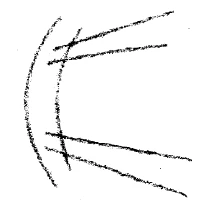
[ 6 ] Was tut denn dieser unsichtbare Kopf? Er frißt Sie ja fortwährend, er sperrt sein Maul gegen Sie auf. Und hier haben Sie in der äußeren Gestalt ein wunderbares Bild des Tatsächlichen. Während der richtige Kopf des Menschen ein leiblich-materieller Kopf ist, ist der Kopf, der zu den Gliedmaßen dazugehört, der geistige Kopf. Aber er wird ein Stückchen materiell, damit er fortwährend den Menschen verzehren kann. Und im Tode, wenn der Mensch stirbt, hat er ihn ganz aufgezehrt. Das ist in der Tat der wunderbare Prozeß, daß unsere Gliedmaßen so gebaut sind, daß sie uns fortwährend aufessen. Wir schlüpfen fortwährend mit unserem Organismus in den aufgesperrten Mund unserer Geistigkeit hinein. Das Geistige verlangt von uns fortwährend das Opfer unserer Hingabe. Und auch in unserer Leibesgestaltung ist dieses Opfer unserer Hingabe ausgedrückt. Wir verstehen die menschliche Gestalt nicht, wenn wir nicht dieses Opfer der Hingabe an den Geist schon ausgedrückt finden in der Beziehung der menschlichen Glieder zu dem übrigen menschlichen Leib. So daß wir sagen können: Kopf- und Gliedmaßennatur des Menschen sind entgegengesetzt, und die Brust- oder Rumpfnatur des Menschen, die in der Mitte liegt, ist in gewisser Beziehung dasjenige, was zwischen diesen beiden Gegensätzen die Waage hält.
[ 6 ] What does this invisible head do? It’s constantly devouring you; it opens its mouth wide against you. And here, in its outward form, you have a marvelous image of reality. While the human being’s actual head is a physical, material head, the head that belongs to the limbs is the spiritual head. But it becomes a little bit material so that it can continually consume the human being. And in death, when the human being dies, it has completely consumed him. This is indeed the marvelous process: our limbs are constructed in such a way that they are constantly consuming us. We continually slip, with our entire organism, into the open mouth of our spirituality. The spiritual realm constantly demands from us the sacrifice of our devotion. And this sacrifice of our devotion is also expressed in the structure of our body. We cannot understand the human form unless we recognize this sacrifice of devotion to the spirit as already expressed in the relationship of the human limbs to the rest of the human body. Thus we can say: the nature of the human head and limbs are opposites, and the nature of the human chest or torso, which lies in the middle, is, in a certain sense, what maintains the balance between these two opposites.
[ 7 ] In der Brust des Menschen ist in der Tat ebensoviel Kopf- wie Gliedmaßennatur. Gliedmaßennatur und Kopfnatur vermischen sich miteinander in der Brustnatur. Die Brust hat nach oben hin fortwährend die Anlage, Kopf zu werden und nach unten hin fortwährend die Anlage, den entgegengestreckten Gliedmaßen, der Außenwelt, sich anzuorganisieren, sich anzupassen, also, mit anderen Worten, Gliedmaßennatur zu werden. Der obere Teil der Brustnatur hat fortwährend die Tendenz, Kopf zu werden, der untere Teil hat fortwährend die Tendenz, Gliedmaßenmensch zu werden. Also der obere Teil des menschlichen Rumpfes will fortwährend Kopf werden, er kann es nur nicht. Der andere Kopf verhindert ihn daran. Daher bringt er nur fortwährend ein Abbild des Kopfes hervor, man möchte sagen, etwas, was ausmacht den Beginn der Kopfbildung. Können wir nicht deutlich erkennen, wie im oberen Teil der Brustbildung der Ansatz gemacht wird zur Kopfbildung? Ja, da ist der Kehlkopf da, der ja aus der naiven Sprache heraus sogar Kehlkopf genannt wird. Der Kehlkopf des Menschen ist ganz und gar ein verkümmertes Haupt des Menschen, ein Kopf, der nicht ganz Kopf werden kann und der daher seine Kopfesnatur auslebt in der menschlichen Sprache. Die menschliche Sprache ist der fortwährend vom Kehlkopf in der Luft unternommene Versuch, Kopf zu werden. Wenn der Kehlkopf versucht, der oberste Teil des Kopfes zu werden, da kommen zum Vorschein diejenigen Laute, welche deutlich zeigen, daß sie am stärksten von der menschlichen Natur zurückgehalten werden. Wenn der menschliche Kehlkopf versucht, Nase zu werden, da kann er nicht Nase werden, weil ihn die wirklich vorhandene Nase daran verhindert. Aber er bringt hervor in der Luft den Versuch, Nase zu werden, in den Nasenlauten. Die vorhandene Nase staut also die Luftnase, die da entstehen will, in den Nasenlauten. Es ist außerordentlich bedeutungsvoll, wie der Mensch, indem er spricht, fortwährend in der Luft den Versuch macht, Stücke von einem Kopf hervorzubringen, und wie sich wiederum diese Stücke von dem Kopf in welligen Bewegungen fortsetzen, die sich dann stauen an dem leiblich ausgebildeten Kopf. Da haben Sie dajenige, was die menschliche Sprache ist.
[ 7 ] In the human chest, there is in fact just as much “head nature” as there is “limb nature.” Limb nature and head nature intermingle within chest nature. The chest has a constant tendency toward the head as it moves upward, and a constant tendency toward the outward-reaching limbs—the external world—as it moves downward, to organize itself, to adapt, that is, in other words, to become limb nature. The upper part of the chest nature constantly tends to become the head, while the lower part constantly tends to become a “limb-human.” Thus, the upper part of the human torso constantly wants to become the head, but it simply cannot. The other head prevents it from doing so. Therefore, it only continually produces an image of the head—one might say, something that marks the beginning of head formation. Can we not clearly see how, in the upper part of chest formation, the groundwork is laid for head formation? Yes, there is the larynx, which, in naive language, is even called the “larynx.” The human larynx is entirely an atrophied human head—a head that cannot fully become a head and which therefore lives out its head-nature in human language. Human language is the larynx’s constant attempt, made in the air, to become a head. When the larynx attempts to become the uppermost part of the head, the sounds that emerge clearly reveal that they are most strongly restrained by human nature. When the human larynx attempts to become a nose, it cannot become a nose because the actual nose prevents it from doing so. But it produces in the air the attempt to become a nose, in the form of nasal sounds. The existing nose thus blocks the “air nose” that seeks to emerge in the nasal sounds. It is extraordinarily significant how, when speaking, a person continually attempts in the air to produce fragments of a head, and how, in turn, these fragments of the head continue in undulating movements that then accumulate at the physically formed head. Therein lies the essence of human language.
[ 8 ] Sie werden sich daher nicht wundern, daß in dem Augenblick, wo der Kopf gewissermaßen leiblich fertig geworden ist, so gegen das siebente Jahr hin, mit dem Zahnwechsel dann schon die Gelegenheit geboten ist, den seelischen Kopf, der aus dem Kehlkopf hervorgetrieben wird, mit einer Art von Knochensystem zu durchsetzen. Es muß nur ein seelisches Knochensystem sein. Das tun wir, indem wir nicht mehr bloß wild durch Nachahmung die Sprache entwickeln, sondern indem wir angehalten werden, die Sprache durch das Grammatikalische zu entwickeln. Haben wir doch, meine lieben Freunde, das Bewußtsein, daß wir, wenn das Kind uns zur Volksschule übergeben wird, seelisch bei ihm eine ähnliche Tätigkeit auszuüben haben wie der Leib ausgeübt hat, indem er die zweiten Zähne in diese Organisation hineingetrieben hat! So machen wir fest, aber nur seelisch fest, die Sprachbildung, indem wir in vernünftiger Weise das Grammatikalische hineinbringen: dasjenige, was aus der Sprache hineinwirkt in Schreiben und Lesen. Wir werden zu dem menschlichen Sprechen das richtige Gemütsverhältnis bekommen, wenn wir wissen, daß die Worte, die der Mensch formt, in der Tat veranlagt sind, Haupt zu werden.
[ 8 ] You will therefore not be surprised that at the moment when the head is, so to speak, physically complete—around the age of seven—the process of losing baby teeth provides the opportunity to interweave the spiritual head, which is being driven forth from the larynx, with a kind of skeletal system. It must be a spiritual skeletal system. We do this not by merely developing language haphazardly through imitation, but by being guided to develop language through grammar. Let us, my dear friends, be aware that when the child is entrusted to us at elementary school, we must carry out a similar process in the child’s soul as the body has done by driving the permanent teeth into this organism! In this way, we establish—but only psychologically—language development by sensibly introducing the grammatical: that which works from language into writing and reading. We will develop the proper emotional attitude toward human speech when we realize that the words a person forms are, in fact, destined to become the foundation.
[ 9 ] Nun, so wie der menschliche Brustteil nach oben die Tendenz hat, Haupt zu werden, so hat er nach unten die Tendenz, Gliedmaßen zu werden. So wie dasjenige, was als Sprache aus dem Kehlkopf hervorgeht, ein verfeinerter Kopf ist, ein noch luftig gebliebener Kopf, so ist alles dasjenige, was nach unten von dem Brustwesen des Menschen ausgeht und sich nach den Gliedmaßen hin organisiert, vergröberte Gliedmaßennatur. Verdichtete, vergröberte Gliedmaßennatur ist dasjenige, was die Außenwelt gewissermaßen in den Menschen schiebt. Und wenn einmal die Naturwissenschaft dazu kommen wird, das Geheimnis zu ergründen, wie Hände und Füße, Arme und Beine vergröbert und mehr nach innen geschoben sind in den Menschen, als sie nach außen hervortreten, dann wird diese Naturwissenschaft das Rätsel der Sexualität erkundet haben. Und dann wird der Mensch erst den richtigen Ton finden, über so etwas zu sprechen. Es ist daher gar nicht zu verwundern, daß all das Gerede, das heute getrieben wird über die Art, wie sexuelle Aufklärung gepflogen werden soll, ziemlich wesenlos ist. Denn man kann nicht gut dasjenige erklären, was man selber nicht versteht. Was die Wissenschaft der Gegenwart ganz und gar nicht versteht, das ist dasjenige, was nur angedeutet wird, wenn man so den Gliedmaßenmenschen im Zusammenhang mit dem Rumpfmenschen charakterisiert, wie ich es eben getan habe. Aber man muß dann wissen, daß eben so, wie man gewissermaßen in den ersten Volksschuljahren dasjenige in das Seelische hineingeschoben hat, was sich in die Zahnnatur hineindrängt vor dem siebenten Lebensjahre, so hat man in den letzten Jahren der Volksschule alles dasjenige, was aus der Gliedmaßennatur stammt und was erst nach der Geschlechtsreife voll zum Ausdruck kommt, hineingeschoben in das kindliche Seelenleben.
[ 9 ] Now, just as the upper part of the human chest tends to become the head, so does it tend, toward the lower part, to become limbs. Just as what emerges from the larynx as speech is a refined head—a head that has remained airy—so everything that emanates downward from the human chest and organizes itself toward the limbs is a coarsened limb nature. Condensed, coarsened limb nature is what the external world, so to speak, pushes into the human being. And once natural science comes to fathom the mystery of how hands and feet, arms and legs are coarsened and pushed more inward in human beings than they protrude outward, then natural science will have explored the enigma of sexuality. And only then will human beings find the right tone to speak about such things. It is therefore hardly surprising that all the talk going on today about how sex education should be conducted is rather meaningless. For one cannot properly explain what one does not understand oneself. What contemporary science fails to understand entirely is precisely what is only hinted at when one characterizes the “limb-human” in relation to the “torso-human,” as I have just done. But one must then realize that just as, in a sense, what manifests in the nature of the teeth before the age of seven was pushed into the soul during the early years of elementary school, so, in the final years of elementary school, everything that originates in the nature of the limbs—and which only comes to full expression after puberty—has been incorporated into the child’s soul life.
[ 10 ] Und so wie sich anzeigt in der Fähigkeit, Schreiben und Lesen zu lernen in den ersten Schuljahren, das seelische Zahnen, so kündigt sich an in alledem, was Phantasietätigkeit ist und was von innerer Wärme durchzogen ist, alles dasjenige, was die Seele entwickelt am Ende der Volksschuljahre vom zwölften, dreizehnten, vierzehnten und fünfzehnten Lebensjahre an. Da tritt ganz besonders hervor alles dasjenige, was an seelischen Fähigkeiten darauf angewiesen ist, von innerer seelischer Liebe durchströmt zu werden, das heißt also dasjenige, was als Phantasiekraft sich zum Ausdruck bringt. Die Kraft der Phantasie, an sie müssen wir appellieren insbesondere in den letzten Jahren des Volksschulunterrichts. Wir dürfen dem Kinde viel mehr zumuten, wenn es durch das siebente Jahr in die Volksschule eintritt, an Schreiben und Lesen die Intellektualität zu entwickeln, als wir unterlassen dürfen, in die herankommende Urteilskraft — denn die Urteilskraft kommt dann langsam heran vom zwölften Jahr ab — die Phantasie fortwährend hineinzubringen. Die Phantasie des Kindes anregend, so müssen wir an das Kind heranbringen alles dasjenige, was es in diesen Jahren lernen muß; so müssen wir an das Kind alles heranbringen, was zum geschichtlichen, zum geographischen Unterricht gehört.
[ 10 ] Just as the “spiritual teething” is evident in the ability to learn to read and write during the first years of school, so too is everything that the soul develops at the end of elementary school—from the twelfth, thirteenth, fourteenth, and fifteenth years of life onward—foretold in all that constitutes imaginative activity and is permeated by inner warmth. What stands out most clearly here is everything in the soul’s capacities that depends on being permeated by inner, soulful love—that is, what expresses itself as the power of imagination. The power of imagination—this is what we must appeal to, especially in the final years of elementary school. We may expect much more from a child entering elementary school at age seven in terms of developing intellectual skills through reading and writing than we can afford to neglect to continually infuse imagination into the emerging power of judgment—for the power of judgment begins to develop gradually from the age of twelve onward. By stimulating the child’s imagination, we must introduce the child to everything they need to learn during these years; we must introduce the child to everything that is part of history and geography lessons.
[ 11 ] Und auch dann appellieren wir ja eigentlich an die Phantasie, wenn wir zum Beispiel dem Kinde beibringen: Sieh, du hast gesehen die Linse, die Sammellinse, welche das Licht ansammelt; solch eine Linse hast du in deinem Auge. Du kennst die Dunkelkammer, in der äußere Gegenstände abgebildet werden; solch eine Dunkelkammer ist dein Auge. -— Auch da, wenn wir zeigen, wie hineingebaut ist die äußere Welt durch die Sinnesorgane in den menschlichen Organismus, auch da appellieren wir eigentlich an die Phantasie des Kindes. Denn dasjenige, was da hineingebaut ist, es wird ja nur in seiner äußeren Totheit gesehen, wenn wir es aus dem Körper herausnehmen; das können wir ja am lebenden Körper nicht sehen.
[ 11 ] And even then, we are actually appealing to the imagination when, for example, we teach a child: “Look, you’ve seen the lens, the converging lens, which gathers light; you have a lens just like that in your eye.” You know the camera obscura, in which external objects are projected; your eye is just like that.” — Even there, when we show how the external world is integrated into the human organism through the sense organs, even there we are actually appealing to the child’s imagination. For what is integrated there is seen only in its external lifelessness when we remove it from the body; we cannot see that in the living body.
[ 12 ] Ebenso muß der ganze Unterricht, der dann erteilt wird in bezug auf Geometrie, sogar in bezug auf Arithmetik, nicht unterlassen, an die Phantasie zu appellieren. Wir appellieren an die Phantasie, wenn wir uns immer bemühen, so wie wir es versucht haben im praktisch-didaktischen Teil, dem Kinde Flächen nicht nur für den Verstand begreiflich zu machen, sondern die Flächennatur wirklich so begreiflich zu machen, daß das Kind seine Phantasie anwenden muß selbst in der Geometrie und Arithmetik. Deshalb sagte ich gestern, ich wunderte mich, daß niemand darauf gekommen ist, den pythagoreischen Lehrsatz auch so zu erklären, daß er gesagt hätte: Nehmen wir an, da wären drei Kinder. Das eine Kind hat so viel Staub zu blasen, daß das eine der Quadrate mit Staub überdeckt ist; das zweite Kind hat so viel Staub zu blasen, daß das zweite Quadrat mit Staub bedeckt ist und das dritte so viel, daß das kleine Quadrat mit Staub überdeckt ist. Da würde man dann der Phantasie des Kindes nachhelfen, indem man ihm zeigte: die große Fläche, die muß mit so viel Staub bepustet werden, daß der Staub, der zu der kleinsten Fläche und der, der zur größeren Fläche gehört, ganz gleich ist dem Staub, der in der ersten Fläche ist. Da würde dann, wenn auch nicht mit mathematischer Genauigkeit, aber mit phantasievoller Gestaltung, das Kind seine Auffassekraft in den ausgepusteten Staub hineinbringen. Es würde die Fläche verfolgen mit seiner Phantasie. Es würde den pythagoreischen Lehrsatz durch den fliegenden und sich setzenden Staub, der auch noch quadratförmig gepustet werden müßte — das kann natürlich nicht in Wirklichkeit geschehen, die Phantasie muß angestrengt werden -, es würde das Kind mit der Phantasie den pythagoreischen Lehrsatz begreifen.
[ 12 ] Likewise, all instruction given in geometry—and even in arithmetic—must not fail to appeal to the imagination. We appeal to the imagination when we always strive—as we have attempted to do in the practical-didactic section—not only to make surfaces comprehensible to the child intellectually, but to make the nature of surfaces truly comprehensible in such a way that the child must use his or her imagination even in geometry and arithmetic. That is why I said yesterday that I was surprised that no one had thought to explain the Pythagorean theorem in this way: “Let’s suppose there are three children.” One child has to blow so much dust that one of the squares is covered with dust; the second child has to blow so much dust that the second square is covered with dust; and the third has to blow so much that the small square is covered with dust. One would then help the child’s imagination along by showing them: the large area must be blown with so much dust that the dust belonging to the smallest area and that belonging to the larger area is exactly the same as the dust in the first area. Then, even if not with mathematical precision, but through imaginative visualization, the child would apply their conceptual understanding to the blown-out dust. They would follow the area with their imagination. Through the dust as it flies and settles—which would also have to be blown into a square shape (though this, of course, cannot happen in reality; the imagination must be engaged)—the child would grasp the Pythagorean theorem through the power of imagination.
[ 13 ] So muß man fortwährend darauf Rücksicht nehmen, daß insbesondere in diesen Jahren noch anregend ausgebildet werden muß, was, die Phantasie gebärend, von dem Lehrer auf den Schüler übergeht. Der Lehrer muß in sich selber lebendig erhalten den Unterrichtsstoff, muß ihn mit Phantasie durchdringen. Das kann man nicht anders, als indem man ihn durchdringt mit gefühlsmäßigem Willen. Das wirkt manchmal noch in späteren Jahren ganz merkwürdig. Was gesteigert werden muß in den letzten Volksschulzeiten, was ganz besonders wichtig ist, das ist das Zusammenleben, das ganz zusammenstimmende Leben zwischen dem Lehrer und den Schülern. Daher wird keiner ein guter Volksschullehrer werden, der nicht sich immer wiederum bemüht, phantasievoll seinen ganzen Lehrstoff zu gestalten, immer neu und neu seinen Lehrstoff zu gestalten. Denn in der Tat, es ist so: wenn man dasjenige, was man einmal phantasievoll gestaltet hat, nach Jahren genau so wiedergibt, dann ist es verstandesmäßig eingefroren. Die Phantasie muß notwendig fortwährend lebendig erhalten werden, sonst frieren ihre Produkte verstandesmäßig ein.
[ 13 ] Thus, one must constantly bear in mind that, especially during these years, it is still necessary to foster in a stimulating way that which, giving birth to the imagination, passes from the teacher to the student. The teacher must keep the subject matter alive within himself and infuse it with imagination. This can only be achieved by imbuing it with emotional will. This sometimes has a remarkable effect even in later years. What must be emphasized in the final years of elementary school—and what is particularly important—is the sense of community, the harmonious relationship between the teacher and the students. Therefore, no one will become a good elementary school teacher unless they constantly strive to present their entire curriculum imaginatively, shaping it anew time and again. For in fact, it is true: if one reproduces exactly, years later, what one once presented imaginatively, then it becomes intellectually frozen. The imagination must necessarily be kept alive at all times; otherwise, its products become intellectually frozen.
[ 14 ] Das aber wirft ein Licht auf die Art, wie der Lehrer selber sein muß. Er darf in keinem Momente seines Lebens versauern. Und zwei Begriffe gibt es, die nie zusammenpassen, wenn das Leben gedeihen soll, das ist Lehrerberuf und Pedanterie. Wenn jemals im Leben zusammenkommen würden Lehrerberuf und Pedanterie, so gäbe diese Ehe ein größeres Unheil, als sonst irgendwie im Leben entstehen könnte. Ich glaube nicht, meine lieben Freunde, daß man das Absurde anzunehmen hat, daß jemals im Leben sich vereinigt haben Lehrerberuf und Pedanterie!
[ 14 ] But this sheds light on the kind of person a teacher must be. He must never become embittered at any moment in his life. And there are two concepts that never go together if life is to flourish: the teaching profession and pedantry. If the teaching profession and pedantry were ever to come together in life, this union would cause greater calamity than anything else that could possibly arise in life. I do not believe, my dear friends, that we must accept the absurd notion that the teaching profession and pedantry have ever been united in life!
[ 15 ] Sie sehen daraus auch, daß es eine gewisse innere Moralität des Unterrichtens gibt, eine innere Verpflichtung des Unterrichtens. Ein wahrer kategorischer Imperativ für den Lehrer! Und dieser kategorische Imperativ für den Lehrer ist der: Halte deine Phantasie lebendig. Und wenn du fühlst, daß du pedantisch wirst, dann sage: Pedanterie mag für die anderen Menschen ein Übel sein — für mich ist es eine Schlechtigkeit, eine Unmoral! — Das muß Gesinnung für den Lehrer werden. Wenn es nicht Gesinnung für den Lehrer wird, dann, meine lieben Freunde, dann müßte eben der Lehrer daran denken, dasjenige, was er für den Lehrerberuf sich erworben hat, für einen anderen Beruf im Leben nach und nach anwenden zu lernen. Natürlich können diese Dinge im Leben nicht dem vollen Ideal gemäß durchgeführt werden, aber man muß das Ideal doch kennen.
[ 15 ] You can also see from this that there is a certain inner morality to teaching, an inner obligation inherent in teaching. A true categorical imperative for the teacher! And this categorical imperative for the teacher is this: Keep your imagination alive. And when you feel yourself becoming pedantic, then say: Pedantry may be a nuisance to other people—but for me, it is wickedness, it is immorality!—This must become the teacher’s mindset. If it does not become a mindset for the teacher, then, my dear friends, the teacher would simply have to consider gradually learning to apply what he has acquired for the teaching profession to another profession in life. Of course, these things in life cannot be carried out in full accordance with the ideal, but one must still know the ideal.
[ 16 ] Sie werden aber nicht den richtigen Enthusiasmus für diese pädagogische Moral gewinnen, wenn Sie sich nicht durchdringen lassen wiederum von Fundamentalem: von der Erkenntnis, wie schon der Kopf selber ein ganzer Mensch ist, dessen Gliedmaßen und Brust nur verkümmert sind; wie jedes Glied des Menschen ein ganzer Mensch ist, nur daß beim Gliedmaßenmenschen der Kopf ganz verkümmert ist und im Brustmenschen Kopf und Gliedmaßen sich das Gleichgewicht halten. Wenn Sie dieses Fundamentale anwenden, dann bekommen Sie aus diesem Fundamentalen heraus jene innere Kraft, die Ihnen durchdringen kann Ihre pädagogische Moral mit dem nötigen Enthusiasmus.
[ 16 ] However, you will not develop the proper enthusiasm for this pedagogical morality unless you allow yourself to be permeated once again by a fundamental principle: the realization that the head itself is already a complete human being, whose limbs and chest are merely stunted; how every part of a human being is a complete human being in itself, except that in the “limb-human,” the head is completely atrophied, and in the “chest-human,” the head and limbs maintain a balance. If you apply this fundamental principle, then from it you will draw the inner strength that can imbue your educational ethics with the necessary enthusiasm.
[ 17 ] Dasjenige, was der Mensch als Intellektualität ausbildet, das hat einen starken Hang, träge, faul zu werden. Und es wird am faulsten, wenn der Mensch es nur immer fort und fort speist mit materialistischen Vorstellungen. Es wird aber beflügelt, wenn der Mensch es speist mit aus dem Geiste gewonnenen Vorstellungen. Die bekommen wir aber nur in unsere Seele hinein auf dem Umweg durch die Phantasie.
[ 17 ] What human beings develop as intellectuality has a strong tendency to become sluggish and lazy. And it becomes most lazy when human beings feed it nothing but materialistic mental images over and over again. But it is inspired when human beings feed it with mental images drawn from the spirit. We can only bring these into our soul by taking the detour through the imagination.
[ 18 ] Was hat die zweite Hälfte des 19. Jahrhunderts gewettert gegen das Hereindringen der Phantasie in das Unterrichtswesen! Wir haben in der ersten Hälfte des 19. Jahrhunderts solche leuchtende Gestalten wie zum Beispiel Schelling; Menschen, die auch in Pädagogik gesunder gedacht haben. Lesen Sie die schöne, anregende Ausführung Schellings «Über die Methode des akademischen Studiums» — was allerdings nicht für die Volksschule, was für die höhere Schule ist -, worin aber der Geist der Pädagogik von der ersten Hälfte des 19. Jahrhunderts lebt. Er ist dann im Grunde genommen in einer etwas maskierten Form in der zweiten Hälfte des 19. Jahrhunderts begeifert worden, wo man alles dasjenige verschimpfte, was irgendwie auf dem Umweg durch die Phantasie in die menschliche Seele einziehen will, weil man feige geworden war in bezug auf das seelische Leben, weil man glaubte, in dem Augenblick, wo man sich irgendwie der Phantasie hingibt, werde man gleich der Unwahrheit in die Arme fallen. Man hatte nicht den Mut, selbständig zu sein, frei zu sein im Denken und dennoch der Wahrheit sich zu vermählen statt der Unwahrheit. Man fürchtete, sich frei zu bewegen im Denken, weil man glaubte, dann würde man gleich die Unwahrheit in seine Seele aufnehmen. So muß der Lehrer zu dem, was ich eben gesagt habe, zu dem phantasievollen Durchdringen seines Unterrichtsstoffes, hinzufügen Mut zur Wahrheit. Ohne diesen Mut zur Wahrheit kommt er mit seinem Willen im Unterrichte, insbesondere bei den größer gewordenen Kindern, nicht aus. Das, meine lieben Freunde, was sich als Mut zur Wahrheit entwickelt, muß aber auch gepaart sein auf der anderen Seite mit einem starken Verantwortlichkeitsgefühl gegenüber der Wahrheit.
[ 18 ] How vehemently the second half of the 19th century railed against the intrusion of imagination into the educational system! In the first half of the 19th century, we had such brilliant figures as Schelling, for example—people who also had a sounder approach to pedagogy. Read Schelling’s beautiful, inspiring treatise “On the Method of Academic Study”—which, admittedly, is intended for secondary schools rather than elementary schools—but in which the spirit of 19th-century pedagogy from the first half of the century is very much alive. Essentially, this spirit was then embraced in a somewhat veiled form during the second half of the 19th century, a time when people denounced anything that sought to enter the human soul via the detour of the imagination, because they had become cowardly with regard to spiritual life, because people believed that the moment they surrendered themselves in any way to the imagination, they would immediately fall into the arms of untruth. They lacked the courage to be independent, to be free in their thinking, and yet to unite themselves with truth rather than with untruth. One feared to think freely, believing that doing so would immediately allow falsehood to enter one’s soul. Thus, the teacher must add courage for the truth to what I have just said—to the imaginative penetration of the subject matter. Without this courage for the truth, the teacher cannot succeed in his or her efforts in the classroom, especially with older children. That, my dear friends, which develops as courage for the truth must also be paired, on the other hand, with a strong sense of responsibility toward the truth.
[ 19 ] Phantasiebedürfnis, Wahrheitssinn, Verantwortlichkeitsgefühl, das sind die drei Kräfte, die die Nerven der Pädagogik sind. Und wer Pädagogik in sich aufnehmen will, der schreibe sich vor diese Pädagogik als Motto:
[ 19 ] The need for imagination, a sense of truth, and a sense of responsibility—these are the three forces that form the backbone of pedagogy. And anyone who wishes to embrace pedagogy should adopt the following as their motto:
Durchdringe dich mit Phantasiefähigkeit,
habe den Mut zur Wahrheit,
schärfe dein Gefühl für seelische Verantwortlichkeit.
Immerse yourself in imagination,
have the courage to face the truth,
sharpen your sense of spiritual responsibility.