

General Human Studies
as the Basis of Education
GA 293
5 September 1919, Stuttgart
Translated by Steiner Online Library
Fourteenth Lecture
[ 1 ] When we consider human beings in the way we have done so far in order to develop a true art of education, then—amidst all the diversity—the outer, physical threefold structure of the human being also catches our eye. We clearly distinguish everything related to the formation and structure of the human head from what is related to the formation of the chest and torso in general, and in turn from what is related to the formation of the limbs—though we must bear in mind that the formation of the limbs is much more complex than the common mental image suggests, because what is inherent in the limbs—and, as we have seen, is actually formed from the outside in—continues into the interior of the human being; and we must therefore distinguish in the human being between that which is built from the inside out and that which is, so to speak, pushed into the human body from the outside in.
[ 2 ] When we consider this threefold division of the human body, it becomes particularly clear to us how the head of a human being is already a complete human being in itself—a complete human being raised above the animal kingdom.
[ 3 ] On the head, we have the actual head. On the head, we have the torso: that is everything that belongs to the nose. And on the head, we have the part of the limbs that extends into the body cavity: that is everything that surrounds the mouth. Thus, we can see in the human head how the entire human being is physically present. However, the chest of the head has already atrophied. It has atrophied to such an extent that, in a sense, everything that belongs to the nose only vaguely reveals how it is connected to the lung-like structure. But what belongs to the nose is indeed connected to the lung-like structure. In a sense, the human nose is something like a metamorphosed lung. It therefore also reshapes the breathing process in such a way that it develops it more in the direction of the physical. To regard the lung as perhaps less spiritual than the nose is a mistake. The lungs are more artfully constructed. They are more permeated by the spiritual—or at least by the soul—than the nose, which, if one truly understands the matter correctly, actually projects itself outward onto the human face with great audacity, whereas the lungs, despite being more soulful than the nose, conceal their existence much more modestly.
[ 4 ] Related to everything pertaining to metabolism, digestion, and nutrition—and which continues into the human being from the forces of the limbs—is that which pertains to the human mouth, which, after all, cannot deny its connection to nutrition and to everything pertaining to the human limbs. Thus, the head of a human being is a complete human being in whom only the non-head aspects are atrophied. The chest and abdomen are present in the head, but they are atrophied there.
[ 5 ] If, by contrast, we look at the “limb-human,” we see that in everything it presents to us externally—in its outward physical form—it is essentially a transformation of the two human jawbones, the upper and lower jaws. What encloses your mouth at the top and bottom is—albeit in a stunted form—what your legs and feet, and your arms and hands, are. You just have to picture it in the right context. You might say: If I create a mental image of my arms and hands as the upper jaw, and my legs and feet as the lower jaw, then I must ask: Yes, where is what is spoken through these jaws directed? Where does it bite? Where is the mouth?—And there you must give yourself the answer: where your upper arm meets your torso, and where your upper legs—the thigh bones—meet your torso. So that, if you want to create a mental image of this as the human torso (it is drawn), you must imagine that somewhere out there is the actual head; it opens its mouth toward the upper side and it opens its mouth toward the lower side, so that you can imagine a strange tendency of this invisible head, which opens its jaws toward your chest and toward your abdomen.
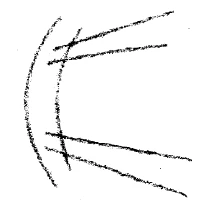
[ 6 ] What does this invisible head do? It’s constantly devouring you; it opens its mouth wide against you. And here, in its outward form, you have a marvelous image of reality. While the human being’s actual head is a physical, material head, the head that belongs to the limbs is the spiritual head. But it becomes a little bit material so that it can continually consume the human being. And in death, when the human being dies, it has completely consumed him. This is indeed the marvelous process: our limbs are constructed in such a way that they are constantly consuming us. We continually slip, with our entire organism, into the open mouth of our spirituality. The spiritual realm constantly demands from us the sacrifice of our devotion. And this sacrifice of our devotion is also expressed in the structure of our body. We cannot understand the human form unless we recognize this sacrifice of devotion to the spirit as already expressed in the relationship of the human limbs to the rest of the human body. Thus we can say: the nature of the human head and limbs are opposites, and the nature of the human chest or torso, which lies in the middle, is, in a certain sense, what maintains the balance between these two opposites.
[ 7 ] In the human chest, there is in fact just as much “head nature” as there is “limb nature.” Limb nature and head nature intermingle within chest nature. The chest has a constant tendency toward the head as it moves upward, and a constant tendency toward the outward-reaching limbs—the external world—as it moves downward, to organize itself, to adapt, that is, in other words, to become limb nature. The upper part of the chest nature constantly tends to become the head, while the lower part constantly tends to become a “limb-human.” Thus, the upper part of the human torso constantly wants to become the head, but it simply cannot. The other head prevents it from doing so. Therefore, it only continually produces an image of the head—one might say, something that marks the beginning of head formation. Can we not clearly see how, in the upper part of chest formation, the groundwork is laid for head formation? Yes, there is the larynx, which, in naive language, is even called the “larynx.” The human larynx is entirely an atrophied human head—a head that cannot fully become a head and which therefore lives out its head-nature in human language. Human language is the larynx’s constant attempt, made in the air, to become a head. When the larynx attempts to become the uppermost part of the head, the sounds that emerge clearly reveal that they are most strongly restrained by human nature. When the human larynx attempts to become a nose, it cannot become a nose because the actual nose prevents it from doing so. But it produces in the air the attempt to become a nose, in the form of nasal sounds. The existing nose thus blocks the “air nose” that seeks to emerge in the nasal sounds. It is extraordinarily significant how, when speaking, a person continually attempts in the air to produce fragments of a head, and how, in turn, these fragments of the head continue in undulating movements that then accumulate at the physically formed head. Therein lies the essence of human language.
[ 8 ] You will therefore not be surprised that at the moment when the head is, so to speak, physically complete—around the age of seven—the process of losing baby teeth provides the opportunity to interweave the spiritual head, which is being driven forth from the larynx, with a kind of skeletal system. It must be a spiritual skeletal system. We do this not by merely developing language haphazardly through imitation, but by being guided to develop language through grammar. Let us, my dear friends, be aware that when the child is entrusted to us at elementary school, we must carry out a similar process in the child’s soul as the body has done by driving the permanent teeth into this organism! In this way, we establish—but only psychologically—language development by sensibly introducing the grammatical: that which works from language into writing and reading. We will develop the proper emotional attitude toward human speech when we realize that the words a person forms are, in fact, destined to become the foundation.
[ 9 ] Now, just as the upper part of the human chest tends to become the head, so does it tend, toward the lower part, to become limbs. Just as what emerges from the larynx as speech is a refined head—a head that has remained airy—so everything that emanates downward from the human chest and organizes itself toward the limbs is a coarsened limb nature. Condensed, coarsened limb nature is what the external world, so to speak, pushes into the human being. And once natural science comes to fathom the mystery of how hands and feet, arms and legs are coarsened and pushed more inward in human beings than they protrude outward, then natural science will have explored the enigma of sexuality. And only then will human beings find the right tone to speak about such things. It is therefore hardly surprising that all the talk going on today about how sex education should be conducted is rather meaningless. For one cannot properly explain what one does not understand oneself. What contemporary science fails to understand entirely is precisely what is only hinted at when one characterizes the “limb-human” in relation to the “torso-human,” as I have just done. But one must then realize that just as, in a sense, what manifests in the nature of the teeth before the age of seven was pushed into the soul during the early years of elementary school, so, in the final years of elementary school, everything that originates in the nature of the limbs—and which only comes to full expression after puberty—has been incorporated into the child’s soul life.
[ 10 ] Just as the “spiritual teething” is evident in the ability to learn to read and write during the first years of school, so too is everything that the soul develops at the end of elementary school—from the twelfth, thirteenth, fourteenth, and fifteenth years of life onward—foretold in all that constitutes imaginative activity and is permeated by inner warmth. What stands out most clearly here is everything in the soul’s capacities that depends on being permeated by inner, soulful love—that is, what expresses itself as the power of imagination. The power of imagination—this is what we must appeal to, especially in the final years of elementary school. We may expect much more from a child entering elementary school at age seven in terms of developing intellectual skills through reading and writing than we can afford to neglect to continually infuse imagination into the emerging power of judgment—for the power of judgment begins to develop gradually from the age of twelve onward. By stimulating the child’s imagination, we must introduce the child to everything they need to learn during these years; we must introduce the child to everything that is part of history and geography lessons.
[ 11 ] And even then, we are actually appealing to the imagination when, for example, we teach a child: “Look, you’ve seen the lens, the converging lens, which gathers light; you have a lens just like that in your eye.” You know the camera obscura, in which external objects are projected; your eye is just like that.” — Even there, when we show how the external world is integrated into the human organism through the sense organs, even there we are actually appealing to the child’s imagination. For what is integrated there is seen only in its external lifelessness when we remove it from the body; we cannot see that in the living body.
[ 12 ] Likewise, all instruction given in geometry—and even in arithmetic—must not fail to appeal to the imagination. We appeal to the imagination when we always strive—as we have attempted to do in the practical-didactic section—not only to make surfaces comprehensible to the child intellectually, but to make the nature of surfaces truly comprehensible in such a way that the child must use his or her imagination even in geometry and arithmetic. That is why I said yesterday that I was surprised that no one had thought to explain the Pythagorean theorem in this way: “Let’s suppose there are three children.” One child has to blow so much dust that one of the squares is covered with dust; the second child has to blow so much dust that the second square is covered with dust; and the third has to blow so much that the small square is covered with dust. One would then help the child’s imagination along by showing them: the large area must be blown with so much dust that the dust belonging to the smallest area and that belonging to the larger area is exactly the same as the dust in the first area. Then, even if not with mathematical precision, but through imaginative visualization, the child would apply their conceptual understanding to the blown-out dust. They would follow the area with their imagination. Through the dust as it flies and settles—which would also have to be blown into a square shape (though this, of course, cannot happen in reality; the imagination must be engaged)—the child would grasp the Pythagorean theorem through the power of imagination.
[ 13 ] Thus, one must constantly bear in mind that, especially during these years, it is still necessary to foster in a stimulating way that which, giving birth to the imagination, passes from the teacher to the student. The teacher must keep the subject matter alive within himself and infuse it with imagination. This can only be achieved by imbuing it with emotional will. This sometimes has a remarkable effect even in later years. What must be emphasized in the final years of elementary school—and what is particularly important—is the sense of community, the harmonious relationship between the teacher and the students. Therefore, no one will become a good elementary school teacher unless they constantly strive to present their entire curriculum imaginatively, shaping it anew time and again. For in fact, it is true: if one reproduces exactly, years later, what one once presented imaginatively, then it becomes intellectually frozen. The imagination must necessarily be kept alive at all times; otherwise, its products become intellectually frozen.
[ 14 ] But this sheds light on the kind of person a teacher must be. He must never become embittered at any moment in his life. And there are two concepts that never go together if life is to flourish: the teaching profession and pedantry. If the teaching profession and pedantry were ever to come together in life, this union would cause greater calamity than anything else that could possibly arise in life. I do not believe, my dear friends, that we must accept the absurd notion that the teaching profession and pedantry have ever been united in life!
[ 15 ] You can also see from this that there is a certain inner morality to teaching, an inner obligation inherent in teaching. A true categorical imperative for the teacher! And this categorical imperative for the teacher is this: Keep your imagination alive. And when you feel yourself becoming pedantic, then say: Pedantry may be a nuisance to other people—but for me, it is wickedness, it is immorality!—This must become the teacher’s mindset. If it does not become a mindset for the teacher, then, my dear friends, the teacher would simply have to consider gradually learning to apply what he has acquired for the teaching profession to another profession in life. Of course, these things in life cannot be carried out in full accordance with the ideal, but one must still know the ideal.
[ 16 ] However, you will not develop the proper enthusiasm for this pedagogical morality unless you allow yourself to be permeated once again by a fundamental principle: the realization that the head itself is already a complete human being, whose limbs and chest are merely stunted; how every part of a human being is a complete human being in itself, except that in the “limb-human,” the head is completely atrophied, and in the “chest-human,” the head and limbs maintain a balance. If you apply this fundamental principle, then from it you will draw the inner strength that can imbue your educational ethics with the necessary enthusiasm.
[ 17 ] What human beings develop as intellectuality has a strong tendency to become sluggish and lazy. And it becomes most lazy when human beings feed it nothing but materialistic mental images over and over again. But it is inspired when human beings feed it with mental images drawn from the spirit. We can only bring these into our soul by taking the detour through the imagination.
[ 18 ] How vehemently the second half of the 19th century railed against the intrusion of imagination into the educational system! In the first half of the 19th century, we had such brilliant figures as Schelling, for example—people who also had a sounder approach to pedagogy. Read Schelling’s beautiful, inspiring treatise “On the Method of Academic Study”—which, admittedly, is intended for secondary schools rather than elementary schools—but in which the spirit of 19th-century pedagogy from the first half of the century is very much alive. Essentially, this spirit was then embraced in a somewhat veiled form during the second half of the 19th century, a time when people denounced anything that sought to enter the human soul via the detour of the imagination, because they had become cowardly with regard to spiritual life, because people believed that the moment they surrendered themselves in any way to the imagination, they would immediately fall into the arms of untruth. They lacked the courage to be independent, to be free in their thinking, and yet to unite themselves with truth rather than with untruth. One feared to think freely, believing that doing so would immediately allow falsehood to enter one’s soul. Thus, the teacher must add courage for the truth to what I have just said—to the imaginative penetration of the subject matter. Without this courage for the truth, the teacher cannot succeed in his or her efforts in the classroom, especially with older children. That, my dear friends, which develops as courage for the truth must also be paired, on the other hand, with a strong sense of responsibility toward the truth.
[ 19 ] The need for imagination, a sense of truth, and a sense of responsibility—these are the three forces that form the backbone of pedagogy. And anyone who wishes to embrace pedagogy should adopt the following as their motto:
Immerse yourself in imagination,
have the courage to face the truth,
sharpen your sense of spiritual responsibility.