

General Human Studies
as the Basis of Education
GA 293
4 September 1919, Stuttgart
Translated by Steiner Online Library
Thirteenth Lecture
[ 1 ] We can understand human beings in terms of their behavior toward the external world and gain insight into how we should relate to children with regard to their behavior toward the external world if we base our approach on the insights we have gained in these lectures. It is simply a matter of applying these insights appropriately in life. Bear in mind that we must consider a twofold aspect of human behavior toward the external world, in that we can speak of a completely opposite configuration between the “limb-oriented human” and the “head-oriented human.”
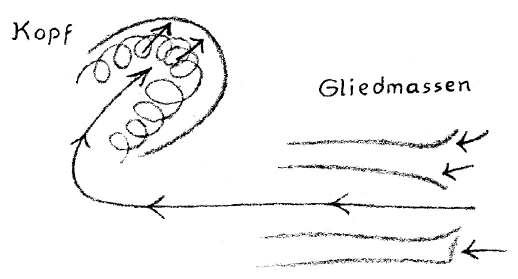
[ 2 ] We must come to terms with the difficult mental image that we can only understand the forms of the human body with limbs if we imagine that the head shapes are turned inside out like a glove or a sock. What this expresses is of great significance in the whole of human life. If we sketch it schematically, we can say: The shape of the head is formed in such a way that it is, as it were, pushed from the inside out, that it is puffed up from the inside out. When we think of the human limbs, we can create a mental image in which they are pushed from the outside in, through the turning inside out—which means a great deal in a person’s life—at your forehead. And bring to mind that your inner human essence strives from within toward your forehead. Look at the palm of your hand and look at the sole of your foot: a kind of pressure is constantly exerted on them, which is the same as the pressure exerted on your forehead from within, only in the opposite direction. So when you hold out the palm of your hand toward the outside world, when you place the sole of your foot on the ground, the same force that flows from within toward your forehead flows in from the outside through that sole. This is an extraordinarily important fact. It is so important because it allows us to see the true nature of the spiritual-soul aspect within the human being. This spiritual-soul aspect, as you can see from this, is a current. In fact, this spiritual-soul aspect flows through the human being as a current.
[ 3 ] And what, then, is the human being in relation to this spiritual-soul aspect? Imagine a stream of water flowing along and being held back by a weir, so that it backs up and surges back upon itself. In the same way, the spiritual-soul aspect overflows within the human being. The human being is a dam for the spiritual-soul aspect. It actually wants to flow unhindered through the human being, but the human being holds it back and slows it down. He allows it to accumulate within himself. Now, however, this effect—which I have described as a current—is a very remarkable one. I have described this effect of the spiritual-soul aspect flowing through the human being as a current, but what is it, actually, in relation to the outer physical body? It is a continuous absorption by the human being.
[ 4 ] Human beings face the external world. The spiritual-soul aspect strives to constantly absorb it. That is why we constantly shed layers on the outside. And if the spirit is not strong enough, we must cut off parts of ourselves—such as our fingernails—because the spirit, coming from the outside, seeks to destroy them by absorbing them. It destroys everything, and the body holds back this destruction wrought by the spirit. And a balance must be created within the human being between the destructive spiritual-soul aspect and the body’s constant constructive activity. Inserted into this flow is the chest-abdominal system. And the chest-abdominal system is the one that counteracts the destruction wrought by the invading spiritual-soul aspect and that, of its own accord, permeates the human being with material substance. From this, however, you can see that the human limbs, which extend beyond the chest-abdominal system, are in fact the most spiritual parts, for it is in the limbs that the process of producing matter takes place to the least extent in the human being. Only those metabolic processes sent from the chest-abdominal system into the limbs are what make our limbs material. Our limbs are highly spiritual, and it is they that draw upon our body when they move. And the body is dependent on developing within itself that which a person is actually predisposed to do from birth. If the limbs move too little or do not move appropriately, then they do not draw sufficiently upon the body. The chest-abdomen system is then in the fortunate position—in the position that is fortunate for it—that it is not sufficiently drawn upon by the limbs. It uses what it retains in this way to generate excess materiality within the human being. This excess materiality then permeates what the human being is predisposed to have from birth—that is, what he should actually possess in terms of physicality, since he is born as a soul-spiritual being. It permeates what a person ought to have with something they ought not to have—something they possess only materially as an earthly human being, something that is not spiritually-psychic in the true sense of the word; it permeates them more and more with fat. But when this fat is stored in the human being in an abnormal way, it actually presents too much resistance to the spiritual-soul process—which penetrates as a suction process, as a consuming process—and this hinders its path toward the head system. Therefore, it is not right to allow children to consume too much fat-producing food. This separates their head from the spiritual-soul realm. For the fat stands in the way of the spiritual-soul realm, and the head becomes empty. The point is to develop the sensitivity to interact with the child’s overall social situation in such a way that the child does not, in fact, become too fat. Later in life, gaining weight depends on all sorts of other factors, but in childhood—for children who are not abnormally developed, that is, particularly weakly developed children who, because they are weak, easily gain weight—and for normally developed children as well—it is still within our power to help prevent excessive weight gain through an appropriate diet.
[ 5 ] But one cannot take proper responsibility for these matters unless one appreciates their immense significance; if one does not realize that, when one allows a child to accumulate too much fat, one is interfering with the cosmic process that has a purpose for humanity—a purpose it expresses by allowing its spiritual-soul aspect to flow through human beings. One is indeed interfering with the world process when one allows the child to become too fat.
[ 6 ] For, you see, something most remarkable happens in the human head: as everything of a spiritual-soul nature accumulates within the human being, it surges back like water when it reaches a dam. That is to say, that which the spiritual-soul elements carry along with matter—just as the Mississippi carries sand—spills back even within the brain, so that there are surging currents in the brain where the spiritual-soul elements accumulate. And as the material elements surge back, matter within the brain is constantly collapsing in on itself. And when matter that is still permeated by life collapses in on itself—that is, rebounds as I have shown you—then the nerve arises. The nerve always arises when matter driven by the spirit through life collapses in on itself and dies off within the living organism. That is why the nerve is matter that has died within the living organism, so that life shifts, becomes congested within itself, and matter crumbles and collapses. This is how channels arise within the human being that extend everywhere, filled with dead matter: the nerves; through them, the spiritual-soul aspect can then surge back into the human being. Along the nerves, the spiritual-soul aspect surges through the human being because it needs the decaying matter. It causes the matter on the surface of the human being to decay, causing it to flake off. This spiritual-soul aspect will only engage in filling the human being if the matter within him first dies. The human being’s spiritual-soul aspect moves inward along the nerve pathways from which the material has died.
[ 7 ] In this way, one gains insight into how the spiritual-soul aspect actually works within the human being. One sees it pressing in from the outside, developing a sucking, consuming activity. One sees it penetrating; one sees how it is dammed up, how it bubbles back up, how it kills the material substance. One sees how the material substance disintegrates in the nerves, allowing the spiritual-psychic realm to now penetrate even to the skin from within, by creating its own pathways through which it can pass. For the spiritual-psychic realm does not pass through what lives organically.
[ 8 ] So how, then, can you create a mental image of the organic, the living? You see, you can also create a mental image of the living as something that absorbs the spiritual-soul aspect, something that does not let it pass through. You can create a mental image of the dead, the material, the mineral as something that allows the spiritual-soul aspect to pass through, so that you can arrive at a kind of definition of the physical-living and a definition of the bony-nervous, as well as of the mineral-material in general: The living-organic is impervious to the spirit; the physically dead is permeable to the spirit. - “Blood is a very special fluid,” for it relates to the spirit in the same way that opaque matter relates to light; it does not allow the spirit to pass through it; it retains it within itself. Nervous substance is, in fact, also a very special substance. It is like transparent glass in relation to light. Just as transparent glass allows light to pass through, so does physical matter—including nervous matter—allow the spirit to pass through.
[ 9 ] You see, there lies the difference between two components of the human being: between that which is mineral within him—which is permeable to the spirit—and that which is more animal, more organically alive within him—which holds back the spirit within him and causes the spirit to bring forth the forms that shape the organism.
[ 10 ] But this has all sorts of implications for how a person is treated. When a person—let’s say—works physically, he moves his limbs; that is to say, he is completely adrift in his mind. This is not the mind that has already become concentrated within him; it is the mind that is outside. Whether you’re chopping wood or walking—whenever you move your limbs, whether for useful or useless work—you are constantly moving about in the spirit, constantly engaged with the spirit. This is very important. And it is also important to ask ourselves: When we engage in mental work—when we think or read or the like—what is it like then? — Yes, there we are dealing with the spiritual-soul aspect that is within us. There, it is not we who are chattering away with our limbs in the mind; rather, the spiritual-soul aspect works within us and constantly makes use of our physical body—that is, it finds its full expression within us through a physical-bodily process. There, matter is constantly thrown back into itself through this accumulation. During mental work, our body is in a state of excessive activity; during physical work, on the other hand, our mind is in a state of excessive activity. We cannot engage in mental-soul work without constantly cooperating inwardly with our body. When we perform physical labor, our spiritual-soul aspect is involved internally at most only insofar as we use our thoughts to set the direction of our movements—that is, to orient ourselves through thought—but the spiritual-soul aspect is involved from the outside. We are constantly working into the spirit of the world. We are constantly connecting with the spirit of the world through our physical labor. Physical labor is spiritual; spiritual labor is physical, in and upon the human being. We must take this paradox to heart and understand that physical labor is spiritual and spiritual labor is physical in and upon the human being. The spirit surrounds us as we perform physical labor. Matter is active and alive within us as we engage in spiritual work.
[ 11 ] These are things one must know the moment one wishes to think clearly about work—whether mental or physical—as well as about rest and fatigue. One cannot think sensibly about work, rest, and fatigue unless one truly understands what we have just discussed. For just consider, my dear friends: if a person works too hard with his limbs—if he works too hard physically—what will be the consequence? It brings them into too close a relationship with the spirit. After all, the spirit constantly surrounds them when they are engaged in physical labor. The consequence of this is that the spirit—the spirit that approaches the person from the outside—gains too much power over them. We make ourselves too spiritual when we engage in too much physical labor. From the outside, we make ourselves too spiritual. The consequence of this is that we must surrender ourselves to the spirit for too long—that is, we must sleep for too long. If we do too much physical work, we must sleep for too long. And sleeping too long, in turn, excessively stimulates physical activity originating from the chest-abdominal system, rather than from the head system. It stimulates life too strongly; we become too feverish, too hot. The blood surges too strongly within us; its activity in the body cannot be processed when we sleep too much. Accordingly, we create the desire to sleep too much through excessive physical labor.
[ 12 ] But the lazy ones—they love to sleep so much and sleep so much; where does that come from? Well, it comes from the fact that people actually can’t help but work. They simply can’t help it. The lazy person doesn’t get his sleep because he works too little, for the lazy person must, after all, move his legs all day long, and somehow he does wave his arms about. The lazy person does something, too; outwardly speaking, he actually does no less than the diligent person, but he does it pointlessly. The diligent person turns toward the outside world; he imbues his activities with meaning. And that is the difference. Meaningless activity, as practiced by the lazy person, is what leads to sleep more than meaningful activity. For meaningful activity does not merely let our minds drift aimlessly; rather, as we engage meaningfully in our work, we gradually draw the spirit into it as well. By reaching out to meaningful work, we connect with the spirit, and the spirit, in turn, does not need to work too much unconsciously during sleep, because we are working with it consciously. So what matters is not that a person is active—for even the idle person is active—but rather the extent to which a person is meaningfully active. “Meaningfully active”—these words must already permeate us as we become the child’s educators. When is a person acting without purpose? A person acts without purpose when they act only as their body requires. A person acts meaningfully when they act in a way that their environment requires—not merely what their own body requires. We must take this into account with the child. On the one hand, we can increasingly direct the child’s external physical activity toward what is purely physical—toward physiological gymnastics—where we ask only the body: What movements should we have the child perform? - And we can guide the child’s external movement toward meaningful movements, toward movements imbued with meaning, so that the child’s movements do not merely splash about in the spirit, but follow the spirit in its directions. Then we develop the physical movements into eurythmy. The more we limit ourselves to purely physical exercise, the more we lead the child to develop an excessive need for sleep and an excessive tendency toward obesity. The more we alternate this swing toward the physical—which, of course, we must not neglect entirely, because human beings must live in rhythm—the more we allow this swing toward the body to swing back again toward the meaningful imbued nature of movements, as in eurythmy, where every movement expresses a sound, where every movement has a meaning: the more we alternate gymnastics with eurythmy, the more we bring about harmony between the need for sleep and the need for wakefulness; the more we maintain a normal life for the child as well, from the perspective of the will and from the external side. The fact that we have gradually reduced gymnastics to a meaningless activity, one that merely follows the body, was a side effect of the materialistic age. That we even want to elevate it to the level of sport—where we not only allow senseless, meaningless movements, derived solely from the body, to take effect, but also introduce absurdity and contradiction into them—corresponds to the endeavor not only to reduce the human being to a materially thinking being, but to drag him down to a being with animal-like sensibilities. Excessive sporting activity is practical Darwinism. Theoretical Darwinism means claiming that humans are descended from animals. Practical Darwinism is sport and means establishing an ethic that reduces humans back to animals.
[ 13 ] One must speak of these things today in such radical terms because today’s educator must understand them—not merely because he must become an educator of the children entrusted to him, but also because he is to have a social impact, because he is to exert a influence on all of humanity, so that such things—which, in fact, must gradually have a truly brutalizing effect on humanity—do not arise more and more. This is not false asceticism; it is something derived from the objective reality of true insight, and it is just as true as any other scientific finding.
[ 14 ] What about mental work? Mental work—that is, thinking, reading, and so on—is constantly accompanied by physical activity, by the continuous internal decay of organic matter, by the death of organic matter. Therefore, when we engage in too much mental and emotional activity, we have decaying organic matter within us. If we spend our entire day solely in scholarly pursuits, by evening we have too much decayed matter within us—decayed organic matter. This affects us; it disturbs our peaceful sleep. Excessive mental and emotional work disrupts sleep just as much as excessive physical labor makes one drowsy. But if we exert ourselves too much mentally and emotionally, if we read difficult material that requires us to think while reading—which is not exactly popular among people today—if, in other words, we try to read while thinking too much, we fall asleep in the process. Or if we do not listen to the crystal-clear drivel of popular orators or other people who merely say what we already know, but instead listen to those whose words we must follow with our thinking because they tell us something we do not yet know, then we become tired and drowsy. It is, after all, a well-known phenomenon that when people—because “that’s the done thing”—attend lectures or concerts and are not accustomed to truly grasping, through thought and feeling, what is being presented to them, they fall asleep at the very first note or the very first word. They often doze through the entire lecture or concert that they attended out of a sense of duty or social obligation.
[ 15 ] Well, here again there are two aspects. Just as there is a difference between meaningful external activity and meaningless external busyness, so too is there a difference between internal thought and perception that proceeds mechanically and internal thought and perception that is continually accompanied by feelings. If our mental and spiritual work is carried out in such a way that we combine it with sustained interest, then that interest—that attention—enlivens our heart activity and prevents our nerves from withering away excessively. The more you simply skim through what you read, the less you make an effort to absorb what you read with deep interest, the more you contribute to the withering away of your inner substance. The more you follow everything with interest and warmth, the more you promote blood circulation and keep your physical substance alive, and the more you also prevent your mental activity from disturbing your sleep. When you have to cram for an exam—or “plow through” it, depending on the context—you end up absorbing a lot against your interests. For if you were to absorb information solely based on your interests, you would—at least under today’s circumstances—fail. The result is that cramming or “plowing through” for an exam disrupts your sleep and brings disorder into your normal human existence. This must be taken into account especially with children. Therefore, it is best for children—and it will most closely correspond to the ideal of education—if we completely eliminate the cramming that always takes place before exams, that is, if we eliminate exams altogether; if the end of the school year proceeds just as the beginning does. If we, as teachers, impose upon ourselves the obligation to ask: Why should the child be tested at all? I have always had the child before my eyes and know quite well what he or she knows or does not know. — Of course, under today’s circumstances, this can only be an ideal for the time being; I ask you, in general, not to project your rebellious nature too strongly outward. For now, direct whatever objections you have to our current culture inward, like thorns, so that you can gradually work toward—for in this area we can only work slowly—helping people learn to think differently; then external social conditions will also take on forms different from what they are now.
[ 16 ] But one must consider everything in context. One must understand that eurythmy is an outward activity imbued with meaning, the spiritualization of physical work, and a way to make lessons engaging in a non-trivial way—it is, literally speaking, a means of enlivening and invigorating intellectual work.
[ 17 ] We must infuse our external work with a spiritual dimension; we must breathe life into our internal work—our intellectual work! If you reflect on these two sentences, you will see that the former has a significant educational aspect as well as a significant social aspect; that the latter has a significant educational aspect as well as a significant health-related aspect.