

General Human Studies
as the Basis of Education
GA 293
3 September 1919, Stuttgart
Translated by Steiner Online Library
Twelfth Lecture
[ 1 ] When we consider the human body, we must relate it to our physical-sensory environment, for it is in a constant interplay with that environment, and it is sustained by it. When we look out into our physical-sensory environment, we perceive mineral beings, plant beings, and animal beings within it. Our physical body is related to the mineral, plant, and animal kingdoms. But the specific nature of this relationship is not immediately apparent from a superficial observation; rather, it is necessary to delve deeper into the very essence of the natural kingdoms if one wishes to understand the interrelationship between human beings and their physical-sensory environment.
[ 2 ] When we observe a human being insofar as he is a physical, bodily being, we first perceive his solid skeletal framework and his muscles. As we delve deeper into him, we then perceive the circulatory system along with the organs that are part of it. We perceive respiration. We perceive the processes of nutrition. We perceive how the organs develop from the most diverse forms of vessels—as they are called in natural science. We perceive the brain and nerves, the sense organs, and the task arises of integrating these various human organs and the processes they mediate into the external world in which the human being is situated.
[ 3 ] Let us start with what initially appears to be the most perfect aspect of the human being—we have already seen what the reality of the matter is—namely, the brain and nervous system, which are integrated with the sense organs. In this, we find the human organism that has undergone the longest evolutionary development, so that it has transcended the form developed by the animal kingdom. In a sense, the human being has passed through the animal kingdom with regard to this, his actual primary system, and has moved beyond the animal system to the truly human system, which is most clearly expressed in the formation of the head.
[ 4 ] Yesterday we spoke about the extent to which the development of our head participates in individual human development, and to what extent the formation and shaping of the human body originate from the forces inherent in the head. And we saw that, in a sense, the activity of the head reaches a kind of culmination with the change of teeth around the age of seven. We should clarify for ourselves what actually happens there, as the human head interacts with the chest organs and the limb organs. We should answer the question: What does the head actually do as it carries out its work in connection with the chest-torso system and the limb system? It continually shapes and forms. Our life actually consists of this: during the first seven years of life, a powerful formative force emanates from the head, which also flows into the physical form; but even then, the head continues to assist, preserving the form, animating it with soul, and imbuing it with spirit.
[ 5 ] The head is connected to the formation of the human form. Yes, but—does the head actually shape our true human form? It does not, in fact. You must come to terms with the idea that the head is constantly and secretly trying to turn you into something other than what you are. There are moments when your head wants to shape you so that you look like a wolf. There are moments when your head wants to shape you so that you look like a lamb, and then again, so that you look like a worm; it wants to turn you into a worm, into a dragon. All the forms that your head actually has in store for you can be found spread out in nature in the various forms of animals. Look at the animal kingdom, and you can say to yourself: That is myself; it is just that my torso and my limbs do me the favor of continually transforming—for example, when the wolf-like form emanates from the head—that wolf-like form into the human form. You are continually overcoming the animalistic within yourself. You take control of it in such a way that you do not allow it to fully come into being within you, but rather metamorphose it, transform it. Thus, through his head system, the human being is in a relationship with the animal world, but in such a way that, in his physical activity, he continually transcends this animal world. What, then, actually remains within you? You can look at a human being. Imagine this person. You can engage in an interesting observation by saying: There is a human being. At the top, he has his head. There is actually a wolf moving there, but it does not become a wolf; it is immediately dissolved by the torso and the limbs. There is actually a lamb moving there; it is dissolved by the torso and the limbs.
[ 6 ] The animal forms within the human being are constantly moving in a supersensible way and are being dissolved. What would it be like if there were a supersensible photographer who could capture this process—that is, who could record this entire process on a photographic plate or on constantly changing photographic plates? What would one see on the photographic plate? One would see the human being’s thoughts. For these thoughts are, in fact, the supersensible correlate of that which is not expressed through the senses. This continuous metamorphosis from the animal realm, flowing from the head downward, is not expressed through the senses, but it operates supersensibly within the human being as the thought process. As a supersensually real process, this certainly exists. Your head is not merely a lazy lump resting on your shoulders; rather, it is the part of you that would actually like to keep you in the animal realm. It gives you the forms of the entire animal kingdom; it would like to see animal kingdoms continually arise. But through your torso and limbs, you prevent an entire animal kingdom from coming into being through you in the course of your life; instead, you transform this animal kingdom into your thoughts. This is how we relate to the animal kingdom. We allow this animal kingdom to arise within us on a supersensible level and then do not let it become a sensory reality, but hold it back in the supersensible realm. The torso and limbs do not allow these emerging animals to enter their domain. If the head is too inclined to produce something of this animal nature, then the rest of the organism resists absorbing it, and the head must then resort to a migraine to eradicate it once again, and to similar processes that take place within the head.
[ 7 ] The trunk system, too, is related to its surroundings. But it is not related to the animal system of its surroundings; rather, it is related to the entire realm of the plant world. There is a mysterious relationship between the human trunk system, the chest system, and the plant world. It is in the trunk system, the chest system—the trunk-chest system—that the most essential processes of blood circulation, respiration, and nutrition take place. All these processes are interrelated with what is happening outside in physical-sensory nature, in the plant world, but in a very peculiar way.
[ 8 ] Let’s start with breathing. What does a person do when they breathe? As you know, they take in oxygen, and through their metabolic processes, they transform the oxygen by combining it with carbon to form carbon dioxide. The carbon is present in the body in the form of metabolized nutrients. This carbon absorbs the oxygen. When the oxygen combines with the carbon, carbon dioxide is formed. Indeed, this would be a wonderful opportunity for a person—once they have this carbon dioxide inside them—not to let it out, but to keep it inside. And if they could now separate the carbon from the oxygen again—well, what would happen then? If a person first inhales oxygen through their life processes and allows it to combine internally with carbon to form carbon dioxide, and if that person were now able to internally remove the oxygen—to eliminate it—while processing the carbon internally, what would then arise within the person? The plant world. Suddenly, the entire plant kingdom would grow within the person. It could grow. For when you look at a plant, what does it do? It does not inhale oxygen in the same regular way that a human does, but rather it assimilates carbon dioxide. During the day, the plant is eager for carbon dioxide; it releases oxygen. It would be terrible if it did not do so; we would not have it then, and neither would the animals. But it retains the carbon. From this, it forms starch and sugar and everything within it; from this, it builds its entire organism. The plant world arises precisely because it is built up from the carbon that plants separate from carbon dioxide through their assimilation. If you look at the plant world, it is metamorphosed carbon that has been separated through the process of assimilation, which corresponds to the human respiratory process. The plant also “breathes” to some extent, but this is different from how humans do. Only an external observation suggests that the plant also breathes. It does breathe a little, especially at night; but this is just like when someone says: “Here is a razor; I will cut meat with it.” — The respiratory process in plants is different from that in humans and animals, just as a razor is different from a table knife. The human respiratory process corresponds in plants to the reverse process, the process of assimilation.
[ 9 ] Therefore, you will understand: if you were to continue within yourself the process by which carbon dioxide is produced—that is, if oxygen were released again and the carbon dioxide were converted into carbon, just as nature does outside—you would have the necessary substances within you to do so—then you could cause the entire plant kingdom to grow within yourself. You could bring about a situation where you suddenly blossomed into the plant kingdom. You would disappear, and the entire plant kingdom would arise. For this ability is inherent in human beings—that they continually generate the plant kingdom; they simply do not allow it to happen. Their trunk system has a strong tendency to continually generate the plant kingdom. The head and limbs prevent this from happening; they resist it. And so human beings expel the carbon dioxide and do not allow the plant kingdom to arise within themselves. Instead, they allow the plant kingdom to arise outside themselves from the carbon dioxide.
[ 10 ] There is a remarkable interrelationship between the chest-torso system and the sensory-physical environment: out there lies the plant kingdom, and in order not to become a plant, human beings are constantly compelled not to allow the vegetative process to arise within themselves, but rather, when it does arise, to send it outward immediately. We can therefore say: With regard to the chest-torso system, human beings are capable of creating the counter-realm to the plant kingdom. If you have a mental image of the plant kingdom as positive, then human beings produce the negative of the plant kingdom. They produce, so to speak, a reversed plant kingdom.
[ 11 ] And what happens when the plant kingdom within him begins to act up, and his head and limbs lack the strength to nip its emergence in the bud, to drive it away? Then the person becomes ill! And fundamentally, internal illnesses that originate in the chest-torso system consist in the fact that a person is too weak to immediately prevent the plant-like nature arising within them. The moment even a little of what tends toward the plant kingdom arises within us—the moment we are unable to ensure right away that what seeks to emerge as the plant kingdom within us comes out and establishes its realm outside—at that very moment we become ill. Thus, the essence of the disease processes must be sought in the fact that plants begin to grow within the human being. Of course, they do not actually become plants, because, after all, the human interior is not a pleasant environment for a lily. But the tendency for the plant kingdom to emerge can result from a weakness in the other systems, and then the human being becomes ill. If we therefore turn our gaze to the entire plant environment surrounding us, we must say to ourselves: In a certain sense, we also find in the plant environment the images of all our illnesses. This is the remarkable mystery in the connection between human beings and the natural environment: that not only—as we have explained on other occasions—do they see in plants images of their own development up to sexual maturity, but that in the plants outside—particularly insofar as these plants carry within themselves the potential to bear fruit—they must also see images of their own disease processes. This is something that people may not like to hear at all, because they naturally love the plant world for its aesthetic beauty, and because, when the plant world unfolds its nature outside of the human being, the human being is right in appreciating this beauty. But the moment the plant world seeks to unfold its nature within the human being—the moment it begins to take on a vegetative character within the human being—that very moment, what is at work in the colorful, beautiful plant world outside acts as a cause of disease within the human being. Medicine will one day be a science when it can draw a parallel between every single disease and some form of the plant world. The fact is that, by exhaling carbon dioxide, a person is, in essence, for the sake of his own existence, continually exhaling the entire plant world that seeks to arise within him. Therefore, it should come as no surprise to you that when a plant begins to transcend its ordinary plant existence and produce toxins within itself, these toxins are also connected to the processes of health and illness in human beings. But this is also related to the normal process of nutrition.
[ 12 ] Yes, my dear friends, nutrition—which, at least in terms of its point of origin, takes place in the chest-torso system just as the process of respiration does—must be viewed in a manner very similar to that of respiration. In the process of nutrition, human beings also take in substances from their environment, but they do not leave them as they are; they transform them. They transform them precisely with the help of the oxygen from respiration. The substances that human beings take in through their diet, after they have been transformed, combine with the oxygen. This resembles a combustion process, and it appears as if a person were constantly burning from within. Natural science often asserts that a combustion process is at work within the human body. But this is not true. What takes place within the human body is not a true combustion process, but rather—please note this carefully—a combustion process that lacks a beginning and an end. It is merely the middle stage of the combustion process; it lacks the beginning and the end. The beginning and end of the combustion process must never take place within the human body; only the middle stage of the combustion process may occur there. It is destructive for a person when the very earliest stages of a combustion process—such as that which occurs during fruit ripening—take place within the human organism; for example, when a person eats completely unripe fruit. A person cannot undergo this initial process, which is similar to combustion. This process does not exist within the human body; it makes the person sick. And if a person eats a lot of unripe fruit—as robust country folk do, for example—then they must have a very, very close connection to the surrounding natural world in order to digest the unripe apples and pears in the same way they digest fruit that has already been ripened by the sun. Thus, they can only participate in the middle stage of the process. Of all combustion processes, humans can participate only in the middle stage during the process of nutrition. If the process is carried through to its end—leading, for example, to the same outcome as with ripe fruit outdoors, namely that it rots—humans can no longer participate in that. Thus, they must not participate in the final stage either; instead, they must excrete the nutrients beforehand. In fact, humans do not carry out natural processes exactly as they occur in the environment; rather, they carry out only the middle part; they cannot carry out the beginning and the end within themselves.
[ 13 ] And now we see something most remarkable. Consider breathing. It is the counterpart to everything that takes place in the plant world outside. It is, so to speak, the anti-plant kingdom. Human respiration is the “anti-plant kingdom,” and it is intrinsically linked to the process of nutrition, which serves as a central link to the process taking place outside. You see, there are two distinct processes at work in our physical chest-torso system: this “anti-plant” process, which takes place there through breathing, always interacts with the central link of the other natural processes outside. These processes intertwine. There, you see, the soul and the body are connected. Therein lies the mysterious connection between soul and body. As that which takes place through the process of breathing connects with the other natural processes—whose execution occurs only in their central link—so the soul, which is the anti-vegetative process, connects with the physical that has become human, which is always the central link of the natural processes. Science can ponder at length what the interrelationship between body and soul is, if it does not seek it in the mysterious connection between breathing—which has become a spiritual process—and the physical existence of the central part of natural processes. These natural processes do not arise within the human being, nor do they cease within the human being. Their arising takes place outside the human being; their ceasing can only occur once the human being has excreted them. Human beings are physically connected only to a central part of natural processes, and they imbue these natural processes with spirit through the act of breathing.
[ 14 ] This is where that intricate web of processes emerges, which the medicine and hygiene of the future will have to study with particular attention. Future hygiene will have to ask: How do the various temperature gradients interact with one another out in space? How does heat affect us when moving from a cooler place to a warmer one, and vice versa? And how does what acts as a thermal process out there affect the human organism when it is placed within that thermal process? — Human beings encounter an interplay of air and water in the external process of vegetation. They will have to study how this affects humans when they are placed within it, and so on.
[ 15 ] With regard to such matters, modern medicine is just a tiny bit in its infancy—but hardly in its infancy anymore. Modern medicine, for example, places much greater emphasis on identifying the pathogen—in the form of a germ or bacterium—whenever there is something resembling a disease. Once it has identified it, it is satisfied. But what matters far more is recognizing how it comes to be that a person is capable, at a certain moment in their life, of developing a slight vegetative process within themselves, so that the germs then sense a pleasant place to dwell there. What matters is that we maintain our physical constitution in such a way that there is no longer a pleasant habitat for all this vegetative growth; if we do that, then these little creatures will not be able to wreak too much havoc within us.
[ 16 ] This leaves us with the question: How do the skeletal system and muscles relate to the entire human life process when we consider the human being physically in relation to the outside world?
[ 17 ] You see, this brings us to something you absolutely must grasp if you want to understand human beings—something that is almost completely overlooked in contemporary science. Just observe what happens when you bend your arm. By contracting the muscles that bend your forearm, you’re setting in motion a purely mechanical process. Now imagine that this had happened simply because you had initially been in a position like this (see first drawing).
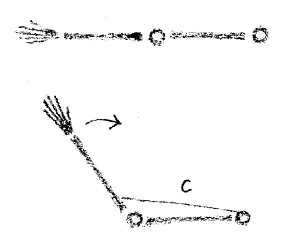
[ 18 ] You would now stretch a band (c) and roll it up; then this rod would perform this movement (see the second drawing). It is an entirely mechanical movement. You also perform such mechanical movements when you bend your knee and when you walk. For when walking, the entire machinery of your body is constantly in motion, and forces are constantly at work. These are primarily lever forces, but forces are indeed at work. Now imagine for a moment that, through some intricate photographic process, you could arrange it so that when a person walks, nothing about the person would be photographed, but all the forces they exert would be photographed. That is, the forces they exert to lift a leg, set it down again, and bring the other leg forward. So nothing of the person would be photographed except the forces. At first, if you were to see these forces unfolding, a shadow would be photographed, and while walking, even an entire trail of shadows. You are greatly mistaken if you believe that you live with your “I” in muscles and flesh. Even when you are awake, you do not live with your “I” in muscles and flesh; rather, you live with your “I” primarily in this shadow that you are photographing here—in the forces through which your body carries out its movements. As grotesque as it may sound to you: when you sit down, you press your back against the back of the chair; with your “I,” you live in the force that develops in this pressing together. And when you stand, you live in the force with which your feet press against the earth. You live continually in forces. It is not at all true that we live with our “I” in our visible body. We live with our “I” within forces. We merely carry our visible body along; we simply drag it along during our physical earthly life until death. But even in the waking state, we live solely within a force body. And what, in fact, does this force body do? It continually sets itself a peculiar task.
[ 19 ] Isn’t it true that when you eat, you also take in all kinds of minerals? Even if you don’t add much salt to your soup—since the salt is already in the food—you’re still taking in minerals. You also have a need to take in minerals. What do you do with these minerals? Well, you see, your head system can’t do much with these minerals. Neither can your torso-chest system. But your limb system—that prevents these minerals from taking on their natural crystalline form inside you. If you do not develop the forces of your limb system, then when you eat salt, you would turn into a salt cube. Your limb system—the skeletal framework and the muscular system—has a constant tendency to counteract the Earth’s mineral formation, that is, to dissolve the minerals. The forces that dissolve the minerals within the human being come from the limb system.
[ 20 ] When the disease process goes beyond the merely vegetative—that is, when the body tends not only to allow the vegetative process to begin within itself but also the mineral crystallization process—then a higher, highly destructive form of disease is present, such as diabetes. In such cases, the human body is unable to truly dissolve the minerals it is constantly meant to dissolve using the power of its limbs, which it draws from the world. And if people today are unable to overcome precisely those forms of illness that often stem from pathological mineralization in the human body, this is often due to the fact that we are unable to sufficiently apply the antidotes to this form of illness—antidotes that we would all have to derive from the interrelationships of the sense organs, the brain, the nerve tracts, and the like. We would have to utilize the “apparent substances”—I call them “apparent substances” for certain reasons—that are found in the sense organs, in the brain, and in the nerves; this decaying matter, we would have to use it in some form to overcome diseases such as gout, diabetes, and the like. In this field, what is truly beneficial to humanity can only be achieved once the connection between human beings and nature is fully understood from the perspective I have outlined for you today.
[ 21 ] The human body cannot be explained in any other way than by first understanding its processes; by knowing that the human being must dissolve the mineral realm within itself, must transform the plant realm within itself, and must transcend the animal realm—that is, must spiritualize it. And everything the teacher needs to know about physical development is based on the kind of anthropological, anthroposophical perspective that I have shared with you here. We will discuss further tomorrow what can be built upon this from a pedagogical standpoint.