

General Human Studies
as the Basis of Education
GA 293
3 September 1919, Stuttgart
Translate the original German text into any language:
Versions Available:
General Human Studies as the Basis of Education, tr. SOL
Zwölfter Vortrag
Twelfth Lecture
[ 1 ] Wenn wir den menschlichen Leib betrachten, müssen wir ihn in Beziehung bringen zu unserer physisch-sinnlichen Umwelt, denn mit der steht er in einem fortwährenden Wechselverhältnis, durch die wird er unterhalten. Wenn wir hinausblicken in unsere physisch-sinnliche Umwelt, dann nehmen wir in dieser physisch-sinnlichen Umwelt wahr mineralische Wesen, pflanzliche Wesen, tierische Wesen. Mit den Wesen des Mineralischen, des Pflanzlichen, des Tierischen ist unser physischer Leib verwandt. Aber die besondere Art der Verwandtschaft wird nicht ohne weiteres durch eine Oberflächenbetrachtung klar, sondern es ist notwendig, da tiefer in das Wesen der Naturreiche überhaupt einzudringen, wenn man die Wechselbeziehung des Menschen mit seiner physisch-sinnlichen Umgebung kennenlernen will.
[ 1 ] When we consider the human body, we must relate it to our physical-sensory environment, for it is in a constant interplay with that environment, and it is sustained by it. When we look out into our physical-sensory environment, we perceive mineral beings, plant beings, and animal beings within it. Our physical body is related to the mineral, plant, and animal kingdoms. But the specific nature of this relationship is not immediately apparent from a superficial observation; rather, it is necessary to delve deeper into the very essence of the natural kingdoms if one wishes to understand the interrelationship between human beings and their physical-sensory environment.
[ 2 ] Wir nehmen am Menschen, insofern er physisch-leiblich ist, wahr zunächst sein festes Knochengerüst, seine Muskeln. Wir nehmen dann, wenn wir weiter in ihn eindringen, den Blutkreislauf wahr mit den Organen, die zum Blutkreislauf gehören. Wir nehmen die Atmung wahr. Wir nehmen die Ernährungsvorgänge wahr. Wir nehmen wahr, wie aus den verschiedensten Gefäßformen — wie man es in der Naturlehre nennt — die Organe sich herausbilden. Wir nehmen wahr Gehirn und Nerven, die Sinnesorgane, und es entsteht die Aufgabe, diese verschiedenen Organe des Menschen und die Vorgänge, die sie vermitteln, in die äußere Welt, in der er drinnensteht, hineinzugliedern.
[ 2 ] When we observe a human being insofar as he is a physical, bodily being, we first perceive his solid skeletal framework and his muscles. As we delve deeper into him, we then perceive the circulatory system along with the organs that are part of it. We perceive respiration. We perceive the processes of nutrition. We perceive how the organs develop from the most diverse forms of vessels—as they are called in natural science. We perceive the brain and nerves, the sense organs, and the task arises of integrating these various human organs and the processes they mediate into the external world in which the human being is situated.
[ 3 ] Gehen wir da aus von demjenigen, was am Menschen zunächst als das Vollkommenste erscheint — wie es sich in Wirklichkeit damit verhält, haben wir ja schon gesehen -, gehen wir aus von seinem GehirnNervensystem, das sich zusammengliedert mit den Sinnesorganen. Wir haben ja darin diejenige Organisation des Menschen, die die längste zeitliche Entwickelung hinter sich hat, so daß sie hinausgeschritten ist über die Form, welche die Tierwelt entwickelt hat. Der Mensch ist gewissermaßen durchgeschritten durch die Tierwelt in bezug auf dieses sein eigentliches Hauptsystem, und er ist hinweggeschritten über das Tiersystem zu dem eigentlich menschlichen System, das ja am deutlichsten in der Hauptesblidung zum Ausdruck kommt.
[ 3 ] Let us start with what initially appears to be the most perfect aspect of the human being—we have already seen what the reality of the matter is—namely, the brain and nervous system, which are integrated with the sense organs. In this, we find the human organism that has undergone the longest evolutionary development, so that it has transcended the form developed by the animal kingdom. In a sense, the human being has passed through the animal kingdom with regard to this, his actual primary system, and has moved beyond the animal system to the truly human system, which is most clearly expressed in the formation of the head.
[ 4 ] Nun haben wir gestern davon gesprochen, inwiefern unsere Hauptesbildung an der individuellen menschlichen Entwickelung teilnimmt, inwiefern die Formung, die Gestaltung des menschlichen Leibes ausgeht von den Kräften, die im Haupte, im Kopfe veranlagt sind. Und wir haben gesehen, daß gewissermaßen dem Kopfwirken eine Art Schlußpunkt gesetzt wird mit dem Zahnwechsel gegen das siebente Jahr zu. Wir sollten uns klar werden, was da eigentlich geschieht, indem der menschliche Kopf in Wechselwirkung steht mit den Brustorganen und mit den Gliedmaßenorganen. Wir sollten die Frage beantworten: Was tut denn eigentlich der Kopf, indem er seine Arbeit verrichtet in Zusammenhang mit dem Brust-Rumpfsystem und dem Gliedmaßensystem? Er formt, er gestaltet fortwährend. Unser Leben besteht eigentlich darin, daß in den ersten sieben Lebensjahren eine starke Gestaltung von ihm ausgeht, die sich auch bis in die physische Form hineinergießt, daß dann aber der Kopf immer noch nachhilft, die Gestalt erhält, die Gestalt durchseelt, die Gestalt durchgeistigt.
[ 4 ] Yesterday we spoke about the extent to which the development of our head participates in individual human development, and to what extent the formation and shaping of the human body originate from the forces inherent in the head. And we saw that, in a sense, the activity of the head reaches a kind of culmination with the change of teeth around the age of seven. We should clarify for ourselves what actually happens there, as the human head interacts with the chest organs and the limb organs. We should answer the question: What does the head actually do as it carries out its work in connection with the chest-torso system and the limb system? It continually shapes and forms. Our life actually consists of this: during the first seven years of life, a powerful formative force emanates from the head, which also flows into the physical form; but even then, the head continues to assist, preserving the form, animating it with soul, and imbuing it with spirit.
[ 5 ] Der Kopf hängt mit der Gestaltbildung des Menschen zusammen. Ja aber - bildet der Kopf unsere eigentliche Menschengestalt? Das tut er nämlich nicht. Sie müssen sich schon bequemen zu der Anschauung, daß der Kopf fortwährend im geheimen etwas anderes aus Ihnen machen will, als Sie sind. Da gibt es Augenblicke, in denen Sie der Kopf so gestalten möchte, daß Sie aussehen wie ein Wolf. Da gibt es Augenblicke, in denen Sie der Kopf so gestalten möchte, daß Sie aussehen wie ein Lamm, dann wiederum, daß Sie aussehen wie ein Wurm; zum Wurm, zum Drachen möchte er Sie machen. All die Gestaltungen, die eigentlich Ihr Haupt mit Ihnen vorhat, die finden Sie ausgebreitet draußen in der Natur in den verschiedenen Tierformen. Schauen Sie das Tierreich an, so können Sie sich sagen: Das bin ich selbst, nur erweist mir mein Rumpfsystem und mein Gliedmaßensystem die Gefälligkeit, fortwährend, indem vom Kopf ausgeht zum Beispiel die Wolfsgestalt, diese Wolfsgestalt umzuwandeln zur Menschenform. Sie überwinden in sich fortwährend das Animalische. Sie bemächtigen sich seiner so, daß Sie es in sich nicht ganz zum Dasein kommen lassen, sondern es metamorphosieren, umgestalten. Es ist also der Mensch durch sein Kopfsystem mit der tierischen Umwelt in einer Beziehung, aber so, daß er in seinem leiblichen Schaffen über diese tierische Umwelt fortwährend hinausgeht. Was bleibt denn da eigentlich in Ihnen? Sie können einen Menschen anschauen. Stellen Sie sich den Menschen vor. Sie können die interessante Betrachtung anstellen, daß Sie sagen: Da ist der Mensch. Oben hat er seinen Kopf. Da bewegt sich eigentlich ein Wolf, aber es wird kein Wolf; er wird gleich durch den Rumpf und die Gliedmaßen aufgelöst. Da bewegt sich eigentlich ein Lamm; es wird durch den Rumpf und die Gliedmaßen aufgelöst.
[ 5 ] The head is connected to the formation of the human form. Yes, but—does the head actually shape our true human form? It does not, in fact. You must come to terms with the idea that the head is constantly and secretly trying to turn you into something other than what you are. There are moments when your head wants to shape you so that you look like a wolf. There are moments when your head wants to shape you so that you look like a lamb, and then again, so that you look like a worm; it wants to turn you into a worm, into a dragon. All the forms that your head actually has in store for you can be found spread out in nature in the various forms of animals. Look at the animal kingdom, and you can say to yourself: That is myself; it is just that my torso and my limbs do me the favor of continually transforming—for example, when the wolf-like form emanates from the head—that wolf-like form into the human form. You are continually overcoming the animalistic within yourself. You take control of it in such a way that you do not allow it to fully come into being within you, but rather metamorphose it, transform it. Thus, through his head system, the human being is in a relationship with the animal world, but in such a way that, in his physical activity, he continually transcends this animal world. What, then, actually remains within you? You can look at a human being. Imagine this person. You can engage in an interesting observation by saying: There is a human being. At the top, he has his head. There is actually a wolf moving there, but it does not become a wolf; it is immediately dissolved by the torso and the limbs. There is actually a lamb moving there; it is dissolved by the torso and the limbs.
[ 6 ] Fortwährend bewegen sich da übersinnlich die tierischen Formen im Menschen und werden aufgelöst. Was wäre es denn, wenn es einen übersinnlichen Photographen gäbe, der diesen Prozeß festhielte, der also diesen ganzen Prozeß auf die Photographenplatte oder auf fortwährend wechselnde Photographenplatten brächte? Was würde man denn da auf der Photographenplatte sehen? Die Gedanken des Menschen würde man sehen. Diese Gedanken des Menschen sind nämlich das übersinnliche Korrelat desjenigen, was sinnlich nicht zum Ausdruck kommt. Sinnlich kommt nicht zum Ausdruck diese fortwährende Metamorphose aus dem Tierischen, vom Kopfe nach unten strömend, aber übersinnlich wirkt sie im Menschen als der Gedankenprozeß. Als ein übersinnlich realer Prozeß ist das durchaus vorhanden. Ihr Kopf ist nicht nur der Faulenzer auf den Schultern, sondern er ist derjenige, der Sie eigentlich gerne in der Tierheit erhalten möchte. Er gibt Ihnen die Formen des ganzen Tierreiches, er möchte gerne, daß fortwährend Tierreiche entstehen. Aber Sie lassen es durch Ihren Rumpf und die Gliedmaßen nicht dazu kommen, daß durch Sie ein ganzes Tierreich im Laufe Ihres Lebens entsteht, sondern Sie verwandeln dieses Tierreich in Ihre Gedanken. So stehen wir zum Tierreich in Beziehung. Wir lassen übersinnlich dieses Tierreich in uns entstehen und lassen es dann nicht zur sinnlichen Wirklichkeit kommen, sondern halten es im Übersinnlichen zurück. Rumpf und Gliedmaßen lassen diese entstehenden Tiere in ihr Gebiet nicht herein. Wenn der Kopf zu sehr die Neigung hat, etwas von diesem Tierischen zu erzeugen, dann sträubt sich der übrige Organismus, das aufzunehmen, und dann muß der Kopf zur Migräne greifen, um es wiederum auszurotten, und zu ähnlichen Dingen, die sich im Kopfe abspielen.
[ 6 ] The animal forms within the human being are constantly moving in a supersensible way and are being dissolved. What would it be like if there were a supersensible photographer who could capture this process—that is, who could record this entire process on a photographic plate or on constantly changing photographic plates? What would one see on the photographic plate? One would see the human being’s thoughts. For these thoughts are, in fact, the supersensible correlate of that which is not expressed through the senses. This continuous metamorphosis from the animal realm, flowing from the head downward, is not expressed through the senses, but it operates supersensibly within the human being as the thought process. As a supersensually real process, this certainly exists. Your head is not merely a lazy lump resting on your shoulders; rather, it is the part of you that would actually like to keep you in the animal realm. It gives you the forms of the entire animal kingdom; it would like to see animal kingdoms continually arise. But through your torso and limbs, you prevent an entire animal kingdom from coming into being through you in the course of your life; instead, you transform this animal kingdom into your thoughts. This is how we relate to the animal kingdom. We allow this animal kingdom to arise within us on a supersensible level and then do not let it become a sensory reality, but hold it back in the supersensible realm. The torso and limbs do not allow these emerging animals to enter their domain. If the head is too inclined to produce something of this animal nature, then the rest of the organism resists absorbing it, and the head must then resort to a migraine to eradicate it once again, and to similar processes that take place within the head.
[ 7 ] Auch das Rumpfsystem steht zur Umgebung in Beziehung. Aber es steht nicht zu dem Tiersystem der Umgebung in Beziehung, sondern es steht in Beziehung zu dem gesamten Umfang der Pflanzenwelt. Eine geheimnisvolle Beziehung ist zwischen dem Rumpfsystem des Menschen, dem Brustsystem und der Pflanzenwelt. In dem Rumpfsystem, in dem Brustsystem, Rumpf-Brustsystem spielt sich ja ab das Hauptsächlichste des Blutkreislaufes, die Atmung, die Ernährung. All diese Prozesse sind in einer Wechselbeziehung zu dem, was draußen in der physisch-sinnlichen Natur, in der Pflanzenwelt vor sich geht, aber in einer sehr eigenartigen Beziehung.
[ 7 ] The trunk system, too, is related to its surroundings. But it is not related to the animal system of its surroundings; rather, it is related to the entire realm of the plant world. There is a mysterious relationship between the human trunk system, the chest system, and the plant world. It is in the trunk system, the chest system—the trunk-chest system—that the most essential processes of blood circulation, respiration, and nutrition take place. All these processes are interrelated with what is happening outside in physical-sensory nature, in the plant world, but in a very peculiar way.
[ 8 ] Nehmen wir zunächst die Atmung. Was tut der Mensch, indem er atmet? Sie wissen, er nimmt den Sauerstoff auf, und er verwandelt durch seinen Lebensprozeß den Sauerstoff, indem er ihn verbindet mit dem Kohlenstoff, zur Kohlensäure. Der Kohlenstoff ist im Organismus durch die umgewandelten Ernährungsstoffe. Dieser Kohlenstoff nimmt den Sauerstoff auf. Dadurch, daß sich der Sauerstoff mit dem Kohlenstoff verbindet, entsteht die Kohlensäure. Ja, jetzt wäre eine schöne Gelegenheit in dem Menschen, wenn er die Kohlensäure da in sich hat, diese nicht herauszulassen, sondern sie drinnen zu behalten. Und wenn er jetzt den Kohlenstoff wiederum loslösen könnte vom Sauerstoff — ja, was würde denn dann geschehen? Wenn der Mensch zunächst durch seinen Lebensprozeß den Sauerstoff einatmet und ihn da drinnen sich verbinden läßt mit dem Kohlenstoff zur Kohlensäure und wenn der Mensch jetzt in der Lage wäre, innerlich den Sauerstoff wieder fortzuschaffen, auszuschalten, aber den Kohlenstoff drinnen zu verarbeiten, was würde denn da im Menschen entstehen? Die Pflanzenwelt. Im Menschen würde plötzlich die ganze Vegetation wachsen. Sie könnte wachsen. Denn wenn Sie die Pflanze ansehen, was tut sie denn? Die atmet nämlich nicht in derselben regelmäßigen Weise wie der Mensch den Sauerstoff ein, sondern sie assimiliert die Kohlensäure. Die Pflanze ist bei Tage erpicht auf die Kohlensäure, den Sauerstoff gibt sie ab. Es wäre schlimm, wenn sie es nicht tun würde; wir hätten ihn dann nicht, und auch die Tiere hätten ihn nicht. Aber den Kohlenstoff behält sie zurück. Daraus bildet sie sich Stärke und Zukker und alles, was in ihr ist; daraus baut sie sich ihren ganzen Organismus auf. Die Pflanzenwelt entsteht eben dadurch, daß sie sich aufbaut aus dem Kohlenstoff, den sich die Pflanzen durch ihre Assimilation absondern von der Kohlensäure. Wenn Sie die Pflanzenwelt ansehen, ist sie metamorphosierter Kohlenstoff, der abgesondert ist aus dem Assimilationsprozeß, der dem menschlichen Atmungsprozeß entspricht. Die Pflanze atmet auch etwas, aber das ist etwas anderes als beim Menschen. Nur eine äußerliche Betrachtung sagt, die Pflanze atme auch. Sie atmet zwar ein wenig, namentlich in der Nacht; aber das ist gerade so, wie wenn einer sagt: Da ist ein Rasiermesser, ich werde Fleisch damit schneiden. -— Der Atmungsprozeß ist bei den Pflanzen anders als beim Menschen und bei den Tieren, wie das Rasiermesser etwas anderes ist als das Tischmesser. Dem menschlichen Atmungsprozesse entspricht bei den Pflanzen der umgekehrte Prozeß, der Assimilationsprozeß.
[ 8 ] Let’s start with breathing. What does a person do when they breathe? As you know, they take in oxygen, and through their metabolic processes, they transform the oxygen by combining it with carbon to form carbon dioxide. The carbon is present in the body in the form of metabolized nutrients. This carbon absorbs the oxygen. When the oxygen combines with the carbon, carbon dioxide is formed. Indeed, this would be a wonderful opportunity for a person—once they have this carbon dioxide inside them—not to let it out, but to keep it inside. And if they could now separate the carbon from the oxygen again—well, what would happen then? If a person first inhales oxygen through their life processes and allows it to combine internally with carbon to form carbon dioxide, and if that person were now able to internally remove the oxygen—to eliminate it—while processing the carbon internally, what would then arise within the person? The plant world. Suddenly, the entire plant kingdom would grow within the person. It could grow. For when you look at a plant, what does it do? It does not inhale oxygen in the same regular way that a human does, but rather it assimilates carbon dioxide. During the day, the plant is eager for carbon dioxide; it releases oxygen. It would be terrible if it did not do so; we would not have it then, and neither would the animals. But it retains the carbon. From this, it forms starch and sugar and everything within it; from this, it builds its entire organism. The plant world arises precisely because it is built up from the carbon that plants separate from carbon dioxide through their assimilation. If you look at the plant world, it is metamorphosed carbon that has been separated through the process of assimilation, which corresponds to the human respiratory process. The plant also “breathes” to some extent, but this is different from how humans do. Only an external observation suggests that the plant also breathes. It does breathe a little, especially at night; but this is just like when someone says: “Here is a razor; I will cut meat with it.” — The respiratory process in plants is different from that in humans and animals, just as a razor is different from a table knife. The human respiratory process corresponds in plants to the reverse process, the process of assimilation.
[ 9 ] Daher werden Sie es begreifen: wenn Sie in sich den Prozeß fortsetzen, wodurch Kohlensäure entstanden ist, das heißt, wenn Sauerstoff wieder weggegeben würde und die Kohlensäure in Kohlenstoff umgewandelt würde, wie die Natur es draußen macht — die Stoffe hätten Sie auch dazu in sich -, dann könnten Sie in sich die ganze Vegetation wachsen lassen. Sie könnten es bewirken, daß Sie plötzlich aufgingen als Pflanzenwelt. Sie verschwänden, und die ganze Pflanzenwelt entstünde. Diese Fähigkeit ist nämlich im Menschen, daß er fortwährend eine Pflanzenwelt erzeugt; er läßt es nur nicht dazu kommen. Sein Rumpfsystem hat stark die Neigeng, fortwährend die Pflanzenwelt zu erzeugen. Kopf und Gliedmaßen lassen es nicht dazu kommen; sie wehren sich dagegen. Und so treibt der Mensch die Kohlensäure heraus und läßt das Pflanzenreich in sich nicht entstehen. Er läßt draußen das Pflanzenreich entstehen aus der Kohlensäure.
[ 9 ] Therefore, you will understand: if you were to continue within yourself the process by which carbon dioxide is produced—that is, if oxygen were released again and the carbon dioxide were converted into carbon, just as nature does outside—you would have the necessary substances within you to do so—then you could cause the entire plant kingdom to grow within yourself. You could bring about a situation where you suddenly blossomed into the plant kingdom. You would disappear, and the entire plant kingdom would arise. For this ability is inherent in human beings—that they continually generate the plant kingdom; they simply do not allow it to happen. Their trunk system has a strong tendency to continually generate the plant kingdom. The head and limbs prevent this from happening; they resist it. And so human beings expel the carbon dioxide and do not allow the plant kingdom to arise within themselves. Instead, they allow the plant kingdom to arise outside themselves from the carbon dioxide.
[ 10 ] Es ist das eine merkwürdige Wechselbeziehung zwischen dem BrustRumpfsystem und der sinnlich-physischen Umgebung, daß da draußen das Reich der Vegetabilien ist und daß der Mensch fortwährend genötigt ist, damit er nicht zur Pflanze wird, den Vegetationsprozeß nicht in sich aufkommen zu lassen, sondern, wenn er entsteht, ihn gleich nach außen zu schicken. Wir können also sagen: Mit Bezug auf das BrustRumpfsystem ist der Mensch in der Lage, das Gegenreich des Pflanzlichen zu schaffen. Wenn Sie sich das Pflanzenreich vorstellen als positiv, so erzeugt der Mensch das Negativ vom Pflanzenreich. Er erzeugt gewissermaßen ein umgekehrtes Pflanzenreich.
[ 10 ] There is a remarkable interrelationship between the chest-torso system and the sensory-physical environment: out there lies the plant kingdom, and in order not to become a plant, human beings are constantly compelled not to allow the vegetative process to arise within themselves, but rather, when it does arise, to send it outward immediately. We can therefore say: With regard to the chest-torso system, human beings are capable of creating the counter-realm to the plant kingdom. If you have a mental image of the plant kingdom as positive, then human beings produce the negative of the plant kingdom. They produce, so to speak, a reversed plant kingdom.
[ 11 ] Und was ist es denn, wenn das Pflanzenreich in ihm beginnt, sich schlecht aufzuführen und Kopf und Gliedmaßen nicht die Kraft haben, sein Entstehen im Keime gleich zu ersticken, es wegzuschicken? Dann wird der Mensch krank! Und im Grunde genommen bestehen die inneren Erkrankungen, die herrühren vom Brust-Rumpfsystem, darin, daß der Mensch zu schwach ist, um die in ihm entstehende Pflanzlichkeit sogleich zu verhindern. In dem Augenblick, wo nur ein bißchen in uns entsteht, was nach dem Pflanzenreich hintendiert, wo wir nicht in der Lage sind, gleich dafür zu sorgen, daß das, was als Pflanzenreich in uns entstehen will, herauskommt und draußen sein Reich aufrichtet, in dem Augenblick werden wir krank. So daß man das Wesen der Erkrankungsprozesse darin suchen muß, daß Pflanzen im Menschen anfangen zu wachsen. Sie werden natürlich nicht zu Pflanzen, weil schließlich für die Lilie das menschliche Innere keine angenehme Umgebung ist. Aber die Tendenz, daß das Pflanzenreich entsteht, kann durch eine Schwäche der anderen Systeme sich ergeben, und dann wird der Mensch krank. Richten wir daher unseren Blick auf die ganze pflanzliche Umwelt unserer menschlichen Umgebung, so müssen wir uns sagen: In einem gewissen Sinne haben wir in der pflanzlichen Umwelt auch die Bilder unserer sämtlichen Krankheiten. Das ist das merkwürdige Geheimnis im Zusammenhang des Menschen mit der Naturumwelt, daß er nicht nur, wie wir bei anderen Gelegenheiten ausgeführt haben, in den Pflanzen zu sehen hat Bilder seiner Entwickelung bis zur Geschlechtsreife, sondern daß er in den Pflanzen draußen, namentlich insofern diese Pflanzen in sich die Anlage tragen zum Fruchtwerden, die Bilder zu sehen hat seiner Erkrankungsprozesse. Das ist etwas, was vielleicht der Mensch gar nicht gerne hört, weil er selbstverständlich die Pflanzenwelt ästhetisch liebt und weil, wenn die Pflanzenwelt ihr Wesen außerhalb des Menschen entfaltet, der Mensch mit dieser Ästhetik recht hat. In dem Augenblick aber, wo die Pflanzenwelt innerhalb des Menschen ihr Wesen entfalten will, in dem Augenblick, wo es im Menschen anfangen will zu vegetarisieren, in dem Augenblick wirkt das, was draußen in der farbenschönen Pflanzenwelt wirkt, im Menschen als Krankheitsursache. Die Medizin wird dann einmal eine Wissenschaft sein, wenn sie jede einzelne Krankheit in Parallele bringen wird zu irgendeiner Form der Pflanzenwelt. Es ist einmal so, daß, indem der Mensch die Kohlensäure ausatmet, er im Grunde genommen um seines eigenen Daseins willen die ganze Pflanzenwelt fortwährend ausatmet, die in ihm entstehen will. Daher braucht es Ihnen auch nicht verwunderlich zu sein, daß dann, wenn die Pflanze beginnt, über ihr gewöhnliches Pflanzendasein hinauszugehen und Gifte in sich zu erzeugen, daß diese Gifte auch zusammenhängen mit den Gesundheits- und Erkrankungsprozessen des Menschen. Aber es hängt ja auch mit dem normalen Ernährungsprozeß zusammen.
[ 11 ] And what happens when the plant kingdom within him begins to act up, and his head and limbs lack the strength to nip its emergence in the bud, to drive it away? Then the person becomes ill! And fundamentally, internal illnesses that originate in the chest-torso system consist in the fact that a person is too weak to immediately prevent the plant-like nature arising within them. The moment even a little of what tends toward the plant kingdom arises within us—the moment we are unable to ensure right away that what seeks to emerge as the plant kingdom within us comes out and establishes its realm outside—at that very moment we become ill. Thus, the essence of the disease processes must be sought in the fact that plants begin to grow within the human being. Of course, they do not actually become plants, because, after all, the human interior is not a pleasant environment for a lily. But the tendency for the plant kingdom to emerge can result from a weakness in the other systems, and then the human being becomes ill. If we therefore turn our gaze to the entire plant environment surrounding us, we must say to ourselves: In a certain sense, we also find in the plant environment the images of all our illnesses. This is the remarkable mystery in the connection between human beings and the natural environment: that not only—as we have explained on other occasions—do they see in plants images of their own development up to sexual maturity, but that in the plants outside—particularly insofar as these plants carry within themselves the potential to bear fruit—they must also see images of their own disease processes. This is something that people may not like to hear at all, because they naturally love the plant world for its aesthetic beauty, and because, when the plant world unfolds its nature outside of the human being, the human being is right in appreciating this beauty. But the moment the plant world seeks to unfold its nature within the human being—the moment it begins to take on a vegetative character within the human being—that very moment, what is at work in the colorful, beautiful plant world outside acts as a cause of disease within the human being. Medicine will one day be a science when it can draw a parallel between every single disease and some form of the plant world. The fact is that, by exhaling carbon dioxide, a person is, in essence, for the sake of his own existence, continually exhaling the entire plant world that seeks to arise within him. Therefore, it should come as no surprise to you that when a plant begins to transcend its ordinary plant existence and produce toxins within itself, these toxins are also connected to the processes of health and illness in human beings. But this is also related to the normal process of nutrition.
[ 12 ] Ja, meine lieben Freunde, die Ernährung, die sich ebenso vollzieht im Brust-Rumpfsystem, wenigstens ihrem Ausgangspunkt nach, wie der Atmungsvorgang, sie muß in einer ganz ähnlichen Art betrachtet werden wie die Atmung. Bei der Ernährung nimmt der Mensch auch die Stoffe seiner Umwelt in sich auf, aber er läßt sie nicht so, wie sie sind; er verwandelt sie. Er verwandelt sie gerade mit Hilfe des Sauerstoffes der Atmung, Es verbinden sich die Stoffe, die der Mensch durch seine Ernährung aufnimmt, nachdem er sie verwandelt hat, mit dem Sauerstoff. Das sieht so aus wie ein Verbrennungsprozeß, und es sieht aus, als ob der Mensch in seinem Inneren fortwährend brennen würde. Das sagt auch vielfach die Naturwissenschaft, daß im Menschen ein Verbrennungsprozeß wirke. Es ist aber nicht wahr. Es ist kein wirklicher Verbrennungsprozeß, was da im Menschen vorgeht, sondern es ist ein Verbrennungsprozeß - beachten Sie das wohl -, dem der Anfang und das Ende fehlt. Es ist bloß die mittlere Stufe des Verbrennungsprozesses;, es fehlt ihm der Anfang und das Ende. Im menschlichen Leibe darf niemals Anfang und Ende des Verbrennungsprozesses vor sich gehen, sondern nur das Mittelstück des Verbrennungsprozesses. Es ist für den Menschen zerstörend, wenn die allerersten Stadien eines Verbrennungsprozesses, wie er in der Fruchtbereitung vor sich geht, im menschlichen Organismus vollzogen werden; zum Beispiel, wenn der Mensch ganz unreifes Obst genießt. Diesen Anfangsprozeß, der der Verbrennung ähnlich ist, den kann der Mensch nicht durchmachen. Das gibt es nicht in ihm, das macht ihn krank. Und kann er viel unreifes Obst essen, wie die starken Landleute zum Beispiel, dann muß er schon sehr, sehr viel von Verwandtschaft mit der umgebenden Natur haben, daß er die unreifen Apfel und Birnen in sich so verdauen kann, wie er das schon von der Sonne reifgekochte Obst verdaut. Also nur den mittleren Prozeß kann er mitmachen. Von allen Verbrennungsprozessen kann der Mensch im Ernährungsvorgang nur den mittleren Prozeß mitmachen. Wird der Prozeß zu seinem Ende getrieben, kommt es dahin, wohin es zum Beispiel das reife Obst draußen bringt, daß es fault, das darf der Mensch nicht mehr mitmachen. Also das Ende darf er auch nicht mitmachen; da muß er vorher die Ernährungsstoffe ausscheiden. Der Mensch vollzieht tatsächlich nicht die Naturprozesse so, wie sie sich in der Umgebung abspielen, sondern er vollzieht nur das Mittelstück; Anfang und Ende kann er nicht in sich vollziehen.
[ 12 ] Yes, my dear friends, nutrition—which, at least in terms of its point of origin, takes place in the chest-torso system just as the process of respiration does—must be viewed in a manner very similar to that of respiration. In the process of nutrition, human beings also take in substances from their environment, but they do not leave them as they are; they transform them. They transform them precisely with the help of the oxygen from respiration. The substances that human beings take in through their diet, after they have been transformed, combine with the oxygen. This resembles a combustion process, and it appears as if a person were constantly burning from within. Natural science often asserts that a combustion process is at work within the human body. But this is not true. What takes place within the human body is not a true combustion process, but rather—please note this carefully—a combustion process that lacks a beginning and an end. It is merely the middle stage of the combustion process; it lacks the beginning and the end. The beginning and end of the combustion process must never take place within the human body; only the middle stage of the combustion process may occur there. It is destructive for a person when the very earliest stages of a combustion process—such as that which occurs during fruit ripening—take place within the human organism; for example, when a person eats completely unripe fruit. A person cannot undergo this initial process, which is similar to combustion. This process does not exist within the human body; it makes the person sick. And if a person eats a lot of unripe fruit—as robust country folk do, for example—then they must have a very, very close connection to the surrounding natural world in order to digest the unripe apples and pears in the same way they digest fruit that has already been ripened by the sun. Thus, they can only participate in the middle stage of the process. Of all combustion processes, humans can participate only in the middle stage during the process of nutrition. If the process is carried through to its end—leading, for example, to the same outcome as with ripe fruit outdoors, namely that it rots—humans can no longer participate in that. Thus, they must not participate in the final stage either; instead, they must excrete the nutrients beforehand. In fact, humans do not carry out natural processes exactly as they occur in the environment; rather, they carry out only the middle part; they cannot carry out the beginning and the end within themselves.
[ 13 ] Und jetzt sehen wir etwas höchst Merkwürdiges. Betrachten Sie die Atmung. Sie ist das Gegenstück zu alledem, was in der Pflanzenwelt draußen vor sich geht. Sie ist gewissermaßen das Anti-Pflanzenreich. Die Atmung des Menschen ist das Anti-Pflanzenreich, und sie verbindet sich innerlich mit dem Ernährungsprozeß, der ein Mittelstück zu dem Prozeß draußen ist. Sehen Sie, da lebt zweierlei in unserem leiblichen Brust-Rumpfsystem: dieser Anti-Pflanzenprozeß, der sich da abspielt durch die Atmung, wirkt immer zusammen mit dem Mittelstück der übrigen Naturprozesse draußen. Das wirkt durcheinander. Da, sehen Sie, hängen zusammen Seele und Leib. Da ist der geheimnisvolle Zusammenhang zwischen Seele und Leib. Indem sich dasjenige, was sich durch den Atmungsprozeß abspielt, verbindet mit den übrigen Naturprozessen, deren Ausführung nur in ihrem Mittelstück erfolgt, da verbindet sich das Seelische, das der Anti-Pflanzenprozeß ist, mit dem menschlich gewordenen Leiblichen, das immer das Mittelstück ist der Naturprozesse. Die Wissenschaft kann lange nachdenken, welches die Wechselbeziehung zwischen Leib und Seele ist, wenn sie sie nicht sucht in dem geheimnisvollen Zusammenhange zwischen dem seelisch gewordenen Atmen und dem leiblich gewordenen Dasein des Mittelstückes der Naturprozesse. Diese Naturprozesse entstehen im Menschen nicht und vergehen im Menschen nicht. Ihr Entstehen läßt er außerhalb; ihr Vergehen darf erst sein, wenn er sie ausgeschieden hat. Der Mensch verbindet sich leiblich nur mit einem mittleren Teil der Naturprozesse, und er durchseelt diese Naturprozesse im Atmungsprozeß.
[ 13 ] And now we see something most remarkable. Consider breathing. It is the counterpart to everything that takes place in the plant world outside. It is, so to speak, the anti-plant kingdom. Human respiration is the “anti-plant kingdom,” and it is intrinsically linked to the process of nutrition, which serves as a central link to the process taking place outside. You see, there are two distinct processes at work in our physical chest-torso system: this “anti-plant” process, which takes place there through breathing, always interacts with the central link of the other natural processes outside. These processes intertwine. There, you see, the soul and the body are connected. Therein lies the mysterious connection between soul and body. As that which takes place through the process of breathing connects with the other natural processes—whose execution occurs only in their central link—so the soul, which is the anti-vegetative process, connects with the physical that has become human, which is always the central link of the natural processes. Science can ponder at length what the interrelationship between body and soul is, if it does not seek it in the mysterious connection between breathing—which has become a spiritual process—and the physical existence of the central part of natural processes. These natural processes do not arise within the human being, nor do they cease within the human being. Their arising takes place outside the human being; their ceasing can only occur once the human being has excreted them. Human beings are physically connected only to a central part of natural processes, and they imbue these natural processes with spirit through the act of breathing.
[ 14 ] Hier entsteht jenes feine Gewebe von Vorgängen, welches die Zukunftsmedizin, die Zukunftshygiene ganz besonders wird studieren müssen. Die Zukunftshygiene wird sich fragen müssen: Wie wirken im Weltall draußen die verschiedenen Wärmeabstufungen ineinander? Wie wirkt die Wärme beim Übergang von einem kühleren Ort zu einem wärmeren und umgekehrt? Und wie wirkt das, was da draußen wirkt als Wärmevorgang, im menschlichen Organismus, wenn er in diesen Wärmevorgang hineingestellt ist? — Ein Zusammenspiel von Luft und Wasser findet der Mensch im äußeren Vegetationsprozeß. Er wird studieren müssen, wie das auf den Menschen wirkt, wenn der Mensch da hineingestellt ist und so weiter.
[ 14 ] This is where that intricate web of processes emerges, which the medicine and hygiene of the future will have to study with particular attention. Future hygiene will have to ask: How do the various temperature gradients interact with one another out in space? How does heat affect us when moving from a cooler place to a warmer one, and vice versa? And how does what acts as a thermal process out there affect the human organism when it is placed within that thermal process? — Human beings encounter an interplay of air and water in the external process of vegetation. They will have to study how this affects humans when they are placed within it, and so on.
[ 15 ] Mit Bezug auf solche Dinge ist die Medizin von heute ein ganz klein wenig im Anfang, aber kaum noch im Anfang. Die Medizin von heute legt zum Beispiel viel größeren Wert darauf, daß sie, wenn irgend so etwas da ist wie eine Krankheitsform, den Krankheitserreger aus der Bazillen- oder Bakterienform findet. Dann, wenn sie ihn hat, ist sie zufrieden. Es kommt aber viel mehr darauf an, zu erkennen, wie es kommt, daß der Mensch imstande ist, in einem Augenblick seines Lebens ein klein wenig einen Vegetationsprozeß in sich zu entwickeln, so daß die Bazillen darin dann einen angenehmen Aufenthaltsort wittern. Es kommt darauf an, daß wir unsere Leibeskonstitution so erhalten, daß für all das vegetabilische Gezücht kein angenehmer Aufenthaltsort mehr da ist; wenn wir das tun, dann werden diese Herrschaften nicht allzugroße Verheerungen bei uns selbst anrichten können.
[ 15 ] With regard to such matters, modern medicine is just a tiny bit in its infancy—but hardly in its infancy anymore. Modern medicine, for example, places much greater emphasis on identifying the pathogen—in the form of a germ or bacterium—whenever there is something resembling a disease. Once it has identified it, it is satisfied. But what matters far more is recognizing how it comes to be that a person is capable, at a certain moment in their life, of developing a slight vegetative process within themselves, so that the germs then sense a pleasant place to dwell there. What matters is that we maintain our physical constitution in such a way that there is no longer a pleasant habitat for all this vegetative growth; if we do that, then these little creatures will not be able to wreak too much havoc within us.
[ 16 ] Nun bleibt uns noch die Frage: Wie stehen nun eigentlich Knochengerüst und Muskeln zum gesamten menschlichen Lebensprozeß, wenn wir den Menschen betrachten leiblich in seiner Beziehung zur Außenwelt?
[ 16 ] This leaves us with the question: How do the skeletal system and muscles relate to the entire human life process when we consider the human being physically in relation to the outside world?
[ 17 ] Sehen Sie, da kommen wir auf etwas, was Sie unbedingt begreifen müssen, wenn Sie den Menschen verstehen wollen, worauf aber in der gegenwärtigen Wissenschaft fast gar nicht gesehen wird. Beachten Sie einmal, was geschieht, indem Sie den Arm beugen. Da bewirken Sie ja durch die Muskelanziehung, die den Vorderarm beugt, einen ganz maschinellen Vorgang. Stellen Sie sich jetzt vor, das wäre einfach dadurch geschehen, daß Sie zuerst gehabt hätten eine Stellung wie diese (siehe erste Zeichnung).
[ 17 ] You see, this brings us to something you absolutely must grasp if you want to understand human beings—something that is almost completely overlooked in contemporary science. Just observe what happens when you bend your arm. By contracting the muscles that bend your forearm, you’re setting in motion a purely mechanical process. Now imagine that this had happened simply because you had initially been in a position like this (see first drawing).
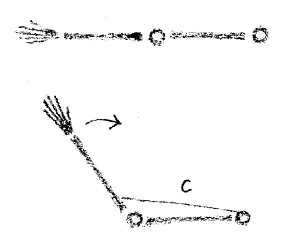
[ 18 ] Sie würden nun ein Band spannen (c) und würden es zusammenrollen; dann würde diese Stange diese Bewegung ausführen (siehe zweite Zeichnung). Es ist eine ganz maschinelle Bewegung. Solche maschinelle Bewegungen führen Sie auch aus, wenn Sie Ihr Knie beugen und auch, wenn Sie gehen. Denn beim Gehen kommt fortwährend die ganze Maschinerie Ihres Leibes in Bewegung, und fortwährend wirken Kräfte. Es sind vorzugsweise Hebelkräfte, aber es wirken eben Kräfte. Denken Sie sich jetzt einmal, Sie könnten durch irgendeinen kniffligen photographischen Vorgang bewirken, daß, wenn der Mensch geht, vom Menschen nichts photographiert würde, aber all die Kräfte, die er anwendet, photographiert würden. Also die Kräfte, die er anwendet, um das Bein zu heben, es wieder aufzustellen, das andere Bein nachzusetzen. Vom Menschen würde also nichts photographiert als nur die Kräfte. Es würde da zunächst, wenn Sie diese Kräfte sich würden entwickeln sehen, ein Schatten photographiert und beim Gehen sogar ein ganzes Schattenband. Sie sind groß im Irrtum, wenn Sie glauben, daß Sie mit Ihrem Ich in Muskeln und Fleisch leben. Sie leben mit Ihrem Ich, auch wenn Sie wachen, nicht in Muskeln und Fleisch, sondern Sie leben mit Ihrem Ich hauptsächlich in diesem Schatten, den Sie da abphotographieren, in den Kräften, durch die Ihr Leib seine Bewegungen ausführt. So grotesk es Ihnen klingt: wenn Sie sich setzen, dann drücken Sie Ihren Rücken an die Stuhllehne an; mit Ihrem Ich leben Sie in der Kraft, die sich in diesem Zusammendrücken entwickelt. Und wenn Sie stehen, leben Sie in der Kraft, mit der Ihre Füße auf die Erde drücken. Sie leben fortwährend in Kräften. Es ist gar nicht wahr, daß wir in unserem sichtbaren Körper mit unserem Ich leben. Wir leben mit unserem Ich in Kräften. Unseren sichtbaren Körper tragen wir nur mit; den schleppen wir nur mit während unseres physischen Erdenlebens bis zum Tode. Wir leben aber auch im wachen Zustand lediglich in einem Kraftleib. Und was tut denn eigentlich dieser Kraftleib? Er setzt sich fortwährend eine sonderbare Aufgabe.
[ 18 ] You would now stretch a band (c) and roll it up; then this rod would perform this movement (see the second drawing). It is an entirely mechanical movement. You also perform such mechanical movements when you bend your knee and when you walk. For when walking, the entire machinery of your body is constantly in motion, and forces are constantly at work. These are primarily lever forces, but forces are indeed at work. Now imagine for a moment that, through some intricate photographic process, you could arrange it so that when a person walks, nothing about the person would be photographed, but all the forces they exert would be photographed. That is, the forces they exert to lift a leg, set it down again, and bring the other leg forward. So nothing of the person would be photographed except the forces. At first, if you were to see these forces unfolding, a shadow would be photographed, and while walking, even an entire trail of shadows. You are greatly mistaken if you believe that you live with your “I” in muscles and flesh. Even when you are awake, you do not live with your “I” in muscles and flesh; rather, you live with your “I” primarily in this shadow that you are photographing here—in the forces through which your body carries out its movements. As grotesque as it may sound to you: when you sit down, you press your back against the back of the chair; with your “I,” you live in the force that develops in this pressing together. And when you stand, you live in the force with which your feet press against the earth. You live continually in forces. It is not at all true that we live with our “I” in our visible body. We live with our “I” within forces. We merely carry our visible body along; we simply drag it along during our physical earthly life until death. But even in the waking state, we live solely within a force body. And what, in fact, does this force body do? It continually sets itself a peculiar task.
[ 19 ] Nicht wahr, indem Sie sich ernähren, nehmen Sie auch auf allerlei mineralische Stoffe. Auch wenn Sie sich nicht stark Ihre Suppe salzen — das Salz ist ja in den Speisen drinnen -, nehmen Sie mineralische Stoffe auf. Sie haben auch das Bedürfnis, mineralische Stoffe aufzunehmen. Was tun Sie denn mit diesen mineralischen Stoffen? Ja, sehen Sie, Ihr Kopfsystem kann nicht viel mit diesen mineralischen Stoffen anfangen. Ihr Rumpf-Brust-System auch nicht. Aber Ihr Gliedmaßensystem; das verhindert, daß diese mineralischen Stoffe in Ihnen die ihnen eigene Kristallform annehmen. Wenn Sie nicht die Kräfte Ihres Gliedmaßensystems entwickeln, so würden Sie, wenn Sie Salz essen, zum Salzwürfel werden. Ihr Gliedmaßensystem, das Knochengerüst und das Muskelsystem haben die fortwährende Tendenz, der Mineralbildung der Erde entgegenzuwirken, das heißt, die Minerale aufzulösen. Die Kräfte, die die Mineralien auflösen im Menschen, die kommen vom Gliedmaßensystem.
[ 19 ] Isn’t it true that when you eat, you also take in all kinds of minerals? Even if you don’t add much salt to your soup—since the salt is already in the food—you’re still taking in minerals. You also have a need to take in minerals. What do you do with these minerals? Well, you see, your head system can’t do much with these minerals. Neither can your torso-chest system. But your limb system—that prevents these minerals from taking on their natural crystalline form inside you. If you do not develop the forces of your limb system, then when you eat salt, you would turn into a salt cube. Your limb system—the skeletal framework and the muscular system—has a constant tendency to counteract the Earth’s mineral formation, that is, to dissolve the minerals. The forces that dissolve the minerals within the human being come from the limb system.
[ 20 ] Wenn der Krankheitsprozeß über das bloß Vegetative hinausgeht, das heißt, wenn der Körper die Tendenz hat, nicht nur das Pflanzliche in sich beginnen zu lassen, sondern auch den mineralischen Kristallisationsprozeßs, dann ist eine höhere, sehr zerstörerische Form von Krankheit vorhanden, zum Beispiel Zuckerkrankheit. Dann ist der menschliche Leib nicht in der Lage, aus der Kraft seiner Gliedmaßen heraus, die er von der Welt aufnimmt, das Mineral, das er fortwährend auflösen soll, wirklich aufzulösen. Und wenn heute die Menschen gerade jener Krankheitsformen, die vielfach von krankhaftem Mineralisieren im Menschenleibe herrühren, nicht Herr werden können, so rührt das vielfach davon her, daß wir nicht genügend anwenden können die Gegenmittel gegen diese Erkrankungsform, die wir alle hernehmen müßten aus den Zusammenhängen der Sinnesorgane oder des Gehirns, der Nervenstränge und dergleichen. Wir müßten die Scheinstoffe - ich nenne sie aus gewissen Gründen Scheinstoffe -, die in den Sinnesorganen sind, die in Gehirn und Nerven sind, diese zerfallende Materie, die müßten wir in irgendeiner Form verwenden, um solcher Krankheiten Herr zu werden wie Gicht, Zuckerkrankheit und dergleichen. Auf diesem Gebiete kann erst das wirklich der Menschheit Heilsame erreicht werden, wenn einmal der Zusammenhang des Menschen mit der Natur ganz durchschaut wird von dem Gesichtspunkte aus, den ich Ihnen heute angegeben habe.
[ 20 ] When the disease process goes beyond the merely vegetative—that is, when the body tends not only to allow the vegetative process to begin within itself but also the mineral crystallization process—then a higher, highly destructive form of disease is present, such as diabetes. In such cases, the human body is unable to truly dissolve the minerals it is constantly meant to dissolve using the power of its limbs, which it draws from the world. And if people today are unable to overcome precisely those forms of illness that often stem from pathological mineralization in the human body, this is often due to the fact that we are unable to sufficiently apply the antidotes to this form of illness—antidotes that we would all have to derive from the interrelationships of the sense organs, the brain, the nerve tracts, and the like. We would have to utilize the “apparent substances”—I call them “apparent substances” for certain reasons—that are found in the sense organs, in the brain, and in the nerves; this decaying matter, we would have to use it in some form to overcome diseases such as gout, diabetes, and the like. In this field, what is truly beneficial to humanity can only be achieved once the connection between human beings and nature is fully understood from the perspective I have outlined for you today.
[ 21 ] Der Leib des Menschen wird auf keine andere Weise erklärlich, als indem man zuerst seine Vorgänge, seine Prozesse kennt, indem man weiß, daß der Mensch in sich auflösen muß das Mineral, in sich umkehren muß das Pflanzenreich, über sich hinausführen muß, das heißt, vergeistigen muß das Tierreich. Und alles dasjenige, was der Lehrer wissen soll über die Leibesentwickelung, das hat zur Grundlage eine solche anthropologische, anthroposophische Betrachtung, wie ich sie hier mit Ihnen angestellt habe. Was nun pädagogisch darauf aufgebaut werden kann, das wollen wir morgen weiterbesprechen.
[ 21 ] The human body cannot be explained in any other way than by first understanding its processes; by knowing that the human being must dissolve the mineral realm within itself, must transform the plant realm within itself, and must transcend the animal realm—that is, must spiritualize it. And everything the teacher needs to know about physical development is based on the kind of anthropological, anthroposophical perspective that I have shared with you here. We will discuss further tomorrow what can be built upon this from a pedagogical standpoint.