

The Art of Education
Methodology and Didactics
GA 294
25 August 1919, Stuttgart
Translate the original German text into any language:
Versions Available:
The Art of Education, tr. SOL
Vierter Vortrag
Fourth Lecture
[ 1 ] Gestützt auf solche Empfindungen, wie sie hervorgehen können aus Auseinandersetzungen, wie wir sie eben in der Stunde über Allgemeine Pädagogik gepflogen haben, möchte ich gleich etwas Merhodisches erwähnen, was außerordentlich wichtig ist und sich außerdem anschließen wird an die methodischen Auseinandersetzungen der vorhergehenden Tage.
[ 1 ] Based on the insights that can emerge from discussions such as the one we just had in the General Pedagogy class, I would like to mention right away a methodological point that is extremely important and will also tie in with the methodological discussions of the previous days.
[ 2 ] Von durchschlagender Bedeutung müssen Sie sich vorstellen die erste Schulstunde, die Sie mit Ihren Schülern in jeder Klasse durchmachen. Von dieser ersten Schulstunde wird etwas viel Wichtigeres ausgehen in einer gewissen Beziehung als von allen andern Stunden. Aber auch die andern Stunden werden dann ausgenützt werden müssen, um das, was von der ersten Stunde ausgehen kann, wiederum für den ganzen Unterricht fruchtbar zu machen. Wir wollen uns nun gleich im Konkreten vorstellen, wie wir mit den Kindern - und Sie werden ja demnächst in der Lage sein, mit diesen aus allen Windrichtungen der Erziehung und auch Verziehung herkommenden Kindern sich bekanntzumachen - die erste Schulstunde gestalten werden. Natürlich kann ich hier nur allgemeine Andeutungen geben, die Sie dann weiter werden ausgestalten können. Es wird sich darum handeln, daß Sie sich nicht nach gewissen vertrackten Erziehungsgrundsätzen richten, die gerade in der neueren Zeit heraufgekommen sind, sondern daß Sie auf das sehen, was für die Entwickelung des Kindes wirklich von Bedeutung sein kann.
[ 2 ] You must have in your mind's eye the first class you teach with your students in each grade. In a certain sense, something far more significant will emerge from this first class than from all the others. But the other lessons will also need to be utilized to ensure that what emerges from that first lesson bears fruit for the entire course of instruction. Let us now create a mental image of how we will structure the first school lesson with the children—and you will soon be in a position to get to know these children, who come from all walks of life in terms of both education and upbringing. Of course, I can only offer general guidelines here, which you will then be able to develop further. The key will be not to follow certain convoluted educational principles that have emerged in recent times, but rather to focus on what is truly significant for the child’s development.
[ 3 ] Sie haben also die Klasse vor sich mit den verschieden gearteten Kindern. Das erste wird sein, daß Sie die Kinder darauf aufmerksam machen, warum sie eigentlich da sind. Es ist von außerordentlicher Wichtigkeit, daß Sie mit den Kindern etwa in der Art sprechen: Ihr seid also jetzt in die Schule gekommen, und ich will euch sagen, warum ihr in die Schule gekommen seid. — Und nun soll gleich diese Handlung, daß die Kinder in die Schule gekommen sind, ins Bewußtsein heraufgehoben werden. - Ihr seid in die Schule gekommen, weil ihr in der Schule etwas lernen sollt. Ihr werdet heute noch keine Vorstellung davon haben, was ihr alles in der Schule lernen sollt, aber ihr werdet vielerlei in der Schule lernen müssen. Warum werdet ihr vielerlei in der Schule lernen müssen? Nun, ihr habt doch auch schon Bekanntschaft gemacht mit den Erwachsenen, mit den großen Leuten, und da werdet ihr gesehen haben, daß sie etwas machen können, was ihr nicht könnt. Und damit ihr auch einmal das können werdet, was die Großen können, dazu seid ihr hier. Ihr werdet einmal das können, was ihr jetzt noch nicht könnt. — Daß man diesen Vorstellungskomplex mit den Kindern durchgeht, ist außerordentlich wichtig. Doch dieser Vorstellungskomplex hat noch etwas anderes im Gefolge.
[ 3 ] So you have the class in front of you, with children of all different kinds. The first thing you should do is make the children aware of why they are actually there. It is of the utmost importance that you speak to the children something like this: “So you have now come to school, and I want to tell you why you have come to school.” — And now this very fact—that the children have come to school—must be brought to the forefront of their consciousness. — You’ve come to school because you’re supposed to learn something here. You won’t have any mental image yet today of everything you’re supposed to learn in school, but you’ll have to learn many things here. Why will you have to learn so many things in school? Well, you’ve already gotten to know the adults—the grown-ups—and you’ve probably noticed that they can do things you can’t. And you’re here so that one day you, too, will be able to do what the grown-ups can do. One day you’ll be able to do what you can’t do yet. — It’s extremely important to go through this set of ideas with the children. But this set of ideas brings something else with it as well.
[ 4 ] Kein Unterricht verläuft im richtigen Fahrwasser, der nicht begleitet ist von einer gewissen Pietät gegen die vorangehende Generation. So gefühls- und empfindungsmäßig diese Nuance bleiben muß, so muß sie doch mit allen Mitteln bei den Kindern kultiviert werden: daß das Kind mit Achtung, mit Respekt hinschaut auf das, was die älteren Generationen schon erreicht haben und was es auch durch die Schule erreichen soll. Dieses Hinschauen auf die Kultur der Umwelt mit einer gewissen Achtung, das muß in dem Kinde gleich von Anfang an erregt werden, so daß es wirklich in denjenigen Menschen, die schon älter geworden sind, gewissermaßen etwas höhere Wesen sieht. Ohne die Erweckung dieses Gefühls kommt man im Unterricht und in der Erziehung nicht vorwärts. Man kommt aber auch nicht vorwärts, wenn man nicht dasjenige ins Bewußtsein der Seele heraufhebt, was nun eigentlich werden soll. Daher stelle man weiterhin mit dem Kinde folgende Betrachtungen an, ganz ohne Bedenken dagegen, daß man etwa damit schon über den Horizont des Kindes hinausgeht. Das macht nämlich nichts, wenn man vieles zu dem Kinde sagt, was es erst später begreifen wird. Der Grundsatz, daß man an das Kind nur heranbringen solle, was es schon begreift, worüber es sich schon ein Urteil bilden kann, das ist der Grundsatz, der so vieles in unserer Kultur ruiniert hat. — Ein sehr bekannter Erzieher einer noch viel bekannteren Persönlichkeit der Gegenwart hat sich einmal gerühmt, diese Persönlichkeit nach dem folgenden Grundsatze erzogen zu haben. Der Mann sagte: Diesen Jungen habe ich gut erzogen, denn ich habe ihn gezwungen, sich sofort über alles ein Urteil zu bilden. - Nun, mit diesem Grundsatz, sich über alles sofort ein Urteil zu bilden, sind heute sehr viele Leute einverstanden, und es ist nicht merkwürdig, daß man von einem sehr bekannten Pädagogen einer noch viel bekannteren Persönlichkeit hervorgehoben findet, daß er diesen Grundsatz dann in pädagogischen Büchern wieder betonen will. Ich habe doch das Erlebnis gehabt, daß, anknüpfend an diesen Grundsatz, in einem pädagogischen Werke der Gegenwart gesagt wurde: Man könne nur wünschen, daß man jedem deutschen Jungen und jedem deutschen Mädchen eine solche mustergültige Erziehung angedeihen lassen könne. - Sie sehen daran, daß man in den gegenwärtigen Pädagogiken vieles von dem finden kann, wie man es nicht machen soll, denn es liegt eine große Tragik in dieser Art des Erziehens, und diese Tragik wieder ist verknüpft mit der gegenwärtigen Weltkatastrophe.
[ 4 ] No lesson is on the right track unless it is accompanied by a certain reverence for the preceding generation. As emotional and intuitive as this nuance must remain, it must nevertheless be cultivated in children by every means possible: so that the child looks with esteem and respect upon what older generations have already achieved and what the child is also meant to achieve through school. This regard for the culture of their surroundings, with a certain sense of respect, must be awakened in the child right from the start, so that the child truly sees, in a sense, something of a higher nature in those who have already grown older. Without awakening this feeling, one cannot make progress in teaching and education. Nor, however, can one make progress unless one brings into the soul’s consciousness what is actually meant to come to be. Therefore, one should continue to engage the child in the following reflections, without any concern that one might thereby be going beyond the child’s current horizon. For it does not matter if one tells the child many things that it will only come to understand later. The principle that one should present to the child only what it already understands—about which it can already form a judgment—is the very principle that has ruined so much in our culture. — A very well-known educator of an even more famous contemporary figure once boasted of having raised this figure according to the following principle. The man said: “I raised this boy well, because I forced him to form an opinion about everything immediately.” - Well, a great many people today agree with this principle of forming an opinion about everything immediately, and it is not surprising that a very well-known educator of an even more famous figure would emphasize this principle and then seek to reiterate it in educational books. I have, in fact, come across a contemporary educational work that, building on this principle, states: “One can only hope that every German boy and every German girl might be granted such an exemplary upbringing.” - You can see from this that in contemporary educational theory, one can find many examples of what not to do, for there is a great tragedy in this kind of upbringing, and this tragedy, in turn, is linked to the current global catastrophe.
[ 5 ] Es handelt sich also nicht darum, daß das Kind sich über alles sofort ein Urteil bildet, sondern daß es zwischen dem 7. und 15. Jahre das, was es aufnehmen soll, aufnimmt aus Liebe, aus Autorität zum Erzieher. Daher suche man auch das schon angedeutete Gespräch, das man in beliebiger Weise erweitern kann, etwa so mit dem Kinde fortzuführen: Sieh einmal, die Erwachsenen haben Bücher und können lesen. Du kannst noch nicht lesen, aber du wirst lesen lernen, und du wirst, wenn du dann lesen gelernt hast, auch einmal die Bücher zur Hand nehmen können und aus ihnen dasjenige wissen können, was die Großen aus diesen Büchern wissen können. Die Großen können sich auch Briefe schreiben, können sich überhaupt über alle Dinge etwas aufschreiben. Du wirst später auch Briefe schreiben können, denn außer dem, daß du lesen lernst, wirst du auch schreiben lernen. Und außer Lesen und Schreiben können die Großen auch Rechnen. Du weißt noch gar nicht, was Rechnen ist. Aber Rechnen muß man im Leben können, wenn man zum Beispiel etwas zum Essen einkaufen will, oder wenn man Kleider einkaufen oder anfertigen will. - Solch ein Gespräch muß man mit dem Kinde führen und ihm dann sagen: Auch Rechnen wirst du lernen. Es ist gut, wenn man die Aufmerksamkeit des Kindes darauf hinlenkt, und wenn man dann vielleicht gleich am nächsten Tage seine Aufmerksamkeit wieder darauf zurücklenkt, so daß man also in öfteren Wiederholungen auch dieses mit dem Kinde durchnimmt. Wichtig ist es also, daß man dasjenige ins Bewußtsein heraufhebt, was das Kind in einer solchen Weise tut.
[ 5 ] It is not, then, a matter of the child immediately forming an opinion about everything, but rather that between the ages of 7 and 15, the child absorbs what it is meant to absorb out of love and respect for the educator. Therefore, one should also seek to continue the conversation already mentioned—which can be expanded in any way—with the child, perhaps like this: “Look, adults have books and can read. You can’t read yet, but you’ll learn to read, and once you’ve learned to read, you’ll also be able to pick up those books and learn from them what grown-ups can learn from them.” Grown-ups can also write letters to each other; they can write down all sorts of things. You’ll be able to write letters later on, too, because in addition to learning to read, you’ll also learn to write. And besides reading and writing, grown-ups can also do arithmetic. You don’t even know yet what arithmetic is. But you have to be able to do arithmetic in life, for example, if you want to buy something to eat, or if you want to buy or have clothes made. — You have to have a conversation like this with the child and then tell them: You’ll learn arithmetic, too. It’s good to draw the child’s attention to this, and then perhaps to bring their attention back to it the very next day, so that through frequent repetition you go over this with the child as well. It is therefore important to bring to the child’s conscious awareness what they are doing in this way.
[ 6 ] Überhaupt ist es für den Unterricht und für dieErziehung von größter Wichtigkeit, daß man darauf sieht, dasjenige — wenn ich mich des Ausdrucks bedienen darf - bewußt ins Bewußtsein heraufzubringen, was sonst gewohnheitsmäßig im Leben vor sich geht. Dagegen ist es nicht von Vorteil für den Unterricht und für die Erziehung, wenn man in den Unterricht allerlei hineinfügt, was man nur zum Zwecke, sogar nur zum scheinbaren Zwecke des Unterrichts hineinfügt. Sie können heute finden, daß empfohlen wird, das Kind solle in die Schule kommen, ausgerüstet mit abgebrannten Zündhölzchen in einer Schachtel, und es sollte dann angeleitet werden, mit diesen abgebrannten Zündhölzchen - die am besten nicht rund sind, sondern viereckig, damit sie auf den schiefen Bänken des Schulzimmers nicht herunterrollen — Stäbchen zu legen. Es solle zum Beispiel angeleitet werden, ein Haus mit diesen Zündhölzchen nachzuformen und ähnliches. Stäbchenlegen ist ja ein Lieblingsfach, das heute für junge Kinder ganz besonders empfohlen wird. Eine solche Sache aber nimmt sich gegenüber einer wirklichen Erkenntnis des Lebens wie eine Spielerei aus, es hat keine Bedeutung für das Wesen des Menschen, irgend etwas am Stäbchenlegen zu lernen. Denn der Mensch kann so etwas, wozu das Stäbchenlegen führen kann, im späteren Leben nur als Spielerei ansehen. Es ist nicht gut, daß man bloße Spielereien in die Erziehung einführt. Dagegen das wirkliche Lebensvolle in die Erziehung einzuführen, das ist unsere Aufgabe; was aber bloße Spielerei ist, sollte nicht eingeführt werden. Also mißverstehen Sie nicht: ich sage nicht, daß das Spiel nicht in die Erziehung eingeführt werden sollte, es soll nur nicht ein für den Unterricht künstlich hergerichtetes Spiel in die Schule eingeführt werden. Über die Art, wie sich das Spiel in den Unterricht eingliedern soll, werden wir noch viel zu reden haben.
[ 6 ] In general, it is of the utmost importance for teaching and education to ensure that—if I may use the expression—we consciously bring into awareness what otherwise takes place habitually in life. On the other hand, it is not beneficial for teaching and education to include all sorts of things in the classroom merely for the sake of teaching—or even merely for the apparent sake of teaching. You may find today that it is recommended that a child come to school equipped with a box of burnt-down matches, and that the child should then be instructed to lay out sticks using these burnt-down matches—which are best not round but square, so that they do not roll off the slanted benches in the classroom. For example, they should be taught to build a house out of these matches and similar activities. Stick-laying is, after all, a favorite activity that is particularly recommended for young children today. But compared to a genuine understanding of life, such an activity seems like a mere trifle; it has no significance for the human being to learn anything from stick-laying. For in later life, a person can only view such things—to which matchstick laying may lead—as mere trifles. It is not good to introduce mere trifles into education. On the other hand, introducing what is truly vital and full of life into education—that is our task; but what is merely a trifle should not be introduced. So please do not misunderstand me: I am not saying that play should not be introduced into education; it is simply that a game artificially contrived for the sake of instruction should not be introduced into school. We will have much more to discuss regarding the way in which play should be integrated into instruction.
[ 7 ] Wie kann man aber nun wirklich, und zwar auf die Willensbildung gleich von Anfang an wirken?
[ 7 ] But how can one truly influence the formation of will right from the start?
[ 8 ] Wenn man in hinreichender Weise das durchgesprochen hat, was ich jetzt auseinandergesetzt habe, was auf der einen Seite dazu bestimmt ist, daß das Kind ein Bewußtsein dafür entwickelt, wozu es in der Schule ist, und was auf der andern Seite bestimmt dazu ist, daß das Kind eine gewisse Achtung, einen gewissen Respekt vor den Erwachsenen bekommt, dann ist es wichtig, daß man zu etwas anderem übergeht. Es ist dann gut, wenn man ihm zum Beispiel sagt: Sieh dich einmal selber an. Du hast zwei Hände, eine linke Hand und eine rechte Hand. Diese Hände hast du zum Arbeiten; mit diesen Händen kannst du allerlei machen. - Also auch das, was am Menschen ist, versuche man ins Bewußtsein heraufzuheben. Das Kind soll nicht nur wissen, daß es Hände habe, sondern es soll sich auch bewußt werden, daß es Hände hat. Natürlich werden Sie nun vielleicht sagen: Es hat doch ein Bewußtsein davon, daß es Hände hat. — Aber es ist ein Unterschied, ob es weiß, daß es Hände zur Arbeit hat, oder ob ihm dieser Gedanke nie durch die Seele durchgegangen ist. Hat man mit dem Kinde über die Hände und über das Arbeiten mit den Händen eine Zeitlang gesprochen, so gehe man dazu über, das Kind irgend etwas in Handgeschicklichkeit machen zu lassen. Das kann unter Umständen schon in der ersten Stunde geschehen. Man kann ihm sagen: Jetzt mache ich dies (siehe Zeichnung links). Also nimm deine Hand und mache es auch! — Man kann die Kinder nun dasselbe machen lassen, möglichst langsam, denn es wird sich schon langsam vollziehen, wenn man die Kinder einzeln herausruft, sie an der’Tafel dieses machen läßt und sie dann wieder an ihren Platz gehen läßt. Das richtige Verdauen des Unterrichtes ist dabei von größter Bedeutung. Darnach kann man dem Kinde sagen: Jetzt mache ich dies (siehe Zeichnung rechts); jetzt macht ihr mit eurer Hand dies auch. —- Nun macht jedes Kind dies auch. Nachdem dies absolviert ist, sagt man ihnen: Dies eine ist eine gerade Linie, und das andere ist eine krumme Linie; ihr habt also jetzt mit euren Händen eine gerade und eine krumme Linie gemacht. - Den Kindern, die ungeschickt sind, hilft man, aber man sehe darauf, daß jedes Kind es gleich von Anfang an in einer gewissen Vollkommenheit macht.
[ 8 ] Once you have sufficiently discussed what I have just explained—which, on the one hand, is intended to help the child develop an awareness of why they are in school, and, on the other hand, is intended to help the child develop a certain regard and respect for adults—it is important to move on to something else. It is then good to say to the child, for example: Take a look at yourself. You have two hands, a left hand and a right hand. You have these hands for working; with these hands you can do all sorts of things. —So, try to bring to consciousness what it means to be human. The child should not only know that they have hands, but they should also become aware that they have hands. Of course, you might now say: “But they are already aware that they have hands.” — But there is a difference between knowing that they have hands for working and this thought never having crossed their mind. Once you have spoken with the child for a while about hands and working with them, move on to having the child do something that requires manual dexterity. Under certain circumstances, this can happen as early as the first lesson. You can say to the child: “Now I’m going to do this (see drawing on the left). So take your hand and do it too!” — You can now have the children do the same thing, as slowly as possible, because the process will naturally proceed slowly if you call the children up one by one, have them do this at the blackboard, and then let them return to their seats. Proper assimilation of the lesson is of the utmost importance here. Afterward, you can say to the child: “Now I’m going to do this (see drawing on the right); now you do this with your hand, too.” —- Now let each child do this as well. Once this is completed, tell them: “This one is a straight line, and the other is a curved line; so you have now made a straight line and a curved line with your hands.” — Help the children who are clumsy, but make sure that every child does it with a certain degree of precision right from the start.
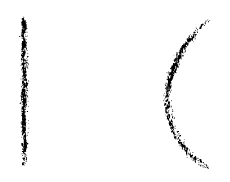
[ 9 ] So also sehe man darauf, daß man die Kinder gleich von Anfang an etwas tun läßt, und man sehe weiter darauf, daß dann eine solche Handlung in den nächsten Stunden wiederholentlich durchgenommen wird. Man läßt in der nächsten Stunde also eine gerade Linie machen, dann eine krummeLinie. Nun kommt da eine feine Nuance in Betracht. Es ist nicht zuerst der große Wert darauf zu legen, daß Sie die Kinder aus dem Gedächtnisse eine gerade und eine krumme Linie machen lassen; sondern Sie machen auch das nächste Mal die gerade Linie an der Tafel vor und lassen die Kinder sie nachmachen und die krumme Linie ebenso. Nur fragen Sie dann: Du, was ist das? — Eine gerade Linie! — Du, was ist das? — Eine krumme Linie! - Sie sollten also das Prinzip der Wiederholung ausnützen, indem Sie das Kind die Zeichnung nachmachen lassen und, indem Sie es nicht selbst angeben, das Kind selber die Angabe machen lassen, was es vor sich hat. Diese feine Nuance zu benutzen, ist von großer Bedeutung. Sie müssen überhaupt darauf Wert legen, gewohnheitsmäßig den Kindern gegenüber das Richtige zu tun, in Ihre Gewohnheiten hinein die Unterrichtsmaximen zu bekommen.
[ 9 ] So, make sure that the children are allowed to do something right from the start, and further ensure that such an activity is repeated several times over the next few hours. In the next lesson, for example, have them draw a straight line, then a curved line. Now there is a subtle nuance to consider. The main emphasis should not initially be on having the children draw a straight line and a curved line from memory; rather, the next time, you should demonstrate the straight line on the board and have the children copy it, and do the same with the curved line. Then simply ask: “Hey, what’s this?” — “A straight line!” — “Hey, what’s this?” — “A curved line!” - You should therefore make use of the principle of repetition by having the child copy the drawing and, rather than providing the answer yourself, letting the child identify what is in front of them. Making use of this subtle nuance is of great importance. You must, in general, make it a habit to do what is right for the children and to incorporate the principles of teaching into your daily routines.
[ 10 ] Dann brauchen Sie durchaus nicht davor zurückzuscheuen, ziemlich früh - es ist gerade besonders gut, so etwas sehr früh mit den Kindern zu machen - einen Farbenkasten aufzustellen, ein Wasserglas daneben, Sie nehmen einen Pinsel zur Hand, tauchen ihn ins Wasserglas, nehmen von der Farbe etwas ab und, nachdem Sie vorher eine weiße Fläche auf der Tafel mit Reißnägeln angemacht haben, tragen Sie eine kleine gelbe Fläche darauf auf. Nachdem Sie diese kleine gelbe Fläche gemacht haben, lassen Sie wieder jedes Kind eine solche gelbe Fläche machen. Es muß jedes Kind einen gewissen Abstand von der andern gelben Fläche lassen, so daß Sie also dann so und so viele gelbe Flächen haben. Darauf tauchen Sie selbst den Pinsel in die blaue Farbe ein und machen neben die kleine Fläche, die Sie gelb angestrichen haben, unmittelbar daneben Blaues. Jetzt lassen Sie auch die Kinder in derselben Weise Blaues machen. Nachdem etwa die Hälfte der Kinder das gemacht hat, sagen Sie: Jetzt wollen wir etwas anderes machen; jetzt will ich den Pinsel ins Grüne tauchen und zu den andern Flächen eine grüne dazu machen. — Von den andern Kindern lasse ich nun — indem ich auf irgendeine Weise vermeide, daß die Kinder dabei gleich eifersüchtig aufeinander werden - in derselben Weise grün machen. Das wird eine gewisse Zeit in Anspruch nehmen; die Kinder werden es gut verdauen, wie es überhaupt darauf ankommt, ganz langsam, nur in ganz wenigem mit dem Unterricht fortzugehen. — Nun sollten Sie schon sagen: Jetzt will ich euch etwas mitteilen, was ihr noch nicht ganz gut verstehen könnt, was ihr aber einmal gut verstehen werdet: was wir da oben gemacht haben, daß wir blau neben gelb gesetzt haben, das ist schöner, als was wir da unten gemacht haben, wo wir grün neben gelb gesetzt haben; blau neben gelb ist schöner als grün neben gelb! - Das wird sehr tief in der Seele des Kindes haften. Darauf wird es erstens öfter zurückzuführen sein in der Wiederholung, es wird aber auch selber daran nagen; es wird es nicht ganz gleichgültig aufnehmen, sondern es wird an einfachen, primitiven Beispielen sehr gut verstehen lernen, nach und nach, im Gefühl abzuheben ein Schönes von einem weniger Schönen.
[ 10 ] Then you certainly don’t need to shy away from setting out a box of paints quite early on—it’s actually especially good to do something like this with children very early on—along with a glass of water next to it, pick up a paintbrush, dip it into the glass of water, take a little paint, and—after you’ve first marked off a white area on the board with thumbtacks—apply a small yellow area there. After you’ve made this small yellow area, let each child make a yellow area of their own. Each child must leave a certain distance between their yellow area and the next one, so that you end up with a certain number of yellow areas. Then you dip the brush into the blue paint yourself and paint a blue area right next to the small yellow area you painted. Now have the children paint blue in the same way. After about half of the children have done this, say: “Now let’s do something else; I’m going to dip the brush in green and add a green patch to the others.” — I’ll now have the other children—while taking care in some way to prevent them from becoming jealous of one another—paint green in the same way. This will take some time; the children will absorb it well, since it’s essential to proceed with the lesson very slowly, in very small steps. — Now you should say: “I want to tell you something that you may not yet fully understand, but that you will understand well one day: what we did up there—putting blue next to yellow—is more beautiful than what we did down here, where we put green next to yellow; blue next to yellow is more beautiful than green next to yellow!” - This will take root very deeply in the child’s soul. Not only will it be a frequent point of reference during review, but it will also linger in the child’s mind; the child will not accept it with complete indifference, but will learn to understand very well—through simple, basic examples—how to distinguish, little by little and intuitively, what is beautiful from what is less beautiful.
[ 11 ] Ein Ähnliches ist auch möglich, beim musikalischen Unterricht zu verwenden. Auch da ist es gut, von irgendeinem Tone auszugehen. Man braucht dem Kinde gar nicht einmal den Namen dieses Tones beizubringen, sondern man schlägt in irgendeiner Weise einen Ton an. Gut ist es dann, von den Kindern selbst diesen Ton gleich anschlagen zu lassen, also auch da das Willentliche damit zu verbinden. Nachher schlägt man einen zweiten konsonierenden Ton an und läßt wieder eine Reihe von Kindern diesen selben konsonierenden Ton anschlagen. Nachher setzt man das fort, indem man zu einem Ton einen dissonierenden 'Ton anschlägt und läßt wieder von den Kindern dasselbe nachmachen. Und man versucht nun, ebenso wie vorher bei der Farbe, ein Gefühl von Konsonanz und Dissonanz für Töne bei den Kindern zu erwecken, indem man ihnen nicht von Konsonanz und Dissonanz redet, sondern von schön und weniger schön, also auch dabei auf die Empfindung sieht. Von diesen Dingen, nicht von Buchstaben aus, sollte der erste Unterricht ausgehen. Damit sollte man beginnen.
[ 11 ] A similar approach can also be used in music lessons. Here, too, it is good to start with any note. You don’t even need to teach the child the name of this note; instead, you simply sound a note in some way. It is then good to have the children strike this note themselves right away, thus also connecting the act of striking the note with their own volition. Afterward, one strikes a second consonant note and again has a group of children strike this same consonant note. One then continues by striking a dissonant note alongside a consonant note and again has the children imitate this. And one now tries, just as before with color, to awaken a sense of consonance and dissonance for tones in the children, not by speaking to them about consonance and dissonance, but rather about what is beautiful and what is less beautiful—thus focusing on their sensory experience. The first lessons should be based on these things, not on letters. That is where one should begin.
[ 12 ] Nun nehmen wir an, wir haben zunächst den Klassenlehrer. Der wird in seinem Unterricht mit den Kindern diese eben angeführten Gespräche führen. Das Musikalische wird vielleicht davon getrennt sein müssen; es wird dann zu einer andern Zeit an die Kinder auch herangebracht werden. Nun wird es gut sein, wenn der Musiklehrer ein ganz ähnliches Gespräch, nur mehr auf das Musikalische abgestuft, mit den Kindern führt und es dann auch wiederholentlich vorbringt, damit das Kind sieht: Es wiederholt sich dies nicht nur bei einem Lehrer, sondern es sagt auch der andere Lehrer dasselbe und dadurch erfährt man dasselbe. Dadurch soll der mehr republikanische Charakter der Schule erzielt werden. In der Wochenkonferenz der Lehrerschaft sollten diese Dinge immer durchgesprochen werden und damit eine gewisse Einheit im Unterricht hervorgerufen werden.
[ 12 ] Now let’s assume we start with the classroom teacher. In his or her lessons with the children, the teacher will have the conversations just mentioned. The musical aspect may need to be kept separate; it will then be introduced to the children at a different time. It would be beneficial for the music teacher to have a very similar conversation with the children—one focused more specifically on music—and to repeat it regularly, so that the child realizes: This is not just one teacher saying this; the other teacher says the same thing as well, and through this, the children learn the same lesson. This is intended to foster a more democratic character in the school. These matters should always be discussed at the weekly faculty meeting to foster a certain unity in instruction.
[ 13 ] Erst dann, wenn man in einer solchen Weise mit den Kindern manuellen Unterricht und Gehörunterricht getrieben hat, ist der Zeitpunkt gekommen, wo man übergeht zu den ersten Elementen des Lesens, und zwar namentlich des Lesens der geschriebenen Schrift. - Über alles einzelne werden wir noch genauer reden; heute möchte ich in der vorbereitenden Stunde nicht alles pedantisch nebeneinander stellen, ich möchte vielmehr die Gesichtspunkte angeben, nach denen wir dann weiter verfahren können. — Schon das wird außerordentlich gut auf das Kind in methodischer Beziehung wirken, wenn Sie ihm in den ersten Stunden davon gesprochen haben, daß es Schreiben, Lesen und Rechnen zwar jetzt noch nicht kann, aber alle diese Dinge in der Schule lernen wird. Dadurch prägt sich in dem Kinde die Hoffnung aus, der Wunsch, der Vorsatz, und es lebt sich durch das, was sie selber tun, in eine Gefühlswelt hinein, die wieder Ansporn ist zur Willenswelt. Also selbst das können Sie tun, daß Sie in bezug auf das Erzieherische das, was Sie später tun wollen, nicht unmittelbar an das Kind heranbringen, sondern es einige Zeit in der Erwartung lassen. Das wirkt außerordentlich günstig auf die Willensausbildung des werdenden Menschen.
[ 13 ] Only after conducting manual and auditory instruction with the children in this manner has the time come to move on to the first elements of reading—specifically, reading written text. — We will discuss each detail in greater depth later; today, in this preparatory lesson, I do not wish to list everything pedantically side by side; rather, I would like to outline the principles according to which we can then proceed. — It will already have an extraordinarily positive effect on the child from a methodological standpoint if, in the first few lessons, you have explained to them that although they cannot yet write, read, or do arithmetic, they will learn all these things in school. This instills in the child hope, desire, and resolve, and through their own actions, they immerse themselves in a world of feelings that in turn serves as an incentive for the world of the will. So even in this regard, you can avoid presenting to the child—in terms of education—what you intend to do later; instead, let them remain in a state of anticipation for some time. This has an extraordinarily beneficial effect on the development of the will in the growing human being.
[ 14 ] Nun möchte ich, bevor ich weiter darauf eingehe, einige Vorstellungen bei Ihnen zerstreuen, die Sie vielleicht beirren könnten. Es ist so viel gesündigt worden durch die bisherigen Methoden des Lesen- und Schreibenlernens, insbesondere aber desjenigen Lernens, das mit dem Lesen- und Schreibenlernen doch verknüpft ist: mit dem Sprachunterricht, mit der Grammatik, der Satzlehre und so weiter. So viel ist gesündigt worden, daß es wohl wenige Menschen gibt, die sich nicht mit einem gewissen Schrecken erinnern an die Art, wie sie Grammatik oder gar Syntax lernen mußten. Dieser Schrecken ist ja voll berechtigt. Allein es darf nicht geglaubt werden, daß deshalb das Lernen der Sprachlehre als solches unnütz wäre und daß man es ganz beseitigen sollte. Das wäre ein ganz falscher Glaube. Selbstverständlich könnte es sein, daß nun — da man einfach das Richtige dadurch zu treffen sucht, daß man von einem Extrem ins andere geht - jemand sagte: Also lassen wir alle Grammatik weg, lehren wir das Kind praktisch lesen, indem wir ihm Lesestücke vorlegen: Lehren wir es Lesen und Schreiben ohne alle Grammatik! - Diese Vorstellung könnte sich gerade aus dem Schrecken heraus ergeben, an den sich mancher erinnert. Doch das Lernen der Grammatik ist nicht ein unnötiger Faktor, besonders nicht in unserer Zeit, aus dem folgenden Grunde.
[ 14 ] Now, before I go into this further, I would like to dispel a few mental images you may have that could lead you astray. So many mistakes have been made with the methods used to date for teaching reading and writing—but especially with those forms of learning that are closely linked to learning to read and write: language instruction, grammar, syntax, and so on. So many mistakes have been made that there are probably few people who do not recall with a certain dread the way they had to learn grammar or even syntax. This dread is, of course, entirely justified. Yet one must not believe that, for this reason, the study of language as such is useless and should be eliminated entirely. That would be a completely false belief. Of course, it could be that now—since one is simply trying to do the right thing by swinging from one extreme to the other—someone might say: “So let’s do away with all grammar; let’s teach the child to read practically by presenting reading passages; let’s teach them to read and write without any grammar at all!” This mental image might arise precisely from the dread that many recall. Yet the study of grammar is not an unnecessary factor, especially not in our time, for the following reason.
[ 15 ] Was tun wir denn eigentlich, indem wir das unbewußte Sprechen zu dem grammatikalischen, zu dem Wissen von dem Grammatikalischen erheben? Wir gehen bei unserem Zögling dazu über, die Sprache von dem Unbewußten überhaupt ins Bewußte zu erheben; wir wollen ihm gar nicht pedantisch Grammatik beibringen, sondern das, was sonst unbewußt vollzogen wird, zum Bewußten erheben. Unbewußt oder halb bewußt rankt sich in der Tat der Mensch im Leben an der Außenwelt hinauf so, wie es dem entspricht, was man in der Grammatik lernt. In der Grammatik lernen wir zum Beispiel, daß es Hauptwörter gibt. Hauptwörter sind Bezeichnungen für Gegenstände, für Gegenstände, die in gewissem Sinne im Raume abgeschlossen sind. Daß wir an solche Gegenstände im Leben herantreten, ist nicht ohne Bedeutung für unser Leben. Wir werden uns an alledem, was durch Hauptwörter ausgedrückt wird, unserer Selbständigkeit als Menschen bewußt. Wir sondern uns von der Außenwelt dadurch ab, daß wir lernen durch Hauptwörter die Dinge zu bezeichnen. Wenn wir etwas Tisch oder Stuhl nennen, so sondern wir uns von dem Tisch oder dem Stuhl ab: Wir sind hier, der Tisch oder Stuhl ist dort. Ganz anders ist es, wenn wir durch Eigenschaftswörter die Dinge bezeichnen. Wenn ich sage: Der Stuhl ist blau -, so drücke ich etwas aus, was mich mit dem Stuhl vereint. Die Eigenschaft, die ich wahrnehme, vereinigt mich mit dem Stuhl. Indem ich einen Gegenstand durch ein Hauptwort bezeichne, sondere ich mich von ihm ab; indem ich die Eigenschaft ausspreche, rücke ich wieder mit ihm zusammen, so daß die Entwickelung unseres Bewußtseins im Verhältnis zu den Dingen in Anreden spielt, die man sich durchaus zum Bewußtsein bringen muß. — Spreche ich das Tätigkeitswort aus: Der Mann schreibt -, dann vereinige ich mich nicht nur mit dem Wesen, von dem ich das Tätigkeitswort ausspreche, sondern ich tue mit, was der andere tut mit seinem physischen Leibe. Das tue ich mit, mein Ich tut es mit. Was mit dem physischen Leibe ausgeführt wird, das tut mein Ich mit, indem ich ein Zeitwort, ein Tätigkeitswort ausdrücke. Ich verbinde mein Ich mit dem physischen Leib des andern, wenn ich ein Tätigkeitswort ausdrücke. Unser Zuhören, namentlich bei den Tätigkeitsworten, ist in Wirklichkeit immer ein Mittun. Das Geistigste zunächst im Menschen tut mit, es unterdrückt nur die Tätigkeit. In der Eurythmie wird nur diese Tätigkeit in die Außenwelt hineingestellt. Die Eurythmie gibt neben allem übrigen eben auch das Zuhören. Wenn einer etwas erzählt, so hört der andere zu, indem er das, was in Lauten physisch lebt, in seinem Ich mittut, doch er unterdrückt es. Das Ich macht immer Eurythmie mit, und das, was wieder die Eurythmie an dem physischen Leibe ausführt, ist nur das Sichtbarwerden des Zuhörens. Sie eurythmisieren also immer, indem Sie zuhören, und indem Sie wirklich eurythmisieren, machen Sie nur dasjenige sichtbar, was Sie unsichtbar sein lassen beim Zuhören. Die Offenbarung der Tätigkeit des zuhörenden Menschen ist nämlich Eurythmie. Sie ist gar nichts Willkürliches, sondern sie ist in Wirklichkeit das Offenbarwerden der Tätigkeit des zuhörenden Menschen. — Die Menschen sind ja heute innerlich furchtbar verschlampt, so daß sie zunächst beim Zuhören innerlich eine furchtbar schlechte Eurythmie machen. Indem Sie es normativ machen, erheben Sie es zu einer wirklichen Eurythmie. Die Menschen werden durch Eurythmie lernen, richtig zuzuhören, denn heute können sie nämlich nicht richtig zuhören. — Ich habe sonderbare Entdeckungen bei meinen jetzigen Vorträgen gemacht. Es treten in der Diskussion zum Beispiel Redner auf. Aber man merkt aus ihren Reden sehr bald, daß sie eigentlich den ganzen Vortrag gar nicht gehört haben, nicht einmal physisch, sondern sie haben nur gewisse Teile des Vortrages gehört. Besonders im jetzigen Zeitraume unserer Menschheitsentwickelung ist das von ganz besonderer Bedeutung. So greift irgend jemand in die Diskussion ein und spricht dann von dem, was er seit Jahrzehnten gewohnt ist zu denken. Nun spricht man vor sozialistisch denkenden Menschen, aber die hören eigentlich nur das, was sie von ihren Agitatoren seit Jahrzehnten gehört haben, das andere hören sie nicht einmal physisch. Sie drücken das manchmal naiv aus, indem sie sagen: Dr. Steiner sagt manches Schöne, aber er sagt nichts Neues! — Die Leute sind so starr geworden von ihrem Zuhören, daß sie alles übrige verwuseln, außer demjenigen, was sich ihnen seit Jahrzehnten eingestarrthat. Die Menschen können nicht zuhören und werden immer weniger zuhören können in unserem Zeitalter, wenn nicht dieses Zuhören durch Eurythmie wieder erweckt wird.
[ 15 ] What are we actually doing when we elevate unconscious speech to the level of grammar, to the knowledge of grammar? With our student, we are in the process of elevating language from the unconscious to the conscious; we do not intend to teach them grammar in a pedantic way, but rather to elevate to the conscious level what is otherwise carried out unconsciously. Unconsciously or semi-consciously, human beings do indeed climb up through life in the external world in a way that corresponds to what we learn in grammar. In grammar, for example, we learn that there are nouns. Nouns are designations for objects—objects that, in a certain sense, are self-contained in space. The fact that we approach such objects in life is not without significance for our lives. Through everything expressed by nouns, we become aware of our independence as human beings. We separate ourselves from the external world by learning to designate things through nouns. When we call something a table or a chair, we separate ourselves from the table or the chair: we are here, the table or chair is there. It is quite different when we designate things using adjectives. When I say, “The chair is blue,” I am expressing something that unites me with the chair. The quality I perceive unites me with the chair. By designating an object with a noun, I separate myself from it; by expressing its quality, I draw closer to it again, so that the development of our consciousness in relation to things plays out in forms of address that we must certainly bring to our awareness. — When I utter the verb “The man is writing,” I not only unite myself with the being of whom I speak, but I also participate in what the other is doing with his physical body. I participate in this; my “I” participates in it. Whatever is carried out with the physical body, my “I” participates in it by uttering a verb. I connect my “I” with the other person’s physical body when I express a verb. Our listening—especially when it comes to verbs—is in reality always a form of participation. The most spiritual aspect of the human being participates; it merely suppresses the activity. In eurythmy, it is precisely this activity that is brought into the outer world. Eurythmy encompasses, among everything else, the very act of listening. When one person tells a story, the other listens by participating in their “I” with what lives physically in the sounds, yet they suppress it. The “I” is always participating in eurythmy, and what eurythmy then expresses through the physical body is merely the manifestation of listening. So you are always performing eurythmy when you listen, and when you truly perform eurythmy, you are merely making visible what you allow to remain invisible while listening. For the revelation of the activity of the person who is listening is, in fact, eurythmy. It is by no means arbitrary; rather, it is in reality the manifestation of the activity of the person who is listening. — People today are, after all, terribly scatterbrained inwardly, so that when they listen, they initially perform a terribly poor eurythmy inwardly. By performing it in a normative way, you elevate it to true eurythmy. People will learn to listen properly through eurythmy, for today they are simply unable to listen properly. — I have made some strange discoveries during my current lectures. For example, speakers emerge in the discussion. But you very quickly realize from their remarks that they haven’t actually heard the entire lecture at all—not even physically—but have only heard certain parts of it. This is of particular significance, especially at this stage of humanity’s development. So someone interjects in the discussion and then speaks of what they have been accustomed to thinking for decades. Now one is speaking before people with socialist views, but they actually hear only what they have been hearing from their agitators for decades; they do not even physically hear the rest. They sometimes express this naively by saying: “Dr. Steiner says many beautiful things, but he says nothing new!” — People have become so rigid in their listening that they tune out everything else except what has become ingrained in them over decades. People cannot listen—and will be less and less able to listen in our age—unless this ability to listen is reawakened through eurythmy.
[ 16 ] Es muß wieder eine Art Gesundung des Seelenwesens eintreten. Daher wird es besonders wichtig sein, daß zu dem MaterialistischHygienischen des Turnunterrichts und zu allem, wo bloß auf die Physiologie der Körperverrichtungen Rücksicht genommen wird, hinzugefügt werde die Hygiene der Seele, indem immer abwechselnd eine Turnstunde und eine Eurythmiestunde gegeben wird. Da wird, wenn auch Eurythmie in erster Linie etwas Künstlerisches ist, das hygienische Element der Eurythmie zum besonderen Vorteil des zu Erziehenden werden, denn die Menschen werden nicht nur etwas Künstlerisches in der Eurythmie lernen, sondern sie werden durch die Eurythmie für die Seele dasselbe lernen, was sie vom 'Turnen für den Leib lernen, und diese beiden Dinge werden gerade sehr schön ineinanderwirken. Es kommt darauf an, daß wir wirklich unsere Kinder so erziehen, daß sie wieder auf die Umwelt, auf ihre Mitmenschen achten lernen. Das ist ja die Grundlage alles sozialen Lebens. Heute redet jeder von sozialen Impulsen, aber lauter antisoziale Triebe sind unter den Menschen vorhanden. Sozialismus müßte damit beginnen, daß die Menschen sich wieder achten lernen. Das können sie nur, wenn sie einander wirklich zuhören. Es ist außerordentlich wichtig, daß man auf diese Dinge wieder die Empfindung lenkt, wenn man Erzieher und Unterrichter werden soll.
[ 16 ] There must once again be a kind of healing of the soul. Therefore, it will be particularly important to supplement the materialistic-hygienic aspects of physical education—and everything that focuses solely on the physiology of physical movements—with the hygiene of the soul, by alternating between a physical education class and a eurythmy class. Although eurythmy is primarily an artistic endeavor, its hygienic element will be of particular benefit to the students, for they will not only learn something artistic through eurythmy, but they will also learn for the soul through eurythmy what they learn from “gymnastics for the body,” and these two things will interact very beautifully with one another. It is essential that we truly educate our children in such a way that they learn once again to pay attention to their surroundings and to their fellow human beings. That, after all, is the foundation of all social life. Today everyone talks about social impulses, but there are nothing but antisocial impulses among people. Socialism would have to begin with people learning to respect one another again. They can only do this if they truly listen to one another. It is extremely important to refocus one’s attention on these matters if one is to become an educator or teacher.
[ 17 ] Indem Sie nun von so etwas wissen: durch das Aussprechen des Hauptwortes trenne ich mich ab von der Umwelt, durch das Aussprechen des Eigenschaftswortes verbinde ich mich mit ihr, und durch das Aussprechen des Tätigkeitswortes gehe ich tätig auf in der Umwelt, tue mit, indem Sie das wissen, werden Sie dadurch schon mit einer ganz andern inneren Betonung von Hauptwort, Eigenschaftswort und Zeitwort reden, als wenn Sie dieses Bewußtsein nicht haben. Das alles ist jedoch nur präliminarisch, soll noch weiter fortgesetzt werden. Ich will nur jetzt gewisse Vorstellungen hervorrufen, deren Nichtvorhandensein Sie beirren könnte.
[ 17 ] Now that you know about something like this: by uttering the noun, I separate myself from the environment; by uttering the adjective, I connect with it; and by uttering the verb, I actively merge with the environment and participate in it—by knowing this, you will already speak with a completely different internal emphasis on nouns, adjectives, and verbs than if you did not have this awareness. All of this, however, is merely preliminary; it is to be continued further. For now, I merely wish to evoke certain mental images, the absence of which might mislead you.
[ 18 ] Es ist also außerordentlich wichtig, daß wir wissen, was das Sich-zum-Bewußtsein-Bringen des Aufbaues unserer Sprache für den Menschen für eine Bedeutung hat. Aber außerdem müssen wir uns ein Gefühl aneignen, das im heutigen Menschen auch schon größtenteils erstorben ist, ein Gefühl dafür, wie weise eigentlich die Sprache ist. Sie ist ja viel gescheiter als wir alle. Die Sprache ist - das werden Sie von vornherein doch glauben - in ihrem Bau nicht von Menschen aufgebaut. Denn denken Sie sich, wenn die Menschen sich hätten in Parlamenten zusammensetzen sollen und aus ihrer Gescheitheit heraus den Sprachbau bestimmen, was dabei herausgekommen wäre! Etwas, was so gescheit ist wie unsere Gesetze! Der Sprachbau aber ist wahrlich gescheiter als unsere Staatsgesetze. Der Sprachbau enthält größte Weistümer. Und wie bei einem Volke oder einem Volksstamme gesprochen wird, davon kann man außerordentlich viel lernen. Indem man sich bewußt hineinlebt in das Gefüge der Sprache, lernt man von dem Sprachgenius selbst sehr viel. Und etwas Konkretes empfinden lernen von dem Wirken und Weben des Sprachgeistes, das ist von außerordentlicher Wichtigkeit. Glauben, daß der Sprachgenius in dem Aufbau der Sprache wirkt, das ist von einer großen Bedeutung. Dieses Gefühl kann auch weiter ausgebaut werden, kann so weit ausgebaut werden, daß man sich bewußt wird: Wir Menschen sprechen; die Tiere können noch nicht sprechen, sie haben höchstens die Anfänge einer artikulierten Sprache. - In unserer Zeit, wo man alles verwischen will, schreibt man ja auch den Ameisen und den Bienen Sprache zu. Aber das ist ja gegenüber der Wirklichkeit alles Unsinn. Das ist alles aufgebaut auf eine Urteilsform, auf die ich öfter aufmerksam gemacht habe. Es gibt heute Naturphilosophen, die sich sehr weise dünken und die sagen: Warum sollten denn nicht auch die Pflanzen ein Willens- und Empfindungsleben haben? Gibt es doch sogar solche Pflanzen, die sogenannten fleischfressenden Pflanzen, die, wenn kleine Tiere in ihre Nähe fliegen, diese anziehen und sich dann schließen, wenn das Tier in sie hereingekrochen ist. — Das sind also Wesen, die sich scheinbar willentlich verhalten zu dem, was in ihre Nähe kommt. Aber man darf solche äußere Merkmale nicht zur Charakteristik des Willens verwenden. Wenn von einer solchen Anschauung die Rede ist, dann sage ich gewöhnlich, indem ich dieselben logischen Formen dabei verwende: Ich kenne ein Ding, das auch wartet, bis ein lebendiges Wesen in seine Nähe kommt, dann es aufnimmt und innerlich festhält. Das ist die Mausefalle. Das bloße Anschauen der Mausefalle könnte man also ebenso für einen Beweis für das Leben der Mausefalle halten, wie das Anschauen der Venusfliegenfalle für das Bewußtsein dieser Pflanze.
[ 18 ] It is therefore extremely important that we understand what significance becoming aware of the structure of our language has for human beings. But in addition, we must cultivate a sense—one that has already largely died out in people today—of just how wise language actually is. After all, it is far wiser than any of us. Language—as you will surely agree from the outset—was not constructed by human beings. Just imagine, if people had had to sit together in parliaments and determine the structure of language based on their own cleverness, what would have come of it! Something as clever as our laws! But the structure of language is truly wiser than our state laws. The structure of language contains the greatest wisdom. And one can learn an extraordinary amount from the way a people or a tribe speaks. By consciously immersing oneself in the fabric of language, one learns a great deal from the genius of language itself. And learning to perceive something concrete about the workings and interplay of the linguistic spirit is of extraordinary importance. Believing that the linguistic genius is at work in the structure of language is of great significance. This sense can also be further developed—to the point where one becomes aware: We humans speak; animals cannot yet speak; at most, they possess the beginnings of an articulated language. - In our time, when people want to blur all distinctions, they even attribute language to ants and bees. But in light of reality, that is all nonsense. It is all based on a form of judgment that I have often drawn attention to. There are natural philosophers today who consider themselves very wise and who say: Why shouldn’t plants also have a life of will and feeling? After all, there are even plants—the so-called carnivorous plants—that, when small animals fly near them, attract them and then close in on them once the animal has crawled inside. — These are, then, beings that appear to behave intentionally toward whatever comes near them. But one must not use such external characteristics to define the nature of will. When such a view is discussed, I usually respond—using the same logical forms—by saying: I know of a thing that also waits until a living being comes near it, then takes it in and holds it fast within itself. That is the mousetrap. Merely observing the mousetrap could therefore be considered just as much proof of the mousetrap’s life as observing the Venus flytrap could be considered proof of that plant’s consciousness.
[ 19 ] Man muß sich ein starkes Bewußtsein dafür aneignen, daß artikuliertes Sprechen menschliches Eigentum ist. Der Mensch muß sich auch zum Bewußtsein bringen, wie er in der Welt den andern drei Reichen der Natur gegenübersteht. Wenn er sich dessen bewußt ist, weiß er, daß sein Ich wesentlich mitbedingt ist durch alles, was Sprache ist. Heute ist allerdings für die Menschen das Sprechen auch schon etwas sehr Abstraktes geworden. Aber ich möchte Sie an etwas erinnern, aus dem Sie wieder Respekt für die Sprache bekommen können. Wenn in sehr alten Zeiten, zum Beispiel in der jüdischen Kultur — aber noch deutlicher ausgesprochen gilt das für die noch älteren Kulturen — die Kultusvertreter, die Kultusverwalter, die Priester bei den Kultushandlungen auf gewisse Begriffe gekommen sind, so haben sie die Rede unterbrochen und gewisse Bezeichnungen für hohe Wesen nicht durch Worte gegeben, sondern sie sind dann stumm geworden und haben nur die entsprechende eurythmische Gebärde gemacht, dann haben sie weiter geredet. So wurde zum Beispiel jener Name, der uns heute schon ganz abstrakt klingt und der im Hebräischen wiedergegeben hat das «Ich bin der Ich-bin», niemals ausgesprochen, sondern es wurde immer die Rede bis zu ihm geführt, dann das Zeichen gemacht, dann wurde die Rede fortgesetzt. Das bedeutete, durch die Gebärde ausgedrückt, den «unaussprechlichen Namen des Gottes im Menschen». Warum wurde das so gemacht? Es wurde deshalb gemacht, weil, wenn dieser Name ohne weiteres ausgesprochen und nachgesprochen worden wäre, dann die Menschen durch ihre damalige Sensitivität betäubt worden wären. Es gab noch Sprachlaute und Sprachlautverbindungen, durch welche die Menschen alter Kulturen betäubt werden konnten, so stark wirkten sie auf sie. Etwas wie ein reines Ohnmachtsgefühl wäre beim Aussprechen und Anhören solcher Worte über die Menschen gekommen. Deshalb sprach man von dem «unaussprechlichen Namen Gottes». Das hatte eine große Bedeutung. Und beschrieben finden Sie dies, indem davon gesagt wird: Es dürfen nur die Priester und auch die nur bei besonderen Gelegenheiten solche Namen aussprechen, weil sonst, beim Aussprechen vor nicht dazu vorbereiteten Menschen, Himmel und Erde zusammenfallen würden. Das heißt, der Mensch wäre ohnmächtig geworden. Daher wurde ein solcher Name durch eine Gebärde ausgedrückt. Was also die Sprache wirklich ist, wurde durch eine solche Empfindung ausgedrückt. Heute aber plappern die Menschen alles gedankenlos hin. Wir können heute nicht mehr die Empfindungen variieren, und diejenigen Menschen sind sehr selten geworden, die, ohne sentimental zu sein, bei gewissen Romanstellen zum Beispiel die Tränen in die Augen bekommen. Das ist etwas heute schon recht Atavistisches. Es hat sich das lebendige Empfinden für das, was in der Sprache und in der Sprachempfindung liegt, sehr abgestumpft.
[ 19 ] One must develop a strong awareness that articulate speech is a uniquely human trait. Human beings must also become aware of how they relate to the other three kingdoms of nature in the world. Once they are aware of this, they know that their “I” is essentially conditioned by everything that constitutes language. Today, however, speaking has already become something very abstract for people. But I would like to remind you of something that can help you regain your respect for language. In very ancient times, for example in Jewish culture—but this applies even more clearly to even older cultures — when the representatives of the cult, the custodians of the cult, the priests, encountered certain concepts during ritual acts, they would interrupt their speech and, when referring to exalted beings, would not use words but would fall silent and perform only the corresponding eurythmic gesture; then they would continue speaking. For example, that name—which sounds quite abstract to us today and is rendered in Hebrew as “I am who I am”—was never spoken aloud; instead, the speech would be brought up to that point, the gesture would be made, and then the speech would continue. Expressed through the gesture, this signified the “unspeakable name of God within the human being.” Why was this done? It was done because, if this name had been spoken and repeated without further ado, people would have been stunned by their sensitivity at that time. There were still speech sounds and combinations of speech sounds capable of stunning the people of ancient cultures—so powerful was their effect on them. Something like a pure sense of powerlessness would have overcome people upon uttering or hearing such words. That is why one spoke of the “unpronounceable name of God.” This had great significance. And you will find this described in the statement that only priests—and even they only on special occasions—were permitted to utter such names, because otherwise, if spoken before people who were not prepared for them, heaven and earth would collapse. That is to say, the person would have fainted. Therefore, such a name was expressed through a gesture. What language truly is, then, was expressed through such a sensation. Today, however, people babble everything out thoughtlessly. We can no longer vary our feelings, and those people have become very rare who, without being sentimental, get tears in their eyes at certain passages in a novel, for example. That is something quite atavistic today. The living sensitivity to what lies in language and in the perception of language has become very dulled.
[ 20 ] Das ist etwas, was unter vielen andern Dingen auch wieder belebt werden muß und woran wir, wenn wir es beleben werden, deutlich fühlen lernen können, was wir an dem Sprechen haben. Wir verdanken vieles in unserem Ich-Gefühl, daß wir uns als Persönlichkeit fühlen, gerade der Sprache. Und es kann sich schon im Menschen sogar bis zu etwas wie Gebetsstimmung das Gefühl erheben: Ich höre sprechen in der Sprache um mich her, da fließt die Kraft des Ich durch die Sprache in mich hinein! — Haben Sie dieses Gefühl von der Heiligkeit des Aufrufens des Ich durch die Sprache, dann werden Sie es auch durch die verschiedenen Maßnahmen bei den Kindern erwecken können. Und dann werden Sie namentlich das Ich-Gefühl bei den Kindern nicht in egoistischer Weise erwecken, sondern in einer andern Weise. Denn man kann das Ich-Gefühl in zweifacher Weise beim Kinde erwecken. Wenn man es falsch erweckt, dann wirkt es gerade zur Anfachung des Egoismus, wenn man es richtig erweckt, wirkt es zur Anfachung des Willens, geradezu zur Selbstlosigkeit, gerade zum Leben mit der Außenwelt.
[ 20 ] This is something that, among many other things, must be revived, and through which—if we do revive it—we can learn to clearly appreciate the value of speech. We owe much of our sense of self—the fact that we feel ourselves to be individuals—precisely to language. And in a person, this feeling can even rise to something like a prayerful mood: I hear speech all around me, and the power of the “I” flows into me through language! — If you have this sense of the sacredness of invoking the “I” through language, then you will also be able to awaken it in children through various methods. And then you will not awaken the sense of “I” in children in an egotistical way, but in a different way. For the sense of “I” can be awakened in a child in two ways. If it is awakened incorrectly, it serves to fuel selfishness; if it is awakened correctly, it serves to strengthen the will, to foster selflessness, and to foster a life in harmony with the outside world.
[ 21 ] Was ich jetzt gesprochen habe, das ist für Sie gesprochen als das, was Sie als Erziehende und Unterrichtende durchdringen soll. Anzuwenden werden Sie es haben in der Gestaltung des Sprachunterrichts. Wie man es in der Praxis durchdringen kann mit Bewußtheit, um Persönlichkeitsbewußtseinsgefühl in dem Kinde zu erwecken, davon wollen wir morgen weiter sprechen.
[ 21 ] What I have just said is intended for you—as educators and teachers—to internalize. You will need to apply it in the design of your language instruction. Tomorrow we will discuss further how this can be put into practice with mindfulness in order to awaken a sense of self-awareness in the child.