

The Art of Education
Methodology and Didactics
GA 294
23 August 1919, Stuttgart
Translated by Steiner Online Library
Third Lecture
[ 1 ] I already pointed out yesterday that instruction should begin with a certain artistic approach, so that the whole person—especially the life of the will—is engaged during class. From discussions such as those we have had here, you will readily recognize the importance of such an approach, and you will further recognize that instruction must be conducted in such a way that constant consideration is given to the fact that there is something dead, something dying within the human being, which must be transformed into something new and alive. If we approach natural and other cosmic beings merely through observation—that is, with our mental image, which is pictorial—we are more deeply immersed in a process of dying; if we approach them with our will, we are immersed in a process of enlivening. As educators, therefore, we will have the task of continually bringing the dead to life, of preserving within the human being that which is moving toward death before it dies completely—indeed, in a sense, of fertilizing it with what we can develop out of our will as a life-giving element. Therefore, we must not shy away from beginning, even with children, to shape our teaching in a certain artistic way.
[ 2 ] Now, everything that approaches people artistically can be divided into two currents: the plastic-visual current and the musical-poetic current. These two artistic realms—the plastic-visual and the musical-poetic—are truly polar opposites, although it is precisely through their polar opposition that they can find harmony in a higher synthesis, in a higher unity. You are surely aware that, in the course of world history, this duality in the arts is even expressed in terms of race. You need only recall certain writings by Heinrich Heine to be made aware of such a duality: that everything that originated with the Greek people or was related to them—that is, everything that, in racial terms, grew out of the essence of the Greek people—possesses, in the most eminent sense, a predisposition toward the sculptural and visual shaping of the world, whereas everything that grew out of the Jewish element possesses a special predisposition toward the truly musical element of the world. So you will find these two currents distributed along racial lines as well, and anyone who is receptive to these things will be able to trace them very clearly in the history of art. Of course, there are always efforts—justified efforts—to unite the musical with the sculptural and pictorial. But they could only be truly and completely united in fully developed eurythmy, where the musical and the visual can become one—not, of course, in the early stages in which we currently find ourselves, but in the goals that eurythmy must set for itself. We must therefore take into account, within the whole of harmonious human nature, that there is a sculptural-artistic element present in it toward which the volitional aspect of the human being tends. How, then, can we correctly characterize this tendency in human beings to become sculptural and artistic?
[ 3 ] If we were merely rational beings, if we viewed the world solely through our mental images, then we would gradually become walking corpses. We would, in fact, give the impression here on Earth of beings on the verge of death. It is only by feeling the urge within us to bring to life—through imagination—that which is, in concepts, on the verge of death, that we save ourselves from this dying. You must be careful not to seek to unify things in an abstract way if you wish to be true educators. You must not now say: One should therefore not cultivate what is deadly in human beings; one must avoid cultivating the conceptual, the mental image world within human beings. However, with regard to the spiritual-soul aspect, this would lead to the same error as if doctors, acting as great educators, were to view cultural development and then say: ‘The bones are the first part of the human being to die, so let us protect people from this first-to-die aspect; let us try to keep the bones alive and supple.’ You see, the view of such doctors would lead people to become rickety, so that they could not fully fulfill their purpose. It is always a false principle to proceed as many Theosophists and Anthroposophists wish to do when speaking of Ahriman and Lucifer and their influences on human development—saying: “These are things that harm human nature, so we must guard against them.” - But that would lead to excluding human beings from everything that is meant to constitute them. Nor can one prevent the development of the imaginative element; one must develop it, but one must never neglect to approach human nature at another time through the plastic-artistic. This is how unity arises. It does not arise by eliminating one aspect, but by developing one aspect alongside the other. In this regard, people today are not yet capable of thinking in a unified way. This is why they do not understand the threefold structure of the social organism. For social life, it is only right that the spiritual, economic, and legal spheres stand side by side, and that unity first takes shape rather than being brought about by abstractly constructing it. Just imagine what it would mean if people were to say: Since the head is a unity and the rest of the body is as well, human beings should not actually exist at all; one should separate the head from the rest of the human being and let it move freely in the world! One imitates nature only when one allows the whole to emerge from its individual parts.
[ 4 ] The point, then, is to develop one aspect: education through the imagination; the other aspect—the plastic and artistic—then brings to life what is developed in the mere concept. The point is that, without losing our naivety, we must—in our age, which constantly destroys consciousness—raise these things up into consciousness. There is no need to lose one’s naivety if one shapes things concretely rather than abstractly. For example, it would be very beneficial under all circumstances to begin as early as possible—in relation to the sculptural and artistic—by allowing the child to live within the world of colors, and for teachers to immerse themselves in what Goethe presents in the didactic section of his Theory of Colors. What is the basis of this didactic section of Goethe’s Theory of Colors? It is based on the fact that Goethe always imbues every single color with a nuance of feeling. Thus, he emphasizes the challenging quality of red; he emphasizes not only what the eye sees, but what the soul feels in red. Likewise, he emphasizes the quiet, introspective quality that the soul feels in blue. It is possible, without disrupting the child’s naivety, to introduce the child to the world of colors in such a way that the subtle nuances of sensation in the world of colors come vividly to life. If, in the process, the child perhaps gets quite dirty at first, it will be a good educational measure to guide the child to the point where he or she no longer gets too dirty.

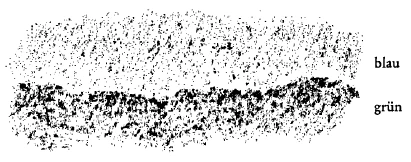
[ 5 ] One should begin as early as possible to introduce the child to colors, and it would be good to apply different colors to a colored surface than to a plain white surface, and to try to evoke in the child the kinds of sensations that can arise only from a understanding of the world of colors based on Spiritual Science. When one works as I did with some friends on the small dome of the Dornach building, one develops a living relationship with color. One then discovers, for example when applying blue, that it lies within the blue color itself to characterize everything that is inner life. So let’s say, in the case of an angel moving out of its inner life, one will naturally feel the urge to render it in blue, because the nuances of blue—its light and dark shades—evoke in the soul a sense of movement that arises from the soul itself. The yellow-reddish color evokes in the soul a sense of radiance, of something revealing itself outwardly. So when something appears aggressive, when something appears before us as a warning, when the angel wants to tell us something, when he wants to speak to us from his background, then we express this through the yellow-reddish nuances. In a very basic way, one can certainly point out this living, inner quality of colors to children. Then one must deeply imbue oneself with the realization that mere drawing already contains something untrue. The truest thing is the feeling that arises from color; the feeling that arises from light and dark is already somewhat less true; and the least true is drawing. Drawing, as such, already comes quite close to that abstract element that exists in nature as something that is dying. We should actually only draw in such a way that we become aware: we are essentially drawing the dead. We should paint with colors in such a way that we are aware: we are bringing forth the living from the dead. — What, after all, is the horizon line? If we simply take a pencil and draw the horizon line, that is an abstraction, a deadening, untrue element in relation to nature, which always has two currents: the dead and the living. We isolate one of these currents and claim that this is nature. But when I say, “I see a green, and I see a blue, which are distinct from one another,” then the horizon line emerges from the meeting of the colors; then I am speaking the truth. In this way, you will gradually come to realize that the form of nature truly arises from color, and that drawing, therefore, is an act of abstraction. One should cultivate a good mental image and a good sense of such things even in the growing child, because this enlivens the child’s entire soul and brings it into a proper relationship with the outside world. This is precisely what ails our culture: that we lack a proper relationship with the outside world. In doing so, one need not—I would say—become one-sided in one’s teaching. It would be quite good, for example, if we could gradually develop the ability to move from the purely abstract artistic—which people produce out of their love of beauty—to the concrete artistic, to the arts and crafts, for humanity today has a great need to incorporate genuine arts and crafts into general cultural life. After all, over the course of the 19th century, we have actually reached the point where we make our furniture for the eye—for example, making a chair for the eye—while it should possess the inherent quality that one feels it when sitting on it. It should be designed accordingly. One should be able to feel the chair; it should not merely be beautiful; it should possess the inherent quality that allows a person to sit on it. The entire process of the sensory experience growing together with the chair—and even the shaped sensory experience—through the way armrests are designed on the chair and so on, as a person seeks support from the chair—should be expressed in the chair itself. If, therefore, craft education with a clear focus on the arts and crafts could be introduced into the school system, it would be a great service to culture. For just consider how deeply concerned a person who is sincerely committed to humanity is today when we see, for example, the abstractions of our time—which, of course, will not come to pass if we can carry out our intentions—when the Botoku-like nature of today’s socialist-minded people seeks to overwhelm our culture: There will then be nothing beautiful left in culture, only the useful! And even if people dream of beauty—they will have no sense that, as we move toward socialization, we will have to emphasize the necessity of beauty even more strongly than before. This should be recognized.
[ 6 ] Therefore, the sculptural and visual elements should not be neglected in the classroom. Nor, however, should there be any neglect of ensuring that the dynamic element expressed in architecture is truly experienced. It is very easy to fall into the trap of introducing this or that to the children too early. But in a certain sense, this must even happen. I had addressed a few words to the children who were in Dornach as part of the Munich summer camp—80 in number—and who had taken 12 hours of eurythmy with Mrs. Kisseleff and were then able to demonstrate what they had learned to some of their teachers and the Dornach anthroposophical community. The children were really into it, and after the entire eurythmy performance—which also included demonstrations by our Dornach eurythmists—had come to an end, the children came up and asked, “Did you like our performance, too?”—They truly had the urge to perform something themselves; it was a really lovely experience. Now, at the request of the people who had arranged the whole event, I was to say a few words to the children. It was the evening before the day the children were to be taken back to the Munich area. So I said explicitly: “I’m going to say something now that you don’t yet understand. You will only understand it in the future.” But take note: when you hear the word ‘soul’ in the future, because you cannot understand it yet. — Drawing a child’s attention to something they do not yet understand—something that must first mature—is extraordinarily important. And the only principle that is wrong is the one that is so strongly emphasized today: that one should teach a child only what it already understands—a principle that renders all education lifeless. For education only comes alive when what has been taken in has been carried along in the background for a time and is then brought back to the surface after some time. This is very important for education from ages 7 to 15; then one can gently instill much into the child’s soul that can only be understood later. I ask you not to be put off by the idea that you might be going beyond the child’s current level of maturity and appealing to something the child can only understand later. The opposite principle has introduced a stifling element into our pedagogy. But the child simply must know that it has to wait. One can also instill in the child the sense that it must wait to fully understand what it is already absorbing. That is why it was not so bad in earlier times when children simply had to learn that \(1 \times 1 = 1\), \(2 \times 2 = 4\), \(3 \times 3 = 9\), and so on, rather than learning it on a calculator, as they do today. This principle of holding back the child’s understanding must be broken. Of course, this can only be done with the necessary tact, for one must not stray too far from what the child is capable of loving; but the child can grasp quite a lot based purely on the authority of the teacher, even if their understanding of it comes only later.
[ 7 ] If you introduce the child to the plastic and creative arts in this way, you will see that you can breathe life into much of what is otherwise dull.
[ 8 ] The musical element, which lives within human beings from the moment of birth and which, as I have already said, finds expression in children—particularly between the ages of three and four—as a tendency to dance, is in and of itself an element of the will; it carries life within itself. But as strange as it may sound, it is true: as it manifests in the child, it initially carries within it a life that is too intense, a numbing life—a life that easily overwhelms consciousness. A child’s development can very easily slip into a certain state of numbness due to the intense musical element. Therefore, it must be said: The educational process that arises when music is used must consist of a continuous harmonization of the Dionysian—which springs from human nature—through the Apollonian. Just as what is numbing must be enlivened through the plastic and creative arts, so too must that which is supremely alive in music be tempered, so that it does not affect people too strongly through music. This is the sensibility with which we should introduce music to children.
[ 9 ] The point is that human nature is shaped one way or another by karma. This is particularly noticeable in the musical element. But I would like to say that it is emphasized too strongly there. One should not emphasize too strongly: “This is an unmusical child; this is a musical one.” Certainly, the fact exists as such, but to use this as a reason to keep the unmusical child away from all things musical and to reserve musical education solely for children of a musical disposition is entirely wrong; at the very least, even the most unmusical children should be included in everything that is done musically. It is certainly true that, when it comes to musical performances, one increasingly allows only those children who are truly musical to perform. But even the unmusical children should be present and develop receptivity; for one will notice that even in the most unmusical child there is a remnant of musical aptitude, which is simply buried quite deep and can only be brought to the surface through loving encouragement. This should never be neglected, for what is written in a Shakespearean play is far truer than one might think: “The man who has no music within himself… is fit for treachery, robbery, and deceit… trust no such man!” This is a profound truth. Therefore, no effort should be spared to bring music to even those children who are initially considered unmusical.
[ 10 ] However, it will be of the utmost importance, especially in a social context, that music be cultivated even at a basic level, so that children are taught based on fundamental musical principles—without being overwhelmed by theory—using basic musical concepts. Children should gain a clear mental image of the fundamentals of music—harmony, melody, and so on—through the use of the most basic musical concepts possible and through the aural analysis of melodies and harmonies, so that in music we proceed just as fundamentally in the development of the entire artistic process as we do in the visual and plastic arts, where we also build up from the details. This will mitigate what exerts such a strong influence on music: dilettantism—although it certainly cannot be denied that musical dilettantism also has a certain usefulness in our social life. We would not be able to make much progress without it, but it should be limited to the audience. It is precisely through this, however, that it would be possible to allow those who produce music to be properly valued within our social order. For we should not forget that everything in the plastic and visual arts works toward the individualization of human beings, whereas everything in music and poetry works toward the promotion of social life. People come together in unity through music and poetry; they individualize themselves through the plastic and visual arts. Individuality is sustained more by the plastic and visual arts, while sociality is sustained more by communal life and interaction through music and poetry. Poetry is born out of the solitude of the soul—and only there; it is understood through human community. It is not an abstract concept that one seeks to establish, but something thoroughly concrete, when one says that human beings open up their innermost selves through their poetic creations, and that, by receiving these creations, the deepest inner self of another human being responds in kind. Therefore, above all else, a love of and a longing for music and poetry should be cultivated in the growing child. As for poetry, the child should be introduced to what is truly poetic at an early age. Today, people grow up in a social order in which they are tyrannized by the prose of language. Today there are countless reciters who tyrannize people with prose by emphasizing the purely factual, content-based aspects of a poem. And when a poem is presented in such a way that the actual nuances of content play the leading role, this is regarded today as a perfect recitation. A truly perfect recitation, however, is one that particularly emphasizes the musical element. — In the few words I sometimes preface my eurythmy performances with, I have often drawn attention to how, in the case of a poet like Schiller, a poem emerges from the depths of his soul. In many of his poems, he first had a general melody reigning in his soul, and only later did he, as it were, set the content—the words—to this general melody. The general melody is what the content hangs upon, and the poetic then finds its fulfillment in the shaping of the language—not in the content itself, but in the meter, the rhythm, and the maintenance of rhyme—that is, in the musicality underlying the poetic. I said that today’s style of recitation tyrannizes people, because one always tyrannizes when one places the primary value solely on the prose, on the content of a poem, which is taken in a completely abstract manner. From a Spiritual Science perspective, the only way to transcend this tyranny is—as I always strive to do—to present a subject from the most diverse angles, so that the concepts remain fluid, even artistically. I once had a special joy when one of our artistically gifted friends told me that certain lecture cycles could be transformed into a symphony purely through their inner structure. Such a structure is, in fact, inherent in certain cycles. Take, for example, the cycle given in Vienna on life between death and a new birth; you will see that you could turn it into a symphony. This is possible because a Spiritual Science lecture is not meant to be overbearing, but rather to awaken people’s will. But when people approach a subject such as the “Key Points of the Social Question,” they say it is incomprehensible to them. Yet it is not incomprehensible; rather, they are simply unaccustomed to this style.
[ 11 ] It is therefore extremely important that, in the case of any piece of poetry, the child’s attention be drawn to the underlying musicality. For this reason, the structure of the lessons should be organized in such a way that the recitative element introduced into the school is brought as close as possible to the musical element. The music teacher should work as closely as possible with the recitation teacher, so that one follows the other immediately and a living connection is established between the two. It would be particularly beneficial if the music teacher could be present during recitation lessons and vice versa, so that one could continually point out the connections to the other subject. This would thoroughly eliminate what still plays such a major role in our school system today and is truly appalling: the abstract explanation of poems. This abstract explanation of poetry, which is closely tied to grammar, is the death of everything that should have an effect on the child. Interpreting poems is something truly dreadful.
[ 12 ] Now you might object: But interpretation is necessary to understand the poem! To this it must be said: The lesson must be structured as a whole. This must be discussed at the weekly faculty meeting. Certain poems will be selected for recitation. Then, the necessary elements for understanding a poem must be woven into the rest of the curriculum. Care must be taken to ensure that the child already brings to the recitation lesson what is necessary for understanding the poem. It is perfectly possible—for example, when working through Schiller’s “Spaziergang” with a child—to present to the child the cultural-historical and psychological aspects related to the poem, but not by going through the poem line by line; rather, by presenting to the child what lies beyond the content itself. In the recitation lesson, the emphasis should be placed solely on the artistic expression of the artistic.
[ 13 ] If one were to use the artistic in its two currents in this way to harmonize human nature, one would achieve an extraordinary great deal. One need only consider that something infinitely important is achieved in the union of the human being with the world through singing. Singing is, after all, in itself a re-creation of what already exists in the world. By singing, human beings express the profound wisdom upon which the world is built. But one must also not forget that, in singing, human beings connect the cosmic aspect of the actual sequence of tones with the human word. Hence, something unnatural enters into the song. One can already sense this when one perceives the lack of harmony between the musical elements of a poem and its content. It would already be a step forward if we could further develop the approach we have now begun: to keep the lines in a simple recitative and enliven only the rhyming word with melody, so that the line flows in recitative while the rhyming word is sung in the style of an aria. This would create a clear separation between the sound of a poem and its verbal content, which, after all, disturbs the truly musical person.
[ 14 ] And again, as a person’s ear is trained to perceive music, they are led to experience the musicality of the world itself in a vivid way. This is of the utmost importance for the developing human being. We must not forget: In the plastic and visual arts, we behold beauty and live it; in music, we ourselves become beauty. This is extraordinarily significant. If we go back to earlier times, we find that the further back we go, the less there is of what we actually call “music.” One can have the distinct sense that the musical realm is still in the process of becoming, even though some forms of music are already in the process of dying out. This is based on a very significant cosmic fact. In all plastic and visual arts, human beings were imitators of the ancient celestial order. The highest imitation of a cosmic-celestial order is a plastic and visual representation of the world. But in music, human beings are creators in their own right. Here, they do not create from what already exists, but lay the foundation for what will only come into being in the future. Of course, one can create a certain kind of musicality by, for example, merely imitating the sound of water waves or the song of nightingales in a musical way. But what is truly musical and truly poetic is a new creation, and out of this new creation will one day arise the later developments of Jupiter, Venus, and Vulcan. In a sense, we rescue what is yet to come from the existing nothingness of its existence and bring it into reality by connecting with the musical.
[ 15 ] It is only by connecting in this way to the great realities of the world that we can truly gain a proper understanding of teaching. This alone can give it the proper consecration, so that teaching might truly become a kind of worship by becoming a consecrated service.
[ 16 ] What I’m presenting here will be, more or less, an ideal. But we can still incorporate what we do in practice into that ideal. For example, there is one thing we should not neglect—when we take the children we teach into the mountains and fields, which will certainly happen, that is, when we lead them into nature—but in contrast to this, when leading the children into nature, we should above all always keep in mind that natural history instruction itself belongs only within the school building. Let’s suppose we now go out into nature with the children and direct their attention to a stone or a flower. In doing so, we should strictly avoid alluding outdoors to what we teach inside the school building. Outdoors, we should draw the children’s attention to nature in a completely different way than we do inside the school building. We should never fail to point this out to them: We bring you outdoors so that you can experience the beauty of nature, and we bring the products of nature into the school building so that we can analyze nature indoors. Therefore, when we’re outdoors, we should never talk to the children about what we demonstrate to them indoors—for example, regarding plants. We should emphasize the difference: it is one thing to dissect inanimate nature in the classroom, and quite another to contemplate nature in all its beauty outdoors. We should present these two experiences side by side. Anyone who takes children out into nature to use a natural object as an example of something they teach in the classroom is not doing the right thing. We should instill a certain feeling in the children: Unfortunately, we must dissect nature when we bring it into the classroom. However, the children should perceive this as a necessity, because the destruction of the natural world is also necessary for the development of the human being. We should certainly not believe that we are doing the right thing when we scientifically explain a beetle out in nature. The scientific explanation of the beetle belongs in the classroom! We should aim to awaken a joy in the beetle—joy in its movement, in its playfulness, in its relationship to the rest of nature—when we take the children outdoors. And so we should also not fail to awaken in the child’s soul this clear sense that there is something creative in music—something that transcends nature—and that human beings themselves become co-creators of nature by developing music. Of course, this will have to take shape as a very primitive feeling, but it will be the first thing that must emanate precisely from the volitional element of music: that human beings feel at home within the cosmos!