

The Art of Education
GA 295
6 September 1919, Stuttgart
Translate the original German text into any language:
Versions Available:
Discussions with Teachers, tr. Fox & Creeger
Fünfzehnte Seminarbesprechung und dritter Lehrplanvortrag
Discussion Fifteen
[ 1 ] Sprechübungen:
[ 1 ] Speech Exercises:
Schlinge Schlange geschwinde
Gewundene Fundewecken wegGewundene Fundewecken
Geschwinde schlinge Schlange wegMarsch schmachtender
Klappriger Racker
Krackle plappernd linkisch
Flink von vorne fortKrackle plappernd linkisch
Flink von vorne fort
Marsch schmachtender
Klappriger Racker
Slinging slanging a swindler
the wounding fooled a victor vexed
The wounding fooled a swindler
slinging slanging vexedMarch smarten ten
clap rigging rockets
Crackling plopping lynxes
fling from forward forthCrackling plopping lynxes
fling from forward forth
March smarten ten
clap rigging rockets
[ 2 ] Rudolf Steiner: Das ist zum Einsetzen gut. Hinweisen auf den, der fortsetzen soll; dann setzt der nächste oder ein anderer fort.
[ 2 ] RUDOLF STEINER: With this exercise you should share the recitation, like a relay race, coming in quickly one after the other. One begins, points to another to carry on, and so on.
Dritter Lehrplanvortrag
Third Lecture on the Curriculum
[ 3 ] Wir haben am Vormittag schon darauf hingewiesen: in ähnlicher Weise, wie nur allgemeine Linien angegeben werden können für das BildendKünstlerische, so kann man auch für das Musikalische nur allgemeine Linien angeben. Das einzelne muß selbstverständlich der pädagogischen Freiheit überlassen bleiben. Und da würde ich nun bitten, diese allgemeinen Linien so zu betrachten, daß sie im Grunde genommen alles eingliedern lassen, was man für vernünftig halten kann im musikalischen Unterricht.
[ 3 ] This morning it was pointed out that we can give only general guidelines for music, just as it is possible to give only general guidelines for the visual arts. The details, of course, must be left to the teacher’s independent initiative. If you take these general guidelines in the right way, you will find that, basically, they are able to incorporate whatever you may find reasonable as musical instruction.
[ 4 ] Im ersten, zweiten und dritten Schuljahr wird man es ja im wesentlichen zu tun haben mit einfachen musikalischen Verhältnissen. Und diese einfachen musikalischen Verhältnisse sollen so benützt werden, daß der Gesichtspunkt der ist: an dem, was man pädagogisch zurichtet im Musikalischen, Stimmbildung und Gehör des Menschen, des werdenden Menschen, heranzubilden. Also der Gesichtspunkt ist, das Musikalische so zuzurichten, daß es geeignet ist, den Menschen zum richtigen Bilden des Stimmlichen, des Tonlichen, und zum richtigen Hören aufzurufen. Wir verstehen uns wohl darin.
[ 4 ] In the first, second, and third grades, we will essentially be dealing with very simple musical relationships, which should be applied with a view to developing the human voice and listening ability—that is, we should use the element of music to call upon the individual to use the human voice and the element of sound properly, and also to listen appropriately. I’m sure we all understand this.
[ 5 ] Dann kommt das vierte, fünfte und sechste Schuljahr. Da wird man ja auch schon drinnen sein in der Zeichenerklärung, der Notenerklärung. Man wird schon umfassende Übungen machen können in der Tonleiter. Namentlich im fünften und sechsten Schuljahr wird man auf die Tonarten eingehen können. Man wird da schon D-dur und so weiter haben können. Mit dem Moll muß man möglichst lange warten, aber es kann doch schon auch in dieser Zeit an das Kind herangebracht werden.
[ 5 ] Then come the fourth, fifth, and sixth grades. By then we will already be involved in explaining musical notation and will be able to do comprehensive scale exercises. Especially in the fifth and sixth grades, we will be able to go into the different keys and talk about D major and so on. We should wait as long as possible before introducing the minor keys, but by this point they too can be presented to the children.
[ 6 ] Aber alles das, um was es sich dabei handelt, ist, nunmehr gewissermaßen nach dem Entgegengesetzten hinzuarbeiten: das Kind anzupassen an die Erfordernisse des Musikalischen, also den Unterricht mehr nach der ästhetischen Seite hinüberzutreiben. Zuerst soll das Kind die Hauptsache sein. Es soll alles so zugerichtet sein, daß das Kind Hören und Singen lernt. Dann aber soll das Kind, nachdem es in den ersten drei Schuljahren begünstigt worden ist, sich den künstlerischen Anforderungen der musikalischen Kunst anpassen. Das wird das Pädagogische sein, was dabei zu berücksichtigen ist.
[ 6 ] However, the important thing now is to work from the opposite of our original point of view—that is, to get the children to adapt to the demands of music. This means leaning more toward the esthetic in our teaching. At first the children themselves were the focus, and we had to structure everything so that they would learn to listen and sing. But after having been encouraged in this during the first three grades, the children should then begin to adapt to the artistic demands of music, and the pedagogical element becomes the focus.
[ 7 ] Und in den beiden letzten Schuljahren, im siebenten und achten Schuljahr, bitte ich zu berücksichtigen, daß das Kind überhaupt nicht mehr das Gefühl hat, es werde «dressiert» zu irgend etwas, sondern daß das Kind schon das Gefühl hat, es treibe Musik, weil das ihm Vergnügen macht, weil es das genießen möchte, als Selbstzweck, zur Freude. Dahin hat der sogenannte Musikunterricht zu wirken. Daher kann in diesen zwei Jahren das musikalische Urteil geweckt und ausgebildet werden. Es kann schon darauf aufmerksam gemacht werden, welchen Charakter dieses musikalische Kunstwerk hat und welchen jenes hat. Welchen Charakter ein Beethovensches Kunstwerk hat und welchen Charakter ein Brahmssches Kunstwerk hat. In einfachen Formen also sollte man das Kind zum musikalischen Urteil bringen. Vorher muß man das musikalische Urteil zurückhalten, aber jetzt muß man es pflegen.
[ 7 ] In the last two elementary grades—the seventh and eighth—I ask you to take into consideration the fact that the children must no longer have the feeling that they are being “trained” to do something, but must feel that they are making music for the pleasure it gives them, for the sake of enjoying it. This must be the thrust of our instruction in music. Therefore, during these two years the children’s musical judgment can be awakened and educated. We can make them aware of the different character of different pieces of music, of the difference in character between a work by Beethoven and a work by Brahms. In simple ways, therefore, we should encourage the children to form opinions about music. Earlier, it was important to refrain from such opinions and judgments, but now we must cultivate them.
[ 8 ] Es wird nun von ganz besonderer Wichtigkeit sein, daß eine gewisse Verständigung eintritt. Sie wissen, ich habe am Vormittag ganz das gleiche angegeben für ein bildendes Kunstwerk. Ich sagte: Zuerst verwenden wir das Zeichnen so, daß das Schreiben daraus hervorgehen kann. Dann wird das Zeichnen als Selbstzweck verwendet. Also es bildet dann die Kunst dasjenige, worauf es ankommt. In dem Moment, wo das Kind übergeht von den Utilitätsformen dazu, im Zeichnen und Malen die freien, künstlerischen Formen zu entwickeln, in dem Moment — also zwischen dem dritten und vierten Schuljahr - ist auch im Musikalischen überzugehen, so wie ich es bezeichnet habe; zuerst so arbeiten, daß es auf das Physiologische des Kindes ankommt; dann so arbeiten, daß das Kind sich der musikalischen Kunst anpassen muß. Also diese Übergänge im Zeichnerisch-Malerischen und im Musikalischen sollten eigentlich einander entsprechen.
[ 8 ] Now it will be especially important to understand one thing. You know I said something very similar this morning about the visual arts—that the way we initially use drawing allows writing to develop out of it. Later, however, drawing is used as an end in itself, and art itself becomes the important thing. As soon as the children progress from utilitarian forms of drawing and painting to developing independent artistic forms—in the third or fourth grade—it is also time to make the musical transition just described. At first we must work to affect the children physiologically; our work must help them adapt to the art of music. There should be a correspondence between these transitions in the graphic arts and in music.
[ 9 ] Nun kommt uns im offiziellen Lehrplan eines zugute: da ist in den ersten drei Schuljahren überhaupt kein Turnen. Da beginnen wir also mit der Eurythmie. Und da wäre es schon sehr schön, wenn im ersten Schuljahre namentlich Eurythmie im Einklang mit dem Musikalischen getrieben würde, so daß tatsächlich die Anpassung an Geometrie und Musik in der Eurythmie besonders gepflegt wird.
[ 9 ] One thing in the state curriculum is to our advantage—that there is no physical education instruction during the first three grades. So we may take the opportunity to begin with eurythmy. It would be very nice if eurythmy could be done in harmony with music instruction in the first grade, so that eurythmy would in fact help the children adapt to geometry and music.
[ 10 ] Im zweiten Schuljahr würde man erst mit dem Ausbilden der Buchstaben beginnen, das man dann weiter fortsetzt im dritten Schuljahr; immer so, daß man immer wiederum an Musik und Geometrie und Zeichnerisches anknüpft.
[ 10 ] Not until the second grade would we begin to develop the gestures for the letters. This would be continued in the third grade, always linking eurythmy to music, geometry, and drawing.
[ 11 ] Und dann im vierten, fünften und sechsten Schuljahr kommen hinzu die Formen, also für Konkretes, Abstraktes und so weiter, wobei solche Dinge für die Kinder ja möglich werden, weil sie in der Grammatik ja mittlerweile so weit vorwärtsgekommen sind.
[ 11 ] Forms are added in the fourth, fifth, and sixth grades—for concrete and abstract expressions, and so on—since by now the children will have made enough progress in grammar to make this possible.
[ 12 ] Dann setzen wir das fort im siebenten und achten Schuljahr für kompliziertere Formen.
[ 12 ] This is continued in the seventh and eighth grades, but the forms become more complicated.
[ 13 ] Vom vierten Schuljahr ab teilen wir die eurythmische Kunst mit dem Turnen, und zwar so, daß wir im vierten, fünften und sechsten Schuljahr «Gliederbewegen» im Turnen haben, dann alles das, was mit Laufen, Springen, Klettern zusammenhängt, und nur einfache Geräteübungen.
[ 13 ] Starting in the fourth grade, this slot in the schedule is divided between eurythmy and physical education. In the fourth, fifth, and sixth grades, instruction in physical education should focus on the movement of the limbs and include everything that has to do with running, jumping, and climbing. Any exercises on gymnastic apparatus should be kept simple.
[ 14 ] Kompliziertere Geräteübungen sind erst im siebenten und achten Schuljahr zu machen, in dem die freien Übungen auch fortgesetzt werden. Aber die freien Übungen sollen alle mit Laufen, Klettern, Springen zusammenhängen.
[ 14 ] More complicated exercises involving equipment should not be done until the seventh and eighth grades. Meanwhile, the free-form exercises should be continued, and they should still all involve running, climbing, and jumping.
[ 15 ] Wenn Sie das alles durchdenken, was Sie selber sich haben überlegen können, werden Sie das alles im Einklang finden mit dem, was jetzt auf diese Weise zu schildern versucht worden ist.
[ 15 ] If you go through all of what you’ve been able to conclude, I’m sure you will find that it agrees with the way I have tried to present this.
Fortsetzung der Seminarbesprechung
Not translated
Alexander Strakosch spricht über Ellipse, Hyperbel, Kreis, Lemniskate und den Begriff des geometrischen Ortes. Er erwähnt dabei, wie die Lemniskate (Cassinische Kurve) eine Form III annehmen kann, bei der der eine Ast der Kurve den Raum verläßt und als der andere Ast wieder in ihn eintritt.
Someone spoke about the ellipse, the hyperbola, the circle, the lemniscate, and the conception of geometrical loci. At the same time he mentioned how the lemniscate (Cassini curve) can take on the form III, in the diagram, where the one branch of the curve leaves space and enters space again as the other branch.
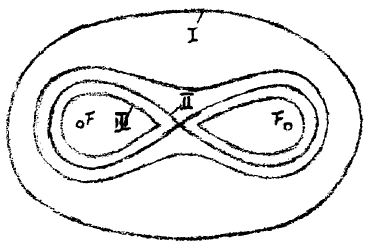
[ 16 ] Rudolf Steiner: Das hat ein inneres organisches Korrelat. Die beiden Stücke verhalten sich zueinander wie Zirbeldrüse und Herz. Der eine Ast liegt im Kopf, die Zirbeldrüse, der andere Ast liegt in der Brust, das Herz. Nur ist das eine, die Zirbeldrüse, schwächer ausgebildet, das Herz stärker.
[ 16 ] RUDOLF STEINER: This has an inner organic correlate. The two parts have the same relation to each other as the pineal gland to the heart. The one branch is situated in the head—the pineal gland, the other lies in the breast—the heart. Only the pineal gland is more weakly developed, the heart is stronger.
Caroline von Heydebrand spricht über die Völkerwanderung.
Someone spoke on a historical theme—the migrations of various peoples.
Rudolf Steiner als Zwischenbemerkung zum Vortrag von Caroline von Heydebrand:
Not translated
[ 17 ] Was als Gründe für die Völkerwanderung angeführt wird, beruht sehr häufig auf geschichtlichen Konstruktionen. Das Wesentliche ist, wenn man den Dingen zu Leibe geht, bei der eigentlichen Völkerwanderung, wo die Goten und so weiter vorrücken, daß die Römer das Geld haben, und die Germanen kein Geld haben, und daß die Tendenz besteht, daß überall da, wo eine Grenze ist, die Germanen in irgendeiner Weise sich das römische Geld aneignen wollen. Daher werden sie Söldner und alles mögliche. Es sind ja ganze Legionen von Germanen in den römischen Sold eingetreten. Es ist die Völkerwanderung eine wirtschaftlich-finanzielle Frage. Erst auf dieser Grundlage konnte dann die Ausbreitung des Christentums vor sich gehen. Die Völkerwanderung als solche rührt aber von der Habgier der Germanen her, die das Geld der Römer haben wollten. Die Römer wurden auch arm dabei! Auch schon beim Cimbernzug war es so. Den Cimbern wurde gesagt: Die Römer haben Gold! — während sie selbst arm waren. Das wirkte auf die Cimbern sehr stark. Sie wollen Gold holen. Römisches Gold!
[ 17 ] RUDOLF STEINER: The causes assigned to such migrations very often depend on the explanations of historical facts. As to the actual migrations—for example, the march of the Goths—at the root of the matter, you will find that the Romans had the money and the Germanic peoples had none, and at every frontier there was a tendency among the Germanic peoples to try to acquire Roman money one way or another. Because of this, they became mercenaries and the like. Whole legions of the Germanic peoples entered into Roman hire. The migration of the people was an economic matter. This was the only thing that made the spread of Christianity possible, but the migrations as such began, nevertheless, with the avarice of the Germanic peoples who wanted to acquire Roman money. The Romans of course were also impoverished by this. This was already the case as early as the march of the Cimbri. The Cimbri were told that the Romans had money, whereas they themselves were poor. This had a powerful effect on the Cimbri. “We want gold,” they cried, “Roman gold!”
[ 18 ] Es sind verschiedene Völkerschichten da, auch noch keltische Überreste. Sie finden heute noch deutliche Sprachanklänge an die keltische Sprache, zum Beispiel bei den Quellflüssen der Donau, Brig und Breg, Brigach und Brege. Dann überall, wo in den Ortsnamen «-ach» vorhanden ist, zum Beispiel Unterach, Dornach und so weiter. «Ach» kommt von Wässerchen her, von aqua, weist auf Keltisches zurück. Auch «Ill» und dergleichen erinnert ans alte Keltische. Über das Keltische schichtet sich dann das Germanische. - Gegensatz von Arianern und Athanasianern.
[ 18 ] There are still various race strata—even Celtic traces. Today there are definite echoes of the Celtic language—for example, at the sources of the Danube, Brig and Breg, Brigach, and Brege, and wherever you find the suffix ach in the place names such as Unterach, Dornach, and so on. Ach comes from a word meaning a “small stream” (related to aqua), and points to a Celtic origin. “Ill,” too, and other syllables remind us of the old Celtic language. The Germanic language subsequently overlaid the Celtic. [Rudolf Steiner referred to the contrast between Arians and Athanasians.1Athanasian refers to the doctrine of Saint Athanasius, or Athanasius the Great (c. 293–373), who was a Greek theologian and prelate in Egypt. Throughout his life he opposed Arianism and became known as the “Father of Orthodoxy.” He was exiled three times by Roman emperors for his stand; he wrote Four Orations against the Arians but not the Athanasian Creed (written after the fifth century), which espouses his teachings on the Trinity. The Arian doctrine, on the other hand, has to do with Arius (c. 250–336), also a Greek ecclesiastic in Alexandria, who taught a Neoplatonic doctrine that God is alone and unknowable, the creator of every being, including the Christ. Emperor Constantine I formed the Council of Nicaea in 325 to declare Arianism a heresy.
[ 19 ] Sehr wichtig ist, daß Sie den Kindern klarmachen müssen, daß ein großer Unterschied besteht - das ist gerade an der Völkerwanderung ersichtlich -, ob, wie zum Beispiel in Spanien und Italien, die germanischen Völker, wie die Goten, in schon der Agrikultur nach völlig in Anspruch genommene Gebiete einziehen. Hier wurde alles besessen. Da ziehen die gotischen und andere Völker ein. Die verschwinden. Die gehen also auf in den anderen Völkern, die schon da waren. - Nach Westen ziehen die Franken vor. Die kommen in Gegenden, die der Agrikultur nach noch nicht vollständig besetzt sind. Die erhalten sich. Daher hat sich von den Goten nichts erhalten, die eben in Gegenden eingezogen sind, wo der Boden schon ganz in Besitz genommen war. Von den Franken hat sich alles erhalten, weil sie in noch brachliegende Gegenden eingezogen sind. Das ist ein geschichtliches Gesetz, das sehr wichtig ist. Später kann der Hinweis wiederholt werden bei der Konfiguration von Nordamerika, wo allerdings die Indianer ausgerottet worden sind, aber doch das bestand, daß in Brachgegenden eingewandert werden konnte.
[ 19 ] There is something connected with the history of these migrations that is very important to explain to the children—that is, that it was very different for the migrating peoples to come into districts that were already fully developed agriculturally. In the case of the Germanic peoples, such as the Goths in Spain and Italy, they found that all the land was being cultivated already. The Goths and other ethnic groups arrived but soon disappeared. They became absorbed by the other nations who were there before them. The Franks, on the other hand, preferred to go to the West, and arrived in districts not yet fully claimed for agriculture, and they continued to exist as Franks. Nothing remained of the Goths who settled where the land was all already owned. The Franks were able to preserve their nationality because they had migrated into untilled areas. That is a very important historical law. You can refer to this law again later in relation to the configuration of North America. There, it is true that the Red Indians were almost exterminated, but it was also true, nevertheless, that people could migrate into uncultivated districts.
[ 20 ] Es handelt sich auch darum, daß Sie dann klarmachen, welches der Unterschied ist zwischen so etwas, wie zum Beispiel das Frankenreich Karls desGroßen war, und einem späteren Staat. Wenn Sie diesen Unterschied nicht kennen, kommen Sie nicht über den Rubikon des 15. Jahrhunderts hinweg. Das Reich Karls des Großen ist noch kein Staat. Wie ist es bei den Merowingern? Sie sind eigentlich zunächst nichts anderes als Großgrundbesitzer. Und bei ihnen gilt lediglich nur das Privatrecht. Und immer mehr geht dann dasjenige, was aus den alten germanischen Großgrundbesitz-Verhältnissen stammt, über in das römische Recht, wo derjenige, der bloß die Ämter verwaltet, nach und nach die Macht bekommt. So geht allmählich der Besitz über an die Verwaltung, an die Beamten, und indem dann später die Verwaltung die eigentliche Herrschermacht wird, entsteht erst der Staat. Der Staat entsteht also durch die Inanspruchnahme der Verwaltung. Es entsteht der Grafenadel im Gegensatz zum Fürstenadel. «Graf» hat denselben Ursprung wie Graphologe: es kommt her von graphein, schreiben. «Graf» heißt Schreiber. Der Graf ist der römische Schreiber, der Verwalter, während der Fürstenadel als alter Kriegeradel noch mit Tapferkeit und Heldenmut und dergleichen zusammenhängt. Der «Fürst» ist der Erste, der Vorderste. So ist also mit dem Übergang vom Fürsten zum Grafen das staatliche Prinzip entstanden. Das kann man natürlich an diesen Dingen ganz gut anschaulich machen.
[ 20 ] It is also important to explain the difference between such things as, for example, the France of Charles the Great and the state of a later time. If you are unaware of this difference, you cannot cross the Rubicon of the fifteenth century. The empire of Charles the Great was not yet a state. How was it for the Merovingians? Initially they were no more than large-scale landowners. The only thing that mattered to them was civil law. As time passed, this product of the old Germanic conditions of ownership became the Roman idea of “rights,” whereby those who were merely administrators gradually acquired power. And so, by degrees, property went to the administrative authorities, the public officials, and the state arose only when these authorities became the ruling power later. The state, therefore, originated through the claims of the administration. The “count nobility” arose as the antithesis of “prince nobility.” The word Graf (count) has the same origin as “graphologist” or “scribe.” It is derived from graphein, to write. The “count” is the Roman scribe, the administrator, whereas the “prince nobility,” originally the warrior nobility, is still associated with bravery, heroism, and similar qualities. The prince (Fürst) is “first,” the foremost one. And so this transition from Fürst to Graf (prince to count) marked the rise of the concept of “state.” This can of course be made very clear by using examples such as these.
Rudolf Treichler führt aus, wie er die Ausbreitung des Christentums bei den Germanen an die Kinder heranbringen würde.
Someone described how he would introduce the spread of Christianity among the Germanic peoples.
[ 21 ] Rudolf Steiner: Das arianische Christentum hat im praktischen Ausleben etwas sehr stark dem späteren Protestantismus ähnliches, es war aber weniger abstrakt, war noch konkreter.
[ 21 ] RUDOLF STEINER: Arian Christianity, expressed in practical life, is very similar to later Protestantism, except that it was less abstract and more concrete.
[ 22 ] Im 1. und 2. Jahrhundert war unter den römischen Soldaten an Rhein und Donau sehr stark der Mithrasdienst verbreitet, namentlich unter den Offizieren. — Thor, Wotan, Saxnot wurden im heutigen EIsaß und überall bis ins 6., 7., 8. Jahrhundert als die alten germanischen Volksgötter, als die drei wesentlichen Hauptgötter verehrt mit germanischen religiösen Gebräuchen.
[ 22 ] During the first and second centuries the Mithras cult was very widespread among Roman soldiers on the Rhine and the Danube, especially among the officers. In what is now Alsace and elsewhere, Thor, Wotan, and Saxnot were worshipped as the three principal gods of the ancient Germanic people, and the old Germanic religious rites and ceremonies were used.2This is a reference to Steiner’s lectures on the history of the Middle Ages, given in the Workers’ College in Berlin between October 18 and December 20, 1904 Geschichte des Mittelalters bis zu den großen Erfindungen und Entdeckungen (GA 51).
[ 23 ] Man kann zahlreiche Szenen schildern, wie im Elsaß, im Schwarzwald die Kirchlein durch die römischen Kleriker gebaut werden. «Wir wollen dem Wotan das und das tun», sangen die Männer. Die Frauen sangen: «Der Christus ist für die gekommen, die nichts tun von sich aus.» Dieser Trick wurde schon benützt bei der Ausbreitung des Christentums, daß man nichts zu tun hatte, um selig zu werden.
[ 23 ] We could describe many scenes that demonstrate how the little churches were built in Alsace and the Black Forest by the Roman clerics. “We want to do this or that for Odin” sang the men. The women sang, “Christ came for those who do nothing by themselves.” This trick was actually used to spread Christianity—that by doing nothing one could achieve salvation.
[ 24 ] Es gab damals eine alte germanische Kultsprache; darin war «Eiche» ist in der altgermanischen Kultsprache die Bezeichnung für den Priester des Donar. In der Zeit, als Bonifatius wirkte, kam noch stark in Betracht, ob man noch die Formeln wußte. Bonifatius wußte sich in Besitz gewisser Formeln zu setzen. Er wußte das Zauberwort, der Donarpriester wußte es nicht mehr. Bonifatius hat durch seine höhere Macht, durch die «Axt», das Zauberwort, den Priester des Donar, die «Donar-Eiche», gefällt. Der Priester starb vor Gram; er ging zugrunde «durch das Feuer des Himmels». Das sind Imaginationsbilder! Nach einigen Generationen ist das in das bekannte Bild umgeformt worden.
[ 24 ] Eiche (the oak), in the old Germanic cult-language, designates the priest of Donar. During the time of Boniface it was still considered very important that the formulas were still known. Boniface knew how to gain possession of some of these formulas; he knew the magic word, but the priest of Donar no longer knew it. Boniface, through his higher power, felled the priest of Donar—the “Donar-oak”—by means of his “axe,” the magic word. The priest died of grief; he perished through the “fire from Heaven.” These are images of imagination. Several generations later this was all transformed into the well-known picture.
[ 25 ] Solche imaginativen Bilder müssen Sie lesen lernen. Und so lernend lehren, lehrend lernen.
[ 25 ] You must learn to “read” pictures of this kind, and thus through learning to teach, and through teaching to learn.
[ 26 ] Bonifatius hat das germanische Christentum verrömischt.
[ 26 ] Boniface romanized Germanic Christianity.
[ 27 ] Karls des Großen Leben hat Eginhard beschrieben. Eginhard ist ein Schmeichler.
[ 27 ] Charles the Great’s biography was written by Eginhard, and Eginhard is a flatterer.
Paul Bawmann spricht über den musikalischen Unterricht von der 1. bis zur 8. Klasse.
Music teaching was spoken about.
Rudolf Steiner als Zwischenbemerkung:
Not translated
[ 28 ] Die im Musikunterricht weniger Fortgeschrittenen sollte man wenigstens zu den Übungen der Fortgeschrittenen dazunehmen, wenn sie auch untätig dabei sind und nur zuhören. Wenn alles nichts nützt, kann man sie immer noch absondern. Es wird übrigens noch viele Gegenstände geben, wo ähnliche Übelstände eintreten, daß also die Fortgeschrittenen und die Zurückgebliebenen nicht in Einklang zu bringen sind. Das wird sich weniger einstellen, wenn man für die richtigen Methoden sorgt. Heute wird das nur durch allerlei Verhältnisse kaschiert. Wenn Sie nach unseren Gesichtspunkten praktisch unterrichten werden, werden Sie die Schwierigkeiten, die Sie sonst gar nicht bemerken, auch mit anderen Gegenständen bekommen als nur mit der Musik. Zum Beispiel beim Zeichnen und Malen. Sie kriegen Kinder, die Sie im Künstlerischen sehr schwer vorwärtsbringen können, auch im Plastisch-Künstlerischen, im Bildnerisch-Künstlerischen. Da muß man auch versuchen, nicht zu früh an die Trennung der Kinder zu gehen, sondern erst, wenn es gar nicht mehr geht.
[ 28 ] RUDOLF STEINER: Those who are less advanced in music should at least be present when you teach the more advanced students, even if they do not take part and merely listen. You can always separate them later as a last resort. There will be many other subjects in which the situation will be just as bad, in which it will be impossible for the more advanced students to work with those who are backward. This will not happen as often if we keep trying to find the right methods. But due to a variety of circumstances, such things are not obvious now. When you really teach according to our principles you will discover that the difficulties, usually unnoticed, will appear not only in music lessons, but in other subjects as well—for example, in drawing and painting. You will find it very difficult to help some of the children in artistic work, and also in the plastic arts, in modeling. Here, too, you should try not to be too quick to separate the children, but try to wait until they can no longer work together.
Herbert Hahn spricht über [die Behandlung] des Poetischen im französischen und englischen Unterricht [in der ersten, zweiten und dritten Klasse].
Someone spoke about teaching poetry in French and English [foreign language] lessons.
[ 29 ] Rudolf Steiner: Wir halten durchaus daran fest, das Englische und Französische ganz von Anfang an mit den Kindern in mäßiger Weise zu treiben. Nicht gouvernantenhaft, sondern so, daß sie die beiden Sprachen richtig schätzen lernen, und daß sie ein Gefühl bekommen für den richtigen Ausdruck in den beiden Sprachen.
[ 29 ] RUDOLF STEINER: We must stay strictly with speaking a certain amount of English and French with the children right from the beginning—not according to old-fashioned methods, but so that they learn to appreciate both languages and get a feeling for the right expressions in each.
[ 30 ] Wenn ein Schüler in der zweiten bis vierten Klasse beim Rezitieren steckenbleibt, muß man ihm gutmütig und in aller Sanftheit nachhelfen, damit er zutraulich wird und nicht den Mut verliert. Man muß da den guten Willen auch für das Werk nehmen.
[ 30 ] When a student in the second, third, or fourth grade breaks down over recitation, you must help in a kind and gentle way, so that the child trusts you and doesn’t lose courage. The child’s good will must also be aroused for such tasks.
[ 31 ] Für die zwölf- bis fünfzehnjährigen Kinder ist das lyrisch-epische Element geeignet, Balladen; auch markante historische Darstellung, gute Kunstprosa und einzelne dramatische Szenen.
[ 31 ] The lyric-epic element in poetry is suitable for children between twelve and fifteen years of age, for example, ballads or outstanding passages from historical writings, good prose extracts, and selected scenes from plays.
[ 32 ] Und dann fangen wir mit dem vierten Schuljahr mit der lateinischen Sprache an, und im sechsten Schuljahr mit dem Griechischen, für diejenigen Kinder, die es mitnehmen wollen, damit wir es drei Jahre lang treiben können. Wenn wir die Schule ausbauen könnten, würden wir mit dem Lateinischen und dem Griechischen zugleich beginnen. Wir müssen dann Rat schaffen dafür, daß diejenigen Kinder, die Lateinisch und Griechisch mitnehmen, im Deutschen etwas entlastet werden. Das kann sehr gut geschehen, weil viel Grammatikalisches dann im Griechischen und Lateinischen besorgt wird, was sonst im Deutschen besorgt werden muß. Und auch noch manches andere wird erspart werden können.
[ 32 ] Then in the fourth grade we begin Latin, and in the sixth grade Greek for those who want it, and in this way they can get a three-year course. If we could enlarge the school we would begin Latin and Greek together. We shall have to see how we can manage to relieve children who are learning Latin and Greek of some of their German. This can be done very easily, because much of the grammar can be dealt with in Latin and Greek, which would otherwise come into the German lessons. There can also be various other ways.
[ 33 ] Man sprach C wie K im alten Latein; das mittelalterliche, das ein gesprochenes Latein war, hatte C. Im alten Römerland wurden viele Dialekte gesprochen. Man kann «Cicero» sagen, weil das im Mittelalter noch so gesprochen wurde. Man kann von etwas «Richtigem» in der Sprache nicht reden, da es etwas Konventionelles ist.
[ 33 ] C was pronounced “K” in old Latin; and in medieval Latin, which was a spoken language, it was C as in “cease.” The ancient Romans had many dialects in their empire. We can call Cicero “Sisero” because in the Middle Ages it was still pronounced like that. We can’t speak of what is “right” in pronunciation because it is something quite conventional.
[ 34 ] Die Methodik des altsprachlichen Unterrichts ist auf derselben Linie aufzubauen, nur ist darauf Bedacht zu nehmen, daß man beim altsprachlichen Unterricht, mit Ausnahme dessen, was ich heute morgen gesagt habe, im wesentlichen den Lehrplan benützen kann. Denn er stammt noch aus den besten pädagogischen Zeiten des Mittelalters her. Es ist da noch vieles, was sich pädagogisch noch ein wenig zeigen kann, was sich für die Methodik des Griechischen und Lateinischen findet. Da schreiben die Lehrpläne noch immer das nach, was man früher getan hat, und das ist nicht ganz unvernünftig. Die Abfassung der Schulbücher ist etwas, was man heute nicht mehr benützen kann, insofern man die etwas holperigen Memorierregeln doch heute eigentlich unterlassen sollte. Die kommen dem heutigen Menschen etwas kindlich vor, und sie sind ja, indem sie ins Deutsche übertragen sind, auch etwas zu holperig. Das wird man versuchen zu vermeiden, sonst aber ist die Methodik nicht so schlecht.
[ 34 ] The method of teaching classical languages can be similarly constructed; here, however, with the exception of what I referred to this morning,3See morning lecture pp. 189–190. it is usually possible to use the normal contemporary curricula, because they originated in the best educational periods of the Middle Ages, and they still contain much that has pedagogical value for teaching Latin and Greek. Today’s curricula still copy from the old, which makes good sense. You should avoid one thing, however: the use of the little doggerel verses composed for memorizing the rules of grammar. To the people of today they seem rather childish, and when they are translated into German they are just too clumsy. You must try to avoid these, but otherwise such methods are not at all bad.
[ 35 ] Plastisches soll vor dem neunten Jahre beginnen, Kugeln, dann anderes und so weiter. Auch beim Plastischen soll man ganz aus den Formen heraus arbeiten.
[ 35 ] Sculpting should begin before the ninth year. With sculpture too, you should work from the forms—spheres first, then other forms, and so on.
Johannes Geyer fragt, ob man Zeugnisse geben soll.
Someone asked whether reports should be provided.
[ 36 ] Rudolf Steiner: Solange die Kinder in derselben Schule sind, wozu soll man da Zeugnisse geben? Geben Sie sie dann, wenn die Kinder abgehen. Es ist ja nicht von einer tiefgehenden pädagogischen Bedeutung, neue Zensuren auszusinnen. Zensuren unter die einzelnen Arbeiten wären ganz frei zu geben, ohne bestimmtes Schema.
[ 36 ] RUDOLF STEINER: As long as children remain in the same school, what is the purpose of writing reports? Provide them when they leave school. Constant reports are not vitally important to education. Remarks about various individual subjects could be given freely and without any specific form.
[ 37 ] Die Mitteilung an die Eltern ist ja unter Umständen auch etwas wie eine Zensur, aber das wird sich nicht ganz vermeiden lassen. Wie es auch zum Beispiel als notwendig sich herausstellen kann — was wir natürlich mit einer gewissen anderen Note behandeln würden, als es gewöhnlich behandelt wird -, daß ein Schüler länger auf einer Stufe bleiben muß; das müssen wir natürlich dann auch machen. Wir werden es ja tunlichst vermeiden können durch unsere Methode. Denn wenn wir den praktischen Grundsatz verfolgen, womöglich so zu verbessern, daß der Schüler durch die Verbesserung etwas hat - also wenn wir ihn rechnen lassen, weniger Wert darauf legen, daß er etwas nicht kann im Rechnen, sondern darauf, daß wir ihn dazu bringen, daß er es nachher kann -, wenn wir also das dem bisherigen ganz entgegengesetzte Prinzip verfolgen, dann wird das Nichtkönnen nicht mehr eine so große Rolle spielen, als es jetzt spielt. Es würde also im ganzen Unterricht die Beurteilungssucht, die der Lehrer sich dadurch anerzieht, daß er jeden Tag Noten ins Notizbuch notiert, umgedreht werden in den Versuch, in jedem Momente dem Schüler immer wieder und wiederum zu helfen und gar keine Beurteilung an die Stelle zu setzen. Der Lehrer müßte sich ebenso eine schlechte Note geben wie dem Schüler, wenn der Schüler etwas nicht kann, weil es ihm dann nur noch nicht gelungen ist, es ihm beizubringen.
[ 37 ] Necessary communication with the parents is in some cases also a kind of grading, but that cannot be entirely avoided. It may also prove necessary, for example, for a pupil to stay in the same grade and repeat the year’s work (something we should naturally handle somewhat differently than is usual); this may be necessary occasionally, but in our way of teaching it should be avoided whenever possible. Let’s make it our practice to correct our students so that they are really helped by the correction. In arithmetic, for example, if we do not stress what the child cannot do, but instead work with the student so that in the end the child can do it—following the opposite of the principle used until now—then “being unable” to do something will not play the large role it now does. Thus in our whole teaching, the passion for passing judgment that teachers acquire by marking grades for the children every day in a notebook should be transformed into an effort to help the children over and over, every moment. Do away with all your grades and placements. If there is something that the student cannot do, the teachers should give themselves the bad mark as well as the pupil, because they have not yet succeeded in teaching the student how to do it.
[ 38 ] Als Mitteilung an die Eltern und als von der Außenwelt Gefordertes können wir, wie gesagt, Zeugnisse figurieren lassen. Da müssen wir uns schon an das halten, was üblich ist. Aber in der Schule müssen wir durchaus die Stimmung geltend machen, daß das eben für uns — das brauchen wir ja nicht besonders auseinanderzusetzen — nicht in erster Linie eine Bedeutung hat. Diese Stimmung müssen wir verbreiten wie eine moralische Atmosphäre.
[ 38 ] Reports have a place, as I have said, as communication with the parents and to meet the demand of the outside world; in this sense we must follow the usual custom. I don’t need to enlarge on this, but in school we must make it felt that reports are very insignificant to us. We must spread this feeling throughout the school so that it becomes a kind of moral atmosphere.