

Discussions with Teachers
GA 295
6 September 1919, Stuttgart
Translated by Helen Fox and Katherine E. Creeger
Discussion Fifteen
[ 1 ] Speech Exercises:
Slinging slanging a swindler
the wounding fooled a victor vexed
The wounding fooled a swindler
slinging slanging vexedMarch smarten ten
clap rigging rockets
Crackling plopping lynxes
fling from forward forthCrackling plopping lynxes
fling from forward forth
March smarten ten
clap rigging rockets
[ 2 ] RUDOLF STEINER: With this exercise you should share the recitation, like a relay race, coming in quickly one after the other. One begins, points to another to carry on, and so on.
Third Lecture on the Curriculum
[ 3 ] This morning it was pointed out that we can give only general guidelines for music, just as it is possible to give only general guidelines for the visual arts. The details, of course, must be left to the teacher’s independent initiative. If you take these general guidelines in the right way, you will find that, basically, they are able to incorporate whatever you may find reasonable as musical instruction.
[ 4 ] In the first, second, and third grades, we will essentially be dealing with very simple musical relationships, which should be applied with a view to developing the human voice and listening ability—that is, we should use the element of music to call upon the individual to use the human voice and the element of sound properly, and also to listen appropriately. I’m sure we all understand this.
[ 5 ] Then come the fourth, fifth, and sixth grades. By then we will already be involved in explaining musical notation and will be able to do comprehensive scale exercises. Especially in the fifth and sixth grades, we will be able to go into the different keys and talk about D major and so on. We should wait as long as possible before introducing the minor keys, but by this point they too can be presented to the children.
[ 6 ] However, the important thing now is to work from the opposite of our original point of view—that is, to get the children to adapt to the demands of music. This means leaning more toward the esthetic in our teaching. At first the children themselves were the focus, and we had to structure everything so that they would learn to listen and sing. But after having been encouraged in this during the first three grades, the children should then begin to adapt to the artistic demands of music, and the pedagogical element becomes the focus.
[ 7 ] In the last two elementary grades—the seventh and eighth—I ask you to take into consideration the fact that the children must no longer have the feeling that they are being “trained” to do something, but must feel that they are making music for the pleasure it gives them, for the sake of enjoying it. This must be the thrust of our instruction in music. Therefore, during these two years the children’s musical judgment can be awakened and educated. We can make them aware of the different character of different pieces of music, of the difference in character between a work by Beethoven and a work by Brahms. In simple ways, therefore, we should encourage the children to form opinions about music. Earlier, it was important to refrain from such opinions and judgments, but now we must cultivate them.
[ 8 ] Now it will be especially important to understand one thing. You know I said something very similar this morning about the visual arts—that the way we initially use drawing allows writing to develop out of it. Later, however, drawing is used as an end in itself, and art itself becomes the important thing. As soon as the children progress from utilitarian forms of drawing and painting to developing independent artistic forms—in the third or fourth grade—it is also time to make the musical transition just described. At first we must work to affect the children physiologically; our work must help them adapt to the art of music. There should be a correspondence between these transitions in the graphic arts and in music.
[ 9 ] One thing in the state curriculum is to our advantage—that there is no physical education instruction during the first three grades. So we may take the opportunity to begin with eurythmy. It would be very nice if eurythmy could be done in harmony with music instruction in the first grade, so that eurythmy would in fact help the children adapt to geometry and music.
[ 10 ] Not until the second grade would we begin to develop the gestures for the letters. This would be continued in the third grade, always linking eurythmy to music, geometry, and drawing.
[ 11 ] Forms are added in the fourth, fifth, and sixth grades—for concrete and abstract expressions, and so on—since by now the children will have made enough progress in grammar to make this possible.
[ 12 ] This is continued in the seventh and eighth grades, but the forms become more complicated.
[ 13 ] Starting in the fourth grade, this slot in the schedule is divided between eurythmy and physical education. In the fourth, fifth, and sixth grades, instruction in physical education should focus on the movement of the limbs and include everything that has to do with running, jumping, and climbing. Any exercises on gymnastic apparatus should be kept simple.
[ 14 ] More complicated exercises involving equipment should not be done until the seventh and eighth grades. Meanwhile, the free-form exercises should be continued, and they should still all involve running, climbing, and jumping.
[ 15 ] If you go through all of what you’ve been able to conclude, I’m sure you will find that it agrees with the way I have tried to present this.
Not translated
Someone spoke about the ellipse, the hyperbola, the circle, the lemniscate, and the conception of geometrical loci. At the same time he mentioned how the lemniscate (Cassini curve) can take on the form III, in the diagram, where the one branch of the curve leaves space and enters space again as the other branch.
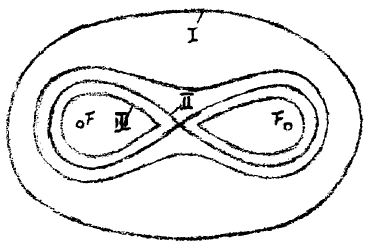
[ 16 ] RUDOLF STEINER: This has an inner organic correlate. The two parts have the same relation to each other as the pineal gland to the heart. The one branch is situated in the head—the pineal gland, the other lies in the breast—the heart. Only the pineal gland is more weakly developed, the heart is stronger.
Someone spoke on a historical theme—the migrations of various peoples.
Not translated
[ 17 ] RUDOLF STEINER: The causes assigned to such migrations very often depend on the explanations of historical facts. As to the actual migrations—for example, the march of the Goths—at the root of the matter, you will find that the Romans had the money and the Germanic peoples had none, and at every frontier there was a tendency among the Germanic peoples to try to acquire Roman money one way or another. Because of this, they became mercenaries and the like. Whole legions of the Germanic peoples entered into Roman hire. The migration of the people was an economic matter. This was the only thing that made the spread of Christianity possible, but the migrations as such began, nevertheless, with the avarice of the Germanic peoples who wanted to acquire Roman money. The Romans of course were also impoverished by this. This was already the case as early as the march of the Cimbri. The Cimbri were told that the Romans had money, whereas they themselves were poor. This had a powerful effect on the Cimbri. “We want gold,” they cried, “Roman gold!”
[ 18 ] There are still various race strata—even Celtic traces. Today there are definite echoes of the Celtic language—for example, at the sources of the Danube, Brig and Breg, Brigach, and Brege, and wherever you find the suffix ach in the place names such as Unterach, Dornach, and so on. Ach comes from a word meaning a “small stream” (related to aqua), and points to a Celtic origin. “Ill,” too, and other syllables remind us of the old Celtic language. The Germanic language subsequently overlaid the Celtic. [Rudolf Steiner referred to the contrast between Arians and Athanasians.1Athanasian refers to the doctrine of Saint Athanasius, or Athanasius the Great (c. 293–373), who was a Greek theologian and prelate in Egypt. Throughout his life he opposed Arianism and became known as the “Father of Orthodoxy.” He was exiled three times by Roman emperors for his stand; he wrote Four Orations against the Arians but not the Athanasian Creed (written after the fifth century), which espouses his teachings on the Trinity. The Arian doctrine, on the other hand, has to do with Arius (c. 250–336), also a Greek ecclesiastic in Alexandria, who taught a Neoplatonic doctrine that God is alone and unknowable, the creator of every being, including the Christ. Emperor Constantine I formed the Council of Nicaea in 325 to declare Arianism a heresy.
[ 19 ] There is something connected with the history of these migrations that is very important to explain to the children—that is, that it was very different for the migrating peoples to come into districts that were already fully developed agriculturally. In the case of the Germanic peoples, such as the Goths in Spain and Italy, they found that all the land was being cultivated already. The Goths and other ethnic groups arrived but soon disappeared. They became absorbed by the other nations who were there before them. The Franks, on the other hand, preferred to go to the West, and arrived in districts not yet fully claimed for agriculture, and they continued to exist as Franks. Nothing remained of the Goths who settled where the land was all already owned. The Franks were able to preserve their nationality because they had migrated into untilled areas. That is a very important historical law. You can refer to this law again later in relation to the configuration of North America. There, it is true that the Red Indians were almost exterminated, but it was also true, nevertheless, that people could migrate into uncultivated districts.
[ 20 ] It is also important to explain the difference between such things as, for example, the France of Charles the Great and the state of a later time. If you are unaware of this difference, you cannot cross the Rubicon of the fifteenth century. The empire of Charles the Great was not yet a state. How was it for the Merovingians? Initially they were no more than large-scale landowners. The only thing that mattered to them was civil law. As time passed, this product of the old Germanic conditions of ownership became the Roman idea of “rights,” whereby those who were merely administrators gradually acquired power. And so, by degrees, property went to the administrative authorities, the public officials, and the state arose only when these authorities became the ruling power later. The state, therefore, originated through the claims of the administration. The “count nobility” arose as the antithesis of “prince nobility.” The word Graf (count) has the same origin as “graphologist” or “scribe.” It is derived from graphein, to write. The “count” is the Roman scribe, the administrator, whereas the “prince nobility,” originally the warrior nobility, is still associated with bravery, heroism, and similar qualities. The prince (Fürst) is “first,” the foremost one. And so this transition from Fürst to Graf (prince to count) marked the rise of the concept of “state.” This can of course be made very clear by using examples such as these.
Someone described how he would introduce the spread of Christianity among the Germanic peoples.
[ 21 ] RUDOLF STEINER: Arian Christianity, expressed in practical life, is very similar to later Protestantism, except that it was less abstract and more concrete.
[ 22 ] During the first and second centuries the Mithras cult was very widespread among Roman soldiers on the Rhine and the Danube, especially among the officers. In what is now Alsace and elsewhere, Thor, Wotan, and Saxnot were worshipped as the three principal gods of the ancient Germanic people, and the old Germanic religious rites and ceremonies were used.2This is a reference to Steiner’s lectures on the history of the Middle Ages, given in the Workers’ College in Berlin between October 18 and December 20, 1904 Geschichte des Mittelalters bis zu den großen Erfindungen und Entdeckungen (GA 51).
[ 23 ] We could describe many scenes that demonstrate how the little churches were built in Alsace and the Black Forest by the Roman clerics. “We want to do this or that for Odin” sang the men. The women sang, “Christ came for those who do nothing by themselves.” This trick was actually used to spread Christianity—that by doing nothing one could achieve salvation.
[ 24 ] Eiche (the oak), in the old Germanic cult-language, designates the priest of Donar. During the time of Boniface it was still considered very important that the formulas were still known. Boniface knew how to gain possession of some of these formulas; he knew the magic word, but the priest of Donar no longer knew it. Boniface, through his higher power, felled the priest of Donar—the “Donar-oak”—by means of his “axe,” the magic word. The priest died of grief; he perished through the “fire from Heaven.” These are images of imagination. Several generations later this was all transformed into the well-known picture.
[ 25 ] You must learn to “read” pictures of this kind, and thus through learning to teach, and through teaching to learn.
[ 26 ] Boniface romanized Germanic Christianity.
[ 27 ] Charles the Great’s biography was written by Eginhard, and Eginhard is a flatterer.
Music teaching was spoken about.
Not translated
[ 28 ] RUDOLF STEINER: Those who are less advanced in music should at least be present when you teach the more advanced students, even if they do not take part and merely listen. You can always separate them later as a last resort. There will be many other subjects in which the situation will be just as bad, in which it will be impossible for the more advanced students to work with those who are backward. This will not happen as often if we keep trying to find the right methods. But due to a variety of circumstances, such things are not obvious now. When you really teach according to our principles you will discover that the difficulties, usually unnoticed, will appear not only in music lessons, but in other subjects as well—for example, in drawing and painting. You will find it very difficult to help some of the children in artistic work, and also in the plastic arts, in modeling. Here, too, you should try not to be too quick to separate the children, but try to wait until they can no longer work together.
Someone spoke about teaching poetry in French and English [foreign language] lessons.
[ 29 ] RUDOLF STEINER: We must stay strictly with speaking a certain amount of English and French with the children right from the beginning—not according to old-fashioned methods, but so that they learn to appreciate both languages and get a feeling for the right expressions in each.
[ 30 ] When a student in the second, third, or fourth grade breaks down over recitation, you must help in a kind and gentle way, so that the child trusts you and doesn’t lose courage. The child’s good will must also be aroused for such tasks.
[ 31 ] The lyric-epic element in poetry is suitable for children between twelve and fifteen years of age, for example, ballads or outstanding passages from historical writings, good prose extracts, and selected scenes from plays.
[ 32 ] Then in the fourth grade we begin Latin, and in the sixth grade Greek for those who want it, and in this way they can get a three-year course. If we could enlarge the school we would begin Latin and Greek together. We shall have to see how we can manage to relieve children who are learning Latin and Greek of some of their German. This can be done very easily, because much of the grammar can be dealt with in Latin and Greek, which would otherwise come into the German lessons. There can also be various other ways.
[ 33 ] C was pronounced “K” in old Latin; and in medieval Latin, which was a spoken language, it was C as in “cease.” The ancient Romans had many dialects in their empire. We can call Cicero “Sisero” because in the Middle Ages it was still pronounced like that. We can’t speak of what is “right” in pronunciation because it is something quite conventional.
[ 34 ] The method of teaching classical languages can be similarly constructed; here, however, with the exception of what I referred to this morning,3See morning lecture pp. 189–190. it is usually possible to use the normal contemporary curricula, because they originated in the best educational periods of the Middle Ages, and they still contain much that has pedagogical value for teaching Latin and Greek. Today’s curricula still copy from the old, which makes good sense. You should avoid one thing, however: the use of the little doggerel verses composed for memorizing the rules of grammar. To the people of today they seem rather childish, and when they are translated into German they are just too clumsy. You must try to avoid these, but otherwise such methods are not at all bad.
[ 35 ] Sculpting should begin before the ninth year. With sculpture too, you should work from the forms—spheres first, then other forms, and so on.
Someone asked whether reports should be provided.
[ 36 ] RUDOLF STEINER: As long as children remain in the same school, what is the purpose of writing reports? Provide them when they leave school. Constant reports are not vitally important to education. Remarks about various individual subjects could be given freely and without any specific form.
[ 37 ] Necessary communication with the parents is in some cases also a kind of grading, but that cannot be entirely avoided. It may also prove necessary, for example, for a pupil to stay in the same grade and repeat the year’s work (something we should naturally handle somewhat differently than is usual); this may be necessary occasionally, but in our way of teaching it should be avoided whenever possible. Let’s make it our practice to correct our students so that they are really helped by the correction. In arithmetic, for example, if we do not stress what the child cannot do, but instead work with the student so that in the end the child can do it—following the opposite of the principle used until now—then “being unable” to do something will not play the large role it now does. Thus in our whole teaching, the passion for passing judgment that teachers acquire by marking grades for the children every day in a notebook should be transformed into an effort to help the children over and over, every moment. Do away with all your grades and placements. If there is something that the student cannot do, the teachers should give themselves the bad mark as well as the pupil, because they have not yet succeeded in teaching the student how to do it.
[ 38 ] Reports have a place, as I have said, as communication with the parents and to meet the demand of the outside world; in this sense we must follow the usual custom. I don’t need to enlarge on this, but in school we must make it felt that reports are very insignificant to us. We must spread this feeling throughout the school so that it becomes a kind of moral atmosphere.