

Knowledge of the Human Being
and Lesson Planning
GA 302
15 June 1921, Stuttgart
Translated by Steiner Online Library
Fourth Lecture
[ 1 ] It will have become clear to you from the observations we have made that the teacher must incorporate a more precise understanding of the physical, bodily human being into all of his or her considerations. And the reason we are making such seemingly distant observations right now is that we face a very significant task in our school: namely, to add the 10th grade to the regular elementary school classes, which will then include boys and girls who are already more mature; and that in doing so, we are dealing with an age group that must be treated with particular care. In the coming days, I would actually like to work toward prompting you to engage in a thorough examination of precisely this childhood stage, which is, after all, connected to important developmental phases.
[ 2 ] Now you might say: This only concerns those who work with these children. — But that’s not true. It is true that our teaching staff must increasingly grow together into a single, cohesive unit; and in that process, we will all, in one way or another, have to be directly or indirectly involved in the overall education of the school’s children,
[ 3 ] I just need to cover a few things today before I discuss with you the requirements for the 14th, 15th, and 16th years of a child’s life. And then, of course, we will also have to work out the curriculum for the important 10th grade during our joint conference.
[ 4 ] Well, today I would like to continue along the lines we began yesterday and the day before. First, I would like to draw your attention once again to the so-called connection between the spiritual-soul aspect and the physical-bodily aspect in human beings, especially in children. After all, in general education today, the spiritual-soul aspect is present almost exclusively in intellectual form. We do not have a truly living spiritual life in our cultural life. And in those regions of Central Europe that are still permeated by Catholicism, Catholicism has taken on false forms, so that even there one cannot say that much help is being provided in terms of the religious transmission of spiritual life. Protestant spiritual life has, after all, become more or less entirely intellectualistic. Now, of course, true spiritual life can only find its way into our school because our teaching staff is composed of anthroposophists. Through this—not through the teaching of anthroposophy (our school must not be an ideological school)—but through the entire manner in which our teachers conduct themselves, through what they carry within their souls, the spiritual-soul aspect is carried into our school as if through spiritual imponderables.
[ 5 ] Now, when we engage in the very activities we must teach children in a wide variety of areas, that is to say, what we teach them while reading with them or imparting what leads to reading, what we teach them in terms of the intellectual aspects of arithmetic, what we teach them in natural history or natural science—through all that is expressed in thought, we are conveying mental images to them. And presenting mental images to children is, in essence, a completely different kind of activity for the child’s organism than the one that, while it certainly intertwines with the others to some extent, is also carried out independently. Isn’t it true that the physical aspect is pursued entirely independently in eurythmy, in music lessons, in physical education, and to a certain extent in instrumental lessons—but no longer in singing lessons? Of course, everything is relative. But there is a distinct polar difference between what we introduce to the children in these subjects—including what the child learns in reading and writing, where we strongly appeal to physical activity—and the subjects where this is much less the case, such as arithmetic, where physical activity plays a subordinate role; whereas in writing, physical activity plays a very significant role.
[ 6 ] Well, there’s actually a lot that could be said about all these details. I’d just like to use writing as an example to illustrate the extent to which physical activity plays a role. There are two types of people when it comes to writing—I believe I’ve already discussed this fact with those of you who’ve been here for a while—so there are two types of people. One type writes in such a way that the written words flow, as it were, right out of the hand. The shaping of the handwriting literally takes place in the wrist. Commercial writing instruction, in particular, is taught in such a way that the writing is done with the wrist. And that is, essentially, all that matters when it comes to writing. This is the case with one type of person: they are predisposed to learn to write in this way. The other type is predisposed to look at the written characters. They constantly focus their gaze on their handwriting and, even if only subtly, relate to it aesthetically. They look at what they’re writing and take pleasure in the appearance of their letters. This is the “painting” type. For them, writing isn’t so much a matter of the wrist. There are people who write the way a businessperson does; they don’t “paint” at all. I even encountered a peculiar method of teaching handwriting at a school that prepared students for careers in business. There, students were instructed to make continuous sweeping motions, and—wouldn’t you know it—they formed every letter with a specific sweep of the wrist—so the handwriting took on a character where everything in it was sweeping and fluid. Well, I’ll just remind you that taken to the extreme, this leads to something terrible. You’ve probably met people who, before they start writing, wave their pen around in the air, making sweeping motions before they even put it to paper. It’s a terrible state of affairs when these wrist movements are taken to the extreme.
[ 7 ] We should really bring “painterly” writing closer to people. It is far more wholesome, far healthier. If one writes in such a way that one keeps one’s eye focused on one’s handwriting at the same time and derives aesthetic pleasure from one’s characters—that is, writes in a painterly manner—then the mechanical aspect is pushed further back into the body. It is not the wrist that writes; rather, it is the inner organism. And this is extraordinarily important, because it diverts the mechanical aspect much more from the periphery and redirects it toward the whole person. You will also notice: if you succeed in guiding someone quite well toward this painterly style of writing, they will eventually even learn to write with their toes. And it would be something of a triumph if one could achieve the point where letters could be correctly formed by holding a pencil between the big toe and the next toe. I do not mean that this should be developed artistically; but inherent in it is this transfer of mechanical activity to the whole person.
[ 8 ] Well, in this regard, people are extraordinarily clumsy; they can’t even pick something up with their toes—as they would with their hands—if it falls off the sink, and surely people should at least be able to do that. It sounds grotesque when you put it that way. But you’ll understand that it points to something significant. So one should cultivate “painting-like” writing, because through this, on the one hand, the actual mechanical activity is pushed back into the body, and on the other hand, the relationship between the person and the written word is brought to the surface—and even beyond the surface. The person is integrated into their surroundings. People should actually get used to seeing everything they do—not merely going through the motions thoughtlessly, but actually seeing it; and writing is usually done thoughtlessly.
[ 9 ] Writing is, then, an activity with many different aspects. But precisely for this reason, it can also be regarded, in a certain sense, as something significant in the classroom. In arithmetic, the actual act of writing does not come into play, because the student is too fully engaged in mental work; there, the act of writing takes a back seat to a greater or lesser extent.
[ 10 ] Now we need to be clear about what is actually going on inside a person when you read something with a child. It is, figuratively speaking—but nevertheless—primarily a mental activity. This activity extends into the physical realm. And it is precisely in those activities that are based on mental and intellectual processes that very subtle aspects of the human physical organization are particularly engaged. As a physiologist, you can also arrive at this conclusion if you form a picture of the deeper part of the brain, the white matter. This is actually the more perfectly organized part. It is the part that is more oriented toward function, whereas the superficial gray matter—which is particularly well-developed in humans—remains at a very primitive stage of development; it serves as the brain’s source of nourishment. In terms of development, it is not the cerebral cortex that is the more perfect, but rather the underlying parts that are the more perfect. And when we teach a child something specific to observe, or what they experience while reading, we place a very heavy demand on their gray matter, and a subtle metabolic process takes place within the human being. This subtle metabolic process taking place within the human being extends—albeit in a very subtle way—to the entire organism. And precisely when we think we are engaging the child in the most intellectual way, we are actually exerting the strongest physical influence on the child. It is an immersion into the metabolism that occurs during observation, reading, and listening to stories. The child is exceptionally heavily engaged in this process. This is what one might call the imprinting of the spiritual into the physical. A kind of embodiment is necessary of what we develop through observation and listening to stories. Something like a physical phantom must form, which integrates itself into the entire organism. Within the organism, subtle salts are deposited. One should not form a mental image of this in overly crude terms. A salt phantom is integrated into the entire organism, and it is then necessary for this to be dissolved again through metabolism.
[ 11 ] This is the process we undergo when reading or listening to a story. It is precisely when we believe we are engaging our spiritual and soul aspects that we stimulate the most metabolism in the classroom. And this is something that must definitely be taken into account in the classroom. We therefore have no choice but to structure what we tell or what we have the children read in such a way that it is flawless in two respects. First, it must be flawless in the sense that we structure the narrative and the reading material so that the child is absolutely interested in it and follows everything with a certain degree of interest. When this interest takes effect, when the interest is in the soul, it is a kind of subtle feeling of pleasure. This must always be present. This subtle feeling of pleasure is physically expressed through a subtle glandular secretion, and through this secretion, the salt deposits that formed as a result of reading or listening to stories are absorbed. We must try not to bore the children, not to teach them anything that bores them; for otherwise, no sense of interest is aroused, and then undissolved salt is produced and distributed throughout the body, and we are actually contributing to the child later developing all sorts of metabolic diseases. Particular attention must be paid to this, especially with girls. Migraine-like conditions are a consequence of their being crammed too one-sidedly with all sorts of things they must learn, without these being clothed in the kind of narrative that brings them joy. They are filled with small deposits that have not quite dissolved, with a tendency toward the formation of such deposits.
[ 12 ] It is indeed true that we must pay attention to these things. And then, you see, comes the real problem, which lies precisely in the fact that we simply do not have enough time for so many things. We must ensure that we do not use the numerous reading passages found in today’s standard readers—the kind that are so long they seem to crawl up the wall. I have already seen such a variety of readers used in classrooms, with selections of reading passages that are simply dreadful. We must not forget that we are physically preparing children for their entire future lives. If we teach them such trivial material as is usually found in standard readers, we are, in effect, shaping their finer faculties in that direction; and the child will become a philistine instead of a well-rounded human being. We must realize just how much we are contributing to the child’s overall development through reading and through the process of learning to read. It will show later on. Therefore, I would ask you to try, if possible, to select reading passages from the classics or elsewhere and to compile the reading material yourself, avoiding anything from the standard readers, which are almost without exception dreadful. Those should really play as minor a role as possible. Of course, it is much more inconvenient to gather the material yourself, but ultimately it is necessary that we pay special attention to these things; for this is precisely the task of our Waldorf school—to approach these essentially methodological matters differently than they are usually handled. The point is that when reading and listening to stories—even when we are otherwise presenting topics from natural history—we must ensure that nothing harmful is done in these two areas.
[ 13 ] Eurythmy and singing, on the other hand, have the opposite effect; a completely different organic process takes place there. In all the organs involved in these activities, the spiritual element is initially contained within the organs themselves. When you let a child practice eurythmy, the child begins to move, and through the course of this movement, the spiritual element present in the limbs flows upward from the organs. It is a liberation of the spiritual when I let a child practice eurythmy or sing. The spiritual element, which the limbs are brimming with, is released. That is the actual process. What I accomplish in doing this is therefore a genuine drawing out of the spiritual element from the child. And this, in turn, has the consequence that when the child stops doing such exercises, the spiritual element waits to be put to use. — I explained this to you yesterday in a different context. — But the spiritual aspect, in turn, is also waiting to take root. I have truly spiritualized the child by having it do gymnastics, eurythmy, or singing. The child has become a completely different being; it has much more of the spiritual within it. But this wants to take root; it wants to remain with the child; we must not allow it to be diverted. And there is a very simple way to do this: Shortly after the child has done eurythmy, gymnastics, or singing, we help the child settle down a little; we let the whole group rest just a little and try to maintain this calm, even if it’s only for a few minutes. The older the children are, the more necessary this becomes. We should also take this into account; otherwise, the very thing we actually need will not be present the next day. It is not exactly right to send the children off again right away; rather, we should let them rest a little.
[ 14 ] In all of this, one is essentially depicting a universal principle. People come up with all kinds of theories about matter and spirit. But underlying both—matter and spirit—is something higher. And one can actually say: When this higher principle is brought to rest, it is matter; when this higher principle is set in motion, it is spirit. Because it is a very high principle, we can certainly apply this to human beings. Through stillness, a person creates within themselves a framework—as I have described—for that which is redeemed in the spiritual realm. This framework takes shape, and the person can then make use of it. It is certainly good to know such things at all, because one can then find all sorts of parallels in other areas as well, enabling one to behave appropriately toward children.
[ 15 ] The task now is to apply these ideas in even greater detail. In school, we have a mix of children who lack imagination and those who are somewhat more imaginative. We need not immediately assume that half of the schoolchildren are poets and the other half are not. This is less evident in the actual activity of the imagination than in the development of memory. Memory is, after all, closely related to the activity of the imagination. For we have children—and we should observe this—who quickly forget the images of what they have experienced or heard; the images fade easily. And then there are other children in whom the images remain, developing into a force of their own, and they constantly surface involuntarily. It is good to note that these two types exist. Of course, there are all kinds of transitions. When we have imaginative children before us, this means nothing other than that they have a memory that functions in such a way that things resurface in a transformed state. But it is much more common for them not to resurface in a transformed way, but rather as reminiscences, so that the children are, in a sense, prisoners of what they have absorbed. And then there are those in whom everything disappears again.
[ 16 ] The point is that we need to know how to deal with these types of children in the appropriate way. We really do have the opportunity to engage a group of children in a wide variety of ways if we develop a routine for this—in the best sense of the word, a routine in the intellectual sense. And so it is good that, with children who have a poor memory—who, in other words, cannot bring the images to mind—we try to encourage them to observe more closely while reading and to place greater emphasis on listening to the story being told; whereas with those children whom we see are virtually prisoners of the mental images they have absorbed, we should focus more on writing, on practice, and on getting them moving. So, we should actively try to engage a larger group of children in such a way that we give one half—the half with less imagination—the opportunity to cultivate reading and observation. — Of course, only to a greater extent; after all, everything is relative. — With the children who have more vivid imaginations, we should place special emphasis on drawing and writing.
[ 17 ] We can expand on this even further. It is therefore of particular importance to observe the following, for example—we can only gradually assimilate these things because we were unable to cover everything before the child’s first year—: with children who lack imagination—that is, those who have difficulty conjuring up images—it is good to aim to have them do eurythmy exercises more while standing, that is, preferably with their arms. For the more imaginative children, who are overwhelmed by their own mental images, it will be particularly beneficial if we get their whole body moving through running, striding, and walking. We can certainly help them in this regard, and it is extremely important that we truly take such things into account. It should also be noted that practicing consonant sounds in particular is very beneficial for children who are more phlegmatic when it comes to conjuring up mental images—that is, those who have a harder time bringing these images to mind. And for those who are plagued by their mental images, it is good to have them practice a lot of vowel-based eurythmy. One can observe that when children vocalize, the process of bringing mental images up from the organism is actually calmed, whereas when they practice consonant sounds, these images are brought up; so that those who lack imagination—that is, those who are not troubled by their mental images and who forget easily—should be guided in eurythmy using vowels, while the others, who are troubled by their mental images, should be guided in eurythmy using consonants. If one pays attention to such things, one can contribute a great deal to a group of children.
[ 18 ] I would also like to mention that it is very beneficial for music education to gain a mental image of how children are disposed in this regard—whether they lack imagination or are rich in imagination—that is, in terms of how this relates to memory. If children lack imagination—that is, if they have difficulty conjuring up mental images—one should engage them in more instrumental musical activities, whereas children who are rich in imagination—that is, who are easily overwhelmed by their own mental images, even to an extreme degree—should be engaged more in singing. It would indeed be ideal if we could already arrange things—we would, of course, need the necessary space—so that we could engage the children in both playing music and singing at the same time. When these two elements—which could have such a tremendous effect on the children: listening to music and actively participating in it—interact, the result is incredibly harmonizing. And perhaps we could even arrange to alternate between the two. This would be extraordinarily significant in the classroom if we could have one half singing and the other half listening, and then vice versa. This is something that would be extremely desirable and should be cultivated. For when listening to music, it has, above all, a healing and restorative effect on what the head is supposed to do for the human organism; when singing oneself, it has a healing effect on everything the body is supposed to do for the head. Thus, people would become much healthier if one could do everything that should be done in the classroom.
[ 19 ] We are actually not nearly aware enough of how far we have regressed in human development; people once reached a point where they let children grow up more or less in the wild; where they did not have them educated in any particular way. Back then, people did not interfere with human freedom the way we do. We begin interfering with human freedom at age 6, and we must make up for what we are destroying—the very freedom we are taking away—by educating children in the right way. We must be clear that we need to improve the methods of teaching, because otherwise we are heading toward a terrible situation. People may emphasize as much as they like how advanced our culture has become, how few illiterate people there are, and so on—but they are merely impressions, automatons of what has been instilled in school.
[ 20 ] We must also avoid simply producing copies in schools. We must nevertheless allow people to develop their individuality. Such things become particularly important when we develop, so to speak, artificial methods—for example, in all forms of recitation from memory. Reciting from memory is, after all, not a simple matter. Reciting from memory is a process that transfers the content the child is assimilating from the spiritual-soul realm to the physical-bodily realm. The content has first been imparted to the child on a spiritual-soul level. The child must, of course, understand what it is memorizing, for there is no point in talking about memorization if the child does not even understand what it is memorizing. So this understanding comes first. But as the child truly learns by heart, it comes to perform the task in an increasingly mechanical, physical manner. And this is a process that first brings the content of what is to be learned into the subjective realm and then transfers it into the objective realm. In this matter, however, one must also be truthful. As this content is transferred into the objective realm, one must encourage the child to listen to itself. One must make the child aware that it is listening to itself. One must lead the child to learn, to an ever-greater extent, to listen to itself as the content is recited. This can be achieved by guiding the child, for example, to truly distinguish within itself the sounds it produces. One says to the child: “It is what you are reciting, just as it is all around you—you can hear that, too.” — One must try to teach the child to listen to itself. But that alone is not enough. Something else entirely is necessary. You will never get the child to make the right transition between having the content in their mind—as a thought, an image, or a feeling—and what has been memorized unless you try, before memorization begins, to impart the material to the child in a very deeply emotional way. Nothing should ever be pushed to the point of memorization unless the child has a clear sense and a keen feeling for it in every detail—and, above all, a feeling that enables the child to relate to the content in the right way.
[ 21 ] Let us consider an extreme case. Think of a prayer; when a child is to learn a prayer, he or she should be encouraged to enter into a kind of reverent mood as he or she recites it. And we must ensure that the child first enters into this reverent mood. We must be wary of teaching a child a prayer if we have not first instilled in them a devout mood. Under no circumstances should the child recite the prayer without first being in that devout mood. So we should not have the child recite a cute, pretty poem without first having awakened in them a gentle smile, a sense of joy, and a feeling of delight; not by commanding them, but by allowing the content itself to awaken these feelings. And so it is with everything.
[ 22 ] Humanity has gradually been corrupted to a terrible extent. You may not have experienced this firsthand, since people have become a bit more reasonable in this regard. But older people today remember being made to memorize things, for example, that should never have been memorized. History was taught in such a way that children memorized it. I’ve even seen high school teachers have students bring their history books to class, then read a passage aloud and quiz them on it. The children would simply memorize it. I’ve heard that an excellent student is said to have answered: “The Kar of Jerusalem.”—That actually happened, instead of: ‘The Tsar of Russia’—he said, ‘The Kar of Jerusalem.’ It didn’t matter to him; he was so deeply immersed in rote recitation. Many such incidents have occurred. Much of what has led to decadence stemmed from this very fact—that subjects like geography and history simply had to be memorized.
[ 23 ] It is essential that the material rightly memorized—prayers, poems, and so on—be prepared in such a way that the emotional element the child must experience when listening to themselves is present. When praying, the child must truly feel: “You are now transcending yourself; you are saying something that takes you beyond yourself.” —- And so it must be with everything graceful and beautiful,
[ 24 ] But this has a very real, physical significance, because every time we teach a child something that has a tragic or sublime character, we are essentially influencing their metabolism. Every time we teach a child something that has a cute, graceful character, we are affecting their mind, their sensory-nervous system. And we can take a hygienic approach in this regard. If, for example, we have a child who is, let’s say, very frivolous—who is constantly seeking thrills—then we try to remedy this by creating within the child the state of mind required for memorizing sublime or tragic material. In this way alone, we are already helping the child. And we must certainly take such things into account in our teaching.
[ 25 ] You will achieve all of this when you yourself adopt the right attitude toward teaching—that is, when you consistently set yourself the task of trying, from time to time, in an almost meditative way, to answer the question inwardly, even if only briefly: What are you actually giving a person by teaching them history, geography, and so on? — Gaining clarity about what one is actually doing is particularly necessary for the teacher. We have, after all, spoken in the most varied ways about what one has to say to the child through history, geography, and so on. One must not be content merely to know such things; rather, one must briefly call them to mind in a meditative way. Does the eurythmy teacher, for example, know that he is liberating the spirit from the child’s limbs? Does the one who teaches reading know that he is giving form to the spiritual, embodying it? and if they are always clear about this, they see, as it were, how—when they read incorrectly or teach the child tedious material—the child becomes increasingly prone to a metabolic disorder; they feel that they are creating a future diabetic by making the child read tedious material aloud: then they feel the true responsibility. You create diabetics when you constantly occupy the child with tedious reading beyond what is necessary. You create people who lose their way in life when you do not allow the liberated spirit to settle down again after a physical or vocal exercise.
[ 26 ] These are the things that are especially necessary for a teacher: to occasionally reflect on what he is actually doing. And this is by no means a depressing feeling; for the teacher, who has a great deal to do with reading, will come to realize through this that he is actually constantly embodying something, that he is working on human physicality, and that in doing so he is sending people out into the world—whether strong or weak—even in terms of their physical constitution. The teacher of handicrafts or manual arts will be able to say that he works especially on the spirit. When we knit with the child in the right way and make things that have meaning, or when we make things that have meaning through manual arts instruction, then we are often truly working more on the spirit than when we teach children what is considered to be intellectual.
[ 27 ] There is a great deal that can be done in this area. After all, it’s somewhat common these days for children to make many mistakes in their needlework classes. We can have a particularly positive impact by focusing on this area. I noticed right away how the children here in Dornach were embroidering pillows—small cushions with this or that design on them. We need to make sure that they actually turn out to be pillows. It’s not really a pillow if you just embroider whatever you like onto a little cushion. You have to be able to tell from the embroidery that you can lie down on it, that you can rest your ear on it. The children seem to particularly enjoy making those little covers that you put on tea and coffee pots. But they have to make them in such a way that they’re actually designed for that purpose. When I open it up at the bottom, what I’m doing with my hands has to continue in the design. I have to be able to tell from the drawing that it needs to be opened there. The child is so spoiled by the circumstances that, down there where it’s supposed to be opened, they draw something that looks like this:
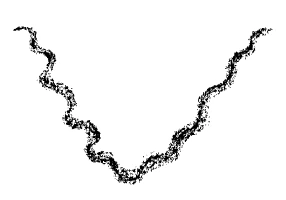
[ 28 ] Yes, that’s wrong. You have to be able to tell from the drawing where it opens and where it closes, and where it cannot be opened. Likewise, it is necessary for the child to learn to distinguish that something worn around the neck, if sewn with ribbons, must be such that it widens toward the bottom and narrows toward the top. When making a belt, it must be immediately apparent that it opens on both sides at the same time, and that the pattern is widest in the middle. The point is that children should be able to grasp these shapes in every context.
[ 29 ] That is precisely where an immense amount can be achieved, and you will only succeed if you do not simply work with your eyes, but rather create it through feeling. You must create this through feeling, so that the child wants the drawing in such a way that, in a sense, they feel: it’s pulling apart from below and pushing down from above; it’s striving from above toward below. You must transform this into feeling; you must bring into the hand what is to be worked with the hand. Essentially, the person is fully engaged in this process with their whole being, and they think with their entire body. So one must definitely strive to ensure that these things are felt. In handicrafts class, the focus must be on developing this sense of feeling. In a sense, when a child is to embroider a corner, they must have the feeling: “This corner must be embroidered in such a way that when I try to go through it, I cannot pass through.” - If it’s different—if one can pass through—then there must be something that makes it obvious at a glance: “You can pass through here.” That’s how it must be done. Here, the handicrafts teacher can say: “I approach this task by focusing particularly on the child’s mental activity.” No one needs to feel sidelined by any part of the lesson.