

The Healthy Development of the Human Being
An Introduction to Anthroposophical Education and Didactics
GA 303
26 December 1921, Dornach
Translated by Steiner Online Library
Fourth Lecture
[ 1 ] In all current considerations—which, after all, find their expression in the realm of knowledge and also in practical life through an intellectualistic-naturalistic explanation of the world—one actually bases one’s analysis on an observation of what is present to the human being at the very moment. Outward appearances might suggest otherwise. Yet as these discussions proceed, it will become clear that these are, in fact, merely superficial aspects. We examine the human being in terms of its organization using the standard methods of biology, physiology, and anatomy, and in doing so, we are actually always dealing with what the present moment reveals to us. Admittedly, it appears differently at first glance. For example, we examine the lungs of a child, the lungs of an adult, and the lungs of an elderly person, and we record the findings at that moment. Then we draw our conclusions regarding the course of human life. From the changes in the lungs from childhood to old age, we infer something about human development. But what we are actually doing here is not immersing ourselves in the temporal progression; rather, we are focusing on the spatial aspect, and we infer the temporal progression solely from the spatial changes. We do this in much the same way as we do when observing a clock. We observe the clock—let’s say in the morning—and note the position of its hands, using a spatial reference to orient ourselves regarding time. We then observe the clock at noon and again use a spatial reference to orient ourselves regarding time. We infer time from the spatial. This way of relating to life has become our customary approach. We observe the moment we are experiencing. We experience it through spatiality. But we do not experience the inner unfolding of time in the same way. The essence of the human life course between birth and death can only be properly assessed if one can place oneself just as vividly within time as we have become accustomed to placing ourselves within space. I would like to illustrate what I have just stated theoretically with a few examples, specifically in relation to human life. For those who wish to practice the art of education and teaching, this immersion in the flow of time is of particular importance. This becomes clear from such examples.
[ 2 ] Suppose a child develops a very special sense of reverence for adults. A healthy perspective will regard as healthy precisely that aspect of the child which leads him or her to such a natural sense of reverence for adults, provided that this reverence is justified by the adult’s character—and that is indeed how it should be. We will discuss this in future lectures specifically in the context of the art of education and teaching. For now, I simply want to cite this as an example.
[ 3 ] Now, people usually limit themselves to saying: There are children who develop such a sense of awe. — This is attributed to certain peculiarities of certain children, and people are content with the moment. One never arrives at an understanding of the full significance of this awe unless one considers the entirety of human life. One will then gradually find oneself in a position to observe this or that person at a late, perhaps very late, stage of life, and one will discover that there are people who have the distinctive quality of naturally comforting others who need comfort, and of providing encouragement to others who need it in the midst of life’s hardships. Often, it is truly not even the content of what such comforting, uplifting people say; it lies in the timbre, in the sound of their voice; it is the way in which they speak. If one then looks back at the childhood of such people in the course of their lives, one finds: these are people who, in their childhood, were particularly devoted to reverence, to respect for adults. This reverent attitude toward adults, which then fades over time, lives on in the depths of their life story and reemerges in maturity as the gift of offering edification and uplift.
[ 4 ] What has been described in a certain way can also be expressed as follows. One could say: When a child has truly learned to pray from within, has learned to develop a prayerful disposition, this disposition sinks into the depths of life in the manner described during the middle stage of life, reemerges in very old age, and then manifests as a certain gift of blessing that is perceived by others. But precisely in the case of such people, whose very presence in later life has a blessing effect on their fellow human beings, one will again find that they had made the prayerful disposition their own in childhood. — Such things can only be discovered if one learns to live with time just as we have become accustomed to doing with space. And there must be a kind of knowledge that lives in time just as it does in space—namely, directly, not through inferences drawn from spatial relationships, as we do with a clock.
[ 5 ] What I have just illustrated for you—I would say—regarding the moral and inner life through a few examples must, however, if we are to achieve a true art of education and teaching, be applied from the very beginning of our general consideration of human nature. And this can be done in the following way.
[ 6 ] If we compare human beings—as they appear to us as a whole in life—with animals, we find that animals, especially higher animals, are born already possessing the skills necessary for their lives. The chick that hatches is already fully adapted to its environment and needs to learn nothing more; its organs possess a fixed degree of plasticity precisely as required by that particular animal according to its specific nature. This is certainly not the case with humans. Humans are born helpless; they must first acquire their specific skills in certain areas through interaction with the external world. Humans owe this to the fact that the most important phase of their earthly life is an intermediate stage between childhood and old age in the broader sense. This intermediate stage—this time of maturity—is the most crucial aspect of human life on Earth. It is during this time that humans adapt their physical constitution to external life by acquiring these skills. It is during this time that they enter into an experiential relationship with the external world. This intermediate stage, in which the organs still possess their labile plasticity, is actually completely absent in animals. The animal is born into life in the same way that we humans, in essence, only become like the elderly—when our forms become fixed, when our forms possess a stable plasticity. If one wishes to understand animality in its relationship to the world, one can only truly understand it by comparing it to human old age.
[ 7 ] But the question may then arise: Does the animal not also immediately manifest senility in its psychological characteristics? — That is not the case, because there is another pole within the animal that counteracts this senility, and that is the capacity for reproduction. The ability to reproduce is, at the same time, a rejuvenating force for the human being—or for the creature—who possesses it. And because the animal develops senility on the one hand, while on the other hand the ability to reproduce flows into this senility, it remains, in a certain sense, protected from premature aging until it becomes capable of reproduction.
[ 8 ] But if you can observe an animal or an animal species objectively, you will say to yourself: the moment the animal reaches the stage where it is capable of producing offspring, it has in fact already entered into old age. This is precisely what is unique about human beings: that both old age and childhood—for during childhood the ability to reproduce develops slowly—are situated at the extremes of life, while in the middle lies the organically malleable stage, which, through its relationship with the outside world, can adapt to that world. And in a certain sense, one can call it the norm of human life that this middle stage is present in humans in the proper way. Then, as it were, at the right time, people will be children, cease to be children at the right time, enter adulthood, and they will also, at the right time, transition from adulthood into old age.
[ 9 ] If one considers the entire course of a human life by placing oneself within the temporal realm, then it is precisely from that perspective that one also arrives at a consideration of abnormalities. For one can see in certain individuals how they—if I may put it that way—fail to hold back the signs of old age long enough. I am not referring here to the kind of aging that manifests as gray hair or premature baldness; that is not the kind of aging I mean, for even after one has gone bald, one can remain childlike for a long time, but I am referring to the kind of senility that manifests itself more internally, organically, and that becomes visible only through an inner observation of life, an intimate observation of life: the psychological—if we may call it that—senility that comes into play in life when that life is, outwardly, still very much in its formative stage.
[ 10 ] However, the opposite can also occur: a person may fail to outgrow childishness at the right time in the course of their life. In that case, childishness carries over into middle age; the person then carries into middle age what should actually remain only as an inner, spiritual quality of childhood. And this gives rise to something particularly peculiar in the course of human life, which we will now consider in outline form.
[ 11 ] If we consider human life from this perspective as it unfolds over time, we can trace a path from what is called “normal” human life to the various abnormalities of human existence. As we, as human beings, approach old age, our head—our central nervous system—in particular loses its inner flexibility and plasticity. We become stiffer and less malleable with regard to our head organization as we approach the end of life. And all the abilities we have acquired in life become more psychological and spiritual in old age. But this happens at the cost of an “animalization” of our head organization. Physically, we become like the animal is from the very beginning. We become, so to speak, animalized. Through this, we pay the price for what we—if our upbringing has been proper—might still be able to retain throughout our entire lives in terms of a spiritual-soul connection to life; we pay this price because, in this later stage of life, what we experience spiritually and soulfully with the world no longer truly penetrates our constitution. The skull has become too rigid, too fixed in its form. In old age, therefore, we deal more with what connects us spiritually and psychologically to the outside world. We no longer take what we experience in the outside world into our inner being to the same extent as before. An “animalization” of our higher organization sets in.
[ 12 ] This “animalization” of our higher mental organization can, in fact, begin as early as adolescence—in the internal way I have explained. But since human beings, of course, always remain human—that is, even when they are, so to speak, animalized in terms of their mental organization, they are still human—what we are considering here does not manifest itself in external characteristics, but rather in inner, psychological traits. This happens as follows: When this particular way of relating to the outside world—which the elderly man or woman possesses—occurs too early, it can even occur as early as childhood—then, because plasticity naturally still predominates in the rest of the human being, this aspect is projected back into the physical constitution, and one experiences—in an inner sense and ahead of time—what one would otherwise experience in a healthy relationship with the external world when one has understood how to grow old at the right time. One connects it with one’s physical being. One incorporates it into one’s physical constitution, and as a result, characteristics emerge that become more akin to the animalistic, the bestial, than is otherwise the case with normal people.
[ 13 ] One might say, if one wishes, that animals possess a certain instinct that gives them an edge over humans, connecting them to their environment to a greater degree than humans are connected to theirs under normal circumstances. It is by no means a legend, but rather fully consistent with the characteristics of animal life, that certain animals, when natural phenomena approach that threaten their lives, move away from those places where danger might strike. Animals possess a certain instinctive, prophetic gift when it comes to preserving their lives. It is also quite accurate to say that animals perceive the changing of the seasons to a much greater degree than humans do. Animals sense the approach of the time when they must fly away—if they are migratory—to seek out other places. Animals thus have an intimate, instinctive relationship with their environment. And if one could look into what is going on in the inner life of an animal, one would see—though it is entirely shrouded in the unconscious—that animals possess an instinctive wisdom that manifests as a harmonious coexistence with the entire course of nature.
[ 14 ] When a human being allows senility to enter his life at an early stage in the manner described, then—though not in the same way as in animals, because in humans everything is elevated to the human level—this instinctive experience of the environment does indeed arise. And what is known today—often correctly, but often also incorrectly—as lower clairvoyance, telepathy, teleplasty, and telekinesis—that is, phenomena that occur abnormally in human life—is nothing other than the intrusion of senility into a person’s earlier experiences. One can experience senility at just the right time, and then one experiences it as a healthy person. If one experiences senility as early as age twenty, one becomes, in the lower sense, a clairvoyant. The phenomena that appear as manifestations of premature senility and constitute abnormalities of life are expressed not so much in external as in internal characteristics. One would gain much deeper insight into what exists as lower clairvoyance—such as telepathy, telekinesis, and teleplasty—which, to a certain extent, has already been very well researched—if one could properly appreciate the fact that what is at work here is a premature inner aging.
[ 15 ] But one must then move on to a genuine contemplation of life. In the present moment, one must not only see what is physically before one, but one must also be able to interpret it in such a way that one knows: when one observes a person in the present moment and that person exhibits certain characteristics, this stems from the fact that what is actually meant to be later is already influencing the present.
[ 16 ] In the coming days, we will see how healing processes can come about in a precise way through such an examination of human nature. It is therefore entirely possible for a kind of “animalization” of the human being to occur, which, however, does not manifest itself in an outward aging of the body, but rather in the fact that the relationships to the environment—which otherwise occur in an animalistic manner through animal instinct—are translated into the human realm, albeit into the lower human realm.
[ 17 ] From an unbiased perspective on the world, the peculiarities of telepathy, telekinesis, and teleplasty do not, of course, lose their significance. They retain their significance when one views them not as manifestations of the supernatural, but as the result of a later influence interplaying with an earlier phase of human life. It is precisely by viewing human nature in this temporal context that one learns to recognize its fundamental character; for to view it temporally means not to draw conclusions about the course of life from its various moments, but to live inwardly with time and to be able to see how what comes later, instead of emerging later, plays itself out earlier. To view in a temporal perspective means to survey time in one’s perception and to be able to see both the past and the future in the present moment.
[ 18 ] You will feel for yourselves how, even though it may appear different on the surface, our current way of looking at things is actually quite far removed from this inner perspective, which is in harmony with time and its passage. This is the source of the inadequate interpretations of what occurs in life. And today, so-called scientific knowledge and the impact of scientific knowledge on life are, in fact, full of these inadequate interpretations.
[ 19 ] But the opposite can also occur: childlike traits can carry over into a person’s later, mature life. The childlike aspect consists in the fact that the child not only experiences the conditions of the environment instinctively through the organization of the head, but the organization of the head also intensely participates in the metabolic processes that reflect its relationship to the outside world. When a child sees colors, vivid metabolic processes take place within the child. In a sense, the child “consumes” external impressions right down into its metabolism. One can certainly say—not figuratively, but quite literally—that the child’s digestive function is guided not only by the food’s taste and digestibility but also by the color impressions of the surroundings. It is governed by what the child experiences from the environment. So one can say: In the elderly person, we see an “animalization” of life in a physical sense; in the child, the entire life is filled with a sensitivity of the vegetative-organic process.
[ 20 ] The vegetative-organic process—not the animal-organic process, but the vegetative-organic process—is experienced by the child in everything it encounters in the external world. This extends all the way into the child’s psychological characteristics. Thus, we will never arrive at a complete understanding of the child unless we also ask ourselves: How does the child assimilate its impressions right down into its metabolism? — This is, after all, what constitutes so-called normal human life: that in later, mature age, a person leaves their metabolism more to its own devices, that they experience life with the external world in a more independent way, that a person experiences what they have and spiritually with the outside world—does not allow to sink down into the metabolism as the child does, so that not all external relationships with the outside world are constantly accompanied by such lively, internal glandular secretion as is the case with the child.
[ 21 ] The child absorbs what it experiences in the outside world—I would say—as if it were nourishment. And the later, mature adult leaves his metabolism to its own devices. It is precisely because things do not penetrate so deeply into his vegetative-organic processes that he is a mature adult in normal life. But this can persist in certain individuals. Certain individuals can carry this childlike quality into later life. Then they retain precisely this characteristic: that they link external experiences to their organic processes, and that they also link psychological experiences to their organic-vegetative processes.
[ 22 ] Let’s take an example: Someone who has already reached a certain age of maturity develops a special love—let’s say, for a dog. Such intense love for dogs does indeed exist. And it is precisely these kinds of loves that are often associated with a strong intensity of experience. If such a person has carried some of their childlike nature into later, mature adulthood—or if they experienced childlikeness to a heightened degree during childhood—then this love is not limited to a psychological connection to the outside world; rather, it triggers organic, vegetative processes. The organism experiences this love as well. Something always happens when this love is felt vividly, including in the metabolic processes. Metabolic processes then adapt not only to serve normal digestion, normal movement through the world, and other aspects of normal life, but a certain area—a certain “province”—of metabolism also adapts to undergoing such secretions and, in turn, regenerations as correspond to this particular instance of the vivid experience of this love for dogs. A certain province of the organism requires this particular change, which occurs internally in a purely organic-vegetative manner as a result of love for a dog.
[ 23 ] And now suppose the dog dies. The external relationship with life can no longer develop; it is no longer there. The dog has died; but an inner realm of the vegetative-organic system has become accustomed to developing such processes. What happens in humans is that this organic process, which now no longer finds satisfaction and lacks an external counterpart, continues to function but is no longer satisfied because its external correlate is no longer there. Such organic processes have their own internal inertia; they carry on. This stirs up turmoil within the person. And the strangest disturbances can remain when, for example, a love for a dog is so deeply integrated into the organ-vegetative processes and the dog then dies.
[ 24 ] If there is a reasonable person who also has some life experience, what will that person do? Well, he will probably try to ensure that another dog is purchased and then make sure that the former dog owner in question can grow just as fond of this new dog. Once they have achieved this, they will have actually performed a healing act; for now the inner organic process can once again find satisfaction in external experience. We will, of course, see in the course of these lectures that there are even more effective methods of treatment, but I believe a reasonably sensible person would act more or less in this way.
[ 25 ] However, there are indeed experiences of the external world that are not as drastic as, say, a love for a dog. There are countless things we can experience in the external world. And if the individual experiencing these things has retained a childlike quality—that is, this active engagement with the external world—then something of the stirrings within the vegetative organism will remain in such an individual when the experience is taken away from them, that is, when they can no longer externally experience that which has given rise to inner processes. These are the kinds of situations in human life where one must investigate the origin of such an inner state, which rises inexplicably from the depths of the human being. As a result, the person becomes dissatisfied, morose, hypochondriacal, and develops all manner of secondary conditions. If one investigates this, one finds that something has been taken away from the person through life or other circumstances—something that had actually already found its counterpart in the vegetative-organic processes. When such a person turns their consciousness toward the external world, they can no longer find satisfaction for what is churning inside their organism. Something is going on within their organism that actually wants to be observed externally—or at least thought about—and which they cannot think about because the impetus to do so is lacking.
[ 26 ] Once again, we find people with a practical approach to life who have the peculiar ability to instinctively sense such qualities in a person when they are present, and then they find a way to speak all sorts of things to them that bring these qualities up from the indeterminate depths of the vegetative-organic realm and elevate them into the life of thought and mental images, so that the person can think and create mental images of what they actually desire to think and create. Anyone who can observe life will find countless such words of encouragement in life, where a vegetative-organic content—arising from a previous disappointment or from a previous loss of purpose in life—is healed and resolved simply by approaching the person with the intensity of human encouragement and introducing into their conscious life what they need.
[ 27 ] Since, in our present-day society, due to the particular nature of our civilization, there are indeed quite a number of individuals who carry their childishness into adulthood, what I have just described has been observed frequently in both mild and severe cases. While in everyday life this is not made a big deal of—and one speaks of encouragement, which, through one person’s loving devotion to another, can bring about many beneficial effects—this has also been incorporated, and in many respects rightly so, into the scientific-psychological perspective. We encounter people who experience such inner turmoil. We now know that this inner turmoil stems from residual vegetative-organic processes—processes left behind as a result of life’s disappointments and the like. We encounter such people. When we transfer the matter into the scientific realm, we must, of course, express ourselves scientifically as well. One then examines the person in question. And from their life history to date—which one uncovers through confessions, their dreams, or other means—one finds what is necessary to bring into the person’s consciousness precisely what is desired by the subconscious vegetative-organic processes. This is then called analytical psychology or psychoanalysis. One then speaks—expressing oneself scientifically, of course—of “hidden provinces of the soul.” These are not “hidden provinces of the soul,” but rather vegetative-organic processes that remain in the manner described, processes that yearn for fulfillment from the outside. And one searches for what one can offer the person as such fulfillment. It is said: One ensures the catharsis of such repressed processes. — You see, in what I have just indicated lies the validity of so-called analytical psychology or psychoanalysis.
[ 28 ] Anthroposophy always finds itself in a special position when it comes to matters that are, after all, entirely legitimate within their own fields. Anthroposophy is not, in and of itself, confrontational. It readily acknowledges everything that arises within the horizon in which it is legitimate. Thus, within the scope in which it is legitimate, it will of course also recognize psychoanalysis. But anthroposophy must seek to understand things from the perspective of the whole human nature and from a comprehensive worldview; it must, so to speak, incorporate the narrow circles—which are still pursued today by scientists in a somewhat amateurish, layman-like manner—into broader circles. It therefore has no reason to argue. It merely incorporates what is explained one-sidedly into the larger circle. Consequently, it generally does not initiate arguments on its own. But the others argue, because they want to remain within their small circle. In their own way, they see only what lies within that small circle. And because they are not particularly attracted to that which comes from a broader horizon—and which, in fact, ultimately benefits them—they furiously reject it. As a result, anthroposophy is generally compelled only to defend itself against the one-sided views that attack it. This is something that must be said, especially in relation to contemporary trends such as psychoanalysis.
[ 29 ] What is particularly peculiar is this: we see that when a person begins to draw the end of their life too strongly into the middle stage of life, abnormal relationships with the outside world arise—telepathy and clairvoyance in the lower sense. The person instinctively expands their horizon beyond the circles of their life. When a person moves in the opposite direction—when they carry over into later stages of life what belongs to the childlike nature of early life—they penetrate too deeply into their organic being; this stirs up waves within the organic realm, leading to internal abnormalities; they enter, so to speak, into an overly close relationship with their own organic inner self. And these relationships manifest precisely as described by analytical psychology, which, however, would actually have to delve into organology in order to truly grasp them.
[ 30 ] A complete understanding of the human being absolutely requires taking into account the temporal course of life between birth and death. And such a complete understanding of the human being therefore depends on directing all attention toward the temporal course of life and experiencing that course firsthand. Precisely for this reason, anthroposophy—in seeking to penetrate the supersensible and thereby attain a complete understanding of the human being through its special method—must be able to remain grounded in the temporal. In the spirit of today’s civilization, however, human beings do not pay attention to this temporal aspect. Imagination, inspiration, and intuition—which are the special methods of knowledge in anthroposophy—must be built entirely upon a temporal experience of existence.
[ 31 ] Imagination, inspiration, and intuition are not meant to be something that intrudes into human life as something entirely foreign and is supposed to lead to supersensible knowledge as something foreign, but rather something that lies entirely within the extension of ordinary human abilities. Anthroposophy therefore does not claim that any special gifts are required to attain imagination, inspiration, and intuition, but rather that human beings can become aware of certain deeper abilities within themselves, which they can develop in a perfectly appropriate manner. One must certainly ascend from that kind of knowledge we acquire in ordinary life, in today’s scientific understanding, and in today’s practical living.
[ 32 ] How, then, do we actually go about becoming people of insight? By “people of insight,” I do not mean merely those who engage in scientific inquiry, but rather people of insight solely in the sense that we must be in order to live our lives in a practical way. We are surrounded by what we might call the “carpet of the senses”: the world of colors, the world of sounds, the world of temperature, and so on—everything that makes an impression on our sense organs. We surrender ourselves to these sensory impressions and weave them together with what we think—with our thoughts. If you consider—when you surrender yourself to your own inner life with a certain sense of recollection—what constitutes the content of this soul life: it is sensory impressions woven into thoughts. We live entirely by taking such a fabric of sensory impressions and thoughts into our soul life.
[ 33 ] What is actually going on here? Well, in this schematic drawing, consider this line from a to b as the tapestry of the senses—the colors, sounds, smells, and so on that surround us. Human beings surrender to their observations—to this tapestry of the senses—and weave these impressions together through their thoughts, which I have depicted here as the red serpentine line. By surrendering to sensory life, human beings mentally connect everything they experience in this sensory world. They interpret the sensory world through their thoughts. Because they, in a sense, project everything they develop in thought into this sensory world, this sensory world forms a boundary for them—a wall they cannot penetrate. They, as it were, inscribe all their thoughts upon this wall, but they do not pierce through it in today’s ordinary consciousness. The thoughts come to a halt at this wall and are inscribed upon it.
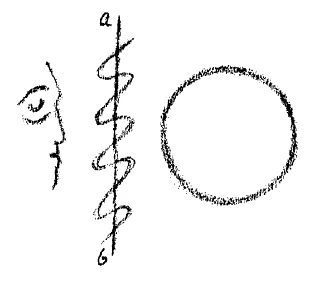
[ 34 ] One can move beyond this “stopping” at the wall by first developing imaginative insight through what might be called systematic and regular meditation. This meditation can be cultivated as an inner method of inquiry just as the external methods of chemical or astronomical experimentation can be cultivated. You can even see for yourselves from my book *How Does One Attain Knowledge of the Higher Worlds?* and from the second part of my *Outline of Esoteric Science* that the methods for engaging in this meditation are by no means simpler or less time-consuming than the methods one must master to become an astronomer or a chemist, if one wishes to follow them through to their ultimate consequences. It is, however, relatively easy to read works that provide instructions for the corresponding exercises and then to reach a point where, with the aid of common sense, one can truly convince oneself inwardly of the truth of what is said in anthroposophical research. One need not accept it on authority alone. Even if one cannot investigate it oneself, one can still examine it, provided one takes the peculiarities of the research method into account.
[ 35 ] Well, this entire practice is based on refraining from engaging with sensory impressions. When meditating, one does not give oneself over to sensory impressions; one gives oneself over solely to the life of thought. But this life of thought must—through a firm grounding in certain easily comprehensible thoughts—be brought to such vitality, to such intensity, as is otherwise found only in external sensory life. You know, of course, that it is quite different when we are absorbed in external sensory impressions than when, with ordinary consciousness, we are absorbed only in our pale, lifeless world of thought. Sensory impressions have a vivid, intense effect on us. We are absorbed in them. Thoughts fade; they become abstract; they grow cold. But this is precisely the essence of meditation: that through practice we bring the mere weaving of thoughts to such a degree of intensity and liveliness that we can live within it just as we otherwise do in our external sensory life. If one can grasp a meditative thought with the same inner vitality that is otherwise present when one is absorbed in a color, then one has brought the meditative thought into life in the right way. But all of this must take place with the same inner freedom with which normal thought processes and sensory perception occur. Just as we do not indulge in nebulous moods or mystical reveries when observing the external world, and just as we do not become dreamers then, so too must we avoid doing so when we meditate correctly in this way. This meditation must contain exactly the same mood as is otherwise present in external, sensory perception.
[ 36 ] This is what is unique about the anthroposophical method: it takes sensory perception as its very model. One does, of course, find other nebulous mystics who say: Sensory perceptions—something very inferior! One must abandon them. One must transport oneself into the realm of dreams, the mystical, and that which is detached from the senses!—Of course, this results only in a half-sleep, not in true meditation. Anthroposophy takes the opposite approach: it takes sensory perception as its very model in terms of its quality, intensity, and liveliness. Thus, in this form of meditation, a person moves as freely as they otherwise do in sensory perception. In doing so, they have no fear of becoming a dry, sober-minded person. The things they experience in this way, with complete objectivity, already keep them from dry philistinism, and they have no need to rise into dreamlike nebulosity for the sake of overcoming the mundane, simply because of the objects they experience.
[ 37 ] Thus, by meditating correctly, a person comes to move freely in thought. As a result, however, the thoughts themselves are freed from their previous abstract nature; they become vivid and imagery-filled. And this occurs while the person is fully awake and conscious, right in the midst of other healthy thinking. For one must not lose that. The hallucinator, the dreamer—at the very moment he is hallucinating or daydreaming, he is entirely a hallucinator, entirely a dreamer; he completely sets aside common sense. But the person who follows the methods described here must not do that. He always has common sense at his side. He carries it with him through everything he experiences in his pictorial life of thought. And what happens as a result? Well, you see: in a fully waking state, what otherwise shapes only the unconscious life through the imagery of the dream comes to the fore. But that is precisely the difference between imagination and the dream: in the dream, everything is created within us; then it penetrates from unrecognized depths into waking life, and we can only observe it afterward. In imagination—in the preparation for imagination, in the meditative content—we ourselves create what is otherwise created within us. We become creators of images that are not mere figments of the imagination, but differ in intensity and vitality from these figments just as dream images differ from mere figments of the imagination. But we create all of this ourselves, and that is what matters. And by doing it ourselves, we are also freed from a profound illusion—namely, the belief that what we create in this way could be regarded as a manifestation of the objective external world. This will never happen, for we are aware that we are creating this entire tapestry of images ourselves. The person experiencing hallucinations takes his hallucinations for reality. He takes images for reality because he does not create them himself—because he knows they are being created. This gives rise to the delusion that they are reality. The person who prepares himself for imagination through meditation cannot possibly fall into the trap of taking what he himself forms there to be real images. A first step toward supersensory knowledge will consist precisely in becoming free of illusion by shaping—with complete freedom of will—the entire fabric that one now regards as the inner ability to evoke images with the same vividness as dream images. And of course, one would have to be insane to take that for reality!
[ 38 ] Well, the next stage in this meditation consists in regaining the ability to let these images—which have something fascinating about them— and which, if one does not develop them in complete freedom as one does in meditation, actually take root like parasites—to let these images disappear completely from consciousness once again, and to regain the inner freedom to make these images vanish entirely whenever one wishes. This second stage is just as necessary as the first. Just as forgetting is necessary in life as a counterbalance to remembering—otherwise we would always be carrying around the entire sum of our memories—so, at this first stage of cognition, casting off the imaginative images is just as necessary as weaving and shaping them.
[ 39 ] But by going through all of this, by practicing it, one has accomplished something in the soul that could be compared to how a muscle becomes strong when it is constantly used and exercised. One has now accomplished an exercise in the soul by learning to weave and shape images, and then to suppress them again—and all of this takes place entirely within the realm of our free will. You see, by developing the power of imagination, one has attained the conscious ability to shape images in the same way that the unconscious life of dreaming otherwise shapes them—over there in the world that one cannot otherwise perceive with ordinary consciousness, a world situated in the states between falling asleep and waking up. Now one consciously extends this same activity over here. Thus, in that meditation aimed at imaginative cognition, one develops the will to attain the ability to consciously create images—and, in turn, the ability to consciously remove images from consciousness. Through this, another ability arises.
[ 40 ] This ability is one that is otherwise present involuntarily—not during sleep, but at the moments of waking and falling asleep. The moment of waking and falling asleep can unfold in such a way that one carries over into waking life the experiences from the time of falling asleep until waking—and then, from there, assesses what lies beyond. However, what we open ourselves to upon waking can also surprise us so much that all memory of the dream fades away. In general, one can say: In dreams, something chaotic—something like erratic formations from a realm outside ordinary waking life—protrudes into waking life. It intrudes because, during sleep, a person develops the pictorial, imagination-creating activity. If, in waking life, a person develops both the activity that creates imaginations and the activity that dispels them, they can thus move from their preparation for imagination to a state devoid of consciousness: then it is like waking up, and then, from beyond the sensory veil—which I have marked here in the drawing with a red circle—those essences that lie beyond this sensory veil penetrate through it into us along the thought pathways developed through meditation. We pierce the veil of the senses when we remain with an empty consciousness after creating the images; then the images enter through inspiration from beyond the sensory world. We enter the world that lies beyond the sensory world. We prepare ourselves for inspiration through the life of imagination. And inspiration consists in our being able to consciously experience something akin to the moment of waking up, which we otherwise experience unconsciously. Just as, in the moment of waking, something from beyond our waking soul life enters into it, so too, when we have developed our soul life through imagination as I have described, something from beyond the consciousness of the tapestry of the senses enters in.
[ 41 ] In this way, we experience the spiritual world that lies beyond the sensory world. What is acquired as such abilities for supersensory knowledge is, in fact, a continuation of what human beings already possess as abilities in ordinary life. And anthroposophy is based on the further development of these abilities. In doing so, however, it must rely entirely on what human beings acquire through a temporal understanding of the courses of life and existence.
[ 42 ] If, therefore, you read through what you will find as preparatory exercises for imagination, inspiration, and intuition in my book, *How Does One Gain Insight into the Higher Worlds?* ” or in my “Secret Science,” and view them with an open mind, you will see that all of this boils down to one thing: being able to experience the passage of time. Otherwise, a person lives their life successively through a childlike perception of the world, a mature perception of the world, and an elderly perception of the world—or they experience the intrusion of one or the other in an abnormal way. It is not imagination itself, but that which properly prepares for it, that must work toward ensuring that all of life flows from the whole human being; that the human being, drawing from the entire course of life, gives himself over to the world; that is to say, what in childhood is particularly suited to the world, what in maturity is particularly suited to the world, and what in old age is particularly suited to the world—all of this must converge in the worldview that leads to the supersensible and must be harmonized. The whole human being, as a temporal organism, must also act in relation to the world. The human being must, so to speak, bring the freshness and liveliness of childhood to the supersensible perception; they must bring the clarity of thought characteristic of maturity, and they must bring the devotion to life—the loving devotion to life—that is attained in old age in a truly human life. And all of this—freshness and liveliness of perception, clarity of judgment, and loving devotion to phenomena—must be brought by the human being as preparation so that imagination, inspiration, and intuition can develop in an appropriate manner.