

The Healthy Development of the Human Being
An Introduction to Anthroposophical Education and Didactics
GA 303
28 December 1921, Dornach
Translated by Steiner Online Library
Sixth Lecture
[ 1 ] In yesterday’s and today’s reflections, I do not intend to say anything specific about the science of health and disease just yet, but rather, for now, only what will demonstrate the necessity for the teacher and educator to embark on paths that lead them to an understanding of what promotes health and what causes illness in human beings. Above all else, the master of teaching and education must truly be able to look into the human organism as a whole, and he must not allow his unbiased—one might say instinctive and intuitive—view of this human organism to be disturbed by all sorts of abstract pedagogical and didactic rules. These rules only make him self-conscious in his dealings with the child. He must stand before the child in complete freedom.
[ 2 ] Now, especially in Central Europe—I don’t know if this is also the case in Western Europe—one very often hears the saying: “There is only one kind of health, but very, very many kinds of illness.” This saying, which is widely believed, cannot, however, stand up to a true understanding of human nature, for human beings are so individual—so uniquely constituted—that, in essence, every person, even every child, has their own health, a health that is uniquely tailored to them. And one can say: There are as many states of health and illness as there are people. - This alone shows us how we must always focus our attention on recognizing the unique individual nature of human beings.
[ 3 ] But this can only be the case if a person is able to truly view what they see in another person in all its wholeness and totality. In the human being we encounter in life, we are faced with an interplay of the spiritual-soul and the physical-bodily, just as we are faced with oxygen and hydrogen in water. And in what stands before us as a human being, the spiritual-soul and the physical-bodily cannot be directly perceived any more than hydrogen and oxygen can be perceived in water.
[ 4 ] In order to properly consider the two essential aspects of the human being together, one must first come to know them. And one cannot recognize them through ordinary knowledge of life. Today, on the one hand, people view human beings in such a way that, in physiology and anatomy, they regard them as physical beings standing before us, and they are particularly fond of basing physiology and anatomy on what is no longer the concrete human being standing before them, but rather the corpse, from which the spiritual and soul elements have departed.
[ 5 ] On the other hand, one views human beings in terms of what they are capable of experiencing within themselves. But in our naturalistic-intellectualistic age, when a person looks within, they actually perceive only abstractions—only very thin, cold mental images. They only feel warmth when, in a way they cannot explain, they are moved to feel and experience impulses of will. Yet they do not understand these either. They well up from within as indefinable waves. When looking inward, they become aware only of these very thin, cold thoughts.
[ 6 ] You see, when a person perceives these cold, pale, insubstantial thoughts through introspection, they simply cannot gain a sense of reality—a sense of reality that is, in fact, quite self-evident. And I am now going to say something that may seem somewhat paradoxical to today’s view of life, but which nevertheless corresponds entirely to the truth. People today have become materialistic precisely because of an excessive—that is, an overly thin—spirituality, since what they see within themselves truly no longer has any character of reality. And it is precisely those people in our cultural epoch who live in the most abstract thoughts who have become the strongest materialists. It is precisely today’s spirituality that turns people into materialists. Conversely, those people who are less afflicted by the pallor of thought as it is produced in our time—who do not immerse themselves too deeply in the current style of academic, scientific thinking—who adhere more to external, material processes, sense enough mystery in these external material processes. There is not much mystery in our thoughts today. They are quite thin, transparent, and above all, abhorrently clear—and for that very reason, they do not stand in reality. The material processes out there, however, are indeed mysterious; one can not only observe them with clarity, but one can also admire them, and one’s feelings can attach themselves to them. Consequently, those who are only slightly affected by our present-day intellectual life—those who have not gone to the trouble of studying contemporary science—will cling more to the material, to the mysteriously material. And if they do feel a longing to perceive something of the spirit, they will seek to present this spirit as something material as well. And they will become spiritualists. Based on today’s abstract scientific knowledge, one does not become a spiritualist but a materialist; yet it is precisely the inclination toward the material that leads one to become a spiritualist today. This is the peculiar, paradoxical aspect of our time: that people attached to materialism, if they still yearn for the spirit, become spiritualists. They want the spirit to be presented in material form, in material manifestations. And those who immerse themselves in the science of our time become materialists. But one cannot understand human beings through either materialism or spiritualism; rather, one can understand human beings only if one can perceive the interplay of the spiritual-soul and the physical-bodily in what stands before us, if one always sees in every organ and in the whole human being the intimate interpenetration of the physical-bodily and the soul-spiritual.
[ 7 ] People today speak of the soul and the spirit, certainly; they speak of the body and the physical form. And then they devise grand philosophies about the relationship between the soul and the body. Even the wisest people put forward elaborate theories. These theories are very clever, very astute, but they cannot touch reality, for the simple reason that reality only reveals itself when one can perceive, in the full human being, in the whole human being, through direct observation, how the spiritual-soul aspect and the physical-bodily aspect interpenetrate one another. And anyone who takes a close look at today’s understanding of the human being will indeed find how gray and nebulous both the external and the internal understanding of the human being are.
[ 8 ] When a person today looks at the person standing before them, they say: This is a whole. -- One regards him as a whole because he is beautifully enclosed by his skin. But little consideration is given to the fact that this unity is actually a unity only because the most diverse organs work together within it. One can only grasp this unity by seeing how the most diverse organs work together to form it. And when someone today argues that a human being cannot be regarded as a unity from the outset, opponents come forward and say: “Yes, you are destroying the unity of the human being; one must regard him as a unity.” — But this unity remains a purely abstract “idea” if one cannot construct and harmonize it in one’s own mental image from the concrete parts contained within the human being.
[ 9 ] And again, when a person looks inward, he sums up that which lives within him by saying “I” to himself. Even people of the greatest intellect, such as John Stuart Mill, had to go to great lengths to formulate theories about what is actually contained in this inner sense of unity that expresses itself as “I.” One need only pay close attention to how nebulous this specific mental image of “I” is—what one actually means by it. One will see that one no longer grasps anything concrete in what one designates with the word “I.” In German—it usually consists of three letters, and one cannot go beyond those letters. In English, what is encompassed by “I” is said to be even less—not even three letters. So you see: today’s understanding of the human being is nebulous when looking inward, and nebulous when looking outward at physicality.
[ 10 ] It is precisely this integration of the spiritual and the physical that enriches the human way of perceiving the world. People today feel immensely at ease when they hear Goethe’s words: “Matter in spirit, spirit in matter.” — It is nice that people feel comfortable with this, for it does indeed correspond to reality. But for those who are accustomed to viewing the spiritual and the physical together in everything, it can seem just as trivial when they are still asked to acknowledge this self-evident truth. And the fact that people feel so at ease when something like this is presented to them theoretically is precisely proof that they do not possess it in practice. Very definitive theories are, as a rule, proof that one does not possess the thing in question in practice, as history shows. People only began to discuss theories about Holy Communion when they no longer brought the necessary feeling to the matter in practice. Theories are generally formulated for what one lacks, not for what one has in life.
[ 11 ] It is precisely with this mindset that anyone who wishes to be a true artist of education and instruction can approach the understanding of human nature. But then they are led to grasp the interconnectedness of the human being in its concreteness, not as a vague, unified entity; unity does ultimately emerge, but out of the interconnection of this segmented nature. And there one cannot help but be led, at first, to what I initially hinted at in my book *On the Mysteries of the Soul*—namely, the division of the human being into three essential parts that differ in their organization. Even externally, the organization of the head appears quite different from, let us say, the organization we perceive as the limb-metabolic organization. I speak of limb-metabolic organization because metabolism comes to the fore characteristically when the human being is active through his or her limbs. Morphologically, metabolism is, in a sense, the continuation inward—not of the human being at rest, but of the human being in motion; therefore it is more active when the human being is in motion. There is an inner connection—which can be demonstrated in great detail, though I will only hint at it here—between the limb organism and the metabolic organism, so that I initially speak of a unity: the limb-metabolic organism. But in and of themselves, these two represent opposing organizations.
[ 12 ] Take just the outward appearance, purely in terms of form. The head—if we disregard the hair, which, however, extends outward and is actually something that lies outside the living organism, something dead—it is interesting to consider the hair, but that would take us too far afield at this moment—the head is surrounded by a bony shell, which is most robust at its periphery; while that which constitutes the soft, living substance of the head lies within. In contrast, look at the human organism at the opposite pole; look at the structure of the limbs: you have the tubular bone, and within it the marrow—which is usually barely noticed—to which one does not ascribe the same significance for the entire organism as to the interior of the head; in contrast, you see that which is important for the organism attached externally. So it is precisely this contrast that we see manifested here. And this contrast is determined by human nature as a whole. Thus we can speak of two opposing natures: the nervous-sensory system, which is primarily—I say primarily, not exclusively—located in the head, and the metabolic system, which is located in the metabolic-limb system. Of course, in reality, the human being is still a unity. And we must not forget that we cannot—in accordance with a certain tendency toward schematization—now once again set out three parts and define them precisely: the nervous-sensory organization, the other of which we will learn about shortly, and the metabolic-limb organization; and then provide precise definitions as if they were so separate. It is not that separate. There is a continuous metabolic process and also motor activity taking place in the muscles of the head and within the head itself; but the head is primarily a nervous-sensory system; and there is also an interpenetration of the metabolic-limb system by thought forces. But the metabolic-limb system is, after all, primarily a metabolic-limb system.
[ 13 ] And in between lies everything that can be called the human rhythmic organism. It is located in the chest organism. There we find the primary rhythms—the respiratory rhythm and the circulatory rhythm—distinct from one another; the respiratory rhythm is slow, the circulatory rhythm faster; the respiratory rhythm is noticeable in the breaths, the circulatory rhythm in the pulse. This is the mediating factor, situated between the other two poles within, which balances them out. It would be fascinating to explore all of this in detail, but that is not always possible when one is analyzing things for a specific purpose, such as the pedagogical-didactic one here. But if you develop a sense for observing the organization of the chest, you will find everywhere—in the structure of the skeleton and in the structure of the organs—the transition from the form of the head organs to the form of the limb organs and the metabolic organs. Everything that is part of the thoracic organization—including its form—is situated in the middle between these two poles of the human organization. We are led to this perspective when we set out to actually observe the human being according to his inner configuration, rather than simply positing the nebulous construct of a “uniform human being” before us.
[ 14 ] But this goes much further. It also extends to the way the whole person acts. And I would like to give you an example of this as well. One could cite countless such examples, but from just one such example you will see how necessary it is that the teacher and educator, in particular, embark on the path I am describing here. Suppose you have a person before you who suffers from outbursts of anger. Outbursts of anger and a hot temper can already appear in children. As an educator and teaching artist, one must deal with this. Now, if one examines human beings through the lens of modern physiology and anatomy, one will, on the one hand, certainly still investigate abstractly how the soul expresses itself when it becomes angry, and how habitual anger manifests; that is one aspect. On the other hand, one might also come to conclude that in a hot-tempered person, bile is secreted in abnormal quantities. But these two things are not viewed in conjunction. One does not view the spiritual-psychic aspect of anger and irritation, and the physical aspect—the secretion of bile—as a unified whole. Now, in a normal person, bile secretion is necessary because bile must mix with the substances that the organism absorbs through nutrition. Of what is entirely normal in a healthy organism, the hot-tempered person does too much—he secretes too much bile. And if he remains in this state, he will eventually develop jaundice, as you know.
[ 15 ] We see a predisposition to illness arise through the interplay of the spiritual-soul aspects with the physical-bodily aspects. But that alone is not enough to judge human nature. While bile is secreted in the metabolic organism, a polar opposite process always takes place in the head organism. One does not view human nature completely at all if one again directs one’s attention solely to bile and its secretion, without realizing that while bile is secreted in the metabolic organism, the polar opposite is happening in the head organism. There, a milky-juice-like fluid prepared by the rest of the organism is absorbed. Thus, while bile is secreted to an abnormal degree in the metabolic organism, the head draws a milky-juice-like fluid from the rest of the organism by absorbing it. As a result, the hot-tempered person develops a tendency to fill his head with this fluid; however, once the fit of anger has passed, he feels as if his head were about to burst. And while, on the one hand, the secretion of bile provides him with something in the milky fluid, on the other hand, as the anger subsides, it becomes apparent that he turns completely blue due to what has accumulated in his head. — We see, then, even when we look not merely at the form but also at the processes, a polarity between the head or nervous-sensory organization and the limb-metabolic organization. Between the two lies the rhythmically regulating organization—precisely the rhythmic organization that consists of respiration and circulation.
[ 16 ] Thus, the rhythmic organization—in the rhythm of breathing and the rhythm of circulation—stands, so to speak, at the center of human nature. If one now attempts not to shape one’s understanding of the human being in such a convenient way that it is oriented toward the organs at rest—and seeks to depict them with as sharp contours as possible—but rather makes one’s understanding of the human being internally flexible, then one will be captivated above all by the relationship that exists between the three aforementioned aspects of human nature. One will see, when turning one’s gaze toward the rhythmic activity of breathing, how—during inhalation—the breath is, as it were, directed all the way to the fluid that fills the spinal canal. This fluid, by receiving the respiratory rhythm, carries this rhythm all the way into the cerebrospinal fluid that fills the various cerebral ventricles; and through the impact of this respiration on the brain, that aspect of the respiratory process which prepares the human being to act through his nervous-sensory system and through the organization of the head is continually stimulated. It is as if the respiratory process were being transmitted through the spinal canal into the head with the aid of the cerebrospinal fluid—a process in which stimuli from this middle link, the respiratory link, continually seek to enter the head.
[ 17 ] And again, when we move downward, when we see how the respiratory rhythm, so to speak, becomes more closely linked to the pulse rhythm and how it transitions into the circulatory rhythm, we learn to observe how, during exhalation, when the cerebrospinal fluid and spinal fluid flow downward, the circulatory rhythm influences metabolic activity, and we see the circulatory rhythm interacting with the sensory-nervous system and the metabolic-limb system indirectly through a living, plastic-artistic contemplation of the respiratory-circulatory system. We see how it extends polarized in one direction into the brain, into the head organization, and in the other direction—quite differently, in a polar oppositely—manifests itself in the metabolic-limb organism. But once one sets out on the path that grasps the human being in this living way, then one makes progress. Then one turns one’s attention to the respiratory-circulatory rhythm and forms mental images that, in a sense, correspond to the respiratory-circulatory rhythm. These mental images are not so straightforward that one can record them, but this act of recording and categorizing is, in general, something problematic in the face of human nature, which is always in motion.
[ 18 ] When we—let me turn this on—were still active within the Theosophical Society, guided by anthroposophical insight and way of life, we would encounter tables everywhere we went in the various branches: one, two, three, four, five—sometimes an enormous number of figures—and accompanying terms for each of these figures. Everything was structured. There was a kind of schematic ladder. One could have climbed this ladder up into the highest regions of existence. Some even had a mental image of something like a climbing exercise, ascending from the physical world up into the highest regions of existence. It was all so neatly packaged. For someone who knows that the only way to truly grasp human nature—with its inherent flexibility—in a supersensible way is by keeping one’s imaginative life flexible, it can become like this—yes, one’s limbs would tremble terribly when entering these branches; one couldn’t bear it at all; one would have wanted to run right out immediately, simply because of these habits of thought. Well, that is precisely the point: that one must seek the path to a true understanding of human nature by making one’s mental images flexible. Through this, however, one goes a step further than what I have already mentioned.
[ 19 ] When one tries to form a mental image of this respiratory-circulatory rhythm—how it modifies and metamorphoses as it moves upward—one comes to say to oneself, by drawing not schematically but only suggestively (it is drawn): one has here something like strands of mental images through which one can picture, in a rather robust way, the processes taking place in the respiratory and circulatory tracts, and one then grasps what is materially present in the blood fluid and in the much finer, imponderable nerve-ether fluid, one might say. But when one continues to visualize the human being by turning one’s gaze upward from the thoracic region, one finds oneself compelled to break down these mental images into their constituent parts and arrange them in a network-like pattern. And through this process, one comes to grasp something that is externally real and actual through one’s mental images, which have been modified as one moves upward. One comes to break down these robust, thick strands, and by imagining this process, one gradually enters into what is known as the white, fibrous brain matter that lies beneath the gray matter. One’s mental images become as flexible as human nature itself.
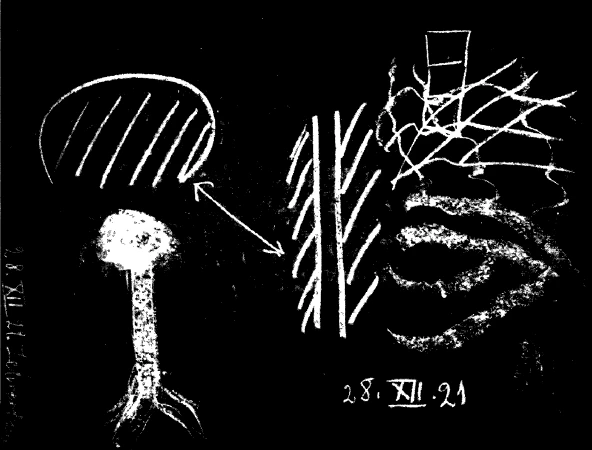
[ 20 ] And again, if one does a person the honor of not simply viewing him so rigidly: he is a unified whole—but rather, if one looks at his chest and holds these robust mental images there, then, by moving toward the head and allowing those images to unravel, one enters material life precisely through this unraveling of images, which is then reflected in the nerve fibers and their interconnections.
[ 21 ] If one now moves one’s imagination downward, one finds that one is unable to unravel the mental images so that they form a fabric that can then be found in the nervous system; rather, by attempting to continue the robust strands downward, one ends up losing them. They stop; they do not want to continue; they stop. One enters into a mental image that no longer quite corresponds to the material world, because the material world becomes fluid. You see, when you look at the brain and how it extends through the spinal cord via the twelve thoracic vertebrae, lumbar vertebrae, sacral vertebrae, and so on, the nerve masses—which are now white on the outside and gray on the inside—dissolve toward the metabolic region. In a sense, the ability to create a mental image of this in material terms is lost in this sensation. One cannot encompass the whole human being with mental images that remain static. One must make one’s imaginative life inwardly flexible. When one looks upward at a human being, the mental images become something different than when one looks downward at a human being. It is possible to recreate, in a sense, that which has become flexible within the human being. — You see, this is the beginning of an artistic activity that then, in a sense, places the perceiver within what one actually sees as the material realm outside in the world, in human beings. One does not, one might say, have on the one hand the coarse, material, concrete world and then a mental image, but rather one delves into human nature. And the mental image one holds becomes, in itself, something that comes alive and shares in human life. There is simply no other way to truly recognize in human beings what is necessary, especially for those who work as educators and teachers. One must become flexible in this way oneself in order to truly understand human beings. Then, however, one will also be able to discover exactly how these three aspects of human organization must interact to create a healthy human balance. And one will be able to become aware of what, when the balance is disturbed, gives rise to tendencies toward all manner of pathological conditions. One will gain a living understanding of the path toward health and the path toward illness in human beings.
[ 22 ] This becomes particularly important when one considers the course of human life. For these three aspects of the human organism interact in one way in childhood, in another way in adulthood, and in yet another way in old age. In the child, the spiritual-soul entity influences the physical-bodily entity in a completely different way, so that a very different kind of interaction arises between these three components than in the mature adult and the elderly person. And one must pay attention to this different mode of interaction. If one embarks on the path toward a mental image at all, one will gradually come to understand the course of human life in a different way than one is accustomed to.
[ 23 ] People took particular offense at the fact that, in my book *The Spiritual Guidance of Man and Humanity*, I pointed out how a child possesses a wisdom that adults, in fact, no longer have. Certainly, I do not wish to offend the wisdom and intelligence of our adult readers; but just imagine, if in later life you had to muster all that wisdom—the kind capable of wisely permeating the entire organism from the relative indeterminacy of the brain matter and the rest of the body, as we do instinctively in childhood—we would fare poorly. Admittedly, in the child all of this remains stuck in the unconscious—just as the brain shapes itself plastically, just as the rest of the organism shapes itself plastically; but it is nevertheless present, and one can see that it is present when one approaches the entire course of life using the means of cognition I have described to you in recent days; specifically, when one develops a true faculty for understanding children’s dreams. Adults today usually dismiss them as nonsense; but these childhood dreams, when considered in their essence, are extraordinarily interesting; they are quite different from the dreams of adults. They are such that the child actually dreams in many cases of what it simply cannot express—but we can come to understand the child in this regard—that the child dreams in images of that wisdom through which it plastically shapes its brain and the rest of its organism. If one were to explore some children’s dreams with an inner love in this direction, one would already see how the child—I would say—dreams of primordial wisdom that reigns there. From this point of view—forgive the harsh expression—the child is much wiser, much more intelligent than the adult. And the educator should actually be aware, when crossing the threshold of the school door, that the child possesses far more wisdom in this regard than he does. After all, the child has already developed and refined it; what the educator now possesses as the wisdom and intelligence gained through experience cannot really be compared to the wisdom the child once had. Therefore, if we consider the human dreams of later life, they no longer contain what is found in a child’s dreaming, but rather what the person carries from external life into their dreams. I have spoken about this from a different perspective. When an adult dreams, they carry their daytime wisdom into their nighttime life; this, in turn, has an effect on them, whereas a much higher wisdom acts upon the child. The child is not conscious of this wisdom, but in the unconscious the child senses it, and when sitting in school, the child has an unconscious feeling that it possesses this wisdom within itself—a wisdom that the teacher lacks, having already cast it aside. Outwardly, the teacher considers himself much wiser than the child. This is natural; otherwise, he would not be able to truly feel like a teacher. But his wisdom resides in his conscious mind. In this respect, he has an advantage over the child. But it is not as comprehensive, not as magnificent as the child’s wisdom. If one were to put into words what the child unconsciously carries within as wisdom, and if one were also to put into words what the teacher has lost, something very peculiar would emerge—something that is, however, of great importance for the truly intangible life at school. For one would arrive at the following: When the teacher enters the school with the cleverness he has acquired in the world, this abstract cleverness of today has—and this does happen—turned him into a rather dry, philistine person, who sometimes even shows this in his outward appearance. The child, however, still possesses all the liveliness that springs from the wisdom I have spoken of. Naturally, the child is forbidden to express these feelings. And so it comes to pass that in school, the teacher’s judgment prevails: The teacher is smart; the child is stupid. — But in the subconscious, it is different. And if words were spoken in dreams, it would be different yet again. In the subconscious, children unconsciously think: “How stupid the teacher is”—and the teacher unconsciously thinks: “How clever the children are!”—In the whole picture, what prevails in a school classroom plays an extraordinarily large role.
[ 24 ] One must be perfectly clear that, in fact, when a child behaves as I have described, it must always, in a very natural way, face the teacher with a certain inner arrogance—which, however, remains unconscious—and a sense of amusement; for the child cannot help but sense, in the depths of its childlike nature, the wise, uplifting essence of humanity—and the other side—how little has actually come of it, as one can see; that is how the child’s unconscious nature judges it—when the teacher enters with his stiffness, with his demeanor made gloomy by abstract, intellectualistic concepts, with the coat that has become so dusty in the library that one can never brush it clean enough, for, isn’t it true, the child feels in the most intense way what I would like to call an amusing realization.
[ 25 ] This is precisely what one must always feel toward a child, and what, in a certain sense, is entirely justified by human nature. The child actually preserves its health in this way; for it is quite certain that the child does not dream in an uplifting way about teachers, but rather dreams of that wisdom I have described, which interweaves with and flows through it. In the teacher, something opposite develops in the subconscious, which is also a possibility among the intangible elements of the classroom. But it is clearly present. In the child, it is more—I would say—a relationship of insight. For the teacher, it becomes something desirable; it becomes something that expresses itself in the capacity for desire. The teacher thinks about this in his subconscious and even dreams of it—something he, of course, by virtue of his school-based civilization, does not admit to himself at all in his conscious mind—he actually dreams of possessing some of the forces inherent in the child’s nature. One would certainly see, if one were to psychoanalyze human souls with a little more insight than is done today, what role these lively, fresh forces of growth and other human powers of the child play in the teacher’s subconscious life.
[ 26 ] But all of this takes place in the intangible realm of life; these are forces that truly develop in the classroom. And one can certainly say that, if one looks behind the scenes of a child’s ordinary existence, the child behaves in the classroom in such a way that it turns its interest away from the teacher and asks: “What has become of all that we have within us in this individual?” — But in the teacher, this affects the capacity for desire. Subconsciously, he begins to “vampirize” the children. Unconsciously, he seeks to appropriate the children’s forces. And if one were to look more closely, one would see how strongly this “vampirization” often operates behind the scenes of physical existence. One would see where the frailty of some children comes from—though, of course, these matters must again be considered intimately—and the pathological predispositions of the children in this or that classroom. One would need only, if one had a free, open view of it, to observe the teacher’s physical appearance; then one would gain some insight into the healthy and unhealthy tendencies of the children in the classroom.
[ 27 ] As educators and teachers, we can overcome this only by imbuing ourselves with an understanding of human nature that — because it is inwardly flexible, because it is itself a spiritual-soul organism modeled on the human organism in the way I have shown — is at the same time united with love for humanity, with true love for humanity, which overcomes and harmonizes the various one-sided forces of human nature. By acquiring such an understanding of human nature, one also comes to realize not only how human nature expresses itself in various ways in different human individuals, but also how human nature expresses itself in entirely different ways in childhood, in maturity, and in old age. The three aspects of human nature interact in very different ways, and they must be harmonized with one another.
[ 28 ] This becomes very real, for example, when we have to consider how to allocate the time we have available for teaching and education in the right way. Of course, we must take the whole person into account in our educational and instructional practices—that is, both the nature of the head and the nature of the limbs and metabolism—and since the processes of the other limbs are also taking place within each individual limb, we must take this into consideration. Metabolic processes are, of course, constantly taking place in the head as well.
[ 29 ] If we now find it necessary, for certain instructional and educational formalities, to have the child sit quietly in class—we will discuss this further—even on ergonomically designed desks, then we are nevertheless treating the child in such a way that it sits still; that is, activity does not take place in the metabolic-limb organism, but rather everything that is active must be drawn out of the head. This is a one-sided situation into which we place the child. We compensate for this, however, by subsequently—and quite rightly so—relieving the head of its activity and stimulating the metabolic-limb organism through movement, by having the child participate in physical education.
[ 30 ] If one is aware of how polar opposites the processes in the head organism and in the limb-metabolic organism are, one will certainly understand how important it is to alternate in this way as well. But when we have the children do gymnastics, let them jump, have them do all kinds of exercises, and then bring them back into the classroom to continue teaching them—well, what happens then?
[ 31 ] You see, while a human being’s metabolic-limb organism is active, those thoughts that are artificially implanted in the mind between birth and death are, in fact, absent from the mind. The child jumps around, moves about, and sets the metabolic-limb organism in motion. The thoughts implanted during physical life on Earth recede. But that which otherwise appears in dreams—this supersensible wisdom—is now present in the mind in an unconscious way and is making itself felt there. If, therefore, we lead the child back into the classroom after gymnastics, we are substituting something that is inferior to the child in the subconscious for what it previously experienced during the gymnastic exercises. For during the gymnastic exercises, it is not only the sensory realm that has an educational effect on the child, but also the supersensible realm, which finds a very special outlet during these exercises. Consequently, the child becomes inwardly resentful during the following lesson. The child may not express this resentment very strongly, but inwardly, the child becomes resentful. And we are harming the child; we are predisposing the child to illness by grafting ordinary instruction onto the gymnastic exercises once again.
[ 32 ] This is, in fact, a fact that has even been observed externally on many occasions, as a physiologist assured me. But here, from anthroposophical spiritual research, you have the reasons why we can see how we can indeed foster a healthy disposition by acquiring a proper understanding of human nature as teachers and educators. Of course, if we do not do this in the right way, we create all sorts of predispositions to illness. We must certainly bear this in mind. For, as you have noticed, I do not wish to fall into glorifying what human beings acquire as their wisdom of life; it would not be sufficient to shape the human organism plastically in later life. But if, in later, mature age, we were already so rigid in our constitution that what we fill our heads with—as external wisdom acquired in a naturalistic-intellectualistic manner—did not all radiate back in the right way as a memory image, it would later flow down into the rest of the organism. And what—as paradoxical as it may sound—is supposed to remain in the head organism according to the normal human organization, when it flows down into the metabolic organism of the limbs, makes the person sick; it is like poison. Intellectual wisdom is in fact a kind of poison as soon as it ends up in the wrong place, as soon as it enters the metabolic organism, at the very least. We can only live with intellectual wisdom if this poison—I say this in a purely technical sense, not as a moral judgment—if this poison does not penetrate into our metabolic-limb organism. There it has a terribly destructive effect.
[ 33 ] But a child does not possess this rigidity. When we approach them with our mature wisdom of today, this poison seeps in and indeed poisons the child’s metabolic and limb systems. You see, it is necessary to learn from direct life experience just how much one can expect of a child’s mind, so as not to cram too much into it—which cannot then be held back and which then seeps down into the metabolic-limb organism.
[ 34 ] As a teacher and educator, one therefore has the power to either have a healing or a harmful effect on the child’s organism. And if, according to today’s wisdom, one wants to make a child particularly intelligent, one sits the child down and crams as much as possible into it while it is seated; then the opposite occurs: one prevents the unconscious wisdom within the child from taking effect. For this unconscious wisdom is active precisely when the child is romping about, when it is making more or less rhythmic movements; for rhythm promotes the organism’s connection with unconscious wisdom through the unique mediating position that this rhythmic organism has assumed between the head organization and the metabolic-limb organization. So it turns out that when we apply this “monastic education” that Herbert Spencer speaks of—intended to make children and young people particularly intelligent—we actually end up equipping them with a predisposition to illness, which means that later in life they will no longer know what to do with the wisdom we have taught them.
[ 35 ] These are all things that truly cannot be weighed on a scale, but are revealed only to a flexible way of thinking that constantly adapts to life—a way of thinking that can be acquired through anthroposophical training. And with this, let us generally point out how the teacher and educator must familiarize themselves with the great principles of health and illness in human beings.
[ 36 ] And here it is of essential importance to note how the striving—with its perspective, with its understanding of the world—does not remain stuck on the external, the immovable, fixed, but rather to rise to an inner flexibility of thought—how this is connected to the recognition of all the unstable states in which human nature manifests itself, both in its healthy and unhealthy aspects, and which the teacher encounters in school as something he must address.
[ 37 ] We will go into the details as we now consider the child—the developing human being—through the successive stages of life.