

The Healthy Development of the Human Being
An Introduction to Anthroposophical Education and Didactics
GA 303
28 December 1921, Dornach
[ ] Translate the original German text into any language:
Versions Available:
The Healthy Development of the Human Being, tr. SOL
Sechster Vortrag
Sixth Lecture
[ 1 ] In den Betrachtungen von gestern und heute will ich nicht etwa schon etwas Spezielles über Gesundheits- und Krankheitslehre sagen, sondern zunächst nur dasjenige, was die Notwendigkeit darlegen wird, daß sich der Lehrende und Unterrichtende auf Wege begeben muß, die ihn zu einem Durchschauen des Gesundenden und Krankmachenden im Menschen führen. Der Unterrichts- und Erziehungskünstler muß ja vor allen anderen Dingen wirklich in die menschliche Gesamtorganisation hineinschauen können, und er darf sich nicht den unbefangenen, man möchte sagen, instinktiv-intuitiven Blick für diese menschliche Gesamtorganisation stören lassen durch allerlei abstrakte pädagogische und didaktische Regeln. Die machen ihn dem Kinde gegenüber nur befangen. Er muß ganz frei dem Kinde gegenüberstehen.
[ 1 ] In yesterday’s and today’s reflections, I do not intend to say anything specific about the science of health and disease just yet, but rather, for now, only what will demonstrate the necessity for the teacher and educator to embark on paths that lead them to an understanding of what promotes health and what causes illness in human beings. Above all else, the master of teaching and education must truly be able to look into the human organism as a whole, and he must not allow his unbiased—one might say instinctive and intuitive—view of this human organism to be disturbed by all sorts of abstract pedagogical and didactic rules. These rules only make him self-conscious in his dealings with the child. He must stand before the child in complete freedom.
[ 2 ] Nun hört man ja besonders in Mitteleuropa, ich weiß nicht, ob es in Westeuropa auch so ist, sehr häufig den Satz anführen: es gäbe nur eine Gesundheit und sehr, sehr viele Krankheiten. Dieser Ausspruch, an den vielfach geglaubt wird, kann aber doch einer wirklichen Menschenerkenntnis gegenüber nicht bestehen, denn der Mensch ist so individuell, so als besonderes Wesen gestaltet, daß eigentlich im Grunde genommen jeder und auch schon jedes Kind seine eigene Gesundheit hat, eine ganz besonders modifizierte Gesundheit. Und man kann sagen: So viele Menschen es gibt, so viele Gesundheitsverhältnisse und Krankheitsverhältnisse gibt es. - Das schon weist uns darauf hin, wie wir unser Augenmerk immer darauf lenken müssen, die besondere individuelle Natur des Menschen zu erkennen.
[ 2 ] Now, especially in Central Europe—I don’t know if this is also the case in Western Europe—one very often hears the saying: “There is only one kind of health, but very, very many kinds of illness.” This saying, which is widely believed, cannot, however, stand up to a true understanding of human nature, for human beings are so individual—so uniquely constituted—that, in essence, every person, even every child, has their own health, a health that is uniquely tailored to them. And one can say: There are as many states of health and illness as there are people. - This alone shows us how we must always focus our attention on recognizing the unique individual nature of human beings.
[ 3 ] Davon aber kann nur dann die Rede sein, wenn der Mensch imstande sein wird, dasjenige, was er im anderen Menschen vor sich hat, wirklich seiner Ganzheit, seiner Totalität nach zu betrachten. In dem Menschen, dem wir im Leben gegenüberstehen, haben wir ein Ineinanderwirken von Geistig-Seelischem und Physisch-Leiblichem vor uns, gerade so, wie wir im Wasser Sauerstoff und Wasserstoff vor uns haben. Und in dem, was als Mensch vor uns steht, kann das Geistig-Seelische und das Physisch-Leibliche unmittelbar ebensowenig angeschaut werden wie im Wasser der Wasserstoff und der Sauerstoff.
[ 3 ] But this can only be the case if a person is able to truly view what they see in another person in all its wholeness and totality. In the human being we encounter in life, we are faced with an interplay of the spiritual-soul and the physical-bodily, just as we are faced with oxygen and hydrogen in water. And in what stands before us as a human being, the spiritual-soul and the physical-bodily cannot be directly perceived any more than hydrogen and oxygen can be perceived in water.
[ 4 ] Man muß, um die beiden Wesensglieder des Menschen richtig zusammenzuschauen, sie eben erst kennen. Und man kann sie nicht aus der gewöhnlichen Lebenserkenntnis heraus erkennen. Heute betrachtet man ja den Menschen auf der einen Seite so, daß man ihn in der Physiologie und Anatomie so betrachtet, wie er als leibliches Wesen vor uns steht, und man liebt es ganz besonders, die Physiologie und die Anatomie nach dem aufzubauen, was man nun nicht mehr als den konkreten Menschen vor sich hat, sondern als den Leichnam, wo das Geistig-Seelische weg ist.
[ 4 ] In order to properly consider the two essential aspects of the human being together, one must first come to know them. And one cannot recognize them through ordinary knowledge of life. Today, on the one hand, people view human beings in such a way that, in physiology and anatomy, they regard them as physical beings standing before us, and they are particularly fond of basing physiology and anatomy on what is no longer the concrete human being standing before them, but rather the corpse, from which the spiritual and soul elements have departed.
[ 5 ] Und auf der anderen Seite betrachtet man den Menschen nach dem, was er in seinem Inneren erleben kann. Aber in unserer naturalistisch-intellektualistischen Zeitperiode bemerkt ja der Mensch, indem er in sein Inneres hineinschaut, eigentlich nur noch Abstraktionen, nur noch ganz dünne, kalte Vorstellungen. Er wird nur warm, wenn er auf eine ihm unerklärliche Weise dann zum Fühlen und zu den Willensimpulsen kommt. Die durchschaut er aber wieder nicht. Die dringen als unbestimmte Wogen aus seinem Inneren herauf. Beim Hineinschauen in das Innere wird er nur die ganz dünnen, kalten Gedanken gewahr.
[ 5 ] On the other hand, one views human beings in terms of what they are capable of experiencing within themselves. But in our naturalistic-intellectualistic age, when a person looks within, they actually perceive only abstractions—only very thin, cold mental images. They only feel warmth when, in a way they cannot explain, they are moved to feel and experience impulses of will. Yet they do not understand these either. They well up from within as indefinable waves. When looking inward, they become aware only of these very thin, cold thoughts.
[ 6 ] Sehen Sie, daß der Mensch, wenn er durch Innenschau diese kalten, blassen, dünnen Gedanken wahrnimmt, ja kein Wirklichkeitsgefühl bekommen kann, kein Realitätsgefühl, das ist eigentlich ganz selbstverständlich. Und ich werde jetzt etwas aussprechen, was der heutigen Lebensauffassung etwas paradox erscheint, aber was doch eben durchaus der Wahrheit entspricht. Man wird nämlich materialistisch gestimmt heute wegen einer zu hohen, nämlich einer zu dünnen Geistigkeit, weil dasjenige, was man im Inneren sieht, wirklich keinen Realitätscharakter mehr hat. Und gerade diejenigen Menschen unserer Kulturperiode sind ja die stärksten Materialisten geworden, die in den abstraktesten Gedanken leben. Man wird gerade durch die heutige Geistigkeit zum Materialisten. Und umgekehrt, diejenigen Menschen, welche wenig angekränkelt sind von des Gedankens Blässe, wie er in unserer Zeit hervorgebracht wird, die sich wenig einleben in die gegenwärtige Art des schulmäßigen, des wissenschaftlichen Denkens, die sich mehr an die äußeren, materiellen Vorgänge halten, die ahnen in diesen äußeren materiellen Vorgängen Geheimnisvolles genug. In unseren Gedanken ist nicht viel Geheimnisvolles heute. Die sind recht dünn, durchsichtig, vor allen Dingen ganz abscheulich klar, deshalb aber auch nicht in der Wirklichkeit stehend. Die materiellen Vorgänge draußen, die sind aber schon geheimnisvoll; die kann man nicht nur in Klarheit anschauen, sondern man kann sie auch bewundern, an die kann sich auch das Gefühl anheften. Daher werden diejenigen, die wenig angekränkelt sind von unserem heutigen Gedankenleben, die es sich nicht so unbequem gemacht haben, die Wissenschaft der heutigen Zeit zu studieren, sich mehr an das Materielle, an das geheimnisvoll Materielle halten. Und wenn sie dann doch die Sehnsucht haben, etwas vom Geist zu erkennen, dann wollen sie diesen Geist auch als etwas Materielles hinstellen. Und die werden Spiritisten. Man wird aus der heutigen abstrakten naturwissenschaftlichen Erkenntnis heraus nicht Spiritist, sondern Materialist; man wird aber gerade aus dem Hinneigen zum Materiellen heute Spiritist. Das ist das Eigentümliche, Paradoxe unserer Zeit, daß die am Materialismus hängenden Menschen, wenn sie noch Sehnsucht haben nach dem Geiste, Spiritisten werden. Sie wollen den Geist auch in materieller Form, in materiellen Erscheinungen hingestellt haben. Und diejenigen, welche sich in die Wissenschaft der heutigen Zeit einleben, die werden Materialisten. Aber man kann weder mit Materialismus noch mit Spiritismus den Menschen erkennen, sondern man kann den Menschen nur erkennen, wenn man in dem, was vor uns steht, das Geistig-Seelische und das Physisch-Leibliche ineinanderschauen kann, wenn man in jedem Organ und im ganzen Menschen immer die innige Durchdringung von Physisch-Leiblichem und Seelisch-Geistigem sieht.
[ 6 ] You see, when a person perceives these cold, pale, insubstantial thoughts through introspection, they simply cannot gain a sense of reality—a sense of reality that is, in fact, quite self-evident. And I am now going to say something that may seem somewhat paradoxical to today’s view of life, but which nevertheless corresponds entirely to the truth. People today have become materialistic precisely because of an excessive—that is, an overly thin—spirituality, since what they see within themselves truly no longer has any character of reality. And it is precisely those people in our cultural epoch who live in the most abstract thoughts who have become the strongest materialists. It is precisely today’s spirituality that turns people into materialists. Conversely, those people who are less afflicted by the pallor of thought as it is produced in our time—who do not immerse themselves too deeply in the current style of academic, scientific thinking—who adhere more to external, material processes, sense enough mystery in these external material processes. There is not much mystery in our thoughts today. They are quite thin, transparent, and above all, abhorrently clear—and for that very reason, they do not stand in reality. The material processes out there, however, are indeed mysterious; one can not only observe them with clarity, but one can also admire them, and one’s feelings can attach themselves to them. Consequently, those who are only slightly affected by our present-day intellectual life—those who have not gone to the trouble of studying contemporary science—will cling more to the material, to the mysteriously material. And if they do feel a longing to perceive something of the spirit, they will seek to present this spirit as something material as well. And they will become spiritualists. Based on today’s abstract scientific knowledge, one does not become a spiritualist but a materialist; yet it is precisely the inclination toward the material that leads one to become a spiritualist today. This is the peculiar, paradoxical aspect of our time: that people attached to materialism, if they still yearn for the spirit, become spiritualists. They want the spirit to be presented in material form, in material manifestations. And those who immerse themselves in the science of our time become materialists. But one cannot understand human beings through either materialism or spiritualism; rather, one can understand human beings only if one can perceive the interplay of the spiritual-soul and the physical-bodily in what stands before us, if one always sees in every organ and in the whole human being the intimate interpenetration of the physical-bodily and the soul-spiritual.
[ 7 ] Der Mensch spricht heute von der Seele und vom Geist, gewiß; er spricht vom Leib und vom Körper. Und dann stellt er große Philosophien an, welches Verhältnis zwischen der Seele und zwischen dem Leibe besteht. Da werden von den gescheitesten Menschen ausführliche Theorien aufgestellt. Die Theorien sind sehr gescheit, sehr scharfsinnig, aber sie können ja nicht die Wirklichkeit berühren, aus dem einfachen Grunde, weil sich die Wirklichkeit nur ergibt, wenn man in dem vollen Menschen, in dem ganzen Menschen, in unmittelbarer Anschauung das Geistig-Seelische und das Physisch-Leibliche sich durchdringend, durchschauen kann. Und wer die Menschenerkenntnis von heute recht betrachtet, der wird ja auch finden, wie grau und nebulos sowohl die äußere Menschenerkenntnis wie auch die innere ist.
[ 7 ] People today speak of the soul and the spirit, certainly; they speak of the body and the physical form. And then they devise grand philosophies about the relationship between the soul and the body. Even the wisest people put forward elaborate theories. These theories are very clever, very astute, but they cannot touch reality, for the simple reason that reality only reveals itself when one can perceive, in the full human being, in the whole human being, through direct observation, how the spiritual-soul aspect and the physical-bodily aspect interpenetrate one another. And anyone who takes a close look at today’s understanding of the human being will indeed find how gray and nebulous both the external and the internal understanding of the human being are.
[ 8 ] Wenn der Mensch heute den Menschen betrachtet, der vor ihm steht, dann sagt er: Das ist ein Ganzes. -- Man betrachtet ihn als ein Ganzes, weil er durch die Haut schön abgeschlossen ist. Aber man berücksichtigt wenig, wie ja diese Einheit eigentlich nur dadurch eine Einheit ist, daß die mannigfaltigsten Organe in dieser Einheit zusammenwirken. Man kann ja die Einheit nur erfassen, wenn man sieht, wie die mannigfaltigsten Organe zu dieser Einheit zusammenwirken. Und wenn heute jemand spricht, daß der Mensch doch nicht so von vornherein als eine Einheit angesehen werden kann, dann kommen die Gegner und sagen: Ja, ihr zerstört die Einheit des Menschen; man muß ihn als eine Einheit betrachten. — Aber diese Einheit bleibt ja ein ganz abstrakter "Gedanke, wenn man sie in der eigenen Vorstellung nicht selber aus den konkreten Gliedern, die im Menschen enthalten sind, aufbauen, harmonisieren kann.
[ 8 ] When a person today looks at the person standing before them, they say: This is a whole. -- One regards him as a whole because he is beautifully enclosed by his skin. But little consideration is given to the fact that this unity is actually a unity only because the most diverse organs work together within it. One can only grasp this unity by seeing how the most diverse organs work together to form it. And when someone today argues that a human being cannot be regarded as a unity from the outset, opponents come forward and say: “Yes, you are destroying the unity of the human being; one must regard him as a unity.” — But this unity remains a purely abstract “idea” if one cannot construct and harmonize it in one’s own mental image from the concrete parts contained within the human being.
[ 9 ] Und wiederum, wenn der Mensch nach innen schaut, faßt er dasjenige, was in ihm lebt, zusammen, indem er zu sich «Ich» sagt. Leute von größter Kapazität, wie John Stuart Mill, mußten sich alle Mühe geben, Theorien darüber zu finden, was eigentlich da in diesem innerlichen Zusammengefühle enthalten ist, das sich als Ich ausdrückt. Der Mensch soll nur einmal recht achtgeben darauf, wie nebulos diese punktuelle Vorstellung «Ich» ist, was er damit eigentlich hat. Er wird schon sehen, daß er nicht mehr etwas Konkretes erfaßt in dem, was er mit dem Worte Ich bezeichnet. Im Deutschen - drei Buchstaben sind es in der Regel, und über die Buchstaben kommt der Mensch nicht hinaus. Im Englischen sollen es sogar noch weniger sein, was man mit dem Ich umfaßt, nicht einmal drei Buchstaben. Sie sehen also: nebulos beim Hineinschauen ins Innere, nebulos beim Hinausschauen in die äußere Leiblichkeit wird die heutige Menschenerkenntnis.
[ 9 ] And again, when a person looks inward, he sums up that which lives within him by saying “I” to himself. Even people of the greatest intellect, such as John Stuart Mill, had to go to great lengths to formulate theories about what is actually contained in this inner sense of unity that expresses itself as “I.” One need only pay close attention to how nebulous this specific mental image of “I” is—what one actually means by it. One will see that one no longer grasps anything concrete in what one designates with the word “I.” In German—it usually consists of three letters, and one cannot go beyond those letters. In English, what is encompassed by “I” is said to be even less—not even three letters. So you see: today’s understanding of the human being is nebulous when looking inward, and nebulous when looking outward at physicality.
[ 10 ] Gerade dieses Zusammenschauen des Geistigen mit dem Physischen, das ist es, was die Anschauungsweise des Menschen befruchtet. Die Menschen fühlen sich heute ungeheuer wohl, wenn ihnen das Goethesche Wort entgegenklingt: Materie in Geist, Geist in Materie. — Es ist schön, daß sich die Leute wohl fühlen dabei, denn es entspricht ja das wirklich einer Realität. Aber für denjenigen, der gewöhnt wird, überall das Geistige und das Physische zusammenzuschauen, für den kann das ebenso eine Trivialität sein, wenn man ihn noch zur Anerkennung dieser Selbstverständlichkeit auffordert. Und daß sich die Leute so wohl fühlen, wenn so etwas theoretisch vor sie hingestellt wird, das ist eben ein Beweis dafür, daß sie es in der Praxis nicht haben. Sehr dezidierte Theorien sind in der Regel ein Beweis dafür, daß man das Betreffende in der Praxis nicht hat, wie die Geschichte zeigt. Die Leute haben erst über das heilige Abendmahl in Theorien zu diskutieren angefangen, als sie in der Praxis der Sache nicht mehr die nötige Empfindung entgegenbrachten. Theorien stellt man in der Regel auf für das, was man nicht hat, nicht für das, was man im Leben hat.
[ 10 ] It is precisely this integration of the spiritual and the physical that enriches the human way of perceiving the world. People today feel immensely at ease when they hear Goethe’s words: “Matter in spirit, spirit in matter.” — It is nice that people feel comfortable with this, for it does indeed correspond to reality. But for those who are accustomed to viewing the spiritual and the physical together in everything, it can seem just as trivial when they are still asked to acknowledge this self-evident truth. And the fact that people feel so at ease when something like this is presented to them theoretically is precisely proof that they do not possess it in practice. Very definitive theories are, as a rule, proof that one does not possess the thing in question in practice, as history shows. People only began to discuss theories about Holy Communion when they no longer brought the necessary feeling to the matter in practice. Theories are generally formulated for what one lacks, not for what one has in life.
[ 11 ] Gerade mit dieser Gesinnung kann nun derjenige, der ein wirklicher Erziehungs- und Unterrichtskünstler sein will, an eine Menschenerkenntnis herangehen. Dann wird er aber dazu geführt, die Gliedhaftigkeit des Menschen in der Konkretheit zu erfassen, nicht ein verschwommenes Einheitsgebilde; die Einheit tritt zuletzt auch auf, aber aus dem Zusammenhang der Gliedhaftigkeit. Und da kann man dann nicht anders, als zunächst zu dem geführt werden, was ich zuerst in meinem Buche «Von Seelenrätseln» angedeutet habe, zu der Gliederung des Menschen in drei ihrer Organisation nach verschiedene Wesensteile. Schon äußerlich zeigt sich die Kopforganisation ganz anders als, sagen wir, die Organisation, die wir sehen als die Gliedmaßen-Stoffwechselorganisation. Ich spreche von Gliedmaßen-Stoffwechselorganisation, weil der Stoffwechsel dann charakteristisch hervortritt, wenn der Mensch durch seine Gliedmaßen in Tätigkeit ist. Der Stoffwechsel ist ja auch morphologisch gewissermaßen die Fortsetzung nicht des ruhenden, sondern des bewegten Menschen nach innen; daher ist er reger, wenn der Mensch bewegt ist. Es ist ein innerer Zusammenhang, den man auch ganz im einzelnen nachweisen kann - ich will ihn hier nur andeuten - zwischen dem Gliedmaßenorganismus und dem Stoffwechselorganismus, so daß ich da zunächst von einer Einheit spreche: Gliedmaßen-Stoffwechselorganismus. Aber an sich stellen diese beiden einander entgegengesetzte Organisationen dar.
[ 11 ] It is precisely with this mindset that anyone who wishes to be a true artist of education and instruction can approach the understanding of human nature. But then they are led to grasp the interconnectedness of the human being in its concreteness, not as a vague, unified entity; unity does ultimately emerge, but out of the interconnection of this segmented nature. And there one cannot help but be led, at first, to what I initially hinted at in my book *On the Mysteries of the Soul*—namely, the division of the human being into three essential parts that differ in their organization. Even externally, the organization of the head appears quite different from, let us say, the organization we perceive as the limb-metabolic organization. I speak of limb-metabolic organization because metabolism comes to the fore characteristically when the human being is active through his or her limbs. Morphologically, metabolism is, in a sense, the continuation inward—not of the human being at rest, but of the human being in motion; therefore it is more active when the human being is in motion. There is an inner connection—which can be demonstrated in great detail, though I will only hint at it here—between the limb organism and the metabolic organism, so that I initially speak of a unity: the limb-metabolic organism. But in and of themselves, these two represent opposing organizations.
[ 12 ] Nehmen Sie schon das Äußerliche, rein der Gestalt nach. Der Kopf ist, wenn wir von den Haaren absehen, die aber nach außen gehen und eigentlich etwas sind, was sich der lebendigen Organisation entzieht, die etwas Totes sind - es ist interessant, die Haare zu betrachten, aber es würde uns im gegenwärtigen Augenblicke zu weit führen -, der Kopf ist von einer Skelettkapsel umgeben, und die ist an der Peripherie am mächtigsten ausgebildet; während dasjenige, was das Weiche, Lebendige des Hauptes, des Kopfes ist, im Inneren liegt. Sehen Sie sich dagegen die Organisation des Menschen am entgegengesetzten Pole an, sehen Sie sich die Gliedmaßenorganisation an: Sie haben den Röhrenknochen, innerhalb desselben das gewöhnlich kaum bemerkte Mark, dem man für den Gesamtorganismus nicht eine solche Bedeutung zuschreibt wie dem Inneren des Kopfes; dagegen sehen Sie dasjenige, was wichtig ist für den Organismus, äußerlich angehängt. Also gerade den Gegensatz sehen wir hier ausgebildet. Und dieser Gegensatz ist durch die ganze menschliche Natur bedingt. So daß wir von zwei entgegengesetzten Naturen sprechen können: von der Nerven-Sinnesorganisation, die hauptsächlich, ich sage hauptsächlich, nicht ausschließlich, im Kopfe lokalisiert ist, und von der Stoffwechseltätigkeits-Organisation, die im Stoffwechsel-Gliedmaßenorganismus lokalisiert ist. Natürlich ist der Mensch in Wirklichkeit doch eine Einheit. Und wir dürfen nicht vergessen, daß wir nicht, einer gewissen schematisierenden Neigung entsprechend, jetzt wiederum drei Teile hinstellen und diese fein definieren dürfen: Nerven-Sinnesorganisation, die andere werden wir gleich kennenlernen, Stoffwechsel-Gliedmaßenorganisation; und dann feine Definitionen hinstellen, als ob das so getrennt wäre. So getrennt ist es nicht. Es findet ein fortwährender Stoffwechsel und auch eine Bewegungstätigkeit in den Muskeln des Kopfes statt und im Kopfe; aber es ist der Kopf hauptsächlich Nerven-Sinnesorganisation; und es findet auch ein Durchdringen des Stoffwechsel-Gliedmaßenorganismus mit Gedankenkräften statt. Aber es ist der Stoffwechsel-Gliedmaßenorganismus eben hauptsächlich Stoffwechsel-Gliedmaßenorganismus.
[ 12 ] Take just the outward appearance, purely in terms of form. The head—if we disregard the hair, which, however, extends outward and is actually something that lies outside the living organism, something dead—it is interesting to consider the hair, but that would take us too far afield at this moment—the head is surrounded by a bony shell, which is most robust at its periphery; while that which constitutes the soft, living substance of the head lies within. In contrast, look at the human organism at the opposite pole; look at the structure of the limbs: you have the tubular bone, and within it the marrow—which is usually barely noticed—to which one does not ascribe the same significance for the entire organism as to the interior of the head; in contrast, you see that which is important for the organism attached externally. So it is precisely this contrast that we see manifested here. And this contrast is determined by human nature as a whole. Thus we can speak of two opposing natures: the nervous-sensory system, which is primarily—I say primarily, not exclusively—located in the head, and the metabolic system, which is located in the metabolic-limb system. Of course, in reality, the human being is still a unity. And we must not forget that we cannot—in accordance with a certain tendency toward schematization—now once again set out three parts and define them precisely: the nervous-sensory organization, the other of which we will learn about shortly, and the metabolic-limb organization; and then provide precise definitions as if they were so separate. It is not that separate. There is a continuous metabolic process and also motor activity taking place in the muscles of the head and within the head itself; but the head is primarily a nervous-sensory system; and there is also an interpenetration of the metabolic-limb system by thought forces. But the metabolic-limb system is, after all, primarily a metabolic-limb system.
[ 13 ] Und zwischen drinnen steht alles dasjenige, was man nennen kann den rhythmischen Organismus des Menschen. Er ist lokalisiert im Brustorganismus. Da haben wir die hauptsächlichsten Rhythmen, Atmungsrhythmus, Zirkulationsrhythmus voneinander differenziert; der Atmungsrhythmus langsam, der Zirkulationsrhythmus schneller; der Atmungsrhythmus in den Atemzügen bemerkbar, der Zirkulationsrhythmus im Pulsschlag. Das ist das Vermittelnde, das steht zwischen den beiden anderen Polen drinnen, das gleicht aus. Es wäre reizvoll, das alles im einzelnen durchzuführen, allein das kann man nicht immer, wenn man zu einem besonderen Zweck, wie hier zu dem pädagogischdidaktischen, die Dinge auseinandersetzt. Wenn Sie sich aber einen Sinn dafür aneignen, die Brustorganisation zu betrachten, dann werden Sie in der Skelettgestaltung, in der Gestaltung der Organe, überall den Übergang finden von der Gestalt der Kopforgane zu der Gestalt der Gliedmaßenorgane, der Stoffwechselorgane. Es steht das alles, was in der Brustorganisation ist, auch seiner Form nach, in der Mitte drinnen zwischen diesen beiden Polen der menschlichen Organisation. Zu dieser Betrachtungsweise werden wir geführt, wenn wir uns auf den Weg begeben, den Menschen nun tatsächlich seiner inneren Konfiguration nach anzuschauen und nicht einfach das nebulose Gebilde des Einheitsmenschen vor uns hinstellen.
[ 13 ] And in between lies everything that can be called the human rhythmic organism. It is located in the chest organism. There we find the primary rhythms—the respiratory rhythm and the circulatory rhythm—distinct from one another; the respiratory rhythm is slow, the circulatory rhythm faster; the respiratory rhythm is noticeable in the breaths, the circulatory rhythm in the pulse. This is the mediating factor, situated between the other two poles within, which balances them out. It would be fascinating to explore all of this in detail, but that is not always possible when one is analyzing things for a specific purpose, such as the pedagogical-didactic one here. But if you develop a sense for observing the organization of the chest, you will find everywhere—in the structure of the skeleton and in the structure of the organs—the transition from the form of the head organs to the form of the limb organs and the metabolic organs. Everything that is part of the thoracic organization—including its form—is situated in the middle between these two poles of the human organization. We are led to this perspective when we set out to actually observe the human being according to his inner configuration, rather than simply positing the nebulous construct of a “uniform human being” before us.
[ 14 ] Aber das geht viel weiter. Das geht auch in die Betätigungsweise des ganzen Menschen hinein. Und dafür möchte ich Ihnen auch ein Beispiel anführen. Man könnte unzählige solcher Beispiele anführen, aber gerade aus einem solchen Beispiel werden Sie sehen, wie notwendig es ist, daß gerade der Unterrichts- und Erziehungskünstler sich auf einen solchen Weg begibt, wie ich ihn hier darstelle. Nehmen Sie einmal an, Ste haben einen Menschen vor sich, der an Zornanwandlungen leidet. Zornanwandlungen, Zornmütigkeit beim Menschen können schon im Kinde auftreten. Man muß damit fertig werden als Erzieher, als Unterrichtskünstler. Nun, wenn man mit der heutigen Physiologie und Anatomie den Menschen betrachtet, so wird man ja allerdings noch auf der einen Seite abstrakt untersuchen, wie die Seele sich auslebt, wenn sie zornig wird, wie der Gewohnheitszorn sich äußert; das steht auf der einen Seite. Auf der anderen Seite wird man vielleicht auch wiederum dazu kommen, sich zu sagen: beim zornmütigen Menschen sondert sich Galle ab im abnormen Maße. Aber man schaut diese zwei Dinge nicht zusammen. Man schaut nicht das Geistig-Seelische des Zorns, des Ärgers, und das Leiblich-Physische, die Gallenabsonderung als eine Einheit zusammen. Nun, im normalen Menschen ist es notwendig, daß er die Gallenabsonderung hat, weil sich der Gallsaft vermischen muß mit den Stoffen, die sich seinem Organismus durch die Ernährung einverleiben. Von dem, was ganz in der Ordnung ist im normalen Organismus, von dem tut der Zornmütige zuviel, er sondert zuviel Galle ab. Und wenn er in diesem Zustande verbleibt, wird er zuletzt die Gelbsucht bekommen, wie Sie wissen.
[ 14 ] But this goes much further. It also extends to the way the whole person acts. And I would like to give you an example of this as well. One could cite countless such examples, but from just one such example you will see how necessary it is that the teacher and educator, in particular, embark on the path I am describing here. Suppose you have a person before you who suffers from outbursts of anger. Outbursts of anger and a hot temper can already appear in children. As an educator and teaching artist, one must deal with this. Now, if one examines human beings through the lens of modern physiology and anatomy, one will, on the one hand, certainly still investigate abstractly how the soul expresses itself when it becomes angry, and how habitual anger manifests; that is one aspect. On the other hand, one might also come to conclude that in a hot-tempered person, bile is secreted in abnormal quantities. But these two things are not viewed in conjunction. One does not view the spiritual-psychic aspect of anger and irritation, and the physical aspect—the secretion of bile—as a unified whole. Now, in a normal person, bile secretion is necessary because bile must mix with the substances that the organism absorbs through nutrition. Of what is entirely normal in a healthy organism, the hot-tempered person does too much—he secretes too much bile. And if he remains in this state, he will eventually develop jaundice, as you know.
[ 15 ] Wir sehen durch ein Zusammenschauen des Geistig-Seelischen mit dem Physisch-Leiblichen eine Krankheitsneigung entstehen. Das allein aber genügt nicht, um die Menschennatur zu beurteilen. Während im Stoffwechselorganismus die Galle abgesondert wird, geschieht immer im Kopforganismus ein polarisch entgegengesetzter dazugehöriger Vorgang. Man betrachtet überhaupt die menschliche Natur nicht vollständig, wenn man nun wiederum nur die Aufmerksamkeit auf die Galle und auf ihre Absonderung richtet, wenn man nicht weiß: während im Stoffwechselorganismus Galle abgesondert wird, geschieht im Kopforganismus gerade das polarisch Entgegengesetzte. Da findet eine Aufnahme einer aus dem übrigen Organismus zubereiteten milchsaftähnlichen Flüssigkeit statt. Während also im abnormen Maße im Stoffwechselorganismus Gallenflüssigkeit abgesondert wird, entnimmt der Kopf aus dem übrigen Organismus, indem er sie aufsaugt, eine milchsaftähnliche Flüssigkeit. Dadurch entwickelt der Zornmütige einen Hang; seinen Kopf mit dem auszustaffieren; allerdings, wenn die Zornanwandlung vorüber ist, dann fühlt er so etwas, wie wenn sein Kopf zerspringen würde. Und während ihm einerseits durch die Gallenabsonderung etwas gegeben werden kann in der milchsaftähnlichen Flüssigkeit, zeigt sich andererseits, wenn der Zorn im Abfluten ist, daß er durch dasjenige, was sich in seinem Kopf ansammelte, ganz blau wird. -— Wir sehen also, auch wenn wir nicht bloß auf die Form, sondern auch auf die Vorgänge schauen, eine Polarität zwischen der Kopfoder Nerven-Sinnesorganisation und der Gliedmaßen-Stoffwechselorganisation. Zwischen beiden ist die rhythmisch-regulierende Organisation, eben die rhythmische Organisation, die in Atmung und Zirkulation besteht.
[ 15 ] We see a predisposition to illness arise through the interplay of the spiritual-soul aspects with the physical-bodily aspects. But that alone is not enough to judge human nature. While bile is secreted in the metabolic organism, a polar opposite process always takes place in the head organism. One does not view human nature completely at all if one again directs one’s attention solely to bile and its secretion, without realizing that while bile is secreted in the metabolic organism, the polar opposite is happening in the head organism. There, a milky-juice-like fluid prepared by the rest of the organism is absorbed. Thus, while bile is secreted to an abnormal degree in the metabolic organism, the head draws a milky-juice-like fluid from the rest of the organism by absorbing it. As a result, the hot-tempered person develops a tendency to fill his head with this fluid; however, once the fit of anger has passed, he feels as if his head were about to burst. And while, on the one hand, the secretion of bile provides him with something in the milky fluid, on the other hand, as the anger subsides, it becomes apparent that he turns completely blue due to what has accumulated in his head. — We see, then, even when we look not merely at the form but also at the processes, a polarity between the head or nervous-sensory organization and the limb-metabolic organization. Between the two lies the rhythmically regulating organization—precisely the rhythmic organization that consists of respiration and circulation.
[ 16 ] So steht gewissermaßen in der Mitte der menschlichen Natur die rnythmische Organisation in Atmungsrhythmus, in Zirkulationsrhythmus. Wenn man nun versucht, seine Menschenerkenntnis nicht so bequem auszugestalten, daß man sie nach den ruhenden Organen richtet, und diese möglichst in scharfen Konturen aufzeichnen will, sondern wenn man seine Menschenerkenntnis innerlich beweglich macht, so wird man vor allen Dingen von der Beziehung, dem Verhältnis gefangengenommen werden, das zwischen den drei angeführten Gliedern der menschlichen Natur besteht. Man wird sehen, wenn man den Blick zu der rhythmischen Atmungstätigkeit hinwendet, wie beim Einatmen gewissermaßen der Atmungsstoß bis zu jener Flüssigkeit geführt wird, die den Rückenmarkskanal ausfüllt. Diese Flüssigkeit setzt, indem sie den Atmungsrhythmus empfängt, diesen Atmungsrhythmus bis in die Flüssigkeit des Gehirns hinein fort, welche die verschiedenen Hirnhöhlen ausfüllt, und durch das Anschlagen dieser Atmung an das Gehirn wird fortwährend dasjenige aus der Atmung heraus angeregt, was den Menschen bereit macht, durch seine Nerven-Sinnesorganisation, durch die Kopforganisation zu wirken. Es ist wie eine Umsetzung des Atmungsprozesses durch den Rückenmarkskanal mit Hilfe der Rückenmarksund Gehirnflüssigkeit in den Kopf hinein, was von diesem mittleren Gliede, von dem Atmungsgliede an Reizen fortwährend in den Kopf hinein will.
[ 16 ] Thus, the rhythmic organization—in the rhythm of breathing and the rhythm of circulation—stands, so to speak, at the center of human nature. If one now attempts not to shape one’s understanding of the human being in such a convenient way that it is oriented toward the organs at rest—and seeks to depict them with as sharp contours as possible—but rather makes one’s understanding of the human being internally flexible, then one will be captivated above all by the relationship that exists between the three aforementioned aspects of human nature. One will see, when turning one’s gaze toward the rhythmic activity of breathing, how—during inhalation—the breath is, as it were, directed all the way to the fluid that fills the spinal canal. This fluid, by receiving the respiratory rhythm, carries this rhythm all the way into the cerebrospinal fluid that fills the various cerebral ventricles; and through the impact of this respiration on the brain, that aspect of the respiratory process which prepares the human being to act through his nervous-sensory system and through the organization of the head is continually stimulated. It is as if the respiratory process were being transmitted through the spinal canal into the head with the aid of the cerebrospinal fluid—a process in which stimuli from this middle link, the respiratory link, continually seek to enter the head.
[ 17 ] Und wiederum, wenn wir nach unten gehen, wenn wir sehen, wie der Atmungsrhythmus sich gewissermaßen mehr erregt zum Pulsrhythmus, wie er in den Zirkulationsrhythmus übergeht, so lernen wir darauf blicken, wie nun wiederum bei der Ausatmung, wenn die Gehirnflüssigkeit und Rückenmarksflüssigkeit nach unten stößt, der Zirkulationsrhythmus auf die Stoffwechseltätigkeit wirkt, und wir sehen den Zirkulationsrhythmus ineinanderwirken mit dem Sinnes-Nervenorganismus und dem Stoffwechsel-Gliedmaßenorganismus auf dem Umwege durch eine lebendige, plastisch-künstlerische Betrachtung der Atmungs-Zirkulationsorganisation. Wir sehen, wie sie sich polarisch nach der einen Seite hin in das Gehirn, in die Kopforganisation erstreckt, auf der anderen Seite ganz anders, polarisch entgegengesetzt in dem Stoffwechsel-Gliedmaßenorganismus sich äußert. Aber wenn man sich einmal auf den Weg begibt, der in dieser Art den Menschen lebendig auffaßt, dann kommt man weiter. Dann wendet man den Blick auf den Atmungs-Zirkulationsrhythmus hin und verschafft sich Vorstellungen, die sich gewissermaßen mit dem Atmungs-Zirkulationsrhythmus decken. Diese Vorstellungen sind ja nicht so bequem, daß man sie aufzeichnen kann, aber dieses Aufzeichnen und Einteilen, das ist überhaupt etwas Mißliches gegenüber der immer beweglichen Menschennatur.
[ 17 ] And again, when we move downward, when we see how the respiratory rhythm, so to speak, becomes more closely linked to the pulse rhythm and how it transitions into the circulatory rhythm, we learn to observe how, during exhalation, when the cerebrospinal fluid and spinal fluid flow downward, the circulatory rhythm influences metabolic activity, and we see the circulatory rhythm interacting with the sensory-nervous system and the metabolic-limb system indirectly through a living, plastic-artistic contemplation of the respiratory-circulatory system. We see how it extends polarized in one direction into the brain, into the head organization, and in the other direction—quite differently, in a polar oppositely—manifests itself in the metabolic-limb organism. But once one sets out on the path that grasps the human being in this living way, then one makes progress. Then one turns one’s attention to the respiratory-circulatory rhythm and forms mental images that, in a sense, correspond to the respiratory-circulatory rhythm. These mental images are not so straightforward that one can record them, but this act of recording and categorizing is, in general, something problematic in the face of human nature, which is always in motion.
[ 18 ] Als wir uns, lassen Sie mich das einschalten, noch innerhalb der Theosophischen Gesellschaft bewegten mit der anthroposophischen Erkenntnis und Lebenspraxis, da traf man überall, wenn man in die Zweige kam, Tabellen, ein, zwei, drei, vier, fünf, manchmal ganz ungeheuer viele Zahlen und überall zu diesen Zahlen Termini dazu. Da war alles gegliedert. Man hatte so eine schematische Leiter. An dieser hätte man hinaufsteigen können in die höchsten Regionen des Daseins. Manche stellten sich auch so etwas wie ein Kletterturnen vor von der physischen Welt hinauf in die höchsten Regionen des Daseins. Es war alles so hübsch eingekapselt. Das kann für denjenigen, der weiß, daß man die bewegliche Menschennatur übersinnlich wirklich nur so erfassen kann, daß man sich sein Vorstellungsleben beweglich erhält, das kann so werden - ja, es zuckte einem furchtbar in den Gliedern, wenn man in diese Zweige hineinkam, man konnte es gar nicht aushalten, man hätte immer gleich hinauslaufen mögen, bloß wegen dieser Denkgewohnheiten. Nun, das ist es eben, worauf es ankommt, daß man zu einer wirklichen Menschenerkenntnis den Weg suchen muß durch Beweglichmachen seiner Vorstellungen. Dadurch gelangt man aber von dem, was ich schon angeführt habe, dann noch um einen Schritt weiter.
[ 18 ] When we—let me turn this on—were still active within the Theosophical Society, guided by anthroposophical insight and way of life, we would encounter tables everywhere we went in the various branches: one, two, three, four, five—sometimes an enormous number of figures—and accompanying terms for each of these figures. Everything was structured. There was a kind of schematic ladder. One could have climbed this ladder up into the highest regions of existence. Some even had a mental image of something like a climbing exercise, ascending from the physical world up into the highest regions of existence. It was all so neatly packaged. For someone who knows that the only way to truly grasp human nature—with its inherent flexibility—in a supersensible way is by keeping one’s imaginative life flexible, it can become like this—yes, one’s limbs would tremble terribly when entering these branches; one couldn’t bear it at all; one would have wanted to run right out immediately, simply because of these habits of thought. Well, that is precisely the point: that one must seek the path to a true understanding of human nature by making one’s mental images flexible. Through this, however, one goes a step further than what I have already mentioned.
[ 19 ] Wenn man versucht, Vorstellungen zu gewinnen über diesen Atmungs-Zirkulationsrhythmus, wie er sich nach oben modifiziert und metamorphosiert, dann kommt man dazu, sich zu sagen, indem man jetzt nicht schematisch, sondern nur andeutend zeichnet (es wird gezeichnet): man hat hier etwas wie Vorstellungsstränge, durch die man sich in einer ziemlich robusten Art vorstellt, was durch die Atmungswege, Zirkulationswege sich für Prozesse abspielen, und man erfaßt dann das, was da materiell ist in der Blutflüssigkeit, in der viel feineren imponderablen Nerven-Ätherflüssigkeit, könnte man sagen. Aber wenn man nun den Menschen weiter vorstellt, indem man den Blick von der Brustorganisation im Menschen nach aufwärts wendet, so sieht man sich gedrängt, seine Vorstellungen selber zu zerfasern, sie netzförmig zu gestalten. Und dadurch kommt man dazu, etwas, was äußerlich real, wirklich ist, tatsächlich durch seine nach oben hin modifizierten Vorstellungen zu erfassen. Man kommt dazu, diese robusten, dicken Stränge zu zerfasern, und man kommt allmählich durch das Vorstellen dieses Prozesses in dasjenige hinein, was die sogenannte weiße, faserige Hirnsubstanz ist, die unter der grauen Masse liegt. Man wird mit seinen Vorstellungen so beweglich, wie die menschliche Natur selber beweglich ist.
[ 19 ] When one tries to form a mental image of this respiratory-circulatory rhythm—how it modifies and metamorphoses as it moves upward—one comes to say to oneself, by drawing not schematically but only suggestively (it is drawn): one has here something like strands of mental images through which one can picture, in a rather robust way, the processes taking place in the respiratory and circulatory tracts, and one then grasps what is materially present in the blood fluid and in the much finer, imponderable nerve-ether fluid, one might say. But when one continues to visualize the human being by turning one’s gaze upward from the thoracic region, one finds oneself compelled to break down these mental images into their constituent parts and arrange them in a network-like pattern. And through this process, one comes to grasp something that is externally real and actual through one’s mental images, which have been modified as one moves upward. One comes to break down these robust, thick strands, and by imagining this process, one gradually enters into what is known as the white, fibrous brain matter that lies beneath the gray matter. One’s mental images become as flexible as human nature itself.
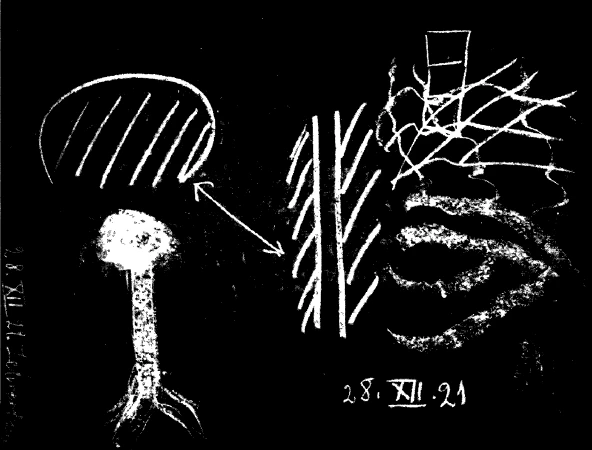
[ 20 ] Und wiederum, wenn man dem Menschen die Ehre antut, ihn nicht einfach so robust anzuschauen: er ist eine Einheit, sondern, wenn man auf seine Brust schaut, hier diese robusten Vorstellungen hat, dann, indem man sich dem Kopf nähert, die Vorstellungen zerfasert, kommt man gerade dadurch, indem die Vorstellungen sich zerfasern, in das materielle Leben hinein, was einem dann in den Nervenfasern und in ihren Verwebungen abgebildet wird.
[ 20 ] And again, if one does a person the honor of not simply viewing him so rigidly: he is a unified whole—but rather, if one looks at his chest and holds these robust mental images there, then, by moving toward the head and allowing those images to unravel, one enters material life precisely through this unraveling of images, which is then reflected in the nerve fibers and their interconnections.
[ 21 ] Wenn man nun mit seinem Vorstellen nach abwärts geht, dann kommt man dazu, das nicht zu können, die Vorstellungen zu zerfasern, so daß sie ein Gewebe bilden, das man dann im Nervensystem wiederfindet, sondern dann kommt man dazu, indem man versucht, die robusten Stränge nach unten fortzusetzen, daß man sie verliert. Sie hören auf, sie wollen sich nicht fortsetzen, sie hören auf. Man kommt in ein Vorstellen hinein, das sich nicht mehr recht mit einem Materiellen decken will, weil einem das Materielle flüssig wird. Sehen Sie, wenn Sie sich das Gehirn anschauen, wie es sich im Rückenmark durch die zwölf Brustwirbel, Lendenwirbel, Kreuzwirbel und so weiter fortsetzt, so lösen sich die Nervenmassen, die jetzt außen weiß und innen grau sind, gegen das Stoffwechselgebiet hin auf. Gewissermaßen verliert sich die Möglichkeit in diesem Gefühl, sich das materiell vorzustellen. Man kann nicht mit gleichartig bleibenden Vorstellungen den ganzen Menschen umfassen. Man muß sein Vorstellungsleben innerlich beweglich machen. Indem man beim Menschen hinaufschaut, werden die Vorstellungen zu etwas anderem, als wenn man beim Menschen herunterschaut. Es ist eine Art Nachschaffen desjenigen möglich, was beim Menschen beweglich geworden ist. — Sie sehen, es ist ein Anfang zu einer künstlerischen Tätigkeit, die dann gewissermaßen den Erkennenden in dasjenige hineinstellt, was man als materielles Gebiet wirklich draußen am Menschen in der Welt sieht. Man hat, möchte man sagen, nicht auf der einen Seite die derbmaterielle konkrete Welt und dann das abstrakte Vorstellen, sondern man taucht unter in die menschliche Natur. Und das, was man in den Vorstellungen hat, das wird selber so, daß es lebendig wird und das menschliche Leben mitlebt. Auf eine andere Weise kann man insbesondere das, was man als Erziehungs- und Unterrichtskünstler nötig hat, am Menschen gar nicht erkennen. Man muß in dieser Weise selber beweglich werden, um den Menschen wirklich zu erkennen. Dann wird man aber auch richtig herausfinden, wie diese drei Glieder der menschlichen Organisation zusammenwirken müssen, um das menschliche gesunde Gleichgewicht zu erzeugen. Und man wird auf dasjenige aufmerksam werden können, was in gestörtem Gleichgewicht die Neigungen zu allerlei Krankhaftem hervorbringt. Man wird eine lebendige Anschauung von dem Wege zum Gesundenden und dem Erkrankenden im Menschen gewinnen.
[ 21 ] If one now moves one’s imagination downward, one finds that one is unable to unravel the mental images so that they form a fabric that can then be found in the nervous system; rather, by attempting to continue the robust strands downward, one ends up losing them. They stop; they do not want to continue; they stop. One enters into a mental image that no longer quite corresponds to the material world, because the material world becomes fluid. You see, when you look at the brain and how it extends through the spinal cord via the twelve thoracic vertebrae, lumbar vertebrae, sacral vertebrae, and so on, the nerve masses—which are now white on the outside and gray on the inside—dissolve toward the metabolic region. In a sense, the ability to create a mental image of this in material terms is lost in this sensation. One cannot encompass the whole human being with mental images that remain static. One must make one’s imaginative life inwardly flexible. When one looks upward at a human being, the mental images become something different than when one looks downward at a human being. It is possible to recreate, in a sense, that which has become flexible within the human being. — You see, this is the beginning of an artistic activity that then, in a sense, places the perceiver within what one actually sees as the material realm outside in the world, in human beings. One does not, one might say, have on the one hand the coarse, material, concrete world and then a mental image, but rather one delves into human nature. And the mental image one holds becomes, in itself, something that comes alive and shares in human life. There is simply no other way to truly recognize in human beings what is necessary, especially for those who work as educators and teachers. One must become flexible in this way oneself in order to truly understand human beings. Then, however, one will also be able to discover exactly how these three aspects of human organization must interact to create a healthy human balance. And one will be able to become aware of what, when the balance is disturbed, gives rise to tendencies toward all manner of pathological conditions. One will gain a living understanding of the path toward health and the path toward illness in human beings.
[ 22 ] Das wird namentlich dann wichtig, wenn man den menschlichen Lebenslauf ins Auge faßt. Denn in einer anderen Weise wirken im Kinde, in einer anderen Weise im reifen Alter und in einer noch anderen Weise im Greisenalter diese drei Glieder des menschlichen Organismus zusammen. Beim Kinde ist es so, daß die geistig-seelische Wesenheit in einer ganz anderen Art in die physisch-leibliche hineinwirkt, so daß zwischen diesen drei Gliedern ein ganz anderes Zusammenwirken zustande kommt als beim reifen Menschen und beim Greise. Und auf dieses verschiedene Wirken wird man hinschauen müssen. Wenn man überhaupt den Weg zu einem solchen Vorstellen nimmt, wird man es allmählich dazu bringen, auch den menschlichen Lebenslauf in einer anderen Weise zu erfassen, als man das gewöhnt ist.
[ 22 ] This becomes particularly important when one considers the course of human life. For these three aspects of the human organism interact in one way in childhood, in another way in adulthood, and in yet another way in old age. In the child, the spiritual-soul entity influences the physical-bodily entity in a completely different way, so that a very different kind of interaction arises between these three components than in the mature adult and the elderly person. And one must pay attention to this different mode of interaction. If one embarks on the path toward a mental image at all, one will gradually come to understand the course of human life in a different way than one is accustomed to.
[ 23 ] Man hat es mir besonders übelgenommen, daß ich in meinem Buche «Die geistige Führung des Menschen und der Menschheit» darauf aufmerksam gemacht habe, wie das Kind eine Weisheit besitzt, die der Erwachsene eigentlich gar nicht mehr hat. Gewiß, ich will ja der Weisheit, der Gescheitheit unserer erwachsenen Leute nicht nahetreten; aber denken Sie nur einmal, wenn Sie all diese Weisheit im späteren Leben aufbringen müßten, die imstande ist, aus der verhältnismäßigen Unbestimmtheit der Gehirnmasse, des übrigen Organismus weisheitsvoll den ganzen Organismus zu durchdringen, wie wir es im Kindheitsalter instinktiv machen, wir würden schlecht damit fahren. Allerdings bleibt das beim Kinde alles im Unbewußten stecken, wie es das Gehirn plastisch herausgestaltet, wie es das übrige plastisch herausgestaltet; aber es ist doch vorhanden, und man sieht, daß es vorhanden ist, wenn man mit den Mitteln des Erkennens, die ich Ihnen in den letzten Tagen geschildert habe, herangeht, den ganzen Lebenslauf zu betrachten; wenn man namentlich ein wirkliches Organ entwickelt für die kindlichen Träume. Die Erwachsenen weisen sie ja heute meistens als unsinnig zurück; aber diese kindlichen Träume, in ihrer Wesenheit betrachtet, sind außerordentlich interessant, sind ganz anders als die Träume des Erwachsenen. Sie sind so, daß das Kind tatsächlich vielfach von dem träumt es kann es nur nicht ausdrücken, aber wir können dahin kommen, das Kind nach dieser Richtung zu verstehen -, daß das Kind in Gestalten von jener Weisheit träumt, durch die es sich sein Gehirn und seinen übrigen Organismus plastisch gestaltet. Würde man manchen Kindestraum mit einer inneren Liebe nach dieser Richtung hin verfolgen, man würde schon sehen, wie das Kind, ich möchte sagen, Urweisheit träumt, die da waltet. Von diesem Gesichtspunkte aus, verzeihen Sie den harten Ausdruck, ist das Kind viel weiser, viel gescheiter als der erwachsene Mensch. Und der Erziehende sollte sich eigentlich bewußt sein, wenn er über die Schwelle der Schultüre schreitet, daß das Kind nach dieser Richtung viel mehr Weisheit hat als er. Er hat es ja schon abgelegt und ausgebildet; was er nun als die mittlerweile errungene Erfahrungsweiisheit, Erfahrungsgescheitheit hat, läßt sich doch nicht gut mit dem vergleichen, was er damals als Weisheit hatte. Wenn man daher die menschlichen Träume des späteren Alters nimmt, enthalten sie nicht mehr das, was das kindliche Träumen hat, sondern dasjenige, was der Mensch von dem äußeren Leben in das Träumen hineinträgt. Ich habe darüber von einem anderen Gesichtspunkte aus gesprochen. Träumt der erwachsene Mensch, trägt er seine Tagesweisheit auch in das Nachtleben hinein; die wirkt wiederum auf ihn zurück, während auf das Kind eine viel höhere Weisheit wirkt. Die hat das Kind nicht im Bewußtsein, aber im Unbewußten empfindet das Kind diese Weisheit, und wenn es in der Schule sitzt, so hat es ein unbewußtes Gefühl, daß es diese Weisheit in sich hat, die der Lehrer nicht hat, die er schon abgelegt hat. Der Lehrer hält sich äußerlich für viel weiser als das Kind. Es ist natürlich, er würde sich ja sonst nicht recht als Lehrer fühlen können; aber er hat seine Weisheit eben im Bewußtsein. Das hat er ja vor dem Kinde voraus. Aber sie ist nicht so umfassend, nicht so großartig wie die Weisheit des Kindes. Würde man dasjenige, was das Kind unbewußt als Weisheit in sich trägt, aussprechen, und würde man dasjenige, was der Lehrer verloren hat, auch wiederum in Worte kleiden, so würde etwas sehr Sonderbares herauskommen, das aber eine große Wichtigkeit hat für das wirklich imponderable Leben in der Schule. Da würde man nämlich auf das Folgende kommen: Wenn der Lehrer mit seiner in der Welt erworbenen Gescheitheit die Schule betritt, ist er durch diese abstrakte Gescheitheit von heute, das kommt vor, ein ziemlich trockener, philiströser Mensch geworden, der das auch zuweilen schon im Äußeren zeigt. Das Kind hat ja noch all die Munterkeit, die aus jener Weisheit kommt, von der ich gesprochen habe. Man verbietet ihm natürlich, seine Empfindung auszudrücken. Und so kommt das zustande, daß in der Schule das Lehrerurteil waltet: Der Lehrer ist gescheit, das Kind ist dumm. — Aber im Unterbewußten ist es anders. Und wenn in den Träumen erst gesprochen würde, so wäre es wieder anders. Im Unterbewußten kommt das zustande, daß die Kinder unbewußt denken: Wie ist doch der Lehrer dumm - und der Lehrer denkt unbewußt: Wie sind doch die Kinder gescheit! - In dem ganzen Ensemble spielt dasjenige, was da waltet in einer Schulklasse, eben eine außerordentlich große Rolle.
[ 23 ] People took particular offense at the fact that, in my book *The Spiritual Guidance of Man and Humanity*, I pointed out how a child possesses a wisdom that adults, in fact, no longer have. Certainly, I do not wish to offend the wisdom and intelligence of our adult readers; but just imagine, if in later life you had to muster all that wisdom—the kind capable of wisely permeating the entire organism from the relative indeterminacy of the brain matter and the rest of the body, as we do instinctively in childhood—we would fare poorly. Admittedly, in the child all of this remains stuck in the unconscious—just as the brain shapes itself plastically, just as the rest of the organism shapes itself plastically; but it is nevertheless present, and one can see that it is present when one approaches the entire course of life using the means of cognition I have described to you in recent days; specifically, when one develops a true faculty for understanding children’s dreams. Adults today usually dismiss them as nonsense; but these childhood dreams, when considered in their essence, are extraordinarily interesting; they are quite different from the dreams of adults. They are such that the child actually dreams in many cases of what it simply cannot express—but we can come to understand the child in this regard—that the child dreams in images of that wisdom through which it plastically shapes its brain and the rest of its organism. If one were to explore some children’s dreams with an inner love in this direction, one would already see how the child—I would say—dreams of primordial wisdom that reigns there. From this point of view—forgive the harsh expression—the child is much wiser, much more intelligent than the adult. And the educator should actually be aware, when crossing the threshold of the school door, that the child possesses far more wisdom in this regard than he does. After all, the child has already developed and refined it; what the educator now possesses as the wisdom and intelligence gained through experience cannot really be compared to the wisdom the child once had. Therefore, if we consider the human dreams of later life, they no longer contain what is found in a child’s dreaming, but rather what the person carries from external life into their dreams. I have spoken about this from a different perspective. When an adult dreams, they carry their daytime wisdom into their nighttime life; this, in turn, has an effect on them, whereas a much higher wisdom acts upon the child. The child is not conscious of this wisdom, but in the unconscious the child senses it, and when sitting in school, the child has an unconscious feeling that it possesses this wisdom within itself—a wisdom that the teacher lacks, having already cast it aside. Outwardly, the teacher considers himself much wiser than the child. This is natural; otherwise, he would not be able to truly feel like a teacher. But his wisdom resides in his conscious mind. In this respect, he has an advantage over the child. But it is not as comprehensive, not as magnificent as the child’s wisdom. If one were to put into words what the child unconsciously carries within as wisdom, and if one were also to put into words what the teacher has lost, something very peculiar would emerge—something that is, however, of great importance for the truly intangible life at school. For one would arrive at the following: When the teacher enters the school with the cleverness he has acquired in the world, this abstract cleverness of today has—and this does happen—turned him into a rather dry, philistine person, who sometimes even shows this in his outward appearance. The child, however, still possesses all the liveliness that springs from the wisdom I have spoken of. Naturally, the child is forbidden to express these feelings. And so it comes to pass that in school, the teacher’s judgment prevails: The teacher is smart; the child is stupid. — But in the subconscious, it is different. And if words were spoken in dreams, it would be different yet again. In the subconscious, children unconsciously think: “How stupid the teacher is”—and the teacher unconsciously thinks: “How clever the children are!”—In the whole picture, what prevails in a school classroom plays an extraordinarily large role.
[ 24 ] Man muß sich durchaus klar darüber sein, daß eigentlich das Kind, indem es sich so verhält, wie ich es geschildert habe, immer ein wenig in einer Art von innerem Hochmut, der aber unbewußt bleibt, in einer Belustigungsstimmung dem Lehrer auf ganz naturgemäße Weise gegenüberstehen muß; denn es kann ja nicht anders, als empfinden im Hintergrunde seiner kindlichen Natur das weisheitsvolle, den Menschen aufbauende Wesen, und das andere — wie wenig eigentlich dann daraus geworden ist, wie man ja sieht; so urteilt dann ja die unbewußte Natur des Kindes -, wenn der Lehrer hereintritt mit seiner Steifigkeit, mit seiner durch abstrakt-intellektualistische Begriffe moros gewordenen Signatur, mit dem Rock, der in der Bibliothek so staubig geworden ist, daß man ihn gar niemals genügend ausbürsten kann, da, nicht wahr, empfindet das Kind in der allerintensivsten Weise dasjenige, was ich ein belustigendes Erkennen nennen möchte.
[ 24 ] One must be perfectly clear that, in fact, when a child behaves as I have described, it must always, in a very natural way, face the teacher with a certain inner arrogance—which, however, remains unconscious—and a sense of amusement; for the child cannot help but sense, in the depths of its childlike nature, the wise, uplifting essence of humanity—and the other side—how little has actually come of it, as one can see; that is how the child’s unconscious nature judges it—when the teacher enters with his stiffness, with his demeanor made gloomy by abstract, intellectualistic concepts, with the coat that has become so dusty in the library that one can never brush it clean enough, for, isn’t it true, the child feels in the most intense way what I would like to call an amusing realization.
[ 25 ] Das ist dasjenige, was man dem Kinde gegenüber tatsächlich immer empfinden muß, und was in einer gewissen Weise aus der menschlichen Natur heraus durchaus berechtigt ist. Das Kind rettet sich ja eigentlich seine Gesundheit dadurch; denn es ist ganz sicher, das Kind träumt nicht in erhebender Weise von Lehrern, sondern es träumt von jener Weisheit, die ich geschildert habe, die es durchwebt, durchströmt. Beim Lehrer entwickelt sich etwas Entgegengesetztes im Unterbewußtsein, das auch eine Möglichkeit in den Imponderabilien der Schulstube ist. Aber es ist deutlich da. Beim Kinde ist es mehr, ich möchte sagen, ein Erkenntnisverhältnis. Beim Lehrer wird es zu etwas Begehrlichem, wird es zu etwas, was im Begehrungsvermögen sich äußert. Der Lehrer denkt in seinem Unterbewußtsein und träumt auch davon — was er sich natürlich vermöge seiner schulmäßigen Zivilisation im Oberbewußtsein ganz und gar nicht gesteht -, er träumt eigentlich davon, etwas von dem zu haben, was an Kräften der kindlichen Natur eigen ist. Man würde schon sehen, wenn man gerade daraufhin manchmal mit etwas mehr Geist, als es heute geschieht, die menschlichen Seelen psychoanalysieren würde, welche Rolle im unterbewußten Leben des Lehrers diese munteren, frischen Wachstumskräfte und sonstigen menschlichen Kräfte des Kindes spielen.
[ 25 ] This is precisely what one must always feel toward a child, and what, in a certain sense, is entirely justified by human nature. The child actually preserves its health in this way; for it is quite certain that the child does not dream in an uplifting way about teachers, but rather dreams of that wisdom I have described, which interweaves with and flows through it. In the teacher, something opposite develops in the subconscious, which is also a possibility among the intangible elements of the classroom. But it is clearly present. In the child, it is more—I would say—a relationship of insight. For the teacher, it becomes something desirable; it becomes something that expresses itself in the capacity for desire. The teacher thinks about this in his subconscious and even dreams of it—something he, of course, by virtue of his school-based civilization, does not admit to himself at all in his conscious mind—he actually dreams of possessing some of the forces inherent in the child’s nature. One would certainly see, if one were to psychoanalyze human souls with a little more insight than is done today, what role these lively, fresh forces of growth and other human powers of the child play in the teacher’s subconscious life.
[ 26 ] Das aber wirkt alles im imponderablen Leben, das sind Kräfte, die sich wirklich in der Schulstube entwickeln. Und man kann schon sagen, sieht man etwas hinter die Kulissen des gewöhnlichen kindlichen Daseins, dann wirkt das Kind in der Schulstube so, daß es sein Interesse von dem Lehrer wegwendet und frägt: Was ist denn in diesem Individuum aus all dem geworden, was wir in uns haben? — Aber beim Lehrer wirkt das auf das Begehrungsvermögen. Er beginnt im Unterbewußten die Kinder zu vampyrisieren. Unter dem Bewußtsein will er sich die Kräfte der Kinder aneignen. Und würde man genauer zusehen, so würde man sehen, wie stark oft dieses Vampyrisieren hinter den Kulissen des physischen Daseins wirkt. Man würde sehen, woher die Schwächlichkeit mancher Kinder — allerdings müssen die Dinge wiederum intim betrachtet werden - und die krankhafte Veranlagung der Kinder dieser oder jener Schulstube kommen. Man würde sich nur, wenn man freien, offenen Blick dazu hat, die Figuration des Lehrers oder der Lehrerin anzuschauen brauchen, dann würde man manchen Einblick in die gesunden und kranken Neigungen der Kinder in der Schulstube bekommen.
[ 26 ] But all of this takes place in the intangible realm of life; these are forces that truly develop in the classroom. And one can certainly say that, if one looks behind the scenes of a child’s ordinary existence, the child behaves in the classroom in such a way that it turns its interest away from the teacher and asks: “What has become of all that we have within us in this individual?” — But in the teacher, this affects the capacity for desire. Subconsciously, he begins to “vampirize” the children. Unconsciously, he seeks to appropriate the children’s forces. And if one were to look more closely, one would see how strongly this “vampirization” often operates behind the scenes of physical existence. One would see where the frailty of some children comes from—though, of course, these matters must again be considered intimately—and the pathological predispositions of the children in this or that classroom. One would need only, if one had a free, open view of it, to observe the teacher’s physical appearance; then one would gain some insight into the healthy and unhealthy tendencies of the children in the classroom.
[ 27 ] Wir können so etwas als Erziehungs- und Unterrichtskünstler nicht anders überwinden, als wenn wir uns von einer Menschenerkenntnis erfüllen, die — weil sie innerlich beweglich ist, weil sie selber geistigseelisch ein Organismus ist, der dem Menschenorganismus nachgebildet ist in der Art, wie ich das gezeigt habe -, die sich zugleich mit Menschenliebe, mit wahrer Menschenliebe verbindet, die die verschiedenen einseitigen Kräfte der menschlichen Natur eben überwindet und harmonisiert. Dadurch, daß man sich eine solche Menschenerkenntnis aneignet, kommt man auch darauf, wie nicht nur die menschliche Natur sich in verschiedener Weise in verschiedenen menschlichen Individuen ausspricht, sondern wie sich die menschliche Natur in ganz anderer Weise in der Kindheit, im reifen Alter, im Greisenalter ausspricht. Die drei Glieder der Menschennatur wirken eben ganz verschieden ineinander, und sie müssen aufeinander abgestimmt werden.
[ 27 ] As educators and teachers, we can overcome this only by imbuing ourselves with an understanding of human nature that — because it is inwardly flexible, because it is itself a spiritual-soul organism modeled on the human organism in the way I have shown — is at the same time united with love for humanity, with true love for humanity, which overcomes and harmonizes the various one-sided forces of human nature. By acquiring such an understanding of human nature, one also comes to realize not only how human nature expresses itself in various ways in different human individuals, but also how human nature expresses itself in entirely different ways in childhood, in maturity, and in old age. The three aspects of human nature interact in very different ways, and they must be harmonized with one another.
[ 28 ] Das wird zum Beispiel sehr real, wenn wir daran denken müssen, die Zeit die wir zum Unterrichten und Erziehen zur Verfügung haben, in der richtigen Weise einzuteilen. Wir müssen ja selbstverständlich den ganzen Menschen in das Erziehungs- und Unterrichtswesen hineinstellen, also sowohl seine Kopfnatur wie auch seine Gliedmaßen-Stoffwechselnatur, und da ja wiederum in jedem einzelnen Gliede die anderen Prozesse der anderen Glieder auch vor sich gehen, müssen wir das berücksichtigen. Im Kopfe finden natürlich auch fortwährend Stoffwechselvorgänge statt.
[ 28 ] This becomes very real, for example, when we have to consider how to allocate the time we have available for teaching and education in the right way. Of course, we must take the whole person into account in our educational and instructional practices—that is, both the nature of the head and the nature of the limbs and metabolism—and since the processes of the other limbs are also taking place within each individual limb, we must take this into consideration. Metabolic processes are, of course, constantly taking place in the head as well.
[ 29 ] Haben wir es nun nötig, für gewisse unterrichtliche, erzieherische Formalia das Kind ruhig sitzen zu haben in der Klasse, wir werden davon noch sprechen, auch auf den hygienisch eingerichteten Bänken, dann behandeln wir das Kind aber immerhin so, daß es still sitzt, daß also nicht im Stoffwechsel-Gliedmaßenorganismus die Tätigkeit wirkt, sondern daß alles dasjenige, was wirkt, aus dem Kopf herausgeholt werden muß. Das ist eine Einseitigkeit, in die wir das Kind versetzen. Wir gleichen das wiederum aus, indem wir nachher, mit Recht nachher, den Kopf entlasten von seiner Tätigkeit und den GliedmaßenStoffwechselorganismus in Regsamkeit bringen, indem wir das Kind zur Gymnastik bringen.
[ 29 ] If we now find it necessary, for certain instructional and educational formalities, to have the child sit quietly in class—we will discuss this further—even on ergonomically designed desks, then we are nevertheless treating the child in such a way that it sits still; that is, activity does not take place in the metabolic-limb organism, but rather everything that is active must be drawn out of the head. This is a one-sided situation into which we place the child. We compensate for this, however, by subsequently—and quite rightly so—relieving the head of its activity and stimulating the metabolic-limb organism through movement, by having the child participate in physical education.
[ 30 ] Wenn man sich bewußt ist, wie polarisch entgegengesetzt die Prozesse im Kopforganismus und im Gliedmaßen-Stoffwechselorganismus sind, wird man gar wohl begreifen, wie wichtig es ist, daß man auch in dieser Weise in der rechten Art abwechselt. Aber wenn wir dann die Kinder haben turnen, springen lassen, alle möglichen Übungen haben machen lassen und sie dann wiederum zurücknehmen in die Klasse und in der Klasse weiter unterrichten, ja, wie ist es denn dann?
[ 30 ] If one is aware of how polar opposites the processes in the head organism and in the limb-metabolic organism are, one will certainly understand how important it is to alternate in this way as well. But when we have the children do gymnastics, let them jump, have them do all kinds of exercises, and then bring them back into the classroom to continue teaching them—well, what happens then?
[ 31 ] Sehen Sie, während der Mensch seinen Stoffwechsel-Gliedmaßenorganismus in Regsamkeit hat, da sind allerdings diejenigen Gedanken, die künstlich zwischen Geburt und Tod in den Kopf hineingebracht werden, aus dem Kopf draußen. Das Kind springt herum, bewegt sich, bringt den Stoffwechsel-Gliedmaßenorganismus in Bewegung. Die während des physischen Erdenlebens eingepflanzten Gedanken, die gehen zurück. Aber dasjenige, was sonst in den Träumen figuriert, diese übersinnliche Weisheit ist jetzt auf unbewußte Art im Kopfe drinnen, macht sich gerade im Kopfe geltend. Führen wir daher das Kind nach der Gymnastik wiederum zurück in die Schulstube, dann setzen wir ihm etwas, was im Unterbewußten für das Kind minderwertig ist, an die Stelle desjenigen, was es vorher gehabt hat während der gymnastischen Übungen. Denn während der gymnastischen Übungen wirkt nicht nur das Sinnliche auf das Kind erziehend, sondern auch das Übersinnliche, das während der gymnastischen Übungen ganz besonderen Anlaß hat. Daher wird das Kind in der folgenden Stunde innerlich unwillig. Es äußert vielleicht den Unwillen nicht so stark, aber es wird innerlich unwillig. Und wir verderben es, wir veranlagen in ihm Krankheitsneigungen dadurch, daß wir wiederum auf die gymnastischen Übungen den gewöhnlichen Unterricht hinaufpfropfen.
[ 31 ] You see, while a human being’s metabolic-limb organism is active, those thoughts that are artificially implanted in the mind between birth and death are, in fact, absent from the mind. The child jumps around, moves about, and sets the metabolic-limb organism in motion. The thoughts implanted during physical life on Earth recede. But that which otherwise appears in dreams—this supersensible wisdom—is now present in the mind in an unconscious way and is making itself felt there. If, therefore, we lead the child back into the classroom after gymnastics, we are substituting something that is inferior to the child in the subconscious for what it previously experienced during the gymnastic exercises. For during the gymnastic exercises, it is not only the sensory realm that has an educational effect on the child, but also the supersensible realm, which finds a very special outlet during these exercises. Consequently, the child becomes inwardly resentful during the following lesson. The child may not express this resentment very strongly, but inwardly, the child becomes resentful. And we are harming the child; we are predisposing the child to illness by grafting ordinary instruction onto the gymnastic exercises once again.
[ 32 ] Es ist das ja eine Tatsache, die sogar häufig schon äußerlich bemerkt worden ist, wie mir ein Physiologe versicherte. Aber hier haben Sie aus anthroposophischer Geistesforschung die Gründe dafür, daß wir sehen können, wie wir allerdings die Neigungen zum Gesunden dadurch fördern können, daß wir uns als Lehrer und Erziehungskünstler in der richtigen Weise Menschenerkenntnis erwerben. Natürlich, wenn wir es nicht in der richtigen Weise machen, erzeugen wir allerlei Krankheitsanlagen. Das müssen wir durchaus bedenken. Denn, Sie haben ja bemerkt, ich will nicht in Glorifizierung desjenigen verfallen, was der Mensch sich als seine Lebensweisheit aneignet; sie würde ja nicht ausreichen, um die menschliche Organisation im künftigen Alter plastisch zu gestalten. Aber würden wir nicht im späteren, reifen Alter in der Organisation schon so versteift sein, daß dasjenige, was wir da in den Kopf hineinbringen als äußerliche Weisheit, die auf naturalistisch-intellektualistische Art erworben wird, würde das nicht alles in der richtigen Weise als Erinnerungsvorstellung zurückstrahlen, so würde es später in den übrigen Organismus hinunterströmen. Und dasjenige, so paradox es wiederum klingt, was nach der normalen Organisation des Menschen im Kopforganismus bleiben soll, wenn es in den GliedmaßenStoffwechselorganismus hinunterströmt, macht es den Menschen krank, ist wie Gift. Verstandesweisheit ist in der Tat eine Art von Gift, sobald sie an den unrichtigen Ort kommt, sobald sie wenigstens in den Stoffwechselorganismus hineinkommt. Wir können nur dadurch mit der Verstandesweisheit leben, daß dieses Gift - in ganz technischem Sinne, nicht in moralischer Beurteilung sage ich das -, daß dieses Gift nicht in unseren Stoffwechsel-Gliedmaßenorganismus hinunterdringt. Da wirkt es furchtbar zerstörerisch.
[ 32 ] This is, in fact, a fact that has even been observed externally on many occasions, as a physiologist assured me. But here, from anthroposophical spiritual research, you have the reasons why we can see how we can indeed foster a healthy disposition by acquiring a proper understanding of human nature as teachers and educators. Of course, if we do not do this in the right way, we create all sorts of predispositions to illness. We must certainly bear this in mind. For, as you have noticed, I do not wish to fall into glorifying what human beings acquire as their wisdom of life; it would not be sufficient to shape the human organism plastically in later life. But if, in later, mature age, we were already so rigid in our constitution that what we fill our heads with—as external wisdom acquired in a naturalistic-intellectualistic manner—did not all radiate back in the right way as a memory image, it would later flow down into the rest of the organism. And what—as paradoxical as it may sound—is supposed to remain in the head organism according to the normal human organization, when it flows down into the metabolic organism of the limbs, makes the person sick; it is like poison. Intellectual wisdom is in fact a kind of poison as soon as it ends up in the wrong place, as soon as it enters the metabolic organism, at the very least. We can only live with intellectual wisdom if this poison—I say this in a purely technical sense, not as a moral judgment—if this poison does not penetrate into our metabolic-limb organism. There it has a terribly destructive effect.
[ 33 ] Aber beim Kinde ist diese Versteiftheit nicht da. Wenn wir da mit unserer heutigen reifen Weisheit kommen, so dringt dieses Gift hinunter und vergiftet in der Tat den Stoffwechsel-Gliedmaßenorganismus. Sie sehen, es ist notwendig, aus der unmittelbaren Lebenspraxis heraus wissen zu lernen, wieviel man diesem Kinderhaupte zumuten darf, damit man nicht zuviel hineinpreßt, was dann nicht mehr aufgehalten wird und was dann in den Stoffwechsel-Gliedmaßenorganismus hinuntergeht.
[ 33 ] But a child does not possess this rigidity. When we approach them with our mature wisdom of today, this poison seeps in and indeed poisons the child’s metabolic and limb systems. You see, it is necessary to learn from direct life experience just how much one can expect of a child’s mind, so as not to cram too much into it—which cannot then be held back and which then seeps down into the metabolic-limb organism.
[ 34 ] Man hat es also als Lehrer und Erziehungskünstler in der Hand, entweder gesundend oder krankmachend auf den Kindesorganismus zu wirken, Und will man ein Kind nach der heutigen Lebensweisheit ganz besonders gescheit machen, setzt man es also immer hin und pfropft soviel als irgend möglich in es hinein beim Sitzen, dann tritt das andere ein: dann verhindert man im Kind, daß die unbewußte Weisheit in ihm wirkt. Denn diese unbewußte Weisheit wirkt ja gerade, wenn es sich tummelt, wenn es mehr oder weniger rhythmische Bewegungen macht; denn der Rhythmus fördert das Sich-Verbinden des Organismus mit der unbewußten Weisheit durch die eigentümliche Mittelstellung, die dieser rhythmische Organismus zwischen Kopforganisation und Stoffwechsel-Gliedmaßenorganisation angenommen hat. So daß sich schon das herausstellt, wenn wir diese Klostererziehung anwenden, von der Herbert Spencer spricht, um die Kinder und jungen Leute ganz besonders gescheit zu machen, dann machen wir sie dadurch so, daß wir sie mit Krankheitsneigungen ausstatten, durch die sie im späteren Leben mit der Weisheit, die wir ihnen beibringen, gar nichts mehr anzufangen wissen.
[ 34 ] As a teacher and educator, one therefore has the power to either have a healing or a harmful effect on the child’s organism. And if, according to today’s wisdom, one wants to make a child particularly intelligent, one sits the child down and crams as much as possible into it while it is seated; then the opposite occurs: one prevents the unconscious wisdom within the child from taking effect. For this unconscious wisdom is active precisely when the child is romping about, when it is making more or less rhythmic movements; for rhythm promotes the organism’s connection with unconscious wisdom through the unique mediating position that this rhythmic organism has assumed between the head organization and the metabolic-limb organization. So it turns out that when we apply this “monastic education” that Herbert Spencer speaks of—intended to make children and young people particularly intelligent—we actually end up equipping them with a predisposition to illness, which means that later in life they will no longer know what to do with the wisdom we have taught them.
[ 35 ] Das sind alles Dinge, die wahrhaftig nicht mit der Waage abgewogen werden können, sondern nur vor einer beweglichen Vorstellungsart sich enthüllen, die sich immer ans Leben anpaßt, wie sie eben durch anthroposophische Schulung erworben werden kann. Und damit sei im allgemeinen darauf hingedeutet, wie der Lehrer und Erziehungskünstler sich bekanntmachen muß mit den großen Grundsätzen des Gesundens und Krankens im Menschen.
[ 35 ] These are all things that truly cannot be weighed on a scale, but are revealed only to a flexible way of thinking that constantly adapts to life—a way of thinking that can be acquired through anthroposophical training. And with this, let us generally point out how the teacher and educator must familiarize themselves with the great principles of health and illness in human beings.
[ 36 ] Und da ist es von wesentlicher Bedeutung, zu bemerken, wie das Streben, mit seiner Anschauung, mit seinem Welterkennen nicht an dem Äußerlichen, Unbeweglichen, Fixen hängenzubleiben, sondern zu einer inneren Beweglichkeit des Denkens aufzusteigen, wie das mit der Erkenntnis all der labilen Zustände zusammenhängt, in denen die menschliche Natur sich nach der gesunden und kranken Seite äußert, und die als etwas, was er zu behandeln hat, dem Lehrer in der Schule entgegentritt.
[ 36 ] And here it is of essential importance to note how the striving—with its perspective, with its understanding of the world—does not remain stuck on the external, the immovable, fixed, but rather to rise to an inner flexibility of thought—how this is connected to the recognition of all the unstable states in which human nature manifests itself, both in its healthy and unhealthy aspects, and which the teacher encounters in school as something he must address.
[ 37 ] Auf die Einzelheiten werden wir eingehen, wenn wir nun das Kind, den werdenden Menschen in den aufeinanderfolgenden Lebensaltern betrachten.
[ 37 ] We will go into the details as we now consider the child—the developing human being—through the successive stages of life.