

Educational and Teaching Methods
based on anthroposophy
GA 304
26 September 1921, Dornach
Translated by Steiner Online Library
3. The Pedagogical Significance of Understanding Healthy and Sick People
[ 1 ] Ladies and gentlemen! The pedagogy that arises from the entire anthroposophical worldview—and which is, in fact, being practiced at the Stuttgart Waldorf School and in a few smaller pilot projects undertaken in this direction—must be far more comprehensive than what is currently being carried out under this name. And above all, it must be something much more closely connected, in a much narrower sense, to the whole human being and to what is linked to human knowledge. Once we come to understand in the true sense what we might call anthroposophical pedagogy and didactics, we will speak less of something objective—of pedagogy and didactics as a science or an art— but rather speak more of the people who educate and teach; we will understand more clearly what the human being actually means for other human beings in general, and in particular what the teacher means for the growing human being, for the child. It is precisely this most significant relationship between human beings—the one that exists between the educator, the teacher, and the growing child—that has suffered from the tendency that has increasingly permeated all intellectual work and all intellectual endeavor in recent times, namely, specialization. This trend toward specialization has led to the view that it is increasingly necessary not only for the teacher to exert a certain influence on growing youth in school, but—because we are dealing with what develops in the child in both healthy and unhealthy ways—for the physician to exert a certain influence in school as well. And in recent times, it is even considered a necessity that the trained psychologist—the expert on the soul, that is, the one who acquires certain insights into the human soul, as such insights can be obtained through today’s standard school-based methods—should also intervene in the school system in some advisory capacity. Thus, the teacher would, so to speak, find himself advised on one side by the physician and on the other by the psychologist. But this is nothing other than the introduction of specialization into the school. Anyone who gains a sufficient understanding of just how close a relationship must develop between the child—who is to be educated and instructed—and the teacher, and how intimately the teacher must understand what is developing within the child, will hardly be able to admit that it is in any way beneficial for people—who, after all, have only a certain superficial relationship among themselves, who each understand, so to speak, a part of human development, and who are then supposed to offer each other advice from the outside in order to collaborate in a superficial manner—to interact in this external way. But what is about to arise here is simply a general consequence of specialization in general. Anyone who believes that the human soul is something that has some kind of external relationship to the physical organism may, under certain circumstances, think that the teacher must act upon the soul, and that advice regarding the physical can then be given from the outside by the doctor.
[ 2 ] Of course, when I speak today about the educational significance of understanding healthy and sick people, I am not referring to cases where the children being educated actually suffer from acute or chronic illnesses. In such cases, medical treatment is something that lies outside the realm of education itself. I am speaking of what lies entirely within the course of education and instruction itself. And it must be said that precisely by believing that the doctor, as a specialist, can assist the teacher with the hygienic and sanitary aspects of school administration, one actually promotes a situation in which, on the other hand, pedagogy and didactics become one-sided, detached from their concrete relationship to the whole human being in the child—who is, after all, spiritually and emotional on the one hand, and physical on the other. Pedagogy and didactics are elevated to a certain level of abstraction and distanced from the human being when one relies on the assumption that matters requiring physical care can be handled by the specialist.
[ 3 ] And given the trend that has developed, it has indeed come to pass that today some people express surprise when, in the art of pedagogy and didactics, one not only incorporates the usual abstract rules of education and instruction, but also shapes these rules in such a way that they are conceived from the whole of the human being—that is, including the physical aspect. What must be characterized here as a deviation stems, in essence, from the fact that our modern science has become confused about the relationship between the spiritual-psychic and the physical-bodily, when it speaks of the former as something independent at all.
[ 4 ] Clear evidence of this is the fact that modern psychology often speaks of a psychophysical parallelism. One feels compelled to speak of a spiritual-psychic realm; on the other hand, one naturally feels compelled to speak of a bodily-physical realm. But since one fails to grasp the living interplay, the living interrelation between the two, one speaks of a parallelism, as if spiritual phenomena were taking place on one side and bodily-physical phenomena on the other. Yet one does not engage with what is happening between the two.
[ 5 ] This external relationship, which has gradually entered our perception, has certainly also influenced everything that constitutes pedagogy and didactics. One must simply be clear—and I can only characterize this here by drawing on general anthroposophy, so to speak—one must simply be clear that when we speak of the physical-bodily in the same way that ordinary modern physiology and biology do, we are then speaking of something that does not actually exist in the living human being, as we characterize it. The entire physical-bodily realm is a result, a structure of the soul-spiritual.
[ 6 ] And again, when we speak of the soul-spiritual in a certain abstract sense, we are not speaking of something real, for it is precisely the soul-spiritual that is alive in the living human being—I would say—in that it permeates the body, builds it, and shapes it. And the fact is that one cannot speak in general terms about the relationship of the soul-spiritual to the physical-bodily; rather, the one who now observes the soul-spiritual in its configuration—who does not view it as a mere abstraction but sees it in its inner form—knows at the same time that every detail of the soul-spiritual has a certain relationship to a detail in the physical-bodily. We can, for example—and I am citing this merely as an example—say the following: When we consider the process of vision, this process has its physical-bodily localization very much confined to the human head, and we study the process of vision primarily by studying its localized organs in the human head.
[ 7 ] The situation is different, for example, when we study the process of hearing. When we study the process of hearing, we must study the rhythmic system. To understand the process of hearing, we must actually start with the process of breathing. After all, we cannot study the process of hearing as something isolated in the head, as is often done in today’s abstract physiology—and the same applies to everything. Whatever we study as spiritual-psychic phenomena, we must be able to relate concretely to specific organic systems. This means that true spiritual-psychic understanding is not at all possible without an understanding of the physical-bodily realm. And conversely: a true understanding of the physical-bodily is at the same time an understanding of the spiritual-psychic. We must strive for an understanding in which these two—the spiritual-psychic and the physical-bodily—merge within our understanding just as they are distinct in the living human being.
[ 8 ] Those who are listening to these lectures here as people interested in anthroposophy know, of course, that we do not speak here of some abstract, theoretical aspect of the spiritual and soul, but rather of how genuine knowledge of the spiritual and soul stands in full inner connection with knowledge of the physical and bodily.
[ 9 ] Now, however, when we approach the physical aspect of human beings, the question immediately arises regarding the relationship between health and illness in human beings. Certainly, extreme cases of illness belong in a different realm than that of education, and they are not our concern here today; but everything that, I would say, in a thousand different ways, tends toward illness in a certain sense even in a person who might otherwise be called healthy—in this we have a field that must be understood to an exceptional degree precisely within the realm of pedagogy and didactics, and which is even extraordinarily important for pedagogical and didactic understanding. And to make clear what is actually meant by this, I would like to begin with an extraordinarily important concept that appears in Goethe’s worldview.
[ 10 ] In his theory of metamorphosis, Goethe sought to gain a kind of insight into the organic, and what he achieved in his theory of metamorphosis will certainly be appreciated much more impartially in the future than it can be appreciated today, since the current direction of science often moves in a direction opposite to that of Goethe.
[ 11 ] Goethe observed—if we consider the simplest example—how, let’s say, leaves develop one after another along a plant stem, and how each subsequent leaf, though it has a different shape than the one below it, is nevertheless merely a metamorphosis of the one below it. So Goethe says: The individual organs of the plant—the lower, simpler leaves, then the more complex stem leaves, then the sepals, which are shaped quite differently, and the petals, which even have a different color than the stem leaves— are all, in fact, such that they differ from one another externally in form, but are identical internally in their idea, so that what is identical in the idea multiplies itself according to its external, sensory appearance, manifesting itself in various forms. Goethe therefore sees in the individual leaf the entire plant, and in the plant, in turn, only the complex elaboration of the individual leaf. For Goethe, every leaf is a whole plant, except that the idea of the plant—the plant’s archetype, the primordial plant—takes on a specific form in its outward physical manifestation, is simplified, and so on, so that Goethe, as it were, says to himself (it is depicted): When the plant stem produces a leaf, it actually intends to produce a whole plant. Here, the tendency to produce an entire plant is certainly present. But this plant-forming power manifests itself, so to speak, only to a limited extent; it holds back. In the next leaf, it manifests itself again to a limited extent, in a certain sense, and so on. Here, this plant-forming power wants to become an entire plant; here again, an entire plant. In every leaf, an entire plant actually wants to come into being, and yet only something like a fragment of a plant ever emerges; but the entire plant is still there and is, in turn, a reality. And this invisible entire plant now holds together in harmony all that always wants to become many plants. Every plant actually wants to become many plants; but each of these many plants does not become a complete plant, but only a limited manifestation, an organ. Every organ actually wants to be the entire organism, and the entire organism has the task of holding these individual, fragmentary manifestations of itself together in a greater harmony, so that we have both what acts within the individual organ and what holds the individual organs together.
[ 12 ] Well, Goethe is not concerned with abstract concepts. For example, he did not depict the entirely abstract concept: one sees individual, fragmentary plants striving to take shape, and then the unified plant that holds them together—that would still be abstraction. He wants to grasp how this plant-forming force works. He wants to grasp what is actually taking shape there, and specifically, what is held back within such an individual leaf. He wants to observe this; he does not want to remain at the level of the concept; he wants to arrive at direct perception. That is why it becomes particularly important to him when he sees, as he calls it, “malformations” occurring somewhere—for example, when at a certain point a leaf does not appear as one would expect, but instead the stem thickens for some reason, resulting in a malformation, or when, somewhere, the flower, instead of rounding out into leaves, grows slender, and the like.
[ 13 ] When deformities occur, Goethe told himself, the plant-forming force manifests itself in the plant in such a way that what should actually be held back reveals itself and becomes outwardly visible; if the leaf becomes deformed, it is precisely because the force has not held itself back—it has burst forth into the leaf. And so Goethe said to himself: Thus, when a malformation occurs, one sees how that which is actually spiritual becomes physical; what should remain restrained, what should appear only as a growth force, becomes visible. A malformation reveals something that one should study precisely because, through it, one sees what lies within the plant. If this malformation is not present, then something remains held back, which then finds expression in the subsequent leaves or in the subsequent organs. — Thus, for Goethe, malformations become particularly important for his study. He applies this insight to the entire organism. One could say it is entirely in keeping with Goethe’s thinking when, for example, we consider hydrocephalus, the accumulation of fluid in a child’s head; there we have a malformation. But Goethe would say: When studied correctly, this malformation reveals to me, through observation, something that is present in every child’s head but is merely held back in the spiritual realm. So when a malformation occurs, I can say: Here, in the physical-sensory realm, I see what actually belongs in the spiritual-soul realm.
[ 14 ] If we now look up to human beings or even to animals, we find not only such obvious deformities, but also diseases or at least predispositions to disease. Every disease, viewed in the Goethean sense, reveals something that is quite normal within the human being but, like a deformity, develops only in one particular direction, whereas it should be held in check within the entire organic system. While it should, so to speak, remain within the spirit, it manifests itself in the external form. So one can say: if one notices a predisposition to illness somewhere, this predisposition reveals something specific about the human organism; and whoever understands illness as manifesting in one direction or another begins to study the human spirit precisely through that illness, just as Goethe studied the archetype—the primordial plant—through deformities. It is extraordinarily significant to be able to observe, particularly the finer pathological deviations—let us say in a child—that do not develop into actual diseases but represent tendencies in one direction or another to degenerate pathologically in one way or another. This is what, in a sense, constitutes an external signature of what is also at work in the normal human being. One might say: hydrocephalus is present in the head of every child, and one must be able to study hydrocephalus in order to learn, precisely through the study of hydrocephalus, how to treat what manifests as hydrocephalus when it remains healthy and is of a spiritual-psychic nature. Of course, this is something that, in the most eminent sense, involves everything that I would say, scientific sensitivity—which must not be interpreted in a crude sense, but must be treated with extraordinary sensitivity—so that one is directed here to what is at work within the human being, what appears as illness, but which actually, when it remains in its proper place within, belongs to the normal developmental forces of the human being. And you will now be able to judge for yourselves, since the child is growing and has a tendency to deviate in every direction, how—if one is able to know where these deviations might lead—one can also become capable of harmonizing these things, how one can become capable of bringing forth the counterforces when deviations threaten, and so on.
[ 15 ] But there is something else to consider. You see, when people talk about pedagogy and didactics, they usually feel that one must adhere to an ideal that can be worked out theoretically down to the last detail, or something like that, and that there is something that can be cast into rigid forms and rules. But actually, it’s precisely when you’re working with pedagogy and didactics yourself—when, for example, you’re in charge of a Waldorf school, as I am—that you always realize something else. People do like it when you present them with a convincing pedagogical and didactic art; they do like it. Yes, but anyone who is completely honest—and anthroposophy must be absolutely inwardly honest in everything—will say to themselves: Certainly, something like this kind of pedagogy and didactics must exist. Then people come and say: That’s wonderful; if only we could have attended schools where teaching was done that way! - But you see, very often it is precisely those who then develop such a pedagogy and didactics who received their education and instruction in the very worst schools, and they may well come from the most corrupt educational systems of all—and they didn’t actually fare badly there; in fact, they fared so well that they are able to establish quite decent educational systems. And then the idea might even arise: Do we really have the right to think through and design, down to the finest details, exactly how we should teach children? Wouldn’t it perhaps be best if they could grow up as freely as possible, as many biographies show—that it is not necessarily those who have been squeezed into rigid pedagogical and didactic educational systems who have become the most developed and capable people? Aren’t we actually doing a disservice to the growing child when we establish such a meticulously detailed educational system?
[ 16 ] As you can see, one must consider all sides, and it is precisely when one does so that one arrives at a form of pedagogy and didactics that actually focuses less on how to do this or that with the child, but is concerned above all with providing the teacher with the means to develop the intimate relationship with the growing child that was mentioned earlier.
[ 17 ] But something else is needed as well. When a child is entrusted to us at elementary school age, we are supposed to educate them; we are supposed to teach them. By approaching them with one thing or another—writing, reading, arithmetic—we are, in fact, launching a series of attacks on the child. We teach—let’s say reading instruction—and it is one-sided. The whole human being is by no means fully engaged in ordinary reading instruction. We are essentially fostering a distortion; we are even fostering a predisposition to illness; and again, when we teach writing, we foster a predisposition to illness in a different direction. We are actually constantly launching attacks against the child’s health, even if this is not always apparent, since it manifests itself only—in a state of becoming, I would say—in its nascent stage. But we must, in essence, carry out these constant attacks on the child. Now, in the age of civilization, we have no choice but to carry out these attacks; but we must understand how to repeatedly and consistently make amends for what we are constantly doing that undermines the child’s health—one might well put it that way. We must be clear about this: arithmetic = a distortion; writing = a second distortion; reading = a third distortion—and then there’s history and geography! It never ends there; it leads straight into the most terrible consequences. And in contrast to this, we must constantly offer what, in turn, harmoniously restores within the whole human being that which seeks to fall apart. It is so extraordinarily important that we be aware that, on the one hand, we always have something to teach the child, and on the other hand, we must ensure that nothing harms the child. Proper pedagogy must ask itself: How do I heal the child from the constant attacks I inflict upon it? This must always be an integral part of any proper pedagogy.
[ 18 ] But this can only come from within if one has insight into the entire human organism, if one truly understands how this human organism functions. Only when one is truly able to grasp this principle of distortion and subsequent harmonization can one be a true teacher and educator. For then one approaches the growing human being in such a way that one can always know: What are you doing when you teach them one thing or another and thereby place particular demands on one organ system or another? How are you paralyzing that which you are directing in a one-sided direction? This is what a truly concrete pedagogy and didactics—the kind a teacher needs, the kind that makes the teacher a true connoisseur of human nature in the proper sense—demands. It can really only arise when one truly comes to recognize the whole human being in terms of their potential for health and illness.
[ 19 ] Here we encounter something that today’s more materialistically oriented medicine tends to overlook, but which immediately becomes significant when one considers human beings, on the one hand, in terms of their propensity for illness and, for the time being, on the other hand, in terms of their propensity for health—so that what we learn about human beings is incorporated into our pedagogical and didactic perspective.
[ 20 ] Today, health and illness are generally regarded as two opposites. A person is either healthy or sick. But that is not at all how things really are, when considered in terms of their reality. It is not like that at all. Health and illness are not polar opposites; rather, the opposite of illness is something entirely different from health. One can form a concept of illness—of course, it is only an abstract, general concept, since one is dealing only with individual diseases and, fundamentally, only with individual sick people; but one would also be led to this if one considered the matter in a concrete generality—one does indeed gain a concept of illness when one moves beyond these malformations and then gradually forms a conception of how such malformations initially manifest themselves in a less noticeable way externally in the animal and human organism. But what occurs in disease—that a single organ or organ system falls out of the whole organism, that it, as it were, stands out particularly as an individual entity—is countered by the fact that the individual organ is subsumed within the overall organism.
[ 21 ] Consider, in accordance with Goethe’s principle: instead of a healthy leaf developing here (as depicted), let us say a malformation arises. But something else can also arise. What may happen is that, instead of the plant developing its organ, it develops the harmonizing fundamental tendency—which should actually remain in the spiritual realm— so that this blossoming of the individual organ into the whole organism becomes excessive; so that the organ, in a sense, does not stand out too much in the physical-bodily realm, but rather too little; so that the whole looks far too spirit-like—that is, it is spiritualized—and the spiritual permeates the physical-bodily realm too strongly. That can also happen. It can therefore also degenerate in the opposite direction. And this is the opposite of illness. Illness has a polarity that actually lies in the fact that the individual organ is, so to speak, absorbed by the entire organism and contributes to its particular pleasure, to its particular inner satisfaction. An experience of, I would say, excessive pleasure is actually the polar opposite of illness.
[ 22 ] Consider the matter from a linguistic perspective. If you form the verb from “krank” (sick), you get “kränken” (to cause pain); “kränken”: to cause pain. If you take a verb that would mean the polar opposite, you would have: “to cause pleasure.” And between these two extremes—between being sick and being full of pleasure—a person must maintain a balance. That is health. Human beings do not have the polar opposites of illness and health, but rather illness and an entirely different polar opposite, and health is the state of equilibrium that we must continually strive to maintain organically. We oscillate, so to speak, back and forth between being ill and being inwardly full of joy—being organically joyful. Being healthy is the state of equilibrium between these two polarities. That is reality.
[ 23 ] And this is especially important when we are dealing with a growing child; for what stage of development is the growing child actually in? Well, let’s start with a child of elementary school age. This child is between the stage of losing baby teeth and reaching sexual maturity. What does the loss of baby teeth mean?
[ 24 ] You see, the change of teeth signifies that something—which I once explained in one of my university lectures here—that permeates the organism as a principle of force, that lives within the human being until the permanent teeth come in, that lives organically within him, that organizes the body—that this, just as latent heat transforms into externally perceptible heat—that what acts as an organizing force in the human being on the spiritual-soul level also becomes spiritual-soul in nature. Once the permanent teeth have come in, the human being no longer needs a certain growth force, a certain inner, organizing force. This force is now set free, becomes spiritual-psychic, and finds its full expression in everything we can draw upon in later life, when we send the child to elementary school.
[ 25 ] If I were to draw a diagram, I would say: If this here is the physical organism, then we have this physical organism permeated by a force that organizes it throughout, a force that finds its culmination in the change of teeth; and later, what was still at work within it from an earlier life—during the school-age years—is set free and manifests in the spiritual-soul realm as a transformed power of imagination, a transformed power of memory, and so on. This means that we recognize inwardly the connection between the soul-spiritual and the physical-bodily when, for example, we know that what we are dealing with in children of elementary school age is, like liberated warmth, a soul-being that has been set free; whereas this soul being was previously occupied with the body, we have now set it free and can fill it with what the child must learn according to the cultural conditions of a given epoch, for cultural conditions do, after all, play a role.
[ 26 ] We stand before the child in such a way that we say to ourselves: At this very moment, when you give birth to the child, something spiritual-psychic, so to speak, withdraws from the physical-bodily realm. A part of the organizing force becomes spiritual-psychic, still retaining, so to speak, the residual forms of the physical-bodily; it is still accustomed to reproducing the physical-bodily in all its formations. You are not doing the child any good if you now teach it something completely foreign—if, for example, you now teach it the shapes of letters that are entirely foreign to the child, which have already undergone many changes from the old, hand-drawn script.
[ 27 ] That is why we are introducing an artistically conceived form of instruction from the Waldorf School; we do not simply teach the child to write, but first teach the child to paint through drawing, so that, from the forms in which the whole human being is set in motion, the child must shape forth that which is shaped forth through the change of teeth; which is, so to speak, transferred into the whole human being in accordance with the form of the body, where an attempt is made to set the hands and fingers in such motion—through drawing and painting—that what was woven in the soul while the soul was still organizing can continue to weave.
[ 28 ] You see, this makes us consider what we are actually dealing with. We are dealing with the fact that, from birth until the child’s teeth fall out, the child still has the spiritual-soul aspect—which later emerges—strongly embedded within the physical body. Now the spiritual-soul aspect withdraws. The physical body develops in a one-sided way. We are dealing with a process in the entire physical body similar to that seen in a malformation, where the entire plant-forming force surges into a single organ. In the case of a malformation, it becomes—one might say—a malformation; normally, as one says, the process proceeds in such a way that the human organism is separated with the change of teeth. We are truly dealing with the change of teeth—actually, with the beginning of those processes which, if they develop one-sidedly, become disease processes. Hence also the accompanying disease processes during the change of teeth; they are nothing other than a result of this. One can look very closely into the child’s organism when the child is teething, when this physical-psychic aspect is being separated out and the body becomes one-sided and hardened—just as the same forces, but operating within higher, normal limits, are at work there, forces that, when they become excessive, actually operate in pathological processes. In normal processes, there are always those elements which, when they become excessive, lead directly into illness. So we say: a person stands on the brink of illness when they are teething, and we have an all the more healing effect on the child the more we engage what is now becoming free as the spiritual-soul aspect—which we call the etheric body in anthroposophical terminology—in such a way that this engagement is entirely appropriate to the child’s physical-bodily nature, so that we, as it were, model the physical-bodily in this spiritual-soul aspect. We must recognize the body’s tendency toward illness and toward health, for we must shape it into that which is emerging in the child.
[ 29 ] Let us consider the other end of the elementary school years: sexual maturity. Here we have exactly the opposite process. While something withdraws from the child’s organism during the change of teeth—while, so to speak, the body is cast off by the spiritual-soul aspect, which then becomes free—in sexual maturity we have the now-developed spiritual-soul aspect, which in turn wants to return to the body, permeating and saturating it. In sexual maturity, we have, in fact, the reverse: a submergence of the spiritual-soul aspect into the physical. The body is permeated and overgrown by the instinctively acting spiritual-soul aspect. This is the reverse process; it is the process that moves toward the opposite pole of illness, that tends toward inner well-being—toward being filled with joy, I would say. This is the opposite pole. And as we educate the child during elementary school age, we must continually maintain this state of balance between what strives toward the spiritual-soul aspect—beginning with the change of teeth—in order to become free, and what, in turn, strives back from the spiritual-soul aspect into the body. We must continually strive, amid this back-and-forth—which is present throughout the entire elementary school years—to maintain this state of balance.
[ 30 ] This becomes a particularly important and exciting task between the ages of nine and ten, when, as a result of this clash between the two forces, the child finds itself in a state where it is actually drawn in all possible directions, and it depends on the educator and teacher whether, at the right moment between the ages of nine and ten, they can be a true guide to the child—speaking the right words to them, or refraining from doing so, and so on. It makes an enormous difference for the child’s entire life whether the teacher knows how to relate to the child in the right way between the ages of nine and ten.
[ 31 ] But, you see, only when one understands this interplay between the spiritual-soul and the physical-bodily in the right way does one truly understand what a child is and what needs to be nurtured in the child. It is not at all possible to speak of pedagogy and didactics without considering these ascending and descending processes, which are one-sided only if we refer to them as spiritual-soul or physical-body, because they are always a mutual interflow of the two; reality is this mutual interflow. The child can only be understood if one knows how to shape what is recognized as the two sides—as they have interacted—into a single unity when working with the child.
[ 32 ] So, what should one do with the child starting with the change of teeth? One must ensure, through constant observation, that what is now being released in the spiritual-soul realm is indeed taking shape in accordance with human development; that we, so to speak, reflect in the spiritual-soul realm what is striving to emerge from the organism; that we understand the human being and teach them what brings the entire harmony of their being to life. After all, we must draw everything out from within the human being.
[ 33 ] And as we approach the age of sexual maturity, we must seek what it means to be human in the fact that a person allows their spiritual and soul aspects to be immersed in the body. He will develop abnormally; he will become, inwardly, an agitated, nervous, or neurasthenic person—I do not wish to describe the other states—if, at this age, we do not have the opportunity to understand how we should imbue that which is immersing itself in his physical organization with an interest in the external world. We must guide the child to take an interest in the outside world, so that he or she may incorporate as much as possible of what connects him or her to the outside world into his or her physical being. So while we must know what is emerging in the child when it is entrusted to us for elementary school—so that we can model it for the child—we must be connoisseurs of the world so that we know what a person can take an interest in, if we wish to provide the sinking spiritual-soul elements with that which prevents the person from sinking into the physical, does not allow them to sink voluptuously into themselves, but rather, if we wish to make them into human beings who live in harmony with the world, who can detach themselves from themselves, who do not become absorbed in selfishness, who do not burn inwardly with selfishness, but who have a truly harmonious relationship with the world.
[ 34 ] These are the things that can show you how a truly well-conceived pedagogy and didactics—one conceived from the perspective of the whole human being—must proceed. Of course, I could only hint at these things to you. It is painful when, as I recently experienced once again, one speaks of such things to today’s educators or pedagogues, and they say: “Yes, that’s strange—as it happens, there are also medical findings to support this!”—Of course, these findings are not present “by chance,” but are an absolutely essential part of the pedagogical system. Without them, a healthy educational system is simply inconceivable; instead, it loses itself in empty abstractions that are of no use whatsoever when it comes to working with children.
[ 35 ] Spiritual Science does not lead into a nebulous, mystical fantasy world; rather, Spiritual Science leads precisely into the true understanding of real, material life, because only those who recognize how the spirit creates through and within the material world can truly understand the spirit. It is not the one who wants to escape from the material world in some way who rises to the spiritual, but rather the one who perceives in the spirit the power with which the spirit creates within the material world. This is also the sole foundation that can underpin a healthy pedagogy and didactics. And if one would only see in detail how this anthroposophical Spiritual Science seeks to work everywhere in the real world—how it is far, far removed from all the unhealthy things that are so rampant today in all manner of mysticism, spiritualism, and so on—if one could see how true spiritual knowledge recognizes reality and is, at the same time, knowledge of the material world—then one would be able to form a healthier judgment about anthroposophical Spiritual Science. For after all—and this is what must be said again and again—our natural science has celebrated its great triumphs in modern times; it has produced great, significant results for human development, but it is, in essence, like the human body viewed without a soul. Just as the human body is nothing without the soul, so too is natural science nothing without Spiritual Science.
[ 36 ] This may be difficult to understand or critique if one is familiar only with a few aspects of the Spiritual Science; but those who delve into the specific chapters of the Spiritual Science will come to understand this more and more. And particularly in the field of pedagogy and didactics, it becomes evident how this Spiritual Science—by arriving at universal concepts in the first place—can provide teachers, above all, with precisely what they need in school, based directly on its principles, namely an understanding of healthy and sick human beings. Just as Spiritual Science otherwise overcomes specialization, so too will it restore to the teacher—as such—the very knowledge of healthy and sick human beings that is needed in the school; for there could only be an external collaboration if the doctor were required to stand alongside the teacher. A healthy influence can only exist when the teacher’s living understanding of healthy and sick human beings simultaneously permeates the educational process. However, this can only be effective if a living science—such as that sought by anthroposophy—is also present in relation to healthy and sick human beings.
[ 37 ] How often have I emphasized that anthroposophical Spiritual Science encompasses the whole, the complete human being; the whole human being develops a relationship to what a single branch of Spiritual Science tells him. And as the teacher is introduced in a living way to the healthy and unhealthy growth of the child and to the harmonization of the two, he develops a deep emotional connection. Each teacher then approaches every individual child, with his or her particular dispositions, as a whole human being. If the teacher instructs the child in what leads from the artistic to writing, he certainly leads the child toward a one-sidedness that closely resembles a deformity; but then he stands there again as a whole human being who feels with the whole child, and he himself, as living pedagogy, is the counterforce to this one-sidedness. Ladies and gentlemen, if I must lead the child toward a one-sided focus on reading—as a person who has a living relationship with everything that comes into contact with human beings—I act within that one-sidedness in such a way that, by guiding the child toward it, I simultaneously harmonize the child as a whole. The teacher, who works holistically, must always balance this with what he or she must accomplish with the child on an individual level. Both must always be present in pedagogy: on the one hand, the specific instructional goal; on the other, the myriad intangible factors that operate intimately from person to person. When the teacher is imbued with an understanding of human nature and the world—and these come alive within him—and he thus stands before the child, it is just as with a plant: just as the overall formative force shoots into the individual organ and returns in the proper way to shoot into the other organ, so the teacher holds this totality, this overall force, this total power within his entire being and guides the child from stage to stage.
[ 38 ] Anthroposophical Spiritual Science, however, can inspire such guidance, for it is—for all branches of human life—to external natural science what the soul is to the body. And just as, according to an old saying, a healthy soul is to be found in a healthy body, so too is a healthy Spiritual Science—a healthy anthroposophy—to be found in and through a healthy natural science.
Q&A
[ 39 ] Question: Talented educators have had an instinctive sense of what needs to be done with a child when it starts school. Now, it has not become entirely clear to me how anthroposophically oriented pedagogy relates to this instinctive approach. I would like to ask whether this anthroposophical pedagogy must stand in a certain contrast to the instinctive approach, or whether it can help foster it?
[ 40 ] Question: I would like to ask what is meant by a child being ill—do you include anything that is referred to in academic medicine as “illness,” such as constitutional abnormalities and the like, or any mood swings, bad temper, and the like?
[ 41 ] Dr. Steiner: As far as the relationship between a certain kind of instinctive pedagogy and what I have spoken about here today is concerned, I would like to say the following. There is no need to assume a contradiction between these two. One must simply be clear about the course of human development. The further back we go, the more conscious activity recedes. The further back we go in human history, the more and more activity becomes instinctive—just as we find exclusively instinctive activity in animals. But this is precisely the course of human development: we gradually emerge from instinctive life, and the instinctive must be replaced by a healthy, level-headed understanding of reality. The fact that this must be set on the right course is evidenced by how, especially in our transitional period, instincts become highly disordered. While it is quite clear that children in the countryside, for example, grow up with the necessary harmony even without much formal education, we find that in our cities, if one were to rely on instincts—and especially if these instincts were guided in the manner prescribed by certain pedagogical guidelines—the most detrimental consequences would ensue. If we did not, in turn, turn toward a safe path guided by our inner selves, we would simply not have the possibility of achieving anything wholesome merely through an abstract appeal to instincts—instincts that, in recent times, we have, after all, countered only with reason. Certainly, instinctive life still exists in many ways, but it is being lost more and more. One need only recall—to give a rather striking example—something that once happened to me; such things often come one’s way, but on this occasion it came as a very special surprise. I had been invited to the home of a good friend whom I had previously known as a very healthy eater who knew when he’d had enough. Now, after many years, I was invited to his home again, and lo and behold, next to his plate stood a scale with weights, and he was weighing out every single bite. That was surely clear proof that his instincts had greatly diminished! Well, such things—which one can observe quite symptomatically—can also be found, for example, when studying today’s school curricula. What ought to be included in the eighth and ninth grades—and what would indeed be included if healthy instincts were at work—is by no means incorporated there; instead, the matter is handled according to entirely different, entirely abstract, inhuman, or superhuman rules, and we must once again return to we must once again grasp in a concrete way this interplay of the concrete, health-promoting and harmful or disease-inducing tendencies within the human being. This is precisely what is of particular importance for the development of a modern pedagogy.
[ 42 ] I’d like to say that this becomes clear right away when certain questions are raised: What do we mean by “healing” and “harmful”? It was said that these refer to bad temper or ill will. That takes us right into the realm of the abstract. That is, of course, not what is meant; otherwise we would be right in the midst of the abstract and would be judging the whole child based on the abstract-psychic. That is precisely what is overcome through healthy anthroposophical pedagogy—that we do not rely on abstract psychological concepts, but rather that we know, for example, when a child suffers from particular mood disturbances, what kinds of irregular glandular secretions are involved, and these irregular glandular secretions are much more important to us than the outwardly apparent mood disturbances, which cease as soon as we address the organism. So it is a matter of looking much more deeply into the entire connection between the spiritual-soul aspects and the physical-bodily aspects.
[ 43 ] Of course, when dealing with children in the context of education, we are always concerned with tendencies—as I just mentioned—with states that are essentially a *status nascendi*, a state of becoming. We are dealing with subtle states, not crude ones; the latter would, after all, lead into the pathological realm and would then have to be treated accordingly. But I believe it was clear from what I said that we are always dealing with tendencies toward one side or the other, and with the search for a state of equilibrium.
[ 44 ] Question: A child reaching puberty should be introduced to the things of the world starting from their spiritual side. What does this mean specifically, and what should the teacher do?
[ 45 ] Dr. Steiner: I did not say: “away from his spiritual nature!”—I strive to weigh every single word. What I mean is always clear. I did not say “away from their spiritual nature,” but rather “away from themselves,” so that the spiritual does not press too strongly into their inner being—so that it is, as it were, filtered through internally. We must therefore try, as the child approaches puberty, to awaken their interest in the phenomena of the outer world. The curriculum will take care of that. We will give preference to those subjects that prevent the child from becoming overly preoccupied with themselves—those that direct their interests out into the wider world: geographical interests, historical interests, and other things that have nothing to do with brooding within oneself. We will introduce these to the child, and this involves the concrete shaping of the curriculum.
[ 46 ] In response to another question:
[ 47 ] Dr. Steiner: As I have already hinted, the teacher should try to model what he develops spiritually on the healthy growth of the organism. Isn’t it true that anyone who understands how to study the healthy growth of the organism knows that human beings, by virtue of having a certain form, are constantly striving out of that form and into movement? If one looks at a hand with an unbiased mind—the hand has no purpose at all when it is at rest; every finger shows that it wants to move. And since I already see in the form the potential for movement—movement, when at rest, seeks to take shape—this merely hints at an external aspect, but the tendencies of the human organism’s growth can be traced all the way into its inner organization. So if I understand living anatomy and living physiology, then I know what is, so to speak, appropriate to the child’s inner potential for movement. It is certainly not appropriate for me to prompt the child to scratch out the “-Oz”—something for which there is actually no reason at all! There is no connection between the way the fingers want to move and this symbol, which has passed through many intermediate stages. In earlier stages of development, people drew something entirely different when they regarded writing as a means of expressing what a person possesses by virtue of their constitution; today, our conventional symbols are far removed from inner constitution, and that is why we must first draw out of the child what is inherent in their constitution. When one communicates this—perhaps not to the individual teacher today, who actually embraces it very readily because he sees the perspectives it opens up—but especially when one conveys it to the school authorities, they become anxious and fearful, for they ask themselves: “Yes, but how is one supposed to know all this—what the human organism wants? How, how is one supposed to teach art in the seventh year? And so on.”
[ 48 ] Yes, there’s really only one answer: Learn it! And that’s something that simply must be emphasized. Anthroposophy is not meant to propagate, through abstract formulas, some kind of worldview that one can take satisfaction in—one that one can simply parrot, or even repeat to oneself inwardly, just to derive satisfaction from it—but rather, anthroposophy is a vast and multifaceted field that can truly lead to the most intimate understanding of the human being. It is indeed true that anthroposophy can enrich the individual sciences precisely in those areas that are currently denied them.
[ 49 ] And so one can say that one must understand the human being in order to know—let’s say, when a child enters elementary school—how one must first observe the child’s entire organism, how one should set the child’s hands and fingers in motion so that the child learns to write, and how the child should learn to think. I recently had the opportunity to have someone observe how writing and reading are taught in first grade. These things can be done in a hundred different ways. At the Waldorf School, everything is completely free. Pedagogy is an absolutely free art. The principles are always the same, but every teacher has the opportunity to shape the curriculum according to their own individuality and that of their students. Well, people sometimes fail to see the connections between one thing and another.
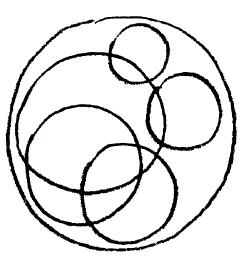
[ 50 ] How were lessons conducted there, a few months after these children had been enrolled in first grade? A child was called up and had to walk around a circle taking a specific number of steps. Then it was made clear to the child how what it experienced firsthand corresponded to what the teacher drew on the blackboard. Then another child was called up and had to walk a small circle in two steps, which, however, was contained within the larger one. Another child was called up to do the same thing in three steps. The children were always fully engaged with their whole being and always transferred what they experienced from their whole being to what they then saw in the drawing. Their attention was not focused on their eyes, but on their whole being. So, three circles; with the fourth, as it grew larger again, the child noticed how it intersected with the others. And so it continued. In this way, the child is given the opportunity to draw something from the whole person, which they can then translate into what they see. Whereas if you simply let the child draw, their mind is occupied with that alone, and you are directing them toward one-sidedness. The children should draw everything from the whole person; they should also draw their writing from the whole person.
[ 51 ] Of course, one shouldn’t think that everyone now has to do the same thing; rather, each individual teacher has done this on their own initiative because that is the principle. What I have introduced as a seminar course prior to Waldorf school instruction is designed so that every teacher actually receives something alive—so that the lecture does not contain something to be pedantically imitated, but rather so that the teacher receives something that is alive. And in this way, the school itself becomes something alive. Whereas regulations—well, of course, one can always make them, because that’s just the way it is: when three people, or thirty, or twelve get together—they don’t even have to be particularly intelligent; they can be of average intelligence, or even below average—if they write down, first, second, and third, what a model school should be like, they’ll produce something wonderfully structured, paragraph by paragraph; one can then discuss it and issue beautiful regulations. But you can’t do anything with that in school. It all comes down to putting it into practice in the real world.
[ 52 ] Question: How should one approach the upbringing of a nervous child?
[ 53 ] Dr. Steiner: The point here, isn’t it, is that the term “nervous child” is an extremely vague one, and of course one cannot simply say that one must take this or that approach; rather, it is a matter of what the child is actually like, and also of knowing exactly how old the child is. When faced with such a situation, one really must be able to view things in context. For example, someone might show you a child—say, three or four years old—who is extremely restless and wild. There are children like that who throw themselves on the ground and act out terribly; they are very difficult to handle, and the parents can be more or less unhappy as a result. Then they ask: “What should we actually do with this child?”—One would often, not always, but often, advise them to do nothing, because the worst thing one can do is to intervene and not let the child work off their energy; for the child must, in fact, release a certain amount of energy in this way in order to develop later on in a normal manner, so to speak. So it is often absolutely necessary to point out that one should refrain from constantly correcting the child’s behavior, because the key is to always know, based on a person’s overall constitution, what is specifically good for them.
[ 54 ] That’s exactly how it is, isn’t it, even with healthy and sick people as such. How often do people—who always have this abstract, pedantic notion of “normality” in their heads—say: “This person has an irregular pulse or something like that; it must be treated in such-and-such a way.” Certainly, one often has to, but often one doesn’t, precisely because that person needs that very pulse according to their overall constitution! And so it is here as well; one must know the child in terms of their entire constitution if one wants to say anything at all—just as anthroposophy aims to free people from abstractions. It is an abstraction to ask: “What should one do with a nervous child?” One is not dealing with something general, but always with a very specific, concrete child, and one must actually always take an individual approach.
[ 55 ] Question: How can anthroposophy provide guidance regarding career choices?
[ 56 ] Dr. Steiner: Yes, ladies and gentlemen, I really don’t know what is meant by this question. For if I were to answer it in somewhat abstract terms, I would say: An environment built on anthroposophical principles will simply foster those inclinations in a person that lead them to the right profession—that is, the profession that is right for them. But isn’t it true that career choice is something that is treated far too schematically? After all, when one wants to enter a profession, one is generally dealing with a destiny that has already been set in motion, and as human beings we are sometimes truly not flexible enough and believe that only a single profession can satisfy us. That may certainly be the case with very distinct, individually tailored professions; but to seek specific guidance for career choice through anthroposophy—that is, of course, something that actually sounds alien to life, I must say—so that I really cannot quite see what is meant by the question.
[ 57 ] The chair asks if there are any further questions. There are none.
[ 58 ] Dr. Steiner: Then I hope that my lecture—brief and sketchy as it had to be—on the broad topic at hand has nevertheless contributed, at least in some specific respects, to the realization that anthroposophy does not in fact intend to be something alien to life or detached from the world, but rather something that, when fully grasped, can indeed lead us into reality and life.