

Contemporary Intellectual Life and Education
GA 307
13 August 1923, Ilkley
Translate the original German text into any language:
Versions Available:
Contemporary Intellectual Life and Education, tr. SOL
Neunter Vortrag
Ninth Lecture
[ 1 ] Daß man, wenn das Kind in das schulpflichtige Alter kommt, also beim Übergang zum Zahnwechsel, mit einem künstlerisch-bildnerischen Unterrichten und Erziehen das Richtige trifft, habe ich in den letzten Vorträgen auseinandergesetzt. Ich will heute nur noch zu den dort gemachten prinzipiellen Bemerkungen einige ergänzend hinzufügen, um namentlich zu zeigen, wie durch einen solchen Unterricht, wie er vorgestern charakterisiert worden ist, gerade das Gefühl, das Gemütsleben des Kindes in Anspruch genommen wird, so daß man durch einen solchen Unterricht vor allen Dingen auf das Gefühlsleben des Kindes wirkt und alles aus dem Gefühlsleben heraus entwickelt.
[ 1 ] In my recent lectures, I have discussed how, when a child reaches school age—that is, during the transition to permanent teeth—artistic and visual arts education is the right approach. Today I would simply like to add a few supplementary remarks to the general points made there, specifically to show how such instruction—as characterized the day before yesterday—engages the child’s emotional life, so that it primarily influences the child’s emotional life and develops everything from within that emotional life.
[ 2 ] Vergegenwärtigen wir uns einmal durch einige charakteristische Beispiele, wie man aus dem Malerischen, aus dem Künstlerisch-Zeichnerischen das Schreiben heraus entwickeln kann. Ich habe schon gesagt, daß das Schreiben bei einem organisch-naturgemäßen Unterrichte vorangehen müsse dem Lesenlernen aus dem Grunde, weil das Schreiben mehr von dem ganzen Menschen in Anspruch nimmt als das Lesen.
[ 2 ] Let us consider, through a few characteristic examples, how writing can be developed from painting and artistic drawing. I have already said that, in an organic, nature-based approach to education, writing must precede learning to read, for the reason that writing engages the whole person more than reading does.
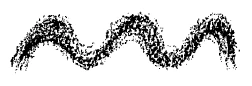
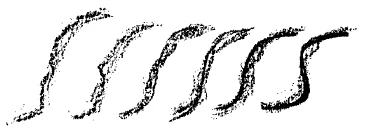
[ 3 ] Das Schreiben wird ausgeübt in einer Bewegung eines Organes, zu dem sich aber im Grunde genommen der ganze Mensch anschicken muß. Das Lesen nimmt nur den Kopf, den Intellekt in Anspruch, und man soll bei einem organischen Unterricht immer aus dem ganzen Menschen heraus dasjenige holen, was zu entwickeln ist. Man nehme also an, man habe die Kinder dahin gebracht, eine Anschauung zu gewinnen von fließendem Wasser. Fließendes Wasser hat das Kind nun gelernt ins Bild zu bringen. Wir nehmen an, wir seien so weit gekommen, daß wir dem Kinde etwas beigebracht haben von der Verbildlichung des fließenden Wassers, das Wellen wirft (es wird farbig gezeichnet). Wir wollen darauf hinarbeiten, daß das Kind nun achten lernt auf den Anfangslaut, den Anfangsbuchstaben des Wortes «Welle». Wir versuchen gerade das Anlauten, das Aussprechen des Anfangsbuchstabens charakteristischer Worte ins Auge zu fassen. Wir bringen dem Kinde bei, wie gewissermaßen an der Oberfläche des wellen werfenden Wassers sich diese Linie ergibt. Und wir bringen das Kind herüber vom Ziehen dieser Linie, den Wellen des fließenden Wassers entlang, zum zeichnerischen Formen dessen, was sich daraus ergibt: W.
[ 3 ] Writing is performed through the movement of a single organ, but in essence, the whole person must be engaged in the process. Reading, on the other hand, involves only the head and the intellect, and in organic education, one should always draw from the whole person whatever needs to be developed. Let us suppose, then, that we have helped the children gain a mental image of flowing water. The child has now learned to visualize flowing water. Let us assume we have reached the point where we have taught the child something about visualizing flowing water that creates ripples (it is drawn in color). We want to work toward the child now learning to pay attention to the initial sound, the first letter of the word “wave.” We specifically try to focus on the initial sound—the pronunciation of the first letter—of characteristic words. We teach the child how this line emerges, as it were, on the surface of the water as it forms waves. And we guide the child from drawing this line along the waves of the flowing water to the artistic rendering of what results from it: W.
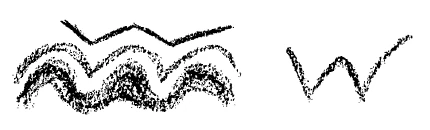
[ 4 ] Und man hat das Kind auf diese Weise dazu gebracht, daß es beginnt, aus dem Bilde heraus das W dem Spiel, der Linie der Welle nach schriftlich zu fixieren. — So holt man aus der Anschauung desjenigen, was das Kind ins Bild bringt, den zu schreibenden Buchstaben heraus.
[ 4 ] And in this way, the child is guided to begin writing the letter W by tracing the line of the wave in the picture. — In this way, the letter to be written is derived from the child’s visual representation of what the child brings into the picture.
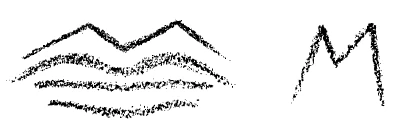
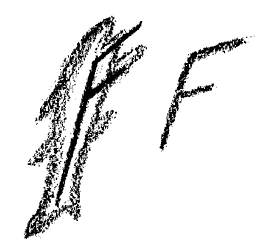
[ 5 ] Oder sagen wir, man bringt das Kind dahin, daß es etwa folgende Zeichnung macht, daß es den menschlichen Mund in dieser Weise zur Aufzeichnung bringt. Man hält es an, diesen Zug des Mundes festzuhalten und herauszuheben, und läßt es von da an herüberkommen zu dem Verspüren des Anfangsbuchstabens des Wortes «Mund». — Ich habe bereits in einer Abendstunde angedeutet, wie man nun das Kind dazu bringen kann, einen Fisch aufzuzeichnen. Man bringt das Kind nun dahin, die Grundform festzuhalten und läßt es von da aus zum Erfühlen des Anfangslautes des Wortes kommen: «Fisch». Man wird auf diese Weise eine Anzahl von Buchstaben gewinnen können; andere wird man auf eine andere Weise aus dem Zeichnerischen hervorholen müssen. Sagen wir zum Beispiel, man bringt dem Kinde auf irgendeine anschauliche Weise bei, wie der dahinbrausende Wind sich bewegt. Bei kleinen Kindern wird dies besser sein als eine andere Art; die Dinge können natürlich in der verschiedensten Weise gemacht werden. Man bringt dem Kinde das Hinstürmen des Windes bei. Nun läßt man das Kind das Sausen des Windes nachmachen und bekommt auf diese Weise diese Form. Kurz, es ist möglich dadurch, daß man in dem Malerischen entweder scharf konturierte Gegenstände oder Bewegungen oder auch Tätigkeiten festzuhalten versucht, auf diese Weise fast alle Konsonanten zu entwickeln.
[ 5 ] Or let’s say we guide the child to make a drawing something like this, so that it depicts the human mouth in this way. We encourage the child to capture and emphasize this feature of the mouth, and from there lead the child to sense the initial letter of the word “mouth.” — I have already hinted at one of our evening sessions how one can now guide the child to draw a fish. One then guides the child to capture the basic shape and, from there, helps the child sense the initial sound of the word “fish.” In this way, one will be able to derive a number of letters; others will have to be drawn out of the child’s drawing in a different way. Let’s say, for example, that one teaches the child in some vivid way how the rushing wind moves. For young children, this method will be more effective than others; of course, things can be done in a wide variety of ways. You teach the child about the rushing of the wind. Now you have the child imitate the whooshing of the wind and in this way obtain this shape. In short, by attempting to capture either sharply contoured objects, movements, or even actions in the act of drawing, it is possible to develop almost all consonants in this way.
[ 6 ] Bei den Vokalen wird man zu der Gebärde gehen müssen, denn die Vokale entstammen der Offenbarung des menschlichen Inneren. Im Grunde genommen ist das A zum Beispiel immer eine Art von Verwunderung und Staunen.
[ 6 ] When it comes to vowels, we must turn to sign language, because vowels stem from the revelation of the human inner self. Essentially, the vowel “A,” for example, is always a kind of wonder and amazement.
[ 7 ] Da wird einem dann die Eurythmie besonders helfen. Denn in der Eurythmie sind genau die dem Empfinden entsprechenden Gebärden gegeben. Und man wird das I, das A und so weiter aus den entsprechenden Eurythmiegebärden durchaus herausentwickeln können. Vokale müssen aus den Gebärden, die ja aus der menschlichen Lebendigkeit die Gefühle begleiten, herausentwickelt werden. |
[ 7 ] This is where eurythmy will be of particular help. For in eurythmy, the gestures that correspond precisely to these feelings are provided. And one will certainly be able to develop the I, the A, and so on from the corresponding eurythmy gestures. Vowels must be developed from the gestures that, arising from human vitality, accompany the emotions. |
[ 8 ] So kann man zu der Abstraktheit des Schreibens hingelangen aus dem ganz Konkreten des zeichnerischen Malens, des malenden Zeichnens, und man erlangt dadurch eben, daß das Kind immer von einem Gefühl im Bilde ausgegangen ist und den Buchstaben mit dem Seelischen des Gefühles in Verbindung hat bringen können, so daß das ganze Prinzip des Schreibens aus dem Gefühlsleben der menschlichen Seele hervorgeht.
[ 8 ] In this way, one can arrive at the abstract nature of writing from the very concrete nature of drawing-like painting and painting-like drawing; and one achieves this precisely because the child has always started from a feeling in the image and has been able to connect the letter with the emotional essence of that feeling, so that the entire principle of writing arises from the emotional life of the human soul.
[ 9 ] Geht man dann über zum Lesen, so hat man ja im Grunde genommen nichts anderes zu tun, als darauf hinzuwirken, daß das Kind dasjenige durch den Kopf wiedererkennt, was es durch den ganzen Körper erarbeiten gelernt hat. So daß das Lesen ein Wiedererkennen einer Tätigkeit ist, die man selbst ausgeführt hat. Das ist von einer ungeheuren Wichtigkeit. Es verdirbt die ganze menschliche Entwickelung, wenn der Mensch zu einem Abstrakten direkt geführt wird, wenn er irgendeine Tätigkeit durch einen Begriff ausführen lernt. Dagegen führt es immer zu einer gesunden menschlichen Entwickelung, wenn zuerst die Tätigkeit angeregt wird und dann aus der Tätigkeit heraus der Begriff entwickelt wird.
[ 9 ] When we then move on to reading, there is really nothing else to do but to help the child recognize with the mind what it has learned to accomplish through the entire body. Thus, reading is the recognition of an activity that one has carried out oneself. This is of immense importance. It undermines the entire process of human development when a person is led directly to the abstract, when they learn to perform an activity through a concept. In contrast, it always leads to healthy human development when the activity is stimulated first, and the concept is then developed out of that activity.
[ 10 ] Das Lesen ist durchaus in Begriffen lebend; daher hat man es als das zweite, nicht als das erste zu entwickeln. Sonst bringt man das Kind viel zu früh in eine Art von Kopfentwickelung hinein statt in eine vollmenschliche Entwickelung.
[ 10 ] Reading is very much a matter of life; therefore, it should be developed as the second step, not the first. Otherwise, the child is led far too early into a kind of intellectual development rather than a fully human development.
[ 11 ] So sehen Sie ja, wie aller Unterricht im Grunde genommen in die Sphäre des ganzen Menschen, in die Sphäre des Künstlerischen dadurch gelenkt werden kann. Und dahin muß auch aller übrige Unterricht bis etwa zum Lebensalter von neuneinhalb Jahren zielen. Da muß alles auf das Bild, auf den Rhythmus, auf den Takt gehen. Alles andere ist verfrüht.
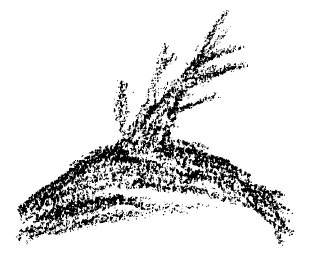
[ 11 ] So you see how all instruction can, in essence, be directed toward the sphere of the whole human being, toward the artistic sphere. And all other instruction up to about the age of nine and a half must also aim toward this. Everything must be directed toward the image, toward rhythm, toward meter. Everything else is premature.
[ 12 ] Daher ist es auch völlig unmöglich, einem Kinde irgendwie schon etwas vor diesem Lebensalter beizubringen, das einen starken Unterschied macht zwischen dem Menschen selber und zwischen der Außenwelt. Das Kind lernt sich selber von der Außenwelt erst zwischen dem neunten und zehnten Jahr unterscheiden. Daher handelt es sich darum, daß man alle Außendinge für das Kind, wenn es in die Schule hereinkommt, in eine Art lebendiger Wesen verwandelt, daß man nicht von Pflanzen spricht, sondern daß man spricht von den Pflanzen als lebenden Wesen, die einem selber etwas sagen, die einander etwas sagen, daß alle Naturbetrachtung, alle Menschheitsbetrachtung im Grunde genommen in Phantasie gegossen wird. Die Pflanzen sprechen, die Bäume sprechen, die Wolken sprechen. Und das Kind darf eigentlich in diesem Lebensalter einen Unterschied zwischen sich und der Welt gar nicht fühlen. Es muß in ihm künstlerisch das Gefühl erzeugt werden, daß es selber sprechen kann, daß die Gegenstände um es herum auch sprechen können.
[ 12 ] Therefore, it is also completely impossible to teach a child anything before this age that makes a clear distinction between the human being itself and the outside world. The child only begins to distinguish itself from the outside world between the ages of nine and ten. Therefore, the point is that when a child enters school, all external things must be transformed into a kind of living being for the child; that is, we do not speak of plants, but rather of plants as living beings that speak to us, that speak to one another; that all observation of nature and all observation of humanity is, in essence, cast into the imagination. The plants speak, the trees speak, the clouds speak. And at this age, the child should not actually feel any distinction between itself and the world. The feeling must be artistically evoked within the child that it can speak itself, and that the objects around it can also speak.
[ 13 ] Je mehr wir dieses Aufgehen des Kindes in der ganzen Umgebung erreichen, je mehr wir in der Lage sind, von allem, von Pflanze, Tier, Stein so zu reden, daß überall darinnen ein Sprechend-Webend-Geistiges an das Kind heranweht, desto mehr kommen wir dem entgegen, was das Kind in diesem Lebensalter aus dem Inneren seines Wesens heraus eigentlich von uns fordert, und wir erziehen dann das Kind in der Art, daß gerade in den Jahren, in denen das Gefühlsleben übergehen soll in Atmung und Blutkreislauf, in die Bildung der Gefäße, übergehen soll in den ganzen menschlichen Organismus, tatsächlich auch das Gefühlsleben für unsere Zeit richtig angesprochen wird, so daß das Kind in naturgemäßer Weise sich auch innerlich organisch gefühlsmäßig stark entwickelt.
[ 13 ] The more we succeed in helping the child become one with their entire surroundings, the more we are able to speak of everything—plants, animals, stones—in such a way that a speaking, weaving, spiritual presence wafts toward the child from all around, the more we meet what the child, at this age, actually demands of us from the very depths of their being, and we then raise the child in such a way that, precisely during the years when the emotional life is to transition into respiration and blood circulation—into the formation of the vessels—and into the entire human organism, the emotional life is in fact addressed in a way that is appropriate for our time, so that the child develops strongly, both internally and organically, in terms of emotion, in a natural manner.
[ 14 ] Es ist eine ungeheure Wohltat, wenn wir so gefühlsmäßig das Schreiben entwickeln und dann leise nur den Intellekt anklingen lassen, indem wir das Geschriebene wiedererkennen lassen im Lesen. Da klingt leise der Intellekt an. Wir führen so das Kind am besten gegen das neunte Lebensjahr heran.
[ 14 ] It is an immense blessing when we develop writing in such an emotional way and then gently allow the intellect to come into play by recognizing what we have written as we read it. That is when the intellect gently makes itself heard. This is the best way to guide a child up to the age of nine.
[ 15 ] So daß wir sagen müssen: zwischen dem siebenten und neunten oder neuneinhalbten Lebensjahr ist vor allen Dingen aller Unterricht so zu geben, daß er an das Gefühlsleben appelliert, daß das Kind wirklich alle Formen der Buchstaben in das Gefühl hineinbekommt. Man tut damit ungeheuer Bedeutsames für das Leben des Kindes. Denn es verfestigt das Kind zu stark, macht es gewissermaßen zu stark in seinem Knochen- und Sehnen- und Knorpelsystem gegenüber dem übrigen Organismus, wenn wir ihm das Schreiben mechanisch beibringen, wenn wir ihm eine gewisse Linienführung für die Buchstaben beibringen, um dadurch an den Körpermechanismus zu appellieren, statt an das Auge mitzuappellieren.
[ 15 ] So we must say: between the ages of seven and nine or nine and a half, all instruction must above all be given in such a way that it appeals to the child’s emotional life, so that the child truly internalizes all the forms of the letters on an emotional level. This has an immensely significant impact on the child’s life. For it over-strengthens the child—making the child’s system of bones, tendons, and cartilage, so to speak, too strong in relation to the rest of the organism—if we teach the child to write mechanically, if we teach the child a certain way of drawing the lines for the letters, thereby appealing to the body’s mechanics rather than also appealing to the eye.
[ 16 ] Wenn man an das Auge mitappelliert, das in Verbindung steht mit der sich bewegenden Hand, dadurch daß man aus dem Künstlerischen die Buchstaben herausarbeitet, wird der Buchstabe nicht bloß mechanisch durch eine Handführung erzeugt, sondern er wird so erzeugt, daß das Auge mit Wohlgefallen auf dem Ergebnis der eigenen Tätigkeit ruht. Dadurch wird eben das Seelische in der richtigen Weise für den Menschen in Anspruch genommen; dadurch wird in der richtigen Weise in dem Lebensalter das Gefühlsleben entwickelt, in dem es gerade am allerbesten in den physischen Organismus gesundend hineinströmen kann.
[ 16 ] When one appeals to the eye—which is connected to the moving hand—by carving out the letters from the artistic form, the letter is not merely produced mechanically by the movement of the hand, but is produced in such a way that the eye rests with pleasure upon the result of its own activity. In this way, the spiritual aspect is properly engaged for the individual; in this way, the emotional life is developed in the right way at the stage of life when it can flow most effectively into the physical organism, bringing healing.
[ 17 ] Was würden Sie sagen, meine sehr verehrten Anwesenden, wenn jemand, dem ein Fisch auf den Teller gelegt worden ist, sorgfältig das Fischfleisch weglegen würde, sich die Gräten aussondern und diese verzehren würde! Sie würden wohl wahrscheinlich eine furchtbare Angst bekommen, daß ein solcher Mensch an den Fischgräten ersticken könnte. Außerdem würde er diese Fischgräten nicht in der richtigen Weise seinem Organismus einverleiben können.
[ 17 ] What would you say, my esteemed audience, if someone who had been served fish were to carefully set aside the fish meat, pick out the bones, and eat them! You would probably be terribly afraid that such a person might choke on the fish bones. Furthermore, he would not be able to properly assimilate these fish bones into his body.
[ 18 ] Aber so ist es, ganz genau so, nur auf einem anderen Niveau, auf dem Niveau der seelischen Unterweisung, wenn wir einem Kinde statt der lebensvollen Bilder, statt desjenigen, was den ganzen Menschen beansprucht, trockene, abstrakte, nüchterne Begriffe beibringen. Diese trockenen, abstrakten, nüchternen Begriffe müssen bloß da sein, damit sie gewissermaßen stützen, was bildhaft in der menschlichen Seele wird.
[ 18 ] But that is exactly how it is—only on a different level, the level of spiritual instruction—when we teach a child dry, abstract, and sober concepts instead of vivid images, instead of what engages the whole person. These dry, abstract, and sober concepts need only be there to, so to speak, support what takes shape as imagery in the human soul.
[ 19 ] Nun richten wir tatsächlich, wenn wir so erziehen, wie ich es eben angeführt habe, dadurch, daß wir alles aus dem Bildhaften heraus entwickeln, das Kind so zurecht, daß es in die Lage kommt, immer bewegliche Begriffe zu haben, nicht starre Begriffe. Und dadurch werden wir bemerken können, daß, wenn das Kind das neunte oder neuneinhalbte Lebensjahr überschritten hat, es nun in schön organischer Weise hineingeführt werden kann in das Begreifen der Welt, wobei es sich selber schon von den Dingen und Ereignissen der Welt unterscheiden muß. Wir können dem Kind, nachdem wir ihm von den Pflanzen wie von sprechenden Wesen genügend lange erzählt haben, so daß es in Bildern gelebt hat, indem es auf die Pflanzenwelt hinschaute, wir können ihm dann dasjenige beibringen, was der Mensch am allerbesten von der Pflanzenwelt lernt, wenn er damit anfängt zwischen dem neunten und zehnten Jahre und allmählich im zehnten, elften Jahre dazu geführt wird.
[ 19 ] Now, when we educate in the way I have just described—by developing everything from the pictorial—we are in fact guiding the child in such a way that it is able to always have flexible concepts, not rigid ones. And through this, we will be able to observe that once the child has passed the age of nine or nine and a half, it can now be guided in a beautifully organic way into understanding the world, whereby it must already distinguish itself from the things and events of the world. After we have told the child about plants as if they were speaking beings for a sufficiently long time—so that the child has lived in images by observing the plant world—we can then teach the child what a person learns best from the plant world when they begin between the ages of nine and ten and are gradually guided toward it in their tenth and eleventh years.
[ 20 ] Da ist wiederum gerade der menschliche Organismus dazu bereit, mit der Pflanzenwelt sich innerlich ideenhaft auseinanderzusetzen. Allerdings muß die Pflanzenkunde eine ganz andere Form annehmen für einen lebendigen, die Menschenentwickelung wirklich fördernden Kindesunterricht als dasjenige, was wir heute oftmals als Pflanzenkunde in die Schule hineintragen, weil wir es selber als Pflanzenkunde gelernt haben. Es hat gar keine Bedeutung für das Menschenleben seiner Wirklichkeit nach, höchstens eine konventionelle, ob man vorgelegt bekommen hat diese Pflanzen und jene Pflanzen und so weiter und einem dann Namen und Staubgefäßezahl, Farbe der Blumenblätter für diese Pflanzen beigebracht worden sind.
[ 20 ] Here, too, the human organism is ready to engage with the plant world on an inner, conceptual level. However, for a vibrant form of children’s education that truly fosters human development, botany must take on a completely different form than what we often bring into schools today as “botany,” simply because that is how we ourselves learned it. In reality, it has no significance whatsoever for human life—at most a conventional one—whether one has been presented with this plant or that plant and so on, and has then been taught the names, the number of stamens, and the color of the petals for these plants.
[ 21 ] Alles, was auf diese Weise an das Kind herangebracht wird, bleibt dem Kinde fremd. Das Kind fühlt nur den Zwang, das erlernen zu müssen. Und derjenige, der auf diese Weise Pflanzenkunde im zehnten, elften Jahre an das Kind heranbringt, weiß eigentlich nichts von dem wirklichen Naturzusammenhange. Eine Pflanze für sich abgesondert zu betrachten, sie in die Botanisiertrommel einzupacken und dann zu Hause herauszulegen und für sich abgesondert zu betrachten, das heißt nichts anderes, als ein Haar sich auszupfen und dieses Haar auf ein Papier legen und das Haar für sich betrachten. Das Haar für sich ist nichts, das Haar für sich kann nicht entstehen, das Haar für sich hat keine Bedeutung - es hat nur eine Bedeutung, indem es lebendig am Kopfe des Menschen oder auf der Haut des Tieres wächst. Es hat nur einen lebendigen Sinn in seinem Zusammenhange. So aber hat auch die Pflanze nur einen lebendigen Sinn im Zusammenhange mit der Erde und mit den Sonnenkräften und - wie ich gleich nachher auseinandersetzen werde — mit noch anderen Kräften. So daß wir niemals eine Pflanze für das kindliche Alter anders betrachten sollen als im Zusammenhange mit der Erde und im Zusammenhange mit den Sonnenkräften.
[ 21 ] Everything presented to the child in this way remains foreign to the child. The child feels only the compulsion to have to learn it. And anyone who teaches botany to a child in the tenth or eleventh year in this way actually knows nothing about the true interrelationships of nature. To view a plant in isolation, to pack it into a botanical collection box, and then to take it out at home and view it in isolation—this is nothing other than plucking a hair, placing it on a piece of paper, and viewing the hair in isolation. A hair on its own is nothing; a hair on its own cannot come into being; a hair on its own has no meaning—it has meaning only insofar as it grows, alive, on a person’s head or on an animal’s skin. It has a living meaning only within its context. In the same way, the plant, too, has a living meaning only in connection with the earth and with the forces of the sun—and, as I will explain shortly, with other forces as well. Thus, we should never view a plant—especially for children—other than in connection with the earth and in connection with the forces of the sun.
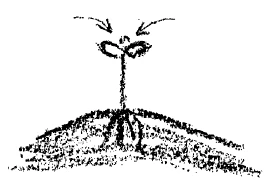
[ 22 ] Ich kann hier nur skizzieren, was man in einer anschaulichen, bildlichen Weise in einer Anzahl von Stunden dem Kinde beibringen kann. Da muß es sich darum handeln, dem Kinde das Folgende beizubringen: Hier ist die Erde (siehe Zeichnung). Mit der Erde in inniger Verbindung, zur Erde gehörig, ist die Wurzel der Pflanze. Niemals sollte eine andere Vorstellung erweckt werden als die einzig lebendige, daß Erde und Wurzel zusammengehören. Und dann sollte niemals eine andere Vorstellung erweckt werden als diese, daß die Blüte von der Sonne und ihren Strahlen an der Pflanze hervorgerufen wird. So wird das Kind lebendig ins Weltenall hineinversetzt.
[ 22 ] Here I can only outline what can be taught to a child in a vivid, visual way over the course of a few hours. The aim must be to teach the child the following: Here is the Earth (see drawing). The root of the plant is intimately connected to the earth and belongs to it. Never should any mental image be suggested other than the one true, living image that the earth and the root belong together. And never should any mental image be suggested other than that the flower is brought forth on the plant by the sun and its rays. In this way, the child is vividly transported into the universe.
[ 23 ] Wer als Lehrer innere Lebendigkeit genug hat, der kann dieses lebendig in das Weltenall Hineinversetztsein der Pflanze durchaus gerade in diesem Lebensalter, von dem ich jetzt spreche, am besten an das Kind heranbringen. Er kann in dem Kinde zunächst förmlich das Gefühl hervorrufen, wie die Erde mit ihren Stoffen die Wurzel durchdringt, wie die Wurzel sich der Erde entringt, und wie dann, wenn die Wurzel nach oben den Sproß getrieben hat, der Sproß von der Erde geboren wird, wie von der Sonne Licht und Wärme zum Blatt und zur Blüte entfaltet wird, wie die Sonne die Blüte sich heranerzieht, wie die Erde die Wurzel in Anspruch nimmt.
[ 23 ] A teacher who possesses sufficient inner vitality can best convey to the child—precisely at this age I am now speaking of—the plant’s vivid sense of being immersed in the universe. They can first help the child to literally feel how the earth, with its substances, permeates the root, how the root breaks free from the earth, and how, once the root has driven the shoot upward, the shoot is born from the earth; how light and warmth from the sun unfold toward the leaf and the flower; how the sun draws the flower toward itself; and how the earth takes hold of the root.
[ 24 ] Dann macht man das Kind in lebendiger Art darauf aufmerksam, wie eine feuchtliche Erde, eine Erde, die also innerlich wässerig ist, in anderer Weise auf die Wurzel wirkt als eine trockene Erde; wie durch eine trockene Erde die Wurzel verkümmert wird, durch eine wässerige Erde die Wurzel selber saftig und lebensvoll gemacht wird.
[ 24 ] Then one vividly draws the child’s attention to how moist soil—that is, soil that is watery at its core—affects the root differently than dry soil; how dry soil causes the root to wither, while moist soil makes the root itself succulent and full of life.
[ 25 ] Man macht das Kind darauf aufmerksam, wie die senkrecht auf die Erde auffallenden Sonnenstrahlen die gelben Löwenzahnblüten aus der Pflanze herausholen oder die Blüten der Ranunkeln oder dergleichen, oder auch die Rosenblüten; wie aber der schief einfallende Sonnenstrahl, der über die Pflanzen gewissermaßen hinwegstreicht, die dunkle, violette Herbstzeitlose hervorruft. Und man bringt so überall in lebendigen Zusammenhang die Wurzel mit der Erde, Blatt und Blüte mit der Sonne.
[ 25 ] One draws the child’s attention to how the sun’s rays, falling vertically onto the earth, bring forth the yellow dandelion blossoms from the plant, or the blossoms of the buttercups and the like, or even the rose blossoms; but how the obliquely falling sunbeam, which, as it were, sweeps across the plants, brings forth the dark, violet autumn crocus. And in this way, one establishes a living connection everywhere between the root and the earth, and between the leaf and the flower and the sun.
[ 26 ] Und dann wird man auch, wenn man in dieser Weise lebendig das Ideenbild des Kindes in den Kosmos hineinstellt, ihm beibringen können, wiesich wiederum oben das ganze Pflanzenwachstum zum Fruchtknoten zusammenzieht, wie daraus die neue Pflanze wird.
[ 26 ] And then, when we place the child’s mental image into the cosmos in this living way, we will also be able to teach the child how, up above, the entire plant grows and contracts into the ovary, and how the new plant emerges from it.
[ 27 ] Und jetzt wird man - ich darf da schon die Zukunft etwas vorausnehmen — einmal eine Wahrheit, ganz zugerichtet für das kindliche Lebensalter, entwickeln müssen, die auszusprechen man sich heute im öffentlichen Leben eigentlich noch etwas genieren muß, weil es als ein Aberglaube, als eine Phantasterei, als etwas mystisch Nebuloses angesehen wird. Aber geradeso wie die Sonne herausholt die Blüte in ihrer Farbigkeit, so holen die Mondenkräfte den wiederum sich zusammenziehenden Fruchtknoten aus der Pflanze heraus. Die Mondenkraft ist es, die den Fruchtknoten aus der Pflanze wiederum herausholt.
[ 27 ] And now—if I may anticipate the future a bit—we will have to develop a truth, tailored specifically for childhood, which we are still somewhat embarrassed to voice in public life today because it is regarded as superstition, as fantasy, as something mystically nebulous. But just as the sun brings out the flower’s colors, so do the forces of the moon draw the ovary—which is contracting once again—out of the plant. It is the power of the moon that draws the ovary out of the plant once more.
[ 28 ] Und so stellt man die Pflanze lebendig hinein in Erdenwirkung, Sonnenwirkung, Mondenwirkung. Nur, die Mondenwirkung muß man heute noch weglassen; denn wenn die Kinder dann nach Hause kommen würden und würden erzählen, daß sie gelernt haben, der Fruchtknoten hätte etwas mit dem Mond zu tun, so würde vielleicht - selbst wenn die Eltern schon geneigt wären, bei den Kindern das entgegenzunehmen -, wenn gerade ein Naturforscher als Besuch da wäre, dieser sofort die Möglichkeit haben, die Eltern zu veranlassen, das Kind doch ja aus dieser Schule gleich wegzunehmen! Also damit muß man heute noch zurückhalten, wie man überhaupt in bezug auf wichtige Dinge selbstverständlich heute, unserer ganz veräußerlichten Zivilisation Rechnung tragend, mit manchem zurückhalten muß. Aber ich möchte gerade in dieser radikalen Weise zeigen, wie man die lebendigen Begriffe entwickeln muß, die nun nicht aus irgend etwas, was im Grunde genommen für sich gar nicht existiert, herausgeholt sind — denn die Pflanze existiert für sich nicht, ohne Sonne, ohne Erde ist sie nichts —, sondern wie man diesen Begriff von der wahren Wirklichkeit nehmen muß. Darum handelt es sich.
[ 28 ] And so one places the plant, alive, within the influence of the earth, the sun, and the moon. However, the influence of the moon must still be left out today; for if the children were to come home and say that they had learned the ovary has something to do with the moon, then perhaps—even if the parents were already inclined to accept this from their children—if a naturalist happened to be visiting, he would immediately have the opportunity to persuade the parents to take the child out of that school right away! So we must still hold back on that today, just as we must, of course, hold back on many things when it comes to important matters, taking into account our thoroughly alienated civilization. But I would like to demonstrate precisely in this radical way how one must develop living concepts—concepts that are not derived from something that, in essence, does not exist on its own—for the plant does not exist on its own; without the sun and without the earth, it is nothing—but rather how one must derive this concept from true reality. That is what is at stake.
[ 29 ] Nun muß man dem Kinde beibringen — und da wird man schon eher so vorgehen können -, wie, wenn hier die Erde ist (siehe Zeichnung), die Erde nun etwas auswächst, einen Hügel erzeugt. Aber der Hügel, der wird von den Kräften der Luft und schon von den Kräften der Sonne durchsetzt. Er bleibt nicht mehr Erde. Er wird etwas, was zwischen dem saftigen Pflanzenblatt und auch schließlich der Pflanzenwurzel und der trockenen Erde mitten drinnen steht: er wird Baumstamm. Und auf der also ausgewachsenen Pflanze wachsen nun erst die einzelnen Pflanzen, die die Äste des Baumes sind. So daß man kennenlernt, wie eigentlich der Baumstamm eine aufsprossende Erde ist.
[ 29 ] Now one must teach the child—and here it will be easier to proceed in this way—how, when there is earth here (see drawing), the earth begins to grow upward, forming a mound. But this mound is permeated by the forces of the air and, indeed, by the forces of the sun. It is no longer just earth. It becomes something that stands between the lush plant leaf and, ultimately, the plant root and the dry earth in the middle: it becomes a tree trunk. And it is on this fully grown plant that the individual plants—which are the branches of the tree—now begin to grow. In this way, one comes to understand how the tree trunk is, in fact, earth that has sprouted.
[ 30 ] Man bekommt dadurch nun auch den Begriff davon, wie innig verwandt dasjenige, was ins Holz übergeht, mit dem eigentlichen Erdreiche ist. Und damit das Kind das recht gut begreift, weist man es hin, wie das Holz vermodert, immer erdiger und erdiger wird und schließlich in Staub auseinanderfällt, schon ganz ähnlich der Erde ist, und wie im Grunde genommen aller Erdensand, alles Erdengestein auf diese Weise aus dem, was eigentlich hat Pflanze werden sollen, hervorgegangen ist, wie die Erde im Grunde genommen eine große Pflanze ist, ein Riesenbaum, und alle einzelnen Pflanzen als Äste darauf wachsen. Man bekommt nun für das Kind den möglichen Begriff, daß die Erde eigentlich im ganzen ein lebendes Wesen ist, und daß die Pflanzen zur Erde hinzugehören.
[ 30 ] This also gives one an idea of how intimately connected that which passes into the wood is with the earth itself. And so that the child can understand this well, one points out how wood decays, becoming more and more like earth until it finally crumbles into dust—already quite similar to the earth itself—and how, fundamentally, all the sand and rock of the earth have arisen in this way from what was actually meant to become a plant, how the earth is, in essence, a great plant, a giant tree, and all individual plants grow on it as branches. One can now convey to the child the concept that the Earth as a whole is actually a living being, and that plants belong to the Earth.
[ 31 ] Das ist außerordentlich bedeutsam, daß das Kind in dieser Weise nicht den vertrackten Begriff unserer Geologie und Geognosie bekommt, als ob die Erde nur aus Gestein bestehen würde, und nur die Gesteinskräfte zur Erde gehörten, während doch die Pflanzenwachstumskräfte geradeso zur Erde gehören wie die Gesteinskräfte. Und was das Wichtigste ist: man redet gar nicht von Gestein für sich zunächst. Und man wird merken, daß das Kind in mancher Beziehung sehr neugierig ist. Aber wenn man ihm in dieser Beziehung lebendig, wie aus der Erde hervorgehend, durch die Sonne hervorgezogen, die ganze Pflanzendecke als etwas zur Erde Gehöriges beibringt, dann wird es nicht neugierig dem gegenüber, was die Steine für sich sind. Es interessiert sich noch nicht für das Mineralische. Und es ist das größte Glück, wenn das Kind sich bis zum elften, zwölften Jahre nicht für das tote Mineralische interessiert, sondern wenn es die Vorstellung aufnimmt, daß die Erde ein ganzes lebendes Wesen ist, gewissermaßen nur ein schon im Verbröckeln begriffener Baum, der alle Pflanzen als Äste hervorbringt. Und Sie sehen, man bekommt auf diese Weise außerordentlich gut die Möglichkeit, auch zu den einzelnen Pflanzen überzugehen.
[ 31 ] It is extremely important that, in this way, the child does not come to understand the convoluted concepts of our geology and geognosy, as if the Earth consisted only of rock and only the forces of rock belonged to the Earth, whereas the forces of plant growth belong to the Earth just as much as the forces of rock. And most importantly: one does not speak of rock in and of itself at first. And one will notice that the child is very curious in many respects. But if one teaches the child, in this context, to view the entire plant cover as something that belongs to the Earth—vividly, as if emerging from the Earth and drawn forth by the sun—then the child will not become curious about what the stones are in and of themselves. They are not yet interested in the mineral realm. And it is a great blessing if, up until the age of eleven or twelve, the child is not interested in the lifeless mineral realm, but instead forms a mental image that the Earth is a whole living being—in a sense, merely a tree already in the process of crumbling, which produces all plants as branches. And you see, in this way one gains an exceptionally good opportunity to move on to the individual plants as well.
[ 32 ] Ich sage zum Beispiel dem Kinde: Nun ja, bei solch einer Pflanze (siehe Zeichnung) sucht die Wurzel den Boden, die Blüte wird von der Sonne herausgezogen. - Man nehme nun an, die Wurzel, die an der Pflanze wachsen will, finde nicht recht den Boden, sie findet nur verkümmerten Boden, und dadurch gibt sich auch die Sonne keine Mühe, die Blüte hervorzubringen. Dann hat man eine Pflanze, welche nicht recht den Boden findet, keine richtige Wurzel treibt, aber auch keine richtige Blüte hervorbringt: man hat einen Pilz.
[ 32 ] For example, I say to the child: Well, in a plant like this (see drawing), the root seeks out the soil, and the flower is drawn out by the sun. - Now suppose the root, which wants to grow on the plant, cannot quite find the soil; it finds only stunted soil, and as a result, the sun does not bother to bring forth the flower. Then you have a plant that cannot quite find the soil, does not develop a proper root, but also does not produce a proper flower: you have a fungus.
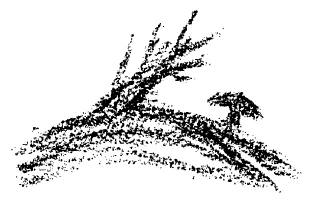
[ 33 ] Und man führt dann das Kind dazu, zu verstehen, wie es nun ist, wenn sich dasjenige, was, wenn es die Erde nicht recht findet, zum Pilz entwickelt, wenn das sich einpflanzen kann in etwas, wo die Erde schon ein wenig Pflanze geworden ist, wenn es sich also, statt sich in den Erdboden einpflanzen zu müssen, einpflanzen kann in den pflanzlich gewordenen Hügel, in den Baumstamm: da wird es Baumflechte, da wird es jene graugrüne Flechte, welche man an der Oberfläche der Bäume findet, ein Parasit.
[ 33 ] And then one guides the child to understand what happens when that which, if it does not find the right soil, develops into a fungus—when it can take root in something where the soil has already become a little like a plant—when, instead of having to take root in the ground, it can take root in the mound that has become plant-like, in the tree trunk: there it becomes tree lichen; there it becomes that gray-green lichen found on the surface of trees—a parasite.
[ 34 ] Man bekommt auf diese Weise die Möglichkeit, aus dem lebendigen Wirken und Weben der Erde heraus selber dasjenige zu ziehen, was sich in allen einzelnen Pflanzen ausdrückt. Dadurch entwickelt man in dem Kinde, wenn man es so lebendig in das Pflanzenwachstum einführt, aus dem Botanischen, aus der Pflanzenkunde heraus die Anschauung von dem Antlitz der Erde.
[ 34 ] In this way, one gains the opportunity to draw from the living activity and interplay of the Earth that which is expressed in all individual plants. By introducing the child so vividly to plant growth in this way, one develops in the child, through botany—through the study of plants—an understanding of the face of the Earth.
[ 35 ] Das Antlitz der Erde ist anders, wo gelbe, sprossende Pflanzen sind, das Antlitz der Erde ist anders, wo verkümmerte Pflanzen sind. Und man findet von der Pflanzenkunde den Übergang zu etwas anderem, was außerordentlich bedeutsam für die Entwickelung des Kindes wird, wenn es gerade aus der Pflanzenkunde herausgeholt wird: die Geographie. Das Antlitz der Erde den Kindern beizubringen, soll auf diese Weise geschehen, daß man hervorholt die Art und Weise, wie die Erde an ihrer Oberfläche wirken will, aus der Art und Weise, wie sie die Pflanzen an einer bestimmten Oberfläche hervorbringt.
[ 35 ] The face of the earth is different where there are yellow, sprouting plants; the face of the earth is different where there are stunted plants. And from botany, one finds the transition to something else that becomes extraordinarily significant for the child’s development when it is drawn directly from botany: geography. Teaching children about the face of the Earth should be done in such a way that one draws out the way the Earth seeks to act on its surface from the way it brings forth plants on a particular surface.
[ 36 ] Auf diese Weise entwickelt man in dem Kinde einen lebendigen Intellekt statt eines toten. Und für die Entwickelung dieses lebendigen Intellektes ist die Lebenszeit zwischen dem neunten, zehnten und dem elften, zwölften Lebensjahr die allerbeste. Dadurch, daß man in dieser Weise das Kind hineinführt in das lebendige Weben und Leben der Erde, die aus ihrer inneren Vitalkraft die verschieden gestalteten Pflanzen hervorbringt, bringt man dem Kinde statt toter Begriffe lebendige Begriffe bei, Begriffe, die dieselbe Eigenschaft haben wie ein menschliches Glied. Wenn man noch ein ganz kleines Kind ist, dann muß ein menschliches Glied wachsen. Wir dürfen die Hand nicht in einen eisernen Handschuh einspannen, sie würde nicht wachsen können. Aber die Begriffe, die wir den Kindern beibringen, die sollen möglichst scharfe Konturen haben, sollen Definitionen sein, und das Kind soll immer definieren. Das Schlimmste, was wir dem Kinde beibringen können, sind Definitionen, sind scharf konturierte Begriffe, denn die wachsen nicht; der Mensch aber wächst mit seinem organischen Wesen. Das Kind muß bewegliche Begriffe haben, die, wenn das Kind reifer und reifer wird, ihre Form fortwährend ändern. Wir dürfen uns nicht, wenn wir vierzig Jahre alt geworden sind, bei irgendeinem Begriff, der auftaucht, an das erinnern müssen, was wir mit zehn Jahren gelernt haben, sondern der Begriff muß sich in uns verändert haben, so wie unsere Glieder, unser ganzer Organismus sich organisch auch verändert haben.
[ 36 ] In this way, one develops a living intellect in the child rather than a dead one. And the period between the ages of nine and ten and eleven and twelve is the very best time for the development of this living intellect. By introducing the child in this way to the living interplay and life of the earth—which, from its inner vital force, brings forth plants of various forms—one teaches the child living concepts instead of dead ones, concepts that possess the same quality as a human limb. When one is still a very young child, a human limb must grow. We must not force the hand into an iron glove; it would not be able to grow. But the concepts we teach children should have as sharp contours as possible; they should be definitions, and the child should always be defining. The worst thing we can teach a child are definitions—sharply defined concepts—because they do not grow; but human beings grow along with their organic nature. The child must have flexible concepts that continually change their form as the child matures. When we reach the age of forty, we should not have to recall, upon encountering any concept that arises, what we learned at the age of ten; rather, the concept must have changed within us, just as our limbs and our entire organism have also changed organically.
[ 37 ] Lebendige Begriffe bekommt man aber nur, indem man nicht dasjenige an das Kind heranträgt, was man Wissenschaft nennt, und was heute sich zumeist dadurch auszeichnet, daß man dadurch nichts weiß, diese tote Wissenschaft, die man nun einmal lernen muß, sondern indem man das Kind gerade einführt in das Lebendige im Natürlichen in der Welt. Dadurch bekommt es seine beweglichen Begriffe, und es wird seine Seele wachsen können in einem Körper, der wie die Natur wächst. Dann wird man nicht dasjenige, was so oft die Erziehung bietet, auch bieten: daß man in einen Körper, der naturgemäß wächst, ein Seelisches hineinverpflanzt, das nicht wachsen kann, sondern das tot ist. Für die menschliche Entwickelung taugt es nur, wenn in dem lebendig wachsenden physischen Organismus auch eine lebendig wachsende Seele, ein lebendig wachsendes Seelenleben ist.
[ 37 ] However, one can only acquire living concepts by not presenting the child with what is called “science”—which today is mostly characterized by the fact that it teaches us nothing, this dead science that one simply has to learn—but rather by introducing the child directly to the living aspects of the natural world. In this way, the child acquires flexible concepts, and its soul will be able to grow within a body that grows just as nature does. Then one will not offer what education so often offers: transplanting into a body that grows naturally a soul that cannot grow, but is dead. It is only suitable for human development if, within the living, growing physical organism, there is also a living, growing soul—a living, growing soul life.
[ 38 ] Das muß aber auf diese Weise erzeugt werden und kann am besten erzeugt werden, wenn alles Pflanzenleben in innigem Zusammenhang mit der Erdengestaltung angeschaut wird, wenn also Erdenleben und Pflanzenleben dem Kinde als Einheit vorgeführt werden, wenn Erdenerkenntnis Pflanzenerkenntnis ist, und wenn das Kind das Leblose zunächst daran erkennt, daß der Baum vermodert und zu Staub wird, wenn es also das Leblose zunächst als den Überrest des Lebendigen kennenlernt. Wir sollen dem Kinde nur ja nicht Mineralkenntnis beibringen in diesem Lebensalter, von dem ich jetzt spreche, sondern Begriffe, Ideen von dem Lebendigen. Darauf kommt es an.
[ 38 ] But this must be brought about in this way, and it can best be achieved when all plant life is viewed in close connection with the structure of the earth—that is, when earth life and plant life are presented to the child as a unity, when knowledge of the earth is knowledge of plants, and when the child first recognizes the inanimate by the fact that the tree decays and turns to dust—that is, when the child first comes to know the inanimate as the remnant of the living. We must by no means teach the child knowledge of minerals at this age of which I am now speaking, but rather concepts and ideas of the living. That is what matters.
[ 39 ] Wie man die Pflanzenwelt bei dem Unterweisen des Kindes in Zusammenhang bringen soll mit der Erde, so daß gewissermaßen die Pflanzenwelt als etwas erscheint, was aus dem lebendigen Erdenorganismus als dessen letztes Ergebnis nach außen herauswächst, so soll man die gesamte Tierwelt als eine Einheit wiederum heranbringen an den Menschen. Und so stellt man das Kind lebendig in die Natur, in die Welt hinein. Es lernt verstehen, wie der Pflanzenteppich der Erde zu dem Organismus Erde gehört. Es lernt aber auf der anderen Seite auch verstehen, wie alle Tierarten, die über die Erde ausgebreitet sind, in einer gewissen Weise der Weg zum Menschenwachstum sind. Die Pflanzen zur Erde, die Tiere an den Menschen herangeführt, das muß Unterrichtsprinzip werden. Ich kann dies nur prinzipiell rechtfertigen. Es handelt sich darum, daß dann mit wirklich künstlerischem Sinn für die Einzelheiten des Unterrichtes für das zehn-, elf-, zwölfjährige Kind die Unterweisung über die Tierwelt im Detail durchgeführt wird.
[ 39 ] Just as one should relate the plant world to the Earth when teaching a child—so that, in a sense, the plant world appears as something that grows outward from the living Earth organism as its ultimate result—so, in turn, one should bring the entire animal world to the child as a unified whole. And in this way, the child is placed vividly within nature, within the world. The child learns to understand how the Earth’s carpet of plants belongs to the Earth as an organism. But on the other hand, the child also learns to understand how all the animal species spread across the Earth are, in a certain sense, the path to human development. Plants connected to the Earth, animals brought closer to human beings—this must become a guiding principle of education. I can only justify this in principle. The point is that, with a truly artistic sensibility for the details of instruction, the ten-, eleven-, and twelve-year-old child should then be taught about the animal world in detail.
[ 40 ] Sehen wir uns den Menschen an. Wir wollen, wenn auch in ganz einfacher, vielleicht primitiver Weise schon dem Kinde die Menschenwesenheit vor das Seelenauge führen, und man kann es, wenn man es in der Weise künstlerisch vorbereitet hat, wie es geschildert worden ist. Da wird das Kind, wenn auch in primitiver Weise, unterscheiden lernen, wie der Mensch zu gliedern ist in eine dreifache Organisation. Wir betrachten die Kopforganisation, bei der im wesentlichen die weichen Teile im Inneren sind, wie eine harte Schale insbesondere um das Nervensystem herumwächst, wie also die Kopforganisation in einer gewissen Weise nachbildet die kugelförmige Erde, wie sie im Kosmos drinnen steht, wie diese Kopforganisation im wesentlichen den weichen Innenteil, insbesondere nach dem Gehirn zu, und die harte äußere Schale umfaßt. Man wird möglichst anschaulich künstlerisch das Kind durch alle möglichen Mittel an ein Verstehen der Kopforganisation heranführen, und man wird dann versuchen, ebenso das Kind heranzuführen an das zweite Glied der menschlichen Wesenheit, an alles dasjenige, was zusammenhängt mit dem rhythmischen System des Menschen, was die Atmungsorgane, was die Blutzirkulationsorgane mit dem Herzen umfaßt. Man wird, grob gesprochen, das Kind heranführen an die Brustorganisation, wird — ebenso wie man plastisch-künstlerisch die schalenförmigen Kopfknochen, welche die Weichteile des Gehirnes umschließen, betrachtet - jetzt die sich Glied an Glied heranreihenden Rückgratknochen der Wirbelsäule künstlerisch betrachten, an die sich die Rippen anschließen. Man wird die ganze Brustorganisation mit Einschluß des Atmungs-, des Zirkulationssystems, kurz, der rhythmischen Wesenheit des Menschen in ihrer Eigenart betrachten und wird dann zum dritten Glied der menschlichen Organisation, zur Stoffwechsel-Gliedmaßenorganisation übergehen. Die Gliedmaßen als Bewegungsorgane unterhalten im wesentlichen den Stoffwechsel, indem sie durch ihre Bewegung eigentlich die Verbrennung regulieren. Sie hängen zusammen mit dem Stoffwechsel. Die Gliedmaßen-Stoffwechselorganisation ist eine einheitliche.
[ 40 ] Let’s take a look at human beings. We want—albeit in a very simple, perhaps primitive way—to present human existence to the child’s inner eye, and this can be done if one has prepared the child artistically in the manner described. Then the child will learn—albeit in a primitive way—to distinguish how the human being is structured into a threefold organization. We consider the head organization, in which the soft parts are essentially on the inside, and a hard shell grows around them—particularly around the nervous system—so that the head organization in a certain way mirrors the spherical Earth as it stands within the cosmos; how this head organization essentially encloses the soft inner part, especially toward the brain, and is enclosed by the hard outer shell. We will guide the child as vividly and artistically as possible, using every means at our disposal, toward an understanding of the head organization, and we will then attempt to guide the child in the same way toward the second aspect of the human being—toward everything connected with the human rhythmic system, which encompasses the respiratory organs and the circulatory organs, including the heart. Roughly speaking, one will introduce the child to the organization of the chest; just as one has artistically and vividly examined the shell-like skull bones that enclose the soft tissues of the brain, one will now artistically examine the vertebrae of the spine, which are arranged one after another, and to which the ribs are connected. We will examine the entire thoracic organization—including the respiratory and circulatory systems; in short, the rhythmic essence of the human being—in its unique character, and then move on to the third component of the human organization: the metabolic-limb organization. The limbs, as organs of movement, essentially sustain metabolism by regulating combustion through their movement. They are interconnected with metabolism. The limb-metabolic system is a unified whole.
[ 41 ] So gliedern wir den Menschen zunächst in diese drei Glieder. Und wenn man den nötigen künstlerischen Sinn als Lehrer hat und dabei bildhaft vorgeht, so kann man durchaus diese Anschauung von dem dreigliedrigen Menschen schon dem Kinde beibringen.
[ 41 ] So we begin by dividing the human being into these three parts. And if, as a teacher, one possesses the necessary artistic sensibility and uses visual methods, it is certainly possible to teach this concept of the threefold human being to children from an early age.
[ 42 ] Jetzt führt man die Aufmerksamkeit des Kindes auf die in dem Erdendasein ausgebreiteten verschiedenen Tierarten. Man führt das Kind zunächst zu den niederen Tieren, zu denjenigen Tieren besonders, welche Weichteile im Inneren haben, Schalenförmiges nach außen, zu den Schalentieren, zu den niederen Tieren, die eigentlich nur aus einer das Protoplasma umhüllenden Haut bestehen; und man wird dem Kinde beibringen können, daß gerade diese niederen Tiere primitiv die Gestalt der menschlichen Hauptesorganisation an sich tragen.
[ 42 ] Now the child’s attention is directed toward the various species of animals found on Earth. First, one introduces the child to the lower animals, particularly those that have soft internal parts and a shell-like exterior—the shelled animals—and to the lower animals that consist essentially only of a skin enveloping the protoplasm; and one will be able to teach the child that it is precisely these lower animals that bear the primitive form of the human organism.
[ 43 ] Unser Haupt ist das aufs höchste ausgestaltete niedere Tier. Wir müssen — wenn wir das menschliche Haupt, namentlich die Nervenorganisation ins Auge fassen — nicht auf die Säugetiere schauen, nicht auf die Affen, sondern wir müssen zurückgehen gerade bis zu den niedersten Tieren. Wir müssen auch in der Erdengeschichte zurückgehen bis in älteste Formationen, wo wir Tiere finden, die gewissermaßen nur ein einfacher Kopf sind. Und so müssen wir die niedere Tierwelt dem Kinde als eine primitive Kopforganisation begreiflich machen. Wir müssen dann die etwas höheren Tiere, die um die Fischklasse herumgruppiert sind, die besonders die Wirbelsäule ausgebildet haben, die «mittleren Tiere» den Kindern begreiflich machen als solche Wesen, die eigentlich nur den rhythmischen Teil des Menschen stark ausgebildet und das andere verkümmert haben. Indem wir das Haupt des Menschen betrachten, finden wir also in der Tierwelt auf primitiver Stufe die entsprechende Organisation bei den niedersten Tieren; wenn wir die menschliche Brustorganisation betrachten, finden wir die Tierart, die um die Fischklasse herum ist als diejenige, welche in einseitiger Weise die rhythmische Organisation äußerlich offenbart. Und gehen wir zu der Stoffwechsel-Gliedmaßenorganisation, dann kommen wir herauf zu den höheren Tieren. Die höheren Tiere bilden besonders die Bewegungsorgane in der mannigfaltigsten Weise aus. Wie schön hat man Gelegenheit, mit künstlerischem Sinn den Bewegungsmechanismus im Pferdefuß zu betrachten, in dem Krallenfuß des Löwen, in dem Fuß, der mehr ausgebildet ist zum Waten beim Sumpftier. Welche Gelegenheiten hat man, von den menschlichen Gliedmaßen aus die einseitige Ausbildung des Affenfußes zu betrachten. Kurz, kommt man zu den höheren Tieren herauf, so fängt man an, das ganze Tier durch besondere Gliederung, durch plastische Ausgestaltung der Bewegungsorgane oder auch der Stoffwechselorgane zu begreifen. Die Raubtierarten unterscheiden sich von den Wiederkäuerarten dadurch, daß bei den Wiederkäuerarten ganz besonders das Darmsystem zu einer starken Länge ausgebildet ist, während bei den Raubtierarten der Darm kurz ist, dafür aber alles dasjenige, was das Herz und die Blutzirkulation zur Verdauung beitragen, besonders stark und kräftig ausgebildet ist.
[ 43 ] The human head is the most highly developed of the lower animals. When we consider the human head—specifically its nervous system—we must not look to mammals or apes, but rather go back all the way to the lowest forms of animal life. We must also go back in the history of the Earth to the earliest geological formations, where we find animals that are, in a sense, nothing more than a simple head. And so we must help children understand the lower animal kingdom as a primitive head organization. We must then help children understand the somewhat higher animals—those grouped around the class of fish, which have particularly well-developed spines—the “middle animals”—as beings that have, in fact, only strongly developed the rhythmic aspect of the human being, while the other aspects have atrophied. Thus, when we consider the human head, we find the corresponding organization at a primitive level in the animal kingdom among the lowest animals; when we consider the human chest organization, we find the animal species grouped around the class of fish as those that outwardly reveal the rhythmic organization in a one-sided manner. And when we turn to the metabolic-limb organization, we ascend to the higher animals. Higher animals develop their locomotive organs in the most diverse ways. How wonderful it is to have the opportunity to observe, with an artistic sensibility, the locomotive mechanism in the horse’s hoof, in the lion’s clawed paw, and in the foot of a marsh animal, which is more highly developed for wading. What opportunities we have to observe, from the perspective of human limbs, the one-sided development of the ape’s foot. In short, as we move up to the higher animals, we begin to understand the entire animal through its distinctive structure and the sculptural design of its locomotive organs—or even its metabolic organs. Predatory species differ from ruminant species in that, in ruminants, the intestinal system in particular is developed to be very long, whereas in predatory species the intestine is short; in contrast, everything related to the heart and blood circulation that contributes to digestion is developed to be particularly strong and robust.
[ 44 ] Und indem man gerade die höheren Tiere betrachtet, erkennt man, wie einseitig diese höhere Tierorganisation dasjenige gibt, was im Menschen in der Stoffwechsel-Gliedmaßenorganisation ausgebildet ist. Anschaulich kann man da schildern, wie beim Tiere die Kopforganisation eigentlich nur der Vorderteil des Rückgrates ist. Da geht ja das ganze Verdauungssystem beim Tiere in die Kopforganisation hinein. Beim Tier gehört der Kopf wesentlich zu den Verdauungsorganen, zum Magen und Darm. Man kann beim Tiere eigentlich den Kopf nur im Zusammenhange mit Magen und Darm betrachten. Der Mensch setzt gerade dasjenige, was, man möchte sagen, jungfräulich geblieben ist, bloß als Weichteile von Schale umgeben ist, auf diese StoffwechselGliedmaßenorganisation, die das Tier noch im Kopfe trägt, darauf und erhebt dadurch die menschliche Kopforganisation eben über die Kopforganisation des Tieres, die nur eine Fortsetzung des Stoffwechsel-Gliedmaßensystems ist; während der Mensch mit seiner Kopforganisation zurückgeht zu demjenigen, was in der einfachsten Weise die Organisation selber gibt: Weichteile, umschlossen von schaligen Organen, von schaligen Knochen. Man kann anschaulich entwickeln, wie die Kieferorganisation gewisser Tiere im Grunde genommen am besten betrachtet wird, wenn man den Kiefer, Unterkiefer, Oberkiefer als die vordersten Gliedmaßen betrachtet. So versteht man plastisch am allerbesten den Tierkopf.
[ 44 ] And when we consider the higher animals in particular, we can see how one-sidedly this higher animal organization reflects what is developed in humans in the metabolic-limb organization. To illustrate this, we can describe how, in animals, the head organization is actually only the front part of the spine. After all, the entire digestive system in animals is integrated into the head structure. In animals, the head is essentially part of the digestive organs—the stomach and intestines. In animals, one can really only consider the head in connection with the stomach and intestines. Humans, however, place precisely that which—one might say—has remained “virginal,” consisting merely of soft tissues enclosed by a shell, upon this metabolic-limb organization that animals still carry in their heads, thereby elevating the human head organization above the animal’s head organization, which is merely a continuation of the metabolic-limb system; whereas, with his head organization, the human being returns to what the organization itself provides in the simplest way: soft tissues enclosed by bony structures, by bony skeletons. One can vividly illustrate how the jaw organization of certain animals is, in essence, best understood by viewing the jaw, lower jaw, and upper jaw as the foremost limbs. This is the best way to gain a vivid understanding of the animal’s head.
[ 45 ] Auf diese Weise bekommt man den Menschen als eine Zusammenfassung dreier Systeme: Kopfsystem, Brustsystem, Gliedmaßen-Stoffwechselsystem; die Tierwelt als einseitige Ausbildung entweder des einen oder des anderen Systems. Niedere Tiere, zum Beispiel Schalentiere, entsprechen also dem Kopfsystem; die anderen lassen sich aber auch in einer gewissen Weise dadurch betrachten. Dann Gliedmaßentiere: Säugetiere, Vögel und so weiter. Brusttiere, die also das Brustsystem vorzugsweise ausgebildet haben: Fische, und was ähnlich noch den Fischen ist, die Reptilien und so weiter. Man bekommt das Tierreich als den auseinandergelegten Menschen, als den in fächerförmige Glieder über die Erde ausgebreiteten Menschen. Wie man die Pflanzen mit der Erde zusammenbringt, bringt man die fächerförmig ausgebreiteten Tierarten der Welt mit dem Menschen zusammen, der in der Tat die Zusammenfassung der ganzen Tierwelt ist.
[ 45 ] In this way, we see the human being as a synthesis of three systems: the head system, the chest system, and the limb-metabolic system; the animal kingdom as a one-sided development of either one system or the other. Lower animals, such as shellfish, thus correspond to the head system; the others, however, can also be viewed in a certain way through this lens. Then there are the limb-bearing animals: mammals, birds, and so on. Chest animals, which have developed the chest system to a greater degree: fish, and creatures similar to fish, such as reptiles, and so on. One perceives the animal kingdom as humanity laid out in sections, as humanity spread out across the earth in fan-shaped segments. Just as one brings plants together with the earth, one brings the fan-shaped spread of the world’s animal species together with humanity, which is, in fact, the synthesis of the entire animal kingdom.
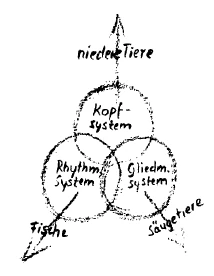
[ 46 ] Geht man also zuerst von der physischen Organisation des Menschen aus, bringt man dem Kinde so die dreifache Gliederung des Menschen in einfacher Weise bei, und geht man die Tiere durch, zeigt man, wie die Tiere einseitig nach irgendeiner Richtung dasjenige entwickeln, was beim Menschen in ein Ganzes harmonisch eingegliedert ist: dann kann man finden, wie gewisse Tiere die Brustorgane einseitig entwickeln, andere die Darmorgane einseitig entwickeln, andere die oberen Verdauungsorgane einseitig entwickeln und so weiter; wie bei manchen Tieren, etwa bei den Vögeln, Umgestaltungen gewisser Organe da sind, sogar der Verdauungsorgane in der Kropfbildung der Vögel und dergleichen. Man kann jede Tierart als die einseitige Ausbildung eines menschlichen Organsystems auf diese Weise hinstellen; die ganze Tierwelt als die fächerartige Ausbreitung des Menschenwesens über die Erde; den Menschen als die Zusammenfassung der ganzen Tierwelt.
[ 46 ] If, then, one begins with the physical organization of the human being, one can teach the child the threefold structure of the human being in a simple way; and if one goes through the animals, one can show how animals develop, in a one-sided manner toward some particular direction, that which in humans is harmoniously integrated into a whole: then one can observe how certain animals develop their thoracic organs in a one-sided manner, others develop their intestinal organs in a one-sided manner, others develop their upper digestive organs in a one-sided manner, and so on; how in some animals, such as birds, there are transformations of certain organs—even of the digestive organs, as seen in the formation of the crop in birds and the like. In this way, one can view every animal species as the one-sided development of a human organ system; the entire animal kingdom as the fan-like spread of the human being across the earth; and the human being as the synthesis of the entire animal kingdom.
[ 47 ] Bringt man das zustande, versteht das Kind die Tierwelt als den Menschen, der seine einzelnen Organsysteme einseitig ausgebildet hat — das eine Organsystem lebt als diese Tierart, das andere Organsystem als die andere Tierart —, dann kann man, wenn sich das zwölfte Lebensjahr naht, wieder heraufkommen zum Menschen. Denn dann wird das Kind wie selbstverständlich begreifen, wie der Mensch gerade dadurch, daß er seinen Geist in sich trägt, eine symptomatische Einheit, eine künstlerische Zusammenfassung, eine künstlerische Ausgestaltung der einzelnen Menschenfragmente ist, welche die Tiere, die in der Welt verbreitet sind, darstellen. Eine solche künstlerische Zusammenfassung ist der Mensch dadurch, daß er seinen Geist in sich trägt. Dadurch harmonisiert er gegenseitig zu einem Ganzen die niedere Tierorganisation, die erkompliziert umbildet zur Kopforganisation, entsprechend eingliedert in die Brustorganisation, die er entsprechend ausbildet, damit sie zu den anderen Teilen der Organe paßt; er trägt also auch dasjenige, was in der Fischorganisation ist, in sich, und er trägt dasjenige in sich, was in der höheren Tierorganisation ist, aber harmonisch einem Ganzen eingeordnet. Der Mensch stellt sich heraus als die durch den Geist aus einzelnen Fragmenten, die als Tiere über die Welt zerstreut sind, zusammengefaßte totale Wesenheit. Dadurch wird die Tierwelt an den Menschen herangebracht, der Mensch aber zu gleicher Zeit als Geistträger über die Tierwelt erhöht.
[ 47 ] If this is achieved—that is, if the child comes to understand the animal world as a human being who has developed his or her individual organ systems in a one-sided manner—with one organ system living as one animal species and another as another—then, as the twelfth year of life approaches, the child can return to the human being. For then the child will grasp as a matter of course how the human being, precisely because he carries his spirit within himself, is a symptomatic unity, an artistic synthesis, an artistic embodiment of the individual human fragments represented by the animals scattered throughout the world. The human being is such an artistic synthesis precisely because he carries his spirit within himself. Through this, he harmonizes the lower animal organization into a whole, transforming it into the head organization in a complex manner, integrating it appropriately into the chest organization, which he develops accordingly so that it fits with the other parts of the organs; he thus also carries within himself that which is found in the fish organization, and he carries within himself that which is found in the higher animal organization, but harmoniously arranged into a whole. Human beings turn out to be the total entity brought together by the spirit from individual fragments scattered throughout the world as animals. Through this, the animal world is brought closer to human beings, while human beings are simultaneously elevated above the animal world as bearers of the spirit.
[ 48 ] Gibt man einen solchen Unterricht, dann wird man sehen, wenn man unbefangene Menschenerkenntnis hat, daß geradeso wie ein solcher Pflanzenkunde-Unterricht auf die lebendige Begriffswelt wirkt und den Menschen in der rechten Weise durch Klugheit in die Welt hineinstellt, durch Klugheit ihn tüchtig macht, so daß er sich mit seinen Begriffen lebendig durch das Leben findet; daß er dadurch, daß er aufnimmt eine solche belebte Anschauung über seine Stellung zur gesamten Tierwelt, besonders seinen Willen kräftigt.
[ 48 ] If one teaches in this way, one will see—provided one has an unbiased understanding of human nature—that just as such a course in botany influences the living world of concepts and places the human being in the world in the right way through wisdom, making him capable through wisdom so that he finds his way through life with his concepts in a living way; that by taking in such a vibrant perspective on their place within the entire animal kingdom, they particularly strengthen their will.
[ 49 ] Man muß nur bedenken, daß man ja das, was ich jetzt in zwanzig Minuten zu erörtern habe, durch längere Zeit erörtern wird, daß das von Stufe zu Stufe geht, daß man das Kind allmählich gewöhnt, seine ganze Wesenheit zu vereinigen mit solchen Vorstellungen. Und dadurch saugen sich diese Vorstellungen hinein in die willensgemäße Stellung, die sich der Mensch auf Erden gibt. Der Mensch wird innerlich dem Willen nach stark, wenn er in dieser Weise in seiner eigenen Erkenntnis sich hervorwachsen sieht aus dem Zusammenfließen aller tierischen Fragmente durch den lebendigen Geist, der diese Synthese bewirkt. Das geht über in die Willensbildung der Seele.
[ 49 ] One need only consider that what I now have to discuss in twenty minutes will be discussed over a longer period of time, that this proceeds step by step, and that the child is gradually accustomed to uniting its entire being with such mental images. And through this, these mental images become ingrained in the volitional stance that a person assumes on Earth. A person becomes inwardly strong in the will when, in this way, they see themselves growing in their own understanding out of the convergence of all animal fragments through the living spirit that brings about this synthesis. This transitions into the formation of the soul’s will.
[ 50 ] Und so wirken wir in einem Unterrichte nicht nur dahin, daß wir dem Menschen Kenntnisse beibringen über die Pflanzen, Kenntnisse beibringen über die Tiere, sondern wir wirken durch unseren Unterricht auf die Charakterbildung, auf die Bildung des ganzen Menschen: indem wir den Menschen heranführen an die Pflanzen und so seine Klugheit in gerechter Weise ausbilden, indem wir den Menschen heranbringen an die Tierwelt und dadurch seinen Willen in gerechter Weise ausbilden.
[ 50 ] And so, in our lessons, we do not merely aim to impart knowledge about plants to people, teach them about animals, but through our teaching we also work toward character development and the formation of the whole person: by introducing people to plants and thereby developing their intelligence in a balanced way, and by introducing them to the animal world and thereby developing their will in a balanced way.
[ 51 ] Dann haben wir es erreicht zwischen dem neunten und zwölften Jahre, daß wir den Menschen mit den anderen Geschöpfen, den Pflanzen und den Tieren der Erde, so in Zusammenhang gebracht haben, daß er in der richtigen Weise durch Klugheit, durch eine gerechte Klugheit, und auf der anderen Seite durch eine entsprechende, ihm seine Stellung in der Welt für sein eigenes Bewußtsein sichernde Willensstärke seinen Weg durch die Welt findet.
[ 51 ] Then, between the ages of nine and twelve, we have succeeded in placing human beings in such a relationship with the other creatures—the plants and animals of the earth—that they find their way through the world in the right way: through wisdom—a just wisdom—and, on the other hand, through a corresponding strength of will that secures their place in the world for their own consciousness.
[ 52 ] Und das sollen wir vor allem durch die Erziehung bewirken: den jungen Menschen sich so entwickeln zu lassen, daß er nach diesen beiden Seiten hin seinen Weg durch die Welt findet. Aus dem Fühlen, das wir entwickelt haben vom siebenten bis zum neunten oder neuneinhalbten Jahre, haben wir herausentwickelt Klugheit und Willensstärke. Und so kommen in der richtigen Weise, was sonst oftmals in ganz unorganischer Weise im Menschen entwickelt wird, Denken, Fühlen und Wollen in das richtige Verhältnis. Im Fühlen wurzelt alles andere. Das muß auch beim Kinde zuerst ergriffen werden, und aus dem Fühlen entwickeln wir im Zusammenhange mit der Welt das Denken an dem, was das Denken niemals tot sein läßt: an der Pflanzenwelt; den Willen an dem, was den Menschen, wenn er richtig betrachtet wird, mit dem Tiere richtig zusammenbringt, aber ihn auch über das Tier erhöht: durch die Tierkunde die Ausbildung des Willens.
[ 52 ] And we are to achieve this above all through education: to allow young people to develop in such a way that they find their way through the world in accordance with these two aspects. From the feeling we developed between the ages of seven and nine or nine and a half, we have cultivated intelligence and strength of will. And so, in the right way—unlike how these qualities are often developed in a completely disorganized manner in human beings—thinking, feeling, and willing come into the proper balance. Everything else is rooted in feeling. This must also be grasped first in the child, and from feeling we develop, in connection with the world, thinking about that which never allows thinking to die: the plant world; and will through that which, when properly considered, truly unites human beings with animals but also elevates them above animals: the development of the will through the study of animals.
[ 53 ] So geben wir dem Menschen die richtige Klugheit und den starken Willen ins Leben mit. Und das sollen wir; denn dadurch wird er ein ganzer Mensch, und darauf hat es vor allen Dingen die Erziehung anzulegen.
[ 53 ] In this way, we equip people with sound judgment and a strong will for life. And that is what we should do; for in this way they become well-rounded individuals, and this is the primary goal of education.