

Contemporary Intellectual Life and Education
GA 307
13 August 1923, Ilkley
Translated by Steiner Online Library
Ninth Lecture
[ 1 ] In my recent lectures, I have discussed how, when a child reaches school age—that is, during the transition to permanent teeth—artistic and visual arts education is the right approach. Today I would simply like to add a few supplementary remarks to the general points made there, specifically to show how such instruction—as characterized the day before yesterday—engages the child’s emotional life, so that it primarily influences the child’s emotional life and develops everything from within that emotional life.
[ 2 ] Let us consider, through a few characteristic examples, how writing can be developed from painting and artistic drawing. I have already said that, in an organic, nature-based approach to education, writing must precede learning to read, for the reason that writing engages the whole person more than reading does.
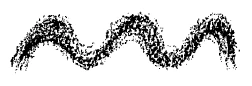
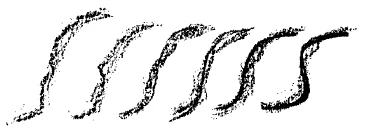
[ 3 ] Writing is performed through the movement of a single organ, but in essence, the whole person must be engaged in the process. Reading, on the other hand, involves only the head and the intellect, and in organic education, one should always draw from the whole person whatever needs to be developed. Let us suppose, then, that we have helped the children gain a mental image of flowing water. The child has now learned to visualize flowing water. Let us assume we have reached the point where we have taught the child something about visualizing flowing water that creates ripples (it is drawn in color). We want to work toward the child now learning to pay attention to the initial sound, the first letter of the word “wave.” We specifically try to focus on the initial sound—the pronunciation of the first letter—of characteristic words. We teach the child how this line emerges, as it were, on the surface of the water as it forms waves. And we guide the child from drawing this line along the waves of the flowing water to the artistic rendering of what results from it: W.
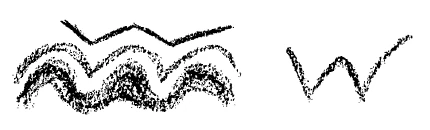
[ 4 ] And in this way, the child is guided to begin writing the letter W by tracing the line of the wave in the picture. — In this way, the letter to be written is derived from the child’s visual representation of what the child brings into the picture.
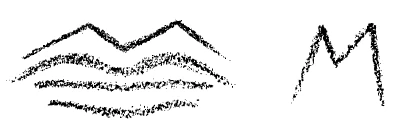
[ 5 ] Or let’s say we guide the child to make a drawing something like this, so that it depicts the human mouth in this way. We encourage the child to capture and emphasize this feature of the mouth, and from there lead the child to sense the initial letter of the word “mouth.” — I have already hinted at one of our evening sessions how one can now guide the child to draw a fish. One then guides the child to capture the basic shape and, from there, helps the child sense the initial sound of the word “fish.” In this way, one will be able to derive a number of letters; others will have to be drawn out of the child’s drawing in a different way. Let’s say, for example, that one teaches the child in some vivid way how the rushing wind moves. For young children, this method will be more effective than others; of course, things can be done in a wide variety of ways. You teach the child about the rushing of the wind. Now you have the child imitate the whooshing of the wind and in this way obtain this shape. In short, by attempting to capture either sharply contoured objects, movements, or even actions in the act of drawing, it is possible to develop almost all consonants in this way.
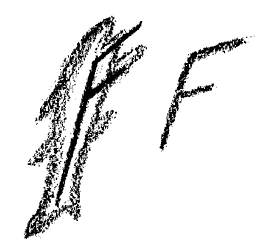
[ 6 ] When it comes to vowels, we must turn to sign language, because vowels stem from the revelation of the human inner self. Essentially, the vowel “A,” for example, is always a kind of wonder and amazement.
[ 7 ] This is where eurythmy will be of particular help. For in eurythmy, the gestures that correspond precisely to these feelings are provided. And one will certainly be able to develop the I, the A, and so on from the corresponding eurythmy gestures. Vowels must be developed from the gestures that, arising from human vitality, accompany the emotions. |
[ 8 ] In this way, one can arrive at the abstract nature of writing from the very concrete nature of drawing-like painting and painting-like drawing; and one achieves this precisely because the child has always started from a feeling in the image and has been able to connect the letter with the emotional essence of that feeling, so that the entire principle of writing arises from the emotional life of the human soul.
[ 9 ] When we then move on to reading, there is really nothing else to do but to help the child recognize with the mind what it has learned to accomplish through the entire body. Thus, reading is the recognition of an activity that one has carried out oneself. This is of immense importance. It undermines the entire process of human development when a person is led directly to the abstract, when they learn to perform an activity through a concept. In contrast, it always leads to healthy human development when the activity is stimulated first, and the concept is then developed out of that activity.
[ 10 ] Reading is very much a matter of life; therefore, it should be developed as the second step, not the first. Otherwise, the child is led far too early into a kind of intellectual development rather than a fully human development.
[ 11 ] So you see how all instruction can, in essence, be directed toward the sphere of the whole human being, toward the artistic sphere. And all other instruction up to about the age of nine and a half must also aim toward this. Everything must be directed toward the image, toward rhythm, toward meter. Everything else is premature.
[ 12 ] Therefore, it is also completely impossible to teach a child anything before this age that makes a clear distinction between the human being itself and the outside world. The child only begins to distinguish itself from the outside world between the ages of nine and ten. Therefore, the point is that when a child enters school, all external things must be transformed into a kind of living being for the child; that is, we do not speak of plants, but rather of plants as living beings that speak to us, that speak to one another; that all observation of nature and all observation of humanity is, in essence, cast into the imagination. The plants speak, the trees speak, the clouds speak. And at this age, the child should not actually feel any distinction between itself and the world. The feeling must be artistically evoked within the child that it can speak itself, and that the objects around it can also speak.
[ 13 ] The more we succeed in helping the child become one with their entire surroundings, the more we are able to speak of everything—plants, animals, stones—in such a way that a speaking, weaving, spiritual presence wafts toward the child from all around, the more we meet what the child, at this age, actually demands of us from the very depths of their being, and we then raise the child in such a way that, precisely during the years when the emotional life is to transition into respiration and blood circulation—into the formation of the vessels—and into the entire human organism, the emotional life is in fact addressed in a way that is appropriate for our time, so that the child develops strongly, both internally and organically, in terms of emotion, in a natural manner.
[ 14 ] It is an immense blessing when we develop writing in such an emotional way and then gently allow the intellect to come into play by recognizing what we have written as we read it. That is when the intellect gently makes itself heard. This is the best way to guide a child up to the age of nine.
[ 15 ] So we must say: between the ages of seven and nine or nine and a half, all instruction must above all be given in such a way that it appeals to the child’s emotional life, so that the child truly internalizes all the forms of the letters on an emotional level. This has an immensely significant impact on the child’s life. For it over-strengthens the child—making the child’s system of bones, tendons, and cartilage, so to speak, too strong in relation to the rest of the organism—if we teach the child to write mechanically, if we teach the child a certain way of drawing the lines for the letters, thereby appealing to the body’s mechanics rather than also appealing to the eye.
[ 16 ] When one appeals to the eye—which is connected to the moving hand—by carving out the letters from the artistic form, the letter is not merely produced mechanically by the movement of the hand, but is produced in such a way that the eye rests with pleasure upon the result of its own activity. In this way, the spiritual aspect is properly engaged for the individual; in this way, the emotional life is developed in the right way at the stage of life when it can flow most effectively into the physical organism, bringing healing.
[ 17 ] What would you say, my esteemed audience, if someone who had been served fish were to carefully set aside the fish meat, pick out the bones, and eat them! You would probably be terribly afraid that such a person might choke on the fish bones. Furthermore, he would not be able to properly assimilate these fish bones into his body.
[ 18 ] But that is exactly how it is—only on a different level, the level of spiritual instruction—when we teach a child dry, abstract, and sober concepts instead of vivid images, instead of what engages the whole person. These dry, abstract, and sober concepts need only be there to, so to speak, support what takes shape as imagery in the human soul.
[ 19 ] Now, when we educate in the way I have just described—by developing everything from the pictorial—we are in fact guiding the child in such a way that it is able to always have flexible concepts, not rigid ones. And through this, we will be able to observe that once the child has passed the age of nine or nine and a half, it can now be guided in a beautifully organic way into understanding the world, whereby it must already distinguish itself from the things and events of the world. After we have told the child about plants as if they were speaking beings for a sufficiently long time—so that the child has lived in images by observing the plant world—we can then teach the child what a person learns best from the plant world when they begin between the ages of nine and ten and are gradually guided toward it in their tenth and eleventh years.
[ 20 ] Here, too, the human organism is ready to engage with the plant world on an inner, conceptual level. However, for a vibrant form of children’s education that truly fosters human development, botany must take on a completely different form than what we often bring into schools today as “botany,” simply because that is how we ourselves learned it. In reality, it has no significance whatsoever for human life—at most a conventional one—whether one has been presented with this plant or that plant and so on, and has then been taught the names, the number of stamens, and the color of the petals for these plants.
[ 21 ] Everything presented to the child in this way remains foreign to the child. The child feels only the compulsion to have to learn it. And anyone who teaches botany to a child in the tenth or eleventh year in this way actually knows nothing about the true interrelationships of nature. To view a plant in isolation, to pack it into a botanical collection box, and then to take it out at home and view it in isolation—this is nothing other than plucking a hair, placing it on a piece of paper, and viewing the hair in isolation. A hair on its own is nothing; a hair on its own cannot come into being; a hair on its own has no meaning—it has meaning only insofar as it grows, alive, on a person’s head or on an animal’s skin. It has a living meaning only within its context. In the same way, the plant, too, has a living meaning only in connection with the earth and with the forces of the sun—and, as I will explain shortly, with other forces as well. Thus, we should never view a plant—especially for children—other than in connection with the earth and in connection with the forces of the sun.
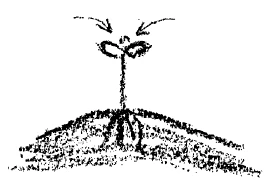
[ 22 ] Here I can only outline what can be taught to a child in a vivid, visual way over the course of a few hours. The aim must be to teach the child the following: Here is the Earth (see drawing). The root of the plant is intimately connected to the earth and belongs to it. Never should any mental image be suggested other than the one true, living image that the earth and the root belong together. And never should any mental image be suggested other than that the flower is brought forth on the plant by the sun and its rays. In this way, the child is vividly transported into the universe.
[ 23 ] A teacher who possesses sufficient inner vitality can best convey to the child—precisely at this age I am now speaking of—the plant’s vivid sense of being immersed in the universe. They can first help the child to literally feel how the earth, with its substances, permeates the root, how the root breaks free from the earth, and how, once the root has driven the shoot upward, the shoot is born from the earth; how light and warmth from the sun unfold toward the leaf and the flower; how the sun draws the flower toward itself; and how the earth takes hold of the root.
[ 24 ] Then one vividly draws the child’s attention to how moist soil—that is, soil that is watery at its core—affects the root differently than dry soil; how dry soil causes the root to wither, while moist soil makes the root itself succulent and full of life.
[ 25 ] One draws the child’s attention to how the sun’s rays, falling vertically onto the earth, bring forth the yellow dandelion blossoms from the plant, or the blossoms of the buttercups and the like, or even the rose blossoms; but how the obliquely falling sunbeam, which, as it were, sweeps across the plants, brings forth the dark, violet autumn crocus. And in this way, one establishes a living connection everywhere between the root and the earth, and between the leaf and the flower and the sun.
[ 26 ] And then, when we place the child’s mental image into the cosmos in this living way, we will also be able to teach the child how, up above, the entire plant grows and contracts into the ovary, and how the new plant emerges from it.
[ 27 ] And now—if I may anticipate the future a bit—we will have to develop a truth, tailored specifically for childhood, which we are still somewhat embarrassed to voice in public life today because it is regarded as superstition, as fantasy, as something mystically nebulous. But just as the sun brings out the flower’s colors, so do the forces of the moon draw the ovary—which is contracting once again—out of the plant. It is the power of the moon that draws the ovary out of the plant once more.
[ 28 ] And so one places the plant, alive, within the influence of the earth, the sun, and the moon. However, the influence of the moon must still be left out today; for if the children were to come home and say that they had learned the ovary has something to do with the moon, then perhaps—even if the parents were already inclined to accept this from their children—if a naturalist happened to be visiting, he would immediately have the opportunity to persuade the parents to take the child out of that school right away! So we must still hold back on that today, just as we must, of course, hold back on many things when it comes to important matters, taking into account our thoroughly alienated civilization. But I would like to demonstrate precisely in this radical way how one must develop living concepts—concepts that are not derived from something that, in essence, does not exist on its own—for the plant does not exist on its own; without the sun and without the earth, it is nothing—but rather how one must derive this concept from true reality. That is what is at stake.
[ 29 ] Now one must teach the child—and here it will be easier to proceed in this way—how, when there is earth here (see drawing), the earth begins to grow upward, forming a mound. But this mound is permeated by the forces of the air and, indeed, by the forces of the sun. It is no longer just earth. It becomes something that stands between the lush plant leaf and, ultimately, the plant root and the dry earth in the middle: it becomes a tree trunk. And it is on this fully grown plant that the individual plants—which are the branches of the tree—now begin to grow. In this way, one comes to understand how the tree trunk is, in fact, earth that has sprouted.
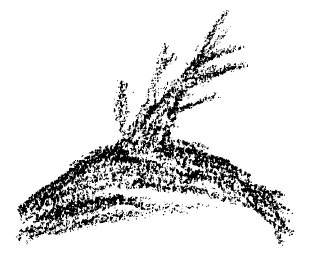
[ 30 ] This also gives one an idea of how intimately connected that which passes into the wood is with the earth itself. And so that the child can understand this well, one points out how wood decays, becoming more and more like earth until it finally crumbles into dust—already quite similar to the earth itself—and how, fundamentally, all the sand and rock of the earth have arisen in this way from what was actually meant to become a plant, how the earth is, in essence, a great plant, a giant tree, and all individual plants grow on it as branches. One can now convey to the child the concept that the Earth as a whole is actually a living being, and that plants belong to the Earth.
[ 31 ] It is extremely important that, in this way, the child does not come to understand the convoluted concepts of our geology and geognosy, as if the Earth consisted only of rock and only the forces of rock belonged to the Earth, whereas the forces of plant growth belong to the Earth just as much as the forces of rock. And most importantly: one does not speak of rock in and of itself at first. And one will notice that the child is very curious in many respects. But if one teaches the child, in this context, to view the entire plant cover as something that belongs to the Earth—vividly, as if emerging from the Earth and drawn forth by the sun—then the child will not become curious about what the stones are in and of themselves. They are not yet interested in the mineral realm. And it is a great blessing if, up until the age of eleven or twelve, the child is not interested in the lifeless mineral realm, but instead forms a mental image that the Earth is a whole living being—in a sense, merely a tree already in the process of crumbling, which produces all plants as branches. And you see, in this way one gains an exceptionally good opportunity to move on to the individual plants as well.
[ 32 ] For example, I say to the child: Well, in a plant like this (see drawing), the root seeks out the soil, and the flower is drawn out by the sun. - Now suppose the root, which wants to grow on the plant, cannot quite find the soil; it finds only stunted soil, and as a result, the sun does not bother to bring forth the flower. Then you have a plant that cannot quite find the soil, does not develop a proper root, but also does not produce a proper flower: you have a fungus.
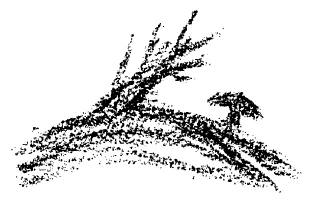
[ 33 ] And then one guides the child to understand what happens when that which, if it does not find the right soil, develops into a fungus—when it can take root in something where the soil has already become a little like a plant—when, instead of having to take root in the ground, it can take root in the mound that has become plant-like, in the tree trunk: there it becomes tree lichen; there it becomes that gray-green lichen found on the surface of trees—a parasite.
[ 34 ] In this way, one gains the opportunity to draw from the living activity and interplay of the Earth that which is expressed in all individual plants. By introducing the child so vividly to plant growth in this way, one develops in the child, through botany—through the study of plants—an understanding of the face of the Earth.
[ 35 ] The face of the earth is different where there are yellow, sprouting plants; the face of the earth is different where there are stunted plants. And from botany, one finds the transition to something else that becomes extraordinarily significant for the child’s development when it is drawn directly from botany: geography. Teaching children about the face of the Earth should be done in such a way that one draws out the way the Earth seeks to act on its surface from the way it brings forth plants on a particular surface.
[ 36 ] In this way, one develops a living intellect in the child rather than a dead one. And the period between the ages of nine and ten and eleven and twelve is the very best time for the development of this living intellect. By introducing the child in this way to the living interplay and life of the earth—which, from its inner vital force, brings forth plants of various forms—one teaches the child living concepts instead of dead ones, concepts that possess the same quality as a human limb. When one is still a very young child, a human limb must grow. We must not force the hand into an iron glove; it would not be able to grow. But the concepts we teach children should have as sharp contours as possible; they should be definitions, and the child should always be defining. The worst thing we can teach a child are definitions—sharply defined concepts—because they do not grow; but human beings grow along with their organic nature. The child must have flexible concepts that continually change their form as the child matures. When we reach the age of forty, we should not have to recall, upon encountering any concept that arises, what we learned at the age of ten; rather, the concept must have changed within us, just as our limbs and our entire organism have also changed organically.
[ 37 ] However, one can only acquire living concepts by not presenting the child with what is called “science”—which today is mostly characterized by the fact that it teaches us nothing, this dead science that one simply has to learn—but rather by introducing the child directly to the living aspects of the natural world. In this way, the child acquires flexible concepts, and its soul will be able to grow within a body that grows just as nature does. Then one will not offer what education so often offers: transplanting into a body that grows naturally a soul that cannot grow, but is dead. It is only suitable for human development if, within the living, growing physical organism, there is also a living, growing soul—a living, growing soul life.
[ 38 ] But this must be brought about in this way, and it can best be achieved when all plant life is viewed in close connection with the structure of the earth—that is, when earth life and plant life are presented to the child as a unity, when knowledge of the earth is knowledge of plants, and when the child first recognizes the inanimate by the fact that the tree decays and turns to dust—that is, when the child first comes to know the inanimate as the remnant of the living. We must by no means teach the child knowledge of minerals at this age of which I am now speaking, but rather concepts and ideas of the living. That is what matters.
[ 39 ] Just as one should relate the plant world to the Earth when teaching a child—so that, in a sense, the plant world appears as something that grows outward from the living Earth organism as its ultimate result—so, in turn, one should bring the entire animal world to the child as a unified whole. And in this way, the child is placed vividly within nature, within the world. The child learns to understand how the Earth’s carpet of plants belongs to the Earth as an organism. But on the other hand, the child also learns to understand how all the animal species spread across the Earth are, in a certain sense, the path to human development. Plants connected to the Earth, animals brought closer to human beings—this must become a guiding principle of education. I can only justify this in principle. The point is that, with a truly artistic sensibility for the details of instruction, the ten-, eleven-, and twelve-year-old child should then be taught about the animal world in detail.
[ 40 ] Let’s take a look at human beings. We want—albeit in a very simple, perhaps primitive way—to present human existence to the child’s inner eye, and this can be done if one has prepared the child artistically in the manner described. Then the child will learn—albeit in a primitive way—to distinguish how the human being is structured into a threefold organization. We consider the head organization, in which the soft parts are essentially on the inside, and a hard shell grows around them—particularly around the nervous system—so that the head organization in a certain way mirrors the spherical Earth as it stands within the cosmos; how this head organization essentially encloses the soft inner part, especially toward the brain, and is enclosed by the hard outer shell. We will guide the child as vividly and artistically as possible, using every means at our disposal, toward an understanding of the head organization, and we will then attempt to guide the child in the same way toward the second aspect of the human being—toward everything connected with the human rhythmic system, which encompasses the respiratory organs and the circulatory organs, including the heart. Roughly speaking, one will introduce the child to the organization of the chest; just as one has artistically and vividly examined the shell-like skull bones that enclose the soft tissues of the brain, one will now artistically examine the vertebrae of the spine, which are arranged one after another, and to which the ribs are connected. We will examine the entire thoracic organization—including the respiratory and circulatory systems; in short, the rhythmic essence of the human being—in its unique character, and then move on to the third component of the human organization: the metabolic-limb organization. The limbs, as organs of movement, essentially sustain metabolism by regulating combustion through their movement. They are interconnected with metabolism. The limb-metabolic system is a unified whole.
[ 41 ] So we begin by dividing the human being into these three parts. And if, as a teacher, one possesses the necessary artistic sensibility and uses visual methods, it is certainly possible to teach this concept of the threefold human being to children from an early age.
[ 42 ] Now the child’s attention is directed toward the various species of animals found on Earth. First, one introduces the child to the lower animals, particularly those that have soft internal parts and a shell-like exterior—the shelled animals—and to the lower animals that consist essentially only of a skin enveloping the protoplasm; and one will be able to teach the child that it is precisely these lower animals that bear the primitive form of the human organism.
[ 43 ] The human head is the most highly developed of the lower animals. When we consider the human head—specifically its nervous system—we must not look to mammals or apes, but rather go back all the way to the lowest forms of animal life. We must also go back in the history of the Earth to the earliest geological formations, where we find animals that are, in a sense, nothing more than a simple head. And so we must help children understand the lower animal kingdom as a primitive head organization. We must then help children understand the somewhat higher animals—those grouped around the class of fish, which have particularly well-developed spines—the “middle animals”—as beings that have, in fact, only strongly developed the rhythmic aspect of the human being, while the other aspects have atrophied. Thus, when we consider the human head, we find the corresponding organization at a primitive level in the animal kingdom among the lowest animals; when we consider the human chest organization, we find the animal species grouped around the class of fish as those that outwardly reveal the rhythmic organization in a one-sided manner. And when we turn to the metabolic-limb organization, we ascend to the higher animals. Higher animals develop their locomotive organs in the most diverse ways. How wonderful it is to have the opportunity to observe, with an artistic sensibility, the locomotive mechanism in the horse’s hoof, in the lion’s clawed paw, and in the foot of a marsh animal, which is more highly developed for wading. What opportunities we have to observe, from the perspective of human limbs, the one-sided development of the ape’s foot. In short, as we move up to the higher animals, we begin to understand the entire animal through its distinctive structure and the sculptural design of its locomotive organs—or even its metabolic organs. Predatory species differ from ruminant species in that, in ruminants, the intestinal system in particular is developed to be very long, whereas in predatory species the intestine is short; in contrast, everything related to the heart and blood circulation that contributes to digestion is developed to be particularly strong and robust.
[ 44 ] And when we consider the higher animals in particular, we can see how one-sidedly this higher animal organization reflects what is developed in humans in the metabolic-limb organization. To illustrate this, we can describe how, in animals, the head organization is actually only the front part of the spine. After all, the entire digestive system in animals is integrated into the head structure. In animals, the head is essentially part of the digestive organs—the stomach and intestines. In animals, one can really only consider the head in connection with the stomach and intestines. Humans, however, place precisely that which—one might say—has remained “virginal,” consisting merely of soft tissues enclosed by a shell, upon this metabolic-limb organization that animals still carry in their heads, thereby elevating the human head organization above the animal’s head organization, which is merely a continuation of the metabolic-limb system; whereas, with his head organization, the human being returns to what the organization itself provides in the simplest way: soft tissues enclosed by bony structures, by bony skeletons. One can vividly illustrate how the jaw organization of certain animals is, in essence, best understood by viewing the jaw, lower jaw, and upper jaw as the foremost limbs. This is the best way to gain a vivid understanding of the animal’s head.
[ 45 ] In this way, we see the human being as a synthesis of three systems: the head system, the chest system, and the limb-metabolic system; the animal kingdom as a one-sided development of either one system or the other. Lower animals, such as shellfish, thus correspond to the head system; the others, however, can also be viewed in a certain way through this lens. Then there are the limb-bearing animals: mammals, birds, and so on. Chest animals, which have developed the chest system to a greater degree: fish, and creatures similar to fish, such as reptiles, and so on. One perceives the animal kingdom as humanity laid out in sections, as humanity spread out across the earth in fan-shaped segments. Just as one brings plants together with the earth, one brings the fan-shaped spread of the world’s animal species together with humanity, which is, in fact, the synthesis of the entire animal kingdom.
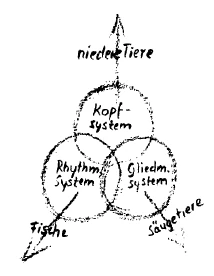
[ 46 ] If, then, one begins with the physical organization of the human being, one can teach the child the threefold structure of the human being in a simple way; and if one goes through the animals, one can show how animals develop, in a one-sided manner toward some particular direction, that which in humans is harmoniously integrated into a whole: then one can observe how certain animals develop their thoracic organs in a one-sided manner, others develop their intestinal organs in a one-sided manner, others develop their upper digestive organs in a one-sided manner, and so on; how in some animals, such as birds, there are transformations of certain organs—even of the digestive organs, as seen in the formation of the crop in birds and the like. In this way, one can view every animal species as the one-sided development of a human organ system; the entire animal kingdom as the fan-like spread of the human being across the earth; and the human being as the synthesis of the entire animal kingdom.
[ 47 ] If this is achieved—that is, if the child comes to understand the animal world as a human being who has developed his or her individual organ systems in a one-sided manner—with one organ system living as one animal species and another as another—then, as the twelfth year of life approaches, the child can return to the human being. For then the child will grasp as a matter of course how the human being, precisely because he carries his spirit within himself, is a symptomatic unity, an artistic synthesis, an artistic embodiment of the individual human fragments represented by the animals scattered throughout the world. The human being is such an artistic synthesis precisely because he carries his spirit within himself. Through this, he harmonizes the lower animal organization into a whole, transforming it into the head organization in a complex manner, integrating it appropriately into the chest organization, which he develops accordingly so that it fits with the other parts of the organs; he thus also carries within himself that which is found in the fish organization, and he carries within himself that which is found in the higher animal organization, but harmoniously arranged into a whole. Human beings turn out to be the total entity brought together by the spirit from individual fragments scattered throughout the world as animals. Through this, the animal world is brought closer to human beings, while human beings are simultaneously elevated above the animal world as bearers of the spirit.
[ 48 ] If one teaches in this way, one will see—provided one has an unbiased understanding of human nature—that just as such a course in botany influences the living world of concepts and places the human being in the world in the right way through wisdom, making him capable through wisdom so that he finds his way through life with his concepts in a living way; that by taking in such a vibrant perspective on their place within the entire animal kingdom, they particularly strengthen their will.
[ 49 ] One need only consider that what I now have to discuss in twenty minutes will be discussed over a longer period of time, that this proceeds step by step, and that the child is gradually accustomed to uniting its entire being with such mental images. And through this, these mental images become ingrained in the volitional stance that a person assumes on Earth. A person becomes inwardly strong in the will when, in this way, they see themselves growing in their own understanding out of the convergence of all animal fragments through the living spirit that brings about this synthesis. This transitions into the formation of the soul’s will.
[ 50 ] And so, in our lessons, we do not merely aim to impart knowledge about plants to people, teach them about animals, but through our teaching we also work toward character development and the formation of the whole person: by introducing people to plants and thereby developing their intelligence in a balanced way, and by introducing them to the animal world and thereby developing their will in a balanced way.
[ 51 ] Then, between the ages of nine and twelve, we have succeeded in placing human beings in such a relationship with the other creatures—the plants and animals of the earth—that they find their way through the world in the right way: through wisdom—a just wisdom—and, on the other hand, through a corresponding strength of will that secures their place in the world for their own consciousness.
[ 52 ] And we are to achieve this above all through education: to allow young people to develop in such a way that they find their way through the world in accordance with these two aspects. From the feeling we developed between the ages of seven and nine or nine and a half, we have cultivated intelligence and strength of will. And so, in the right way—unlike how these qualities are often developed in a completely disorganized manner in human beings—thinking, feeling, and willing come into the proper balance. Everything else is rooted in feeling. This must also be grasped first in the child, and from feeling we develop, in connection with the world, thinking about that which never allows thinking to die: the plant world; and will through that which, when properly considered, truly unites human beings with animals but also elevates them above animals: the development of the will through the study of animals.
[ 53 ] In this way, we equip people with sound judgment and a strong will for life. And that is what we should do; for in this way they become well-rounded individuals, and this is the primary goal of education.