

Contemporary Intellectual Life and Education
GA 307
14 August 1923, Ilkley
Translated by Steiner Online Library
Tenth Lecture
[ 1 ] Calculation, arithmetic, and geometry—that is, mathematics—occupy a special place in teaching and education. As a teacher, one should always know exactly what one is doing in school or with the child in general, and what effect one’s actions have on the child. Only when this prerequisite is met—when the teacher knows the consequences for the child of each action he or she takes—can the lesson truly come alive and foster genuine communication between the teacher’s soul and the child’s.
[ 2 ] Now, human beings are beings composed of body, soul, and spirit, in whom the physical is shaped and formed by the spiritual; thus, the teacher must always know what actually takes place in the soul and in the spirit when the body is shaped, and, conversely, what effect an influence on the spirit or the soul has on the body.
[ 3 ] When we teach a child something that appeals to their pictorial mental image—that is, almost everything we mentioned yesterday as being “pictorial”— or drawing—which then leads to writing—if we teach the child something like botany in the sense we explained yesterday, then this affects the child in such a way that it primarily takes into account what I have already characterized in these lectures as a higher member of the human being: the etheric or formative body.
[ 4 ] Human beings, of course, first and foremost have their physical body. We perceive it through ordinary physical sensory perceptions. But in addition to this physical body, human beings have an inner organization that can only be perceived through imagination, through imaginative cognition: a supersensible body, an etheric body, a body of formative forces. And then the human being has within themselves an organization that can only be perceived through inspiration. As I have said before, one need not take offense at these terms; they are simply terminology that must be used. Through inspiration, one gains insight into the so-called astral body and into the human being’s true “I,” into the human being’s true self.
[ 5 ] The fact is that from birth to death, the etheric or formative body—this first supersensible organization—never separates from the physical body. This does not happen until death. During sleep, a person leaves their etheric or formative body behind with the physical body. The physical body and the etheric body remain in bed while the person sleeps; the astral body and the “I”-organization leave the physical body and the etheric body upon falling asleep and re-enter them upon waking.
[ 6 ] When we teach a child, for example, something in arithmetic or geometry, or in those areas I mentioned yesterday—such as drawing-as-painting and painting-as-drawing—as a transition to writing, this instruction influences both the physical body and the etheric body. And when we teach the etheric body—or the body of formative forces—what I outlined here yesterday, when we teach it something from arithmetic or geometry, it retains this even during sleep; it continues to vibrate even while the child sleeps.
[ 7 ] If, on the other hand, we teach the child something about history or that branch of zoology I spoke of yesterday, it affects only the astral body and the “I” organization. When a person falls asleep, they take this with them from their physical and etheric bodies into the spiritual world.
[ 8 ] So there is a huge difference between teaching writing or botany—which keeps the physical and etheric bodies in bed, while the vibrations continue—and teaching history or anthropology, which the “I” and the astral body take with them into the spiritual world every time we sleep. This makes a tremendous difference in the effect on the human being.
[ 9 ] You must be aware that all the vivid, imaginative impressions I make on the child—even during sleep—tend to become more refined and perfect. In contrast, what we teach the child—for example, in history or social studies—must act upon the child’s actual soul-spiritual organization, and this tends to be forgotten during sleep, to become less perfect, to fade. It is therefore necessary that, when teaching, we take into account whether we are dealing with material that speaks to the etheric body and the physical body, or whether we are dealing with material that speaks to the “I” organization and the astral organization.
[ 10 ] Now, those subjects I mentioned yesterday—botany, and that which leads to writing and reading—all speak to the physical body and the etheric body. We will still need to discuss the teaching of history. We have already provided guidelines for the teaching of zoology and anthropology; which address what emanates from the physical body and the etheric body during sleep. Arithmetic and geometry address both; that is what is remarkable. And so, with regard to instruction and education, arithmetic as well as geometry are, one might say, like a chameleon; through their very nature, they adapt to the whole human being. And while in botany and zoology one must take into account that they, in a certain form—as I characterized it yesterday—fall within a very specific age group, in arithmetic and geometry one must ensure that they are pursued throughout the entire childhood, but adapted accordingly as the child’s age changes and its characteristic qualities evolve.
[ 11 ] In particular, however, we must bear in mind that—yes, this really must be said—the etheric or formative body is something that can manage on its own, even when left alone by our ego and our astral body. Through its own inner vibrational power, the etheric or formative body always tends to perfect and further develop what we teach it on its own. When it comes to the astral body and the “I,” we are foolish. We make what we, as human beings, have been taught in this regard even more imperfect. And so it is indeed true that, on a supersensible level, from the moment we fall asleep until we wake up, our form-forming body continues to perform the calculations we have taught it. We are not at all present in our physical and etheric bodies when we sleep; but they continue to calculate, they continue to draw their geometric figures on a supersensible level, perfecting them. And if we know this and structure the entire curriculum accordingly, we can, through properly designed instruction, bring about an immense vitality in the entire fabric and being of the human being. We need only give this etheric or formative body the opportunity, in an appropriate manner, to further perfect the things we teach it.
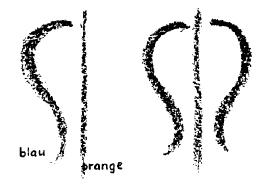
[ 12 ] To this end, it is necessary that, in geometry for example, we not begin with those abstractions, with those intellectual constructs, which people usually assume must be the starting point of geometry; but rather, it is necessary to begin with a form of perception that is not external but internal—to awaken in the child, for example, a strong sense of symmetry,
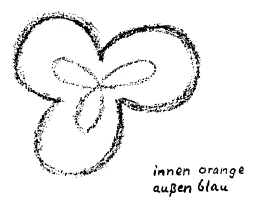
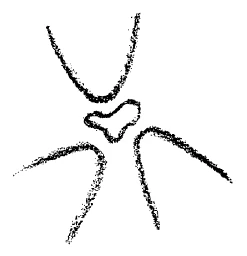
[ 13 ] You can start working on this with even the youngest children. For example: draw any shape (blue) on the board, then draw a line (orange) next to it for the child, and then draw a small part of its symmetrical counterpart, and try to get the child to view this as something incomplete, as something that must first be created in its mental image as finished. Try by every possible means to get the child to complete the figure on their own. In this way, you instill in the child this inner, active urge to finish unfinished things, thereby helping them develop a proper sense of reality within themselves. The teacher must have inventiveness for this, but it is, of course, a good thing for the teacher to possess it: flexible, inventive thinking—that is what the teacher needs. - Once the teacher has conducted such exercises for a while using inventive, flexible thinking, they should move on to others. For example, they should draw a figure like this for the child and try to evoke in the child an inner, three-dimensional mental image of this figure.
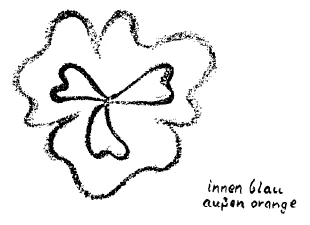
[ 14 ] And then he tries to find the transition by drawing the figure (orange) in such a way that, when the outer shape is varied, the child comes to the conclusion that the inner figure must now also be made to correspond to the outer figure. Here (in the first diagram), the line is simply curved; here, it has been given a bulge. Now try to explain to the child: when drawing the inner figure, in order to bring out the inner symmetry, the child must place an indentation on the inside where there is a bulge on the outside, so that, just as here (in the first diagram) the simple line corresponds to the simple line, here the bulge corresponds to an indentation. — Or try the following:
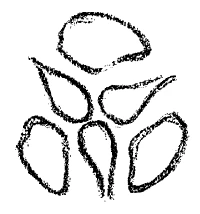
[ 15 ] Try sketching this figure (the inner one) for the child and then adding the corresponding outer line to it, so that the two figures form a harmonious whole. And now try to find a transition from this figure to one in which these outer lines do not converge here, but instead diverge, so that they extend into the indefinite. Now the child gets a mental image of this point wanting to run away from them and of them following it with the lines; they cannot keep up at all, and this point has flown away. They then get a mental image of arranging the corresponding figure in a corresponding way—that, because this ran away, they must now shape this one inward in a special way, and so on. I can only explain the principle here. In short, this method makes it possible for the child to visualize asymmetrical symmetries as well. And in this way, one prepares the etheric body—or body of formative forces—during wakefulness to continue vibrating continuously during sleep, but to perfect within these vibrations what was experienced during wakefulness. Then the person—the child—wakes up in the morning in an innerly and organically animated formative body, and thus also in a physical body. This brings an immense vitality into the person.
[ 16 ] Of course, this can only be achieved by understanding how the form-forming force body works; otherwise, one will always end up fiddling with the child in a mechanical, superficial way.
[ 17 ] A true teacher draws not only on what takes place during waking life, but also on what takes place during sleep. One must be thoroughly aware of the significance of such facts; one must be able to recall how, even as an adult, one has sometimes pondered a problem in the evening: one could not solve it—yet in the morning, the solution comes to one. Why? Because the etheric or formative body has been working on its own throughout the night.
[ 18 ] For some things, waking life is not a state of perfection but a disturbance. We must leave our physical and etheric bodies alone for a while and not let our ego and astral body dull them. This is illustrated by cases—which can indeed occur in real life and have occurred many times—where someone studies and studies in the evening but cannot figure out how to solve a problem. He wakes up in the morning; though he is somewhat restless, he goes to his desk and, lo and behold, he has solved the problem during the night without even being conscious of it!
[ 19 ] These are not fables; these things actually happen and, just like other experiments, have been thoroughly tested. What happened there? The etheric body continued to work through the night; the person didn’t even wake up. Well, that’s abnormal; it’s not something to strive for.
[ 20 ] But the unconscious continuation of the etheric or formative body must be sought not by beginning geometry with triangles and so on—where intellectualism always comes into play—but rather with a concrete conception of space. Arithmetic must then be approached in a similar way.
[ 21 ] You will gain an excellent mental image of how to organize concrete mathematical concepts in this way—as they are applied in arithmetic and geometry—by studying the brochure written by Dr. von Baravalle on the pedagogy of physics and mathematics.
[ 22 ] There you will see, at the same time, an extension of this entire way of thinking to the physical realm. And although it refers mostly to advanced areas of mathematics, once one penetrates its spirit, it will serve as an excellent guide for conducting instruction in this field in a manner consistent with human nature. This little book effectively establishes a starting point for a reform of mathematics and physics education, from early childhood all the way up to the highest levels of instruction. One must now be able to extend what has been said here regarding visual-spatial concepts to the realm of arithmetic. The key point here is that everything which introduces arithmetic—and even counting—to the child in an external manner actually stifles the human constitution. Everything that proceeds from the individual, stringing things together piece by piece, stifles the human constitution. That which proceeds from the whole to the parts—first evoking the mental image of the whole, then that of the parts—enlivens the human organism. This is something that comes into play even when learning to count. We generally learn numbers by focusing on what takes place in the purely external, physical-sensory realm.
[ 23 ] We learn to count by having one; we call that the unit. Then we add two, three, four, and so on; we place one pea next to another, and there is no mental image, no idea at all as to why one is placed next to another, or what actually comes of it. We learn to count by appealing to the arbitrariness of placing things side by side. I am well aware that this arbitrary nature varies in many ways, yet the very thing at issue is still taken into account only to the very slightest degree anywhere today: that one starts from a whole and proceeds to the parts, the elements. The unit is the mental image that must first be formed—even by the child—as a whole. Anything at all, whatever it may be, is a unit. Now, if one is compelled to visualize the concept through drawing, one must draw a line; one can also use an apple to do the same thing I am about to do with the line. There is one, and now one proceeds from the whole to the parts, to the elements, and now one has turned one into two.
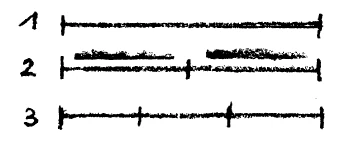
[ 24 ] Unity has remained. Unity has been divided into two. Unity has been “split in two,” and thus the number two has come into being. Now we proceed further; through further subdivision, the number three emerges. Unity always remains as the all-encompassing whole; and so we proceed through the numbers four and five, and at the same time, through other means, we can evoke a mental image of just how far we can hold together the things that relate to numbers. In doing so, we will discover that human beings are, in fact, limited in their perception of the concrete nature of numbers.
[ 25 ] Among certain peoples of modern civilization, the concept of numbers that can be easily grasped actually extends only up to ten; here in England, one can count up to twelve when dealing with money. But that, too, represents the very limit of what can be easily grasped. Then one actually starts over again; one actually begins to count the numbers; first one counts objects up to ten, but then one begins to count the tens: two times ten equals twenty, three times ten equals thirty. One no longer refers to the objects at all, but rather moves on to applying the number itself to the calculation, because the elementary concept already requires the objects themselves to be concrete. And even if modern thinking takes such pride in the fact that we have come so far in counting, while “primitive” peoples are limited to their ten fingers, this pride is not really justified; rather, we count to ten because we feel the joints—the structure of the hands—and perceive the hands and the ten fingers as symmetrical. This perception is thus also brought to the surface, is experienced, and one must bring about in the child the transition from the whole, the unity, to the parts as numbers. Then one will easily be able to find that other transition to counting by adding one thing to another. One can then move on to one, two, three, and so on. So purely additive counting is something that should come only secondarily; for this is an activity that has significance solely here in physical space, whereas the articulation of unity has such inner significance that it continues to resonate in the etheric body even when the person is not present. It is essential to know these things.
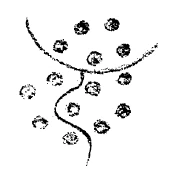
[ 26 ] Likewise, the point is that once we have overcome counting in this way, we do not then proceed in a lifeless, mechanical manner to addition, where we simply line up the addends one after another. Life enters the picture when we start not from the parts of the addition but from the sum; so when we throw down a number of things—let’s say, a number of balls—we’ve reached the point in counting where we can say, “That’s four ten balls.” Now I break this down by continuing with the concept of the part. I have five here, four here, and five again here; so I have broken down the total into five, four, and five. I thus move from the total to the addends, from the whole to the parts, and try to proceed with the child in such a way that I always present the total, as it were, and let the child figure out how the total can be broken down into the individual addends.
[ 27 ] It is therefore extremely important that, just as one does not harness a horse by the tail but by the head when driving it, one should proceed in the same way mentally when calculating; that one actually starts from the sum—which is in fact always present in everything—from the whole: that is the real. Fourteen apples—that is the reality—not the addends; the addends vary in the most diverse ways depending on life circumstances. Thus, one starts from what is always the whole and moves on to the parts. Then one will find one’s way back to ordinary addition.
[ 28 ] But when one proceeds in this way—when one moves from the wholly living to the partial—one has achieved that which underlies calculation, the body of formative forces—which requires living stimulation in order to form—is set into vibrations that it then continues to perfect without us needing to be present with our interfering astral body and the “I” organization.
[ 29 ] Likewise, instruction is enlivened in a very special way when one puts the other types of arithmetic back on their feet—from where they are often kept in the head today—for example, by working toward getting the child to say: “If you have seven, how much do you have to take away to get three?”—not: “What do you get if you take four away from seven?”—but rather the reverse: “If you have seven—that is the real thing—and what you want to get is also the real thing. How much do you have to take away from seven to get three?” — With this form of thinking, one is initially grounded in life, whereas with the other form, one is immersed in abstraction. So that if one proceeds in this manner, one can very easily return to the other.
[ 30 ] In the same way, when multiplying or dividing, one should not ask: “What is the result of dividing ten by two?” — but rather: “How must one divide ten to get five?” — After all, the real is given, and in life, the result should be something that has meaning. There are two children, and ten apples are to be divided among them; each is to receive five: these are the realities. What one must do to achieve this is the abstract element that comes into play. In this way, things are always directly adapted to life. If one succeeds in this, it follows that what we today often do in an additive manner—by merely placing things side by side in a purely external way, thereby having a stifling effect—becomes, precisely in arithmetic instruction, a source of vitality. And it is precisely in this teaching that we must ensure we truly take into account the human subconscious—that is, what influences sleep and what otherwise operates subconsciously even when a person is awake. For a person does not always think of everything, but rather thinks of only a small part of what they have experienced soulfully; the rest, however, is always at work. Let us allow the child’s physical and etheric bodies to continue working in a healthy way. But we can only do this if we truly infuse arithmetic and geometry lessons with excitement, interest, and vitality.
[ 31 ] Recently, someone asked whether it is a good idea to teach in blocks, as is done in Waldorf schools. When done correctly, teaching in blocks is precisely what proves to be most fruitful. Block-style instruction means: I do not structure the schedule so that one subject constantly interferes with another—for example, arithmetic from 8 to 9 a.m., history or religion or whatever else fits from 9 to 10 a.m., or whatever the teacher happens to fit into the schedule; rather, I set aside three, four, or five weeks during which the main lesson in a single subject is taught for two hours each morning. The same subject is always covered. Then, for five to six weeks, the main instruction focuses on something that, in my view, builds upon the previous subject, but again, the same subject is covered during those two hours. In this way, the child remains focused on a specific subject for weeks on end.
[ 32 ] This raised the question of whether too much would be forgotten as a result, and whether the children would, in turn, push everything that had been instilled in them out of their souls. But if instruction is conducted in the proper manner, then even while another subject is being taught, the previous subject continues to work in the subconscious regions. In this kind of epoch-based instruction, one must precisely take into account what is at work unconsciously; and there is nothing more fruitful than allowing a lesson—one that has been taught over three or four weeks—to rest in its own consequences, so that it may continue to work within the person without human intervention. Then one will see: if one has taught correctly and refreshed the material in the student’s memory, it will resurface in a completely different way during the next epoch when the same subject is taught, compared to when it was not taught correctly. But such things are not taken into account at all when one raises the objection: “Are the subjects really being taught correctly, given that they might be forgotten?” After all, one must take forgetting into account to such a great extent. Just think of all the things we would have to keep in our heads if we could not forget properly and then recall what we had forgotten! That is why proper teaching must take not only the teaching itself but also forgetting into account.
[ 33 ] This does not mean that one needs to be delighted that the children forget—they do that on their own—but rather, what matters is what has sunk into the subconscious so that it can later be brought back up in an appropriate manner. The whole person consists not only of the conscious, but also of the unconscious. And with regard to all these things, it must be said: Instruction and education must appeal not only to the whole person, but also to the parts, to the individual components of the person. — But then it is also necessary to start from the whole, to grasp the whole first and then the parts, whereas otherwise one does not concern oneself with the whole person at all when, in counting, one adds one to another, when, in counting, one adds one addend to another. One addresses the whole person when one focuses on unity and proceeds from there to numbers; when one focuses on the sum, the minuend, the quotient, and the product, and proceeds from there to the individual components.
[ 34 ] History instruction, in particular, is very susceptible to the danger of becoming too detached from human beings. We have seen how, for instruction to be fruitful, it is necessary to place every thing in its proper context. We have seen how, in botany, it is necessary to view plants in relation to the earth, and how, in zoology, it is necessary to view the diverse array of animal species in relation to human beings. Thus, history instruction, too, must absolutely—I would say—remain humanly vivid and bring events closer to human beings.
[ 35 ] When we introduce the child or student to history, the point is that we come to understand that during the period when the child is quite naturally inclined to view the plant in relation to the earth and the earth itself as an organism—during the period when the child can still quite well perceive the entire animal kingdom as vividly embodied in the human being— they are absolutely incapable of grasping so-called causal relationships in history. We can go through the standard historical analyses as beautifully as we are particularly accustomed to doing today, describing one epoch after another and always illustrating how one thing arises from another, how the effect follows from the cause. We can, for example, beautifully describe Leonardo in art history, and then Michelangelo as the effect, and so on. Of all that has, I would say, become conventional among adults today—the search for causal motifs in history—a child under the age of twelve cannot understand any of it at all. Just as a kind of completely arbitrary drumming or unmusical piano strumming goes right over one’s head, so does a view of history that, as one might say, causally derives later events from earlier ones—it goes right over the child’s head. And a child can only be compelled to somehow absorb such a view of history into their soul. But then it is absorbed by the soul just as a stomach absorbs a portion of stones that must be swallowed. We must certainly ensure that we do not administer stones to the soul instead of something palatable, just as we must not administer stones to the stomach instead of bread. That is what is at stake: bringing history—historical life—to people in a truly living way. To this end, we first need to awaken a concept of historical time that is connected to the human being.
[ 36 ] If we have a book about antiquity, a second book about the Middle Ages, and a third about modern times, how little attention is actually paid to the fact that a historical concept of time prevails within them! But if I start from the premise that I tell the child: “You are ten years old now, so you were already alive in 1913. Your father, who is much older than you, was already alive in 1890, and his father, in turn, was already alive in 1850.” So imagine, I say to the child, there you stand, you reach your arm backward and touch your father on the sides; he, in turn, reaches his arms backward and touches his father—your grandfather—and so on, until you go all the way back to the year 1850. And then you realize that everyone is touching their father! You go back about a century each time you move to the third or fourth successive generation, as relatives from three or four successive generations reach back to touch their father or mother. We now live in the 20th century. If we line them up like this, with each person reaching back to touch the one before them, we go back to our forefathers and foremothers. And when you go back to the sixtieth great-grandfather or the sixtieth great-grandmother—that is, when sixty people are standing in a row, thought of as moving backward in time—you can almost get a mental image of this in a large hall, with sixty people standing in a row—space transforms into time: there, in this sixtieth ancestor, one has reached the one who lived at the time of Christ’s birth.
[ 37 ] This is how history has been brought closer to people—of course, if one is creative, one can find other means as well, but I merely wish to suggest the principle that the child is now immersed in history himself, and that historical figures such as Alfred the Great, Cromwell, and so on can then always be identified as if they were ancestors. In this way, the entire course of history can be directly integrated into classroom instruction. History is presented to the child within a living historical sense of time.
[ 38 ] It is necessary not to separate the story from the person in this context either, so that the person does not believe the story is contained in a book or something similar. It doesn’t have to be quite that extreme, but some people do have a mental image of history being contained in a book. But every means must be used to evoke the mental image that history is something alive, and that one is oneself part of this living reality.
[ 39 ] The point is that once one has evoked a vivid sense of time, one can proceed to bring history to life inwardly, just as one brings arithmetic and geometry to life by not developing a lifeless conception. People today fantasize so much about “intuition,” but the point is that one must develop a living intuition, not merely attain an intuition that may well be lifeless. When one does those symmetry exercises, the soul lives within the intuition: that is living intuition. Just as one must strive to cultivate this living perception in space and so on, so too must one strive, for a healthy history education of the child between the ages of nine and twelve, to introduce that which can now enliven from within—not from the spatial, but from the soul, from the heart.
[ 40 ] History lessons must be brought to life, especially from the heart. Therefore, history should be presented as ideally as possible through images. Characters and figures should be brought to life; but these figures should not be portrayed coldly. Rather, without resorting to the folly of using historical figures to deliver moral or religious admonitions, the religious and moral elements should nevertheless be woven into the vivid portrayal of these historical figures to bring them to life. The child must be moved in their feelings and will primarily through the story; that is, they must be able to develop a personal connection to the historical figures, as well as to the depiction of the way of life in individual eras of world history.
[ 41 ] When designing lessons, one need not think solely of human beings. One can, for example, describe what life was like, say, in a city in the 12th century. But what is described there must resonate with the child’s feelings and will. The child must form itself within that world—in the way it moves through it, in the way things become appealing or unappealing to it. Feelings and will must be stirred.
[ 42 ] But you can see how, especially in history classes, the artistic element must be incorporated in this way. This artistic element comes into play when the lesson is taught, as I often say, in an “economical” manner.
[ 43 ] From an economic standpoint, teaching is effective when the teacher has essentially completed the main work on his own—to the point of over-preparation—by the time he enters the classroom; when he no longer needs to think about anything there; when the lessons stand vividly before his mind’s eye thanks to his own preparation. A lesson is taught efficiently when one is so well prepared that all that remains for the lesson itself is the artistic presentation. Therefore, every aspect of teaching is not merely a matter of the students’ interest, diligence, and dedication, but first and foremost a matter of the teachers’ interest, diligence, and dedication.
[ 44 ] No lesson should be taught unless the teacher has first fully experienced it in spirit. Therefore, it goes without saying that the teaching staff must be organized in such a way that the teacher has ample time to fully and intensely experience for himself everything he is then to bring into the school.
[ 45 ] It is a terrible sight to see teachers—who are still struggling with the material—walking around in front of the students’ desks with a book in hand! Anyone who fails to sense how terribly unpedagogical this is simply does not know what is going on unconsciously in children’s souls, and how this unconscious plays an immense role. Teaching history in school with a notebook in hand evokes—not in the conscious mind, but in the subconscious—a very specific judgment in the children. This is an intellectualistic judgment—a judgment that does not even become conscious, but is deeply rooted within the human organism: Why should I know all this? He doesn’t know it either, does he? Or she doesn’t know it either; she has to read it first. I can do that later too; I don’t need to learn it right now. - This is not a judgment that comes to the child’s conscious awareness in this form, but the other judgments—those that lie unconsciously deep within the mind and emotions—are much more important.
[ 46 ] Therefore, the point is that instruction should be delivered with inner vitality and freshness, springing from within the person themselves, without the struggle—for example, when depicting historical figures—of first having to bring the facts to mind. Especially in history lessons, it is necessary that the teaching not only speak to the student in the way I have shown with regard to the historical concept of time—with generations arranged one after another—but that it also well up directly and fundamentally from within the student, so that nothing abstract comes into play, but rather the teacher acts as a human being, particularly in history lessons. And while it has so often been said that, when teaching, one must address the whole person—not just a part of the person—it is essential to emphasize the following above all else: just as important as constantly discussing what the child must learn, or whether the child should be educated intellectually or through the will, it is equally necessary for pedagogy to answer the question: How should the teacher act? If the whole person is to be educated, then the educator must be a whole person—that is, not someone who creates and educates based on mechanical memory or mechanistic science, but someone who educates and teaches from within the human being, from within the whole, complete human being. That is what matters!