

Remedial Education Course
GA 317
4 July 1924, Dornach
Translated by Steiner Online Library
Ninth Lecture
[ 1 ] Well, my dear friends, we had a number of children to treat yesterday, and the issues that arise in the treatment of children with abnormalities must, for the most part, be discussed using examples, because the abnormality is such that it manifests in many different ways, and each case is unique; one can only learn by applying the practical skills gained from one case to other cases.
[ 2 ] You may recall yesterday’s case—the twelve-year-old boy whom I had to present as a kleptomaniac. From a spiritual point of view, such a kleptomaniac is, as I characterized it in the discussion on principles, someone who, due to the inhibitions lying within the astral body, cannot gain access to what constitutes sound judgment among people in the outer world. You must create a mental image of everything pertaining to morality—everything that pertains to morality, everything that encompasses moral impulses within its conceptual formations—that finds expression only within earthly existence. One could say—if this were not misunderstood by today’s superficiality—that where the Earth ends, where you enter the supersensible realm, there are, in this sense, no moral judgments as there are on Earth, because there the moral is self-evident. Moral judgments begin only where a choice arises between good and evil. In contrast, for the spiritual world, good and evil are simply character traits. There are good beings; there are evil beings. Just as one cannot speak of whether a lion should or should not possess its lion-like qualities, so too, once one has left the Earth behind, one cannot speak of good and evil in this way. This involves a “yes” and a “no” that can only come into play within the human organism and among people living within their moral environment. It is simply the case with a condition such as kleptomania that the person in question has not developed his astral body sufficiently—because he has the inhibitions already described—to be able to develop a sense of moral judgment. Consequently, in the case of such a boy, the moment he encounters something in which he has a particular interest, he sees no reason whatsoever why he should not take possession of that object. For he does not comprehend that it can belong to someone else, that the concept “I possess something” has any meaning. He does not enter the physical world with his astral body to the extent that he possesses a sense for such judgments.
[ 3 ] It is exactly the same phenomenon as when someone is color-blind to blue or red—they have no perception of blue or red at all and see the entire world as devoid of blue or red. So just as you see a surface as green, a person who is color-blind to red sees a blue surface. If you see a surface as green, a person with blue-color blindness sees a red surface. It is interesting for a person with blue-color blindness to paint a forest—the trees appear red; when dealing with a person with blue-color blindness, one must paint the trees red. And just as it makes little sense to speak of colors in the case of color blindness, it makes just as little sense to speak of possession or non-possession in the higher world. Such a child does not enter the physical world to the extent that he would be able to form any kind of mental image for himself regarding what people say about ownership. For him, the concept of “discovery” is particularly strong—the idea that something surprises him, something interests him. But that is where his conceptual capacity ends. His astral body has simply not penetrated into the realm of the will, but has remained more or less in the intellectual sphere, which manifests itself in such a way that the organs of the will have atrophied. The consequence of this is that he applies what is good in the intellectual realm to the will. If the same error occurs in the intellectual realm, the children are dull-witted. If the same error occurs in the realm of the will, the children are kleptomaniacs.
[ 4 ] Now, it is precisely this kind of abnormality that is extremely difficult to combat. Because, you see, at the age when it is crucial to stand firm against it, one does not notice the problem. At this age, children imitate others, doing what those around them do, and one cannot tell from their behavior that they have a kleptomaniac predisposition. This kleptomaniac predisposition will only become apparent once the transition from baby teeth to permanent teeth is complete. But even after they have lost their baby teeth, the child is still not ready—because their soul has not yet advanced far enough on the physical plane—to develop a sense of moral judgment beyond this: “I like what is good; I dislike what is evil.” Here, everything remains at the level of aesthetic judgment. The educator must therefore awaken in the child a sense of the good by having the child take the educator as a model. That is why our Waldorf school pedagogy emphasizes that authority must be effective at this age, so that the child looks up to the educator with natural devotion, and the educator speaks only of what is good in a way that makes it appealing to the child, and of what is evil in a way that makes it repulsive to the child. In addition to all this, it is essential that this natural authority be present. If this is necessary for a so-called “normal” child, it is all the more necessary for a child such as this one. The most effective educational tool is the trust that the child in question can place in the person who is his or her teacher. With these children, we are particularly dependent on this. It is absolutely essential that this be established as a prerequisite.
[ 5 ] Well, of course, in a course like this, we must not forget to point out that even when raising young children, one should at least pay attention to how the child’s development is progressing. If you notice that the child develops a particular liveliness and joy very early on in what they have learned—that is, the kind of learning that takes place before the teeth change, when one is learning to speak—and if you notice that the child takes great delight in what they have acquired, then you must assume that something could go wrong. Children who later become kleptomaniacs, for example, develop selfishness at a tender age in ways such as clicking their tongues when they have acquired a new word. This is rare among children, but it can certainly happen.
[ 6 ] One must have a certain eye for what may result from this in the future, for what is happening in the world. That is why it is even more essential for the physician, as for the educator—beyond simply knowing his principles, which must be a matter of course—that he develop a sense of what is happening in the world. You see, in this regard, one need not be like District Attorney Wulffen; one must be able to say: Of course, an enormous amount depends on the entire environment of a human child as it grows up. — You see, let’s take the following case: a child has this trait I’ve described—clicking its tongue at every moment when it has mastered something. Well, this joy in intellectual acquisition transforms—around the time of teething—into a clearly noticeable vanity, a vanity that extends to other things as well. There is something troubling about it when, around the time of teething, a craving to dress up in particular emerges as if it were innate. One must take these things into account.
[ 7 ] Two scenarios are possible: a child may grow up—let me consider a small region—in an environment where people are accustomed to living a carefree life, letting things take their course, where the militia is viewed as something necessary for the defense of the country, but there is no enthusiasm for it, at most a contrived one. In every single case, between the ages of seven and fourteen, the people around the child develop a sense of what one must do as a member of humanity. The child grows up, and if one does not pay particular attention to ensuring that the child looks up to an educator whom they regard with affection—if one does not make sure that the child looks up to the educator—which, at this age, is not always the case with parents—then the intellectual disposition slips into the volitional, and kleptomania can emerge.
[ 8 ] Let’s assume that such a child does not grow up in a place where the militia is viewed as a nuisance—these are merely characteristics I’m describing in this specific case— but rather in a kind of Prussian environment where militarism is not merely regarded as a necessity, but as something that brings great joy, that catches one’s eye, and that serves as a guiding principle. Nor does the child remain within the family; it is destined for high school and then for college. It benefits from something that another child does not. Such a child lives out what was present in that disposition I spoke of by becoming a naturalist, by preparing specimens, by reaching out in all directions to bring things under the microscope, by satisfying this longing in an irregular-yet-regular way; the child lives it out to the fullest. The child in question enters an environment where stealing is not customary, or if it does occur, it involves objects to which the concept of stealing does not apply. Kleptomania then develops beneath the surface. The child in question becomes a physiological rhetorician, the most famous physiologist of his age, and the only thing that remains with him for life is this peculiar kleptomaniacal trait, which lies in a certain enthusiasm for war that emerges out of place in his speeches. In the imagery of his speech, he ventures into the realm of waging war, fighting, and so on. But in peculiar cases, this tendency can strangely degenerate into vanity. There may remain a feeling that no one else is allowed to use the rhetorical figures employed by the individual in question. Then, if a mischievous student—who is brilliant and also uses the same rhetorical figures—takes the exam, he fails. If he also clicks his tongue, the situation becomes particularly dire.
[ 9 ] Seeing right through such things—that is what gives one the insight to handle them in the right way. One must have a sense for getting to know life—for getting to know life in all its manifold nuances. Then one will notice right away when things emerge that point in one direction or another.
[ 10 ] As I’ve already said, a good remedy in the psychological realm is to be creative and tell the boy a story you’ve made up, one in which his trait plays a role—where you explain that there are people who do such things, but they dig a pit for themselves and fall into it. Developing this dramatic narrative with genuine enthusiasm is something that can lead to the desired result, provided one does not lose momentum in the process. In addition, such a boy must be treated with therapy—injections of pituitary gland extract and honey—because, as you have seen, the temporal lobes are atrophied, and therefore care must be taken to ensure that this deformation can be influenced by opposing growth forces.
[ 11 ] It can be particularly effective when applied with firm energy—by using therapeutic eurythmy, by having everything that is vocal performed with the legs, by driving the intellectual out of the will, and by driving the effort inherent in the vowels into the will.
[ 12 ] One must simply be clear that one has to use one’s authority to get such a child to discuss with you, in every detail, the abhorrent nature of such an act. But one must not do this too soon. One must instill this understanding in the child’s mind, but not too soon, because otherwise one kills everything. One must work through made-up stories and gradually guide the child toward this understanding. You see, it is extremely difficult to point to success in these matters, because the successes go unnoticed. But there would certainly be fewer kleptomaniacs if, when symptoms such as those I have discussed appear, one were to begin using such stories very early on. They always have an effect; one just must not lose patience. One can be certain that with such a child—especially when the problem is deeply ingrained—it often takes a very long time to achieve any results.
[ 13 ] Now, the other difficult case—the child who is not quite a year old yet, whom I discussed yesterday—hydrocephalus. The treatment was, in fact, exceptionally difficult at first. Because, you see, what do we have here? Above all, we have an extraordinary excitability and irritability of the sensory-nervous system. This alone accounts for the immense enlargement of the head. In other words, a significantly heightened irritability of the sensory-nervous system. Any particular irritability of the sensory-nervous system manifests as an enlargement of the head. However, one must keep relative proportions in mind, not absolute numbers. If a small person is predisposed to this, he may have a head the size that a tall person would normally have, but for him it is a large head. This must be taken into account unless one is dealing with abnormal cases. This boy is also abnormal. He exhibits excessive sensitivity and irritability of the sensory-nervous system, caused by the circumstances I mentioned yesterday regarding the embryonic stage and the interaction between father and mother.
[ 14 ] What should be done with this child if the goal is to bring it, to some extent, into the realm of normality? Any stimulation of the sensory-nervous system must be avoided for most of the child’s life. Therefore, we let the child remain in a dark room—a room that is completely darkened—so that the child is essentially always lying in silence and darkness, receiving no external impressions. At first, I even somewhat overestimated the potential impact of this approach, because the child is not yet sensitive to light. The child is only very slightly sensitive to light, and as a result, shielding the child from light is less important than was originally assumed. It remains true, however, that with such a child one must first and foremost ensure that the child lives in silence and darkness, introducing as few external impressions as possible into the child’s environment; this then stimulates the inner impulse to wriggle and the will, and counteracts the sensory nervous system. This is a first measure to consider. Another is to attempt to influence the sensory-nervous system through agents that act upon it. In this child’s case, gneiss was applied internally, primarily to avoid causing shock effects that might result from the direct application of quartz, thereby helping to distribute the effects of the quartz more evenly. With quartz, the forces act in a very radiant and pointed manner, whereas when the quartz forces are distributed through gneiss, they act gently, spread throughout the organism, and reach the periphery more easily. Gneiss in a high potency will be able to achieve this goal. One must try to calm the agitation of the nerves—the entire human being is, like a child, a sensory-nervous system—including in the region of the will. This is achieved through poppy baths made from meadow poppies. Meadow poppy baths are prepared. In a situation such as the one at hand, observation of the case and the possible therapy must proceed hand in hand at all times. We are dealing with an individual case. And look, I want to help you understand this further by telling you what happened next during the observation. First, we observed that the temperature dropped during the course of injections. Shortly thereafter, we noted that the head circumference was increasing; the child slept during the day and cried at night. That changed when we gave him the poppyseed baths in the evening. His stools are hard; it makes a difference whether the poppyseed baths are given during the day or at night. In the evening, the astral body has a completely different relationship with the physical body than it does in the morning.
[ 15 ] The point is to regulate precisely what is transmitted from the digestive system to the brain. You can imagine that breast milk cannot, under all circumstances, have the same effect on one child as it does on another. Breast milk is designed to be metabolized normally by the digestive system and to reach the sensory-nervous system. For this reason, breast milk was discontinued for this child in early March. The child was fed differently. The child was given nectar juices—the contents of nectar vessels found in the flower region of certain plants. This strengthens, in particular, the “I” in the region of the will. By giving something that develops dynamically and parasitically from the flower region, one appeals to the child’s inner individuality in order to bring it forth and activate it. This was even successful to a certain extent, but when dealing with such matters, one must be fully attuned to the right moment. Setbacks can occur at any time, which a layperson judging such a matter might fail to recognize. The record continues: For several days, the child has been receiving nectar; as a result, the stool became softer, then diarrhea set in; after discontinuing the nectar, the diarrhea stopped, and during the night of June 11–12, a state resembling a crisis set in—the child cries, whimpers, and urinates frequently, straining with every exhalation; there are cramps in the left leg, tension in the left arm, the fontanelles are fully distended, and the reflexes are heightened. After hot compresses and poppy seed packs, the child falls asleep and is feeling well the next day. Appetite and bowel movements are normal. The occurrence of such crises is simply unavoidable if one does not wish to prevent recovery. What the organism needs to do must eventually be released. It is therefore naturally necessary to intervene immediately, as Dr. Wegman did. After hot compresses and poppy seed packs, the crisis will run its course in the appropriate manner. One can offer no other advice than this: it is essential not to be taken by surprise. In such a case, everything may depend on immediate intervention under the given circumstances. I myself had a small experience with this: I heard from another source that the child was said to be in poor health. Dr. Wegman said nothing about it. I was therefore reassured that things were proceeding as they must. That is the fundamental attitude that must permeate the entire situation. One might be tempted to listen when someone who lacks an overview of the situation finds something unusual about it. But in such cases, where anything can happen, one must be clear that one is doing one’s duty, and as long as that duty is fulfilled, everything is as it should be.
[ 16 ] You see, it’s always a matter of being alert to crises, but also of knowing that they will arise in such a case. In such a situation, feelings of pity or pity-like emotions—which can be misleading—will never help you; rather, the only thing that helps is to approach the situation completely objectively and do what needs to be done.
[ 17 ] But now let’s take the treatment a step further. Because, as you know—and as we’ve seen—psychological and pedagogical treatment alone doesn’t get us very far. Yes, psychologically speaking, it is certainly possible to have peace and quiet and as much darkness as possible. But the point now is to truly replace this tendency of the organism to retain water and fluids with the principle of decomposition. Water does not decompose; rather, it simply expands as a liquid. One must call upon those forces that can bring about decay, that strengthen it—and these are precisely the forces of lead. In lead, we truly have a very effective means of inducing forces of decay. Therefore, medically speaking, whenever one observes that proliferative forces of growth are arising in place of the forces of breakdown—for what is this, if not proliferative forces of growth prevailing over the forces of breakdown? This is the fundamental phenomenon when one is faced with such a giant embryo—one must administer a lead treatment, which can be extraordinarily effective, especially when the lead is injected. You need only bear the following in mind when discussing the mode of action of lead—and this has been done for millennia. Those who understand these matters have been drawing attention to the medicinal effects of lead for millennia; however, knowledge of lead’s beneficial effects has gradually faded. Today, it is coming to light in a most remarkable way from a different angle. Just consider where the strongest destructive forces lie throughout the Earth: wherever radium occurs, there lie the strongest destructive forces; there, helium is extracted from radium through an intermediate transformation product, which can be further transformed under certain conditions. So there you have the inner connections. Out there in the cosmos, the strongest forces of disintegration in lead prepare the very substance in which they are concentrated. So when you introduce lead into the organism, you are directly introducing the disintegration of the world into it. You must bear this in mind. And now introduce it into the bloodstream via injection. In the bloodstream, you have a direct reflection of the entire structure of the world. The 25,920 years in which the sun orbits the world are reflected within us in the circulation, in the pulse rate. We are introducing the forces of decay directly into the organism. It is well known that the cosmos takes its time to exert its influence, but if one looks inwardly at these things, one will surely realize that such measures can be helpful.
[ 18 ] In this child’s case, the focus will be on applying such treatments. We have also applied pituitary gland extract as an ointment to the legs in order to harness the formative powers of the pituitary secretion that counteract the deformity. And in this way, the healing process is set in motion. Of course, the key is to provide the necessary stimuli so that the remedies can take effect.
[ 19 ] Well, I would like to say that we can be glad that we have overcome an initial crisis with the boy—one that occurred between the eleventh and twelfth months, when the child exhibited the symptoms mentioned. The child will likely go through such crises more often, and what one must keep in mind is that the child is being treated in a positive sense. For, of course, treatment can also take place in a negative sense. But it all comes down to ensuring that one does not treat the child to death, but rather toward life. Things are very delicate, especially when it comes to an organ in a therapeutic context.
[ 20 ] I would also like to point out that, in the case of such a child, there is no point in puncturing the sac and draining the fluid, because the condition will resume on its own and worsen. Of course, as long as we have not seen a reduction in head circumference, we cannot discuss other treatment methods, such as tapping.
[ 21 ] This case will be particularly interesting, and I must say that, for me, this case is indeed extraordinarily interesting. For every time I think about the child, or see him, it’s not just this child himself who comes to mind—but imagine this child having turned thirty and grown up—that’s possible. And he would then be present at six times his original size. His head, perhaps, three and a half times as large, the rest of his body six times as large. So I have before me a person whom I knew as a boy when I was six years old. We spent time with him; he always came to the trains. He had to walk on crutches because his body couldn’t support his head. His walking muscles were underdeveloped. He had a huge head. So he had remained a thirty-year-old embryo. He made an extraordinary impression on me because he was incredibly intelligent. I thoroughly enjoyed talking with him. Of course, such a deformity also makes a profound impression on one’s emotions when one is so very young—seven or eight years old. But on the other hand, he was incredibly intelligent. One could learn a great deal from him, and his judgments were all marked by great kindness. That gentleness flowed just as freely as his mind did. When he spoke—in sentences that weren’t overly drawn out, but had a normal length—you could almost sense something as if he were always speaking those sentences with sugar syrup on his lips, as if his lips were rubbing together in sugar syrup. There was something quite peculiar about this man, and he was actually inventive. People attributed all sorts of inventions to him, which he had apparently created on a small scale. Yes, he was a very interesting personality. He no longer felt his abnormality so strongly, because he had come to accept it as a matter of habit. Well, wasn’t it in the village? There, under certain circumstances, such people live in a way that they’re viewed with a certain understanding. I’ve never found a village where one child or another hadn’t grown up this way. And then he became the village’s own child. He was always cherished and cared for.
[ 22 ] As such a child grows older, the circumstances I have already partly explained to you—the ones I had to apply to the boy who was diagnosed with hydrocephalus at the eleventh age and who was completely cured—will inevitably arise.
[ 23 ] Now let’s move on to the next child, the girl who was a bit unruly. This child weighed four pounds at birth, was full-term, and was breastfed for seven months. She learned to walk during her first year and also began speaking at the right time. By the age of one and a half, she had stopped wetting the bed at night, but then started doing so during the day. At three and a half years old, she came down with the flu, accompanied by a headache and a high fever, and three weeks later, she contracted measles. Her mother had the flu at the same time and was very anxious. The child has a poor appetite and sometimes has restless dreams.
[ 24 ] This is a “normal-abnormal” child, as is often the case; it is a “normal-abnormal” child for whom it is essential, above all, to ensure that the astral body forms in such a way that it interacts with the etheric body and the physical body in a certain harmonious manner. This is always achieved through arsenic baths—applied externally—and sometimes through arsenic administered internally. This harmonizes the relationship between the astral body, the etheric body, and the physical body. However, to ensure that the arsenic applied externally takes full effect, it is supported by applying mustard juice poultices to the feet before and after the bath, as well as by using grated horseradish. I would just like to point out, however, that in such cases where horseradish poultices are applied, one must always ensure that the horseradish is grated immediately beforehand and that the freshly grated horseradish is used. If it is left to sit for hours, it is no longer effective.
[ 25 ] With regard to the psychological aspect, the key issue with such a child will certainly be to address the peculiarity she has of being so agitated—she is always agitated, I don’t even believe that the environment she has experienced here has had a particular effect on her—that this agitation is broken, just as you must generally consider the beneficial effect of breaking certain character traits. And so one will achieve an extraordinary deal with such a child if one calms her down—even if it means using mechanical means—when she is listening to something or in situations where she would otherwise easily become agitated. So one should observe what particularly agitates the child when one tells it something, and then force it not to become agitated, but to hold itself together, to become somewhat stiff inwardly and to hold itself together; and then one will notice that after some time a kind of breaking of this character trait occurs. When you tell the child a story, they will display a tired demeanor instead of an excited one. Then let the tiredness take effect for some time—eight to fourteen days—and then let the child go about their business for a while, treating them like a normal child. Then some of the excitability will return, and you’ll have to treat them that way again. You must carry out the treatment with breaks, because if you continue the process without pause, a reaction will occur. For the mild symptoms of depression—the fatigue—if pushed too far, will turn into physical states of depression, and you are more likely to harm the child.
[ 26 ] As you can see, I was able to show you, in principle, how to deal with such children on a psychological level as well. One must have the insight to take into account what is there and be aware that psychological abnormalities are symptoms of what is going on within the child—of some behavior of the etheric body, the astral body, the ego organization, and so on. I say, “and so on.” For you see, we divide the human being into:
1. Physical Body
2. Etheric Body
3. Astral Body
4. Ego Organization
5. Spirit-Self
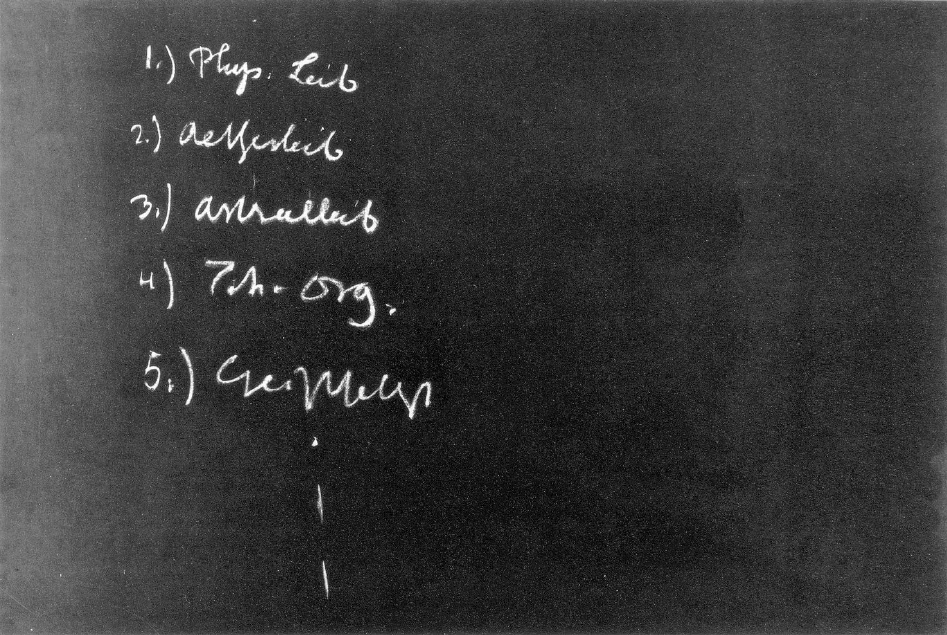
[ 27 ] But now people usually just add: “The Spirit-Self—humankind hasn’t developed that yet; it’s none of our business; we read about it in books, but in the present age, humankind has only reached the level of ‘I’ organization; therefore, there’s no need to concern ourselves with the Spirit-Self.” Yes, my dear friends, but that is not the case. Human beings do indeed reach the level of “I” organization, but not all beings with whom we have to do reach only as far as the “I.” We certainly have to do—and especially when we are dealing with growing children—with beings who reach the level of the “Spirit-Self,” who are ahead of human development. If one wishes to develop something like Waldorf education—and if this is to have a living effect—then one must appeal not only to the people employed there but also to spiritual beings who are more highly developed than humans, beings who show a distinct development up to the Spirit-Self. We are particularly concerned with a specific type of such beings when it comes to the growing child: the beings referred to as linguistic geniuses. If it were left to human beings alone to pass on language to the next generation, then all human beings would wither away. Something as essential as the human being itself lives within language. What comes to us through language is inhabited by beings who, in their ordinary lives, have developed their Spirit-Self just as distinctly as humans have developed their “I” organization. These beings inspire us; these beings live within us through our speech.
[ 28 ] Just imagine how we must develop an artistic expression of speech in eurythmy so that a visible language can emerge. After all, we do not fully grasp language. In eurythmy, we work out only a small part of how the genius of language operates, so that a visible language can emerge. Just imagine how, in therapeutic eurythmy, we appeal to what these beings can achieve with the Spirit-Self within the human being through the intuitive stimulation of the will.
[ 29 ] So, the moment we even speak of education, we are dealing with a summoning of the spirits who have developed the Spirit-Self. And in everything we explain through language, we are describing the Spirit-Self. Therefore, it is already beneficial for those who wish to educate children with special needs to meditate on what is said in the books about the Spirit-Self. This is good material for meditation. It is a source of inspiration for those spiritual beings who are of the nature of linguistic genius. But such spiritual beings do exist.
[ 30 ] When we enter the school and make gestures—and if these gestures are appropriate expressions of what we are experiencing emotionally—they have a tremendous effect on the child. But they also demonstrate that we are in connection with the spiritual beings who carry the Spirit-Self within them. There is really no need to engage in any kind of external agitation—of course not; these things must have an objective effect, just as a crisis in a small child must be accepted. But when entire communities get into the habit of putting their hands in their pockets so as not to make gestures, this amounts to saying: one wishes to be forsaken by the gods—the gods who are closest to the spiritual human being. One wants nothing to do with those beings who have developed the Spirit-Self, just as the human being has developed the “I” organization. And then, first of all, language becomes slurred. This is the great danger of Western culture: that language is not made into what it is meant to be, but instead becomes slurred.
[ 31 ] With a developing child—especially with children with developmental differences—it is essential to ensure that they speak clearly and distinctly. One must not tolerate anything that constitutes any kind of sloppiness in speech. This can be considered a general rule for all children with developmental differences: one must ensure clear, distinct, and well-articulated speech. This has a positive effect. But even if the child is not yet speaking, it is beneficial—unless specific instructions must be given that the child must remain quiet—for those around the child to speak clearly and distinctly. There is no need to avoid exposing a child—whom you have just taken in for education as a child with developmental differences, between the ages of seven and fourteen—to as much good language and recitation as possible. Approaching children with developmental differences time and again with well-structured language—this necessity arises from the very nature of their developmental differences.