

Remedial Education Course
GA 317
5 July 1924, Dornach
Translated by Steiner Online Library
Tenth Lecture
[ 1 ] First, I will return with a few comments on the cases you yourself have on hand at Lauenstein.
[ 2 ] First, I would like to discuss your oldest son, who is sixteen years old and who essentially exhibits a form of inferiority precisely because his physical constitution prevents his ego and astral body from fully developing. After all, he was only entrusted to your care at a relatively late age. Isn’t it true that you weren’t involved with him before—that you didn’t receive him until he was sixteen? Therefore, this is naturally a case with clearly developed antecedents. If the boy had been treated earlier in such a way that he could simply have experienced the principles of Waldorf education— that is, the principle of authority between the change of teeth and puberty, and if he had been guided under constant observation of the things that interest him—and if, based on these interests, his sphere of interest could have been broadened, and if a gently applied “lead cure” had been administered at this age—then the boy would indeed be at a different spiritual level today. For the boy does, as is clearly evident, have interests. He also possesses a very specific skill, but you saw from the test that was administered how things stand. The test was a relatively simple one, but from this very simple test you could see what the situation actually is. Isn’t that right? I gave the boy a very simple arithmetic problem. A subtraction problem, as is customary in Waldorf education. That is, the question is: What must be subtracted from one number to arrive at a specific number? — In other words, rather than giving a minuend and a subtrahend, as is done in conventional arithmetic, one gives the minuend and the remainder, and the subtrahend must be found. This is what particularly influences the constitution of the soul’s life, but on the other hand contributes far more to development than if one were to do the opposite.
[ 3 ] Well, you saw that the boy was able to solve the problem, but he couldn't solve it right away. He came back quite pleased after he had solved it, after I had told him he had to have it solved in an hour and a half. He had the time of one and a half hours and was quite delighted that he had solved the problem. Then you saw clearly that the boy was capable of doing it. Every part of his organism is attuned to the task. He simply needs a longer period of time to carry it out; that is, his etheric body and his physical body immediately resist it—they do not perform their function, even though the capacity for that function is present.
[ 4 ] The point is that, if one traces how the boy’s interests play out, they are such that they remain within the head organization. They cannot extend down into the rest of the organization.
[ 5 ] One small incident is quite telling in this regard. You saw that he came with his little Kodak and wanted to take a picture of us; he did it quite well and with deep interest. Afterward, I tried to tell him he should take another picture. But that would have required him to first get the film—for his interest to extend beyond what was immediately at hand. He resisted that. He simply couldn’t be persuaded to do it. When an interest seizes him in the moment, he is fully present. But if he is to bring that down into the metabolic-limb system, his etheric body and physical body resist quite strongly. And this is precisely where it becomes necessary, at this age—even though it becomes more difficult than before—to intervene more and more with educational therapy. This requires taking the things he pursues with a certain interest as a starting point, but then moving beyond them to expand his sphere of interests in all directions. One will achieve a great deal with this boy if one takes into account the healthy instinct that he nevertheless possesses. For one always sees that healthy instincts are present even in abnormal constitutions. The boy will immediately experience a broadening of his range of interests if he is guided toward activities that require dexterity.
[ 6 ] At first, he can follow the path that leads from the head organization to the metabolic-limb organization; and, as you have heard from me, beyond that, he may find this part of the path difficult to navigate because there is no capacity for perception. Nor does he possess even the subtle perception present in a normal person. On the other hand, when he sees what is right in front of him—when he sees the dexterity of his own limbs—he will take great joy in it. So one must let him do things in which he can see the dexterity of his own limbs. This can be particularly encouraged by having him perform therapeutic eurythmy exercises with his legs and hands, while at the same time vigorously mobilizing his toes and fingers and allowing him to focus his gaze on all these movements of the limbs—in other words, letting him observe himself.
[ 7 ] For children who clearly show early on that they have these difficulties—that they cannot allow what the mind conceives to flow down into the body—it is good for such children—it is already too late for this boy, but you may always encounter such children—it is quite beneficial to first try to help them reach their feet with their minds. If you try this yourself, you’ll see that it’s a difficult procedure. But it’s good to help children who struggle in this regard to be able to kiss their own toes. It’s also good—and it will always work; it could even be extraordinarily beneficial for this boy—to have such children hold a pencil between their big toe and the next toe, use it to form individual letters, and then take pleasure in writing with their foot. That might also be quite helpful for this boy. In such cases—and this is also a form of therapeutic eurythmy, as he learns to write with his toes—therapeutic eurythmy will be of great help to him. Well, whether a lead therapy at this age will also be effective remains to be seen; we’ll find out when we begin to try these things and observe the effects,
[ 8 ] You can see from what I just said that a more careful observation is necessary here. One must make such seemingly trivial matters—such as calculating after an hour and a half, or not wanting to go back into the house to get the movie, and the like—the subject of constant observation. Then it becomes clear that an essential aspect of the education of children with special needs is also placed in the hands of the educator in that these educators must accustom themselves to having a keen sense for everything that is going on with the child in question. You see, you will say: Well, how much time does the education of children with special needs actually take? ‘One must constantly devote one’s attention to it; one cannot meditate at all; one has no time to do anything else.’—That is not the case, and internally countering this view is already part of the esoteric nature of such a life’s work. It is not at all a matter of being, so to speak, on the lookout all day long, but rather of developing a sense for characteristic occurrences. Under certain circumstances, someone who has learned to observe a number of children can, in a relatively short time—five or ten minutes—gain a thorough understanding of a child, provided they apply their gaze correctly in every situation. What matters is not how much time one spends on these things, but how deeply one connects with them inwardly. A great deal of time will be saved, especially in intellectual professions, if one takes into account that one must truly connect with the phenomena in question on an inner level.
[ 9 ] Now there was also a boy—a typical case—a fifteen-year-old boy with epilepsy. Your boy is a typical case similar to the one we had here, except that he is a few years older. The point here is to take into account the difficulty posed by the fact that your boy is going through puberty. Wasn’t he castrated? The process is taking place throughout his entire organism. And since the boy has been castrated, we are dealing all the more with an extraordinarily intense phenomenon—namely, the reaction brought about by this artificial influence on sexual development. As the boy presents himself, he appears to be a boy for whom the transition to puberty will prove exceptionally difficult. For puberty is, after all, a process affecting the entire organism. And for him, castration now has no other significance than that it has a reactive effect on puberty. So, in the case of this boy, it will simply be a matter of taking into account that he is at a stage where it is necessary to treat him as one would treat boys who have reached puberty: namely, by carefully connecting them with everything that instills in them an interest in the processes of the world in which they are placed. Above all, it is a matter of applying Waldorf pedagogy to him. This means trying not to leave him to his inner agitations, but rather trying to keep him constantly engaged with the outside world, so that he develops an intense interest in external things and events.
[ 10 ] Please tell me how far along the boy is in his schoolwork. Perhaps you could describe how far along he is in his schoolwork.
Albrecht Strohschein: He can neither read nor write; he didn’t start anything at all related to schoolwork last year. Last year, Mrs. F. had started teaching him to read and write, but using this Montessori box; he didn’t make any headway at all, couldn’t make any progress, and so he’s actually at square one when it comes to schoolwork.
[ 11 ] He shows a certain insensitivity to external impressions. — Well, in this case we need to apply Waldorf pedagogy just as we would with very young children, that is, to start from the pictorial and simply guide him to the point where he can express what is tormenting him inwardly through colors. We’ll let him paint for now and see what comes of it. And from there, we’ll proceed based on what emerges from his own inclinations.
[ 12 ] However, in this boy’s case in particular, therapeutic intervention will be absolutely necessary. Haven’t we discussed therapy yet? He should be given algae and belladonna. So this would be the therapeutic intervention required here. You can understand the nature of the algae injections, but it’s good if you reflect more deeply on these things, because you’ll be expected to apply them independently in individual cases. Why might one consider algae injections in such a case? With algae, we are dealing with a plant that has neither a strongly developed root system nor a strongly developed flowering system. The flower and the root actually grow together. And the most important aspect is actually the herbaceous organization, which gives rise to everything else. The leaf predominates, so that this plant does not have a very intense relationship with the earth. On the other hand, there is no intense relationship with the outer cosmos either; rather, there is a relationship with everything that takes place in the aqueous and airy elements, immediately at the Earth’s surface. Algae and fungi are the plants that are completely immersed in the interactions between the air and the aqueous element. Now, what is peculiar about this is that these plants are strongly attracted to the very small amount of sulfur that is widespread today, both in the aqueous element and in the air. As a result, when these plants are introduced into the rhythmic organism, they are particularly well-suited to establishing harmony between the astral body and the etheric body. Well, that is precisely what is lacking in a boy like this.
[ 13 ] One then realizes that one is dealing with a disturbance caused by the ego-organization placing too great a demand on the astral body and not allowing it to enter the etheric body; in such cases, one must make greater use of mushrooms. One will turn to algae, which are closer to ordinary plants, when the physical body and the etheric body refuse to allow the astral body to enter, when the disharmony arises because resistance comes from the etheric body—not because there is an overwhelming attraction from the ego-organization, but because specific resistance comes from the etheric body itself.
[ 14 ] Then there was a girl there. Can't you describe that based on the information I've provided?
Albrecht Strohschein: A Girl with Puckered Lips. There you pointed out that something special must have happened to the astral body between the third and fourth years, that it must have experienced severe itching and scratching. The mother later confirmed to us that she had a high fever and that there was itching. The recommended treatment is: a nicotine enema, and if that doesn’t help, nicotine injections. She is fifteen years old.
[ 15 ] Well, don’t you see, we have a girl who has turned fifteen, but who clearly shows that the astral organization has permeated her entire organism in a rather mild way. The girl’s entire constitution reveals this. Above all, “the astral organization proves far too weak to hold the ‘I’ firm against those temptations that arise in a person when they eat—the tendency to perceive food and taste as far too sweet, too delightful, too soothing.” If the astral body is not sufficiently active in the region of the lower face, then the lips, especially at the corners of the mouth, turn upward, because there is already an excessive sensual pleasure associated with tasting and processing food right in the mouth. Such phenomena have long-standing antecedents, and of course something like this can occur at any relatively late stage. Well, didn’t I mention back then that an irregularity in the child’s development must have occurred between the ages of three and four?
[ 16 ] Of course, you can only expect yourself to notice such things once you have first become attuned to the kind of love I just described—the kind I must place such great importance on. You should never use the excuse: “Yes, to perceive such things, I must first be clairvoyant.” - That is a form of inner laziness that anyone who chooses a career in education really must not have. Rather, the point is that long before you attain that clairvoyance which is necessary, for example, for research in general—through loving devotion to what emerges from the human being, to what develops especially in abnormal states—you must, through this loving devotion, cultivate within yourself the ability to simply look at what really matters. In that moment, you tell yourself the right thing. Of course, this requires esoteric courage. This esoteric courage is developed in a person when nothing stands in their way.
[ 17 ] You see, it is indeed a curious phenomenon that these inner intuitions are so rarely noticed by the very people who are relatively well-equipped to perceive them. After all, anthroposophists have so many opportunities to pay attention to these inner intuitions—they have far more of them than one might think—but they do not pay attention to them because, at the very moment they are supposed to do so, they find themselves confronted with a vanity that is difficult for human beings to overcome. Isn’t it true that with this discovery of abilities, all sorts of impulses of vanity have sprung up? And among all the things I described yesterday—for example, regarding the present age—and which I have also described on other occasions, there is also the tendency—the immense tendency of humanity today—to succumb to vanity.
[ 18 ] You see, there is already something here that must be taken into account, especially by those among today’s youth—and you, of course, are among them—who are in some way dedicating themselves to a great calling, one that must naturally arise and that must have a regenerative effect on humanity. I am truly not speaking out of misunderstanding or a lack of understanding of today’s youth movement, but rather from a genuine understanding when I say the following to you: Today’s youth movement is a necessity; it is something extraordinarily significant, and also something of the utmost interest to discerning older people. So not a single word of criticism should be directed at the youth movement. Nor should anything be said against the fact that the older generation has so little aptitude for understanding today’s youth movement, and that much has failed precisely because of this—because it is taken too lightly and not given sufficient consideration. But on the other hand, when it comes to the youth movement taking on concrete, specific tasks, certain things must be taken into account by the youth themselves. Of course, those who have experience in such matters must draw attention to this. The youth themselves must take into account something that makes everything that is to emerge from the youth movement immensely more difficult. That is a certain vanity. Vanity is present everywhere at the root of the youth movement, not so much out of any lack of discipline as rather for the very reason that makes it necessary: precisely because the will requires a strong development of inner abilities, vanity dawns to a high degree simply through Ahrimanic influences. You see, in my life I have been able to observe many hopeful people of various ages. I have been able to observe certain phenomena in this area quite intimately, but it was evident that with the advent of the age that followed the Kali Yuga, vanity—not merely among the youth, though here we are now interested in this specific form that arises among the youth—sprang up with particular intensity and prevents the youth themselves from developing the very quality that lies at the heart of being young today. Hence the phenomenon that occurs so frequently: the general talk of missions and grand tasks, and the scant inclination to address the specific, small details required to achieve them.
[ 19 ] In the future, we will need precisely what was once called—in an extraordinarily philistine context, yet out of a certain intuition—“devotion to the small.” This is something that young people, in particular, should make their own. They are too absorbed in abstractions. But that is precisely what propels one with force into vanity.
[ 20 ] You must consider the nature of the difficulty at hand and make it the focus of your esoteric striving. You must keep in mind the immense difficulty involved. Anyone who is to reach the point where they can say something to a person based on an intuitive insight—after all, things are not laid out plain and simple, and what the layperson says is usually wrong when it comes to children of lower capacity— it is essential to see through to what is actually there—needs something to achieve this; to do so, he must tell himself in an energetic, courageous way—not merely in the moment, but as a lasting, qualitative content of his consciousness: “I can do this.” - If you say this to yourself—without vanity, even with a willingness to make sacrifices, by overcoming the obstacles that stand in your way—if you tell yourself this again and again, rather than merely feeling it, then you will see just how much you are actually capable of in this regard. So do not seek what is to be developed in daydreaming or in webs of thought, but in this enduring, courageous awareness, which develops simply by bringing up from your soul—figuratively speaking—that which is covered by immense filth, swamp, and peat bog, in the simplest possible way.
[ 21 ] People generally cannot achieve anything in the field of education because they have never seriously awakened a truth within themselves. This consists of immersing yourself in the awareness each evening: “God is within me, God is within me,” or “the Spirit of God,” or whatever—but do not merely talk yourself into this theoretically; most people’s meditations consist of talking themselves into something theoretically—and in the morning, let this radiate throughout the entire day: “I am in God.” — Just consider, when you awaken these two mental images within yourself—images that become pure feeling, indeed impulses of the will—what you are actually doing. You are doing this: you have this image before you: “God is within me”—and the next morning you have this image before you: “I am in God.”—This is one and the same thing, the upper and lower figures (see Plate 12). And you simply must understand: this is a circle; this is a point. It just doesn’t emerge in the evening—it only emerges in the morning. In the morning, you must think: this is a circle; this is a point. You must understand that a circle is a point, a point is a circle, and you must understand this completely from within.
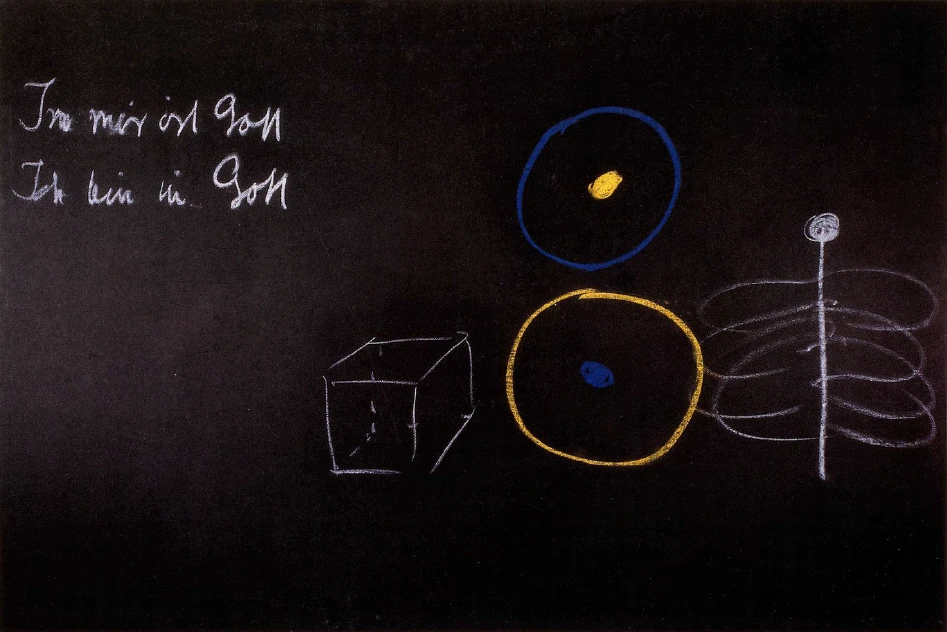
[ 22 ] You see, that’s the only way you can even begin to understand a person. For if you recall the drawing I gave you of the metabolic-limb human and the head human, this drawing signifies nothing other than the manifestation and realization of what is now presented to you in a simple way in a meditative figure. In the human being, this is realized in that the “I” point of the head becomes a circle in the limb human, which is naturally configured. And you will come to understand the whole human being at all if you approach him in this way, if you try to understand him inwardly. But first you must realize that the two figures, the two mental images, are one and the same—that they are not at all distinct from one another. Only when viewed from the outside are they different. There is a yellow circle; there it is. There is a blue dot; there it is, too. Why? Because that is the schematic figure of the head, because that is the schematic figure of the body. But when the dot asserts itself into the body, it becomes the spinal cord; when the dot enters here, it becomes what it is meant to be in the organization of the head—namely, the base of the spinal cord (see Plate 12). The inner dynamics of morphology simply become clear to you through this. You can gain an understanding of anatomy and physiology by meditating on this as your starting point. Then you will already gain the inner intuition of the extent to which your upper and lower jaws are limbs, the extent to which the head is a complete organism perched atop the body—its limbs having atrophied—and how, through this atrophy, it transforms them into jaws; and you will gain an insight into how teeth and toes stand in polar opposition. Just take a look at the bases of the jawbones, and you will perceive the atrophied formation of toes, feet, and hands within them.
[ 23 ] But the meditation that works in such matters must not, my dear friends, be characterized by the mood of wanting to curl up inwardly in a warm nest—where it grows warmer and warmer—but rather by the mood of immersing oneself in reality, of grasping reality. Contemplation of the small. Yes, of the smallest. Our interest in these small things must not be driven out, my dear friends. It must be such that an earlobe, a cut fingernail, or a strand of human hair interests you just as much as Saturn, the Sun, or the Moon. For, after all, everything else is contained within such a strand of human hair, and the one who goes bald does indeed lose an entire cosmos. It is indeed true that what is visible on the outside can be created within, provided one has the resolve that is precisely necessary in the life of meditation. But this resolve is never attained if even the slightest trace of vanity appears—and such traces do indeed crop up everywhere. Therefore, my dear friends, if you truly wish to become educators—especially of children with special needs—it is necessary that you cultivate this devotion to the small things in the most humble way possible, and, building on that, then in turn awaken this devotion to the small things within the broader youth movement.
[ 24 ] Then there are these very possibilities of being made aware of something like this, which is then—as indeed happened in this case—verified from the outside. I must say, this is where I see the greatest mistakes being made in the endeavors within our anthroposophical movement. — You see, here’s the situation: In the case of the girl, I told you there must have been some kind of abnormality between the ages of three and four. You ask the mother, and she confirms this to you. What did you do afterward? Would you please describe, quite honestly and sincerely, what you did after the mother confirmed this to you?
Silence.
[ 25 ] If you three want to be completely honest—in a very esoteric way—what have you done?
Silence.
[ 26 ] If you had done the right thing, you would say: “We jumped over it, and the ceiling got a hole!” — But then, even today, the memory of that jump would not only speak from within you, but shine.
[ 27 ] That is precisely it: the enthusiasm in experiencing the truth! That is what must be there. That is what has been causing me such terrible pain for years within the anthroposophical movement—that people stand so firmly on their own two feet, the young almost as firmly as the old. And let’s think about how they can stand so firmly on their own two feet! You see, Nietzsche was, after all, a different sort of fellow—even if it did make him ill. He made his Zarathustra a dancer. Why not become a dancer yourselves, in the sense that Zarathustra meant it! Live with the deepest joy in the truth! After all, there is nothing more delightful than the experience of truth. This is something that constitutes a far more important and essential form of esotericism than what those long-faced people go around preaching. This inner experience of truth—that is what must precede, by a long way, all other self-persuasion about a mission.
[ 28 ] The girl, who was between three and four years old, developed an occult fever. This is also referred to in medicine as occult fever. This is one of those instances in medicine where the field has retained its earlier terminology. When a doctor does not know the source of the fever, he calls it an occult fever. This occult fever occurred; there was a particular weakness during this period between the third and fourth years—a particular weakness of the astral body. The physical body and the etheric body reacted, and these reactions then developed too strongly; the astral body could no longer keep up. Therefore, with this child, it is particularly necessary, first of all, to recognize that around the age of three, a peculiar withering and inward cramping of the astral body occurs; I must help this process along. This must be properly addressed, and this can be done pedagogically by stimulating her interest. Now please describe how this girl fared in school?
Albrecht Strohschein: We won’t be keeping the girl at the institution; she’ll only be coming in for treatment. She attended a special education school until she was sixteen, can read and write, and can count to about one thousand. Other than that, we don’t know much else about her; she was only here for an initial evaluation. — A tobacco enema was administered.
[ 29 ] The focus will be on treating it with therapeutic eurythmy.
[ 30 ] Why is that? It is because, as a result of the atrophy of the astral body, the child has developed a very strong tendency toward deformation of the upper body. The child has an extraordinarily brutal appearance because everything below the masticatory organs is deformed. It is precisely in this case that the anti-deforming effect of nicotine juice—which has been so thoroughly tested by the local Clinical-Therapeutic Institute—will be able to take full effect. One can proceed slowly at first, administering it orally and then observing carefully; one must develop an eye for whether the masticatory organs are beginning to come more under the organism’s control. Here they lie almost entirely outside the realm of what the child grasps with its soul. They simply lie there. The child can be treated by administering nicotine solution orally in an appropriate decimal dilution—one can start with the sixth and go up to the fifteenth. If, however, one finds that the effects are too weak, one introduces the nicotine solution in high potencies into the circulation, so that the astral body is immediately affected by it through the circulation, and one will see that what cannot be achieved through internal administration is achieved in this way.
[ 31 ] However, it may be a good idea—and I must add this as an afterthought—to try not to allow the effects that are to be retained within the astral body to influence the ego organization too strongly; they should stop short of the ego organization. This can be achieved by taking, even if only rarely—perhaps just once a week—a bath with a small amount of sulfur added, a mild sulfur bath.
[ 32 ] You see, tomorrow we’ll discuss the other cases that were there, and it will be a particular pleasure for me to examine the interesting phenomenon—one that can be studied especially well right there at your facility—the interesting phenomenon of albinos. We had two such children—an older one, fifteen years old, and a very young little sister. Have you perhaps drawn up their horoscopes?
Question for Dr. Elisabeth Vreede, who is presenting the horoscopes.
[ 33 ] That's the older girl, and that's the younger one. — What's Uranus's position? Didn't you find any particular constellations?
Dr. Elisabeth Vreede: Yes, right here with Uranus and Neptune. Neptune in opposition to Uranus for the older girl.
[ 34 ] You see, don’t you, these children are here now. Wherever one sees these children, two main phenomena become apparent. Very light hair and poor vision accompanied by changes in the eyes. These two characteristics are the primary phenomena. But even a very superficial observation suggests that, in the case of albinos, we are dealing with an organism that is very weak in terms of iron metabolism, and that we are dealing with an organism that metabolizes sulfur with extraordinary ease. So the fact is that the organism resists iron—specifically, it resists the transport of iron toward the periphery; it stops short of the periphery; and it is precisely sulfur that is driven toward the periphery and driven beyond the periphery, so that one sees everywhere in the region of hair formation the sulfur aura, which bleaches the hair and robs it of its strength. And in the relatively independent formation of the eyes—which are even formed embryonically from the outside into the organism—one sees all the more clearly the independent sulfur aura that literally urges the eyes to drive their essence out of the etheric and into the astral. In such children, one can literally see the eye torn from its rocky cave, the etheric body disregarded, and the astral body particularly strongly engaged within the eye.
[ 35 ] This raises some very important questions. On the one hand, in terms of their development, human beings are connected to the forces that exist within the Earth—forces revealed to us through the substance of the Earth—and they are connected to the entire cosmos. They are dependent on both. Both are present in both individual karmic development and the flow of heredity. — Now, regarding the hereditary currents. In the case of the two children who were presented, neither the father nor the mother exhibits any signs of albinism. Nothing, absolutely nothing—they are normal people. In contrast, somewhere in the ascendant there was a grandmother who is said to have also exhibited signs of albinism.
Dr. Ilse Knaner: She was a sister of this child's mother.
[ 36 ] So, an aunt. It’s just in the ascendant. We just need to acknowledge that there is definitely a tendency toward this in the ascendant. Didn’t you tell me that day that there were other children as well, including some in Jena, from the Saale region?
Dr. Ilse Knauer: Two children and one adult, a thirty-two-year-old who is already married. Among these three, there is only one case in which an albino was present in the ascendant line.
[ 37 ] You see that the phenomenon occurs—one might say—in a certain sense as something endemic to the territory. But from another perspective, it is sharply contradicted. Very sporadically, under certain circumstances, an albino emerges from the territory—and otherwise not. So the question arises: How does an albino emerge from a territory?
[ 38 ] We know that sulfurization extends all the way to the outer layers, so that small sulfur infarcts occur in the aura, in the periphery. Then we look in the surrounding area to see where sulfur occurs. Now, the entire Saale Valley is rich in pyrite, and so you have this combination of sulfur and iron present in such a way that one can study: what is the nature of the iron in the area, what is the nature of the sulfur in the region—especially in this region where the wonderfully beautiful pyrite deposits appear, which are found in the Saale region. These beautiful, delicate, golden-glistening pyrite cubes appear in the Saale region (see Plate 12). The other areas nearby contain gypsum. Gypsum, as you know, is calcium sulfate containing twenty percent water. So once again, we have the opportunity to study sulfur in its compound form within the gypsum. This sheds light on everything that lives in the atmosphere and so on, so that one must first address everything that arises from the soil in connection with the absorption of sulfur and iron. You also have a region that is otherwise very rich in iron, and the question arises: How does a reciprocal relationship develop between the earth and human beings, such that the earth can strongly attract iron, but human beings cannot—or only with difficulty? What constellations must be present to make a person particularly suited to rejecting iron and absorbing sulfur? — That brings you to the cosmic realm; there you examine the constellations that are present—this cannot be done at conception—but rather at the birth of such a child. It will become apparent that the question arises as to whether these children, who appear as albinos, are subject to very specific constellations—and indeed, such that they cannot occur in this way, or can occur only rarely. We will not have to look for the answer in the data derived from planetary revolutions that occur rapidly, but rather we will have to look for the constellation among those planets that take a long time to complete a revolution—namely, Saturn and Uranus. So you see how the questions arise in such a case. First, one must have the questions; only then can one address such a case.
[ 39 ] Now I’d like to give a brief overview here as well. So I’ll apply what’s been hinted at here to this context as well. I’ll discuss that here tomorrow.
[ 40 ] Based on what I was told this morning, you want something different from what the lectures contain, because they lean too heavily toward the “Devotions on the Little Things”—according to what you need; I would like to accommodate you in the strongest possible way by applying the same new method I used with the workers. There, I gradually phased out the lectures by asking what I should talk about, so that from a certain point on, the topics they wanted discussed were proposed by them. Now the workers can never complain that they aren’t being lectured on what they want.