

Remedial Education Course
GA 317
6 July 1924, Dornach
Translated by Steiner Online Library
Eleventh Lecture
[ 1 ] Now let’s discuss the cases that weren’t addressed yesterday. There was also a younger girl, ten years old, who suffered from memory loss. She is only in second grade. She has growths in the nasopharynx; which is related to excessive etheric growth in the bladder region, which has its counterpart in the head. In this girl’s case, one could indeed trace the physical origin of her developmental delay. The girl is ten years old, and is therefore at a stage where, as I always emphasize, the educator’s attitude toward such a child is particularly important.
[ 2 ] Now, of course, the girl has completely overlooked all the antecedents leading up to this point. The inflammatory symptoms near the bladder region, which have their counterpart in the upper organism, clearly show that the etheric body is not properly integrating into the organism because the interaction with the astral body simply cannot take place properly. Of course, you must always bear in mind that everything that takes place in this way—when it expresses itself in the soul organism—is rooted in the finer organization; thus, so to speak, the gross organization cannot provide a clue. Naturally, it is easier to notice something in the higher organization than in the lower organization. But if one wishes to help such a child—whose etheric body does not function properly due to a defective astral body, so that what the child takes in does not penetrate the organism—then the task is to intensify, as much as possible, the impressions intended for the child and to work with strong impressions for such a child. You must bear this in mind: memory, after all, depends on the proper organization of the physical body and the etheric body. The astral body and the “I” do not, in fact, take with them what is retained in memory from impressions. Dreams, after all, only occur when the astral body and the ego are partially embedded in the physical and etheric bodies. So for the ego and the astral organization, everything from falling asleep to waking up is actually forgotten. It remains stored in what is left behind in bed. Now, if what remains there is not properly organized, it does not incorporate the remnants, the residues of the impressions; and in such a case, the first step is to evoke strong impressions in order to bring the higher organization—that is, the “I” and the astral body—into active operation within the lower organization, namely the etheric and physical bodies.
[ 3 ] Now, I don't know if anyone has ever tried testing one's memory using simple folk melodies?
Dr. Ilse Knauer: It's easier that way.
[ 4 ] So let us try to continue working on the basis of this existing receptivity, using it as a starting point, for example, to direct attention to those short poems in which a certain motif recurs every three lines, so that the child receives a strong sense of rhythm, and thus the time approaches when one can also introduce non-rhythmic impressions to the child. It is unlikely that the time required to achieve results in this case will be less than three to four years, until sexual maturity. If one works according to these principles up to that point—particularly where rhythmic impressions can take effect—and builds upon that foundation to develop other aspects, one can achieve educational results. We have already established the therapy: the child should receive compresses containing 10 percent Berberis vulgaris and therapeutic eurythmy LMS-U (Table 13).
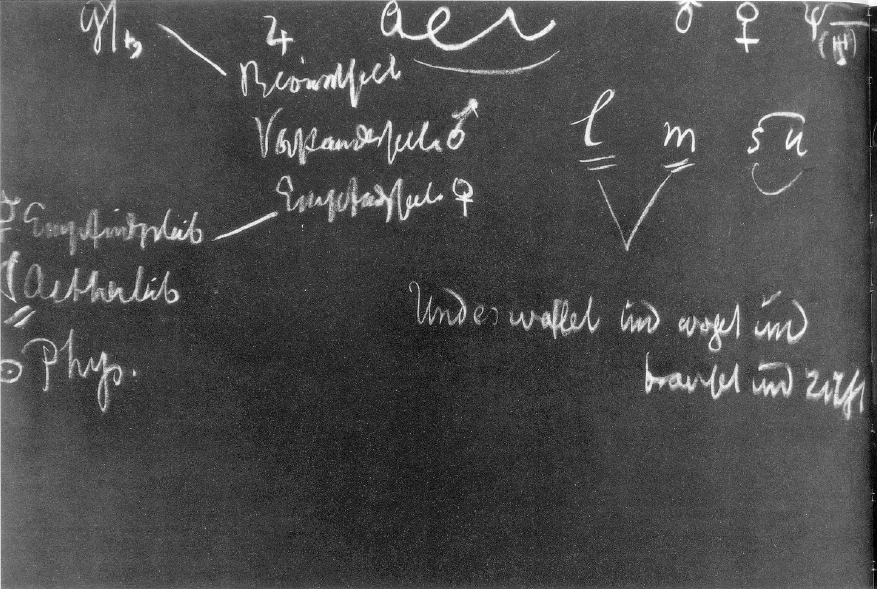
[ 5 ] As you can see, the underlying concept here is that the formative, the clinging element enters into the mobility of the astral body and meets the M. M is that which, as I have told you, places the entire organism into the exhalation, so that the astral and etheric organizations may thus meet. S is there to set the astral body into a strong, lively activity, but in such a way that it remains true to itself, and that is what U is for. These things become clear upon direct observation; we are recalling them here once again. The reason the child receives compresses with *Berberis vulgaris* is that we need to neutralize the inflammatory causes, and this can be achieved in this way.
[ 6 ] Then we had a sixteen-year-old boy who was a kleptomaniac—he was the spitting image of the kleptomaniac boy presented here. You saw the very best example of this in the presentation. He should be treated in exactly the same way. We’ll just have to see whether the impressions we give him can build on this or that. Depending on the kind of upbringing the children have had previously, it could be different things.
[ 7 ] Now there is the child from Stuttgart, who is actually a restless child. He is a sleepy, developmentally delayed child. He is not yet old; he has not learned to speak; he has fallen behind in everything that is supposed to be learned during the first stage of life. It is therefore very easy to understand what this child lacks: it did not engage with the principle of imitation; it did not take to imitating. In other words: it cannot set its organs in motion from the “I” and the astral body. It is an exceptionally endearing child, but it actually finds it extremely difficult to overcome its physical body’s longing for rest. Now, the child will have to be treated in such a way that, first of all, it practices tone eurythmy. In this way, it will be able to make progress. I can only describe the ideal in this matter. If it practices tone eurythmy properly, it can initially reach a point where its astral body is stimulated to such an extent that the rhythm then takes hold of the etheric body.
[ 8 ] The point is to have the child repeat rhythmic phrases so that the child truly gets into the rhythm: “And it surges and swells and roars and hisses.” Now the point is to go through something like “And it surges...” with the child properly and slowly, slowly back and forth. In this case, I deliberately say “surges” instead of “boils” because it is used for therapeutic purposes. Always so slowly back and forth. And if possible, do the same with the following sequence of sounds. The child’s inner awareness is to be awakened in this way, so that we evoke a sense of wonder in them: have them intonate “A,” then “E I,” then back again “IEA-AEI-IEA,” and so on. This is how you gradually awaken such a child, and through the principle of imitation, the child will repeat it. You simply need to work with the child individually and ensure that imitation is present in everything you go through, always letting the child repeat the sounds shortly afterward.
[ 9 ] Then the approach would be to treat this child therapeutically, specifically by allowing a divergent force—something that drives the organism’s substance outward—a centrifugal force—to act. This is always the pituitary gland, but the child is not actually in a condition where one must apply the pituitary gland to it in the same way when dealing with rickets-afflicted children, in whom one seeks to use the pituitary gland to promote expansion—but rather, it involves applying the opposite principle, the centripetal force, which, together with the pituitary gland, tends to build up the human organism from the substantial level, and that is either Carbo vegetabilis or Carbo animalis. The approach would be to use Carbo animalis and alternate it, so that one time one has the formative principle in Carbo animalis, and the next time the organizational principle that stimulates growth, which is found in the pituitary gland.
[ 10 ] Well, of course, when starting such an educational institution, the most important thing is that those involved pay close attention to everything they do. It is a matter of managing the situation with a certain inner sense of confidence. You see, with this child, the worst part won’t be the child—you’ll soon notice progress with him—but the worst part in a case like this is the parents, the mother, who is absolutely convinced that miracles should happen quickly. Now, I’ve even heard that the mother wants to go with the child,
Interjection: She's the only one who can pull it off.
[ 11 ] Well, it’s certainly a relief when your mother isn’t there with you on Plate 13. But in any case, in such a situation, one must stand firm with a certain tenacity against the understandable—but at times terribly misguided—demands of the parents, who do not know, nor can they know, what such a child needs.
[ 12 ] Well, isn't it true that with a child like this, it's quite beneficial to physically place them in those alternating positions indicated by terms such as AEI-IEA and so on? And you can achieve this very well by alternately immersing the child for relatively short periods in moderately warm water and then giving him a moderate shower. In this way, you bring to life what is meant to come to life. In general, if you see that the abnormality is manifesting as lethargy, this measure will always have a beneficial effect—provided, of course, that you do not overdo it. However, you should not be alarmed if the children become somewhat agitated immediately after you begin such a bathing regimen. This will pass. The reaction will come, and things will gradually fall into place.
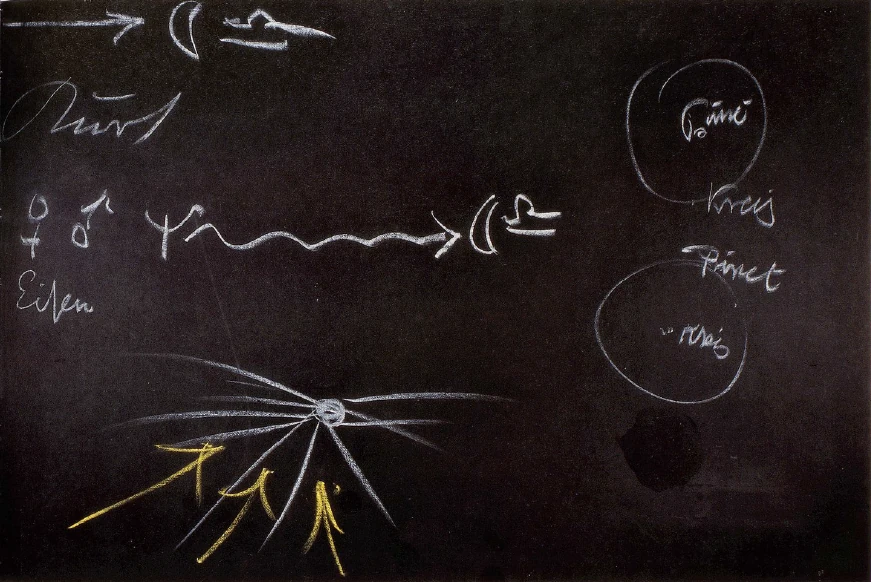
[ 13 ] Now we must discuss Kurt H. Kurt H., who sees everything in colors. That’s the boy who has no money—I can picture him right now. This boy exhibits a fundamental phenomenon, which is this: he cannot quite connect with the external world; he remains trapped within himself. I must explain this phenomenon to you in a way that makes it very vivid. He cannot enter the external world; as a result, he constantly pushes against his own astral body from within with his ego organization, and this gives him an inner clumsiness—or perhaps it would be better to say, an inner sloppiness. And this goes hand in hand with the fact that he develops a subtle sensitivity through this contact with his astral body, and that as a result he possesses something of a refined person. This is connected to his perception of colors. He sees them because he is able to live awake within his own astral body. Now, in his case, he can be educated only by observing the qualities that will increasingly develop in him: a certain quiet longing for ideals, yet at the same time a shrinking back—a sense of not quite fitting in with the world. Now everything will depend on having natural trust in this particular boy—who can be taught exactly according to the Waldorf school methodology. In fact, there is hardly anything else that can be done with this boy. Isn’t it true that the boy has the peculiarity of writing something like this (see Plate 14, left)? Now set about carefully ensuring that the boy develops a finely formed handwriting from his current style; then you will see—he will appear transformed in his entire inner constitution. If attempts at showmanship arise, try immediately—drawing on the trust he has gained in you—to reduce them to absurdity through some means.
[ 14 ] Yesterday I spoke about albinos. I took the discussion so far as to say: We must now find the cosmic impulse that can be at work here. — Well, we can start by asking the expert on such cosmic constellations whether she has noticed anything special in this or other horoscopes that these albinos might have in common.
About Dr. Elisabeth Vreede:
[ 15 ] Have you noticed that, among the outer planets, Uranus and Neptune stand out prominently?
Dr. Elisabeth Vreede: Yes, there are many aspects to it. Otherwise, I wouldn't be able to say anything about horoscopes.
[ 16 ] I’m asking you specifically because you often think about horoscopes and have probably had such things on your mind quite often. For now, I only have these two from you. Since this is a new area, it’s best to take a completely heuristic approach to this matter. There are a lot of other things to consider as well, but for now, we need to take the following into account as well.
[ 17 ] Take the human being, for example. We divide him, after all, by looking at the structure that organizes the entire being more from the perspective of the etheric principle, we divide them into the physical body, the etheric body, the sensory body—which we associate with the sensory soul—the intellectual soul, what the Greeks call the “kratt” soul, the conscious soul, and here we come to the Spirit-Self, the Life-Spirit, and the Spirit-Man. Now you see, when one looks at these members of human nature, they initially appear as something that must be considered in relative independence and that constitutes the human being. But in reality, the composition is different for every human being: one person has a little more strength in the etheric body but less in the physical body; another has a little more strength in the soul of consciousness, and so on—these aspects are interconnected. Within all of this lies the human being with his true individuality, which passes through repeated earthly lives and must bring this entire interconnection into an individual balance based on the principle of freedom. But that which comes from the cosmos is so connected to the human being that the physical body corresponds to the strongest solar influence (see Plate 13), which exerts a powerful influence on human beings in general. The etheric body corresponds to the strongest lunar influences; the feeling body to the strongest Mercurial influences; and the feeling soul to the strongest Venusian influences. The intellectual soul corresponds to the strongest Martian influences; the conscious soul to the Jovian influences; and the Spirit-Self to Saturn. And what is not yet developed in human beings today comes into play through Uranus and Neptune—these are, after all, the “vagabonds” that joined our planetary system later on; it is in them, then, that we must seek the planetary influences that, under normal circumstances, do not exert a very strong influence on the natal chart.
| Spirit-Man | ♆ Neptune |
| Life-Spirit | ♅ Uranus |
| Spirit-Self | ♄ Saturn |
| Consciousness Soul | ♃ Jupiter |
| Intellect Soul | ♀ Venus |
| Feeling Soul | ♂ Mars |
| Feeling Body | ☿ Mercury |
| Etheric Body | ☾ Moon |
| Physical Body | ○ Sun |
[ 19 ] Now, as you know from other anthroposophical lectures, the Moon’s influence is very strong, acting indirectly through the human etheric body. It is, after all, connected to the entire principle of heredity. It imprints all manner of forces onto this model of the physical body, derived from the parents. This lunar influence actually sets the entire course of development from the very earliest stages of embryonic and childhood development.
[ 20 ] Now consider that in human beings there can be a constellation in which this impulse from the Moon is as strong as possible—or at least sufficiently strong—so that the person inherits something that, in a sense, pulls them down into the metabolic organization. But it can also be the case that something is torn away from the lunar influences, so that what resists the lunar influences—what lies on the other side, namely Uranus and Neptune—draws toward itself what is actually supposed to belong to the lunar realm. There may also be other constellations. But with these children, this particular constellation is present, and in their case, one can already see from what appears in the horoscope what the issue is.
[ 21 ] If we take this one horoscope, you’ll find here—as you may have noticed—Uranus with Venus and Mars in this area. Isn’t that right? You don’t need to look beyond the trine aspect here. Here you’ll find Mars, Venus, and Uranus. And if you look at Mars, it’s actually in exact opposition to the Moon for this child, who was born in 1909. So Mars, which has Venus and Uranus nearby, is itself in strong opposition to the Moon. Here is the Moon; there is Mars. Mars draws Uranus and Venus along with it (see Plate 13/14, top).
[ 22 ] Now I would like to draw your attention to something else: The Moon is on the cusp of Libra at this very moment; thus, its hold on the zodiac is as weak as possible, and it wavers—making it a weak influence in itself at this hour; however, its influence is further diminished by the fact that Mars, which carries the Luciferic influence with it, is in opposition to it.
[ 23 ] Now let’s look at the younger child’s horoscope; here’s the situation: Venus, Uranus, and Mars are again in the same region, so that they are close to one another—they encompass only this portion of the sky. They are close to one another once more. In the first chart, we saw that they are in opposition to the Moon and, at the same time, that the Moon is in Libra. Now let’s look at the second horoscope; there we have Mars, Venus, and Uranus again in close proximity, just as they were before. If we look at Mars, we find not a complete, but nearly a full opposition to the Moon. So the younger child does not reach such a complete opposition to the Moon, but there is an approximate opposition to the Moon. But the most peculiar thing is that when we look for the Moon, we find it again in Libra, almost in opposition to Mars, which is dragging Uranus and Venus along with it. Well, so that’s in Libra again. It doesn’t have to be that way, but here, too, you don’t have accurate birth dates. The Moon is in Libra there, and here as well.
Dr. Elisabeth Vreede: It is striking that both have the same aspect between the Moon and Neptune.
[ 24 ] This would have to be explained on its own. Horoscopes must be interpreted on an individual basis. It’s not surprising that such a similarity emerges here—after all, they are siblings. The fact that the older child has a stronger opposition than the younger one—who is already influenced by the older sibling—is, in turn, not surprising. But the point here is that we are seeing a very clear constellation emerge which, when interpreted, leads to the following: Mars, the bearer of iron, becomes independent of the reproductive principle—of the Moon—and, above all, diverts from its proper task that which already belongs to the human being through the Venus principle—everything connected with love; it tears it away from its proper task, does not allow it to remain connected to what pertains to reproduction and then to growth. And so we see what should be living in the lower abdomen—and is connected to the forces of growth—moving upward into the head, and we find that as a result, iron must be lacking in the growth process, whereas everything connected with counteracting iron—sulfur—must be present in excess.
[ 25 ] So we are indeed dealing with an extraordinarily strong predominance of the will, and must above all ensure that, in the course of education, the sensory-nervous system—which is generally unstable—is treated as gently as possible. This actually comes down to specific methods. With such children, one must treat the sensory-nervous system very gently; that is, one must above all try not to strain their eyes with reading and the like, but rather conduct all instruction without requiring them to look with their eyes or read. On the other hand, one should accustom the eyes to color impressions that differ only slightly from one another—specifically, by allowing the colors of the rainbow to blend slowly into one another during transitions and having the child follow them with their gaze. Well, these are measures that could be taken.
[ 26 ] If one still wishes to intervene therapeutically in the organization, then all I can say at this point is that after sexual maturity, such interventions can no longer be very effective. But this can give you an important clue, because one child was born in 1909 and the other in 1921, and the differences in the effects can be clearly observed here. The key will be to actually expose such a child to strong iron radiation originating from the metabolic-limb system. You can only achieve this strong iron radiation by reducing pyrite to a powder, allowing this pyrite to settle as much as possible onto a surface through which the iron radiation passes only minimally—for example, a glass surface—but you cannot use that in this case. So you must try to use paper that is as heavily oil-soaked and pure as possible; the best would be a very thin, parchment-like paper, but it must be thin enough to cling to the body. Ordinary linen rag paper is not suitable for this purpose. You would need to spread fir resin or something similar on it and let the pyrite dust seep into it. This will draw the iron inward to radiate. You must place this along the legs and on the shoulder blades and then try, in turn, to apply a drawing poultice—such as a Cochlearia poultice—to the forehead. If one applies this specifically to the part of the organism where tooth replacement is taking place—where very strong currents and countercurrents are at work—it may be possible to effectively combat the instability in such a child.
[ 27 ] That would be exactly what comes out of these matters. But of course the problem must be investigated further; for so far, the world has done nothing more with albinos than put them on display in sideshows, where they explain: “I’m a bit overweight, I have white hair, I can’t see anything during the day, but I see better at night.” - This is how albinos are presented, and not much is known about them, since modern science does not concern itself with such matters. But as soon as one considers such striking phenomena as I have described, it will become clear that the cosmic influence is a very powerful one when a complete irregularity occurs in the arrangement of the limbs within the human organism.
[ 28 ] Now I'd like to ask you to ask whatever question you'd like to ask.
Question: The reason we have found ourselves in this situation—having to ask questions—is that Dr. Lehr went to see Dr. Wegman and wanted to ask her a specific question on another matter. He felt that the participants were not in the right frame of mind.
[ 29 ] But there’s really no need to waste time discussing the matter; it’s much simpler than that. Dr. Lehrs came to see me and explained that the mood among the Lauenstein participants was that they wanted to undertake something within the anthroposophical movement—something that represents a very first step, a mission, a mission that is just beginning—and that this would require, above all, a discussion of the karmic connections between those who undertake such a task and so on.
Lehrs shakes his head.
[ 30 ] Well, let’s focus on the fact that Lehrs said: “You believe that something completely fundamental must begin,” and I replied that the main concern will be ensuring that students truly learn what is covered in this course. If one were not satisfied with this course and were to remain at the abstract level—for example, by organizing an entirely new movement—then one would be doing something that grows out of what we have long been engaged in. That would expose one to the danger of megalomania. But so that the partly justified underlying concerns might be properly addressed, I said: “You should ask questions.” - The fact is, Lehrs came to me and said that this fundamentally new thing must spring up in the world, that Lauenstein itself must be at the center of the world—all of that provided the impetus for this, didn’t it? —Well, it’s not that bad. Now it’s best if we ask concrete questions and don’t think about the rest at all.
Albrecht Strobschein asks how the Lauenstein Institute is connected to the fact that Trüper was the first to pioneer the education of children with disabilities?
[ 31 ] What do you think this man was doing with these children at first? What is implied here must not be taken to extremes. What may be at issue here regarding the education of children with special needs: I do not believe that the educational institutions for children with special needs in Hanover—which had already achieved a certain degree of success relatively early on—could have been influenced by this man. The practice of educating children with special needs dates back much further. What has always been lacking is precisely what makes it possible to look into the very essence of such children. One cannot even grasp the simplest things, my dear friends, if one does not have the anthroposophical perspective in one’s consideration. On the other hand, it is precisely the human being who provides the very deepest insights into anthroposophy as such.
[ 32 ] Just consider, when looking at Goethe’s theory of metamorphosis today, how it could have come about through Goethe, who was an intelligent man. It is, after all, a complete abstraction—like something that has hints of everything but must stop short everywhere—attempting to show how the leaf lives within the flower, how a petal transforms into a stamen, thus grasping a very elementary metamorphosis, yet stopping short when it comes to animals and humans, timidly mentioning the transformation of vertebral bones into skull bones, Nowhere has one gone beyond the elementary. I myself was shaken; I said to myself: Did it not occur to Goethe—this was what troubled me in the 1880s—that the entire brain is the transformation of a single cerebral ganglion? Intellectually, I could see that it had occurred to him. But only then did I notice his reluctance to articulate what had occurred to him. When I arrived in Weimar, I found the following note in a small notebook written in pencil: “The brain is a transformed main ganglion.”—This was not published until the 1890s, thanks to my efforts. In the 1890s, a whole new writer suddenly emerged: Goethe became, so to speak, the most prolific writer at the end of the 19th century.
[ 33 ] Just think what a long way it is from Goethe’s theory of metamorphosis to that theory of metamorphosis which arises when you find a normal one-year-old child here, metamorphosed into what lay before you a few days ago as a giant embryo. This is retarded metamorphosis—the prolongation of the embryonic state.
[ 34 ] But you will come to understand this, my dear friends, if you practice this very meditation again and again—the one I gave you yesterday when I said: Here is a circle, here is a point; here is the circle-point, here is the point-circle, and so on (see Plate 14). In your meditation, let the point slip into the circle again and again, let the point expand into the circle, and as you do so, feel the emergence of the metabolic organization of the limbs from the organization of the head. Take it so far that you sense the head when you say to yourself: “The point is a point, the circle is a circle.” — Feel yourself gliding down from the head toward the metabolic system as you tell yourself: “The point is a circle, the circle is a point”—the reverse. Then you will have the fully developed theory of metamorphosis within you, and you will be able to say to yourself: It is only through this entire way of thinking, which anthroposophy brings about, that it becomes possible to bring a perspective into the inferiority of children. That is what we have attempted in these lectures.
[ 35 ] Now, if one wants to have an effect, it is not good to have a mental image of karma in such a way that one says: There is one angel who placed the straw spoon there, another angel who placed the pickert there, and yet another angel who placed the spoon there. Then another angel placed the somewhat wayward Dr. Knauer there, and a particularly kind angel brought Miss Becker in as well—we feel as though we’ve been put together by five angels. — If you want to make an impact, that’s not at all the right understanding of karma to adopt. Rather, the correct understanding is this: that you seek out the impulses of enthusiasm that are directed toward karma that continues to have an effect. Then you can ask the question: What precedents are there in Jena that we can take up, that we can align ourselves with? - For of course, when you move into a furnished house, you don’t throw out all the furniture; rather, in some cases—if possible—and here it is possible—you’ll ask yourself: How can I make use of what’s already there? - And so it can only be that you ask yourself: How can I make use of what’s already there?
[ 36 ] Now you know that in Jena there is a curious phenomenon: starting from very similar youthful dispositions—from religious and spiritual tendencies — but tendencies of life that methodically embody the spiritual—the German abbot Hildebrand turned toward Rome and became Pope Gregory VII, exerting a powerful influence from Rome in the very direction from which everything was organized. Here we have a strong Roman impulse pouring from Rome into Europe, through the Cluniac impulse that had been transformed into the Roman tradition. You should study that sometime. What is remarkable is that this very same individuality is driven in its subsequent life to Jena and reappears as Ernst Haeckel. It is precisely as if, within the human being himself, the principles of dissolution were regularly intervening in the principles of construction. As a result, you have in Jena a radiance that quite clearly runs counter to the Roman current. There you have the point of convergence (see Plate 14, below).
[ 37 ] And when Ernst Haeckel spoke in Jena on his sixtieth birthday—first at the Zoological Institute—one could have been under the impression that old Hildebrand had risen from the dead. He had exactly the same manner of speaking; he spoke just like him: with a softly veiled voice, his words always as deliberate as those of someone who, despite having spoken a great deal, is still not entirely in command of speech. And the curious thing is: Abbot Hildebrand, who, after all, merely had the demeanor of a stern pope—he simply represented the Church—had the peculiar habit of telling stories that made others smile, not very strongly, but quite pleasantly. It was truly wonderful how Haeckel got into the spirit of things at dinner, telling precisely those amusing anecdotes from his life between courses that loosened everyone’s tongues and made them smile. The fact is that back then, through his entire demeanor—as a sixty-year-old with a childlike smile and a defiant air—he threw everyone else off balance. I still remember how amusing it was when Oscar Hertwig, heavily pregnant, delivered his speech but couldn’t bring it to a close, while Haeckel was still telling his anecdotes.
[ 38 ] Yes, the fact is that I believe you could gain something particularly valuable from what I have provided as a kind of esoteric foundation by obtaining the speech Haeckel delivered at the Zoological Institute on his sixtieth birthday. It wasn’t long, but it was personal and has something extraordinarily objective about it. And then compare that with the speech given by Professor Gärtner, who was quite inclined not to regard Haeckel as someone of any significance in world history, who explicitly said, “That is something we can disregard,” who always took great pleasure in speaking not of Haeckel as the creator of the *Natural History of Creation*, but who explicitly stated: “This is something we can disregard, but let us emphasize how many lectures our colleague Haeckel has given—that he has given more lectures than all the others combined, which seems strange, given that the other colleagues have given so few lectures that what Haeckel has accomplished could not be matched by the entire Jena Society for Medicine and Natural Sciences!” — He was a philistine little man. It was hilarious to hear this speech delivered by that man. If you take Haeckel’s speech, you have something so fresh and lively; then the scaffold is carried in, then colleague Gärtner comes and beheads him. And the physiologist, who was a Catholic cleric, watches sadly, for they all had to participate. But to see Haeckel in there, how he had a rejuvenating effect! The student body had also become witty that day. There were a great many of them, and the students were remarkably imaginative. Just get yourself a little booklet containing all the songs that were sung throughout the day—such as the one that describes, in a whimsical way, how an Archaeopteryx sharpens its beak on the spire of a church tower—and create a mental image of all that youthful vitality as you read it. This, too, is worth pondering, for it places you within the context of Jena’s role in the development of European thought. — Now, to bring this matter to a close, I will deliver the final lecture to you tomorrow at nine o’clock.