

Remedial Education Course
GA 317
7 July 1924, Dornach
Translated by Steiner Online Library
Twelfth Lecture
[ 1 ] Well, we’ll begin by having you express your various wishes, and then I’ll have to wrap up the course. So please tell me now what still burns in your hearts so that we can move forward.
Albrecht Strohschein: I'd like to say that we have no further questions.
[ 2 ] These discussions have focused on deepening our Waldorf school pedagogy to include those educational methods that address the so-called “abnormal” child. And as you have seen from our discussions, the so-called “abnormal” child must in fact be assessed in a different way from the so-called “normal” child if it is to be treated appropriately; moreover, it must be assessed differently by educators and teachers than it is today in lay circles, where people usually stop short at pointing out the abnormality without delving further into what actually underlies it. We are certainly not yet as far along today as Goethe was, in a certain elementary way, in his observation of plant growth and the nature of plants. Goethe looked with particular delight upon the deformities that arise in plants. And among the most interesting writings one can find in Goethe’s works are those dealing with these deformities, where some organ of the plant—which one is accustomed to finding in a specific, so-called normal form—either grows larger than the norm, or is abnormally structured, or even sometimes sprouts organs that normally are located elsewhere, and so on. It is precisely in the fact that the plant can manifest itself in such deformities that Goethe sees the best clues for arriving at the true idea of the primordial plant. For he knows that what lies behind the plant as an idea reveals itself particularly clearly in such deformities; so that if, in a series of observations of plants, we were to see how the root can become deformed, how the leaf, the stem, the flower, and even the fruits can be malformed—of course, one must observe this in a series of plants—then, by viewing these deformities in their entirety, we would be able to discern the primordial plant.
[ 3 ] And this is essentially true of all living things, including those who live in the spirit. We are increasingly coming to realize that what lives behind the human race and manifests itself in abnormalities is, in fact, the true spirituality of the human race revealed outwardly. And when we view things in this way, we also come to understand how people thought and viewed the world in earlier times, when they saw in education something that was incredibly close to healing. Healing was seen as a bringing together of what is formed by Ahriman and Lucifer with that which maintains the middle path between the Luciferic and the Ahrimanic, in the sense of the progression of the good spiritual. A balance between the Ahrimanic and the Luciferic was seen in healing. And when people came to see, in a much higher sense, that human beings must first be brought into balance through education during their lifetime, they also saw, in a certain sense, something still abnormal in the child—something that is, in a certain respect, actually sick and in need of healing—so that the original terms for “healing” and “education” have exactly the same meaning. Education heals the so-called normal human being, and healing is merely a specialized form of education for the so-called abnormal human being.
[ 4 ] Now, it is only natural that, if one regards such a foundation as correct, one must then continue in this direction and ask further questions. In fact, with every illness that arises from within, we are dealing with something spiritual, but ultimately this is also true of every illness that arises internally in response to an external insult. For even in the case of a broken leg, what occurs is a reaction of the inner to the outer, and surgery would do well to draw inspiration from such a perspective. But when one considers these things, one is led to an even more profound question: How, in fact, should one treat the child in terms of the overall interplay of the physical and the spiritual-psychic? Both are intimately connected, especially in the child, and one must not believe that when a child is given any material medicine, it acts on the child—as is commonly assumed today—only physically. A substance acts on the child in a far more spiritual way than it does on an adult. And the effect of breast milk lies in the fact that what lives within it is precisely what, in older conceptions, was called the “good mummy” in contrast to the “bad mummy,” which lives in other excretory products. The entire mother lives in the breast milk. There we have a force that is truly alive, one that has merely changed its region within the human organism. Until the child’s birth, this force is essentially active in the region that primarily belongs to the metabolic-limb system; after birth, it is mainly active in the region of the rhythmic system. These forces thus migrate one level higher within the organism. As they migrate one level higher, they lose their “I” content—which was essentially active during the embryonic period—but still retain their astral content. If the same forces that act in breast milk rise yet one level higher, to the head, they also lose their astral content and would act solely within the physical and etheric organization. This, however, is the basis for the harmful effect on the mother when these forces rise to the higher level. This is where we see all the abnormal phenomena that occur in the mother.
[ 5 ] Thus, in mother’s milk we still have astral-forming forces that act in a thoroughly spiritual way, and we need only consider the responsibility that falls upon us when we transition the child to self-feeding—a time when there is no longer any awareness of how the spiritual actually acts everywhere in the outer world: how, rising from the root to the flower and fruit, the plant becomes and acts more and more spiritually. If we begin at the plant’s root, we find there that which initially acts as the least spiritual part—the root— The root stands in a relatively strong physical and etheric relationship to its entire surroundings, but a life begins in the plant’s flower that reaches out, as if in longing, toward the astral realm. The plant becomes more spiritual as it grows upward. And so we must ask ourselves further: How does this root of the plant relate to the world as a whole? - Its place in the world is its being rooted in the earth. Yes, my dear friends, this root is rooted in the earth just as we are rooted with our heads in the open air and in the light, so that we can say: down here, in the plant, we have perception, the head-like aspect; up here, in the plant, we have the digestive, the nourishing (see Plate 15). Up here in the plant (Plate 15), we have that which contains the spirituality longed for by the metabolic-limb system and is therefore also related to the human metabolic-limb system. And when we look, on the one hand, at mother’s milk and, on the other hand, at that which hovers above the plant as the astral substance longed for by the plant, then an occult perspective reveals an incredibly close kinship—not a complete identity — between the astral substance that comes from the mother with breast milk and the astral substance that floats from the cosmos toward the plant’s blossom.
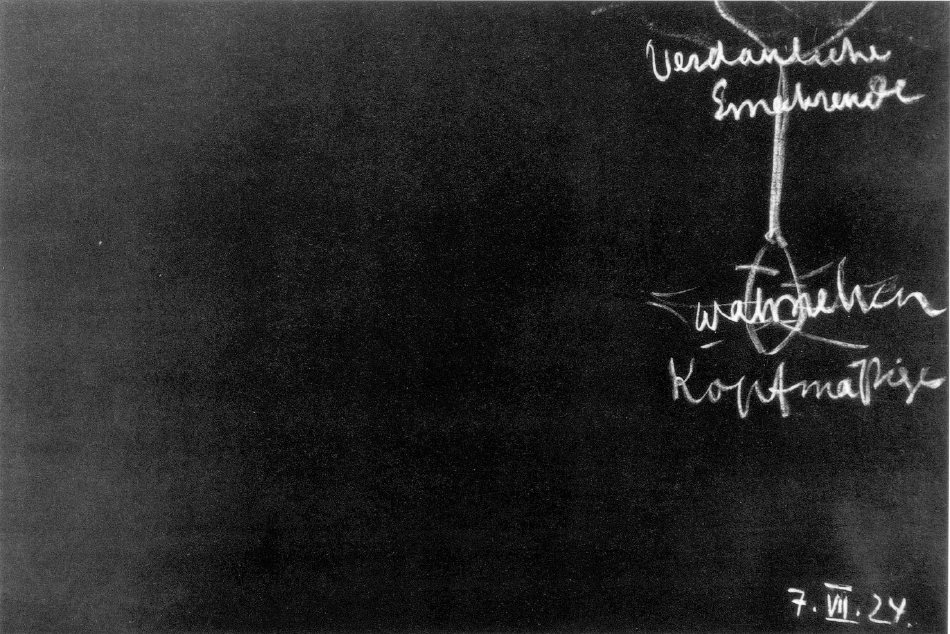
[ 6 ] All these things are not said so that one might learn something theoretical, but so that one might develop the right feelings toward what surrounds a person and enters into the sphere of their actions and deeds. And so we will have to strive to gradually accustom the child to external nourishment in such a way that we stimulate and support its metabolic system through the fruiting and flowering phases, and support the functions of the head through the gentle addition of root-based elements. These things should really only—I would say—be acquired theoretically as a starting point. In practice, they should flow into our handling of the child—but in a spiritual way.
[ 7 ] You see, on top of that, it is extremely difficult today—based on what we learn in all fields—to truly see into people. Our gaze is constantly diverted from precisely what is essential. People today are not trained to look for what is essential. It is true that in the first half of the 19th century, the sense for what is essential had completely died out. In the first half of the 19th century, there was still a mental image that survives today only in language, in the genius of language. One could characterize this, for example, in the following way: When one surveys the human race, there are the most diverse kinds of illnesses. These various illnesses could now be listed, if one were to move into the abstract. One could then, by mapping them out on a flat surface, create a kind of map: in one corner the related illnesses, in the other corner the fatal ones—one could arrange them neatly; then one would have such a map of illnesses and could see, by name, where a child, organized in whatever way, belongs. And one could imagine how what manifests as a predisposition to illness would be drawn schematically on sheets of wax paper, and one would write a child’s name where it belongs. Now imagine that one had such a mental image, that one would do that.
[ 8 ] In the first half of the 19th century, there was still a mental image that wherever one had to name a disease, one could always use the name of an animal. It was still believed that the animal kingdom imprints all manner of diseases into nature. Every animal, when viewed correctly, represents a disease. For the animal, the disease is, so to speak, healthy. If this animal enters into a human being—and instead of maintaining its own organization, the human being degenerates toward the animal’s organization—then the human is sick. Such mental images were not held only by superstitious people in the first half of the 19th century; they were even Hegel’s view, and it was a thoroughly plausible notion. Just consider how clearly you can understand the essence of any human being if you can say that he is degenerating into the lion, into the eagle, into the bark, or even that he is degenerating toward a tearing away of the human being into the overly spiritual. Or if you take it a step further and realize that, if—let’s say—the etheric body becomes too effeminate, there is a strong affinity between the etheric body and physical substance, and you then find in human beings a hint of the kind of organization that otherwise exists only in the lower animal kingdom. These are fundamental mental images that you must internalize. And what you, in turn, must accomplish as an educator in the realm of self-education lies roughly in the following:
[ 9 ] You can, of course, start with very specific meditations. One particularly powerful educational meditation is precisely the one I have described here. But you will come to see the practice you engage in—with a certain sense of direction—as meditation, by the fact that, as if in absentia corporis—in the absence of the body—you are carried along, as in an astral wave bath, into a world that unfolds gently before you, giving you the opportunity to see things around you that then provide answers to your questions. In order to even begin to access such possibilities, you must—in practice, not merely in theory—hold fast to what is specifically set forth, for example, as prerequisites for meditative development in *How Does One Attain Knowledge of the Higher Worlds?*
[ 10 ] Isn’t it true that what is cited as an obstacle to such development is human egotism—in the sense that people focus their judgment too much on their own ego? For just consider what this focus on one’s own ego actually means. We have our physical body, which dates back to the Saturnic era and is artfully formed in four majestic stages. We have the etheric body, which has been artfully transformed three times; we have the astral body, which has been transformed twice. None of these fall within the realm of earthly consciousness; only the “I” falls within the realm of earthly consciousness. But in reality, this is only an illusion of the “I,” for the true “I” can only be seen by looking back into a previous incarnation. The present “I” is merely the “I” in the making and only becomes a reality in the following incarnation. The “I” is still just a baby. And whoever sees through these things—when someone is truly swimming in their egoism—has the image of a sensual nanny who feels sensual delight in her heart toward the little child; but there, the sensual delight is justified, for the child is a separate being. But now, when faced with egoism, one has this image before one’s eyes: that the person is tenderly cradling the baby, this child. And today people walk around like this—if one were to depict them in astral terms, one would have to paint them carrying their child in one arm. —The Egyptians were still able to fashion the well-known scarab, where the ego was at least supported by the head’s structure. Modern humans carry their own ego in their arms and cradle it tenderly. Comparing this image with what one does as a daily activity is, in turn, an extraordinarily useful meditation for the educator. And then one is led into what I have described as “swimming in a bath of spiritual waves.” — Receiving answers to questions based on these insights naturally requires the inner peace that one must strive to preserve for such moments. And one immediately recognizes whether someone is predisposed to undergo any kind of development in this direction. This can be recognized by whether or not they complain about being held back. Those who are undergoing a process of development never complain that they might be held back. For in reality, one is not held back by this or that. It is conceivable that someone might engage in the most effective meditation before a decisive action that follows immediately afterward, or, conversely, after a decisive action, having completely forgotten what they experienced during the action. For what matters is that one has the power to tear oneself away from one world and find one’s way into another. And that is, in fact, the very beginning of summoning all inner forces.
[ 11 ] Look, just observe the difference between approaching a child with more or less indifference and approaching a child with genuine love. The moment you approach the child with genuine love—the moment you stop believing that technical tricks can achieve more than genuine love—the effectiveness of education becomes immediately apparent, especially with children who have behavioral challenges.
[ 12 ] And so it is, in fact, that the blossoming of a certain attitude should be seen as emerging from every foundation laid for a specific activity within the anthroposophical movement. The things that are presented should really be regarded only as the roots from which the plant of attitude sprouts. And it is truly necessary, above all else, to experience the essential nature of anthroposophy as a reality. And you will achieve nothing—this can be said in advance—if you accept what you have taken in here merely as something you have just experienced and which has not served to shape your attitude. That was, I might say, the prerequisite that was taken for granted at the time—and is becoming even more so—which underlies what is now to exist as the Anthroposophical Society since the Christmas Conference. What emanates from the Goetheanum through its institutions must be regarded as entirely real, and so in the future it cannot be otherwise than that what is to have an anthroposophical effect in the future will flow through the various sections. For, according to everything you have sensed from such discussions, this Anthroposophical Society must become an organism in which responsibilities function like lifeblood. And things already work together in the right way when they are properly perceived. Just as, for certain organizational functions in the human organism, the heart and kidneys must work together so that a unified whole may emerge, so too—for what you are currently striving for—must the sections work together; they must nurture within themselves precisely that substance for which they are specifically responsible. But whoever then undertakes something in the world must allow what emanates from the sections to work together in their actions, and one must take the anthroposophical work seriously.
[ 13 ] So suppose you intend to work with children with special needs. In that case, you must first take into account the educational current that is alive within the anthroposophical movement. This educational current must be something that, just as it is, flows into your own work. It must be clear to you that what the actual educational current contains is precisely what heals the typical human being, enabling them to take their place in the world. You must then be clear that the Medical Section alone can provide you with what can deepen pedagogy in relation to human abnormalities. And if you immerse yourselves in this in the right way, you will soon discover for yourselves that this cannot be conveyed by simply hearing, “This is good for that, that is good for this”—but only through the emergence of a continuous, living connection. This tearing apart of the living connection is something that should not exist. A certain selfishness must not take root in specialized work; rather, there must be only the longing to place oneself within the whole. As therapeutic eurythmy approaches curative education, so too does eurythmy as a whole approach curative education. From this you should see once again that a living connection must be sought in this direction as well, which should also be reflected in the fact that, to a certain extent, those who practice therapeutic eurythmy should have a foundation in eurythmy. Therapeutic eurythmy should grow out of a general knowledge of speech and tone eurythmy—even if this knowledge has not yet reached artistic perfection. Above all, however, it must be deeply understood that one must connect with the human being, and thus, wherever therapeutic eurythmy is practiced, collaboration with the physician must be sought. And a condition was set when therapeutic eurythmy was introduced that it should not be practiced without collaboration with a physician. All of this already points to how intricately, how vividly intertwined, the things that unfold in anthroposophy must become.
[ 14 ] But there is more to it than that: in the future, the Anthroposophical Society will face a decision that boils down to this: Should these responsibilities be maintained, or should they not? — You need not believe it, but you could see it from everything that is happening: back when the Christmas Conference was to be organized, these responsibilities were sharply focused upon with an exclusivity—which some might find painfully stark—regarding the quality of the human personalities who are present there. Since the Executive Council at the Goetheanum was formed on the basis of such considerations, it is inevitable that this Executive Council be regarded as the sole authority within the Anthroposophical Society. For the individual matters at hand, this Executive Council must simply be regarded as the sole authority. Will this be understood in the future, or not, within the Anthroposophical movement?
[ 15 ] And that is precisely what, especially in the case of an institution such as yours, I would say must be stated as a kind of cornerstone. Unless criticism ceases at some point within the human context—for criticism never refers to the scholar’s content, but rather to the content of what is brought about— —if this criticism does not cease, if a principle of authority—not in teaching, but in action—is not actually established, particularly with regard to matters where the occult is at work, then it will be impossible for the anthroposophical movement to become what it absolutely must become if it is to endure. This veiled defiance against those who bear the responsibilities—that is what cannot continue in the future; and there, the membership of the school will have to provide the necessary corrective by ensuring that, if the necessary understanding does not emerge, membership in the school must cease. One could say: before the Christmas Conference, the situation was such that—since there was no executive board with the intention of acting in an esoteric manner—thinking and feeling had been left to me. And to the greatest extent, everyone in the Society exercised their will as they saw fit. That was the fundamental phenomenon up until the Christmas Conference. When it came to turning to thinking or even feeling in matters of anthroposophy, people would come to me much as one goes to a cobbler to have boots made. This was all the more intense because people did not realize it; rather, they believed the opposite to be true. But the whole situation can only be remedied if there is a genuine realization that there is also a social will emanating from the Executive Council at the Goetheanum. And people will be able to find their way into this willingly, truly without coercion.
[ 16 ] But this way of thinking is quite peculiar. It clings so strongly to words. It struck me as grotesque yesterday how people everywhere cling to words, how longings are then inflated from words and, inflamed by words, give rise to actions. For example, I am said to have remarked in Breslau, regarding the executive board of the Free Anthroposophical Society, that the others had now left and only the “trunk” of the board remained. From this, it was immediately concluded: this is a “trunk” board; now it must be given a “head.” — Well, you see, the underlying fact here is this: people are clinging to a word. Because the “head” was once called the “trunk” in common parlance, they cling to this word, while completely overlooking the fact that, for the time being, the Executive Board at the Goetheanum is in complete harmony with this so-called “trunk executive board.” Otherwise, it would have said “mau” or something else about it. But since it didn’t say “mau,” the fact remains that it is provisionally in agreement. And so the point is that we must judge based on the facts.
[ 17 ] This is of the utmost importance if one is to come to terms with the anthroposophical movement. Therefore, it is necessary that you view your new home in Lauenstein—which, after all, offers the greatest hope—in such a way that it operates in full harmony with the entire anthroposophical movement; that, on the one hand, you are imbued with the awareness that the anthroposophical movement will cherish and nurture that to which it says “yes” in this way, but can do so only in accordance with its current structures as established following the Christmas Conference. But on the other hand, it must also be the case that such a member, in turn, does what they do to strengthen the power of the anthroposophical movement.
[ 18 ] I would like to urge all of you, my dear friends, to take this to heart, and please consider these heartfelt words as what I wish to leave with you—as an inspiration that will continue to have an impact.
[ 19 ] If, in the course of an intellectual process, you consider how to make that process fruitful for practical life, then you must regard that intellectual process as a living one.
[ 20 ] May this be a source of strength, guidance, and good works for your will, my dear friends!