

An Anthroposophical Understanding
of Humanity and Medicine
GA 319
24 July 1924, Arnheim
Translated by Steiner Online Library
Ninth Lecture
[ 1 ] What I presented in the first two lectures regarding general principles through which medical science can be enriched by anthroposophical research, I would like to supplement today from various angles with specific details—details that can also demonstrate how, by working into practical life from this perspective through anthroposophy, one can indeed arrive at a life-affirming, reality-based approach—if I may put it that way—to life.
[ 2 ] In the first two lectures, I indicated how anthroposophy is compelled to divide the entire human being into the physical body, which can be perceived by the external senses but which is repeatedly shed and reformed in the course of earthly life; how, within this physical body, lives the so-called etheric or Life-Body, which contains the forces of growth and nutrition, and which human beings share with plants; but how we must then further distinguish, in the case of human beings, the bearer of the life of feeling—the life that inwardly mirrors the outer world. This brings us to the astral body. — As I have already said, one need not take offense at these terms, but should simply accept them as they are explained here. — Human beings share this astral body with animals. However, human beings rise above the other kingdoms of nature within their earthly environment in that they carry within themselves the “I”-organization.
[ 3 ] If we were to classify human beings in this way only in general terms, then the value of such a classification would actually be impossible to grasp. But once one comes to understand the real significance of these four aspects of human nature, one will no longer see in them merely a philosophical debate over concepts or simply a classification of phenomena found in human beings; rather, one will realize that such a classification offers something valuable for gaining insight into the human being. And one need only look at an everyday phenomenon in human life—the alternating states of waking and sleeping—to see the significance of such a classification. Every day we see human beings transition from the state in which they move their limbs from within and take in impressions from the external world to process them internally, to the state in which they lie motionless in sleep, where their consciousness sinks—unless dreams come to the surface—into an inner, indeterminate darkness. For if one does not assume that what lives within a person—in the form of willing, feeling, and thinking—vanishes into nothingness upon falling asleep and returns from nothingness upon waking, then one must ask: What is the relationship between the waking person and the sleeping person?
[ 4 ] Here, the perspective that is capable of looking toward these higher, supersensible members of the human being shows us that what lies in bed while a person is asleep consists only of the physical body and the etheric or Life-Body, while the astral body and the “I” organization have separated from the other two members. But as soon as we—and of course I can only hint at these things here as results of Spiritual Science, anthroposophical research, which are as certain as any mathematical or scientific result—have come to realize that the human being can, during sleep, lift his astral body and his “I”-organization—that is, his actual, real spiritual-soul aspect—out of the physical organization, then we also arrive at another conclusion: that this radical, this total separation during sleep can also occur, to some extent, partially, during wakefulness as well. We need only consider how there are, after all, states in the human being that, in a sense, begin the process of falling asleep but do not bring it to the point of complete sleep: states of fainting, unconsciousness, and stupor. These are states in which the human being, so to speak, begins to drift into sleep but does not reach complete sleep, hovering as it were between sleeping and waking. What, then, is happening in a person when such states occur?
[ 5 ] To understand this, one must be able to look deeply into the human being. To do so, one must recall what I explained in my last lecture as a finding of anthroposophical research. I said that it has become possible to divide the entire human organism into the nervous-sensory organism, the rhythmic organism—which encompasses all rhythmic processes as functions—and the metabolic-limb organism. And I also mentioned that the metabolic-limb organism is polar opposites to the nervous-sensory organism, while the rhythmic organism mediates between the two. We can visualize this relationship schematically through the diagram, in which A represents the nervous-sensory organism, C represents the metabolic-limb organism, while B represents the rhythmic organism, which connects the other two and is situated within both. Of course, this is entirely schematic. These four members of the human being—the physical body, the etheric or Life-Body, the astral body, and the ego organization—run through all three of these systems of human nature. But the human being is, in fact, quite complex. And it is not the case that one can say under all circumstances, for example: “During sleep, the entire astral organism and the entire ‘I’ organization leave the physical and etheric organisms.” Rather, it may be that the nervous-sensory organism is, to a certain degree, abandoned by the astral body and the ‘I’ organization. Then, because the nervous-sensory organism—even though it permeates the entire human being—is mainly concentrated and localized in the head, the human head is compelled, by contrast, to develop something that tends toward sleep. But the person does not sleep; for their metabolic-limb system and their rhythmic system still fully contain the astral organism and the ego-organization. These two are merely withdrawn from the head. This induces a dull, numbing state, a state of unconsciousness, in the head. The rest of the organism, however, functions as it does in waking life.
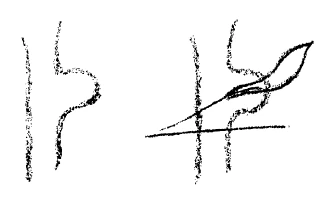
[ 6 ] What I have described to you here need not occur in a person merely as some state determined from within by one factor or another; rather, it can occur by allowing external influences to act upon the person—for example, by administering a certain quantity of lead or a lead compound. As for the state of stupor—the dizziness caused by the separation of the astral body and the “I” organization from the head, that is, this partial state of sleep—we can induce it by administering a certain dose of lead to the human organism. We can see from this that this external substance, lead, when introduced into the human organism, drives the astral body and the “I”-organization out of the head. We thus gain a deep insight into the human organism and its relationship to the environment; we see how the human organism can become dependent on what it takes in in this way.
[ 7 ] But let us now suppose that we find a person exhibiting conditions opposite to those I have just described—that is, that his astral body and his “I” organization are too intensely concentrated in the head and exert too strong an influence on it. We can see how this manifests itself if we examine how the head’s organization affects the entire human organism, and if we study how the organism is structured in the first place. We see the very solid parts—the skeletal parts—developing within it; we also see the softer parts—the muscles and so on—developing. If we study human development from childhood onward, we find that the part of the organism which, through its external structure, first reveals its tendency toward ossification—and which, through its entire organization, shows that its most essential aspect lies in ossification—the head—radiates throughout the entire course of development the forces that form the skeleton and thus act to harden and stiffen the human being. We gradually come to understand the tasks that the ego-organization and the astral organism have in the human being as they permeate the head: they work in such a way that the human being essentially radiates from the head those forces that harden him internally, forces that specifically cause him to secrete solid parts from his more fluid organization. If the astral body and the ego-organization now exert too strong an influence in the human head, then a principle of hardening and stiffening radiates too strongly from the head. And the result is what we observe in the human organism as we grow old, when we carry within us, so to speak, the predisposition for bone formation as it arises in arteriosclerosis, in the calcification of the arteries. The principle of stiffening or hardening, which otherwise shoots into the bones, shoots into the organism in an excessive manner in the case of sclerosis. We are dealing with a powerful effect of the ego-organization and the astral body; these two, so to speak, penetrate too deeply into the organism.
[ 8 ] Here, the concept of the astral body begins to take on a very realistic quality. For if we introduce lead into the organism—provided it is normal—we force its astral and ego organisms out of the head. But if these two are too deeply embedded in the head, and we then administer the appropriate dose of lead, we are correct in saying that we are drawing the astral and ego organizations somewhat out of the head: we are combating sclerosis. Here we see how we can influence this interrelationship of the human constitutional elements through external means: by introducing lead into a healthy organism, we can cause it to become ill, numb, and unconscious, as the astral body and the ego detach from its head organization—as otherwise occurs only during sleep; but if they are embedded too deeply within the head, the person remains too alert; through their persistent, excessive wakefulness, they cause themselves to harden internally, and then they develop sclerosis—and in this case, we are right to drive the astral body and the “I” somewhat out of the head. In this way, we come to understand the inner effect of the remedy by surveying the various aspects of human nature.
[ 9 ] Let us now consider the opposite case: we have the same phenomena in the metabolic-limb organization. When a person is in a deep sleep, the astral body and the “I” organization are also outside the metabolic-limb organization. But without driving the astral body and the “I” out of the head, we can drive them out of the metabolic-limb system; for just as we use lead to expel the astral and ego organizations from the head, thereby causing numbness and the like, so too can we, by administering a certain dose of silver or a silver compound to a person, expel the astral and ego organizations from the metabolic-limb system. We then observe corresponding symptoms in digestion, such as hardening of the excretions, disturbances in the digestive system, and so on.
[ 10 ] But let us suppose that, within the organism, our digestive organs are too strongly permeated by the astral body and the ego. Now, these two—the astral body and the ego—are the actual agents, the active driving forces behind the digestive system, specifically within the metabolic limb system. If they exert too strong an influence—if, so to speak, they become too deeply involved—then too much is digested, and it is digested too intensely. We experience overly rapid digestion, leading to diarrhea and all the associated symptoms; we also experience the symptoms that arise as consequences of such overly superficial digestion, which is carried out too quickly.
[ 11 ] But this is connected to something else as well, namely, that metabolic activity in the limbs will be excessive. In the human organism, however, everything works together. If metabolic limb activity is present in excess, it acts too strongly, affecting both the rhythmic organization and the head organization—but especially the rhythmic one; for it is in this that the digestive organization continues, and what has been digested is transformed into blood. The rhythm in the blood, in turn, depends on what enters the blood in terms of material substance. When this occurs—that is, when the astral body and the ego exert too strong an influence—we experience feverish symptoms and an elevated temperature. If we now know that we can expel the astral body and the ego organization from the metabolic-limb system by administering a dose of silver to a person, then we also know this: if the astral organism and the ego organization are embedded too deeply within the metabolic-limb system, we can now remove them from this system using silver or a silver compound as a remedy.
[ 12 ] This shows once again how we are capable of learning to master these interrelationships within the human being. And so Spiritual Science attempts to “examine” the whole of nature. Last time, I demonstrated, in principle, how this can be done with regard to plant beings; today I have shown how this can be done with regard to two mineral substances, lead and silver. One learns to understand the relationship of the human organism to its environment by first becoming aware of how these various substances found in the environment are processed by the different members of the human being.
[ 13 ] And now let us try to bring to mind an example that will show us how it is possible, through an inner understanding of how the human organism functions, to move from a pathological state to an understanding of the therapeutic. To do this, I must first make a preliminary remark. — We actually always have a kind of remedy within us. Human nature constantly needs a kind of remedy; of course, I am not being entirely precise in saying this, but you will immediately understand what is meant. For human nature tends toward a situation in which the ego-organization and the astral body actually want to sink too deeply into the physical body and the etheric body. To a greater or lesser extent, people tend to look out into the world not with clarity but with dullness; they also do not wish to be active—they actually want to rest and have a certain preference for rest. They actually always carry within them, to some extent, the “illness” of wanting to rest. This must be healed. And we are healthy only when the human organism is continually being healed. Iron in the blood is essential for this healing. Iron is the metal that constantly acts upon the organism in such a way that the astral body and the “I” do not become too strongly bound to the physical body and the etheric body. In fact, we are constantly undergoing a form of therapy within us: iron therapy; and the moment a person has too little iron in their system, they immediately feel a longing to become calm, to become listless; and as soon as a person develops too much iron in their system, we experience an involuntary restlessness, a fidgetiness. Iron is the regulator of the relationship between the physical body and the etheric body on the one hand, and the astral body and the “I” organization on the other. So if anything in this relationship is disturbed, we can also say: an increase or decrease in the iron content in the human organism will restore the proper balance.
[ 14 ] Now let’s take a look at a form of illness that isn’t highly regarded by the medical community. It’s quite easy to understand why. For one thing, it seems so confusing at first that one doesn’t immediately grasp what it consists of. That’s why there are all sorts of remedies for it, so that when one is recommended to someone, people say: “After all, every remedy inventor has already come up with a remedy for that.” It is the condition that, as mentioned, is not highly regarded by the medical profession, but which is nonetheless very unpleasant for those affected by it: migraine. Migraine seems confusing because it is, in fact, quite complicated at its core. - When we consider the human brain, we find within it—primarily in a more central location—the branches of the sensory nerves, which interconnect and intertwine in a marvelous way. What lies more toward the center of the brain in the human head—the internal organization of the sensory nerves—is actually a marvel of construction. This is, in essence, what stands as the most perfect aspect of the physical organization; for it is there that the human “I” exerts its influence most intensely upon the physical body. In the way the sensory nerves extend inward, connect with one another, and bring about something like an internal structure throughout the entire organism, the human organization reaches far, far beyond the animal realm. This is a marvel of construction. And it is quite possible that—precisely because the human “I” organization, the highest link in the human being, must intervene there to regulate this marvel of construction—this “I” organization may temporarily fail, leaving the physical organization to its own devices at this point. It is entirely possible that in this so-called white matter of the brain, the ego-organization is not powerful enough to penetrate it or to organize it completely. The physical and etheric organizations fall outside the scope of the ego-organization, and something like a foreign organization becomes integrated into the human organism.
[ 15 ] Now, the white matter of the brain is surrounded by the gray matter—that substance which is much less finely structured and which, although regarded by conventional physiology as the more important of the two, is not so; it is not so because it is much more closely related to nutrition. We have much more active “activity” with regard to nutrition and the internal accumulation of substances in the gray matter than in the white matter, which lies in the center and is much more closely connected to the spiritual. — But in the human organism, everything is interconnected, for every part affects every other part. And the moment the “I” begins, so to speak, to withdraw from the central brain substance—the white matter—the gray matter immediately falls into disarray. The astral body and the etheric body can no longer interact properly with the gray brain matter; this causes an irregularity throughout the entire interior of the head. The ego organization withdraws from the central brain, while the astral organization withdraws more from the periphery of the brain; the entire organization of the human head is displaced. The central brain begins to serve mental images less and less, becoming more like the gray matter, developing a kind of digestive function that it should not be developing; the gray matter begins to function more as a digestive organ than it should, secreting excessively. Foreign bodies and excessive secretions permeate the brain. But everything that becomes disorganized in this way within the head has a reciprocal effect on the finer respiratory processes, and especially on the rhythmic processes of blood circulation. We have a disorder in the human organism that, while not very profound, is nonetheless significant, and we must now raise the important question: How do we restore the “I” organization to the actual nervous system—to this continuation of the nerves from the outside to the inside? How do we drive the “I” back to where it has withdrawn from: the central regions of the brain?
[ 16 ] We achieve this by using the substance whose mode of action I described in the first two lectures: by introducing silicic acid into the organism. But if we were to use only silicic acid, we would cause the “I” to submerge into the central nervous-sensory organization of the head, while leaving the surrounding area—that is, the gray matter of the brain—as it is. We must therefore simultaneously regulate the digestive process in the gray matter of the brain so that it does not overflow, so that it integrates rhythmically into the entire normal context of the human being. Therefore, we must at the same time supply the organism with the iron that is present to continually regulate this context, in order to connect the rhythmic organism in the proper way to the entire spiritual system of the human being.
[ 17 ] At the same time, however, we notice that we are prone to digestive irregularities, particularly in the cerebrum. However, nothing happens in the human organism without something else being affected as well. And so, subtle, gradual disturbances begin to occur throughout the entire digestive system. When we study external substances in relation to the human organism, we find that sulfur and sulfur compounds act in such a way that the digestive system regulates the entire digestive process.
[ 18 ] We have now discussed the three aspects to consider in relation to migraine: regulation of digestion, the disruption of which manifests as irregular digestive activity in the cerebrum; regulation of nervous and sensory activity originating from the “I” through silicic acid; and regulation of the disrupted rhythms of the circulatory system by administering iron. In this way, we gain a clear understanding of the entire process. As I said, it is somewhat disregarded by conventional medicine; but it is incredibly vivid when one truly understands the human organism. And we come to the conclusion that the organism itself commands us to produce a preparation composed of silicic acid, sulfur, and iron in a specific way. We then obtain what, as a result of anthroposophical research, is now being distributed worldwide as a remedy for migraines—but which at the same time has an extraordinarily regulating effect on the ego organization, so that it intervenes correctly in the organism, on everything that causes disturbed rhythms in the blood circulation, and on everything that ensures the proper influence and radiation of digestion throughout the entire human organism.
[ 19 ] Anyone familiar with the human organism knows that an immense amount of what causes disorder in the organism actually originates from these three aspects, and that, ultimately, migraine is merely a symptom of the fact that the etheric body, the astral body, and the ego are not functioning properly within the physical body. It is therefore no wonder that our migraine remedy is, in fact, suited to regulating the interaction between the ego, the astral body, the etheric body, and the physical organism. Therefore, when a person feels that these aspects of their being are not working together properly within them, our migraine remedy—which is not merely a migraine remedy—will be able to help them under all circumstances. It is a migraine remedy because it specifically addresses what manifests in migraine in its most radical symptoms, and I was able to illustrate to you, using this very remedy, how one studies the nature of a disease according to anthroposophical principles and how one then formulates the preparation once one knows what effects the individual aspects of the human being in one way or another.
[ 20 ] With remedies prepared in this way, it is essential to understand the relationship between the human organism and the environment. But this requires a serious commitment to studying the essence of this relationship. Last time, I explained how we arrive at plant remedies, using the example of field horsetail, Equisetum arvense. One can say of every plant: it acts in this or that way on this or that organ. But if we wish to study such things, we must also be clear that a plant growing somewhere outdoors is something entirely different in the spring than it is in the fall. When we have the sprouting, budding plant in the spring, it contains a physical and an ethereal aspect, just as the human being carries within themselves. If I then use any substantial part of these plants in the human organism, I will be able to exert particularly strong effects on the physical body and the etheric body. If we now leave the plants outside throughout the summer and pick them as autumn approaches, we have the dying, withering, and drying-up plant.
[ 21 ] Let us now look back at the human organism. It sprouts and grows through the development of its physical body; it sprouts and grows through what the etheric body brings about within it. Decay occurs through the astral body, and likewise through the “I” organization. In human beings, we have life that is constantly sprouting and budding through the physical body and through the etheric organization. If only this were present in human beings, they would not develop a calm, level-headed consciousness; for the more we stimulate the forces of growth—the more things sprout and bud within us—the more impulsive we become. And when, during sleep, the ego-organization and the astral organism are separated from the other two members, we are completely unconscious, devoid of consciousness. What builds up the human being causes it to grow; it enables the nourishing forces within to process the substances taken in; but this does not lead to feeling or thinking. Rather, in order for feeling and thinking to occur, a process of breakdown must take place. This is the purpose of the astral body and the “I” organization. They bring about a continuous autumn within the human being. Through the physical organization and the etheric body, there is a constant spring within the human being—sprouting, budding life—but no composure, no consciousness, nothing of a soul-spiritual nature. Through the astral and the “I” organization, breakdown occurs; there, the powers of the etheric body are held back, and the physical body is hardened and made to wither. But this must happen. The physical body must constantly oscillate back and forth between building up and breaking down; the etheric body must constantly move between sprouting and budding forces on the one hand and between forces that withdraw on the other. Out in nature, we find the forces alternating from spring to fall; nature allows spring and fall to occur separately according to the seasons. In human beings, we have a rhythm: when a person falls asleep, it becomes entirely spring within them, as physical and etheric life sprouts and shoots forth; when they awaken, physical and etheric life is pushed back and held in check, and sobriety asserts itself: it becomes autumn and winter. From this we can see how superficially one actually judges when one relies solely on external analogies. Who, looking at outward appearances, would not describe a person’s awakening and transition to daily life as spring and summer, and falling asleep as entering the darkness of winter? But that is not how it really is. When we fall asleep, because the astral body and the “I” are absent, sprouting and budding begin within us; there, in the etheric body—which otherwise delights us in plants—spring and summer arise when we fall asleep; and if we could look back at the physical and etheric bodies and observe what is happening there once we have left them both—for this, of course, one needs spiritual perception; one cannot see this with physical eyes, for with them one would see only the motionless body—one would then be able to describe this sprouting and budding. And upon waking, we would perceive through spiritual insight how we are entering autumn.
[ 22 ] Now let’s assume we’re looking for herbal remedies. We pick gentian in the spring. Gentian is a good remedy for dyspepsia. If we pick it in the spring, then—provided we process it properly into a remedy—we can address whatever is primarily emanating from the physical and etheric bodies. If we have impaired growth or impaired nutritive forces, we will boil gentian roots and use the decoction to improve the nutritive forces and combat the disturbance. But if we use gentian roots by digging them up in the fall—when the entire gentian is organized precisely to break down and become similar to what the astral body effects in human beings—then no healing will result; on the contrary, we will exacerbate the digestive irregularity. We must therefore not only know a plant and say of it, “It is a remedy for this or that,” but we must also know when to harvest that plant in order to use it as a remedy.
[ 23 ] We must therefore take a comprehensive view of the entire development of nature if we wish to use plant remedies that can be particularly effective. For this reason, when preparing remedies—where a rational therapy must indeed be derived from an understanding of the state of the disease—it is necessary to take into account everything that arises from the development of the plant world as well. One must therefore be aware, when preparing remedies, that the process is different when plants are harvested and used in the fall than when they are harvested and used in the spring. However, what is possible only over long periods of time can also be achieved within shorter periods. When we prepare remedies intended for healing, we must learn what it means to pick gentian in the first week of May—and to pick gentian in the last week of May. For what a person carries within themselves over the course of twenty-four hours—spring, summer, fall, and winter—is spread out over three hundred sixty-five days in nature; for a person, over the period of twenty-four hours, we need what develops in nature over three hundred sixty-five days.
[ 24 ] From this you can see what it means to apply anthroposophical principles to medicine. We have a very commendable medical science today, and I have—because this must be particularly emphasized—repeatedly said during these lectures: What anthroposophy seeks to contribute to medicine is by no means intended to stand in opposition to what is achieved by today’s recognized medical science. To the extent that the latter is recognized as legitimate, anthroposophical medicine should certainly stand on the foundation of modern medicine. Anthroposophy cannot go along with those efforts that, in a layman’s way, simply assume that what one is supposed to study is too much, and that one would now like to easily obtain all sorts of quack remedies. For it recognizes that reality, when viewed spiritually, proves to be far more complex than one might suspect based on physical science. Therefore, approaches that arise on one side or the other—where one needs to know very little to be considered a healer—may well become very popular; for they present themselves in such a way that people say: “One can spare oneself the medical studies.”—That cannot be said! Anthroposophy cannot spare people the study of medicine; on the contrary, it must add much more to it. Admittedly, the study of medicine could be pursued more efficiently; what is currently spread out over many years—because it has become so vast—could be taught in a shorter time. But something else must be added: an understanding of the human being.
[ 25 ] Let us take once more what I have already said in these lectures: that the nervous-sensory system is permeated by all four members of the human being—the physical body, the etheric body, the astral body, and the I—and that the metabolic-limb system, in turn, is permeated by all four members. But they are permeated by them in different ways. The metabolic-limb system is permeated in such a way that the “I” organization exerts a significantly stronger influence through the will. Everything that constitutes activity—that sets the human being and the entire human organism in motion—is contained within the metabolic-limb system; everything that allows the human being to rest and fills them with inner experiences, with mental images, thoughts, and emotional experiences, is contained within the nervous-sensory system. This represents a fundamental difference: namely, that in the nervous-sensory system, the physical body and the etheric body are much more important than the “I” and the astral system; whereas for the metabolic-limb system, the “I” and the astral system are particularly important. Therefore, if the “I” and the astral body exert too strong an influence on the nervous-sensory system, then what the nervous-sensory system drives into the other organizational elements of human nature will manifest in the human being. An overactivity of the ego organization and the astral organization within the nervous-sensory organism somehow drives this entire nervous-sensory organization into the metabolic-limb organization. Various pathways can be identified through which the nervous-sensory organization is driven into the metabolic-limb organization: the result is always what we can collectively term “tumor formation.” And we come to understand tumor formation when we see how, through excessive ego activity or astral activity, the nervous-sensory organization is driven into the rest of the organism.
[ 26 ] Let us assume the opposite: In the metabolic-limb organism, the “I” and the astral organization recede; the physical and etheric organizations become too strong, they radiate into the nervous-sensory system, and they flood it with processes that should belong only to the metabolic-limb system: Inflammatory conditions arise. We can see how tumors and inflammatory conditions manifest as polar opposites. If we now know how to counteract the nervous-sensory organization when it begins to exert its influence anywhere in the metabolic-limb system, then we can initiate possible healing processes.
[ 27 ] One of the processes in which the nervous-sensory system can truly manifest itself in a terrible way somewhere within the metabolic-limb system is the formation of cancer, or carcinoma. What occurs here, then, is that the nervous-sensory organization penetrates the metabolic-limb organization and asserts itself within it. In the second lecture, I said that within the metabolic-limb system we see something akin to sensory organ rudiments formed in the wrong place. The ear, when formed in the correct place, is normal; if an ear bud or any sensory organ bud—even in its most rudimentary form—is formed in the wrong place, then we are dealing with a carcinoma, with a cancerous formation. We must counteract this tendency of the human organism to form sensory organs in the wrong places. To do this, we must look deeply into the entire process of development that has led up to the human being in the world and in the cosmos.
[ 28 ] If you read through anthroposophical literature, you will find a cosmology and a theory of the origin of the world that are quite different from those presented by materialism. You will find that the formation of our Earth had a different, earlier stage of development in which human beings did not yet exist in their present form, but in which—in a certain sense—the animal realm was spiritually superior. However, its senses were not yet fully developed at that time. They only reached their final form in humans during the course of Earth’s evolution. Their potential has existed for the longest time; but their final development—in which they are permeated by the “I” organization, just as they are today—was only achieved during Earth’s evolution. The human “I” penetrated into the eyes, ears, and the other senses during Earth’s evolution. Therefore, if ego development becomes too strong, not only do the senses develop in the human organism in the normal way, but an excessive tendency to form senses arises. And cancer develops. What must I do if I wish to intervene here with healing? I must go back to earlier stages of Earth’s evolution, when the organisms that exist on Earth today were not yet present; I must look somewhere for what constitutes the last remnant, the residue, the legacy of earlier states of the Earth. This leads me to the conclusion that it is those plants that grow on trees as parasites, as mistletoe formations—plants that have not managed to take root in the soil but must proliferate on living organisms. Why must they do this? Because they actually developed before our Earth became this solid, mineral Earth. Today, I see in the mistletoe that which could not become a pure Earth formation; it must attach itself to a foreign plant because the mineral kingdom arose last in the Earth’s development. And in the substance of mistletoe we find what, when processed in the appropriate manner, acts as a remedy against the formation of carcinomas—which drive the development of sensory organs to the wrong places within the human organism. —To understand nature means having the ability to combat that which, in some way, deviates from normal development into a pathological state. When a person has cancer within them, they become too much like the Earth; they develop the Earth forces within themselves to an excessive degree. These excessive Earth forces must be countered by forces corresponding to a state of the Earth in which the mineral kingdom and the present-day Earth did not yet exist. That is why, on the basis of anthroposophical research, we are developing the cancer remedy in a specific mistletoe preparation. And through this, based on an understanding of the very nature of this disease, the remedy will undoubtedly be found that will gradually render conventional healing processes—including surgical procedures—unnecessary.
[ 29 ] I have thus provided you with the details. I could add much more to this, for we already have a large number of remedies available. For example, I could point out the following: Since it is possible for the metabolic-limb organization to radiate into the sensory organization at the outermost periphery, this manifests itself in a specific form of illness, namely, hay fever. Here we have the opposite of what I described earlier: when the nervous-sensory system, so to speak, slides down into the metabolic-limb system, this results in tumor formation; if, on the other hand, the metabolic-limb system penetrates into the nervous-sensory system, we get phenomena such as those found, for example, in hay fever. In this case, the aim is to paralyze those centrifugal processes—where metabolic and limb activity is directed too strongly toward the periphery of the organism—by means of something that, in turn, pushes the ethereal forces back. We attempt this with a preparation derived from fruits that are encased in specific shells, where the formation of these shells drives back the ethereal aspect of metabolism. In our preparation, we counter the excessively strong centrifugal forces present in hay fever with other, strongly centripetal forces that combat the former. We gain a very precise understanding of both the pathological process and the healing process. And we can point out how the greatest successes with our remedies are achieved precisely in those areas where it is difficult to know how to proceed today. In the field of hay fever treatment, for example, very good results have been achieved precisely with the preparations derived from the perspective described above.
[ 30 ] Many such details could be cited. And they would show that this characteristic insight into the human being—which is made possible by anthroposophical research—builds a bridge between pathology and therapy. For, after all, how do the ego and the astral organism function? They break things down. It is precisely because we break things down that we are spiritual-soul beings. There is always a purely toxic effect present when something is broken down; the organs are destroyed. If organs proliferate, we must also break them down vigorously. But the astral and ego activities in the human being are themselves processes of breakdown. When we are exposed to external poisons—whether metallic or plant-based—their effect on the human organism is analogous to the activity of the astral and ego organizations. We need only understand how much of the entire normal activity in human beings—through the action of the ego and the astral body within them—also involves toxic effects. In all mental activity, in all soul development, we act upon the body through toxic effects. We come to understand the similarity between the outwardly sprouting and budding forces in plants—which we can also eat without them harming us—and the physical and etheric forces in human beings; and we come to recognize the similarity between the effect of the ego and the astral body on the human organism and the effect of the forces and substances in those plants that we cannot eat because they harm us; but which, because their effects resemble normal metabolic processes in humans, can act as remedies when used appropriately.
[ 31 ] Thus we learn to divide the whole of nature, first, into that which is similar to the forces of our physical and etheric bodies—that is, into what we eat, where we wish to promote proliferation and growth; and second, into that which we break down, that is, into the toxic effects that are similar to our astral body and the “I” organization. If we thus gain insight into these four aspects of the human being—the physical body, the etheric body, the astral organization, and the “I”—we will view this polar opposition between nourishing substances and toxic substances in an entirely different light. Then we look into the healing forces as they are spread throughout nature within the nourishing forces. Then the study of disease becomes a continuation of the study of nature. If we perceive both—health and disease—spiritually, our entire view of nature is enriched. —Only one thing is needed to undertake such a study. Today, people like to undertake studies when the subject at hand is quite calm; they want to calm the subject down as much as possible, to establish a state of calm, so that they have as much time as possible to survey the whole. Anthroposophy, on the other hand, sets everything in motion in its study; everything is activity and movement. There, everything must be observed with presence of mind; one cannot afford to take one’s time by first calming things down. But this is how one comes close to life and reality. And this also includes something I always speak of as being present in our institute in Arlesheim, led by our dear colleague, Dr. Wegman: the courage to heal. This courage to heal is just as necessary as knowledge of healing—a courage that does not foster a nebulous, fanciful optimism in healing, but rather a well-founded optimism that offers certainty, where one says: here is a case of illness, one understands it, one attempts to heal it, and one does what one can. Then what is possible will emerge. However, if one wishes to have this inner certainty, one must certainly have the courage to perceive and grasp the human being and nature in their flow. And so, naturally, remedies such as those we develop can only arise in connection with the living practice of medicine. But this is being pursued in the manner I already outlined in the first lecture: Alongside the Goetheanum, which strives for insights intended to satisfy the individual in the realm of anthroposophy for his or her spiritual life, stands—still in a modest way, it will become even more perfect—as always, the healing center, alongside the place of the Mysteries, the clinic; for a truly holistic relationship of the human being to the entire world encompasses both the healing and the ailing processes, and because a deep insight into the cosmos is only possible if one is able to survey those predispositions that lead to illness just as well as those that lead to health. If what constitutes human, ascending organization could not be held back, if what grows, sprouts, and shoots forth could not be continually restrained, then a spiritual-soul being would never be possible. The very phenomena that, in the normal state of human beings, become illness—a regression in development—must, after all, exist in some form in order to make us spiritual, thinking beings in the first place. If we, as human beings, could not become ill, we could not be spiritual beings either; for we are spiritual beings only because we possess within ourselves the potential to become ill. What must always occur in thinking, feeling, and willing occurs in an abnormal way in illness. Our liver and our kidneys must undergo the same processes that we undergo in thinking, feeling, and willing—processes that simply go too far when they occur in excessive numbers. If we could not become ill, we would have to remain fools our entire lives! It is to the possibility of becoming ill that we owe the other possibility: that of becoming thinking, feeling, and willing human beings.
[ 32 ] When we grasp this connection—and anthroposophy brings it to our awareness in a very special way—then, precisely from the anthroposophical point of view, it becomes a matter close to our hearts to study, in connection with the spiritualization of the human being, the accompanying phenomena that this spiritualization must entail: the manifestations of illness. And then spiritual development and that which must be paid for by this spiritual development—namely, human illness—become two poles of one and the same humanity, and then we adopt the proper attitude—including with our mind and our feelings—toward illness and the necessary healing processes.
[ 33 ] This is the inner, emotional aspect of how anthroposophical Spiritual Science can enrich medicine. It can enrich it through knowledge, as I have shown; but it can also enrich it by enabling the physician to place the heart in the right place, so that medical dedication and a willingness to make sacrifices arise precisely from this inner connection between illness and spiritual development. Anthroposophy has the potential everywhere not only to deepen our thinking and our intellectuality, but also to deepen our feeling—our entire being. This is what I wanted to offer as the answer to the question I posed as the topic: What can the art of healing gain from a perspective based on Spiritual Science?
[ 34 ] The benefit of this is that the physician truly becomes capable of becoming a whole human being as a healer—not merely someone who thinks about illness with his head alone, but one who experiences illness from the innermost essence of human being and thereby sees in the healing process a true, dignified task—his mission. The physician’s profession is only placed in its proper social context when he realizes that illnesses are the shadows of spiritual development. But in order to recognize these shadows in the right way, we must also look toward the light—toward the nature and essence of the spiritual processes themselves. If the physician learns to look at these spiritual processes in the appropriate way—at the light that works within the human being—then he will also understand how to assess the shadows correctly. Where there is light, there must be shadow. Where there is spiritual development—as, for example, within humanity—symptoms of illness must appear as the shadows of such development. Only those who also look toward the light in the right way can master it.
[ 35 ] This is what anthroposophy can offer physicians and the art of healing.