

An Anthroposophical Understanding
of Humanity and Medicine
GA 319
24 July 1924, Arnheim
Translate the original German text into any language:
Versions Available:
An Anthroposophical Understanding of Humanity and Medicine, tr. SOL
Neunter Vortrag
Ninth Lecture
[ 1 ] Was ich in den ersten beiden Vorträgen über allgemeine Prinzipien vorbrachte, durch welche die Heilkunde befruchtet werden kann durch die anthroposophische Forschung, das möchte ich heute nach der einen oder anderen Seite hin durch Einzelheiten ergänzen, durch solche Einzelheiten, die zugleich zeigen können, wie man, indem man von dieser Seite her durch Anthroposophie ins praktische Leben hineinwirkt, tatsächlich auch zu einer lebensfreundlichen, zu einer wirklichkeitsgemäßen Handhabung — wenn ich so sagen darf — des Lebens kommt.
[ 1 ] What I presented in the first two lectures regarding general principles through which medical science can be enriched by anthroposophical research, I would like to supplement today from various angles with specific details—details that can also demonstrate how, by working into practical life from this perspective through anthroposophy, one can indeed arrive at a life-affirming, reality-based approach—if I may put it that way—to life.
[ 2 ] In den ersten beiden Vorträgen habe ich angedeutet, wie Anthroposophie genötigt ist, die gesamte menschliche Wesenheit zu gliedern in den physischen Leib, der für die äußeren Sinne wahrgenommen werden kann, der aber im Laufe des Erdenlebens wiederholt abgeworfen und neu gebildet wird; wie dann innerhalb dieses physischen Leibes lebt der sogenannte Äther- oder Lebensleib, der die Wachstumskräfte, die Ernährungskräfte in sich enthält, und den der Mensch mit der Pflanze gemeinschaftlich hat; wie wir aber dann beim Menschen weiter unterscheiden müssen den Träger des Empfindungslebens, des Lebens, das innerlich die äußere Welt spiegelt. Wir kommen damit zu dem astralischen Leib. — Ich sagte schon, man braucht sich an Ausdrücken nicht zu stoßen, sondern sie nur als das zu nehmen, als was sie hier erklärt werden. - Diesen astralischen Leib hat der Mensch nun mit dem Tiere gemeinschaftlich. Dann ragt aber der Mensch über die übrigen Naturreiche innerhalb seiner Erdenumgebung dadurch hinaus, daß er in sich trägt die Ich-Organisation.
[ 2 ] In the first two lectures, I indicated how anthroposophy is compelled to divide the entire human being into the physical body, which can be perceived by the external senses but which is repeatedly shed and reformed in the course of earthly life; how, within this physical body, lives the so-called etheric or Life-Body, which contains the forces of growth and nutrition, and which human beings share with plants; but how we must then further distinguish, in the case of human beings, the bearer of the life of feeling—the life that inwardly mirrors the outer world. This brings us to the astral body. — As I have already said, one need not take offense at these terms, but should simply accept them as they are explained here. — Human beings share this astral body with animals. However, human beings rise above the other kingdoms of nature within their earthly environment in that they carry within themselves the “I”-organization.
[ 3 ] Wenn wir nur im allgemeinen den Menschen so gliederten, dann würde eine solche Gliederung eigentlich ihrem Werte nach gar nicht eingesehen werden können. Wenn man aber dazu kommt, einzusehen, welche reale Bedeutung diese vier Glieder der menschlichen Natur haben, dann wird man nicht mehr eine bloße philosophische Begriffsauseinandersetzung oder nur eine Einteilung der am Menschen vorkommenden Erscheinungen darin finden; sondern dann wird man einsehen, daß mit einer solchen Gliederung etwas gewonnen ist für das Hineinschauen in die menschliche Wesenheit. Und man braucht ja nur auf eine alltägliche Erscheinung im menschlichen Leben hinzublicken, auf den Wechselzustand von Wachen und Schlafen, dann wird man schon finden, welche Bedeutung eine solche Gliederung hat. Alltäglich sehen wir den Menschen aus dem Zustande, in dem er von innen heraus seine Glieder bewegt und aus der Außenwelt die Eindrücke aufnimmt, um sie innerlich zu verarbeiten, übergehen in denjenigen Zustand, wo er schlafend regungslos daliegt, wo sein Bewußtsein hinuntersinkt — wenn nicht die Träume heraufgaukeln - in eine innere, unbestimmte Finsternis. Will man nämlich nicht annehmen, daß das, was im Menschen innerlich lebt, innerlich west als Wollen, Fühlen und Denken, beim Einschlafen ins Nichts vergeht, beim Aufwachen aus dem Nichts wieder zurückkehrt, dann wird man sich fragen müssen; Wie verhält sich denn der wachende Mensch zum schlafenden Menschen?
[ 3 ] If we were to classify human beings in this way only in general terms, then the value of such a classification would actually be impossible to grasp. But once one comes to understand the real significance of these four aspects of human nature, one will no longer see in them merely a philosophical debate over concepts or simply a classification of phenomena found in human beings; rather, one will realize that such a classification offers something valuable for gaining insight into the human being. And one need only look at an everyday phenomenon in human life—the alternating states of waking and sleeping—to see the significance of such a classification. Every day we see human beings transition from the state in which they move their limbs from within and take in impressions from the external world to process them internally, to the state in which they lie motionless in sleep, where their consciousness sinks—unless dreams come to the surface—into an inner, indeterminate darkness. For if one does not assume that what lives within a person—in the form of willing, feeling, and thinking—vanishes into nothingness upon falling asleep and returns from nothingness upon waking, then one must ask: What is the relationship between the waking person and the sleeping person?
[ 4 ] Da zeigt uns diejenige Anschauung, die in der Lage ist, auf diese höheren, übersinnlichen Glieder der menschlichen Wesenheit hinzublicken, daß dasjenige, was vom Menschen während des Schlafens im Bette liegt, nur den physischen Leib und den Äther- oder Lebensleib enthält, während der astralische Leib und die Ich-Organisation sich von den beiden anderen Gliedern getrennt haben. Sobald wir aber und ich kann diese Dinge natürlich hier nur andeuten als Ergebnisse geisteswissenschaftlicher, anthroposophischer Forschung, die so sicher stehen wie nur irgendein mathematisches oder naturwissenschaftliches Ergebnis - darauf gekommen sind, daß der Mensch sein Astralisches und seine Ich-Organisation, also sein eigentliches reales Geistig-Seelisches, während des Schlafes herausheben kann aus der physischen Organisation, dann kommt man auch auf ein anderes: daß dieses radikale, dieses totale Herausheben während des Schlafes teilweise, partiell, auch während des Wachens eintreten kann. Wir brauchen ja nur darauf hinzuschauen, wie es in der menschlichen Wesenheit immerhin Zustände gibt, die gewissermaßen das Schlafen anheben, aber es nicht bis zum völligen Schlafen bringen: Ohnmachtszustände, Bewußtlosigkeit, Betäubungszustände. Das sind Zustände, in denen die menschliche Wesenheit gewissermaßen das Schlafen anhebt, aber nicht bis zum völligen Schlafen kommt, wo sie so schwebt zwischen Schlafen und Wachen. Was liegt denn beim Menschen vor, wenn derartige Zustände eintreten?
[ 4 ] Here, the perspective that is capable of looking toward these higher, supersensible members of the human being shows us that what lies in bed while a person is asleep consists only of the physical body and the etheric or Life-Body, while the astral body and the “I” organization have separated from the other two members. But as soon as we—and of course I can only hint at these things here as results of Spiritual Science, anthroposophical research, which are as certain as any mathematical or scientific result—have come to realize that the human being can, during sleep, lift his astral body and his “I”-organization—that is, his actual, real spiritual-soul aspect—out of the physical organization, then we also arrive at another conclusion: that this radical, this total separation during sleep can also occur, to some extent, partially, during wakefulness as well. We need only consider how there are, after all, states in the human being that, in a sense, begin the process of falling asleep but do not bring it to the point of complete sleep: states of fainting, unconsciousness, and stupor. These are states in which the human being, so to speak, begins to drift into sleep but does not reach complete sleep, hovering as it were between sleeping and waking. What, then, is happening in a person when such states occur?
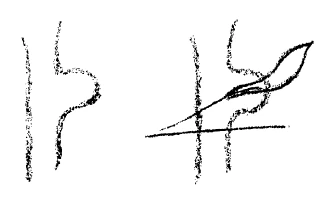
[ 5 ] Um das zu verstehen, muß man völlig in die menschliche Wesenheit hineinschauen können. Dazu muß man dessen gedenken, was ich im letzten Vortrage als ein anthroposophisches Forschungsergebnis auseinandergesetzt habe. Ich sagte, daß es möglich geworden ist, die gesamte Organisation des Menschen zu gliedern nach dem Nerven-Sinnesorganismus, nach dem rhythmischen Organismus, der alle rhythmischen Vorgänge als Funktionen umfaßt, und nach dem Stoffwechsel-Gliedmaßenorganismus. Und ich sagte auch schon, daß der Stoffwechsel-Gliedmaßenorganismus polarisch entgegengesetzt ist dem Nerven-Sinnesorganismus, während der rhythmische zwischen beiden vermittelt. Wir können uns schematisch dieses Verhältnis durch die Zeichnung versinnlichen, in der mit A der Nerven-Sinnesorganismus, mit C der Stoffwechsel-Gliedmaßenorganismus angedeutet sein soll, während B den rhythmischen Organismus darstellen soll, der die beiden anderen verbindet, in beide hineingestellt ist. Natürlich ganz schematisch. Durch alle drei dieser Systeme der menschlichen Natur gehen hindurch diese vier Glieder der menschlichen Wesenheit: der physische Leib, der Äther- oder Lebensleib, der astralische Leib und die IchOrganisation. Aber die menschliche Wesenheit ist eben durchaus kompliziert. Und es ist nicht so, daß man unter allen Umständen sagen kann wie: im Schlafe geht der ganze astralische Organismus und die ganze Ich-Organisation aus dem physischen und dem ätherischen Organismus heraus. Sondern es kann so sein, daß der Nerven-Sinnesorganismus bis zu einem gewissen Grade von dem astralischen Leib und von der Ich-Organisation verlassen wird. Dann ist, weil der Nerven-Sinnesorganismus, wenn er auch den ganzen Menschen erfüllt, hauptsächlich im Haupt konzentriert, lokalisiert ist, dann ist im Gegensatz der menschliche Kopf genötigt, so etwas zu entwickeln, was gegen den Schlaf hinüberneigt. Aber der Mensch schläft nicht; denn sein Stoffwechsel-Gliedmaßensystem und sein rhythmisches System enthalten noch voll den astralischen Organismus und die Ich-Organisation. Diese beiden sind nur aus dem Haupte heraus. Dadurch wird im Kopfe ein dumpfer, ein Betäubungszustand, ein Ohnmachtszustand hervorgerufen. Der übrige Organismus aber funktioniert wie im Wachleben.
[ 5 ] To understand this, one must be able to look deeply into the human being. To do so, one must recall what I explained in my last lecture as a finding of anthroposophical research. I said that it has become possible to divide the entire human organism into the nervous-sensory organism, the rhythmic organism—which encompasses all rhythmic processes as functions—and the metabolic-limb organism. And I also mentioned that the metabolic-limb organism is polar opposites to the nervous-sensory organism, while the rhythmic organism mediates between the two. We can visualize this relationship schematically through the diagram, in which A represents the nervous-sensory organism, C represents the metabolic-limb organism, while B represents the rhythmic organism, which connects the other two and is situated within both. Of course, this is entirely schematic. These four members of the human being—the physical body, the etheric or Life-Body, the astral body, and the ego organization—run through all three of these systems of human nature. But the human being is, in fact, quite complex. And it is not the case that one can say under all circumstances, for example: “During sleep, the entire astral organism and the entire ‘I’ organization leave the physical and etheric organisms.” Rather, it may be that the nervous-sensory organism is, to a certain degree, abandoned by the astral body and the ‘I’ organization. Then, because the nervous-sensory organism—even though it permeates the entire human being—is mainly concentrated and localized in the head, the human head is compelled, by contrast, to develop something that tends toward sleep. But the person does not sleep; for their metabolic-limb system and their rhythmic system still fully contain the astral organism and the ego-organization. These two are merely withdrawn from the head. This induces a dull, numbing state, a state of unconsciousness, in the head. The rest of the organism, however, functions as it does in waking life.
[ 6 ] Was ich Ihnen hier geschildert habe, das braucht für den Menschen nicht bloß als irgendein Zustand einzutreten, der durch das oder jenes von innen heraus bestimmt ist, sondern es kann dadurch eintreten, daß wir Äußeres auf den Menschen wirken lassen, indem wir ihm zum Beispiel eine gewisse Quantität Blei oder einer Bleiverbindung beibringen. Was den Betäubungszustand, den Schwindelzustand durch Abtrennen des astralischen Leibes und der Ich-Organisation vom Haupte bewirkt, also diesen partiellen Schlafzustand, das können wir dadurch hervorrufen, daß wir dem menschlichen Organismus eine gewisse Dosis Blei zuführen. Wir sehen daraus, daß diese äußere Substanz, das Blei, indem es in den menschlichen Organismus eingeführt wird, den astralischen Organismus und die Ich-Organisation aus dem Kopfe heraustreibt. Wir blicken damit tief hinein in die menschliche Organisation, in ihr Verhältnis zur Umwelt; wir sehen, wie der menschliche Organismus abhängig werden kann von dem, was er in dieser Weise aufnimmt.
[ 6 ] What I have described to you here need not occur in a person merely as some state determined from within by one factor or another; rather, it can occur by allowing external influences to act upon the person—for example, by administering a certain quantity of lead or a lead compound. As for the state of stupor—the dizziness caused by the separation of the astral body and the “I” organization from the head, that is, this partial state of sleep—we can induce it by administering a certain dose of lead to the human organism. We can see from this that this external substance, lead, when introduced into the human organism, drives the astral body and the “I”-organization out of the head. We thus gain a deep insight into the human organism and its relationship to the environment; we see how the human organism can become dependent on what it takes in in this way.
[ 7 ] Aber nehmen wir jetzt an, wir finden, daß der Mensch die entgegengesetzten Zustände von denjenigen zeigt, die ich soeben geschildert habe, daß er zeigt: sein astralischer Leib und seine Ich-Organisation stecken zu intensiv im Kopfe drinnen, wirken zu stark auf den Kopf. Worin sich das zeigt, kann uns klarwerden, wenn wir einmal prüfen, wie die Hauptesorganisation auf den ganzen menschlichen Organismus wirkt, wenn wir studieren, wie der Organismus sich überhaupt aufbaut. Wir sehen in ihm entstehen die ganz festen Teile, die Skeletteile; wir sehen weiter die weicheren Teile, die Muskeln und so weiter entstehen. Studieren wir die menschliche Entwickelung von Kindheit auf, so finden wir, daß derjenige Teil des Organismus, der uns zunächst durch seinen äußeren Bau zeigt, wie er nach der Verknöcherung hinneigt, der uns durch seine ganze Organisation zeigt, daß er in der Verknöcherung sein Wesentlichstes hat, das Haupt, durch die ganze Entwickelung hin die Kräfte ausstrahlt, welche skelettbildend sind und damit verhärtend, versteifend in der menschlichen Wesenheit wirken. Wir kommen allmählich darauf, welche Aufgaben die Ich-Organisation und der astralische Organismus im Menschen haben, indem sie den Kopf durchdringen: sie wirken so, daß der Mensch vom Kopfe aus im wesentlichen diejenigen Kräfte ausstrahlt, die ihn innerlich verhärten, die namentlich dahin wirken, daß er feste Teile aussondert aus seiner mehr flüssigen Organisation. Wirken nun im menschlichen Haupt der astralische Leib und die Ich-Organisation zu stark, dann wirkt vom Kopfe ausstrahlend ein zu starkes Prinzip der Verhärtung, des Sich-Versteifens. Und die Folge ist, was wir an der menschlichen Organisation beobachten, wenn wir alt werden, wo wir sozusagen die Anlage zur Knochenbildung im Entstehen in der Arteriosklerose, in der Verkalkung der Adern, in uns tragen. Das Versteifungs- oder Verhärtungsprinzip, das sonst in die Knochen hineinschießt, das schießt in der Sklerose in übermäßiger Weise in den Organismus hinein. Wir haben es zu tun mit einer starken Wirkung der Ich-Organisation und des astralischen Leibes; diese beiden setzen sich gewissermaßen zu tief in den Organismus hinein.
[ 7 ] But let us now suppose that we find a person exhibiting conditions opposite to those I have just described—that is, that his astral body and his “I” organization are too intensely concentrated in the head and exert too strong an influence on it. We can see how this manifests itself if we examine how the head’s organization affects the entire human organism, and if we study how the organism is structured in the first place. We see the very solid parts—the skeletal parts—developing within it; we also see the softer parts—the muscles and so on—developing. If we study human development from childhood onward, we find that the part of the organism which, through its external structure, first reveals its tendency toward ossification—and which, through its entire organization, shows that its most essential aspect lies in ossification—the head—radiates throughout the entire course of development the forces that form the skeleton and thus act to harden and stiffen the human being. We gradually come to understand the tasks that the ego-organization and the astral organism have in the human being as they permeate the head: they work in such a way that the human being essentially radiates from the head those forces that harden him internally, forces that specifically cause him to secrete solid parts from his more fluid organization. If the astral body and the ego-organization now exert too strong an influence in the human head, then a principle of hardening and stiffening radiates too strongly from the head. And the result is what we observe in the human organism as we grow old, when we carry within us, so to speak, the predisposition for bone formation as it arises in arteriosclerosis, in the calcification of the arteries. The principle of stiffening or hardening, which otherwise shoots into the bones, shoots into the organism in an excessive manner in the case of sclerosis. We are dealing with a powerful effect of the ego-organization and the astral body; these two, so to speak, penetrate too deeply into the organism.
[ 8 ] Hier beginnt die Anschauung von dem astralischen Leib sehr wirklichkeitsgemäß zu werden. Denn bringen wir dem Organismus Blei bei und ist er normal, so drängen wir seinen astralischen und seinen Ich-Organismus aus dem Kopfe heraus. Stecken diese beiden aber zu stark im Kopfe drinnen, und bringen wir ihm dann die entsprechende Dosis Blei bei, so haben wir recht, daß wir die astralische und die Ich-Organisation etwas aus dem Kopfe herausbringen: wir bekämpfen die Sklerose. Hier sehen wir, wie wir durch äußere Mittel auf diesen Zusammenhang der menschlichen Wesensglieder wirken können: indem wir dem gesunden Organismus Blei beibringen, können wir dahin wirken, daß er krank, betäubt, ohnmächtig wird, indem aus seiner Hauptesorganisation der astralische Leib und das Ich sich abgliedern, wie sonst nur im Schlafe; stecken sie aber zu tief im Kopfe drinnen, wacht der Mensch zu stark, bewirkt er durch sein fortdauerndes zu starkes Wachsein, daß er sich innerlich verhärtet, dann kommt er in die Sklerose, und wir tun in diesem Falle recht, astralischen Leib und Ich aus dem Haupte etwas herauszutreiben. Wir sehen so die innere Wirkung des Heilmittels ein, indem wir gerade die verschiedenen Glieder der menschlichen Natur überblicken.
[ 8 ] Here, the concept of the astral body begins to take on a very realistic quality. For if we introduce lead into the organism—provided it is normal—we force its astral and ego organisms out of the head. But if these two are too deeply embedded in the head, and we then administer the appropriate dose of lead, we are correct in saying that we are drawing the astral and ego organizations somewhat out of the head: we are combating sclerosis. Here we see how we can influence this interrelationship of the human constitutional elements through external means: by introducing lead into a healthy organism, we can cause it to become ill, numb, and unconscious, as the astral body and the ego detach from its head organization—as otherwise occurs only during sleep; but if they are embedded too deeply within the head, the person remains too alert; through their persistent, excessive wakefulness, they cause themselves to harden internally, and then they develop sclerosis—and in this case, we are right to drive the astral body and the “I” somewhat out of the head. In this way, we come to understand the inner effect of the remedy by surveying the various aspects of human nature.
[ 9 ] Nehmen wir nun den entgegengesetzten Fall an: wir haben dieselben Erscheinungen in der Stoffwechsel-Gliedmaßenorganisation. Wenn der Mensch völlig schläft, sind der astralische Leib und die Ich-Organisation auch aus der Stoffwechsel-Gliedmaßenorganisation heraus. Aber ohne daß wir den astralischen Leib und das Ich aus dem Haupte heraustreiben, können wir sie aus dem Stoffwechsel-Gliedmaßensystem heraustreiben; denn wie wir durch Blei die astralische und die Ich-Organisation aus dem Kopfe herausbringen, Betäubungen und dergleichen hervorrufen, so können wir, indem wir eine gewisse Dosis Silber oder einer Silberverbindung dem Menschen beibringen, die astralische und Ich-Organisation aus dem Stoffwechsel-Gliedmaßensystem heraustreiben. Wir bekommen dann entsprechende Erscheinungen in der Verdauung, bekommen Verhärtung in den Abscheidungen, Störung im Verdauungssystem und so weiter.
[ 9 ] Let us now consider the opposite case: we have the same phenomena in the metabolic-limb organization. When a person is in a deep sleep, the astral body and the “I” organization are also outside the metabolic-limb organization. But without driving the astral body and the “I” out of the head, we can drive them out of the metabolic-limb system; for just as we use lead to expel the astral and ego organizations from the head, thereby causing numbness and the like, so too can we, by administering a certain dose of silver or a silver compound to a person, expel the astral and ego organizations from the metabolic-limb system. We then observe corresponding symptoms in digestion, such as hardening of the excretions, disturbances in the digestive system, and so on.
[ 10 ] Nehmen wir aber an, wir haben im Organismus ein zu starkes Durchsetztsein unserer Verdauungsorgane durch den astralischen Leib und durch das Ich. Nun sind diese beiden, astralischer Leib und Ich, die eigentlichen Akteure, die tätigen Motore für die Verdauungsorganisation eben im Stoffwechsel-Gliedmaßensystem. Wenn sie zu stark wirken, sich gewissermaßen zu tief hineinsetzen, dann wird zuviel verdaut, zu stark verdaut. Wir bekommen eine zu schnelle Verdauung, bekommen die Erscheinung von Durchfällen und alles, was damit zusammenhängen kann; wir bekommen auch diejenigen Erscheinungen, die als Folgezustände einer solchen zu oberflächlichen, weil zu schnell vollzogenen Verdauung eintreten.
[ 10 ] But let us suppose that, within the organism, our digestive organs are too strongly permeated by the astral body and the ego. Now, these two—the astral body and the ego—are the actual agents, the active driving forces behind the digestive system, specifically within the metabolic limb system. If they exert too strong an influence—if, so to speak, they become too deeply involved—then too much is digested, and it is digested too intensely. We experience overly rapid digestion, leading to diarrhea and all the associated symptoms; we also experience the symptoms that arise as consequences of such overly superficial digestion, which is carried out too quickly.
[ 11 ] Aber das ist mit noch etwas anderem verbunden, damit nämlich, daß die Stoffwechsel-Gliedmaßentätigkeit im Überschusse vorhanden sein wird. Im menschlichen Organismus wirkt aber alles zusammen. Ist die Stoffwechsel-Gliedmaßentätigkeit im Überschusse vorhanden, so wirkt sie zu stark, wirkt sowohl auf die rhythmische Organisation wie auf die Kopforganisation, namentlich aber auf die rhythmische; denn in dieser setzt sich die Verdauungsorganisation fort, das Verdaute wird in Blut verwandelt. Von dem, was da stofflich-substantiell in das Blut hineinkommt, hängt wiederum der Rhythmus im Blute ab. Wir bekommen, indem so etwas eintritt, daß der astralische Leib und das Ich zu stark wirken, Fiebererscheinungen, gesteigerte 'Temperatur. Wenn wir jetzt wissen, wir treiben den astralischen Leib und die Ich-Organisation aus dem Stoffwechsel-Gliedmaßensystem heraus, indem wir dem Menschen eine Dosis Silber zuführen, dann wissen wir jetzt weiter: wenn nun der astralische Organismus und die Ich-Organisation zu tief drinnenstecken im Stoffwechsel-Gliedmaßensystem, so können wir sie nun durch Silber oder eine Silberverbindung als Heilmittel aus diesem System herausbringen.
[ 11 ] But this is connected to something else as well, namely, that metabolic activity in the limbs will be excessive. In the human organism, however, everything works together. If metabolic limb activity is present in excess, it acts too strongly, affecting both the rhythmic organization and the head organization—but especially the rhythmic one; for it is in this that the digestive organization continues, and what has been digested is transformed into blood. The rhythm in the blood, in turn, depends on what enters the blood in terms of material substance. When this occurs—that is, when the astral body and the ego exert too strong an influence—we experience feverish symptoms and an elevated temperature. If we now know that we can expel the astral body and the ego organization from the metabolic-limb system by administering a dose of silver to a person, then we also know this: if the astral organism and the ego organization are embedded too deeply within the metabolic-limb system, we can now remove them from this system using silver or a silver compound as a remedy.
[ 12 ] Daraus sehen Sie wieder, wie wir imstande sind, diese Zusammenhänge in der menschlichen Wesenheit beherrschen zu lernen. Und so versucht die Geisteswissenschaft, die ganze Natur «abzusuchen». Ich habe das letzte Mal gezeigt, im Prinzip, wie man das in bezug auf Pflanzenwesenheiten tun kann; ich habe heute gezeigt, wie man es in bezug auf zwei mineralische Substanzen, Blei und Silber, tun kann. Man lernt das Verhältnis des menschlichen Organismus in bezug auf seine Umgebung dadurch durchschauen, daß man erst aufmerksam wird, wie diese verschiedenen Substanzen, die in der Umwelt sind, von den verschiedenen Gliedern der menschlichen Wesenheit verarbeitet werden.
[ 12 ] This shows once again how we are capable of learning to master these interrelationships within the human being. And so Spiritual Science attempts to “examine” the whole of nature. Last time, I demonstrated, in principle, how this can be done with regard to plant beings; today I have shown how this can be done with regard to two mineral substances, lead and silver. One learns to understand the relationship of the human organism to its environment by first becoming aware of how these various substances found in the environment are processed by the different members of the human being.
[ 13 ] Und nun wollen wir einmal versuchen, ein Beispiel uns vor die Seele zu rücken, das uns zeigen wird, wie es möglich ist, aus der inneren Einsicht in die Wirkungsweise der menschlichen Organisation vom pathologischen Zustand zum Durchschauen des Therapeutischen zu kommen. Dazu muß ich etwas vorausschicken. — Wir haben eigentlich immerfort eine Art Heilmittel in uns. Die menschliche Natur braucht immerfort eine Art Heilmittel, es ist selbstverständlich nicht ganz genau gesprochen, indem ich dies sage, aber Sie werden sogleich verstehen, was gemeint ist. Die menschliche Natur neigt nämlich dazu, daß die Ich-Organisation und der astralische Leib eigentlich zu stark in den physischen Leib und Ätherleib versinken möchten. Der Mensch möchte immer mehr oder weniger nicht hell, sondern dumpf in die Welt hinausschauen; er möchte auch nicht rührig sein, er möchte eigentlich ruhen, hat so eine Vorliebe für Ruhe. Er hat eigentlich immer die Krankheit des Ruhenwollens etwas in sich. Die muß ihm geheilt werden. Und wir sind nur gesund, wenn der menschliche Organismus fortwährend geheilt wird. Zu diesem Heilen ist das Eisen im Blute. Das Eisen ist dasjenige Metall, das immerfort auf den Organismus so wirkt, daß astralischer Leib und Ich sich nicht zu stark mit physischem Leib und Ätherleib verbinden. Wir haben eigentlich im Menschen fortwährend eine Therapie: die Eisentherapie; und wir haben in dem Moment, wo der Mensch zu wenig von dem Eisen in sich trägt, sogleich die Sehnsucht, ruhig zu werden, schlaff zu werden; und sobald der Mensch zu viel an Eisen in sich entwickelt, haben wir ein unwillkürliches Regsamsein, ein Zappeligsein. Das Eisen ist der Regulator des Zusammenhanges zwischen physischem Leib und ätherischem Leib einerseits und astralischem Leib und Ich-Organisation andererseits. Wenn also in diesem Zusammenhange irgend etwas gestört ist, so werden wir auch sagen können: Vermehrung oder Verminderung des Eisengehaltes im menschlichen Organismus wird das richtige Verhältnis wieder herstellen.
[ 13 ] And now let us try to bring to mind an example that will show us how it is possible, through an inner understanding of how the human organism functions, to move from a pathological state to an understanding of the therapeutic. To do this, I must first make a preliminary remark. — We actually always have a kind of remedy within us. Human nature constantly needs a kind of remedy; of course, I am not being entirely precise in saying this, but you will immediately understand what is meant. For human nature tends toward a situation in which the ego-organization and the astral body actually want to sink too deeply into the physical body and the etheric body. To a greater or lesser extent, people tend to look out into the world not with clarity but with dullness; they also do not wish to be active—they actually want to rest and have a certain preference for rest. They actually always carry within them, to some extent, the “illness” of wanting to rest. This must be healed. And we are healthy only when the human organism is continually being healed. Iron in the blood is essential for this healing. Iron is the metal that constantly acts upon the organism in such a way that the astral body and the “I” do not become too strongly bound to the physical body and the etheric body. In fact, we are constantly undergoing a form of therapy within us: iron therapy; and the moment a person has too little iron in their system, they immediately feel a longing to become calm, to become listless; and as soon as a person develops too much iron in their system, we experience an involuntary restlessness, a fidgetiness. Iron is the regulator of the relationship between the physical body and the etheric body on the one hand, and the astral body and the “I” organization on the other. So if anything in this relationship is disturbed, we can also say: an increase or decrease in the iron content in the human organism will restore the proper balance.
[ 14 ] Nun betrachten wir einmal eine Krankheitsform, die von der Medizin nicht sehr geschätzt wird. Man kann ganz gut verstehen, warum. Sie ist nämlich zunächst so verworren, scheinbar, daß man nicht sogleich darauf kommt, worin sie besteht. Daher gibt es dafür auch alle möglichen Heilmittel, so daß, wenn jemandem ein solches empfohlen wird, man auch sagt: dafür hat ja schon jeder der Heilmittelerfinder ein Mittel erfunden. Es ist die Krankheit, die zwar von der Medizin, wie gesagt, nicht sehr geschätzt wird, aber die doch für die von ihr Betroffenen sehr unangenehm ist: die Migräne. Die Migräne scheint verworren zu sein, weil sie in der Tat im Grunde recht kompliziert ist. - Wenn wir den menschlichen Hauptesorganismus betrachten, so haben wir in ihm, zunächst mehr zentral gelegen, die Ausläufer der Sinnesnerven, die in einer wunderbaren Weise sich vernetzen und verstricken. Was mehr in der Mitte des Gehirns im menschlichen Haupte liegt, was die Organisation der Sinnesnerven nach innen ist, das ist eigentlich ein Wunderbau. Das ist im Grunde genommen dasjenige, was am vollkommensten in bezug auf die physische Organisation dasteht; denn da prägt sich das Ich des Menschen in seiner Wirksamkeit auf den physischen Leib am allerintensivsten aus. In jener Art, wie die Sinnesnerven nach innen gehen, sich miteinander verbinden, etwas wie eine innere Gliederung im ganzen Organismus bewirken, da strebt die menschliche Organisation über das Tierische weit, weit hinaus. Das ist ein Wunderbau. Und da ist es sehr leicht möglich, daß — weil gerade dort die menschliche Ich-Organisation, das höchste Glied der menschlichen Wesenheit, eingreifen muß, um diesen Wunderbau zu regulieren —, diese Ich-Organisation zeitweilig versagt, so daß die physische Organisation an dieser Stelle sich selbst überlassen ist. Es ist durchaus möglich, daß sich in dieser sogenannten weißen Substanz des Gehirns ergibt: die Ich-Organisation ist nicht mächtig genug, um sie zu durchdringen, um sie ganz durchzuorganisieren. Es fällt die physische und die ätherische Organisation aus der Ich-Organisation heraus, und so etwas wie Fremdorganisation gliedert sich dem menschlichen Organismus ein.
[ 14 ] Now let’s take a look at a form of illness that isn’t highly regarded by the medical community. It’s quite easy to understand why. For one thing, it seems so confusing at first that one doesn’t immediately grasp what it consists of. That’s why there are all sorts of remedies for it, so that when one is recommended to someone, people say: “After all, every remedy inventor has already come up with a remedy for that.” It is the condition that, as mentioned, is not highly regarded by the medical profession, but which is nonetheless very unpleasant for those affected by it: migraine. Migraine seems confusing because it is, in fact, quite complicated at its core. - When we consider the human brain, we find within it—primarily in a more central location—the branches of the sensory nerves, which interconnect and intertwine in a marvelous way. What lies more toward the center of the brain in the human head—the internal organization of the sensory nerves—is actually a marvel of construction. This is, in essence, what stands as the most perfect aspect of the physical organization; for it is there that the human “I” exerts its influence most intensely upon the physical body. In the way the sensory nerves extend inward, connect with one another, and bring about something like an internal structure throughout the entire organism, the human organization reaches far, far beyond the animal realm. This is a marvel of construction. And it is quite possible that—precisely because the human “I” organization, the highest link in the human being, must intervene there to regulate this marvel of construction—this “I” organization may temporarily fail, leaving the physical organization to its own devices at this point. It is entirely possible that in this so-called white matter of the brain, the ego-organization is not powerful enough to penetrate it or to organize it completely. The physical and etheric organizations fall outside the scope of the ego-organization, and something like a foreign organization becomes integrated into the human organism.
[ 15 ] Nun ist die weiße Gehirnsubstanz umgeben von der grauen Gehirnsubstanz, von jener Substanz, die viel weniger fein gegliedert ist, die zwar von der gewöhnlichen Physiologie als die bedeutendere angesehen wird, aber es nicht ist, deshalb nicht ist, weil sie viel mehr mit der Ernährung zusammenhängt. Wir haben eine viel regsamere 'Tätigkeit in bezug auf Ernährung, in bezug auf innere Ansammlung von Stoffen in der grauen Gehirnsubstanz als in der weißen, die in der Mitte liegt, die viel mehr dem Geistigen zugrunde liegt. - Nun hängt aber im menschlichen Organismus alles zusammen, denn jedes Glied wirkt auf jedes andere. Und in dem Augenblick, wo das Ich beginnt, sich gewissermaßen von der mittleren Gehirnsubstanz, der weißen, zurückzuziehen, kommt die graue auch gleich in Unordnung. Der astralische Leib und der ÄÄtherleib können in die graue Gehirnsubstanz nicht mehr ordentlich eingreifen; dadurch entsteht im ganzen Inneren des Hauptes eine Unregelmäßigkeit. Die Ich-Organisation zieht sich vom Mittelgehirn, die astralische Organisation mehr vom Umfange des Gehirns zurück; die ganze Organisation des menschlichen Hauptes wird verschoben. Das mittlere Gehirn fängt an, weniger dem Vorstellen zu dienen, ähnlicher zu werden dem grauen Gehirn, eine Art Verdauung zu entwickeln, die es nicht entwickeln sollte; die graue Gehirnsubstanz fängt an, stärker Verdauungsorgan zu werden, als sie es sein sollte, sie sondert zu stark ab. Fremdkörpereinschlüsse, zu starke Absonderungen durchdringen das Gehirn. Alles aber, was in dieser Weise im Haupte sich ausorganisiert, wirkt wieder zurück auf die feineren Atmungsprozesse, namentlich aber auf die rhythmischen Prozesse der Blutzirkulation. Wir haben eine zwar nicht sehr tiefgehende, aber doch bedeutungsvolle Unordnung im menschlichen Organismus und müssen nun die wichtige Frage aufwerfen: Wie bringen wir in das eigentliche Nervensystem, in diese Fortsetzung der Nerven von außen nach innen, wieder die Ich-Organisation hinein? Wie treiben wir das Ich wieder dorthin, wovon es sich zurückgezogen hat: in die mittleren Gehirnpartien?
[ 15 ] Now, the white matter of the brain is surrounded by the gray matter—that substance which is much less finely structured and which, although regarded by conventional physiology as the more important of the two, is not so; it is not so because it is much more closely related to nutrition. We have much more active “activity” with regard to nutrition and the internal accumulation of substances in the gray matter than in the white matter, which lies in the center and is much more closely connected to the spiritual. — But in the human organism, everything is interconnected, for every part affects every other part. And the moment the “I” begins, so to speak, to withdraw from the central brain substance—the white matter—the gray matter immediately falls into disarray. The astral body and the etheric body can no longer interact properly with the gray brain matter; this causes an irregularity throughout the entire interior of the head. The ego organization withdraws from the central brain, while the astral organization withdraws more from the periphery of the brain; the entire organization of the human head is displaced. The central brain begins to serve mental images less and less, becoming more like the gray matter, developing a kind of digestive function that it should not be developing; the gray matter begins to function more as a digestive organ than it should, secreting excessively. Foreign bodies and excessive secretions permeate the brain. But everything that becomes disorganized in this way within the head has a reciprocal effect on the finer respiratory processes, and especially on the rhythmic processes of blood circulation. We have a disorder in the human organism that, while not very profound, is nonetheless significant, and we must now raise the important question: How do we restore the “I” organization to the actual nervous system—to this continuation of the nerves from the outside to the inside? How do we drive the “I” back to where it has withdrawn from: the central regions of the brain?
[ 16 ] Das erreichen wir, indem wir diejenige Substanz anwenden, deren Wirkungsweise ich in den zwei ersten Vorträgen dargelegt habe: indem wir dem Organismus Kieselsäure beibringen. Würden wir aber bloß Kieselsäure anwenden, dann würden wir bewirken, daß das Ich zwar in die mittlere Nerven-Sinnesorganisation des Hauptes untertaucht, aber wir ließen die Umgebung, das heißt die graue Gehirnsubstanz, so wie sie ist. Wir müssen deshalb zu gleicher Zeit den Verdauungsprozeß in der grauen Gehirnsubstanz so regeln, daß er nicht übersprudelt, daß er sich rhythmisch eingliedert in den ganzen normalen Zusammenhang der menschlichen Wesenheit. Daher müssen wir gleichzeitig dem Organismus das Eisen zuführen, das da ist, um diesen Zusammenhang immerfort zu regeln, um den rhythmischen Organismus in der richtigen Weise zum ganzen geistigen System des Menschen in Zusammenhang zu stellen.
[ 16 ] We achieve this by using the substance whose mode of action I described in the first two lectures: by introducing silicic acid into the organism. But if we were to use only silicic acid, we would cause the “I” to submerge into the central nervous-sensory organization of the head, while leaving the surrounding area—that is, the gray matter of the brain—as it is. We must therefore simultaneously regulate the digestive process in the gray matter of the brain so that it does not overflow, so that it integrates rhythmically into the entire normal context of the human being. Therefore, we must at the same time supply the organism with the iron that is present to continually regulate this context, in order to connect the rhythmic organism in the proper way to the entire spiritual system of the human being.
[ 17 ] Nun merken wir aber zugleich, daß wir zu Unregelmäßigkeiten in der Verdauung gerade im Großhirn neigen. Im menschlichen Organismus geschieht aber nichts, ohne daß etwas anderes auch beeinträchtigt wird. Und so treten im ganzen Verdauungssystem dann leise, feine Unordnungen ein. Indem wir nun wiederum die äußeren Substanzen im Zusammenhange mit dem menschlichen Organismus studieren, kommen wir darauf, daß Schwefel und Schwefelverbindungen so wirken, daß vom Verdauungssystem aus eine Regelung der ganzen Verdauung zustande kommt.
[ 17 ] At the same time, however, we notice that we are prone to digestive irregularities, particularly in the cerebrum. However, nothing happens in the human organism without something else being affected as well. And so, subtle, gradual disturbances begin to occur throughout the entire digestive system. When we study external substances in relation to the human organism, we find that sulfur and sulfur compounds act in such a way that the digestive system regulates the entire digestive process.
[ 18 ] Jetzt haben wir die drei Gesichtspunkte erörtert, die bei der Migräne in Betracht kommen: Regelung der Verdauung, deren Unordnung sich zeigt in unregelmäßiger Verdauung im Großhirn; Regelung der Nerven-Sinnestätigkeit vom Ich aus durch die Kieselsäure; Regelung der in Unordnung gekommenen Rhythmik des Zirkulationswesens, indem wir Eisen anwenden. Wir durchschauen so den ganzen Prozeß. Er ist, wie gesagt, von der gewöhnlichen Medizin ein wenig verachtet; aber er ist ungeheuer anschaulich, wenn man den menschlichen Organismus wirklich durchschaut. Und wir kommen darauf, daß uns der Organismus selber befiehlt, ein Präparat herzustellen, das aus Kieselsäure, Schwefel und Eisen in einer bestimmten Weise zusammengesetzt ist. Wir erhalten dann das, was aus anthroposophischer Forschung heraus jetzt in der Welt als Migränemittel verbreitet wird, das aber zugleich überhaupt außerordentlich regulierend wirkt auf die Ich-Organisation, damit diese richtig in den Organismus eingreift, auf alles das, was gestörte Rhythmik in der Blutzirkulation herstellt, und auf alles das, was die Wirkung, die Ausstrahlung der Verdauung in den ganzen menschlichen Organismus in der richtigen Weise bewirkt.
[ 18 ] We have now discussed the three aspects to consider in relation to migraine: regulation of digestion, the disruption of which manifests as irregular digestive activity in the cerebrum; regulation of nervous and sensory activity originating from the “I” through silicic acid; and regulation of the disrupted rhythms of the circulatory system by administering iron. In this way, we gain a clear understanding of the entire process. As I said, it is somewhat disregarded by conventional medicine; but it is incredibly vivid when one truly understands the human organism. And we come to the conclusion that the organism itself commands us to produce a preparation composed of silicic acid, sulfur, and iron in a specific way. We then obtain what, as a result of anthroposophical research, is now being distributed worldwide as a remedy for migraines—but which at the same time has an extraordinarily regulating effect on the ego organization, so that it intervenes correctly in the organism, on everything that causes disturbed rhythms in the blood circulation, and on everything that ensures the proper influence and radiation of digestion throughout the entire human organism.
[ 19 ] Wer nun den menschlichen Organismus kennt, der weiß, daß von diesen drei Seiten her eigentlich ungeheuer vieles kommt, was Unordnung im Organismus bedeutet, und daß schließlich die Migräne nur ein Symptom dafür ist, daß Ätherleib, astralischer Leib und Ich nicht ordentlich im physischen Leibe drinnen wirken. Es ist daher kein Wunder, daß unser Migränemittel überhaupt dazu geeignet ist, die Zusammenwirkung zwischen Ich, astralischem Organismus, ätherischem Organismus und der physischen Organisation zu regulieren. Wenn daher der Mensch fühlt, diese Glieder seiner Wesenheit wirken nicht ordentlich in ihm zusammen, dann wird unser Migränemittel — das eben nicht ein bloßes Migränemittel ist — unter allen Umständen ihm helfen können. Es ist ein Migränemittel, weil es eben gerade auf das hingeht, was sich in der Migräne in seinen radikalsten Symptomen zeigt, und ich konnte Ihnen gerade an diesem Mittel anschaulich machen, wie man nach anthroposophischen Prinzipien studiert, worin das Wesen einer Krankheit besteht und wie man dann, wenn man weiß, was auf die einzelnen Glieder der menschlichen Wesenheit so oder so wirkt, das Präparat zusammenstellt.
[ 19 ] Anyone familiar with the human organism knows that an immense amount of what causes disorder in the organism actually originates from these three aspects, and that, ultimately, migraine is merely a symptom of the fact that the etheric body, the astral body, and the ego are not functioning properly within the physical body. It is therefore no wonder that our migraine remedy is, in fact, suited to regulating the interaction between the ego, the astral body, the etheric body, and the physical organism. Therefore, when a person feels that these aspects of their being are not working together properly within them, our migraine remedy—which is not merely a migraine remedy—will be able to help them under all circumstances. It is a migraine remedy because it specifically addresses what manifests in migraine in its most radical symptoms, and I was able to illustrate to you, using this very remedy, how one studies the nature of a disease according to anthroposophical principles and how one then formulates the preparation once one knows what effects the individual aspects of the human being in one way or another.
[ 20 ] Bei den Heilmitteln, die auf diese Weise hergestellt werden, kommt es eben überall darauf an, daß man erkennt, welches das Verhältnis des menschlichen Organismus zur Umwelt ist. Aber da muß man ganz ernsthaftig darauf ausgehen, dieses Verhältnis seiner Wesenheit nach zu studieren. Ich habe das letzte Mal angeführt, wie man zu Pflanzenheilmitteln kommt, habe das Beispiel des Ackerschachtelhalms, des Equisetum arvense, angeführt. Man kann von jeder Pflanze sagen: sie wirkt in dieser oder jener Weise auf dieses oder jenes Organ. Aber wir müssen uns, wenn wir so etwas studieren wollen, auch dann darüber klar sein, daß eine Pflanze, die draußen irgendwo wächst, im Frühling etwas ganz anderes ist als im Herbst. Wenn wir im Frühling die sprießende, sprossende Pflanze haben, dann ist in ihr enthalten ein Physisches und ein Ätherisches, wie es der Mensch auch in sich trägt. Verwende ich dann irgend etwas Substantielles von diesen Pflanzen im menschlichen Organismus, dann werde ich insbesondere starke Wirkungen auf den physischen Leib und den ätherischen Leib haben können. Lassen wir jetzt die Pflanzen den Sommer hindurch draußen stehen und pflücken wir sie, wenn es gegen den Herbst zu geht, so haben wir die absterbende, die verdorrende und vertrocknende Pflanze.
[ 20 ] With remedies prepared in this way, it is essential to understand the relationship between the human organism and the environment. But this requires a serious commitment to studying the essence of this relationship. Last time, I explained how we arrive at plant remedies, using the example of field horsetail, Equisetum arvense. One can say of every plant: it acts in this or that way on this or that organ. But if we wish to study such things, we must also be clear that a plant growing somewhere outdoors is something entirely different in the spring than it is in the fall. When we have the sprouting, budding plant in the spring, it contains a physical and an ethereal aspect, just as the human being carries within themselves. If I then use any substantial part of these plants in the human organism, I will be able to exert particularly strong effects on the physical body and the etheric body. If we now leave the plants outside throughout the summer and pick them as autumn approaches, we have the dying, withering, and drying-up plant.
[ 21 ] Schauen wir jetzt zurück auf den menschlichen Organismus. Er sprießt und sproßt durch die Entwickelung seines physischen Leibes, sprießt und sproßt durch das, was der Ätherleib in ihm bewirkt. Durch den astralischen Leib wird abgebaut, durch die Ich-Organisation ebenfalls. Wir haben im Menschen fortwährend sprießendes, sprossendes Leben durch den physischen Leib und durch die ätherische Organisation. Würde nur dies im Menschen sein, er würde nicht ruhiges, besonnenes Bewußtsein entwickeln; denn je mehr wir die Wachstumskräfte anregen, je mehr es in uns sprießt und sproßt, desto unbesonnener werden wir. Und wenn wir gar die Ich-Organisation und den astralischen Organismus im Schlafe aus den beiden anderen Gliedern weg haben, dann sind wir ganz unbewußt, bewußtlos. Was den Menschen aufbaut, das macht ihn wachsend, macht, daß Ernährungskräfte in ihm die aufgenommenen Substanzen verarbeiten; das bringt es aber nicht dahin, daß empfunden und gedacht wird. Sondern damit empfunden und gedacht wird, muß abgebaut werden. Dazu sind der astralische Leib und die Ich-Organisation da. Sie bewirken einen fortwährenden Herbst im Menschen. Durch die physische Organisation und den ätherischen Leib ist fortwährend Frühling im Menschen, sprießendes, sprossendes Leben, aber keine Besonnenheit, kein Bewußtsein, nichts SeelenhaftGeistiges. Durch die astralische und die Ich-Organisation wird abgebaut; da wird der ätherische Leib in seinen Kräften zurückgestaut, da wird der physische Leib verhärtet, verdorrend gemacht. Aber das muß geschehen. Der physische Leib muß fortwährend hin- und herschwingen zwischen Aufbau und Abbau; der ätherische Leib muß fortwährend hindurch zwischen sprießenden und sprossenden Kräften einerseits und zwischen Kräften, die sich zurückziehen, andererseits. Draußen in der Natur finden wir die Kräfte sich abwechseln vom Frühling gegen den Herbst; die Natur läßt es Frühling und Herbst werden getrennt nach Zeiten. Im Menschen haben wir einen Rhythmus: indem er einschläft, wird es in ihm ganz Frühling, da sprießt und sproßt das physische und ätherische Leben; indem er erwacht, wird das physische und ätherische Leben zurückgedrängt, zurückgestaut, die Besonnenheit macht sich geltend: es wird Herbst und Winter. Daraus kann man sehen, wie äußerlich man eigentlich urteilt, wenn man nur nach äußeren Analogien geht. Wer würde denn nicht, wenn er auf Äußerliches sieht, das Aufwachen des Menschen, sein Übergehen zum Tagesleben als Frühling und Sommer schildern und das Einschlafen als das Hineingehen in die Winterfinsternis? Aber so ist es nicht in Wirklichkeit. Schlafen wir ein, dann fängt es in uns an, weil der astralische Leib und das Ich weg sind, zu sprießen und zu sprossen; da geht auf das Ätherische, das uns sonst in der Pflanze erfreut, da wird es Frühling und Sommer, wenn wir einschlafen; und könnten wir auf den physischen und Ätherleib zurückschauen und beobachten, was da vorgeht, wenn wir sie beide verlassen haben — dazu braucht man natürlich geistiges Wahrnehmungsvermögen; das kann man mit physischen Augen nicht sehen, denn mit ihnen würde man nur den regungslosen Leib sehen -, so würde man das Sprießen und Sprossen schildern können. Und beim Aufwachen würden wir mit geistigem Erkennen wahrnehmen, wie wir hineingehen in den Herbst.
[ 21 ] Let us now look back at the human organism. It sprouts and grows through the development of its physical body; it sprouts and grows through what the etheric body brings about within it. Decay occurs through the astral body, and likewise through the “I” organization. In human beings, we have life that is constantly sprouting and budding through the physical body and through the etheric organization. If only this were present in human beings, they would not develop a calm, level-headed consciousness; for the more we stimulate the forces of growth—the more things sprout and bud within us—the more impulsive we become. And when, during sleep, the ego-organization and the astral organism are separated from the other two members, we are completely unconscious, devoid of consciousness. What builds up the human being causes it to grow; it enables the nourishing forces within to process the substances taken in; but this does not lead to feeling or thinking. Rather, in order for feeling and thinking to occur, a process of breakdown must take place. This is the purpose of the astral body and the “I” organization. They bring about a continuous autumn within the human being. Through the physical organization and the etheric body, there is a constant spring within the human being—sprouting, budding life—but no composure, no consciousness, nothing of a soul-spiritual nature. Through the astral and the “I” organization, breakdown occurs; there, the powers of the etheric body are held back, and the physical body is hardened and made to wither. But this must happen. The physical body must constantly oscillate back and forth between building up and breaking down; the etheric body must constantly move between sprouting and budding forces on the one hand and between forces that withdraw on the other. Out in nature, we find the forces alternating from spring to fall; nature allows spring and fall to occur separately according to the seasons. In human beings, we have a rhythm: when a person falls asleep, it becomes entirely spring within them, as physical and etheric life sprouts and shoots forth; when they awaken, physical and etheric life is pushed back and held in check, and sobriety asserts itself: it becomes autumn and winter. From this we can see how superficially one actually judges when one relies solely on external analogies. Who, looking at outward appearances, would not describe a person’s awakening and transition to daily life as spring and summer, and falling asleep as entering the darkness of winter? But that is not how it really is. When we fall asleep, because the astral body and the “I” are absent, sprouting and budding begin within us; there, in the etheric body—which otherwise delights us in plants—spring and summer arise when we fall asleep; and if we could look back at the physical and etheric bodies and observe what is happening there once we have left them both—for this, of course, one needs spiritual perception; one cannot see this with physical eyes, for with them one would see only the motionless body—one would then be able to describe this sprouting and budding. And upon waking, we would perceive through spiritual insight how we are entering autumn.
[ 22 ] Nehmen wir jetzt nun an, wir suchen nach Pflanzenheilmitteln. Wir pflücken den Enzian im Frühling. Der Enzian ist ein gutes Heilmittel gegen Dyspepsie. Pflücken wir ihn im Frühling, dann werden wir, wenn wir ihn in der richtigen Weise zu einem Heilmittel verwerten, auf das wirken können, was immerfort vorzugsweise von dem physischen und dem ätherischen Leib ausgeht. Haben wir gestörtes Wachstum, gestörte Ernährungskräfte, so werden wir Enzianwurzeln auskochen und die ausgekochte Substanz verwenden, um die Ernährungskräfte zu verbessern und die Störung zu bekämpfen. Verwenden wir aber die Enzianwurzeln, indem wir sie im Herbst ausgraben, wo der ganze Enzian daraufhin organisiert ist, gerade abzubauen, dem ähnlich zu werden, was der astralische Leib im Menschen bewirkt, dann wird nichts aus der Heilung; im Gegenteil, dann verstärken wir die Verdauungsunregelmäßigkeit. Wir müssen daher nicht nur irgendeine Pflanze kennen und von ihr sagen: sie ist für dies oder jenes ein Heilmittel, sondern wir müssen noch wissen, wann wir diese Pflanze pflücken müssen, um sie als Heilmittel zu verwenden.
[ 22 ] Now let’s assume we’re looking for herbal remedies. We pick gentian in the spring. Gentian is a good remedy for dyspepsia. If we pick it in the spring, then—provided we process it properly into a remedy—we can address whatever is primarily emanating from the physical and etheric bodies. If we have impaired growth or impaired nutritive forces, we will boil gentian roots and use the decoction to improve the nutritive forces and combat the disturbance. But if we use gentian roots by digging them up in the fall—when the entire gentian is organized precisely to break down and become similar to what the astral body effects in human beings—then no healing will result; on the contrary, we will exacerbate the digestive irregularity. We must therefore not only know a plant and say of it, “It is a remedy for this or that,” but we must also know when to harvest that plant in order to use it as a remedy.
[ 23 ] So müssen wir das ganze Werden der Natur überschauen, wenn wir Pflanzenheilmittel, die besonders wirksam sein können, verwenden wollen. Deshalb ist bei derjenigen Herstellung von Heilmitteln, wo man zu einer rationellen Therapie tatsächlich aus der Erkenntnis des Krankheitszustandes kommen muß, notwendig, daß man alles berücksichtigt, was sich ergibt auch aus dem Werden der Pflanzenwelt. Man muß also wissen, wenn man seine Präparate herstellt, daß man etwas anderes macht, wenn man die Pflanzen im Herbst sammelt und verwendet, und etwas anderes wiederum, wenn man sie im Frühling sammelt und verwendet. Das aber, was da nur getrennt durch große Zeiträume möglich ist, das ist schon auch in kleinen Zeiträumen möglich. Wenn wir die Präparate, die als Heilmittel dienen sollen, herstellen, so müssen wir lernen, was es heißt: Enzian in der ersten Maiwoche pflükken - Enzian in der letzten Maiwoche pflücken. Denn was der Mensch im Verlaufe von vierundzwanzig Stunden in sich trägt: Frühling, Sommer, Herbst und Winter, das ist draußen in der Natur über dreihundertfünfundsechzig Tage ausgedehnt; wir brauchen für den Menschen für den Zeitraum von vierundzwanzig Stunden das, was sich draußen in der Natur in dreihundertfünfundsechzig Tagen entwickelt.
[ 23 ] We must therefore take a comprehensive view of the entire development of nature if we wish to use plant remedies that can be particularly effective. For this reason, when preparing remedies—where a rational therapy must indeed be derived from an understanding of the state of the disease—it is necessary to take into account everything that arises from the development of the plant world as well. One must therefore be aware, when preparing remedies, that the process is different when plants are harvested and used in the fall than when they are harvested and used in the spring. However, what is possible only over long periods of time can also be achieved within shorter periods. When we prepare remedies intended for healing, we must learn what it means to pick gentian in the first week of May—and to pick gentian in the last week of May. For what a person carries within themselves over the course of twenty-four hours—spring, summer, fall, and winter—is spread out over three hundred sixty-five days in nature; for a person, over the period of twenty-four hours, we need what develops in nature over three hundred sixty-five days.
[ 24 ] Daraus sehen Sie, was es heißt: anthroposophische Prinzipien auf die Heilkunde anwenden. Wir haben heute eine sehr verdienstvolle Heilkunde, und ich habe, weil das besonders betont werden muß, wiederholt während dieser Vorträge gesagt: Was Anthroposophie der Heilkunde an Diensten leisten will, das soll durchaus nicht in Opposition treten gegen das, was von der heute anerkannten Heilkunde geleistet wird. Insofern dieses als berechtigt anerkannt wird, soll anthroposophische Heilkunde durchaus auf dem Boden der heutigen Medizin stehen. Mit jenen Bestrebungen, wo man in laienhafter Weise eigentlich bloß davon ausgeht, daß das, was man studieren soll, zuviel ist, und man nun allerlei pfuscherische Heilmittel auf leichte Weise erlangen möchte, mit denen kann Anthroposophie nicht mitgehen. Denn sie erkennt, daß die Wirklichkeit, wenn man sie geistig durchschaut, sich als viel komplizierter erweist, als man nach der physischen Wissenschaft ahnt. Daher wird das, was nach der einen oder anderen Seite auftritt, wo man wenig zu wissen braucht, um als Heiler zu gelten, vielleicht sehr beliebt werden können; denn das gibt sich so, daß man sagt: Man erspart sich das ärztliche Studium. — Das kann man nicht sagen! Anthroposophie kann den Leuten das ärztliche Studium nicht ersparen, im Gegenteil, sie muß noch vieles andere hinzufügen. Allerdings könnte das ärztliche Studium mit größerer Ökonomie getrieben werden; man könnte auf kürzere Zeit gebracht das lehren, was heute, weil es unübersehbar geworden ist, auf viele Jahre ausgedehnt wird. Aber es muß noch etwas dazukommen: das Durchschauen der menschlichen Wesenheit.
[ 24 ] From this you can see what it means to apply anthroposophical principles to medicine. We have a very commendable medical science today, and I have—because this must be particularly emphasized—repeatedly said during these lectures: What anthroposophy seeks to contribute to medicine is by no means intended to stand in opposition to what is achieved by today’s recognized medical science. To the extent that the latter is recognized as legitimate, anthroposophical medicine should certainly stand on the foundation of modern medicine. Anthroposophy cannot go along with those efforts that, in a layman’s way, simply assume that what one is supposed to study is too much, and that one would now like to easily obtain all sorts of quack remedies. For it recognizes that reality, when viewed spiritually, proves to be far more complex than one might suspect based on physical science. Therefore, approaches that arise on one side or the other—where one needs to know very little to be considered a healer—may well become very popular; for they present themselves in such a way that people say: “One can spare oneself the medical studies.”—That cannot be said! Anthroposophy cannot spare people the study of medicine; on the contrary, it must add much more to it. Admittedly, the study of medicine could be pursued more efficiently; what is currently spread out over many years—because it has become so vast—could be taught in a shorter time. But something else must be added: an understanding of the human being.
[ 25 ] Nehmen Sie noch einmal, was ich in diesen Vorträgen schon gesagt habe, daß das Nerven-Sinnessystem durchdrungen ist von allen vier Gliedern der menschlichen Wesenheit, vom physischen Leib, ätherischen Leib, astralischer Organisation und Ich; und das StoffwechselGliedmaßensystem ist wiederum von allen vier Gliedern durchdrungen. Aber in verschiedener Weise sind beide von ihnen durchdrungen. Das Stoffwechsel-Gliedmaßensystem ist so davon durchdrungen, daß die Ich-Organiisation dem Willen nach wesentlich stärker wirkt. Alles, was Aktivität ist, was den Menschen und die ganze menschliche Organisation in Bewegung bringt, steckt in der Stoffwechsel-Gliedmaßenorganisation; alles, was den Menschen in Ruhe läßt und ihn ausfüllt mit inneren Erlebnissen, mit Vorstellungen, Gedanken und Gefühlserlebnissen, das steckt in der Nerven-Sinnesorganisation. Das stellt einen wesentlichen Unterschied dar, den Unterschied, daß in der Nerven-Sinnesorganisation der physische Leib und der Ätherleib viel wichtiger sind als das Ich und die astralische Organisation; und für die Stoffwechsel-Gliedmaßenorganisation sind insbesondere das Ich und die astralische Organisation wichtig. Wenn daher Ich und astralischer Leib zu stark im Nerven-Sinnessystem wirken, dann wird dasjenige im Menschen auftreten, was das Nerven-Sinnessystem in die übrigen Organisationsglieder der menschlichen Natur hineintreibt. Übersteigerung der Ich-Organisation und der astralischen Organisation im Nerven-Sinnesorganismus treiben diese ganze Nerven-Sinnesorganisation irgendwie in die Stoffwechsel-Gliedmaßenorganisation hinein. Da können die verschiedensten Wege gesucht werden, wie die NervenSinnesorganisation hineingetrieben wird in die Stoffwechsel-Gliedmaßenorganisation: immer entsteht das, was wir unter dem allgemeinen Namen Geschwulstbildung fassen können. Und Geschwulstbildungen lernen wir verstehen, wenn wir sehen, wie durch eine übertriebene Ich-Tätigkeit oder astralische Tätigkeit die Nerven-Sinnesorganisation in den übrigen Organismus hineingetfieben wird.
[ 25 ] Let us take once more what I have already said in these lectures: that the nervous-sensory system is permeated by all four members of the human being—the physical body, the etheric body, the astral body, and the I—and that the metabolic-limb system, in turn, is permeated by all four members. But they are permeated by them in different ways. The metabolic-limb system is permeated in such a way that the “I” organization exerts a significantly stronger influence through the will. Everything that constitutes activity—that sets the human being and the entire human organism in motion—is contained within the metabolic-limb system; everything that allows the human being to rest and fills them with inner experiences, with mental images, thoughts, and emotional experiences, is contained within the nervous-sensory system. This represents a fundamental difference: namely, that in the nervous-sensory system, the physical body and the etheric body are much more important than the “I” and the astral system; whereas for the metabolic-limb system, the “I” and the astral system are particularly important. Therefore, if the “I” and the astral body exert too strong an influence on the nervous-sensory system, then what the nervous-sensory system drives into the other organizational elements of human nature will manifest in the human being. An overactivity of the ego organization and the astral organization within the nervous-sensory organism somehow drives this entire nervous-sensory organization into the metabolic-limb organization. Various pathways can be identified through which the nervous-sensory organization is driven into the metabolic-limb organization: the result is always what we can collectively term “tumor formation.” And we come to understand tumor formation when we see how, through excessive ego activity or astral activity, the nervous-sensory organization is driven into the rest of the organism.
[ 26 ] Nehmen wir umgekehrt an: In dem Stoffwechsel-Gliedmaßenorganismus treten Ich und astralische Organisation zurück; physische und ätherische Organisation werden zu stark, sie strahlen hinein in das Nerven-Sinnessystem, sie überfluten es mit den Vorgängen, die nur dem Stoffwechsel-Gliedmaßensystem angehören sollen: Entzündungszustände entstehen. Wir durchschauen, wie Geschwulstbildungen und Entzündungszustände als polarische Gegensätze auftreten. Wissen wir jetzt, wie wir die. Nerven-Sinnesorganisation, wenn sie irgendwo im Stoffwechsel-Gliedmaßensystem zu wirken anfängt, zurücktreiben können, dann kommen wir zu möglichen Heilungsprozessen.
[ 26 ] Let us assume the opposite: In the metabolic-limb organism, the “I” and the astral organization recede; the physical and etheric organizations become too strong, they radiate into the nervous-sensory system, and they flood it with processes that should belong only to the metabolic-limb system: Inflammatory conditions arise. We can see how tumors and inflammatory conditions manifest as polar opposites. If we now know how to counteract the nervous-sensory organization when it begins to exert its influence anywhere in the metabolic-limb system, then we can initiate possible healing processes.
[ 27 ] Einer derjenigen Prozesse nun, wo die Nerven-Sinnesorganisation wirklich in einer furchtbaren Art irgendwo innerhalb der Stoffwechsel-Gliedmaßenorganisation auftreten kann, ist die Krebsbildung, die Karzinombildung. In ihr liegt also das vor, daß die Nerven-Sinnesorganisation in die Stoffwechsel-Gliedmaßenorganisation hineingeht und sich innerhalb dieser geltend macht. Im zweiten Vortrage sagte ich, wir sehen innerhalb des Stoffwechsel-Gliedmaßensystems so etwas auftreten wie an falscher Stelle gebildete Sinnes-Organanlagen. Das Ohr, wenn es an richtiger Stelle gebildet wird, ist normal; wird eine Ohranlage oder überhaupt eine Sinnesorgananlage — nur eben in der ganz spärlichen Anlage — an falschem Orte gebildet, so haben wir es mit einer Karzinombildung, mit einer Krebsorganisation zu tun. Dieser Neigung des menschlichen Organismus, an falscher Stelle Sinnesorgane bilden zu wollen, müssen wir entgegenwirken. Dazu muß man nun tief hineinschauen in die ganze Entwickelung, die in der Welt, im Kosmos, zum Menschen heraufgeführt hat.
[ 27 ] One of the processes in which the nervous-sensory system can truly manifest itself in a terrible way somewhere within the metabolic-limb system is the formation of cancer, or carcinoma. What occurs here, then, is that the nervous-sensory organization penetrates the metabolic-limb organization and asserts itself within it. In the second lecture, I said that within the metabolic-limb system we see something akin to sensory organ rudiments formed in the wrong place. The ear, when formed in the correct place, is normal; if an ear bud or any sensory organ bud—even in its most rudimentary form—is formed in the wrong place, then we are dealing with a carcinoma, with a cancerous formation. We must counteract this tendency of the human organism to form sensory organs in the wrong places. To do this, we must look deeply into the entire process of development that has led up to the human being in the world and in the cosmos.
[ 28 ] Wenn Sie die anthroposophische Literatur durchgehen, so werden Sie eine ganz andere Kosmologie und eine ganz andere Weltentstehungslehre finden, als der Materialismus sie zeigt. Sie werden finden, daß unsere Erdenbildung eine andere, vorhergehende Bildung hatte, in welcher der Mensch noch nicht in seiner heutigen Form vorhanden war, aber doch - in einer gewissen Beziehung — das Tier geistig überragend vorhanden war. Nur waren seine Sinne damals noch nicht ausgebildet. Sie sind erst innerhalb der Erdentwickelung beim Menschen in ihrer letzten Ausbildung entstanden. Veranlagt sind sie am längsten; aber ihre letzte Ausbildung, wo sie so, wie sie heute sind, von der Ich-Organisation durchsetzt sind, haben sie erst während der Erdentwickelung erlangt. Das menschliche Ich schoß in Augen, Ohren und in die übrigen Sinne während der Erdentwickelung hinein. Wird daher die Ich-Entwickelung zu stark, so bildet sich im menschlichen Organismus nicht bloß der Sinn in normaler Weise, sondern es entsteht eine zu starke Neigung, Sinne zu bilden. Und die Karzinombildung tritt auf. Was muß ich tun, wenn ich hier heilend eingreifen will? Ich muß zu riüheren Zuständen der Erdentwickelung zurückgehen, wo auf der Erde noch nicht diejenigen Organismen vorhanden waren, wie sie heute da sind; ich muß irgendwo nachschauen, wo etwas ist, was der letzte Rest, das Überbleibsel, die Erbschaft von früheren Erdenzuständen ist. Da komme ich darauf, daß es diejenigen Pflanzen sind, die als Parasiten, als Viscumbildungen, als Mistelbildungen auf den Bäumen wachsen, die es nicht dazu gebracht haben, im Erdboden zu wurzeln, sondern auf Lebendigem wuchern müssen. Warum müssen sie das? Weil sie sich eigentlich entwickelt haben, bevor unsere Erde diese feste mineralische Erde geworden ist. Ich sehe heute in der Mistel das, was nicht reine Erdenbildung hat werden können; es muß auf der fremden Pflanze aufsitzen, weil das Mineralreich am letzten in der Erdentwickelung entstanden ist. Und in der Mistelsubstanz haben wir das, was in der entsprechenden Weise verarbeitet, sich als Heilmittel gegen die Karzinombildung darstellt, das die Sinnesorg>nbildung an falscher Stelle innerhalb des menschlichen Organismus austreibt. - Die Natur durchschauen, bedeutet, die Möglichkeit zu haben, dasjenige zu bekämpfen, was aus der normalen Entwickelung irgendwie im krankhaften Zustande herausfällt. Der Mensch wird zu stark Erde, indem er die Krebsbildung in sich hat; er bildet zu stark die Erdkräfte in sich aus. Diesen übertriebenen Erdkräften muß man diejenigen Kräfte entgegensetzen, die einem Zustande der Erde entsprechen, wo das Mineralreich und die heutige Erde noch nicht da waren. Deshalb arbeiten wir auf dem Boden anthroposophischer Forschung das Karzinommittel aus in einem bestimmten Viscumpräparat. Und es wird dadurch ganz zweifellos aus der Anschauung der Wesenheit dieser Krankheit das Heilmittel gefunden, das die gewöhnlichen Heilungsprozesse, die Operationsprozesse, allmählich unnötig machen wird.
[ 28 ] If you read through anthroposophical literature, you will find a cosmology and a theory of the origin of the world that are quite different from those presented by materialism. You will find that the formation of our Earth had a different, earlier stage of development in which human beings did not yet exist in their present form, but in which—in a certain sense—the animal realm was spiritually superior. However, its senses were not yet fully developed at that time. They only reached their final form in humans during the course of Earth’s evolution. Their potential has existed for the longest time; but their final development—in which they are permeated by the “I” organization, just as they are today—was only achieved during Earth’s evolution. The human “I” penetrated into the eyes, ears, and the other senses during Earth’s evolution. Therefore, if ego development becomes too strong, not only do the senses develop in the human organism in the normal way, but an excessive tendency to form senses arises. And cancer develops. What must I do if I wish to intervene here with healing? I must go back to earlier stages of Earth’s evolution, when the organisms that exist on Earth today were not yet present; I must look somewhere for what constitutes the last remnant, the residue, the legacy of earlier states of the Earth. This leads me to the conclusion that it is those plants that grow on trees as parasites, as mistletoe formations—plants that have not managed to take root in the soil but must proliferate on living organisms. Why must they do this? Because they actually developed before our Earth became this solid, mineral Earth. Today, I see in the mistletoe that which could not become a pure Earth formation; it must attach itself to a foreign plant because the mineral kingdom arose last in the Earth’s development. And in the substance of mistletoe we find what, when processed in the appropriate manner, acts as a remedy against the formation of carcinomas—which drive the development of sensory organs to the wrong places within the human organism. —To understand nature means having the ability to combat that which, in some way, deviates from normal development into a pathological state. When a person has cancer within them, they become too much like the Earth; they develop the Earth forces within themselves to an excessive degree. These excessive Earth forces must be countered by forces corresponding to a state of the Earth in which the mineral kingdom and the present-day Earth did not yet exist. That is why, on the basis of anthroposophical research, we are developing the cancer remedy in a specific mistletoe preparation. And through this, based on an understanding of the very nature of this disease, the remedy will undoubtedly be found that will gradually render conventional healing processes—including surgical procedures—unnecessary.
[ 29 ] Damit habe ich Ihnen Details angegeben. Ich könnte dem noch vieles hinzufügen, denn unsere Heilmittel sind schon in großer Anzahl vorhanden. So könnte ich zum Beispiel folgendes zeigen: Indem es möglich ist, daß die Stoffwechsel-Gliedmaßenorganisation einstrahlt in der äußersten Peripherie in die Sinnesorganisation hinein, kommt dies in einer bestimmten Form von Erkrankung zum Ausdruck, und zwar im sogenannten Heuschnupfen. Da haben wir das Umgekehrte von dem, was ich vorhin gezeichnet habe: wenn die Nerven-Sinnesorganisation gewissermaßen hinunterrutscht in die Stoffwechsel-Gliedmaßenorganisation, so hat dies Geschwulstbildung zur Folge; geht die Stoffwechsel-Gliedmaßenorganisation dagegen in die Nerven-Sinnesorganisation hinein, so bekommen wir solche Erscheinungen, wie sie zum Beispiel im Heuschnupfen vorliegen. Bei diesem handelt es sich darum, jene zentrifugalen Prozesse, wo die Stoffwechsel-Gliedmaßentätigkeit zu stark nach der Peripherie des Organismus hingelenkt ist, zu paralysieren durch etwas, was die ätherischen Kräfte wiederum zurückdrängt. Wie versuchen das mit einem Präparat, das gewonnen wird aus solchen Früchten, die sich mit bestimmten Schalenbildungen umkleiden, wo durch die Schalenbildung das Ätherische im Stoffwechsel zurückgetrieben wird. Wir setzen in unserem Präparat den zu stark auftretenden zentrifugal wirkenden Kräften im Heuschnupfen andere, stark zentripetal wirkende Kräfte entgegen, die die ersteren bekämpfen. Man durchschaut ganz genau den pathologischen und den Heilungsprozeß. Und wir können ja darauf hinweisen, wie gerade die schönsten Erfolge mit unseren Heilmitteln auf solchen Gebieten zu verzeichnen sind, mit denen man kaum so leicht heute etwas anzufangen weiß. Auf dem Gebiete der Heuschnupfenbekämpfung zum Beispiel sind sehr schöne Erfolge gerade mit den Präparaten erzielt worden, die aus dem angegebenen Gesichtspunkte heraus gewonnen worden sind.
[ 29 ] I have thus provided you with the details. I could add much more to this, for we already have a large number of remedies available. For example, I could point out the following: Since it is possible for the metabolic-limb organization to radiate into the sensory organization at the outermost periphery, this manifests itself in a specific form of illness, namely, hay fever. Here we have the opposite of what I described earlier: when the nervous-sensory system, so to speak, slides down into the metabolic-limb system, this results in tumor formation; if, on the other hand, the metabolic-limb system penetrates into the nervous-sensory system, we get phenomena such as those found, for example, in hay fever. In this case, the aim is to paralyze those centrifugal processes—where metabolic and limb activity is directed too strongly toward the periphery of the organism—by means of something that, in turn, pushes the ethereal forces back. We attempt this with a preparation derived from fruits that are encased in specific shells, where the formation of these shells drives back the ethereal aspect of metabolism. In our preparation, we counter the excessively strong centrifugal forces present in hay fever with other, strongly centripetal forces that combat the former. We gain a very precise understanding of both the pathological process and the healing process. And we can point out how the greatest successes with our remedies are achieved precisely in those areas where it is difficult to know how to proceed today. In the field of hay fever treatment, for example, very good results have been achieved precisely with the preparations derived from the perspective described above.
[ 30 ] So könnten viele Details angeführt werden. Und sie würden zeigen, daß durch dieses charakterisierte Durchschauen der menschlichen Wesenheit, das der anthroposophischen Forschung möglich ist, die Brücke geschlagen wird zwischen Pathologie und Therapie. Denn, wie wirken denn schließlich das Ich und der astralische Organismus? Sie bauen ab. Dadurch, daß wir abbauen, sind wir geistig-seelische Wesen. Es ist immer eine reine Giftwirkung vorhanden, wenn etwas abgebaut wird; die Organe werden zerstört. Wuchern Organe, so müssen wir sie auch stark abbauen. Aber eine Abbautätigkeit im Menschen ist die astralische und die Ich-Tätigkeit. Haben wir die äußeren Gifte, gleichgültig ob metallische oder pflanzliche Gifte, so sind diese in ihrer Wirkung auf den menschlichen Organismus verwandt der Tätigkeit der astralischen und der Ich-Organisation. Wir müssen nur verstehen, wieviel in der ganzen normalen Tätigkeit im Menschen, dadurch daß das Ich und der astralische Leib in ihm wirken, auch Giftwirkungen stattfinden. In aller Denktätigkeit, in aller seelischen Entwickelung wirken wir auf den Leib in Giftwirkungen. Wir lernen verstehen die Ähnlichkeit der äußerlich sprießenden und sprossenden Kräfte in den Pflanzen, die wir auch essen können, ohne daß sie uns schaden, mit den physischen und ätherischen Kräften im Menschen; und wir lernen erkennen die Ähnlichkeit der Wirkung des Ich und des astralischen Leibes auf den menschlichen Organismus mit der Wirkung der Kräfte und Substanzen in jenen Pflanzen, die wir nicht essen können, weil sie uns schaden; die aber, weil sie in ihrer Wirkung ähnlich werden dem, was normale Abbautätigkeit im Menschen ist, in entsprechender Verwendung als Heilmittel wirken können.
[ 30 ] Many such details could be cited. And they would show that this characteristic insight into the human being—which is made possible by anthroposophical research—builds a bridge between pathology and therapy. For, after all, how do the ego and the astral organism function? They break things down. It is precisely because we break things down that we are spiritual-soul beings. There is always a purely toxic effect present when something is broken down; the organs are destroyed. If organs proliferate, we must also break them down vigorously. But the astral and ego activities in the human being are themselves processes of breakdown. When we are exposed to external poisons—whether metallic or plant-based—their effect on the human organism is analogous to the activity of the astral and ego organizations. We need only understand how much of the entire normal activity in human beings—through the action of the ego and the astral body within them—also involves toxic effects. In all mental activity, in all soul development, we act upon the body through toxic effects. We come to understand the similarity between the outwardly sprouting and budding forces in plants—which we can also eat without them harming us—and the physical and etheric forces in human beings; and we come to recognize the similarity between the effect of the ego and the astral body on the human organism and the effect of the forces and substances in those plants that we cannot eat because they harm us; but which, because their effects resemble normal metabolic processes in humans, can act as remedies when used appropriately.
[ 31 ] So lernen wir die ganze Natur einteilen einmal in das, was den Kräften unseres physischen und ätherischen Leibes ähnlich ist, in das also, was wir essen, wo wir das Wuchern, das Wachstum fördern wollen; und zweitens in das, wo wir abbauen, das heißt in die Giftwirkungen, die unserem astralischen Leibe und der Ich-Organisation ähnlich sind. Durchschauen wir so diese vier Glieder der menschlichen Wesenheit, den physischen Leib, den ätherischen Leib, die astralische Organisation und das Ich, dann schauen wir in ganz anderer Weise auf diesen polarischen Gegensatz hin zwischen Ernährungssubstanzen und giftwirkenden Substanzen. Dann schauen wir hinein in die Heilkräfte, wie sie in den Ernährungskräften innerhalb der Natur ausgebreitet sind. Dann wird uns das Studium der Krankheit eine Fortsetzung des Studiums der Natur. Durchschauen wir beides — Gesundheit und Krankheit - geistig, dann bereichert sich uns die ganze Naturanschauung. — Es gehört nur eines dazu, um solches Studium anzustellen. Heute liebt man es, Studien anzustellen, wenn der Gegenstand, um den es sich handelt, recht ruhig ist; man will den Gegenstand ja möglichst zur Beruhigung bringen, will einen ruhigen Zustand herstellen, so daß man möglichst lange Zeit hat, um das Ganze zu überschauen. Die Anthroposophie dagegen bringt bei ihrem Studium alles in Bewegung; alles ist Regsamkeit und Bewegung. Da muß alles geschaut werden mit Geistesgegenwart; da kann man nicht sich Zeit lassen, indem man die Dinge erst beruhigt. Aber dadurch kommt man dem Leben und der Wirklichkeit nahe. Und dazu gehört auch etwas, von dem ich immer sage, wie es vorhanden ist in unserem, von unserer lieben Mitarbeiterin, Frau Dr. Wegman, geleiteten Institut in Arlesheim: der Mut des Heilens. Dieser Mut des Heilens ist ebenso notwendig wie Kenntnisse im Heilen — der Mut, der nicht einen nebulosen, phantastischen Optimismus im Heilen gibt, aber der einen begründeten Optimismus gibt, der Sicherheit bietet, wo man sagt: hier liegt ein Krankheitsfall vor, man durchschaut ihn, man versucht zu heilen, und man tut das, was man kann. Dann wird auch das Mögliche herauskommen. Dann muß man allerdings, wenn man diese innere Sicherheit haben will, durchaus den Mut haben, die menschliche Wesenheit und die Natur in ihrem Flusse erkennend erfassen zu können. Und so können natürlich solche Heilmittel, wie sie bei uns entstehen, auch nur im Zusammenhange mit dem lebendigen Betriebe des Medizinischen entstehen. Der wird aber in der Weise versucht, wie ich es im ersten Vortrage schon dargelegt habe: Neben dem Goetheanum, das Erkenntnisse erstrebt, wie sie den einzelnen Menschen befriedigen wollen auf dem Gebiete der Anthroposophie für sein Seelenleben, steht — in bescheidener Weise noch, es wird noch vollkommener werden - wie immer die Heilstätte, neben der Mysterienstätte die Klinik, weil ein wirkliches Totalverhältnis der menschlichen Wesenheit zur gesamten Welt die gesundenden aber auch die kränkenden Prozesse umfaßt, und weil ein tiefes Hineinschauen in den Kosmos nur möglich ist, wenn man diejenigen Anlagen, die ins Krankhafte hineinführen, ebenso zu überblicken vermag wie die, die ins Gesunde hineinführen. Könnte das, was menschliche aufsteigende Organisation ist, nicht zurückgedrängt werden, könnte das, was wächst und sprießt und sproßt, nicht fortwährend gedämpft werden, so würde nie geistig-seelisches Wesen möglich sein. Dieselben Erscheinungen, die im Normalzustande des Menschen zur Krankheit werden, zur Zurückbewegung der Entwickelung, die müssen ja doch in einer gewissen Form da sein, um uns überhaupt zu geistigen, zu denkenden Wesen zu machen. Könnten wir als Menschen nicht krank werden, so könnten wir auch keine geistigen Wesen sein; denn nur dadurch sind wir geistige Wesen, daß wir die Möglichkeit zum Krankwerden in uns haben. Was im Denken, Fühlen und Wollen immer auftreten muß, tritt in einer abnormen Weise in der Krankheit auf. Unsere Leber und unsere Nieren müssen dieselben Prozesse durchmachen, die wir im Denken, Fühlen und Wollen durchmachen, die nur über das Ziel hinausschießen, wenn sie in zu großer Zahl auftreten. Könnten wir nicht krank werden — wir müßten Toren bleiben unser Leben lang! Der Möglichkeit, krank zu werden, verdanken wir die andere Möglichkeit, denkende, fühlende und wollende Menschenwesen zu werden.
[ 31 ] Thus we learn to divide the whole of nature, first, into that which is similar to the forces of our physical and etheric bodies—that is, into what we eat, where we wish to promote proliferation and growth; and second, into that which we break down, that is, into the toxic effects that are similar to our astral body and the “I” organization. If we thus gain insight into these four aspects of the human being—the physical body, the etheric body, the astral organization, and the “I”—we will view this polar opposition between nourishing substances and toxic substances in an entirely different light. Then we look into the healing forces as they are spread throughout nature within the nourishing forces. Then the study of disease becomes a continuation of the study of nature. If we perceive both—health and disease—spiritually, our entire view of nature is enriched. —Only one thing is needed to undertake such a study. Today, people like to undertake studies when the subject at hand is quite calm; they want to calm the subject down as much as possible, to establish a state of calm, so that they have as much time as possible to survey the whole. Anthroposophy, on the other hand, sets everything in motion in its study; everything is activity and movement. There, everything must be observed with presence of mind; one cannot afford to take one’s time by first calming things down. But this is how one comes close to life and reality. And this also includes something I always speak of as being present in our institute in Arlesheim, led by our dear colleague, Dr. Wegman: the courage to heal. This courage to heal is just as necessary as knowledge of healing—a courage that does not foster a nebulous, fanciful optimism in healing, but rather a well-founded optimism that offers certainty, where one says: here is a case of illness, one understands it, one attempts to heal it, and one does what one can. Then what is possible will emerge. However, if one wishes to have this inner certainty, one must certainly have the courage to perceive and grasp the human being and nature in their flow. And so, naturally, remedies such as those we develop can only arise in connection with the living practice of medicine. But this is being pursued in the manner I already outlined in the first lecture: Alongside the Goetheanum, which strives for insights intended to satisfy the individual in the realm of anthroposophy for his or her spiritual life, stands—still in a modest way, it will become even more perfect—as always, the healing center, alongside the place of the Mysteries, the clinic; for a truly holistic relationship of the human being to the entire world encompasses both the healing and the ailing processes, and because a deep insight into the cosmos is only possible if one is able to survey those predispositions that lead to illness just as well as those that lead to health. If what constitutes human, ascending organization could not be held back, if what grows, sprouts, and shoots forth could not be continually restrained, then a spiritual-soul being would never be possible. The very phenomena that, in the normal state of human beings, become illness—a regression in development—must, after all, exist in some form in order to make us spiritual, thinking beings in the first place. If we, as human beings, could not become ill, we could not be spiritual beings either; for we are spiritual beings only because we possess within ourselves the potential to become ill. What must always occur in thinking, feeling, and willing occurs in an abnormal way in illness. Our liver and our kidneys must undergo the same processes that we undergo in thinking, feeling, and willing—processes that simply go too far when they occur in excessive numbers. If we could not become ill, we would have to remain fools our entire lives! It is to the possibility of becoming ill that we owe the other possibility: that of becoming thinking, feeling, and willing human beings.
[ 32 ] Wenn wir diesen Zusammenhang durchschauen - und die Anthroposophie bringt ihn uns ganz besonders zum Bewußtsein —, dann wird uns gerade vom anthroposophischen Gesichtspunkte aus eine tiefe Herzensangelegenheit, im Zusammenhange mit der Vergeistigung des Menschen die Begleiterscheinungen, die diese Vergeistigung mit sich führen muß: die Krankheitserscheinungen, zu studieren. Und dann werden uns geistige Entwickelung und das, womit diese geistige Entwickelung bezahlt werden muß, nämlich das Kranksein des Menschen, zu zwei Polen einer und derselben Menschheit, und dann stellen wir uns in der richtigen Weise — auch mit unserem Gemüt und unserem Gefühl - zum Kranksein und zu den notwendigen Heilungsprozessen.
[ 32 ] When we grasp this connection—and anthroposophy brings it to our awareness in a very special way—then, precisely from the anthroposophical point of view, it becomes a matter close to our hearts to study, in connection with the spiritualization of the human being, the accompanying phenomena that this spiritualization must entail: the manifestations of illness. And then spiritual development and that which must be paid for by this spiritual development—namely, human illness—become two poles of one and the same humanity, and then we adopt the proper attitude—including with our mind and our feelings—toward illness and the necessary healing processes.
[ 33 ] Das ist die innere, die gefühlsmäßige Seite, wie die anthroposophische Geisteswissenschaft die Heilkunde befruchten kann. Sie kann sie befruchten in der Erkenntnis, wie ich das gezeigt habe; sie kann sie aber auch dadurch befruchten, daß sie beim Arzte das Herz an die rechte Stelle zu versetzen vermag, so daß ärztliche Hingabe und ärztliche Opferwilligkeit gerade aus dieser inneren Verwandtschaft von Krankheit und geistiger Entwickelung sich ergeben. Anthroposophie hat überall die Möglichkeit, nicht nur unser Denken, unsere Intellektualität zu vertiefen, sondern auch unser Fühlen, unseren ganzen Menschen zu vertiefen. Das ist es, was ich als die Beantwortung der Frage, die ich als Thema aufgestellt habe, geben wollte: Was kann die Heilkunst durch eine geisteswissenschaftliche Betrachtung gewinnen?
[ 33 ] This is the inner, emotional aspect of how anthroposophical Spiritual Science can enrich medicine. It can enrich it through knowledge, as I have shown; but it can also enrich it by enabling the physician to place the heart in the right place, so that medical dedication and a willingness to make sacrifices arise precisely from this inner connection between illness and spiritual development. Anthroposophy has the potential everywhere not only to deepen our thinking and our intellectuality, but also to deepen our feeling—our entire being. This is what I wanted to offer as the answer to the question I posed as the topic: What can the art of healing gain from a perspective based on Spiritual Science?
[ 34 ] Sie kann das gewinnen, daß der Arzt wirklich in die Lage kommt, als heilender Mensch ein ganzer Mensch zu werden, nicht bloß einer, der mit dem Kopfe nur über die Krankheit nachdenkt, sondern einer, der das Kranksein aus der innersten Menschenwesenheit miterlebt und dadurch in Heilungsprozessen eine richtige, eine menschenwürdige Aufgabe, seine Mission sieht. Dem Arzte wird sein Beruf dadurch erst auf den rechten sozialen Fleck gerückt, daß er durchschaut, wie die Krankheiten die Schatten der geistigen Entwickelung sind. Um aber die Schatten in der rechten Weise zu erkennen, müssen wir auch auf das Licht hinsehen; auf die Natur und Wesenheit der geistigen Prozesse selber. Lernt der Arzt in der entsprechenden Weise auf diese geistigen Prozesse hinschauen, auf das Licht, das in der menschlichen Wesenheit wirkt, dann wird er auch die Schatten in der richtigen Weise zu beurteilen verstehen. Wo Licht ist, muß Schatten sein. Wo geistige Entwickelung ist, wie zum Beispiel innerhalb der Menschheit, da müssen die Krankheitserscheinungen als die Schattenbilder einer solchen Entwickelung auftreten. Sie kann nur derjenige bemeistern, der in richtiger Weise auch zum Lichte hinschaut.
[ 34 ] The benefit of this is that the physician truly becomes capable of becoming a whole human being as a healer—not merely someone who thinks about illness with his head alone, but one who experiences illness from the innermost essence of human being and thereby sees in the healing process a true, dignified task—his mission. The physician’s profession is only placed in its proper social context when he realizes that illnesses are the shadows of spiritual development. But in order to recognize these shadows in the right way, we must also look toward the light—toward the nature and essence of the spiritual processes themselves. If the physician learns to look at these spiritual processes in the appropriate way—at the light that works within the human being—then he will also understand how to assess the shadows correctly. Where there is light, there must be shadow. Where there is spiritual development—as, for example, within humanity—symptoms of illness must appear as the shadows of such development. Only those who also look toward the light in the right way can master it.
[ 35 ] Das ist das, was Anthroposophie dem Arzte und der Heilkunst geben kann.
[ 35 ] This is what anthroposophy can offer physicians and the art of healing.