

An Anthroposophical Understanding
of Humanity and Medicine
GA 319
29 August 1924, Arnheim
Translated by Steiner Online Library
Eleventh Lecture
[ 1 ] Yesterday I had the opportunity to speak about how, through an understanding of the supersensible nature of the human being, light can be shed on that person’s state of health and illness. I was able to show how the physical, etheric, astral, and ego essences in a healthy human being must have very specific relationships—relationships that do not, however, correspond to an exact, strict equilibrium, but rather to a more unstable one—and yet how the development of illness in a human being depends on a considerable deviation from the healthy balance of these four aspects of human nature. And I began by selecting two examples through which I was able to demonstrate what Spiritual Science and a spiritual perspective reveal about the nature of disease based on an understanding of the etheric organism—which provides specific insight, for example, into carcinoma, Cancer, and I then pointed out how insight into the nature of the astral organism can lead to an understanding of something like the complex set of symptoms associated with Graves’ disease.
[ 2 ] If we now wish to move from the pathological to the therapeutic—and we will first illustrate this using these two examples—I must first provide some fundamental principles to show how an effect arises in the first place through the absorption of external natural substances into the human organism.
[ 3 ] One can only truly understand the entire relationship between so-called nature and the human organism when one realizes not only that this human organism is a unity of physical, soul, and spiritual aspects within the physical body, an etheric body, an astral body, and an “I” organization, but also when one further grasps—as I already demonstrated yesterday with regard to silicic acid and carbonic acid—that wherever natural substances and natural processes are found, there exists, as the foundation of these natural substances and processes, a spiritual element that is concretely graspable to spiritual perception. But then one must also delve into the concrete spiritual. Just as one must distinguish in the physical realm between a mineral and a plant, so too must one recognize in its concreteness that which the beings of the world carry within themselves as spiritual and ethereal.
[ 4 ] Of course, I can only present these matters in a summary form, but I would still like to at least touch on the main categories. Let us first consider the mineral kingdom. After all, we derive a considerable portion of our remedies from the mineral kingdom, and even that which can be created as the spiritual foundation of medicine will have to draw a considerable portion of its remedies from the mineral kingdom.
[ 5 ] If we look around the entire mineral kingdom, we will find that what exists in the mineral kingdom contains the spiritual within itself in such a way that there is a certain kinship between the mineral realm and the human “I” organization, namely: One might think that if one were to administer minerals to a human being in some way—whether orally or by injection—the mineral substance would primarily affect the human organism and make it healthy or sick. In reality, however, the physical-mineral substance as such—that which the chemist examines and with which the physicist deals in his thoughts—does not actually affect the human organism as a physical entity, but remains as it is. It is precisely the physical aspect that, from the spiritual perspective, undergoes hardly any significant metamorphosis when it is transferred from the external world into the human organism. In contrast, the spiritual element present within the physical aspect of minerals exerts a particularly strong influence on the human ego-organization. So we can say: The spirit of such a rock crystal, for example, exerts a particularly strong influence on the human ego-organization. Thus, by carrying, for example, the siliceous element within itself, the human “I” organization masters the spiritual aspect of silicic acid—that is, of quartz. This is what is significant.
[ 6 ] Let us move from the mineral realm to the plant realm. Plants not only have a physical body; they also have what I described yesterday as an etheric body. Now, when we administer plant substances to a human being—whether by injection or orally—the plant substances generally have the following effects: what I am about to say is a general summary; there are exceptions everywhere, which can then be studied, but this applies in general—all plant substances administered to a human being act directly on their astral body. All animal substances—that is, all those essences, liquids, or processed substances that we obtain from the animal kingdom and introduce into the human organism—act upon the etheric body within the human organism.
[ 7 ] This is particularly interesting because in the spiritually based medicine mentioned yesterday, products from the animal kingdom are already used for certain medical conditions—for example, the secretion of the pituitary gland, which is successfully applied to treat children with rickets or deformities of the limbs in childhood, and the like. But it is not only this secretion; other products of the animal organism also act upon the human etheric body, strengthening or weakening it—in short, exerting their primary effect there.
[ 8 ] That which is, so to speak, directly transmitted from one person to another has significance only for the physical organization of the human being. Only a purely physical effect comes into play when something is transferred from one person to another. This is very interesting. For example, when blood is transferred from one person to another, one need only consider the physical effects that blood can have on the organism.
[ 9 ] This was particularly easy to study during the period when the transition was made from smallpox vaccination with human fluid to cowpox vaccination, when one could directly observe how the effect of the physical body—in the case of the earlier vaccine derived from humans—was, so to speak, transferred upward into the etheric body through the use of the animal-derived vaccine.
[ 10 ] So we can say: If we develop spiritual perception within ourselves, we can grasp how nature acts upon the human being in stages; how the human being, through his “I” organization, draws into himself, as it were, the spirit of the mineral kingdom; how, through his astral organization, he draws in the spirit of the plant kingdom; and through his etheric organization, the spirit, the spiritual aspect of the animal kingdom, and through his physical organization, merely the physical aspect of the human being. Here we can no longer speak of the spirit. Even with regard to the animal organization, which acts upon the etheric body, we can no longer strictly speaking speak of the spiritual, but only of the etheric within the animal itself.
[ 11 ] Only by grasping these connections can one truly gain a genuine insight into the entire nature of how the human being is situated within nature, both in a healthy and in a sick state. But one also gains an inner insight into the continuing influence of the natural world on the human organism. And when one must then go further and ask: How, for example, should one deal with something like carcinoma, or cancer? — We saw yesterday that the etheric body develops an excessively strong force of its own at the site of a particular organ. The centrifugal forces—that is, the forces striving outward into the cosmos—become too strong. The astral body and the ego organization are unable to counteract this sufficiently. Now one is guided by what one has spiritually recognized. One tells oneself: now one can try one of two things—either one must strengthen the astral body, in which case one must turn to the plant kingdom, or one must curb the activity of the etheric body, in which case one would have to turn to the animal kingdom.
[ 12 ] Spiritual research has now led us, as a first step, to embark on the path that addresses the astral body in order to achieve the healing of cancer, so that the astral body may be strengthened in its power,
[ 13 ] If one now wishes to seek a remedy for the astral body, the only course of action is to look for it first in the plant kingdom. In the plant kingdom—one might say—this remedy has indeed been found.
[ 14 ] We have been accused of relying on all sorts of layman’s mental images and the like, in that we use a parasitic plant—mistletoe, which is otherwise used in medicine at most for the treatment of epilepsy and similar conditions—in a specially prepared form to embark on the path leading to the cure of carcinoma.
[ 15 ] But mistletoe is something truly special. If you’ve ever looked at trees that have these strange growths on their bark—trunk growths that look like tumors—especially if you’ve looked at them on average, then you’ll notice that something peculiar is happening.

[ 16 ] The entire growth pattern, which otherwise follows a vertical direction, is deflected at that point at a right angle, taking on a horizontal direction; everything is pushed outward as if a second stem were growing outward, and you end up with something that resembles a parasitic growth extracted from the plant itself.
[ 17 ] If one examines it more closely, one finds that when a tree develops such a growth, the following occurs: In some way, the tree’s physical body is inhibited. There is not enough physical matter available everywhere to keep up with the growth force of the etheric body. The physical body lags behind. The etheric body, which otherwise strives to fling physical matter centrifugally out into the universe, is, so to speak, left to its own devices to a certain extent from the point where the first growth spur appears. (A diagram is drawn.) Too little physical matter passes through, or at least matter that lacks sufficient physical force. The result is that the etheric body shifts its focus downward toward the lower part of the tree, which is endowed with greater force. Thus, it is essentially the etheric body once again that becomes strong.

[ 18 ] But now imagine that this does not happen; instead, the parasitic mistletoe takes root here. Then, through this second plant—which now carries its own etheric body within it—the same process occurs that would otherwise take place with the tree’s own etheric body. This creates a very special relationship between the mistletoe and the tree. The tree, which is rooted directly in the earth, processes within itself the forces drawn from the earth. The mistletoe, which is attached to the tree, processes what the tree gives it; in a sense, it uses the tree as earth. It thus artificially causes what, in the case of growths, is an overgrowth of the etheric organization when it occurs without the mistletoe. Mistletoe takes from the tree what it gives only when it lacks physical matter, when the etheric within it is overgrown. An overgrown etheric element draws itself from the tree into the mistletoe. Understanding this inwardly, it tells us—the mistletoe, now processed in an appropriate way so that it can truly transfer this etheric element, wrested from the tree, to the human being (which, under certain circumstances, occurs through injections)—it tells us: The mistletoe, as an external substance, takes on what is the proliferating etheric substance in carcinoma; by pushing back the physical substance, it intensifies the effect of the astral body and thereby causes the carcinoma tumor to crumble and disintegrate within itself. Thus, when we introduce the mistletoe substance into the human organism, we are in fact introducing the etheric substance of the tree into the human being, and the etheric substance of the tree—transferred to the human being via the mistletoe carrier—thereby has a strengthening effect on the human astral body.
[ 19 ] This is a path that can only emerge if we understand how the plant’s etheric body affects the human astral body, and if we understand how the plant’s spiritual essence—which is drawn out of the tree by the parasitic plant—affects the human astral body.
[ 20 ] As you can see, what I said yesterday holds true even in concrete terms: The point is that when we use remedies, we do not merely apply what the chemist thinks about them or what the chemist speaks of, but rather we apply what is spiritual and ethereal within them.
[ 21 ] Well, I was able to explain to you that in Graves’ disease, the astral body becomes rigid, and the ego-organization is unable to control this astral body. The entire complex of symptoms presents itself, as I described yesterday, in this way. What will be crucial? It will be crucial to strengthen the power of the ego-organization. Here, it is a matter of turning our attention to something that plays a minor role in a person’s ordinary interaction with the outside world. People eat many things and consume many different foods, but certain metals, for example, are not part of the diet. Copper or copper ore, for example—chalcocite or cuprite—are not part of the diet.
[ 22 ] It is precisely those substances that play no role in human beings’ ordinary interaction with nature that, in their spiritual aspect, have the greatest effect on the more spiritual nature of human beings. For example, we find that copper gloss—copper and sulfur—has the strongest conceivable effect on the human ego-organization; it truly strengthens the ego-organization.
[ 23 ] If, in the case of Graves’ disease, one teaches the person the “copper sheen” in the corresponding preparation, then one counteracts the stiffening astral body described to you yesterday with an “I-organization” that governs this astral body; for the “copper sheen,” with its inner power, comes to the aid of the “I-organization,” and one restores the necessary balance between the astral body and the “I-organization.”
[ 24 ] I chose these examples initially for the purpose of showing you from within how every product of nature that surrounds us can be studied: How does it affect the human physical body? How does it affect the human etheric body? How does it affect the astral body and the “I”-organization?
[ 25 ] Using the example of mistletoe, Viscum—either Viscum pini or Viscum mali—I have shown you how mistletoe affects the relationship between the etheric body and the astral body, a factor that must be given special consideration in a therapeutic approach aimed at combating carcinoma.
[ 26 ] I have shown you how the coppery sheen affects the organization of the “I.” I have shown you what is at play in Graves’ disease, so that one can say: If one is able to look at the human being on the one hand—how the physical, etheric, and astral bodies and the “I” are interwoven and live together, and how this becomes abnormal in a state of illness—and if one then also perceives what exists out there in nature, one gains, for example, the following insight: In Graves’ disease, the “I” organization is too weak. Out there, I have the coppery sheen. This coppery sheen, when brought into connection with the “I” organization, strengthens it significantly. You see, when you consider something like this, a wonderful understanding of the connection between the human being and nature emerges. The great, wonderfully revealing question answers itself for us: Why does the human being take in so many substances through their food? Why do others play such a minor role? In a healthy person, the latter do not play a special role; in a sick person, however, they begin to play a special role, because it is precisely those substances not contained in food that have a particularly strong effect on the spiritual aspect of the human being; the minerals, plants, and even animal products that do not act through food—it is these that have a special affinity with the “I” and the astral organization.
[ 27 ] And so these matters truly involve looking into the deep secrets of nature. This insight into the deep secrets of nature—I would say, into the mysteries of nature—is actually what first makes it possible to directly connect the observation of the sick person with the observation of the remedy at work. Just as I know that a magnet attracts iron, and if I have a magnet and bring iron filings near it, the iron filings are attracted—when I recognize the effect of the magnet on the iron filings, I know what is happening. If, in the same way, I understand the spiritual nature of the coppery sheen, and, on the other hand, what is lacking in a person who exhibits the symptoms of Graves’ disease, then that is what it means to imbue medicine with spiritual insight.
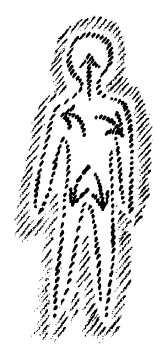
[ 28 ] Only when one examines the entire relationship between the four members of the human being will one find the way to uncover these connections—which I have already hinted at—between non-human substances, natural substances, and the healthy and sick human being themselves. But first we must examine how these four members of the human being—the physical body, the etheric body, the astral body, and the ego—behave quite differently in the two alternating states in which the human being lives during their earthly existence: the states of waking and sleeping. In the waking state, our physical organization is permeated by the etheric organization. Within this, the astral organization spreads out, so to speak, filling both organizations from within. And the whole is in turn permeated by the “I” organization, so that if we wish to create a mental image of this in a schematic manner, we can say: In this diagram, we can create a mental image of the waking human being with the physical and etheric organizations filling him out and even protruding slightly beyond him, while the astral and “I” organizations—which I am indicating here in a different color—are superimposed upon them. (A diagram is drawn.)
[ 29 ] When, on the other hand, we have a sleeping person before us, we see the physical body and the etheric body lying in bed. The human being is only capable of developing mineral and plant-like activity—though not within a plant-like organization—just as a plant does. We have the physical body and the etheric body lying in bed. In contrast, we have the astral body and the “I”-organization outside the physical and etheric bodies. Schematically, I can illustrate this by showing that the astral body and the “I”-organization (red) now surround the etheric body and the physical body like a kind of cloud—one that, however, fades into the indefinite and grows larger and larger. But it is not the case that we can say: During the day, while awake, the astral body and the “I”-organization are active within us, and during sleep, conversely, the “I” and the astral body are not in the physical body and the etheric body; that is not the case. We can only say: While awake, the “I” organization and the astral body act from within, in all directions, wherever the organs—or rather, the forces of the organs—dynamically direct them, within the physical and etheric bodies. During sleep, they act from the outside. In a sense, just as the effects of the cosmos otherwise penetrate our senses and become the content of our consciousness as sensory perceptions and ideas, so too are we, while asleep, enveloped by our astral body and our “I” organization. These sink outside of us into the spirit of the cosmos and act through the eyes, through the ears, through everything that constitutes the peripheral aspects of the human organism.
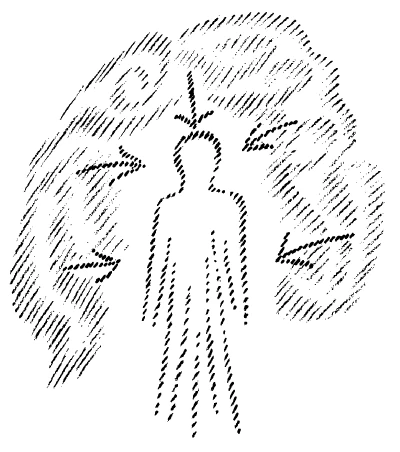
[ 30 ] We have thus characterized the difference between the waking state and the sleeping state by saying that our “I” and our astral body act from within in all directions while we are awake. Our “I” and our astral body, in turn, act back upon us from the outside, in conjunction with the spiritual forces of the cosmos, during sleep. We can thus see that influences can act upon our etheric body and within our physical body—both from the outside and from the inside—through our spiritual organization.
[ 31 ] Now, once we understand this, we come to see how the spiritual essences of natural products are related to these processes, which, after all, constitute human beings as both sleeping and waking beings. For example, it is peculiar that when we ingest a substance—such as lead—that is not part of the ordinary food system, this lead always has the effect of, so to speak, first compelling the human being to project his astral body outward, just as happens during sleep. Lead actually has the effect of putting a person into a state of sleep, propelling the astral body and the “I”-organization outward. Just imagine this vividly. A person wants to sleep when they ingest lead. But sleep does not actually occur. What happens is simply that the “I” and the astral body are propelled outward. At the same time, however, the lead prevents external influences from taking effect. The lead propels the astral body and the “I”-organization centrifugally outward, but it blocks the centripetal forces—those acting inward. The person falls into a half-sleep but cannot sleep completely because the influence from the outside is hindered by the consumption of lead.
[ 32 ] The consequence of this is that, under normal circumstances, when a healthy person ingests lead, they do not fall asleep, but are overcome by dizziness, lose consciousness, and experience all those conditions that must occur with the weakening of the ego and the astral organization in relation to the physical and etheric bodies.
[ 33 ] But let us suppose that such an abnormality has arisen in the human organism that, when a person is put to sleep or falls asleep, the ego-organism and the astral body become too deeply rooted in the external world, that is, they absorb too much of the spirituality of the extra-human cosmos, so that these influences become too strong; thus, every time the person falls asleep, they are subjected to excessive external influences—excessive mental and spiritual influences from the outside. Then they fall into sclerosis.
[ 34 ] This is the true cause of sclerosis: that instead of organizing itself internally, the human being is subjected to excessive external influences, particularly when it is in a state of sleep. At times, as the human organism ages and these influences are able to take effect, it resists this excessive external influence through insomnia. But one cannot, of course, remain in a state of insomnia. The consequence of this is that, as one grows old and must still sleep, the astral body—which emerges in old age from the physical and etheric bodies—and the “I”-organization absorb too many external influences and exert too strong a counter-effect on the organism. What do we find, then, when one grows old and must still sleep, and the astral body—which emerges in old age from the physical and etheric bodies—and the “I”-organization absorb too many external influences and exert too strong a counter-effect on the organism? We find that if we now introduce lead into the human organism, dizziness and fainting do not occur; rather, the sclerosing forces are merely held in check—under certain circumstances—by preparing the lead as an appropriate remedy, the astral forces from outside and the “I” forces from outside—the sclerosing forces—are thereby held at bay, because the person then also goes through states in which they do not fall asleep, but in which only through the lead are their astral body and “I” organization driven out, while the excessively strong forces from outside are held at bay.
[ 35 ] In this way, by gaining insight into the relationship between the physical body, the etheric body, the astral body, and the “I,” one comes to fully understand the basis of the “lead effect” and how it can act as a counterforce to sclerotic processes.
[ 36 ] This is precisely a matter of understanding human organization and understanding the external natural world in terms of its spiritual foundations, thereby gaining the ability to bring the two into interaction and thus exert the appropriate influence on health and illness.
[ 37 ] Of course, the point is that one must be able to combine the various effects. I have explained to you that silicic acid is related to the sensory organs, to the entire periphery of the human organism, and, in turn, to the “I” organization. We have now also learned how lead has a specific relationship to the “I” organization. By producing a remedy in an appropriate manner—one that is properly prepared from a combination of silicic acid and lead— one may, under certain circumstances, either strengthen the centrifugal force of lead or reduce the centripetal force of silicic acid; in this way, one obtains a remedy that actually possesses an inner vitality—one that is transparent, and whose effects within the human organism are clearly understood.
[ 38 ] This is the essence of those remedies that can be produced on the basis of such a spiritual foundation of medicine. They are produced with a complete understanding of what is actually taking place both within and outside the human being; and they are produced in such a way that it is now essential for the person who initiates them—who brings them into the world—to grasp the spiritual connections that are imbued in these remedies. It is therefore a matter of being able to produce, alongside remedies in which one focuses merely on the chemical forces—which are, after all, cited in our materialistic chemistry—remedies of which one can say: “The spirituality of the world has been channeled into this remedy in this specific way.”
[ 39 ] This will be the essence of the remedies that are produced once medicine is given this spiritual foundation. It will be understood that what matters with these remedies is not merely that they contain, in their preparation, what the chemist can discern, but that they are imbued with the spiritual forces of the world. It is the Spirit itself—spirituality—that is directly applied in therapy. That is what matters in these matters.
[ 40 ] You see, one can go even further in this direction. By gaining insight into the human constitution in the way I described yesterday, one can arrive at a strictly precise understanding—I can only hint at this here—of how the physical and etheric bodies are what are imparted to the human being through the stream of heredity, that is, what is inherited from the father, mother, grandfather, grandmother, and so on; whereas in the ego-organization and the astral body lies that which descends from the spiritual world, sinks into the human physical and etheric bodies, and in turn passes through the gate of death back into the spiritual world—that which lives and endures in the human being as the enduring element, the element that outlives the physical body, its true immortality.
[ 41 ] But when we speak scientifically, we must not merely speak of the immortal; rather, we must include the other aspect alongside the immortal. Just as that which passes through the gate of death in the “I,” in the “I” organization, and in the astral body—and enters the spiritual world—represents in this way the very core of the human being, yet dynamically intervenes in its physical and etheric organization, so too is this present before birth or conception. It comes from the spiritual world, takes shape, works, and helps build the physical and etheric bodies. We must also speak of the unborn state.
[ 42 ] In the study of nature, we have strayed so far from the truth in this area that, while we speak of immortality for certain religiously self-serving reasons—because humans want to know what happens to them after death—since humans already exist, they are not interested in what came before birth or before conception. But if one wishes to speak scientifically, one must speak of “pre-birth” just as much as of “immortality,” for it is only the combination of pre-birth and immortality that constitutes eternity.
[ 43 ] Thus we can say: That which is the eternal essence of the human being—which descends through conception, embryonic development, and birth into the physical and etheric bodies, and which in turn leaves this physical and etheric organization at death—must, as it descends into the physical and etheric organization, adapt itself to this physical and etheric body.
[ 44 ] This is not always readily present in human development. An inner struggle certainly takes place. As the child enters the world, the astral body and the “I” come from the spiritual world, while the physical body and the etheric body come from the heredity of the ancestors. These must struggle to fit together. You can observe this process of struggling to fit together externally, in an outward manifestation, by looking at the various types of childhood illnesses.
[ 45 ] Childhood illnesses can only be properly understood when viewed from the perspective that the eternal core of the human being—the true spiritual foundation—must adapt to what is given through heredity. And in particular, when the etheric body has difficulty adapting to the astral body and the “I” organization—to which it must adapt, yet finds it difficult to do so—we see a disease arise that stems precisely from the fact that the etheric body asserts itself predominantly against the encroaching “I” and the encroaching astral organization. And this predominant assertion of the etheric body—this resistance, so to speak—manifests itself in rickets.
[ 46 ] Now, by tracing the spiritual back to the physical, we once again arrive at a way to answer the question in a particular way: How can I remove the counteracting force from this etheric body, which, in a sense, stands in opposition to the astral body? What normally deprives it of this power as the human being gradually approaches the physical world from the spiritual world during the embryonic period?
[ 47 ] This leads one to study how the human being enters the physical world from the spiritual world during the embryonic stage, and one finds that there is a special relationship between the forces present in phosphorus or phosphorus compounds and those forces present in the uterus that counteract embryonic development. If these forces were not present in the uterus, every human being would simply develop rickets. The uterus is, at the same time, a constant remedy against rickets, in that it contains forces that are of the same nature in the organism as the forces found in the mineral substance phosphorus or in phosphorus compounds in the external natural world.
[ 48 ] This is how the mysteries are revealed: when a person who has developed rickets is given phosphorus treatment, the lack of phosphorus’s effect in the womb is compensated for in the external world after birth.
[ 49 ] And so, in fact, if one penetrates to the inner spiritual nature of what happens in human beings and in their interaction with nature, one can indeed paralyze existing disease processes in the appropriate way by counteracting them.
[ 50 ] You see, this is the principle underlying that spiritual foundation of medicine I spoke of yesterday—a foundation that is to be explored for the first time in the book by Dr. Wegman and myself, and which does not seek to offer layman’s criticism of scientific medicine, but rather to present that which can be just as scientifically precise, only that it penetrates into the spiritual world, and aims to add to what already exists in true scientific rigor.
[ 51 ] And one could say: It is precisely those who are quite familiar with the fundamentals of modern scientific medicine and who simply take these fundamentals a step further who end up seeking an expansion into the spiritual realm.
[ 52 ] And in a certain sense, for those who seek the spiritual in human beings, illnesses—as undesirable, unpleasant, and unsympathetic as they naturally are from the standpoint of life—actually shed infinite light on the human being for those seeking spiritual insight into humanity. For in illness, it becomes apparent—albeit in an abnormal way, through intensification or weakening—how that which must continually be at work within a person operates so that the person can be a spiritual being at all.
[ 53 ] Just consider: if human beings did not possess within themselves—without having lead directly within them—the effects of lead, they would not be thinking beings. The thought process would continually prove to be dulled by a latent sclerosis. Once one knows this, the process that takes place here—the one I have described, the lead process that counteracts sclerosis—sheds light on the very way in which human thought comes about in the first place.
[ 54 ] Psychology, or the science of the mind, has an immense amount to learn from pathology and therapy.
[ 55 ] This, however, opens up the prospect that, by combining a spiritual perspective with medicine, our worldview can once again become somewhat more universal than it is today, given its current specialization.
[ 56 ] I would like to add just a few more words at the end regarding what I said, once this has been translated.
[ 57 ] One can look back on the development of humanity, particularly on the development of the spirit that has sustained human civilization and individual civilizations, and that has also produced what is called knowledge and science.
[ 58 ] If we look back to very ancient times—times that, in fact, can only be traced today through the lens of spiritual research, as I characterized it yesterday—then we find—as I already hinted at yesterday — one must look for places of knowledge that were not like our schools, but rather places where human beings were first introduced to the task of penetrating nature and human beings, after their souls had been prepared to look into the spiritual aspect of the external world. Those centers of knowledge, which people have come to call “mysteries,” were not merely schools; rather, they were, in essence, what today appears as separate entities in the world: they were places of religious worship, they were centers for the cultivation of the arts, and they were, at the same time, centers for the cultivation of knowledge in the most diverse areas of human life.
[ 59 ] These ancient mysteries were structured in such a way that those who were to teach did not initially present what they had to convey to people merely in abstract terms, but rather in images—images whose inner configuration, however, represented the actual conditions and the actual effects in the world. This enabled them to present these images in what we would today call a ritualistic form.
[ 60 ] This then branched off in a certain direction, shaping this pictorial quality in such a way that it embodied beauty. The cult took on an artistic character in certain directions.
[ 61 ] And then, when one represented in ideas that which was not derived from arbitrary imagination but from those images that were drawn from the mysteries of the world itself, that was science in those days. The same thing, when presented in such a way that its images evoked the essence of human will as piety, was religious worship. The same thing, when presented in such a way that it delighted and uplifted the human spirit, touched it with grace, and raised it sublimely toward beauty, was art. And the place of art was directly united with the place of worship. The same thing, presented in the form of ideas, was knowledge; it was science.
[ 62 ] But this did not address only the human intellect, sensory observation, or external sensory experimentation; rather, it addressed the whole human being—body, soul, and spirit. But it also penetrated to those depths within the essence of things where that which is reality reveals itself—on the one hand, in a way that divinely inspires piety, and on the other, in a way that expresses itself within the true context of ideas. This way of pursuing the truth, beauty, and also the moral aspect of human nature was called—and can still be called today—the path to the initiations, to the beginnings of things. For people were aware that they lived within the beginnings of things by conjuring these beginnings into the ritual act, into the beautiful revelation, and into the truthfully shaped world of ideas. And such an approach to the things of the world was then called initiatory knowledge—the knowledge of the beginnings from which all things are understood, and through which all things can first be addressed by our will. Initiatory science, which penetrated the mysteries of the world and the beginnings—that was what people were actually seeking.
[ 63 ] There had to come a time in human evolution when this science of initiation receded, when human beings had to use their spiritual powers to become more truly conscious within themselves. Human beings received the ancient science of initiation as if in a dream, as if instinctively. There was no question of human beings evolving toward freedom. An evolution toward freedom came about only because human beings were led away from the beginnings for a time, lost the initiatory worldview for a while, and did not turn to the beginnings but rather to what are more the ends—the outer, sensory revelation—and to that which can be explored through experimentation at the ends.
[ 64 ] Today the time has come once again when, after an immeasurably vast—I would say, science of endings, a superficial science that can have only an external relationship to art and religion—we must once again seek the science of initiation with consciousness, with that consciousness we have cultivated through the exact sciences, with that consciousness which, in this newer science of initiation, can be no less exact than in the exact sciences.
[ 65 ] But here, once again, a bridge will be built from what appears as a worldview—which brings the human soul together with its origin in the inner formation of ideas—to that which consists in the practical application of what is perceived in the idea. In the ancient mysteries, therefore, what was in this way an initiatory worldview was united above all with that which related to the healing of human beings—the art of healing. For that, too, was an art—the art of healing—which at the same time called upon human beings to see the healing process as a sacrificial act. It will, in turn, have to forge a closer connection with what appears, in a more or less philosophical form, as a worldview, in order to satisfy the inner needs of the human soul. This is what, I would say, is being sought in the anthroposophical movement in recognition of what the times demand of us.
[ 66 ] This anthroposophical movement, which has its center at the Goetheanum in Dornach, Switzerland, does not seek to introduce something arbitrary into the world, nor does it seek merely to produce something abstract, unworldly, or nebulously mystical; rather, it seeks to intervene directly in all practical work and in all practical human activity. Rather, it seeks to strive, in a fully conscious manner, toward what was instinctively sought in ancient, primitive times.
[ 67 ] Even if this is only a beginning for now, what exists in the close connection between the Goetheanum—a place that strives for a spiritual worldview—and Dr. Wegman’s clinic is precisely what makes it possible to reestablish what was once taken for granted in ancient times, when knowledge was mystical knowledge: Bringing medicine into the closest possible connection with spiritual insight. And this is what the anthroposophical movement seeks to fulfill in response to the demands of our time. Therefore, we may hope that from this collaboration between the worldview and the clinical, from this work toward the initiations, life can emerge—and, alongside an initiatory knowledge that meets modern requirements, also once again an initiated medicine, a medicine as an initiatory science. I have attempted in these two hours to sketch out in a few broad strokes how this is being sought in the early stages with the first steps.
[ 68 ] I know how little can be accomplished with such brief remarks. I am all the more grateful, then, that, thanks to the kindness of Mrs. and Dr. Larkins, I have been able to share these remarks with you here today. I therefore thank Mrs. and Dr. Larkins for their kind willingness to make this gathering possible. I thank you for your attention, which I deeply appreciate, since what I have to present to you is truly not merely a theoretical aspiration, but something to which one must be deeply committed—with every fiber of one’s heart—if one wishes to advocate for it in today’s world.