

Second Scientific Course
The warmth at the boundary
between positive and negative materiality
Insights from Spiritual Science on the Development of Physics
GA 321
14 March 1920, Stuttgart
Translated by Steiner Online Library
Fourteenth Lecture
[ 1 ] I will be able to conclude these remarks for now with just a few points. It goes without saying that what we have attempted in the previous course and in this one will ultimately only come into its own when we are in a position to continue our exploration. I will have a few more remarks to make about these matters at the end of today’s session. First, however, I would like to draw your attention today to a few points from the entire body of material we have reviewed regarding thermal phenomena and related topics—specifically, from the range of mental images you have been able to gain through this process. The first of these is this:
[ 2 ] If we review this once more, we have distinguished regions of reality in the physical realm: the solid region, which we have called \(z’\); the liquid region, which we have called \(y’\); and the gaseous or air-like region, which we have called \(x’\). Then, in between, we had the realm of heat; we had \(x\) as the realm of light, \(y\) as the realm of chemical effects, and \(z\) as the realm of life forces.
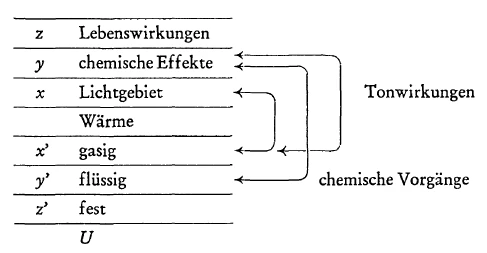
[ 3 ] Yesterday we had to consider very specific relationships that, in a sense, extend across the thermal region from \(x\) to \(x’\), and from \(y\) to \(y’\). We have attempted to bring to light the fact that indicates how chemical effects can occur primarily in the liquid state. Anyone who attempts to understand chemical processes will find that wherever chemical processes take place, in a certain sense, everything that arises—whether chemical combinations, chemical releases, or chemical decompositions—is bound to the liquid state. The liquid must allow its particular nature to take effect and extend into the solid or gaseous states so that chemical effects can come about there. And so, when we speak of our earthly chemistry at all, we can envision an interplay between chemical effects and the liquid—with a relative separation of these two realms—that is, a permeation and, in this permeation, a binding of sorts. Our earthly chemistry would thus represent, in a sense, an enlivening of the liquid element through chemical effects.
[ 4 ] Now, however, you can easily form a mental image of what it would be like if we considered these realms of reality, as we cannot possibly conceive of one such realm acting upon another solely through heat and gaseous matter, so to speak; rather, the other realms will also interact with one another. The other realms will also, in turn, produce certain effects in this or that realm of reality. So we can also say: Even if, at first, as if by an inherent affinity, the chemical effects act particularly strongly in the liquid medium, we must also have in our mental image a mode of action that extends from the chemical effects, for example, to \(x’\), that is, a direct influence of the chemical effects into the gaseous, the air-like state.
[ 5 ] When I say “chemical effects,” you mustn’t think of chemical processes. Instead, when I say “chemical effects,” you must think of that which clearly presents itself to us as an inner, spirit-infused element in the blue-violet part of the spectrum—where, in a sense, the chemical effects reveal themselves to us with a certain independence from material existence—whereas, when we speak of chemical processes, we are actually already speaking of the permeation of the material by these chemical effects. In this context, we must create a mental image of something that initially has nothing to do with our ponderable matter, but rather permeates it—that is, initially permeates the liquid element through an inner kinship, the nature of which I outlined for you yesterday. But if we raise the question: If, so to speak, these chemical effects choose the nearer element—the airy element—as the medium for their action, if I may use that expression, what then comes into being? Then—since we are always remaining within the realm of the concrete—something must arise within the airy element that can be conceived as a mental image by comparing it to what exists in the liquid. In the liquid element, the nature of the chemical effects, so to speak, engages with the matter, stirring it up in such a way that the materials themselves enter into interactions. When we have a mental image of the liquid element, we must conceive of the materials within it as interacting with one another during the chemical processes. But let us suppose that it does not go so far that the chemical effects directly engage the materials themselves; rather, let us suppose that they act upon these materials only from the outside, remaining somewhat more alien to the matter than they can be in the liquid medium. In that case, something occurs that must manifest itself more strongly in the gaseous body than as a mere accompaniment of the chemical effects in the liquid. Then a certain independence of the imponderable must occur in relation to the material carrier. In chemical processes, the imponderable grips the matter sharply. Here we are directed to areas where such a sharp grip does not exist, but where the imponderable does not remain within the matter: this is the case with acoustics, with sound effects. While in chemical-material effects we have a complete immersion of the imponderable into matter, with sound we have a preservation, a self-preservation of the imponderable within gaseous, air-like matter. But this now leads us to something else. It leads us to the conclusion that we must say to ourselves: There must be a reason why, in liquids, the imponderable directly affects matter, but why, when sound effects occur in air, the imponderable is less able to affect matter.
[ 6 ] If we consider chemical processes and have a sense of what is physically tangible within them, then we will naturally feel that it is simply part of the nature of matter that chemical processes occur exactly as they do—that is, the imponderable is present as a characteristic of matter. This is only possible because, in this case—when we are dealing with earthly matter—the Earth itself apprehends the imponderable. Through the forces of the Earth, the chemical effect is, so to speak, grasped and works within the liquid matter. You see the formative force extended and active across the entire surface of the Earth, as this formative force takes hold of the approaching chemical effect.
[ 7 ] If we only understand correctly that what is at work here is the force of the Earth, then—if we wish to grasp correctly the weaving of sound in the air—we must assume the opposite force. That is to say: We must effectively conceive within the sound the tendency radiating outward from the Earth in all directions of space, overcoming the Earth’s forces—a tendency that thus carries the imponderable away from the Earth. This is what constitutes the distinctive nature of the world of sound. What makes the physics of sound—acoustics—so distinctive is that, on the one hand, we are able to study the material processes physically, and on the other hand, we essentially need not take this acoustics into account at all when we live in the world of sound through our sensations. After all, as sentient human beings, what does all this acoustics matter to us when we perceive sounds? This acoustics is beautiful because it reveals to us strange inner regularities and rhythms, but what unfolds as subjective experience in the world of sounds is far, far removed from what takes place in the material realm as the physics of acoustics. And this is because the element of sound preserves its independence precisely by revealing itself to us, in terms of its origin, as determined from the periphery of the universe, just as chemical processes in liquid matter reveal themselves to us as determined from the center of our Earth.
[ 8 ] Well, the one connection—which we might just as well have mentioned yesterday during Dr. Kolisko’s lecture—only becomes apparent when we, so to speak, rise to a universal perspective: namely, that we can form a mental image of the arrangement of the elements in the periodic table in terms of the octave. This reveals an analogy between the inner laws governing tones and the entire structure of matter as it prepares to unfold chemical processes. This also justifies our view that the entire process of combining and separating in material existence is an external reflection of an inner music of the worlds—and that this inner music of the worlds reveals itself to us only in one particular instance: earthly music. This earthly music must by no means be regarded merely in such a way that we say: What is sound within us is vibrating air on the outside. This must be regarded as just as nonsensical as it would be nonsensical, for example, to say: What you are on the outside as a body, that is what you are, viewed from the inside, as a soul—but only for yourself. — Now we lack the subject. So this absence of the subject is also present when we wish to regard sound, in its inner laws, as the same—as identical—with the rarefactions and compressions of the air that externally serve as its carriers in the gaseous medium. Now, if you really bring this to mind, you will see: We are dealing with a certain relationship between \(y\) and \(y’\) in chemical processes, and we are dealing with a certain relationship between \(y\) and \(x’\) in the effects of sound (see diagram).
[ 9 ] I have pointed out to you that, if we remain within one area or another, we are always led to differences in level in what we perceive in the outside world. Now try to sense something similar to differences in level in what we encounter here; simply try to sense something similar—let’s say, a difference in level like the one that occurs with gravity, where water falls, or where the driving force of a wheel is also based on a difference in level. Try to realize that differences in temperature, heat, and sound, as well as the equalization of electricity, are based on differences in level. That is, on differences in level. We always come back to differences in level when we trace effects. But what do we have here? (See diagram, arc \(y - y’\).) There is an intrinsic connection between what we perceive in the spectrum and the material substance in the liquid. And what presents itself to us when we observe a chemical process is itself nothing other than the difference in existence between the chemical effects and the forces present in the liquid. It is a level difference \( y - y’.\) And then there is a smaller level difference \(y - x’\), which presents itself to us in the sound effects. So that we can say: With regard to the realms of reality, a chemical process can represent a level difference between chemical effects and the forces within the liquid. And the occurrence of tone and sound in the air must be for us the difference in level between that which acts formatively in the chemical effects—shooting through the world, yet peripherally from the outside—and the material nature of the gas, the air-like body.
[ 10 ] Even that which manifests itself through these realms of reality does so by the formation of differences in level. Whether we remain within a single element—heat, or even a gas or water—things are based on differences in level. But the fact that we perceive differences between these realms at all is due to the differences in the levels of the effects of these realms themselves.
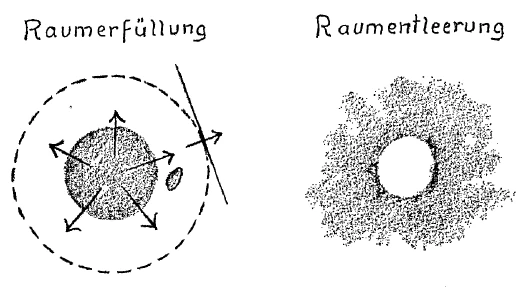
[ 11 ] If you take all of this together, you will arrive at the following conclusion: If we consider liquids and their relative surfaces, we must say that, in the case of solid bodies, we are dealing with terrestrial forces. The extent to which the formative forces—one might call them “figurative energies,” if one were to use the terminology of modern physics—must be related to gravity has already become clear to you in our previous considerations. But if we move from there to the forces that manifest as gravity—to what, in ordinary life, is characterized as a level surface due to the size of the Earth—we find a sphere. Of course, the various levels of the water’s surface together form a sphere. Now you will see that as one moves outward—from the center of the Earth toward these spheres—we must conclude that: In earthly terms, when forces act within the realm of solids, we are dealing with enclosing forces; when forces act within a liquid, we are dealing with forces whose configuration can actually be determined—for example, by drawing a tangent here or establishing a tangential plane. But if we go even further out, if we venture beyond the realm of the spheres, we must say the following: Among these spheres, we are dealing with formative forces for our solid bodies—formative forces that, even on Earth itself, still enclose the spaces of the bodies. Here (the dashed sphere) we are dealing with a single form; the many forms, so to speak, unite and interpenetrate to form the one form that the liquid element of the Earth possesses. But when we now emerge from here (outside the sphere)—how are we to form a mental image of it, having advanced beyond what takes shape individually, what thus brings about within the solid body its cohesion, so that the whole is a single form—how are we to conceive of the matter when we emerge from there? We must create a mental image of it in such a way that we have the opposite. If we have here the solid body, filled with matter, then we must conceive of space here as being hollowed out with negative matter. Here we have a filling of space; here, an emptying of space.
[ 12 ] People must develop a mental image of what it would be like to empty space. And since what happens on Earth—I’ll just put it this way today; we’ll examine it in greater detail later—is by no means influenced from just one direction—otherwise the processes on Earth would be entirely different—it becomes clear that the Earth is influenced in varied ways from all directions. For example, it would not be possible for differences to arise in the continents and in the distribution of water between the North Pole and the South Pole if there were only one such void somewhere in space. These spatial voids must be acting from various directions. If we seek them, we find them in what were called “planets” in the ancient cosmological systems—a category that also included the Sun itself.
[ 13 ] We are thus driven out beyond the realm of the Earth into the realm of the cosmos, and we must find the transition from one side of space to the other; we must find the transition from the fullness of space to the emptiness of space. And we must conceive of this emptiness of space, in terms of its effect on Earth, as localized in the planets that surround the Earth. Therefore, on our Earth—because whatever acts upon it through the emptiness of space appears, so to speak, as a suction effect, and whatever acts here through the formative forces appears as a pressure effect— interactions will take place at every point where earthly events can occur, between the earthly and the cosmic. These interactions present themselves to us in those configurations of earthly events that are usually sought in molecular forces and molecular attractions, whereas we really ought to approach them as was done in earlier times based on different epistemological premises. Instead of allowing the entire cosmos to express itself in its effects—as is always the case with material phenomena, in which imponderables are always involved—we attribute what happens to fantastically imagined internal configurations. What the stars do, what giants accomplish when they manifest themselves in their mutual relationships through the processes on Earth—that is supposed to be brought about by the dwarfs of atoms and molecules. That is precisely what we need: to know that when we introduce anything—whether by drawing it in or calculating it into a material process on our Earth—it is nothing other than the reflection of extraterrestrial, cosmic interactions.
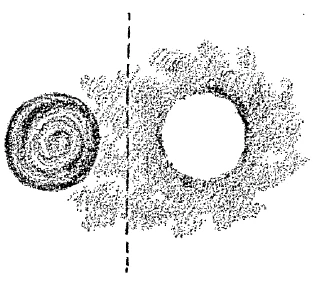
[ 14 ] But now you see, here we have the force to fill space with matter (see drawing, left). Here we still have the force to fill space with matter, only this force has expanded, and it must eventually reach the other side somewhere; it must lead to the emptying of space. There must be a region in between where, so to speak—if I may put it that way—space tears apart. We must realize: Our space, which appears around us and which, so to speak, is the vessel for our physical effects, must be intimately connected with our physical effects. It must represent something that is contained within these physical effects. But as we transition from the ponderable to the imponderable, space tears apart, and when it tears apart, what was not there before it tore apart comes through the tear. Let’s suppose we tear open three-dimensional space and ask: What comes out of the tear? — If I cut my finger here, blood comes out, and that remains within three-dimensional space. But if I cut open space itself, what emerges is that which is already in the non-spatial.
[ 15 ] You see, this is one of the points that quite clearly illustrates how far off track today’s approach to physics has gone. Isn’t it true that when we conduct electrical experiments in the classroom, we have to carefully dry our electrical apparatus; we have to make them poor conductors of electricity, otherwise we can’t get anything to work. If they’re damp, we can’t get anything to work. But there is indeed a view—I have mentioned this many times—that electricity develops through the friction of the clouds, which are certainly damp, and manifests itself in lightning and thunder, according to physicists. This is, of course, one of the most impossible mental images one could possibly conceive.
[ 16 ] On the other hand, anyone who—in order to arrive at a concept that corresponds to reality—brings together everything we are attempting to bring together here in our physical considerations will find that, at the moment the flash of lightning appears, space tears apart, and that which intensely and one-dimensionally fills space bursts forth, just as blood gushes out when I cut myself. But this is the case every time light appears accompanied by heat: Space tears apart; space reveals to us what lies within it, whereas in its usual three dimensions—which we see before us—it shows us only its exterior. Space leads us into its interior.
[ 17 ] We may say: As we continue to ascend from the ponderable to the imponderable and must pass precisely through the realm of heat, we find that heat emanates wherever we move from the compressive forces of ponderable matter into the suction forces of the imponderable. Heat emanates everywhere. If you now imagine that we are dealing with the process we referred to here a few days ago as heat conduction, you must link this to the other mental image that this heat conduction is, in fact, bound to ponderable matter—in contrast to what we have also pointed out as heat itself as it propagates. We now find the spreading heat itself to be that which wells up when space tears apart. How, then, does this heat act? It seeks to act from the intensity of space into its extensiveness. It seeks, so to speak, to act from the interior of space into its exterior. When it interacts with a material body, we observe the phenomenon whereby the inherent tendency of heat is held back, its suction effect is transformed into a pressure effect, and the universal tendency of heat is countered by the individualizing tendency of matter, which then becomes the formative force within the solid body. Thus, in heat—in the phenomenon of heat, insofar as this phenomenon leads to heat conduction—we must seek a tendency to propagate that now forms not in rays but in all directions; we must seek a reflection of imponderable matter upon ponderable matter, or of the imponderable upon ponderable matter. The body that conducts heat to us actually continually brings heat to light by, in essence, repelling it intensely—not extensively, as with light, which, however, confronts us only in its images—the imponderable heat that collides with its material substance.
[ 18 ] Now, however, I would like to ask you to gradually process such mental images—as we are accustomed to conceiving them—in such a way that, in the course of this processing, you truly come to realize how we are, so to speak, dealing with mental images saturated with reality. And let a final image illustrate how such reality-saturated mental images lead us into a living grasp of our existence in the world.
[ 19 ] I have already pointed out to you what perception—subjective perception, the sensation of temperature—is based on. We actually perceive the temperature difference between our own organism and the outside world—which is, after all, what a thermometer does, as I have pointed out to you. Now, however, all perception is based on the fact that we are something within a certain realm, and that which lies outside this realm becomes our perception. We cannot be something and perceive it at the same time; rather, we must always be something other than what we perceive. So when we perceive sounds, insofar as we perceive sounds, we cannot ourselves be sounds. And if we answer the question impartially: What are we when we perceive sounds?—then we can come to the conclusion: We are precisely that which constitutes the other difference in level. We perceive this difference in level ( \(y-x’\) in the diagram); we do not perceive \(y-y’\); that is what we are during this time; those internal chemical processes in our fluid organism—which accompany our perceptions of sounds and proceed just as regularly—that is what we are. That which the chemical effects bring about within us imprints something very regular onto the world. It is by no means uninteresting to consider the following image. As you know, the human body consists only of a very small proportion of solid components; more than ninety percent of it is a column of fluid. What takes place there—namely, chemical processes of a very subtle nature—within our organism while we listen to a symphony is an entirely inner, continuously phosphorescent marvel of construction. There we are, in terms of the chemistry of a “sound painting.” And we perceive the world of sound precisely because we, in a sense, chemically become what the world of sound is, in the sense that I have described here.
[ 20 ] As you can see, our understanding of human beings is greatly enhanced by bringing our understanding of physics closer to human beings. But in order to achieve this, it is always a matter of not forming those abstract mental images that are particularly popular in modern physics, but rather of advancing to mental images that are truly interwoven with the world—the objective world. Essentially, everything that Spiritual Science seeks—both as a quest for knowledge and as a quest for a new mindset—is aimed at bringing this kind of reality-based thinking back into human development. And it is necessary for this to emerge. That is why it would be so very necessary for precisely such beautiful endeavors as those that have come to the fore here over the past fourteen days to be continued. You can see everywhere how something old is dying away in the present. Can we not truly see, in the mental images that are of no use to us, how something old is dying away? And as we attempt here—albeit still quite imperfectly, for these can only ever be very imperfect hints—to develop a physical perspective as well, does this not reveal just how much we are standing today at a turning point in human development?
[ 21 ] You see, my dear friends, something like this must always remind us: We must continue the work that has now begun—work that Dr. von Baravalle, Dr. Blümel, Mr. Strakosch, and Dr. Kolisko have inspired here in a wide variety of fields—to give a new direction to what human development has achieved thus far. Only in this way can we lay the foundation for further progress. For you see, out in the world, people are talking about the need to build things up. Adult education centers must be established. Yes, but what does that actually mean today out in the world: that people are calling for adult education centers? The Danish adult education movement is held up as an example to us. What does all this calling for adult education centers actually mean? What has been practiced at the traditional universities is being carried over into the adult education centers. This creates nothing new. It merely infects the entire population with the very same mindset that has, until now, only infected our scholarly education. There is hardly anything more disheartening than the prospect that what has devastated the minds of our scholars and the educated in the way we have seen will now, through the adult education system, cause the entire educated population of the earth to become equally rigid. If one wishes to establish adult education centers, one must first and foremost ensure that something can be taught there that is, in its very structure, a constructive endeavor. After all, we first need the kind of scholarship that can be pursued at these centers. People always want to remain on the surface; they always want to take only what is already there. Just as people in politics do not want the new, but always want to try again with the old; just as even the Social Democrats do not want to build something new, but want to try it with the old state, merely wanting to throw in their two cents there—so, too, in the intellectual cultural movement, people do not want to strive radically for a renewal of our way of knowing, but rather to carry the old, the dying, into the people. It is precisely in the field of physics that this can be seen most deeply and meaningfully.
[ 22 ] Certainly, you will find plenty that is unsatisfactory here and there in this series of lectures, because the lectures could only be aphoristic, but one thing will become clear to you in this series: that it is simply necessary to rebuild our entire conceptual world of physics, chemistry, physiology, and biology—to rebuild it thoroughly. Of course, we can only make progress in this regard if we develop not only the school system but also the academic world itself. And if something like this could emerge here at our Waldorf School—where we expand, first, the upper grades and, second, simultaneously develop the academic world alongside the school system, for which we have planted a real seed in these —for it was something like the seed of a new academic system—then we would actually be achieving what, in essence, must be achieved if European civilization is not to perish in the spiritual realm.
[ 23 ] Just consider for a moment the dreadful goings-on in the world’s academic institutions today: this mutual recitation of lengthy treatises—devoid of any real life—in academic settings, where people sit in beautiful halls and read their lengthy lectures aloud to one another, yet no one listens to the others. For the strange thing is that one is a specialist in this field, the other in that. The physician does not listen to the mathematician, but the mathematician reads. And when the physician reads, the mathematician’s thoughts are occupied with something entirely different. Moreover, the whole thing is merely an external, traditional formality. This is where renewal must begin. Renewal must begin at the very center of spiritual striving. This must be understood. Therefore, one can already say: If we could bring it to the point where, in connection with the striving for a new kind of reality, an expansion of our school concept could take place, then we would finally achieve what is to be achieved.
[ 24 ] As you can see, there is a lot to do. But one only truly begins to realize just how much there is to do when one delves into the details. That is why it is so infinitely regrettable that people today—who merely translate humanity’s old intellectual prejudices into platitudes (for that is what they have become, having had their time)—are actually amassing vast fortunes to establish their academies and the like. It is particularly difficult for us because we must be imbued with the realization that truly new ground must be broken. We cannot succumb to the illusion of simply saying, “Let’s establish adult education centers!” For we must live in reality and acknowledge that we first need to have something to teach at these centers. But just as—I would say—even between the lines of existing science a fruitful methodology has developed, so an even more fruitful methodology will develop once that science becomes popular—the kind we are striving for here, for example, in the field of physics. You see, everywhere people are trying to move beyond the old theoretical framework and into the real world, so that even our mental images are now imbued with reality. There must also be a methodology that proceeds in a completely different way than the methodology used so far. Practice and knowledge are, after all, intrinsically linked. And when one tackles, at any given point, that which today requires reform—such as physics—one immediately realizes what actually needs to happen. Therefore, since it is now time for us to part ways again, I would like to point out to you that in what has been presented here only in aphoristic form, you should see something that will inspire you to develop these ideas further. You will be able to develop them. Our mathematical physicists, whom we have among us, will be in a position to revise the old formulas, and they will find that, as they incorporate into the old formulas the insights that can be gleaned from the aphoristic hints I have given, these formulas will certainly undergo transformations—which are, in fact, metamorphoses—and from these will spring forth all manner of things that will be of immense technical significance for the further development of humanity. This is something that one cannot even hint at, but which one must initially merely point out.
[ 25 ] But we must now conclude these reflections, the continuation of which must lie in your own independent work—and it is this that I would particularly like to urge you to pursue. For the matters relating to human progress in all three areas are now extraordinarily urgent. First, matters are urgent today: We truly have no time to lose, for chaos is, after all, right at our doorstep. But the second point is this: What is right can only be achieved through orderly human cooperation. So we must try to further process within ourselves what has been inspired. And you will find, on the other hand, right here at the Waldorf School: the moment you make an effort to apply certain refined concepts we have gained here to your teaching, it works immediately. But you will also find that, insofar as you are compelled to apply these things in the practical affairs of life, it works just as well. And it would certainly be desirable that, when it comes to the natural sciences today, we not always have to address an audience that, while it does take in quite a bit, is constantly confronted—as I have already noted in the course of this series—with the judgment of the “real scientists,” the “authorities.” These authorities have no idea that, in everything we observe, everything else is constantly at play. You can see this in language.
[ 26 ] You see, in language we allow everything to exist in mutual interrelation. We speak of a push. It is only because we use the corresponding word to describe something that was originally the push we ourselves performed that we speak of a push even in a space devoid of human presence. And conversely, we express what happens within us using words taken from the external world. But we do not realize that we must look to the external world—for example, to the planetary cosmos—if we want to understand the constitution of the earthly body. And therefore, if we do not realize this, we will not be able to learn what really matters. We can certainly discover some very interesting little things when we focus a microscope on a plant seed or an animal embryo, on any cell that is microscopically small; there we discover all sorts of truly interesting things. But what really matters—what we sense—we would discover if we could only see, for the very first time, the same processes that take place under the microscope as they unfold on a macrocosmic scale. If only we could see how fertilization and defertilization constantly take place in the interplay of external nature; if we were to study how the planets can be understood as the starting points for the imponderable physical effects; if we were to grasp the cosmos in its origins for plant germination and animal germination; if we were to observe all of this on a grand scale—what we are trying to see today when we focus the microscope on the cell on a microscopic scale, where it does not even exist; if we could even begin to look at what surrounds us—then we would make progress. The path is already clearly mapped out today. But it is very, very obscured by people’s prejudices. These prejudices will be difficult to overcome. Yet it is up to us to do everything we can to overcome them.
Hopefully, we'll be able to continue these reflections at some point.