The Agricultural Course
Spiritual Science Foundations
for the Prosperity of Agriculture
GA 327
7 June 1924, Koberwitz
Translated by Steiner Online Library
First Lecture
My dear friends!
[ 1 ] It is with deep gratitude that I reflect on the words just spoken by Count Keyserlingk. For it is by no means only the feeling of gratitude on the part of those who are able to benefit from anthroposophy that is justified; rather, it is, so to speak, truly the gratitude of the anthroposophical cause itself that must be expressed to all those with an interest in anthroposophy in these difficult times we are facing—a gratitude that can be felt deeply. And so, precisely in the spirit of anthroposophical conviction, I would like to express my most heartfelt thanks for the words just spoken.
[ 2 ] It is indeed deeply gratifying that we are able to hold this agricultural course right here at the home of Count and Countess Keyserlingk. From my previous visits, I know what a wonderfully inspiring atmosphere—and by that I mean above all the spiritual and emotional atmosphere—there is here in Koberwitz, and how precisely that which lives here in the spiritual and emotional atmosphere is, in fact, the most beautiful prerequisite for what is to be discussed in this course.
[ 3 ] While the Count has pointed out that there may be some inconveniences for one person or another—in this case, the eurythmy dancers, though other visitors from out of town might also be affected—it must nevertheless be said, with regard to what actually brought us together: I believe we could hardly be better accommodated for this agricultural course than right in the midst of such an excellent and exemplary farm. After all, part of what comes to light in the field of anthroposophy is that one can, so to speak, immerse oneself in the necessary sensory environment. And that will certainly be the case here with regard to agriculture.
[ 4 ] Well, all of this prompts me to express my deepest gratitude to the household of Count Keyserlingk—a sentiment to which Dr. Steiner will certainly agree—for allowing us to spend these festive days—which I imagine will also be days of work—right here. I must bear in mind that—I would say—precisely because we are here in Koberwitz, an agricultural spirit already connected to the anthroposophical movement will prevail during these festive days. For it was Count Keyserlingk who, from the very beginning, supported the efforts we developed for agriculture in Stuttgart—based on *The Coming Day*—with advice, practical assistance, and self-sacrificing work; he allowed his spirit, shaped by such a deep-rooted connection to agriculture, to guide what we were able to do in this field. I would say that, from the very heart of our movement, there was a force at work that drew us here to Koberwitz—almost as a matter of course—at the very moment the Count wanted us here. That is why I can also assure you that I believe everyone actually came here to Koberwitz willingly to attend this course. This is why we who have come owe our deepest thanks—and are very happy to express them—to the Keyserlingk family for agreeing to host us during these days as we pursue these endeavors.
[ 5 ] As for me, I am deeply grateful, and I ask the Keyserlingk family to accept my thanks in a very special way. I know what it means to receive so many visitors over the course of several days—in the way that I sense it will happen—and I believe I can therefore convey the necessary nuance in this expression of gratitude; I also ask that it be taken to mean that I am fully aware of the difficulties involved in hosting such an event in a house that is located far from the city. I am convinced that—just as those inconveniences to which Count Keyserlingk, speaking in this instance as a representative, naturally referred not to the internal but to the external aspects of the local lecture series, will prove to be minor—each of us will leave satisfied in every respect with the hospitality and reception we have received here.
[ 6 ] Well, whether you will be able to leave the course itself feeling equally satisfied is, of course, very much the question—one that will likely become increasingly open to debate, even though we want to do everything we can to reach a mutual understanding in the days ahead through all sorts of discussions about what has been said. For you must bear in mind that, although there has long been a widespread desire for such a course, this is the first time I have undertaken a course of this kind from within the realm of anthroposophical endeavor. A course of this kind requires many things, for it will show us how the interests of agriculture are intertwined on all sides with the broadest sphere of human life, and how, in fact, there is scarcely any area of life that does not belong to agriculture. From every angle, from every corner, all the interests of human life are part of agriculture. Of course, we can only touch upon the central aspects of agriculture here. Yet this will naturally lead us down many side paths, which may prove necessary precisely because what is said here must be spoken from a thoroughly anthroposophical perspective. In particular, you will have to forgive me if today’s introduction must initially be somewhat far-fetched, so that perhaps not everyone will immediately see the connection between the introduction and what we specifically have to discuss regarding agriculture. Nevertheless, what is to be developed here must be based on what is to be said today, even if it may seem somewhat remote.
[ 7 ] Agriculture, in particular, has also been affected—and seriously so—by modern intellectual life. You see, this entire modern intellectual life has taken on destructive forms, particularly with regard to its economic character, the destructive significance of which many people today still scarcely suspect. And it was precisely these things that the economic enterprises arising from our anthroposophical movement sought to counteract. These economic enterprises were created by businesspeople and commercial operators; yet they have not been able to realize the original intentions in every respect—simply because there are far too many opposing forces in our present time to foster a proper understanding of such a cause. The individual is often powerless in the face of these active forces, and as a result, even the most fundamental aspect of these economic endeavors—which emerged from the heart of the anthroposophical movement—has not even been brought up for discussion to this day. For what, in practical terms, has been at stake?
[ 8 ] I would like to discuss this using the example of agriculture, so that we are speaking in concrete terms rather than in generalities. Today, for example, there are all sorts of so-called books and lectures on national economics that also include chapters on agriculture from a socio-economic perspective. People are considering how to organize agriculture based on socio-economic principles. There are writings today that deal with socio-economic ideas on how agriculture should be organized. The whole thing—both giving lectures on national economics and writing such books—is sheer nonsense. But sheer nonsense is practiced today in the widest circles. For it goes without saying that one can only speak about agriculture—including its social organization—if one first has a solid grounding in the subject itself, if one truly understands what beet farming, potato farming, and grain farming entail. Without that, one cannot even speak about the principles of national economics. These matters must be determined from the subject itself, not from some theoretical considerations. When one speaks of such things today to people who have attended a number of university lectures on economics as it relates to agriculture, it strikes them as completely absurd, because the matter seems so firmly established to them. But that is not the case; only those who base their judgment on the fields, the forests, and animal husbandry can truly judge agriculture. All talk about economics that is not grounded in the reality of the matter itself should simply cease. As long as people fail to realize that what is said about economic matters—floating above the reality of things—is mere idle talk, nothing promising will come of it, neither in the agricultural sector nor in any other field.
[ 9 ] The fact that people believe they can discuss things from a wide variety of perspectives [...] stems solely from the fact that, within the individual spheres of life, they themselves cannot go back to the fundamentals. That one regards a turnip as a turnip—certainly, it looks this way or that, is easier or harder to cut, has this color and contains these or those components—all of that can be said. But that is far from understanding the turnip—and above all, it does not explain the turnip’s relationship to the field, to the season in which it ripens, and so on. Rather, one must be clear about the following:
[ 10 ] I have often used an analogy to explain this in other areas of life. I said: You see a magnetic needle; you notice that one end of this needle always points almost north, and the other south. You wonder why this is so; you don’t look for the cause within the magnetic needle itself, but rather in the entire Earth, by assigning the magnetic North Pole to one side of it and the magnetic South Pole to the other. If someone were to look for the cause within the compass needle itself—why it aligns in such a [stubborn] way—they would be talking nonsense. For one can only understand the compass needle’s orientation if one knows its relationship to the entire Earth.
[ 11 ] Everything that seems nonsensical to the magnetic needle makes sense to humans in many other contexts. If you have a turnip growing in the ground: to take it as it is, within its narrow limits, is absurd at that moment, since the turnip’s growth may depend on countless circumstances that do not exist on Earth at all, but rather in the cosmic environment surrounding Earth. And so today we explain many things and organize much of practical life as if we were dealing only with narrowly defined phenomena and not with the effects arising from the entire world. The various spheres of life have suffered terribly as a result and would reveal this suffering far more clearly if it were not for—I would say—a certain instinct that still persists from the time when people relied on instinct rather than science, despite all the scientific knowledge of recent times. When people follow their doctors’ prescriptions on how many grams of meat they should eat, how much cabbage, so that it aligns with proper human physiology—some people even keep a scale by their side and weigh out everything that goes onto their plate—that’s all well and good, of course; one should know such things, but I can’t help but think again and again: It’s a good thing that the person in question also feels hunger when the measured portion isn’t enough, that this instinct is still present.
[ 12 ] Thus, instinct was actually the foundation of everything people had to do before science existed in this field. And these instincts certainly prevailed at times, and even today one can still be extraordinarily surprised when reading the farmers’ sayings in such old almanacs—at how immensely wise and understandable what they express is. For even the instinctively confident person has the capacity to avoid being superstitious in such matters. Just as there are extraordinarily profound sayings about sowing and harvesting, one also finds [...] frivolous nonsense, such as: “If the rooster crows on the manure heap, it will rain, or things will stay as they are.” The necessary humor is also present throughout this instinctive way of thinking, serving to dispel superstition.
[ 13 ] From an anthroposophical perspective, the point here is truly not to revert to the old instincts, but rather, through a deeper spiritual insight, to find what our increasingly unreliable instincts are less and less able to provide. To do this, we must open ourselves to a profound expansion of our view of the life of plants and animals—and indeed, of the life of the Earth itself—toward the cosmic realm.
[ 14 ] It is certainly true, from one perspective, that it is quite correct not to make a trivial connection between rainy weather and the phases of the moon; but on the other hand, there is also the fact that something did happen once. I have often recounted in other circles that there were two professors working in Leipzig, one of whom, Gustav Theodor Fechner—a man endowed with many sound insights into intellectual matters—could not, based on external observations, dismiss the idea that certain periods of rain and dry spells were, after all, related to the moon and its orbit around the Earth as mere superstition. This conclusion emerged for him as a necessity based on statistical analyses. But his colleague, the famous Professor Schleiden, at a time when such matters were generally overlooked, denied all of this on the basis of scientific reasoning. Now, both professors at the University of Leipzig were married. And Gustav Theodor Fechner, who was a somewhat humorous man, said: “Let our wives decide.” Now, back then in Leipzig, there was still a certain custom. The water needed for washing laundry was not easy to come by. It had to be fetched from far away. So people would set out jugs and tubs to collect rainwater. Both Professor Schleiden’s wife and Professor Fechner’s wife did this. But they did not have enough space to set up the tubs at the same time. So Professor Fechner said: “If it really doesn’t matter, and if my esteemed colleague is right, then let Professor Schleiden’s wife set up her tubs during the time when, according to my data based on the moon’s phase, there’s less rain, and my wife will set up her tub during the time when, according to my calculations, there’s more rainwater. If all this is nonsense, Professor Schleiden’s wife will be happy to do so.” — And lo and behold, Professor Schleiden wouldn’t stand for that; instead, she chose to follow Professor Fechner’s instructions rather than those of her own husband.
[ 15 ] That is certainly true. Science may well be correct, but practical application cannot simply accept this scientific correctness. We do not want to speak in this manner; we want to speak seriously. This should simply be said to remind us that we must look further than we are accustomed to doing today when we consider what alone makes physical life on Earth possible for human beings—and that is, after all, agriculture.
[ 16 ] I cannot know whether what can already be said today on the basis of anthroposophy will be able to satisfy us in every respect. But we should try to articulate what anthroposophy has to offer in the field of agriculture.
[ 17 ] I would like to begin by pointing out what is most important in our earthly existence as it relates to agriculture. Today, we have a tendency, when we talk about something, to place the greatest emphasis on its chemical and physical components. Now, let us not start from the chemical and physical components, but rather from something that lies behind them and is nevertheless of very special importance for the life of plants on the one hand and animals on the other. You see, when we consider human life—and to a certain extent, animal life as well—we observe a marked emancipation of human and animal life from the external world. The closer we come to the human being, the greater this emancipation becomes. We find phenomena in human and animal life that, at first glance, appear to us today to be entirely independent of extraterrestrial influences or even of the atmospheric and similar influences immediately surrounding the Earth. This is not merely an impression; it is, in fact, exceptionally true with regard to many aspects of human life. Certainly, we know that certain atmospheric influences intensify the pain associated with certain illnesses. We are less aware, however, that certain diseases in humans—or other life phenomena—unfold in such a way that their temporal patterns mirror external natural processes. Yet their beginning and end do not coincide with these natural processes. We need only recall that one of the most important phenomena—the female menstrual cycle—follows a temporal pattern that mirrors the phases of the moon, yet its beginning and end do not correspond to them. There are numerous other, more subtle phenomena, in both the male and female organisms, that are reflections of natural rhythms.
[ 18 ] If one were to examine things in much greater detail, one would, for example, gain a better understanding of much of what takes place in social life if one properly understood the periodicity of sunspots. But people do not pay attention to such things because what corresponds to the periodicity of sunspots in human social life does not begin when the sunspots begin, nor does it end when the sunspots end—rather, it has emancipated itself from them. It exhibits the same periodicity, the same rhythm, but not the temporal coincidence. It internally maintains the periodicity and the rhythm, but renders this periodicity and this rhythm independent, emancipating itself from them. Anyone to whom one says, “Human life is a microcosm; it mimics the macrocosm,” might well respond, “That’s utter nonsense.” If one were to claim that there is a seven-day fever period for certain illnesses, such a person might object: “Then, when any external symptoms appear, the fever would also have to appear, run parallel to the external symptoms, and then cease when the external symptoms cease.” — The fever does not actually do that, but it maintains the inner rhythm, even if its temporal beginning and end do not coincide with the external symptoms.
[ 19 ] This emancipation has been almost completely realized in the cosmos with regard to human life. For the animal realm, this is somewhat less so, but the plant realm is still, to a high degree, thoroughly embedded within the general life of nature—including that of extraterrestrial life. And therefore, there can be no true understanding of plant life without taking into account that everything on Earth is, in fact, merely a reflection of what is taking place in the cosmos. In humans, this is merely concealed because they have emancipated themselves. They carry only the inner rhythm within themselves. In the plant kingdom, this is still the case in the most eminent sense. And that is what I would like to point out in these introductory remarks today.
[ 20 ] You see, in outer space, the Earth is first surrounded by the Moon and then by the other planets of our solar system. In an ancient, instinctive science—in which the Sun was counted among the planets—this was the order: Moon, Mercury, Venus, Sun, Mars, Jupiter, Saturn. Now, without getting into any astronomical debates, I would like to point out planetary life—specifically, what in this planetary life is connected to earthly life. First of all, when we look at earthly life on a grand scale, we must take into account the fact that, within this earthly life on a grand scale, everything that I would like to call “the life of the siliceous substance in the world” plays an immensely significant role. You find siliceous substance, for example, enclosed in our beautiful quartz in the form of prisms and pyramids. You find this siliceous substance, combined with oxygen, in our quartz crystals; if you mentally remove the oxygen that is bound to the silicon in the quartz, you are left with what is called silicon. Thus, we have this substance—which modern chemistry classifies among the elements (oxygen, nitrogen, hydrogen, sulfur, and so on)—this silicon that combines with oxygen; thus, we have silicon as a chemical element. But we must not forget that what exists in quartz as silicon makes up twenty-seven to twenty-eight percent of our Earth’s surface. All other substances are present in smaller percentages; only oxygen accounts for forty-seven to forty-eight percent. There is an enormous amount of silicon present. Now, certainly, this silicon, when found in rocks such as quartz, occurs in a form that—when one considers the external material world, the soil with its plant growth—which one tends to overlook—does not seem to be of great significance. For it is insoluble in water. It is impermeable to water. So at first glance, it doesn’t seem to have much to do with the general, mundane, trivial conditions of life. But if you take field horsetail, the Equisetum, for example, it consists of ninety percent silicic acid—the same substance found in quartz—in a very fine dispersion. From all this, you can see what immense significance silica, or silicon, must have. After all, nearly half of what we encounter on Earth consists of silica.
[ 21 ] Now, what is remarkable is that this silica is so little recognized that it is still largely excluded today even from the very areas where it can have an extraordinarily beneficial effect. In medicine based on anthroposophy, silica is an essential component of a great many remedies. An entire range of illnesses is treated by internal administration or bathing with silicic acid, because almost everything that manifests in abnormal states of the senses in cases of illness—that which does not lie in the senses themselves but manifests in them, including the inner senses—and that which causes pain here and there in the organs, is influenced in a remarkable way precisely by silicon. But silicon also plays the greatest possible role in what is traditionally called—as the old saying goes—the “household of nature.” For silicon is not only present where we find it, in quartz or other rocks; it is also distributed in an extraordinarily fine form in the atmosphere—it is actually present everywhere. Half of the Earth available to us is actually silica—forty-eight percent, to be exact. You see: What does this silica do? Yes, we must ask ourselves that in a hypothetical sense.
[ 22 ] Let’s assume we had only half as much silica in our Earth’s environment; in that case, we would have plants that all had more or less pyramidal shapes. The flowers would all be stunted, and we would find the cactus-like forms—which seem so abnormal to us—in almost all plants. The cereal plants would look quite strange: the stalks would become thick and even fleshy toward the bottom, the ears would be stunted, and we would have no full ears.
[ 23 ] Now you see, that is on one side. On the other side, we find that—even if not as widespread as siliceous matter—calcareous matter and related substances must also be found everywhere in the earth; lime, potash, and sodium compounds must be present. If these were present in smaller quantities than they actually are, we would end up with plants that have exclusively thin stems—plants that would largely have twisted stems; we would end up with nothing but climbing plants. The flowers would indeed open, but they would be sterile; they would also provide no special nutrients. Only in the equilibrium, in the interplay of these two forces—if I single out two substances—in the interplay of calcium-like and silica-like substances does plant life flourish in the form we see today.
[ 24 ] But now let us continue. You see, everything that lives in the siliceous realm possesses forces that do not originate from the Earth, but rather from the so-called outer planets: Mars, Jupiter, and Saturn. That which emanates from these planets acts, indirectly through the siliceous realm and related elements, upon plant life. But the forces emanating from all the planets close to Earth—the Moon, Mercury, and Venus—also influence plant life, as well as animal life on Earth, indirectly through the calcareous. Thus, we can say of every cultivated field: Within it, siliceous and calcareous forces are at work. Saturn, Jupiter, and Mars act through the siliceous; the Moon, Venus, and Mercury act through the calcareous.
[ 25 ] Now, in contrast, let us look at the plants themselves. There are two aspects of plant life that we must observe. The first is that the entire plant organism—and also the individual plant species—sustains itself, develops the power of reproduction, and is thus able to produce its own kind, and so on. That is one aspect. The other is that the plant, as a being of a relatively lower kingdom of nature, serves as food for the beings of the higher kingdoms of nature. At first glance, these two currents in the plant’s development have little to do with one another. For as far as the process of development from the mother plant to the daughter plant, granddaughter, and so on is concerned, it may be entirely irrelevant to the formative forces of nature whether we eat the plant and thereby nourish ourselves or not. These are two entirely different interests at work here, and [indeed] within the interplay of forces in nature, things function in such a way that everything connected with the inner reproductive power—with growth—and everything that contributes to one generation of plants following another, operates through the influence of the Moon, Venus, and Mercury, acting upon the Earth from the cosmos via the calcic medium. If we simply observe what becomes evident in such plants—those we do not eat, which simply renew themselves continually—we look at them as if we were interested only in the cosmic influence exerted by the forces of Venus, Mercury, and the Moon; these forces are involved in what reproduces itself in the plant kingdom on Earth.
[ 26 ] But when plants become food in the truest sense—when they develop in such a way that the substances within them take shape as food for animals and humans—then Mars, Jupiter, and Saturn are involved in this process through the siliceous element. The siliceous element extends the plant being out into the vastness of the cosmos and awakens the plant’s senses in such a way that it absorbs, from the entire expanse of the cosmos, that which gives form to these distant planets; Mars, Jupiter, and Saturn are involved in this. From the sphere of the Moon, Venus, and Mercury, on the other hand, the plant absorbs that which enables it to reproduce. Now, at first glance, this may seem merely a matter of knowledge. But such things, taken from a somewhat broader perspective, lead quite naturally from understanding to practical application.
[ 27 ] You see, now that forces from the Moon, Venus, and Mercury are acting upon the Earth and these forces are having an effect on plant life, we must ask ourselves: What promotes this effect, and what more or less inhibits it? What promotes the influence of the Moon or Saturn on plant life, and what inhibits it?
[ 28 ] If one observes the course of the year, one sees that it alternates between rainy days and dry days. Today’s physicist, however, examines rain only insofar as more water falls to the earth when it rains than when it does not. And to them, water is an abstract substance consisting of hydrogen and oxygen; they know water only as that which consists of hydrogen and oxygen. When water is broken down by electrolysis, it decomposes into two substances, one of which behaves in one way and the other in another. But this still does not provide a comprehensive understanding of water. Water contains much more than merely what appears chemically as oxygen and hydrogen. Water is, in the most eminent sense, suited to guiding the forces—such as those coming from the moon—along their paths within the earthly realm, so that water brings about the distribution of the moon’s forces within the earthly realm. There is a certain kind of connection between the moon and water on Earth. So let’s assume that rainy days have just passed, and these rainy days are followed by a full moon. Indeed, with the forces coming from the moon on full moon days, something colossal takes place on Earth. These forces surge into the entire process of plant growth. They cannot surge in unless the rainy days have preceded them. So we will have to discuss whether it matters if we sow seeds after rain has fallen—in a certain sense—and the full moon follows, or whether one can sow thoughtlessly at any time. Certainly, something will grow even then, but the question arises: “Is it good to time sowing according to rain and the light of the full moon?”—because precisely what the full moon is supposed to do occurs powerfully and strongly in certain plants after rainy days, but weakly and sparingly after sunny days. Such things were found in the old farmers’ sayings. People would recite a saying and know what to do. Today, such sayings are considered old superstitions, and there is still no science on these matters—one is not yet willing to engage with it.
[ 29 ] Next: We find the atmosphere surrounding our Earth. Yes, apart from the fact that it is air-like, the atmosphere has the peculiarity of sometimes being warmer and sometimes colder. At certain times, it exhibits a considerable accumulation of heat, which—if the tension becomes too great—even discharges in thunderstorms. Now, what about heat? Spiritual observation reveals that, while water has no connection to quartz, this heat nevertheless has an immensely strong connection to quartz—it actually brings the forces that can act through quartz to particular effectiveness—and these are the forces emanating from Saturn, Jupiter, and Mars. These forces emanating from Saturn, Jupiter, and Mars must be considered in an entirely different way than the forces of the Moon. For we must bear in mind: Saturn takes thirty years to orbit the Sun, while the Moon takes only thirty or twenty-eight days to complete its phases. Saturn is therefore visible for only fifteen years. It must be connected to plant growth in a completely different way. However, it is not merely active when it shines down upon the Earth; it is also active when its rays must pass through the Earth.
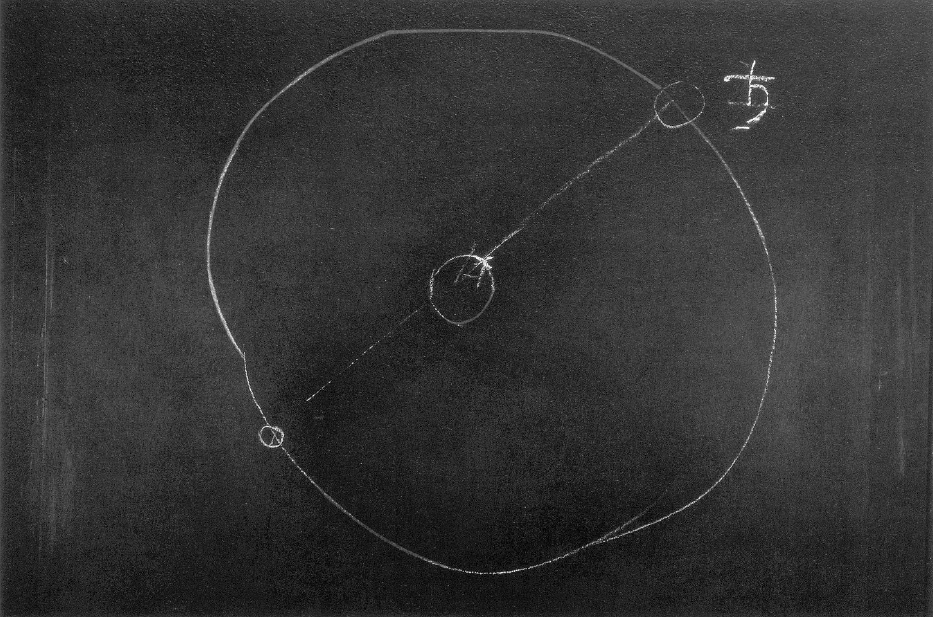
[ 30 ] If it moves so slowly over the course of thirty years, then when we draw this process, we will see the Saturn[al] cycle and find that it sometimes shines directly on a spot on Earth; but then it can also work on that spot by passing through the Earth. It always depends on the thermal state of the air to what extent the forces of Saturn can affect plant life on Earth. In cold air they cannot reach it; in warm air they can. And what they do—where do we see this in plant life? We see it when, instead of annual plants that arise in the course of a year and then perish, leaving only seeds behind, we see what Saturn does with the help of our Earth’s heat forces—we see this when perennial plants develop. For these forces, which enter the plant kingdom indirectly through heat—we see their effects in the bark of trees, in everything that makes a plant a perennial.
[ 31 ] This stems from the fact that the plant’s one-year life cycle and its limitation to a short lifespan are connected to the planets, which have short orbital periods. In contrast, that which breaks free from this transience—that which surrounds the trees with bark, making them enduring—is connected to the planetary forces that act indirectly through the forces of heat and cold and have long orbital periods, such as Saturn’s thirty years and Jupiter’s twelve years. It is therefore significant if someone wants to plant an oak tree and is well-versed in Mars periods. For an oak tree, properly planted during the appropriate Mars period, will thrive differently than if it were thoughtlessly planted in the ground simply whenever it suits one’s convenience. Or if you are planting coniferous forests, where the forces of Saturn play such a major role, the result will be quite different depending on whether the coniferous forest is planted during a so-called ascending period of Saturn or during another period. And anyone who understands these things can tell with complete precision—in the case of plants that thrive or fail to thrive—whether they were cultivated with an understanding of the interplay of forces or not. For what is not so readily apparent to the eye becomes quite evident in the more intimate aspects of life.
[ 32 ] Let us suppose, for example, that we use wood from trees that were planted on Earth without regard for the world periods; this does not provide us with as healthy a heat as when we use wood from trees that were planted with understanding. It is precisely in the more intimate contexts of daily life—where these things play such a significant role—that the immense importance of such matters becomes apparent; yet life today has become almost entirely thoughtless for people. People are glad when they do not have to think about such things. People imagine that the whole thing must run like a machine; you have the necessary mechanisms, and when you wind up the machine, it runs. That is how they imagine—in a materialistic way—that it works throughout nature as well. But this leads to situations that have tremendous consequences in practical life. That is where the great mysteries arise.
[ 33 ] Why is it impossible today to eat potatoes like the ones I used to eat in my youth? It’s true—I’ve tried them everywhere. You can no longer eat potatoes like that, not even where I used to eat them back then. Over time, the intrinsic nutritional value of many things has definitely declined. The last few decades demonstrate this in the most striking sense. Because people no longer understand the more intimate forces at work in the universe—forces that must nevertheless be sought in the manner I have just hinted at in my introduction. I simply wanted to point out where there are questions that extend far beyond today’s horizons. We will not only continue this, but also apply it more deeply in practice.