

The Agricultural Course
Spiritual Science Foundations
for the Prosperity of Agriculture
GA 327
16 June 1924, Koberwitz
Translated by Steiner Online Library
Eighth Lecture
My dear friends!
[ 1 ] Rudolf Steiner:In this final lecture session—which may still be supplemented by some points tailored to your needs during the discussion that follows—I would like, as much as possible within the limited time available, to present some additional points and offer a few practical tips. Today, however, we will be dealing precisely with those practical matters that are exceptionally difficult to express generally in formulas and the like, but which are instead subject to a very high degree of individualization and personal treatment. And it is precisely for this reason that it will be necessary to develop, in this field in particular, insights from the spiritual sciences—insights that can then, in a sensible way, lead to individualization in the measures taken.
[ 2 ] Rudolf Steiner:Just consider that today there is very little understanding in one of the most important areas: the feeding of our farm animals. This situation cannot really be improved much, no matter how much information is provided specifically on this topic: How should we feed them? — However, I am convinced that it can be significantly improved if agricultural education increasingly focuses on developing an understanding of what feeding is really all about. I would like to begin addressing this today.
[ 3 ] Rudolf Steiner:You see—as I’ve already hinted—the very nature of what food means for animals and also for humans is always viewed in a completely wrong light. It’s not a matter of the crude process where nutrients are taken in from the outside and then—as people more or less imagine, even when they think of all sorts of transformations—stored in the organism. In a crude, simplistic way, people imagine: well, there’s the food out there; the animal takes it in, stores what it can use, and excretes what it can’t use. And one must then pay attention to various factors—for example, ensuring that the animal is not overfed, that it receives the most nutritious food possible, so that it can utilize as much as possible of what is contained in the food. And if one is inclined to make materialistic distinctions in this field—as is often the case—one also distinguishes between actual foodstuffs and those substances that, as they say, in the organism, and on this basis one formulates all sorts of theories that are then applied in practice—though one must always acknowledge, of course, that some of these are correct and others are simply not, or cease to be correct after some time, or are modified by one factor or another. And how could one expect it to be any different!
[ 4 ] Rudolf Steiner:For you see: People speak of combustion processes in the organism. Of course, there is not a single combustion process in the organism, and the combination of any substance with oxygen in the organism means something entirely different from a combustion process. Combustion is a process that occurs in the inorganic, inanimate world. But furthermore, just as an organism is something different from a quartz crystal, so too is what is referred to as combustion within the organism—it is not the lifeless combustion process that takes place externally, but rather something living; it is even something that feels.
[ 5 ] Rudolf Steiner:It is precisely by expressing oneself in the manner described above—and thereby steering one’s thoughts in a certain direction—that the greatest nonsense is caused. For the person who speaks carelessly when discussing combustion within the organism. If they have the right idea in mind, it does no harm if they speak carelessly yet still do things reasonably correctly based on instinct or tradition. But when, little by little, the “psychopathia professoralis”—a term I have used many times—takes hold of these matters through such sloppy speech, it transforms what was merely sloppy speech into—and I mean this quite seriously—witty theories. And then people act in accordance with these theories, but completely miss the mark. What people talk about is something entirely different from what actually occurs in plants and animals. That is the characteristic phenomenon of today: people do something entirely different from what corresponds to what happens in nature. Therefore, one must look a little more closely in this very area at what is actually at stake.
[ 6 ] Rudolf Steiner:Let us now consider the points to which our reflections led us yesterday: that the plant has a physical and an etheric body and is, to a greater or lesser extent, enveloped by the astral. The plant does not reach into the astral, but it is, as it were, enveloped by the astral. When it enters into a very specific connection with the astral body—as is the case with fruit formation—something is produced as nourishment that then supports the astral body in the animal and human organism. If one looks closely at the process, one can simply observe in any plant or anything else whether it is intended to support something in the animal organism or not. But I believe one must also consider the opposite pole. For there is something there that is extraordinarily important. I have already touched upon it, but here, where the foundations are to be laid for the processes of nutrition, it must be emphasized once again.
[ 7 ] Rudolf Steiner:Since we are discussing feeding, let us start with animals. In animals, we do not find such a sharp threefold division of the organism as we do in humans. In animals, we also have, to a marked degree, the nervous-sensory organism and the metabolic-limb organism. These are clearly separated from one another, but the middle one—the rhythmic organism—is blurred in various animals. Something that still originates from the sensory organism enters the rhythmic organism, as does something that originates from the metabolic organism, so that we should actually speak differently about animals than we do about humans. In humans, we speak very precisely of this threefold division of the organism. But in animals, we should speak of the nervous-sensory organization, which is primarily localized in the head, and of the metabolic-limb organization, which is organized in the abdomen and limbs but in turn permeates the entire organism. And in the middle, the metabolism in animals becomes more rhythmic than in humans, and the nervous-sensory organization also becomes more rhythmic; the two interflow, so that the rhythmic aspect does not emerge as something so strongly independent in animals. It is a more indistinct interplay between the two outer poles. In animals, therefore, one should actually speak of a two-part structure of the organism, in which, however, the two parts blend together in the middle, giving rise to the [entire] animal organism.
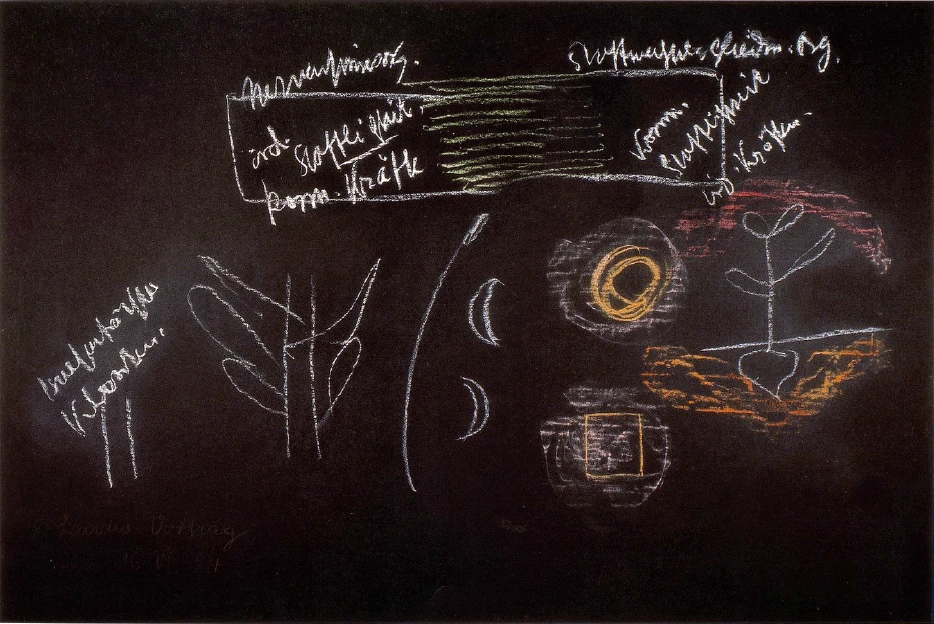
[ 8 ] Rudolf Steiner:Well, all the substances found in the head organization—this is true of humans as well, but let’s stick to animals for now—whatever is in the head organization consists of earthly matter. The matter contained within the head is earthly matter. Already in the embryonic stage, earthly matter is channeled into the head organization. The embryo’s organization must be structured in such a way that the head receives its substances from the earth. So inside there we have earthly, material substance. In contrast, everything we have in terms of material substance in the metabolic-limb organization—that which permeates our intestines, our limbs, our muscles, our bones, and so on—does not come from the earth, but rather from what is absorbed from the air and from the warmth above the earth. That is cosmic material substance. It is important that you do not view a claw as if it were formed by physical matter that the animal eats reaching the claw and being deposited there. That is simply not true; rather, cosmic matter is taken in through the senses and breathing.
[ 9 ] Rudolf Steiner:And what the animal eats serves only to develop the forces of movement within the animal, so that the cosmic can be driven into the metabolic-limb organization—that is, into the hoof—so that cosmic substance is present everywhere here. With the forces, however, it is the other way around. We have them in our heads—precisely because that is where the senses are primarily located and the senses perceive the cosmos—and thus we deal with cosmic forces there. In the metabolic-limb system—just think of it this way: when one walks, one is constantly engaging with the Earth’s gravity, and thus everything one does with the limbs is bound to the Earth—there we are dealing with earthly, terrestrial forces, that is, with cosmic substances and earthly forces.
[ 10 ] Rudolf Steiner:It really does matter [whether one knows] that a cow—with the limbs she needs for work if she is to become a work animal—or an ox, if he is to become a work animal—must be fed in such a way that they absorb as much of the cosmic substance as possible, and that the food passing through the stomach must be prepared in such a way that it develops the strength to channel this cosmic substance throughout the limbs, muscles, and bones. Likewise, one must know that the substances needed by the head must be obtained precisely through food, and that the processed food, having passed through the stomach, must be directed to the head. It is the head, not the big toe, that depends on the stomach in this regard; and one must be clear that the head can process this nourishment it receives from the body only if it can draw the necessary forces from the cosmos in an appropriate manner, [if] animals are not simply locked away in dreary stalls where no cosmic forces can reach them, but [if] they are led out to pasture and given the opportunity to interact with their environment through their senses. You see, one must take the following into account, for example:
[ 11 ] Rudolf Steiner:Imagine an animal standing at the feeding trough in a dreary barn, receiving only what human wisdom deems fit to put in that trough. Indeed, this animal differs greatly—since it cannot find variety there (it can only find it outdoors)—from the other animal that makes use of its senses, for example its sense of smell, seeks out its own food in the freedom of the outdoors, follows its sense of smell, pursues the cosmic forces in accordance with its sense of smell, seeks out its food, takes it for itself, and develops all its activity in this act of taking food indoors.
[ 12 ] Rudolf Steiner:An animal placed at the feeding trough—since traits are inherited, after all—will not immediately show that it lacks cosmic forces within itself; it still passes them on, but gradually produces offspring in whom these cosmic forces are no longer innate in this way—they no longer possess them. And the animal grows weak starting from the head; that is, it can no longer nourish the body because it cannot absorb the cosmic substances that are supposed to re-enter the body. These things already indicate to you that one simply should not make generalizations such as, “Feed this in this case, feed that in that case,” but rather that one should develop an understanding of the value that certain feeding methods have for the entire being of the animal organism.
[ 13 ] Rudolf Steiner:But let’s move on. What, then, is actually contained within the head? Earthly matter. So if one were to cut out the noblest organ from an animal—the brain—one would find earthly matter inside. In humans, the brain contains earthly matter; only the forces are cosmic, while the matter itself is earthly. What is the purpose of this brain? It serves as a foundation for the “I.” The animal does not yet possess the “I.” Let us be very clear about this: The brain serves as a foundation for the “I”; the animal does not yet possess the “I”—[it] is only on the path toward the formation of the “I.” In human beings, this process continues ever further toward the formation of the “I.” So the animal has a brain; how did it come into being?
[ 14 ] Rudolf Steiner:Consider the entire organic process. Everything that takes place there—that which emerges in the brain as earthly-material substance—is simply excreted; it is an excretion from the organic process. Earthly matter is excreted there to serve as the foundation for the “I.” Now, a certain amount of earthly matter—formed on the basis of the process that begins with food intake and proceeds through digestion and distribution in the metabolic-limb system—is capable of being channeled from there into the head and the brain; there is a certain amount of earthly substance that follows this path and is then properly excreted in the brain. But this nutritional matter is not only deposited in the brain; it is already deposited along the way in the intestines. That which cannot be further processed is deposited in the intestines, and here you encounter a connection that you will find extremely paradoxical, but which must not be overlooked if one wishes to understand both the animal and the human organism. What is brain matter? Brain matter is simply intestinal matter that has reached its final stage. Premature brain secretion passes through the intestines. In terms of its processes, the contents of the intestines are quite similar to the contents of the brain.
[ 15 ] Rudolf Steiner:To put it grotesquely, I would say that what spreads throughout the brain is an advanced pile of manure; but objectively speaking, this is entirely correct. It is the manure that, through the body’s own organic process, is transformed into the noble substance of the brain and becomes the foundation for the development of the ego there. In humans, as much as possible is transformed from abdominal manure into brain manure, because humans carry their ego on Earth; in animals, less is transformed, so more remains inside as abdominal manure, which is then used as actual fertilizer. More of the ego remains in its embryonic form there. Because the animal does not develop it into an ego, more of the ego remains in its embryonic form there. That is why animal manure and human manure are two entirely different things. Animal manure still contains the “I” potential. And we find that when we apply manure—when we bring fertilizer from the outside to the root, the “I” to the root, to the plants—that when we draw the plant completely, with the root down below and the developing leaves and flowers above, the astral aspect develops here through interaction with the air, and here, through interaction with the fertilizer, the plant’s “I” principle develops.
[ 16 ] Rudolf Steiner:Agriculture is truly an organism. It develops its astral aspect upward, and the presence of fruit and forest fosters this astral development. When animals eat the right things that grow above the earth, they develop the proper “I” forces in what they excrete as manure; these forces, in turn, cause the plants to grow correctly from the roots, in the direction of gravity. It is a marvelous interaction. But one must gradually come to understand this interaction.
[ 17 ] Rudolf Steiner:Now you see, because that is the case, agriculture is a form of individuality.
[ 18 ] Rudolf Steiner:And one can already see from this that animals should be maintained more or less within this interplay, and that plants, too, should be maintained more or less within this interplay. Therefore, in a certain sense, it is already a disruption of nature when one does not obtain manure from the animals that are part of agriculture, but instead eliminates these animals and imports manure from Chile. For in doing so, one overlooks the fact that this is a self-contained cycle—something that is meant to sustain itself. Of course, one must then organize things so that the system can sustain itself. One simply needs to have enough animals—and the right kinds of animals—in agriculture to ensure a sufficient supply of high-quality manure. And one must also ensure that one plants crops that the animals one wishes to keep will instinctively seek out and eat.
[ 19 ] Rudolf Steiner:Of course, this makes the experiments complicated because they become individualized. But the point here is precisely to provide guidelines on how the experiments should be conducted. And many different approaches will be tried. Rules for practice will then emerge, but all these rules should stem from the guiding principle that agriculture should be organized as self-sufficient as possible. Though not entirely. Why? A objective perspective in the spirit of the humanities will never lead to fanaticism. This cannot be fully achieved within our current economic system. But as far as possible, we should strive to achieve it. Now you see, once we have this, we can then identify, in more concrete terms, the relationships between the animal organism and the plant organism—that is, the feed organism. Let us first look at this in broad terms, in general.
[ 20 ] Rudolf Steiner:Let’s take a look at the root: The root, which generally develops inside the earth and is permeated by the emerging “I”-force through the fertilizer, absorbs the emerging “I”-force through the very way it is situated within the earth, and is aided in absorbing this “I”-force when the right amount of salt can be found for it in the earth.
[ 21 ] Rudolf Steiner:Let us assume that we have derived this root simply from the considerations we have made. We must now define roots as those foods that, when they enter the human organism, most easily find their way to the head through digestion. We will therefore use root foods in situations where we must ensure that we provide the head with substance—material substances—so that the cosmic forces acting through the head find precisely the right material for their formative activity. Imagine someone saying: “I must provide root food to an animal that needs to direct substance toward the head in order to enter into the most active sensory relationship—that is, a cosmic relationship—with the cosmic environment.” — Yes, don’t you immediately think of the calf and the carrot? When the calf eats the carrot, you have, in fact, completed the entire process. The moment you say something like that—and now that you know how things look and how they live—you are directing your gaze toward what is to happen. You only need to know how this process of change works.
[ 22 ] Rudolf Steiner:And let’s move on. Now, if the substance has truly been directed into the head—if we have fed the calf the carrot—the reverse process must be able to begin; that is, the head must now be able to work of its own volition and thereby generate forces within the organism, so that such forces can in turn be incorporated into the organism. It is not enough for mere “carrot dregs” to be deposited in the head; rather, from what is deposited there—that is, what is in the process of being broken down—energetic radiations must flow into the organism. In other words, you must have a second form of nourishment which, after serving a part of the body—in this case, the head—enables that part to work properly in relation to the rest of the organism.
[ 23 ] Rudolf Steiner:Now look at this: I’ve given the carrot. I want the body to be thoroughly permeated by the forces that can develop from the head. For that, I need something in nature that has a radiant form, or that properly gathers this radiant form into, let’s say, a concentrated form. What is needed here? As a second feed to go with the carrot, you need something that, within the plant, transforms into the radiant and brings this radiant force back together. Attention then turns to flaxseed and the like. And if you feed these together to young cattle—carrots and flaxseed, or something else that complements them well, such as, say, fresh hay with carrots—then you’ll achieve that which truly exerts a dominant influence on the entire animal, setting the animal on the path for which it is predisposed. So we must try to provide young cattle with food that, on the one hand, promotes the “I” force and, on the other hand, promotes that which flows from top to bottom—the astral fillings. This is particularly the case with everything that has long stems and is simply left to its own development in this long-stemmed state—that is, it has long stems and becomes hay. This is how we view the matter here, and this is how we should view all of agriculture: knowing about every thing what happens to it as it takes the path either from the animal into the soil or from the plant into the animal.
[ 24 ] Rudolf Steiner:Let’s continue with this topic. Let’s take an animal that is meant to become strong precisely in this middle region, where the head organization—the nervous and sensory system—develops more in accordance with respiration, and where, in turn, the metabolic [limb] organization develops more in accordance with rhythmic processes, resulting in a kind of intermingling. What kind of animals are these that are meant to become strong there? They are precisely the dairy animals. They are meant to become strong in this area. In dairy production, the requirement that the animals become strong in this area is simply fulfilled. Yes, what, then, must we pay attention to? We must ensure that in the flow moving from the head toward the rear—which is primarily a flow of forces—and in the flow moving from the rear toward the front—which is primarily a flow of substances—the proper interaction takes place. If this proper interaction occurs in such a way that what flows from back to front is processed as thoroughly as possible by the forces flowing from front to back, then good milk and abundant milk are produced. For good milk contains that which is particularly developed in the metabolism; it contains a material preparation that has not yet passed through the sexual system but has become as similar as possible, in the digestive process, to the [sexual process]. Milk is simply transformed secretion from the sex glands, transformed by what is imparted to the substance on its way to becoming a sexual secretion by the head forces acting upon it. One can look right into the process that is actually taking place there; one can certainly look right into it.
[ 25 ] Rudolf Steiner:Well, for all such processes that are to develop in this way, we must seek out those foods that affect the head less than the roots that have absorbed the “I”-force. But since it is to remain related to the sexual force—and should not contain too much astral content—we must not take too much of what pertains to flowering and fruiting. That is to say, when it comes to milk production, we must focus on what lies between the flowers and the roots—on the green and leafy parts—and on everything that unfolds in the leaves and herbs.
[ 26 ] Rudolf Steiner:In particular, when we want to increase the milk yield of an animal that we believe has the potential to produce even more milk, we can reliably achieve this increase by doing the following.
[ 27 ] Rudolf Steiner:Suppose, given the circumstances, that I start by feeding a dairy cow some kind of grass or leafy vegetation. I want to increase milk production. I imagine that I can increase milk production. What do I do then? I now use plants that bring the fruiting process—what takes place in flowers and during pollination—into the leafy and herbaceous growth process. Legumes, for example, or specifically the clover species, do this. Within the substance of the clover, various fruit-like structures develop, just like in a herb. If you treat the cow this way, you won’t see much difference in her yet; but when the cow calves—the changes brought about by this feeding regimen usually take one generation to manifest—the calf will grow into a cow that produces plenty of milk.
[ 28 ] Rudolf Steiner:Now, one must pay particular attention to one aspect of these matters. For the most part, as the old traditions rooted in instinctive wisdom in this area have faded away, certain practices have been preserved—just as doctors have continued to use certain remedies even though they no longer know why; but they’ve kept them because they’ve always helped. So we know a few things from old “traditions”—we may not know why we use them, but we try them out anyway, specifying the amount we’re testing—that is, the amount we give to beef cattle, dairy cattle, and so on. And now, of course, this whole situation often plays out just as human trial and error generally does, especially when this trial and error is left entirely to chance. Think about what happens to you when you’re somewhere—when you’re among many people—and you have a sore throat; everyone who cares about you gives you something. Within half an hour, you’ve gathered a whole pharmacy’s worth of remedies. If you were to take all of that, one remedy would counteract the other, and you’d certainly ruin your stomach thoroughly, but the sore throat wouldn’t get any better. Simply because of the circumstances, what should be a simple matter is turned into something quite complicated.
[ 29 ] Rudolf Steiner:But something very similar happens when you experiment with feed. Because, don’t you think, you try something that works in one way but not in another. Now you apply a second one, add that to the mix, and in this way you end up with a number of feeds, each of which has a certain significance for young cattle or fattening cattle; but it all becomes so complicated that you can no longer keep track of it at all, because you can no longer grasp the balance of forces. Or else their effects will cancel each other out. This is exactly what happens in many cases, and it happens especially among those who practice agriculture with only a superficial understanding. They look things up in books, or they recall what they’ve learned: “Young cattle must be fed this way, fattening cattle that way.” That’s what they do. But not much good can come of it, because under certain circumstances, what one reads in the books may actually contradict—in an incorrect way—what one is already feeding the animals anyway. One can proceed rationally only if one adopts the kind of mindset I have outlined, and if one adopts a mindset that simplifies the animal’s nutrition in many ways, so that one can keep track of it.
[ 30 ] Rudolf Steiner:Let’s say you can keep track of it: yellow beets or carrots and flaxseed—they work in this way. You keep track of that. You don’t just mix everything together haphazardly. You keep track of the effects of what you give. Think about how one approaches agriculture when doing this—quite consciously, quite thoughtfully. And in this way, one will gain insights not for the sake of complication, but for the simplification of feeding methods. Some things—even a great many—are correct among what has gradually been discovered through trial and error, but they are unsystematic and imprecise. Precisely this kind of precision that is applied today is in reality imprecise, because things are muddled together and one cannot see through them, whereas something like what I have presented can be clearly traced in its simplicity and straightforward mode of action, right down into the animal organism. Let’s take another example.
[ 31 ] Rudolf Steiner:Let us approach the matter from the perspective of what is more flower-like, of what appears to bear fruit within the flower. But we must go even further; we must also look for what bears fruit in the rest of the plant. After all, the plant has something that particularly appealed to Goethe. Throughout its entire body, it contains the potential for what is otherwise specialized. Isn’t it true that with other plants, we plant what appears as the ovary in the flower into the soil to grow new plants, but with the potato, we don’t do that? Instead, we use the eyes of the tubers. With many plants, we do not do this; there, the fruiting part is present. Now, this fruiting part—which has not yet been carried through to its ultimate conclusion in nature (not everything is carried through to its ultimate conclusion in nature)—can be continually enhanced in its mode of action through processes that are in some way externally similar to external combustion.
[ 32 ] Rudolf Steiner:So, for example, the substance that comes from the plant in the form of dried shavings becomes more potent if you let it steam a little while spread out in the sunlight; this causes the inherent process to be carried a step further toward fruiting. There is actually a wonderful instinct at work here. If one observes the world with discernment, one really does ask oneself: Why did humans come to cook their food? It is certainly a question. It’s just that we don’t usually ask about the things that surround us every day. Why did people start cooking their food? They started cooking their food because they gradually discovered that in everything that works toward fruition, the processes involved in cooking—namely the combustion process, heating, drying, and steaming—because all these processes primarily prepare the floral and seed components—and then indirectly the remaining parts of the plant, namely those located toward the top—to develop, in a particularly powerful way, the forces that are to be developed in the animal’s metabolic and skeletal systems. Even when we consider the flower and the seed, the floral and seed parts of the plant act upon the animal’s metabolic and digestive systems in such a way that they exert their influence there primarily through the development of their forces, not through their material substance. For the metabolic-limb system requires earthly forces. And to the same extent that it needs them, it must receive them.
[ 33 ] Rudolf Steiner:Let’s consider animals grazing in the Alps. They are not like those found on the plains; rather, they must move about under difficult conditions. The conditions are made even more difficult by the fact that the ground is not level. It makes a difference whether they move about on level or sloping ground. Such animals must therefore absorb within themselves what the forces—which are to be mobilized by the will—develop in the region of the limbs. Otherwise, they would be neither good work animals, nor good dairy animals, nor good fattening animals. One must therefore ensure that they receive sufficient nourishment derived from the aromatic Alpine herbs, where—through the process of sun-cooking—the fruiting and flowering parts have been further processed toward the blossoms, even by nature itself. But strength is also imparted to the limbs through artificial further processing, particularly when this artificial treatment involves cooking, simmering, and so on. The best are those derived from the fruiting and flowering parts of the plant, especially when plants are treated in this way—plants that are predisposed from the outset to flowering and fruiting, that develop few herbaceous or leafy parts, but instead proceed directly to flowering and bearing fruit. We should boil everything that places little emphasis on becoming herbaceous, everything that thrives in flowering and fruiting.
[ 34 ] Rudolf Steiner:And it would do people a great deal of good to take such things into account for themselves as well from time to time; otherwise, the things that come from people who are on the slippery slope of becoming sluggish—that is, becoming lazy—would not come to pass. For one can find oneself on this slippery slope; therefore, one can quite reasonably tell oneself: if I’m just faffing about all day, I certainly can’t become a true mystic. I can only become a true mystic if I become completely calm, if I’m not constantly being prompted—neither by myself nor by my surroundings—to get busy, if I reach a state where I can say to those around me: “I don’t have the energy to be busy with chores; then I’ll surely become a true mystic.” So I also try to organize my diet in such a way that I become a true mystic. Well, then you become a raw foodist; you stop cooking for yourself and become a true raw foodist. But now you see: Things all conceal themselves; they don’t come out in the proper way. For, of course, it’s once again the case that if someone becomes a raw foodist—who is strongly inclined toward mysticism in this way—and if they are physically weak by nature from the outset, then they’ll actually make progress; they’ll become increasingly sluggish, which means increasingly mystical. What happens in humans, we can certainly apply to animals as well, so we’ll know how to make the animal more active.
[ 35 ] Rudolf Steiner:The opposite case can also exist in human beings. A person may have a strong physical constitution and only later have developed the eccentricity to become a mystic. He may possess strong physical powers within himself. Then the processes he possesses, along with the forces generated by the raw food he has eaten, are simply further developed within him. In that case, it does him little harm. And when he then calls upon the forces that would otherwise remain dormant—the ones that cause rheumatism and gout—and further processes them, the raw foodist becomes all the stronger for it.
[ 36 ] Rudolf Steiner:All things have two sides, just as a scale has two pans. That is why one must understand how they manifest individually. One cannot lay down general principles. And that is the advantage of the vegetarian lifestyle: it makes one fundamentally stronger because it draws out of the body forces that would otherwise lie dormant—forces that are, in fact, the very same ones that cause gout, rheumatism, diabetes, and so on. And when one consumes only plant-based foods, these forces must ripen the plants for human consumption. But if one eats animals right away, these forces are deposited within the body, remain unused, and then consume themselves by depositing metabolic waste in various places or by driving necessary substances out of the organs and claiming them for themselves—substances that the person should be using—as in the case of diabetes and so on. One can only understand these things by looking into the matter closely.
[ 37 ] Rudolf Steiner:And then it will be a matter of approaching the question of how to fatten animals in such a way that one says to oneself: What must happen is that as much cosmic substance as possible must be poured into them, as if into a sack. Oh, those fattening pigs are such heavenly animals! For in their fat bodies—insofar as it is not the nervous-sensory system—they contain entirely cosmic substance, not earthly substance. They need what they enjoy solely to redistribute throughout their bodies this entire abundance of cosmic substance, which the pigs must absorb from all sides. The pig must eat this so that it can distribute this substance, which must be drawn from the cosmos. It must possess the forces within itself to distribute them, just as other livestock do. That is why you will see that these animals grow fat when you feed them fruit, preferably in a further-processed state—through cooking or steaming—and when you give them something that already contains the essence of the fruit but has been enhanced, such as, for example, beets that have already been enlarged through a process more advanced than the one they originally underwent—beets that, through further cultivation, have become larger than they were in their wild state.
[ 38 ] Rudolf Steiner:And in this way, one might ask again: What, for example, should one feed an animal being fattened for slaughter? Something that contributes as much as possible to the distribution of cosmic substance—that is, something that, first of all, is close to the end of its fruiting cycle and, furthermore, has been treated in the proper manner. Certain oil cakes and the like essentially meet this condition. But we must also ensure that the animal’s head is not left entirely unsupported—that, even with such a fattening regimen, some earthly substances still make their way up to the head. We must therefore counterbalance the previous condition with something that we must now administer in small quantities, since the head does not require as much. Thus, we must administer it in small quantities. For this reason, one should nevertheless mix root matter into the feed of fattening animals, albeit in small doses.
[ 39 ] Rudolf Steiner:You see, there is a type of substance—pure substance—that has no specific function. In general, one can say that the root-like has a function in relation to the head, the flower-like has a function in relation to the metabolic-limb system, and the leaf-like and herb-like have a function in relation to the rhythmic system with its substantiality in the human organism. That which one must support because it relates to all parts of the animal organism is the salt-like. And since food consists of the least amount of salt, both in humans and in animals, you can see from this—precisely from the addition of salt—that it is not always the quantity that matters, but the right [quality]; that even small amounts, in the right [quantity], certainly fulfill their purpose.
[ 40 ] Rudolf Steiner:Now I would like to point out something particularly important, regarding which I would ask that very precise experiments be conducted—experiments that can also be extended to the observation of humans when they have a preference for the food in question. As you know, the tomato has only relatively recently—in fact, quite recently—been introduced as a foodstuff. It is very popular with many people. But it is also an extraordinarily important subject of study. One can learn an extraordinary amount from tomato production and tomato consumption. Those people—and there are certainly some today—who reflect a little on these matters find, quite rightly, that the consumption of tomatoes is of great significance for humans—and this can certainly be extended to animals, if one were to accustom animals to tomatoes— it is of great significance for everything in the organism that is expelled most from the organism and takes on its own organization within it. You see, two things follow from this. First, it confirms the statement made by an American that, under certain circumstances, eating tomatoes as a dietary measure can have a beneficial effect on pathological conditions of the human liver, because the liver is the organ that functions most independently within the human organism; thus, liver diseases—which are generally more common in animals—could also be combated through the consumption of tomatoes.
[ 41 ] Rudolf Steiner:As you can see, one first looks at the connection between the plant and the animal. One should therefore—and I’d like to mention this in parentheses—immediately forbid anyone suffering from cancer—which, from the outset, isolates a certain area within the human or animal organism—from eating tomatoes. But now let us ask ourselves: How does this come about, and what is the connection that causes the tomato to affect, in particular, that which is autonomous within the organism—that which has become so highly specialized within the organism?
[ 42 ] Rudolf Steiner:This has to do with what the tomato wants and needs for its actual development. The tomato thrives best during its development when it has fertilizer that is as close as possible to its original form—as it was excreted by an animal and as it was excreted from something else. If the fertilizer doesn’t have time to decompose fully in nature—if it’s completely raw fertilizer—if you just throw waste together somewhere and end up with a completely haphazard pile of fertilizer or compost containing as much of the original material as possible, just as it was produced, without any further processing or preparation—if you plant tomatoes there, you’ll see that the most beautiful tomatoes will grow. And if you were to use compost piles made from the tomato plants themselves—that is, if you let the tomato grow on its own compost—it will thrive brilliantly. The tomato does not want to leave itself at all; it does not want to leave that strong, living force. It wants to remain within it. The tomato is the most unsociable being in the plant kingdom. It doesn’t want to take anything from strangers in any way. Above all, it rejects anything that has once undergone a process as fertilizer; it doesn’t want that. And this is connected to the fact that it can once again influence the self-sustaining organization within human and animal organisms.
[ 43 ] Rudolf Steiner:And in a certain sense, the potato is related to the tomato in the way suggested above. It, too, has a strong independent effect—so independent, in fact, that it tends to pass easily through the entire digestive process and penetrate the brain, making the brain act independently, even independent of the influence of the other human organs. And among the factors that have made humans and animals materialistic since the invention of potato cultivation in Europe is precisely the excessive consumption of potatoes. Potato consumption should only go so far as to stimulate the cerebral, the intellectual, within us. But one must not, above all, overindulge in potatoes.
[ 44 ] Rudolf Steiner:These are all things that, when understood, reveal how agriculture is intrinsically linked to social life in a practical way. And it is so incredibly important that agriculture is connected to social life as a whole.
[ 45 ] Rudolf Steiner:Of course, I could only provide general guidelines on these matters, but over a long period of time, they can serve as the foundation for a wide variety of experiments in this very field. Brilliant results will emerge if they are incorporated into the process on an experimental basis right now. This should also serve as the guiding principle for how we handle what has been presented in this course. I fully agree with what the farmers present in this course have decided—and decided firmly—namely, that what has been presented to these course participants should initially remain within the circle of farmers, that it should be developed into experiments, and that the farmers’ community—this circle—will determine the appropriate time when it believes its experiments have progressed far enough for the findings to be published.
[ 46 ] Rudolf Steiner:Thanks to the commendable tolerance that has been cultivated, a number of interested individuals who are not farmers themselves have been able to participate in this course. They will therefore remember the well-known opera, keep their mouths shut, and not fall into the common anthroposophical error of proclaiming all these things as widely as possible. For it is precisely this that has so often caused us so much harm—that people who do not actually have something to say out of an inner impulse that is objective, but who simply parrot others, cause these ideas to be spread further out of that very impulse.
[ 47 ] Rudolf Steiner:There is a big difference between a farmer talking about these things and someone who is completely removed from agriculture. It does make a difference; you can see that right away. But what would happen if non-farmers were to pass all of this on simply as an interesting chapter in anthroposophical teaching? The result would be what has happened in various cycles: that people—even farmers—would simply hear it from other sources. Farmers, well, when they hear it from other farmers, they just say, “It’s a shame he’s gone so crazy.” But they might say that the first and second time. Yet when a farmer then sees something, he feels a bit uneasy about dismissing it outright. But if they hear it from a source that isn’t called to this work—but is merely interested in it—then, of course, the whole thing is doomed. Then the message can’t have any lasting effect, because it has been discredited. It is necessary that those friends who were allowed to participate solely out of interest—who are not members of the Agricultural Ring—exercise restraint, keep the matter to themselves, and not spread it far and wide, as is otherwise so often done with anthroposophy. This has been decided by the Agricultural Circle, communicated today by our highly esteemed Count Keyserlingk, and I can wholeheartedly agree with it.
[ 48 ] Rudolf Steiner:Incidentally, since we are now nearing the end of these lectures—with the exception of the discussion session that will follow—I would like to begin by expressing my appreciation that you chose to come here and participate in what has been said here, as well as in what will come of it and how it will develop further. And on the other hand, I think I can safely say that I agree with all of you when I say that what has taken place here is meant to be useful work and, as such, has a profound inner value. But just think for a moment about two things: Just think of all the energy required from Count Keyserlingk, Countess Keyserlingk, and the members of the Keyserlingk family to bring all of this about here, to make this course what it has become. This includes energy, determination, an anthroposophical sense of reality, a deep commitment to the cause of anthroposophy, a willingness to make sacrifices, and all manner of other qualities. And as a result, what for all of you was likely a great deal of work—work that is even meant to strive toward great, fruitful goals for all of humanity—has, while we were here, taken on the character of a true celebration, given the way things have been conducted here. In just five minutes, you will have another small example of this. And everything else that has gone along with it—not least the extraordinary warmth and kindness of all the staff—all of that has truly enveloped this work within the framework of a truly wonderful celebration, and with this agricultural conference, we have celebrated a true agricultural festival here, and we will then, in the proper manner, express our heartfelt and sincere thanks to Countess and Count Keyserlingk and the entire Keyserlingk household for everything they have done for all of us over these ten days in the service of this cause and for the friendly, gracious nature of our stay here.
Fourth Question and Answer Session
Does slurry have the same self-organizing power as manure?
[ 49 ] Rudolf Steiner: Of course, the essential point in this matter is that liquid manure and solid manure be used in the proper combination—that is, in such a way that both work together to contribute to the soil’s organizing power. This connection to the “I” applies entirely to solid manure. [But this does not generally apply to manure. ] For every “I,” even in its potential form as found in manure, must in turn act in connection with something astral, and manure would have no astral quality if liquid manure were not present. Liquid manure supports this. It has a stronger astral force. Manure has a stronger “I” force. Manure is more like the brain, and liquid manure is more like a brain secretion, astral force—more like the fluid component of the brain, more like cerebrospinal fluid.
Could you provide the details here regarding the celestial constellations for preparing the combustion preparations?
Dr. [Elisabeth ] Vreede: The exact figures cannot be provided here. This requires calculations that cannot be performed at this time. In general, the period for insect burning runs from early February through August. For field mouse control this year—the period varies from year to year—the time from the second half of November to the first half of December would be appropriate.
[ 50 ] Rudolf Steiner: The principles of the anthroposophical calendar, as it was originally conceived, would need to be explained in greater detail; then one could follow such a calendar very precisely.
When people talk about the full moon and the new moon, are they referring only to the day of the full moon or the new moon, or do they also mean the time shortly before or shortly after?
[ 51 ] You count the new moon from the moment when this image appears, roughly speaking. This image appears there and disappears there. [When the moon is visible only as a narrow crescent and then disappears. You count the full moon from the time when this image appears. ] Always about twelve to fourteen days.
Can insects that are not available during the periods associated with these constellations be stored until they are burned?
[ 52 ] We will determine more precisely when the specimens should be prepared. The individual insect specimens can be stored.
Does the weed seed have to be burned in the summer, or can it be done at any time?
[ 53 ] Not too long after that, once you've received them.
What about the issue of this insect pepper, which comes from insects that don't actually come into contact with the soil?
[ 54 ] Yes, even into the soil. The point is that it is by no means the physical contact with the insect that matters, but rather the property that is present in this homeopathic dose. The insect has a completely different kind of sensitivity, and it actually flees from precisely what is produced when the substance in question is scattered into the soil. This does not prevent the insect from coming into contact with the soil.
What about the harmful effects of frost on agriculture, particularly on tomatoes? And in what cosmic context should frost be understood?
[ 55 ] If you want the tomato to grow big and beautiful, it must be kept warm. It suffers greatly from frost. As far as frost in general is concerned, you simply need to understand what the effects of frost actually entail. The effects of frost always involve a significant intensification of the cosmic influence at work in the earth. Now, this cosmic influence operates within a normal range when temperatures are within certain limits. At specific temperatures, this influence is precisely what the plant needs. However, if we experience prolonged, intense, and deep-penetrating frost, the influence of the heavens on the earth becomes too strong, and the plants develop a tendency to stretch out in various directions, to form threads—that is, to spread out into thinness—and this, of course, under certain circumstances, because it is thin, is immediately affected by the external frost and destroyed, so that in frost that goes too far, we would have a phenomenon that must be extraordinarily harmful to plant growth, precisely because too much of the heavens is entering the soil.
Should the combustion residues from the brakes be used to treat animal carcasses, or should these residues simply be spread on meadows and pastures?
[ 56 ] Where the animal eats. These animal remains are spread on the fields. They are all intended as a supplement to the fertilizer.
What's the best way to control couch grass? It's very difficult to get couch grass seeds.
[ 57 ] This method of couch grass propagation that you mentioned—where you don’t get to the seed—ultimately resolves itself. If you don’t get any seeds, then you don’t really have it. If it settles in such a way that it sinks into the ground and then continues to spread, then you can also control it. You’ll find as many seeds as you need, since you only need very few. After all, you can also find four-leaf clovers.
Is it even allowed to preserve feed using electricity?
[ 58 ] What do you hope to achieve by this? Of course, one must consider the overall role of electricity in nature. It is, I would say, reassuring that even now, from America—where observational skills are generally more acute than in Europe—voices are being heard suggesting that human beings cannot continue to develop in the same way in an atmosphere permeated on all sides by electric currents and radiation; rather, this has an impact on the entire development of the human being. Spiritual life will change if these things are taken as far as is actually intended. There is a difference between equipping a region with steam engines and steam locomotives for the railroad, and electrifying it. Steam acts more consciously here, while electricity acts in a terribly unconscious way, and people have no idea where certain things come from. There is undoubtedly a development moving in the following direction, when I consider that electricity is used above ground—both as radiant electricity and as conductive electricity—to transmit messages from one place to another as quickly as possible; this aspect of human life, particularly in the context of radiant electricity, will result in people no longer being able to grasp these messages that they receive so rapidly. It has a stifling effect on comprehension. The effects are already noticeable today. You can already observe that people find it much harder to grasp the things that come their way than was the case decades ago. It is comforting that insights into these matters are already being disseminated from America. Now, it is often the case that when something new emerges, it is usually first seen as a remedy. Later, however, the prophets also make use of it. It is curious that whenever something new appears, even clairvoyant phenomena are reduced to human terms. There is one such person who passionately prophesies to people about the healing power of electricity, whereas it would never have occurred to him before. And that is how things come into fashion. Just as no one could have conceived of healing through electricity as long as it did not exist. Now, all of a sudden—not merely because it happens to be available, but because such things have come into fashion—it has suddenly become a remedy. When applied as a form of radiation, electricity is sometimes no more of a remedy than using small, thin needles to prick the skin. It is not the electricity that heals, but rather the shock effect that has a healing effect. However, one must not forget that electricity always has a particularly strong effect on the higher organization—the brain organization—of humans and animals, and accordingly, in plants, it acts with extraordinary intensity on the root system. So if one uses electricity by electrifying foodstuffs, one produces food that will gradually cause the animal consuming it to become sclerotic. This is a slow process—one won’t notice it right away—but one will eventually observe that these animals die earlier than they should. People will not identify electricity as the cause; they will attribute it to all sorts of other things.
[ 59 ] Electricity, however, is not something that should influence living beings or particularly promote their well-being; for it cannot do so. If one simply knows that electricity lies one level below the living, and that the living strives—the higher it is, the more so—to repel electricity—it is a repulsion—if one now guides the living to to use defensive mechanisms when there is nothing at all to defend against, then living organisms gradually become nervous, restless, and sclerotic.
What does Spiritual Science have to say about the preservation of animal feed through acidification, and about the acidification process in general?
[ 60 ] Whether one uses salt-like substances at all in this process—in the broader sense—whether one ultimately adds salt when consuming food directly or adds it to animal feed, it doesn’t make that much of a difference. If you have feed that has too low a salt content to be transported, so to speak, to the parts of the organism where it is supposed to take effect, then acidifying that feed is exactly the right thing to do. Let’s say we have beets in a certain region. We’ve seen that they are particularly well-suited to acting on the head region in the right way. They are therefore an excellent feed for certain animals, such as young cattle. If, on the other hand, you notice in a certain region that they cause the animal to shed its hair too early and too heavily, well, then you’ll add salt to the feed, because you know it isn’t being deposited sufficiently where it’s supposed to go. It doesn’t reach that far. Salt is what generally has an immensely strong effect on ensuring that a nutrient reaches the part of the organism where it is supposed to act.
What is the position of the Spiritual Science on the practice of sowing beet leaves and other green forage crops?
[ 61 ] In this case, one should aim to determine the optimal amount of acidifying agent, which should not be exceeded. Acidification in general will not have a harmful effect unless it is caused in excess by too many additives, because it is precisely the salt-like components that remain in the body most closely in their original form. In general, the organism—including the animal organism, and the human organism even more so—is constituted in such a way that it transforms everything it takes in in the most diverse ways. It is a misconception to believe, for example, that any of the protein introduced through the stomach can be further utilized in the same form in which it was introduced. This protein must first be completely transformed into dead substance and must then be reconverted by the human being’s own etheric body back into protein, which is now specifically human, animal protein. Everything that enters the organism at all must undergo a transformation. What I am saying now applies even to ordinary heat. If I were to draw this schematically, imagine: Here you have an organism, and here you have heat in the environment. Imagine, here you have dead wood, which, although it also comes from organic matter, is already dead; and again, heat from the environment. If this is an organism, then this heat does not simply penetrate a little way into the organism, nor does it pass right through it; rather, the moment the heat enters the organism’s sphere, it is processed by the organism, transforming into heat processed by the organism itself—it cannot be any other way— whereas heat simply penetrates the wood and remains the same inside as it is outside in the mineral soil. The moment heat enters us unchanged, just as it enters a piece of wood, that is the moment we catch a cold. Whatever enters the organism from the outside must not remain as it is, but must be transformed immediately. This process occurs to the least extent in salt. Therefore, when using salts—which are naturally used as you have indicated, to acidify feed—if one is just a little reasonable and does not add too much—since it is already rejected by the taste—one cannot really cause any great harm. If it is necessary for preservation, then that is a sign that it is, to a certain extent, a proper process.
Is it advisable to acidify feed without salt?
[ 62 ] This is a process that has gone too far. It is, I would say, a super-organic process; under certain circumstances, if the process has gone too far, it can be immensely harmful.
Is the slurry chalk used to counteract the acidifying effects harmful to the animals?
[ 63 ] Certain animals cannot tolerate slurry chalk at all. [They cannot digest it. ] They become ill. Some animals can tolerate it, but at this moment I cannot say exactly which ones. In general, however, it does not do the animals much good; rather, they become ill.
I mean, isn't the gastric juice further neutralized by the slurry chalk?
[ 64 ] The gastric juice is rendered unusable.
I would like to ask whether the mindset with which one approaches individual matters is not of great importance. There is a huge difference between sowing grain and scattering something intended to destroy. One’s attitude must be taken into account. When using the methods described here to combat insects, doesn’t that have a vastly greater effect on karma than, for example, eliminating animals with a mechanical tool in individual cases?
[ 65 ] Well, isn’t it true that, when it comes to one’s disposition, what essentially matters is whether it is a good or an evil disposition? And what do you mean by “when one destroys”? Consider the whole way in which one must think about these things. You see, if you consider today’s lecture as it was presented—for example, where I pointed out: You know something about a thing and can also see it externally—you can see in the flaxseed and the carrot what kind of process they undergo in the animal—then this is a form of objectification that one undergoes when it becomes reality, such that it is actually quite inconceivable without imbuing oneself with a certain piety. And you will gain from doing this in the service of humanity, in the service of the universe. The only issue would be if one were to introduce the harms that could arise from this mindset with a directly malicious intent. One would have to have malicious intentions for that. So I can’t really form a mental image of that, if morality is promoted in general at the same time, as it would have no negative effect whatsoever. So you’re simply saying that chasing after the animal and killing it would be less harmful?
I meant, does it make a difference whether the destruction is carried out by mechanical means or through cosmic forces?
[ 66 ] Yes, you see, there are very complicated factors at play here, and understanding them depends on whether you view them within a broader context. Suppose you pull a fish out of the sea and kill it. You have killed something; you have carried out a process that takes place on a certain level. But now suppose you fish out a container full of seawater for some purpose, containing a great many fish eggs—in that case, you have destroyed an entire host of lives at once. Then you have done something entirely different from simply killing that one fish. You have done something entirely different; namely, you have carried out a process on an entirely different level. And when something that exists in nature develops into a fully formed fish, it has followed a certain path. If you reverse that process now, you disrupt the natural order. But if I halt the process before it is complete—or before it reaches the dead end of the fully formed organism—then I have not done the same thing, have I, as I would if I were to carry it out on the fully formed organism itself. So I must reduce the question you’re asking to this: What is the wrongdoing I commit when I obtain the pepper? For what I destroy through the pepper is no longer relevant—it falls into a different category. The only issue would be what I need to do to obtain the pepper. In most cases, it will turn out that I destroy far fewer animals than if I had to round up these animal species and kill them all in some way. I believe that if you think through the question practically—not so abstractly—it will no longer seem so outrageous to you.
[Friedrich Schyre: ] Can human feces be used, and what treatment must they undergo before use?
[ 67 ] Of course, as little as possible. For they have very little effect as fertilizer, and they are far more harmful than any other fertilizer could ever be. Now, if one wishes to use them, what naturally finds its way into the soil as fertilizer in normal farming is quite sufficient. So isn’t it true that you’ll have just the right amount—one that isn’t harmful—if you know how many people are on a farm, and if you add to that all the manure that comes from the animals and other sources, and then mix in what comes from the people themselves, then you’ve reached the maximum amount that can be used. It’s utter nonsense to use human manure near large cities, because there’s so much of it in those cities that it would be enough for an agricultural operation of immense scale. But just think—you can’t possibly fall for the completely crazy idea of using, for example, all of Berlin’s human manure on a small plot of land near a large city. You need only taste the plants that grow there—they can show you. Try it with asparagus, or with anything that remains fairly pure and unadulterated, and you’ll see for yourself what’s going on. And now you must consider this: if you use this manure to feed animals, then what results from such practices is particularly harmful. For in those cases, a great deal remains at this stage. Isn’t that right? As it passes through the organism, a great deal remains at the stage that asparagus retains when it passes through the human organism. In this regard, it is the most blatant ignorance that has led to the terrible nonsense in this area.
How can swine erysipelas be controlled?
[ 68 ] Well, that’s a veterinary question, and that’s what it will come down to—I haven’t had to deal with this case myself, because no one has asked me for advice yet—but I believe it can probably be treated by applying a rub with a certain dose of gray antimonite. This falls within the realm of medicine; it is, after all, a real illness.
Can you also use this powder to control Hederich, which is a hybrid?
[ 69 ] These powders I've mentioned are effective only for the specific plant species from which they are derived. So, if there really is hybridization or something similar with other species, those plants should not actually be affected. Symbiosis is not affected by this.
What can be said about green manure?
[ 70 ] This does have its advantages, especially when used primarily for fruit crops. You can’t apply this in a blanket manner. For certain crops, green manure has its benefits. It should be used with plants where one wishes to stimulate vigorous foliage growth. If that is the goal, one could add a small amount of green manure.