

Social Ideas, Social Reality
and Social Practice I
GA 337a
16 June 1919, Stuttgart
Translated by Steiner Online Library
6. The Land Question from the Perspective of the Threefold Social Order
[ 1 ] Rudolf Steiner: Ladies and gentlemen! Today I would like to speak about the threefold social order in such a way that the perspectives I will be discussing may shed some light on what, based on economic realities in recent times, has come to be called the land question. It is, after all, a distinctive feature of the idea of threefolding that it helps us realize that certain old-style discussions and agitations must come to an end if we are to make any fruitful progress at all—for these discussions and agitations have, in fact, developed out of the conditions that led us into decline.
[ 2 ] The land issue is, after all, something that interests a wide range of people, because the price—as well as the affordability and usability—of land is closely linked to human destiny and living conditions. Isn’t it true that land prices must be factored into what one has to pay for housing and into food prices—this is something everyone feels directly. One need only think about it a little to realize that what stems from land has economic repercussions on all other conditions. Depending on the land prices that determine the cost of one’s food, one must be compensated accordingly for whatever profession one is in, and so on. But it is not only these practical issues of daily life that directly affect people that are linked to humanity’s relationship with land, but also many broader cultural and civilizational conditions. We need only consider how the relationship between the countryside and the city is connected to land, and how the difficulties or ease of living conditions in cities are linked to conditions in the countryside. From these, in turn, it becomes clear what can develop within the city itself. Depending on how conditions of wealth or prosperity arise in a city through a particular relationship between the countryside and the surrounding area and the city itself, what we call our public intellectual life tends to develop primarily in the city—at least under our modern cultural conditions. Of course, one can also become a solitary mystic in the countryside; but within the broader context of modern scientific, technical, and artistic endeavors, one can essentially only participate if one has some connection to urban life. This is something that becomes immediately apparent even from a merely superficial observation of life. And one could cite many other examples that would already demonstrate how the land question—and with it, the question of the relationship between city and countryside—deeply affects our entire cultural landscape. Therefore, the land question must also be connected in some way to what has driven us into the decline of this cultural landscape.
[ 3 ] Well, the recent focus on the land question is, in particular, linked to the fact that a large number of people have become aware of the injustice inherent in increases in land value or price. It has simply been observed how little it has to do with human labor whether one piece of land or another can increase in value over a given period of time. I know what a profound impression a very well-known land reformer has repeatedly made when, in his fundamental lectures, he has presented the following scenario to his audience: Imagine that someone owns a piece of land that he purchased in anticipation that a factory would be built near it, or that the city would expand toward that piece of land, or that a railroad would be built there, or something similar. He bought this piece of land anticipating that, due to such circumstances, its value would increase quite substantially over the next few years. He bought the piece of land at the very moment when he had to face the prospect of spending the next three years in prison. After purchasing this property, he goes to prison, stays there for three years, and when he is released from prison, his plot of land is worth five times as much as before. The man, therefore, contributed nothing to the fivefold increase in the value of his property other than having spent three years in prison. — These are things, ladies and gentlemen, that naturally have an extraordinarily strong impact when one wishes to illustrate a point. And one cannot even say that these things have an unjust effect. What is at work here is something that, quite rightly, is readily understandable, for it may well be the case. And then—one can overlook many things, I would say—it follows from such insights that, of course, the entire [nature of] the incorporation of land value into our economic process is something that cannot remain as it is, something that must, in some way, be subject to reform.
[ 4 ] And now, a wide variety of reforms—all moving in the same direction—have begun: Henry George, Adolf Damaschke, and many others in between. This has begun, and it all essentially boils down to the idea that land—regardless of the specific form this takes—must, to a greater or lesser extent, be something that belongs, so to speak, to the general public. Not that all land reformers want, say, the immediate nationalization of land, but they do want a very substantial percentage of particularly sharp increases in value to be paid to the community as a “capital gains tax”—a percentage that might bring the land’s value down almost to its previous level if it has appreciated in value without any contribution from the owner. One can also imagine other forms under which land is, so to speak, transferred into a kind of communal ownership. But it is undoubtedly obvious that someone who has harmed his fellow human beings to such an extent that they felt compelled to lock him up in prison can, upon his return after three years, justly be required to surrender to the public the amount by which his land has increased in value.
[ 5 ] Well, ladies and gentlemen, Damaschke is in fact emphasizing that he has absolutely no intention of extending the same fate—which he attributes to land in this way—to any other means of production. He demonstrates how other means of production increase in value in a completely different way within the context of human ownership; he demonstrates that increases in the value of the means of production occur in a completely different context, one that cannot be compared at all to the frequent increases in the value of land. Now one might say that this is certainly plausible and cannot really be treated in any other way than by agreeing with it in a certain sense.
[ 6 ] But, ladies and gentlemen, you have surely seen that nationalizations are taking place today—that is, the transfer of what is otherwise produced purely by the private sector, and for which the equivalent value is received through private-sector transactions, into the administration of a certain collective entity. But one cannot say that the experience humanity has had in such matters in recent years has been entirely satisfactory for all parties. For I believe—and at least some of you will have noticed this—that not everyone fared as well as they should have under the system of rationing, that is, in a certain sense, the communalization of, for example, food and other goods. I believe that some people have experienced a certain amount of hoarding during these years, when so much was communized.
[ 7 ] And the social impulse that is to be provided through the threefold social order is by no means an impulse to deceive oneself or others, but rather an impulse to provide such inspiration that does not merely remain on paper and serve a certain type of people, while others are able to circumvent the matters in question—and to do so to a great extent. The impulse intended to be provided by the threefold social order is precisely meant to be an impulse toward reality, one that actually brings about what it intends. Anyone who knows life—and really, only those who know life—can truly understand what the impulse for the threefold social order seriously aims to achieve. Anyone who strives to understand life, and anyone who truly understands life, will have no doubt whatsoever that hoarding of land value gains will be possible if land is communalized in the way advocated by land reformers who think in terms of old ideas. It is indeed entirely possible, both in Lenin’s system of government and in Damaschke’s system of government, to render ineffective—through all sorts of back doors—that which comes into the world as law. The impulse for the threefold structure of the social organism—precisely because it seeks something real—simply cannot close itself off from the fundamental insight that social reality truly cannot be shaped by the laws that arise when one continues to adhere to the old ways of thinking and conceiving of society and the state. What matters are the people and that social organization—that social organism—which alone ensures that people find no means whatsoever to circumvent anything that lies within the spirit of this social organism in an unjust or immoral manner; one must come as close as possible to such a demand of life.
[ 8 ] One can, of course, view what we call the threefold social order from a wide variety of perspectives. One can cite what I initially set forth in the “Key Points,” so to speak, to provide an initial impetus. One can also characterize the necessity of the threefold order from other perspectives, as I and a few others have been doing here in Stuttgart for more than a year now. One can, for example, also bring the following points to bear; one can say: Throughout the course of recent human development, we have reached a point where, simply because of the way we think today, we can no longer tolerate certain institutions and, due to our entire human state of mind, demand different ones. The fact that we have such chaos throughout the world arises precisely because certain conditions—which have arisen from human development over the last few centuries—can no longer be tolerated by people today. One person feels, vaguely, that the current conditions are no longer tolerable; he hears Damaschke speak and learns that an immense amount of injustice stems from the fact that a convict can increase his land holdings fivefold in three years through no merit of his own. Another is presented with Marxist theories and accepts them. A third is told: “If we do not protect the old institutions and the old so-called Junker class, the whole world will descend into chaos; therefore, we must protect them.”
[ 9 ] But fundamentally, the reasons why people are dissatisfied with current conditions lie quite simply deep within human nature; and today, the reality is this: what is developed as “programs” is, at its core, nothing more than dreams, mere illusions that people delude themselves with. They don’t even realize what they actually want. And so one person, based on this or that previous way of life, constructs some theory in the social sphere that he calls logical. It is already the case today that, fundamentally, it depends only on whether one happens to live among the proletariat or was born into a Prussian Junker household, whether one is a Marxist by virtue of old ways of life or a conservative in the sense of Mr. von Heydebrand and der Lasa. These programs, devised by the left and the right, actually have nothing to do with reality anymore. And one might say: When something like a Reichstag election takes place today, the talk on such occasions is roughly like a malevolent demon of the end of the world having a dream, and these dreams seeping into the consciousness of people—of party members and party leaders—so that people are discussing something that, in essence, has nothing to do with what is actually going to happen. For humanity today is moving toward a very specific goal. It is simply unclear about this goal.
[ 10 ] First of all, humanity senses that things cannot continue as they have up to now when it comes to spiritual matters—to the order of spiritual matters. This is simply because, despite all the materialism—which is very much in the style I discussed yesterday in my public lecture—there is a filtered spirituality present in the abstractions to which people today devote themselves, the proletariat, for example, more than anyone else. Even though this seems to be based most of all on “realities,” “relations of production,” and the like, it indulges in spiritual abstractions and can thus never arrive at any structures that grasp reality. People feel they must hold fast to something spiritual, and the spiritual must also be present in order to intervene in social life, to form the social structure of the social organism, which is, after all, animated by human beings. What, fundamentally speaking, has shaped the structure of our social organism right up to the present day? The spirit? No, I don’t think it is the spirit. If, for example, I inherit a large estate from my father, that is something other than the spirit; it is a natural connection—it is blood. And it is blood that, together with all sorts of other circumstances that have become entwined with it, can still place a person in a certain position today. This position, in turn, determines how a person stands in spiritual life. He can absorb certain elements of education simply by virtue of being placed in a certain social position as a result of old circumstances that stem largely from blood ties. Deep down, humanity initially perceives this in relation to spiritual life as something that can no longer be tolerated. Instinctively, humanity feels: Instead of everything being determined by blood, as it has been since time immemorial, the spirit must have a say in social institutions in the future. After all, hasn’t the Church, in order to be a partner in what has [in this way in the past] and which can no longer be tolerated today, the Church had to acquiesce to that conciliar decision adopted at the Eighth Ecumenical Council in Constantinople in 869, where, so to speak, the spirit was abolished, where it was determined that although the human soul possesses certain spiritual qualities, human beings consist only of body and soul, not of body, soul, and spirit. Amid what spread throughout the civilized world as a worldview—precisely because the demands of the spirit were suppressed—what is not determined by the spirit was able to develop within the entire fabric of spiritual life.
[ 11 ] And today, from the depths of his being, man wants the spirit to have a say in determining the social structure. But this can only happen if spiritual life ceases to be an appendage of the state that arose from ancient conquests based on blood ties, and instead stands on its own, acting solely according to the impulses inherent within it. Then one can assume that the leading figures in this spiritual life will carry out what is incumbent upon them—we will speak shortly of some further aspects of what is incumbent upon them; as much of this is, after all, outlined in the “Key Points”—namely, to guide people into the social structure based on an understanding of their talents, diligence, and so on—that they do this truly without laws, purely through an understanding of natural relationships. And one will have to say: In the realm of spiritual life, which will stand on its own and act from its own impulses, it is the knowledge of reality that will be the determining factor. So let us say briefly: Spiritual life, the spiritual part of the social organism, demands as its right a knowledge [of actual forces], which is, however, a knowledge based on active power.
[ 12 ] Let us now turn to the second member of the social organism, the legal or state member. Here we are already entering into something that, in a sense, is not as subject to the extra-worldly as the spiritual life. Ladies and gentlemen, right down to the most concrete circumstances, our entire social organism—insofar as the spiritual is at work within it—is bound to what emerges with each new generation, indeed, to what each new human being brings into the social organism from indeterminate depths as new forces. Take the present moment, for example. If you are sincere in your concern for humanity, can you, based on the circumstances of the present time, establish any kind of organization that determines human coexistence in a very specific way? No, you cannot! For with every single human being, new forces are born from unknown depths; we must nurture them, and we must wait to see what they bring into life. We must not tyrannize what is brought into life through spiritual endowments by means of, say, existing laws or an existing organization; we must receive impartially what is brought to us from the spiritual worlds; we must not tyrannize or dogmatize it through what already exists. That is why we need a component of the social organism that acts entirely out of freedom—out of the freedom of the human faculties that are constantly being born anew into humanity.
[ 13 ] The second member of the social organism—the life of the state and law—is already somewhat less dependent on what comes in from the spiritual worlds. For, as we know, it is people who have reached maturity who are active in the realm of legal life and state life. And, ladies and gentlemen, once we have come of age, a great deal of mediocrity has already taken hold of us. In a sense, the leveling effect of philistinism has caught up with us. And insofar as we, as people who have come of age, are all the same, we are already—and this is not meant in a negative sense—in a certain sense a little caught up in the clutches of philistinism. We are caught up in that which can be regulated by laws.
[ 14 ] But you will say: Well, we can’t make all intellectual life dependent on children; surely intellectual aptitude, intellectual ability, and intellectual diligence must extend beyond the age of majority. — Strictly speaking, no, as paradoxical as that may sound. For our abilities that exceed the average—once we have passed our twenties—are based precisely on the fact that, as serious research in Spiritual Science shows us at every turn, we have preserved what we possessed in childhood as predispositions and so on. And the greatest genius is the person who carries the forces of childhood into their thirties, forties, and fifties to the greatest extent. One then exercises only these forces of childhood with a mature organism, a mature soul, and a mature spirit, but they are the forces of childhood. Unfortunately, our culture has the peculiarity of stifling these powers of childlikeness as much as possible through education, so that in as few people as possible, the childlike qualities remain even into philistine adulthood and liberate people from philistinism. For in fact, everything that constitutes non-philistinism is based on the fact that the preserved forces of childhood are precisely what free one from philistinism—that they break through the later philistinism.
[ 15 ] But since something has now emerged that does not need to be continually renewed in light of humanity’s current needs of consciousness, in modern times the conditions of legal and political life can only be regulated by laws on a democratic foundation. Laws are not insights. With insights, we must always confront reality, and from reality we must derive, through these insights, the impulse for what we are to do. This is true of education and also of everything else that I have shown in *The Key Points* must originate from the spiritual member of the social organism. But what about laws? Laws are enacted so that political and legal life can exist. Yet one must wait until someone needs to act in accordance with a law; only then must they concern themselves with that law. Or one must wait to apply the law until someone violates it. In short, the law is always there, but only for the eventuality that may arise. The essence of contingency—the *casus eventualis*—is always present. This is something that must always underlie the law. One must wait until one can do something with the law. The law may be there; if it does not affect my sphere, then I am not interested in the law. After all, there are many people today who believe they are interested in the law in general, but it is just as I have now indicated—if one is honest, one must admit this. So: the law is something that exists, but it must work toward eventuality. This is what must now underlie the legal, the state, and the political aspects of the threefold organism.
[ 16 ] In the economic sphere, the law alone is not enough, for it is not sufficient merely to enact laws—for example, regarding whether this or that should be provided in a certain way under these or those circumstances. One cannot operate on the basis of contingencies. Here, a third element emerges alongside knowledge and the law: the contract—the specific contract concluded between economic actors—corporations and associations—which, unlike the law, does not operate on the basis of contingencies but rather aims at a very specific fulfillment. Just as knowledge must prevail in spiritual life and the law in political and legal life, so must the contract—the contractual system in all its ramifications—prevail in economic life. The contractual system, which exists not for the sake of contingency but for the sake of binding obligation—this is what must bring about everything you find described in the “Key Points” as the third member of the social organism.
[ 17 ] We can therefore say that we have three clear perspectives from which we can understand what these three elements must be like in essence. Everything in life that is subject to knowledge must be administered on the free ground of the spiritual element. Everything in life that can be governed by laws belongs to the state. Everything that is subject to a binding contract must be integrated into economic life.
[ 18 ] Ladies and gentlemen, if people believe that what has been set forth in the “Key Points” is just a few far-fetched ideas, they are very much mistaken. One can always discuss what is expressed in the “Key Points” from a wide variety of perspectives, because it is drawn from life. And you can describe life in the same way as a tree being photographed: from one side you see one aspect, from a second side another, from a third and fourth side yet another image, and so on. That is the peculiar thing: when something comes from life—when it is not merely a convoluted utopia or a convoluted idea, but truly drawn from life—one can always find new perspectives, because life is richly diverse in its content. [This diversity of life is what the threefold social order takes into account.] Essentially, one can never stop learning to see [throughout this diversity] the necessities of the threefold structure of the social organism. Yet it is not something vague or nebulous, but rather something that can be expressed in the sharpest terms, as I have shown you again today with regard to knowledge, law, and contract.
[ 19 ] The point is that we must tell ourselves: We must work toward this threefold structure, and we can work from today’s ordinary, real conditions in the direction dictated by the fact that we are now finally breaking down this social organism into three interacting administrative sub-organisms. And we must finally recognize that all the answers derived from old conditions—which essentially amount to nothing more than a reorganization of those old conditions—are now obsolete. Therefore, when land reformers say that anyone whose land has increased in value through no merit of their own and without their labor must pay a certain percentage to the state as a tax, they are basing their calculations on the old form of the state. They do not even consider that this state, too, must be reformed. They do not consider that it can be merely one link in the social organism. This is the peculiar thing: even the most radical reformers of the present day cannot really conceive that something new must be shaped from the depths of humanity’s social conditions. And they cannot conceive that not everything that must be achieved today can be achieved if, once again, what should be the focus is forced into the old forms. After all, the state remains the same, even if it puts into its coffers what it takes from the land speculators and perhaps allows it to flow back to them or to other people through channels that are, after all, possible. But consider what follows from the idea of threefolding for the organization of the social organism: If you seriously take up the idea of threefolding, if you get serious about applying what underlies threefolding, then you will find that everything that amounts to merely casting the old nonsense into a different form becomes impossible.
[ 20 ] For what, exactly, is land? You see, land is quite obviously a means of production. We use land to produce. But it is a means of production of a different kind than the other means of production. We must first prepare the other means of production through human labor, whereas land—at least for the most part—is already there without first having to be prepared by humans. Therefore, one can say: The means of production initially follow the path of a commodity; then, once they are ready—once they have been put to their intended use—they are no longer commodities. We have repeatedly emphasized this—and I myself have often stressed it from this very podium—: Means of production may only be commodities in the economic circulation process until they are ready and handed over to the national economy. What are they then afterward? Then they are something that is subject to political or state life, to democracy—specifically with regard to the work that people must perform using these means of production, as they must get along with one another as responsible individuals. The means of production are something that fall under the purview of state life, in that they pass from one person to another, so that the one who uses the means of production is the one who truly possesses them. But they are also something that fall under the institutions of intellectual labor. For it is not on the basis of old inheritance arrangements, but rather through the institutions of intellectual life [that must be determined in the future]—by means of insight, as modern consciousness alone can bear it—how the means of production, when someone no longer works with them, pass to the person who, through their aptitudes and abilities, can continue to maintain them. Thus one can say: If the threefold social order underlies life, then the means of production are commodities only as long as they are being produced. Then they cease to be commodities and are subject to laws and insights. Through laws and insights, they become integrated into the social structure.
[ 21 ] Land cannot be produced; therefore, it is not a commodity from the outset. It is thus never subject to the principle of the commodity, which is the basis for contractual agreements. Land, therefore, has nothing to do with the very subject matter of contracts. It must be gradually integrated into the social structure in such a way that, first of all, the distribution of land with regard to its cultivation by people is a democratic matter for the political state, and that the transition from one to the other is a matter for the intellectual component of the social organism. The living relationship within the democratic state determines who works a piece of land for the benefit of the people. Land is never a commodity. From the very beginning, it is something that cannot be bought or sold.
[ 22 ] Accordingly, the first goal must be to ensure that land cannot be bought or sold, but rather that what brings land into the sphere of human cultivation are legal and intellectual relationships, as well as legal and intellectual impulses. Only those who do not clearly grasp these ideas can believe that there is anything utopian about this. For, fundamentally speaking, it is merely a transformation of something that exists today [as a social injustice]: that today, land is paid for with money derived from the proceeds of goods; that is not the truth—it is a social lie. Money used as an equivalent for land is, in fact, something different in the economic process from money used as an equivalent for a commodity. And you see, this is something that is so difficult to grasp amid the current social chaos. Suppose you buy cherries; you pay money for them. Suppose you buy a manor; you also pay money for it. Now, if the two people who received money—one for cherries (a sufficient amount of money, of course; it doesn’t matter here whether such a transaction is actually possible)—and the other for his manor, were to mix their money together, it would be impossible to distinguish which money was paid for the cherries and which for the manor. But it is precisely because one cannot distinguish between them that one is led into a pernicious, terrible illusion. For, you see, if I were to draw little crosses here and then little circles, and were to mix them all together, I would still be able to tell them apart.
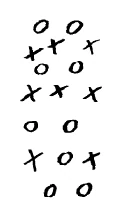
[ 23 ] But if I didn't understand the difference between crosses and circles, then I wouldn't be able to tell one from the other anymore. In other words: If I were to draw the crosses and circles in such a way that I turned the crosses into semicircles and the circles into semicircles as well, and then drew both, then it would no longer be possible to tell them apart. But how is it in reality? Look, suppose I receive the money from the cherries, and I receive the money from the manor. If I mix them up, then I can no longer tell which money comes from the manor and which comes from the cherries. One might now think: Money is money. But that is precisely the terrible illusion. It is not true. For in the economic process, the little rings that come from the manor have a different effect on human life as a whole than the little crosses that come from the cherries. It is not the money itself that actually determines what happens, but the aftereffect of where the money comes from—that is what matters. And a veil is simply cast over this; it is no longer there for human observation. And so money forms the living abstraction. Everything becomes intermingled without differentiation. People are no longer able to remain connected to what they belong to, what they produce, or what they work on. Everything becomes jumbled up through money, just as with the obscure mystics, everything flows together and becomes a few abstract concepts. And just as these abstract concepts [of the mystics] are of no use in our process of cognition, so too is the mental image people have of money of no use, because it, too, is merely an abstraction—something separate from reality, and thus nothing that can be used in life.
[ 24 ] When one thinks about something like this, it becomes clear just how immense and concrete the significance of land is in people’s lives. One realizes that it should never be the case that I am the owner of land without any interest in it, merely collecting my rent from the land while remaining indifferent to everything else. Anyone who has a proper grasp of the economy knows what that means: I make my living from land, but fundamentally, it makes no difference to me whether I make my living from land or from the proceeds of, say, playing CriCri or poker; fundamentally, it’s all the same to me—all that matters is acquiring a sum of money. - The fact that one is indifferent to how one acquires a sum of money is not such a major consideration when it is a matter of actually earning that sum of money through one’s own labor. But if one receives it from something connected to the welfare and misfortune, to the fate of human beings, indeed to the entire cultural configuration—as land is—when one considers such a thing, then it is not possible to transform this land into indifferent, abstract money. For it is precisely land that necessitates that the person who works it, who has a stake in it, and who transfers what depends on the land into the economic process—which, after all, is not the money it yields, but the fruit that thrives upon it—be [truly and fully] involved in it.
[ 25 ] Ladies and gentlemen, land within a given territory certainly cannot be managed according to the economic categories that have emerged in recent times. Just try to figure this out: if someone fertilizes their estate with manure produced naturally by their livestock—try to figure out how one is supposed to assign a value to this manure, how one is supposed to determine the market value of the fertilizer—for example, what the manure would be worth if it were sold on some urban market. This is merely a dramatic example. If you follow this line of reasoning to its conclusion, you will find that there is a tremendous difference in the very way in which what is produced on an estate fits into the economic process. Let us compare the way an estate operates that is subject to so-called self-management, that is, where the person managing the property—be it a small or large one—actually regards the management of the property, based on his own abilities, as his own personal responsibility, and compare that with the way a property functions—and must function—when it is geared solely toward extracting as much financial profit as can be squeezed out of it. But given the state of public life today, things must inevitably balance out; that is to say, the self-manager has no choice but to adapt to the person who leases the property and derives only a rental income from it. Thus, as what emerges from the concrete reality is adapted—and in the case of property, of land, what emerges from the concrete reality is how the individual products must support one another, how one must sustain the other; which, in the case of self-cultivation, is assessed on the basis of entirely different motives than when things are merely brought onto the money market—thus, little by little, what arises from the concrete reality—self-cultivation—becomes dependent on what are entirely abstract monetary relations. This has, in fact, already happened; that is why we have these unnatural conditions today. Land, which cannot be a commodity, is turned into a commodity; thereby, a real lie is introduced into life. It is not merely what is said that is false; what happens is also false. As soon as one regards land as a commodity—that is, as soon as one can buy and sell it—one lies through one’s actions.
[ 26 ] However, once the threefold social order is in place, land cannot be bought and sold. The [legal] relationships through which land passes from one person to another are governed by state laws that have nothing to do with the buying and selling of goods. The determination of how [in individual cases] land passes from one person to another is governed by the spiritual element of the social organism, which has nothing to do with inheritance or blood kinship, but rather with the kinds of things I have described in the “Key Points.” So you see, one need only truly understand what the threefold social order is, and when one moves in this direction, one sets out on the path to solving the social question.
[ 27 ] What does Damaschke want? He takes on the land question, he thinks about it, and he believes the land question should be solved through reflection. Ladies and gentlemen, no real problems are solved through reflection alone. I’d just like to know how you intend to crush sugar, chop wood, or do anything of the sort through thinking alone—or how you intend to eat through thinking alone. Just as one cannot crush sugar or eat through thinking alone, one cannot resolve the land question through thinking alone either. One can only say: Land is, after all, embedded in certain human relationships today. Now let us imagine what people do to the best of their ability within the social organism, in harmony with the impulses of the threefold order; then the facts that arise from devoting oneself to this threefold order will solve the land question not merely in thought, but [in a practical way] just as the knife breaks up the sugar, just as the axe chops the wood. Likewise, the threefold social order resolves the land question by ensuring that land will simply fit into the threefold social organism in such a way that it is no longer—as it is today—treated as a commodity. It will no longer be passed down unjustifiably through blood ties, but will be subject solely to what people today feel is the only tolerable arrangement: that the transfer of land from one person to another takes place on the basis of spiritual insights, that is, out of the impulse of the spiritual element of the social organism.
[ 28 ] You see, the land question is not to be resolved through programs, nor through any abstract or utopian concepts—that is, not in the same way that Damaschke approaches the land question—but rather by saying: No matter how complicated today’s land relations may be, devote yourselves to the threefold order, bring the realities of the threefold order into social life, [take up the matters] that lie in the direction of this threefold order; what then happens will lead land and property into conditions that are a blessing for human beings—insofar as anything on earth can be a blessing at all. Threefold social order does not seek to resolve burning issues through ideas, but through actions that people undertake when they devote themselves to ideas that depend on them, rather than to ideas that merely carry on old traditions. It is one thing to say that one is trying to work toward the threefold social order, and quite another to say that the state is a good person who can do everything and does everything right. Through the threefold social order, the land question is resolved by stripping land of the commodity character into which it has been so swept up; the state does not prevent [the unjust distribution of land]; it merely rations it; it is the state that appoints officials to allocate housing; it is the state that determines how much each person is allowed to have; it is the state that prevents hoarding—that must no longer be allowed!
[ 29 ] Isn’t it true that one could say it’s perfectly all right for people to think the way Morgenstern hinted at [in a poem]? A man gets hit by a car. He’s brought home, sick. Palmström—that’s the man’s name—wraps himself in damp towels; he’s suffering, but he doesn’t give in to his pain, because he’s a good citizen. He finds in the law books: Right there, at the spot where I was hit, no car is allowed to drive at all; so no car could have been driving there, because that would contradict the laws, and since it contradicts the laws, I simply wasn’t hit, because: what cannot be, cannot have happened. — You see, it’s roughly like this when, today, one wants to reform what is rooted in reality in such a way that one says: If land values rise in an indeterminate manner, this will be handed over to the state, which will then know how to prevent hoarding—for hoarding does not occur once the state has spoken. It is forbidden, so it does not exist.
[ 30 ] Well, ladies and gentlemen, this very example shows you just how different the entire method is—how different the whole outlook on life is—that the threefold order brings to all social life. It is not a matter—as I have often said—of merely thinking: We’ll reform external institutions; we’ll take money away from those who have too much through an institution and give it to the state. Rather, it is a matter of people learning to rethink things right down to their innermost being. This is so difficult for them; they certainly do not want to do it. If you proceed in the spirit of what truly springs from a sense of reality and what is described in *The Key Points of the Social Question*, then you would see that the point is that associations everywhere should be based on those who are intimately connected to what they produce or consume—we will, of course, have less to do with the latter, but the former will be even less of a concern.
[ 31 ] Well, you see, first and foremost, all relationships are obscured and veiled by the fact that we live within the abstraction of the monetary economy, as I hinted at today and also last time on an evening like this here. For example, people do not properly observe the relationship between larger and smaller estates. Because people today want everything to be convenient, they will campaign against large estates or in favor of small ones—or vice versa. But everything is thereby drawn into a certain monism of abstract thinking: either only large estates are good, or only small estates are good for the national economy. But that does not correspond to reality. The point is that, given certain conditions, it is precisely the interaction of small and large goods—of large and small enterprises—that is the right approach; however, this correct outcome emerges only through association, which is characterized as the essential element of economic life in the “Key Points.” Large farms cooperate with small ones and thereby achieve the best results for the national economy. The point is not to treat everything the same, but rather that, under certain conditions, large and small estates work together. Do you believe it does not correspond to certain real conditions that the Prussian manors, with regard to sugar beets alone, accounted for 54.8% of total production—that is, more than half of production—while, in all other areas, they accounted for less than half, under 50%, relative to the small estates? All of this is grounded in real conditions. This can only have a fruitful impact on the real economic process if the people directly involved in managing the estates form associations based on these real conditions. Then it becomes clear how one aspect must support the other, for then one works not from abstraction but from reality. And then one can establish through contracts how to simply balance out, on the one hand, what is now a surplus of production, and on the other hand, and so on. That is why I was justified in saying [at the beginning]: I want to speak to you about the conditions in the threefold social order in such a way that they can shed light on the land question. I did not want to speak about the land question in the usual way, but rather I wanted to show how any question of social life must be approached when one stands on the foundation of the threefold social order. And you can already address this question very concretely, whereas from the perspective of the old conditions you can never properly address this question.
[ 32 ] You’d almost have to be like Pastor Planck to think: “social organism,” “threefold social order”—these are three triangles side by side, and nothing from one flows into the other. No, the threefold social organism is truly an organism, and one aspect always influences the others, so that in each of the three parts there is something of the other two. It is the same in the human organism: not only does the nervous-sensory system function in the head, but rhythm and digestion also take place there. In the same way, political life influences economic life—it simply has its own center of administration—and spiritual life also influences economic life, particularly in the transfer of the means of production from one sector to another.
[ 33 ] But we see this interplay even in much more everyday things. Take, for example, a phenomenon of public life where three elements merge into one: traffic. On the one hand, transportation is linked to land because it requires roads. But since the land used for transportation—roads and so on—cannot be private property, nor can it be a commodity, it becomes clear that we must move beyond the concept of the commodity; that is, at least this part of land cannot be regarded as a commodity. Yet our entire culture is also intertwined with the transportation system. In fact, the entire transportation system can be viewed from three perspectives. [We might ask:] What is subject to commerce? First, goods; second, people; third, information. You can classify everything subject to commerce into one of these three categories: information, people, or goods. You see, because goods are involved in commerce, matters relating to the trade of goods must be regulated by contracts and in accordance with the dynamics of economic life. That which relates to people is regulated by the state; these are the legal relationships. The movement of people, too, must be regulated by legal relationships. Messages are subject to intellectual life; they are intellectual life in circulation. And you will see how the essentially threefold system of circulation must be administered from these three perspectives—something the old institutions failed to achieve. Just consider what an absurdity it is that, even today, goods and communications are still handled in the same way by the same institution—that postal packages and messages are delivered together—even though these things do not belong together at all and there is no necessity for this in the external structures. But the old state institutions were unable to separate parcel delivery from the mail service, with the result that one interferes with the other. If you examine the postal rate system, you will see just how inefficient it is for the postal service to handle both mail and parcel delivery.
[ 34 ] Precisely where life must begin to become practical, precisely where life has become too confining for us today because it is no longer practical—impracticality is everywhere—that is where the threefold social order is called upon to restore practicality. Only one thing is needed for this threefold social order: a little courage. However, anyone who does not dare to take the postal packages away from the postal service’s intelligence division and hand them over to regular rail transport—anyone who always raises objections and does not realistically calculate what one thing or another entails—will never understand the threefold order. For the threefold order is based precisely not on clinging to old institutions, not on clinging to ideas of old social stereotypes, of old state structures, and so on, but rather this idea of the threefold order is based on an observation of actual conditions.
[ 35 ] For, my esteemed audience, one cannot expect the threefold impulse, for example, to engage with reality and practical life in such a way that it specifies exactly how a Privy Councilor or a State Councilor will position themselves within the threefold organism. Yes, many of the questions asked are along these lines. This is just one of the grotesque questions. One simply cannot say how a Privy Councilor or a State Councilor will fit into this framework, but nor is it at all necessary to specify that. People’s spiritual, legal, and economic circumstances will be regulated in a very clear manner according to knowledge, the law, and the social contract; it is just that within these three spheres, some things that were once highly valued will no longer exist. But, ladies and gentlemen, must we not admit that under the old regime, people sometimes paid more attention to whether someone was a Privy Councilor than to what he accomplished or what he contributed to the social organism? In reality, however, what matters is not whether someone is a Privy Councilor, but what he contributes to the social organism. Therefore, the idea of the threefold social order must look beyond what remains as a vestige from the old era, if we do not wish to head toward the complete downfall of the West. It must focus on what must emerge in the new era as the fruit of the work that a person accomplishes in whatever form in the service of the threefold, yet unified, social organism.
After Rudolf Steiner’s speech, various figures ask questions:
[ 36 ] Walter Johannes Stein: Land is an indivisible totality. There is, therefore, only a certain amount of land. A certain number of people live on it. One can therefore calculate how much land falls to each individual. Now I would like to ask whether such a calculation has any practical value—that is, whether it provides a measure that can be used for economic purposes. Or is this merely idle statistics?
[ 37 ] Hans Kaltenbach: Dr. Steiner does not have all the findings from
[ 38 ] reflects the views of German land reformers; in his remarks, he omitted only the tax on the appreciation of land value. However, this would constitute only a small part of the proposed land reform. The introduction of a ground rent tax is clear evidence that the land reformers do not want laws in the spirit of the old political system. What they have in mind is a contractual development that has nothing to do with the old way of making laws. It stems from the idea that everyone must pay a ground rent tax in exchange for the right to use the land, for the rent they receive from using the land should be donated to the public. This process does not involve parliamentary laws or laws in the old sense at all, but rather many individual contracts.
[ 39 ] A participant in the discussion: But ultimately, it is the government that collects the basic pension tax.
[ 40 ] Another participant in the discussion: No matter how you look at it, we can’t move forward without land reform; it must be in place as the foundation for the further development of our society.
[ 41 ] Walter Johannes Stein: Dr. Steiner has often described the threefold social order to us as a functional threefold division and not as a division of spheres. Many people, however, are mistaken; they imagine each sphere as separate, with a corporation at the head of each. That, then, is a mistake. I would like to ask what a social organism structured in such a flawed way would actually look like.
[ 42 ] Hermann Heisler: How does one acquire an apartment, and how does an apartment exchange take place? How does the construction of a house take place? Land is a means of production; it is made available by the spiritual organism. Once the house is finished, is it no longer a means of production? Most people would like to have a small garden. How is that supposed to work, since there isn’t that much land available? What role does the legal system play in the administration of land?
[ 43 ] Rudolf Steiner: Ladies and gentlemen! It is true that land is not made of rubber and cannot be expanded at will, and it is therefore also true that there must be a certain connection between a defined area of land and the people living on it. Now, the point at issue here—which involves an ideal-real relationship—is that, in fact, simply by virtue of a person being born, a piece of land is truly, in a sense, occupied—this corresponds to the total available land area divided by the number of previous inhabitants of the land plus one. It is indeed the case that, in an ideal-real sense, every person claims the piece of land allotted to them at birth, and that a real relationship simply forms between the available land area and what the newborn person claims in this way. This is a real relationship. But isn’t it true that, in fact, not everything runs like clockwork in this social reality? The laws—I mean natural laws, not man-made laws—are there, but they are approximate. For example, if various plants grow in a certain area and one species develops particularly vigorously, it displaces the other species, which can no longer grow. Now, if the situation in a given area is essentially such that this one small patch I’ve been talking about becomes far too small for a newborn human, then, in a sense, the floodgates open, and emigration, colonization, and so on occur quite naturally. When the population increases in a given area, one can also examine whether more productive resources can be extracted from the land than in the past. This was essentially the case, for example, with the land of what was once Germany.
[ 44 ] So what Dr. Stein was pointing to does exist: the relationship between human beings and a certain piece of land. We must simply be clear that this relationship is an ideal-real one; however, once the threefold social order becomes a reality, contracts will always be decisive insofar as goods are produced on the land. For the land is managed by people, and the people who manage the land must—simply because not everyone produces the same goods—enter into a relationship with one another. They must conclude contracts, and once they have concluded contracts, there must be something that compels them to fulfill these contracts. Thus, what occurs in the mutual interactions of the people who cultivate the land is subject to legal relationships, political relationships, and state relationships. But what happens when a single plot of land passes from one person to another is subject to the spiritual law that is formed within an independent, emancipating spiritual life and flows into land management. Legal relationships intervene in the interactions among people who manage the land; these are relationships that can only be regulated by law. When this threefold order comes into play, it becomes truly apparent whether the land is still sufficient or not, or whether one might somehow—not through mere instinct, but through an instinct guided by reason—bring about conditions conducive to colonization.
[ 45 ] On the whole, however, one will see that something remarkable happens. There is something in completely ordinary, everyday life that regulates itself in a strangely beautiful way, although, of course, only approximately. It regulates itself quite well, even though people can do nothing about it through state laws or anything else: namely, the ratio of the number of women to the number of men on Earth. To date, it has not been possible—nor will it ever be, in the sense that the Schencks dream of it—to ensure, through any state laws or any other means, that the Earth is populated by approximately as many men as women. Just imagine what it would be like if there were only 1/5 women and 4/5 men, or vice versa.
[ 46 ] It is certainly better to leave this to the laws that interact as harmoniously as the laws of nature. Once the threefold social order is truly in place, what emerges will adapt just as harmoniously to the circumstances. For example, not all people will pursue scholarly careers and see something special in them. Circumstances will indeed develop in such a way that, for example, a suitable number of people will be drawn to a particular area of land, so that the individual’s existence corresponds to the fertility of the area that, in an ideal-real sense, is allocated to him. Even if, in a figurative sense, five or a hundred such areas are managed by a single person who has the special ability to do so, what is cultivated on these areas will still benefit the others.
[ 47 ] I did not understand Dr. Stein’s second question. It seems to me that he was asking what would happen if the three areas of the social organism were structured incorrectly.
[ 48 ] I have already mentioned that people today make a big deal out of engaging in all sorts of “Traubism.” They accuse the anthroposophically oriented Spiritual Science of borrowing elements from Gnosticism, from Hinduism, and from the Egyptian Isis mysteries. One columnist has even “discovered” that a very old book, said to originate from the Atlantean regions, contains the very things that Spiritual Science borrows from it, and so on. This is gradually becoming, so to speak, a technique [for making such claims], even though they are actually blatant untruths—and in many cases, outright lies. For it is, of course, simply this: If I were to write a mathematics textbook today and the Pythagorean theorem were to appear in it, and I were to expect readers who have not learned it, I would include the necessary explanations for them. But if, after the Pythagorean theorem, something else is added that Pythagoras didn’t have, the reader must not say that the whole thing is borrowed, simply because I was compelled to include what was already there. After all, it’s always a matter of building on what is known and then adding the unknown. It is dishonest when the Traubists then come along and say that it is something borrowed from Gnosticism and so on. One must be aware of the sheer volume of falsehoods being peddled on this very page. You see, if one is an official representative of a contemporary creed, one is already very, very tempted not to speak the truth. As a professor, one is also in a peculiar position in relation to the real truth. But if one is both—and then writes a book—I don’t want to elaborate on that thought any further.
[ 49 ] But you see, the same story will also unfold with the threefold division. Since I am not claiming that I have discovered the number three, nor that the number three has not already been applied in a wide variety of ways to certain physical relationships—for example, to human beings—people may come along and say: “Yes, in old Arabic tomes there is also a threefold division of the human being; there, too, the human being has already been divided into three parts.” But what our threefold division is actually about—you will find that in my book *On the Mysteries of the Soul*, where I proceed from functional concepts. I am not saying: The human being consists of three tracts. I am saying: There is a nervous-sensory region, there is a respiratory-circulatory region, and there is a digestive region. But I expressly state: Digestion is present throughout the entire human being; the three regions are present throughout the entire human being. I distinguish according to functions; I speak of a nervous-sensory activity, not of any particular region, and I distinguish from this the function of rhythmic activity and, thirdly, the function of metabolism. This is the human being, structured according to functions. See how I have strictly characterized all of this as functions in the book *On the Mysteries of the Soul*.
[ 50 ] Now someone discovers in an old tome that human beings in Arabia are divided into three parts, into three sections. That person might also say: Here is someone speaking of the threefold division of the human organism; after all, he has borrowed the key element—the number three—from ancient traditions; that is not original. Furthermore, this old tome also classifies things according to analogies—which is something I have just applied to a certain interpretation; look up what is written about analogies in the “Key Points”—and in that very tome, the external political system is classified precisely according to analogies; a distinction is made between regions, and at the head of each region stands a prince. There are three princes at the head, so even in this case, it is nothing other than the number three. Well, princes—if that should ever come to pass, then you can take a stand on it yourself. It is not a matter of three princes; rather, the inner spirit is something entirely different in the social threefold order [there, what matters is the functional aspect]. If one does not look at the functional aspect, the misconception would arise that one could have two or three parliaments side by side, as a Tübingen professor once wrote in the *Tribüne*. This is precisely the point of the threefold social order: that there will not be three parliaments side by side, nor three princes, but only one parliament within the democratic state structure. For in spiritual life, there will be no parliamentary process; rather, an appropriate administration will operate based on the nature of the matter itself, just as in the economic sphere. So, one can certainly allow people the pleasure of looking up the threefold social order even in old books. But if the aim is to bring about fruitful work based on the idea of the threefold social order, then one must truly engage with it as it is described in the *Kernpunkte*.
[ 51 ] Now, regarding Pastor Heisler's questions: How does one find an apartment? — and so on.
[ 52 ] These kinds of questions are just too rigid. I’m not saying they aren’t important—they’re incredibly important. There’s such a severe housing shortage in the world that people try to find places to live in all sorts of bizarre ways. There have even been cases where someone got married just to find a place to live, so as not to end up on the street. It is extremely important to know how to find a place to live, but one should not let one’s entire understanding of the threefold social order be colored by something that is still too much in the style of what must be overcome.
[ 53 ] Imagine that the threefold structure of the social organism is realized—one need not think in abstract terms, for when it comes to how something should be conceived, one must look to this realization of the threefold structure, no matter how far off it may seem; not everything can be answered merely in terms of goals. In the threefold social organism, a person will not merely have to look for a place to live, but will also do other things. He will be something—a factory manager, a carpenter, or something else. By being a factory manager or a carpenter, one can make a living; one is compensated for this. However, in the threefold social organism, this bringing together of the human being with their work must gradually be transferred to the administration of the spiritual component of the organism: obtaining a home will then be part of the compensation; the two go hand in hand. So you must not form a mental image of yourself as a human being and needing a home, but rather you must start from the premise: I am not simply a human being, but I also have a role to play in a particular place, and among the things I receive as compensation for this—provided social conditions are normal—is also a place to live. It is not merely a matter of asking the question in the abstract: “How do I get a place to live?”—but rather one must ask: “What happens when the threefold social order is in place?” — Then a person, if they are a human being—and one usually is, unless one is an angel who is everywhere—will receive, just as they receive their salary, a place to live, and this is governed by what arises from the organization of spiritual life. Or—if the situation is such that one is not being transferred to a new region but is otherwise working in a different professional context—then this falls under the jurisdiction of the state or the political sphere. But such questions cannot be posed in the abstract.
[ 54 ] We will really have to wait and see, at least for a while, how the circumstances brought about by the threefold order will unfold, or we will need to use our imagination to picture how things will take shape. Then it will indeed be possible to determine how one should proceed when taking a job somewhere—that is, performing work—so that one can also have a little garden and the like. These are truly matters that do not touch on the essence of the threefold order. One can be certain that they will work out in such a way that one will truly be able to have one’s little garden in front of the house all the more once the conditions brought about by the threefold social order are in place.
[ 55 ] Likewise, the issue at hand is that housing construction must be regulated. What is it? It is connected to the land question. But if this land question is no longer a matter of commodities, but rather a matter of law and spiritual life, then the issue of housing construction is also a matter connected to the entire cultural development of humanity. It goes without saying that houses are built out of the same impulses that place a person within their work. So the point is that we must not pose all these questions abstractly, that we must not pose them in such a way that the human being, as an abstract entity, is torn away from their entire concreteness. In a living, threefold social organism, it is not simply a matter of being confronted with the question of how to find a home; rather, one is placed within the full concreteness of life through this question, and everything depends on addressing these matters in a way that is true to reality.
[ 56 ] Mr. Kaltenbach did make a valid point there, [when he pointed out the significance of the land rent]. Of course, I only singled out one example—specifically, the tax on appreciation in value. But I should have said exactly the same thing with regard to the taxation of land rent. But, ladies and gentlemen, I would now like to know whether the question that was raised has not already been answered? For my point was not whether we are dealing with a ground rent or an increase in value, but rather that, in principle, a tax is paid to the state; Mr. Kaltenbach clearly said “tax,” and by that he means something that is paid to the state. What kind of tax is to be paid to the state is irrelevant. What matters is that the state be restricted to a single link in the social organism; the structure in which it exists today must not be preserved. One cannot say that the land reformers do not want laws in the spirit of the old state system. That is precisely what they want. They want to impose something on the old state that they believe it is capable of handling. It can never do so. I am, of course, aware of the role played by the fact that once someone has become accustomed to an idea, they cannot let it go. But I think that, in fact, everything that has been said about the ground rent tax has already been answered by the spirit of what was said about appreciation in value.
[ 57 ] One wants this so much that the old ways don’t resurface. One doesn’t want just anyone to come along and say: “I don’t want the Secret Councilors to be exactly like the old Secret Councilors, but I do want the threefold social order to produce new Councilors.” — [It amounts to the same thing], whether one says that or whether one says: “Yes, the land reformers don’t want to give anything to the state at all.” — But they do want to pay taxes, and taxes, in their current form, can only be paid to the state. This brings us right to the heart of the matter: To whom, then, should one pay taxes? — And when it comes to contracts—well, you know, no state has ever actually allowed contracts to be concluded with it regarding taxes. The relationship between the state and the individual looks quite different when taxes are to be paid; that is truly not a matter of contracts.
[ 58 ] The point is that we are trying to grasp, in a living way, how the idea of the threefold social order calls for a change in thinking. But what stands in the way of this—even though people often admit, with good will, that they should and must change their thinking—is that when they then try to do so, they get stuck on the words themselves, for example, the word “law.” Yes, I have even been asked this question: How is the state supposed to introduce the threefold social order? That is the point: We must move beyond our habitual ways of thinking and our habitual use of words. We must arrive at clearly defined ideas; otherwise, the impulse behind the threefold social order will not be understood.