

Social Ideas, Social Reality
and Social Practice I
GA 337a
28 June 1919, Stuttgart
Translated by Steiner Online Library
8. Historical Perspectives on Foreign Policy
[ 1 ] Rudolf Steiner: My dear friends here today! In the present—and by that I mean even the most immediate present of the day—we must emphasize time and again that progress in Central Europe’s economic, political, and intellectual conditions is not possible unless broader perspectives come to influence the entire way of thinking of those who participate in public life, more so than has unfortunately been the case in the widest circles up to now. And so please forgive me if I take a slightly broader view today and, in a sense, shed light on European cultural policy from a few historical perspectives—albeit ones that can only be presented in aphoristic form.
[ 2 ] If we wish to establish a position within the current public climate, we must first take a close look at the contrast that exists—in political, intellectual, and economic terms—between [three spheres]: The first sphere could be called the Western world, which specifically encompasses the populations belonging to the Anglo-American sphere and in whose wake the Romance-speaking populations now follow. Then, based on the three aspects mentioned, we must sharply distinguish from that Anglo-American sphere in the West everything that could be called the Central European cultural sphere. And from this, we must distinguish a third region, namely the East, the Far East, which is indeed uniting more and more into a cohesive region—more so than one is inclined to assume here based on the very imprecise reports—a region that encompasses European Russia with all that over which it is already extending its dominion today and will extend it even further in the future, as well as a large part of Asia. People do not always sufficiently realize the considerable differences that exist between these three regions and how, based on these differences, the individual measures of the day should be regulated according to the three perspectives mentioned, if these measures are to yield anything fruitful for the future. It is truly lamentable that we must time and again witness how, without any awareness that new ideas are necessary for a new order, even such important negotiations as those at Spa are conducted as if it were truly possible today to continue managing affairs with the same ideas that, starting in 1914, led us into absurdity. I will attempt—as I said, only in an aphoristic manner, and it will appear as though I am speaking in very general terms, though by “general” I mean very concrete things—I will attempt to highlight the differences between the mental images in the West, the Center, and the East, and it will become clear that fruitful perspectives for the present and the future can be derived from these mental images.
[ 3 ] We might assume that my appeal, which appeared in the spring of 1919, was so misunderstood in certain circles in Germany because it was based on the premise that, since the 1870s, Germany had lost sight of its true mission in relation to what it had sought to define as a state and gradually consolidate. One might say: This Germany has confined itself to creating a kind of practical framework, but it has failed to develop, within that framework, fundamental ideas—a truly substantial content, a cultural substance. Now, one may well be a so-called practical person and denounce the bearers of ideas as idealists; but the world, with such practical people, gets no further than crises—whether individual ones or universal crises such as the one that began in 1914. If one is a practical person in this sense, one can conduct business, satisfy individual interests, and seemingly even satisfy interests on a grand scale; but no matter how well the individual may fare and no matter how successful his undertakings may seem—time and again, under such conditions, this must lead to crises, and these must ultimately culminate in a catastrophe such as the greatest global catastrophe we have experienced since 1914.
[ 4 ] Well, what is it that we have been encountering more and more frequently as a defining characteristic within Central Europe, particularly since the 1970s? We see that where it comes to the truly ideal realm—from which a certain cultural substance ought to have emerged—there is, within Central Europe—including in political and social life—basically nothing but a kind of theoretical discussion, aside from a few commendable measures. You will find, after all, that almost everything that has been done to, so to speak, cope with the demands of the times is more or less recorded in the negotiations—whether in parliaments or outside them—that have taken place between the proletarian party, which has increasingly taken on a social-democratic character, and the various other parties, which, based on their interests or traditions, believed they had to oppose this proletarian party. A great deal of criticism and counter-criticism has been leveled, much has been said, but: What, in essence, has come of all this? What has emerged from this talk that is necessary for building future social conditions within which people can live? Those of you here today who have heard my lectures on previous occasions will know that I do not care for delving into theories, but rather, when it comes down to it, I prefer to draw broad strokes and focus on the immediate realities of life. And so today, too, I wish to illustrate what I have just hinted at with concrete examples.
[ 5 ] One of the most fascinating publications of our time is Professor Varga’s book *The Economic Problems of the Proletarian Dictatorship*, in which he describes what he himself experienced and did within a European economic region that, while small, was not all that small. Varga’s book is extraordinarily interesting precisely because here a man describes what he himself experienced, what he himself did, and what happened to him while he himself held the power—even if it could only last for a short time—to organize and socially structure a limited territory almost autocratically. Professor Varga was, after all, the Economic Commissar—that is, the minister of economic affairs—during the brief heyday of the Hungarian Soviet Republic, and in this recently published book, he has described what he attempted to accomplish there together with his colleagues. He was specifically [responsible] for economic affairs, and he describes how he sought to reorganize Hungary’s economy from a Marxist perspective—a perspective very close to that of Lenin—and he recounts in detail, with a certain sincerity, the experiences he had in the process. Above all, he describes in detail how, following the specific formula that could be applied in Hungary, he expropriated individual enterprises; how he attempted to form a kind of works council from the workers of each enterprise; how he then sought to merge these individual enterprises into larger economic entities; and how these were to be headed by a supreme economic council with economic commissars who would then manage this economic life from Budapest. He describes in considerable detail how he carried out these measures. He is, as I said, a man who has derived his entire way of thinking—that is, the way of thinking that was to be put into immediate practice, which could have managed the economy within Europe for a few months—he has derived this way of thinking entirely as a result of everything that has taken place over the course of the last fifty years between the Social Democratic Party and everything that this Social Democratic Party has fought against from a wide variety of perspectives. As I said, his views are very close to Leninism; he sharply emphasizes one point in particular. It is clear to a man such as Professor Varga, who describes events with a certain bull-like impulsiveness—a bull-like impulsiveness with which we are all too familiar within the party life of Central Europe— it is clear to him that only the firm, strict application of Marxist principles, as Lenin himself intended, with this or that modification, could bring healing to the social organism; of this he was deeply convinced. Moreover, this Professor Varga is a man who, while not very tall and not particularly clever, is nonetheless capable of thinking; and so he knows—and he describes it as well—that, fundamentally, this entire movement is carried by the industrial proletariat. Now, from the specific circumstances and from his experiences in implementing what he wanted to achieve in Hungary, one thing has become clear to him: that while the industrial proletariat are the only people who wanted to adhere to the demands of Marxism as strictly as he himself did and who expected something from them, the industrial proletariat—like the urban population in general—are the ones who fare the worst when one actually sets out to put these principles into practice. His very brief experiences showed him that, at first, only the rural population actually has a chance of faring somewhat better under these principles. The rural population fares better because these Marxist principles reduce the entire culture to a certain primitive level. This primitive level of culture, however, is not applicable to the structure of urban life, but at most to that of peasant life in the countryside. And so Professor Varga must admit to himself—even though he is a Marxist—which is about as self-evident to him as the fact that the Pythagorean theorem is correct—he must admit: We must prepare ourselves for the fact that the industrial proletariat and the urban population will be living on the bread of poverty.
[ 6 ] Now comes what a man like Professor Varga sees as the consequences of such premises. He says: Yes, but first of all, the industrial proletariat in the cities will be idealistic; it will cling to this ideal even when it is starving. Well, it is, of course, part of the rhetoric of modern times that when any idea fails—an idea that one nevertheless wants to consider absolutely correct—one then disguises that idea as idealism, for which one might even have to go hungry. The other conclusion Varga draws is this: he says, “Well, at first things will get much, much worse in the cities and for the industrial population; but then, once things have been bad for long enough, they’ll eventually get better; therefore, the industrial proletariat and city dwellers in general must be directed toward the future.” So he says: Yes, at first, people will indeed have quite bleak experiences; but in the future, things will certainly improve. — And he is not referring to the very tame works councils that we find in the West, but rather to those very radical works councils that arose out of Leninist-style radicalism and were introduced in Soviet Hungary. Since the people responsible for keeping the entire economic apparatus running are not appointed by any kind of government authority, they are elected from within their own ranks. And this is where Professor Varga’s experience came into play—he was able to experience all of this firsthand—and he said, and this is an interesting admission: “Yes, at first it did indeed turn out that the people who were selected—and who were actually supposed to ensure labor productivity—ended up loitering around the factories and arguing, and the others saw this, found it more pleasant, and all wanted to move up to those positions as well; and so a general striving to move up to these positions developed.” This is an interesting admission from a man who not only had the opportunity to develop theories about the realism of Marxism and Leninism, but who also had the chance to put those theories into practice. But something else is even more interesting. Varga now shows how such economic commissars—who were to be appointed for larger regions, a process that, incidentally, had to be carried out in a rather bureaucratic manner—actually had neither the inclination nor the ability to do anything of substance.
[ 7 ] You see, Varga’s book on Soviet Hungary is extraordinarily interesting from a contemporary cultural-historical perspective because of its descriptions, which go into great detail and are, in their specifics, just as fascinating as the few points I’ve just mentioned. But what I found most interesting in the book was something that takes up about three lines. I would say that the most important point is precisely what Professor Varga says when he discusses the duties of the economic commissars and the way in which they were unable to fulfill those duties. He says: “Yes, but these economic commissars will only have any significance—and gain it in the future—if the right people are found for these positions.” Good old Professor Varga doesn’t seem to realize at all what a powerful admission actually lies in these three lines, which are among the most interesting in the entire book. We see, quite unnoticed, the admission of a man who—I would say with Leninist strength—grew out of the ideas of the 20th century and who had the opportunity to turn those ideas into reality; we see a confession that runs counter to what has been preached time and again at nearly every social democratic gathering: Yes, it is wrong—thoroughly wrong—for people to believe that history arises from ideas or from the genius of individual personalities; rather, it is true that the personalities themselves and all the ideas they can develop arise from economic conditions. — So these people have repeatedly stated how wrong those were who relied on ideas and personalities, and how one must rely solely on the relations of production, which, as a superstructure, give rise to what constitute guiding ideas. Now a man comes along to [truly] implement Marxist ideas, and he says: “Yes, these ideas are all very nice, but they can only be put into practice once we have the right personalities for the task.” — It is hard to imagine a more extreme reduction to absurdity of precisely what constitutes the essence, the nerve, the innermost impulse of the mindset of a man like Varga, this Central Economic Commissar, this Minister of Economic Affairs in Soviet Hungary. He makes it quite clear that the ideas for the future that had been concocted in the Central European regions were bound to fail the moment anyone attempted to build anything positive out of them. One need only read these descriptions, hear this confession, to see just how powerless such a man actually is—a man whom the circumstances of the time in a country that is, after all, important have propelled to the surface into a position of leadership—and to see [what conclusions] such a man reaches in the economic sphere.
[ 8 ] But it is also interesting to see what such a person achieves in the public sector. You see, one really has to consider Professor Varga’s remarks in light of the circumstances of the time. Perhaps you recall how, in recent decades, there have been increasing complaints from a wide variety of quarters that government offices are being flooded—not with technical or commercial experts, but with lawyers. Do you remember how much this issue was discussed within the machinery of the old state apparatus? In other matters as well—notably the nationalization of the railroads—it was always the actual experts who had to take a back seat, while the lawyers were the ones on whom virtually all emphasis was placed and who held the most important positions. Now, how does Professor Varga speak about the lawyers, among whom, incidentally, he also counts himself? How does he speak of other state officials, state leaders, and civil servants? He speaks of them in such a way that he says: No consideration is given to them at all; they are simply abolished; they cease to have any significance; lawyers of all kinds must join the ranks of the proletariat, for they are not needed if one wishes to socialize economic life. - Note how two things immediately clash here: the elitist legal state, which has propelled lawyers to the forefront, and the socialist state, which declares this entire system of jurisprudence unnecessary. So, in the socialist state, lawyers are simply eliminated—no one gives it a second thought. These are people who are no longer counted on. They are not factored in when one seeks to bring about a new social order. And intellectual life—that is simply regulated incidentally by the economic state. That is to say, it was, of course, not regulated at all during the few months of the Hungarian Soviet Republic. That is why Varga has no experience in this area yet; he is merely presenting his bare theories. And so we see right now how this Professor Varga, who has contributed—I would say, in terms of world history—a remarkable work to contemporary literature, how this man is actually rooted nowhere in reality. At most, he is rooted in reality through a single trivial statement, a single self-evident truth: If one wants a position to be properly filled, then one must put the right person in it. Everything else is straw, is worthless rubbish; but this worthless rubbish was supposed to have become reality in a sphere that was, after all, not narrowly limited. Naturally, such a person finds all sorts of excuses for the fact that Soviet Hungary came to an end so quickly—due to the Romanian invasion and whatever else. But anyone who looks more deeply into these matters must conclude: Simply because Hungary is a smaller territory—and thus because all that which undermines, dissolves, and corrodes had a shorter path from the center of Budapest to the country’s periphery— that is why what eventually will also become apparent in the East—in Russia, where the distance from the center of Moscow to the periphery is greater—manifested itself very quickly in Soviet Hungary, albeit, of course, in ways that may give us great cause for concern.
[ 9 ] You see, when it comes down to it, we’re really dealing with only two types of leaders—the truly leading figures. On the one hand, we have those leaders who, like the current Reich Chancellor—people still say “Reich Chancellor” —play the role of a relic in international negotiations, still operating with the most hackneyed ideas; and on the other hand, there are figures like Professor Varga, who wanted to establish something new—something that is new, however, only in that his ideas lead to decline more quickly. The ideas of the others also lead to decline, but because they do not proceed so radically, the decline proceeds more haphazardly and more slowly; when Professor Varga comes forward with his ideas, the process is more thorough and more radical.
[ 10 ] Let’s take Western ideas for a moment. As I said, there’s a lot that could be said about this—we could go on and on until tomorrow—but I’d just like to mention a few points. You see, one can, of course, think of these Western countries—and specifically Anglo-American cultural policy—from a moral standpoint or from the standpoint of human sympathy and antipathy, however one wishes; for my part, one might even call it a “policy of inculture”; I do not wish to argue about matters of taste. [I don’t want to speak about that], but rather I want to speak about world-historical and political necessities, about that which acted as an impetus, as a driving force in English politics during the very same decades in which people in Central Europe were engaged in such theoretical discussions that Vargas’s ideas eventually emerged. Anyone who looks at this English policy will find that it is based, above all, on something that is a trait, a fundamental trait—it need not please anyone, but it is a fundamental trait—through which ideas take effect, through which ideas flow.
[ 11 ] How should one properly characterize the contrast between this Central Europe and these Western, Anglo-American countries—which, after all, also include the colonial offshoots in America? One might be tempted to say: It is exceptionally characteristic that in this trend—which is driven above all by the trade and industrial policies of the Western countries—something is always clearly perceptible—I do not say understandable, but clearly perceptible—something that also expresses itself as an idea. In 1884, an English historian, Professor Seeley, described this in his book *The Expansion of Great Britain*. I’d like to quote his own words—specifically the few sentences that clearly and unambiguously express what this is all about. Seeley says in his book *The Expansion of England*: “We founded our empire partly, as must be admitted, driven by the ambition of conquest, and partly out of philanthropic intentions to put an end to immense evils.” - He is referring to evils in the colonies. This means that a policy of expansion is quite deliberately pursued—the entire book is, after all, permeated by this idea—an extension of Great Britain’s sphere of influence across the world. And this expansion is pursued because it is believed that this mission—which involves harnessing the forces of economic expansion—has been entrusted to the British people—much as a certain mission was entrusted to the Hebrew people in ancient times. One historian puts it this way: In those people who are active in England—I mean those engaged in trade—the industrialists, the colonizers, the civil servants—in all these people there lives a united phalanx dedicated to world conquest. That is what this historian, Seeley, expresses. And the best people in England—who, through their involvement in secret societies, know what this is all about—expressly emphasize: Our empire is an island empire; we are surrounded by the sea, and given the configuration of our empire, this mission falls to us. Because we are an island people, we must, on the one hand, conquer out of ambition and, on the other hand, out of philanthropy—whether genuine or imagined—attempt to eliminate the evils that exist in entirely uncivilized countries. All of this stems from a national instinct, but one so deeply rooted in that national instinct that one is always ready to do one thing and not the other when it comes to somehow advancing the great goal of expanding the British way of life. What do we actually know [about the British character]? I ask you, distinguished guests, to consider very carefully precisely what I have just said—what do we actually know about it? We know that the English think: We are an island people. That is the character of our empire—that it is built on an island. We can be nothing other than a conquering people. — If anyone feels inclined to say “a plundering people,” let them do so; that is not what matters today. What matters are facts and political trends, for they bring about results; judgments of taste have no effect in the realm of which we are speaking. So [in England] they know how to pursue a policy—particularly in the economic sphere—that is based on a clear understanding of what kind of people they are in the part of the world where they live. That is a sense of reality; that is a spirit of realism.
[ 12 ] What is the situation in Central Europe? What good does it do to constantly cling to illusions here? That will never get us anywhere. The only way to make progress is by facing reality head-on. What is the situation in Central Europe during the very same period in which the English will—as I have just described, stemming from a clear understanding of the territory in which one operates—became increasingly crystallized? What is the situation in Central Europe during that very same period? Well, in Central Europe, we are by no means dealing with a similar recognition of the tasks arising from the territories in which one lives—not at all. Let us take the region from which the misfortune in Europe originated, Austria-Hungary; this Austria-Hungary was, in a sense, created by recent history to provide proof of how a modern state should not be.
[ 13 ] You see, this Austro-Hungarian Empire encompassed—I cannot elaborate further today; I merely wish to characterize it in a very aphoristic and superficial manner—this Austro-Hungarian Empire encompassed, first of all, the Germans living in the Alpine regions and in Lower and Upper Austria, who were themselves divided into a wide variety of political views, further included, in the north, the Czechs with significant German enclaves in German Bohemia; further east, the Polish population; even further east, the Ruthenian population; then the various other ethnic groups located in the eastern part of Austria-Hungary, primarily the Magyars; and further south, the South Slavic peoples. Ladies and gentlemen, is all of this held together in a similar way by a reality-grounded idea such as that of the English: “We are an island nation and must therefore conquer”? No! By what means, then, were these thirteen different, state-recognized [linguistic] regions of Austria-Hungary held together? Held together—and I may say this, for I have spent half my life, nearly thirty years, in Austria—they were held together solely by the Habsburg dynastic policy, by that ill-fated Habsburg dynastic policy. One might say that everything that was done in Austria-Hungary was actually done with the following in mind: How can this Habsburg dynastic policy be maintained? This Habsburg dynastic policy is a product of the Middle Ages. Thus, there is nothing [to ensure cohesion] other than the self-serving interest of a princely house, nothing of the sort, as expressed, for example, by the English historian Seeley in 1884.
[ 14 ] And what have we experienced in the rest of Central Europe, for example in Germany? Well, I must say: It has always cut deep into my heart when I’ve read, for example, something like what often appears in Herman Grimm’s writings, where he clearly and vividly describes what he felt during his own student years—back in the days when it was still a crime to call oneself a German. People don’t know that anymore today; we mustn’t forget that one was a Württemberger, a Bavarian, a Prussian, a Thuringian, and so on, but one was not a German. And to be a German—a Greater German—was revolutionary back then; one could only admit it in the most intimate circles; it was a crime against the self-serving interests of the royal houses. Until 1848, says Herman Grimm, what was the greatest honor for the French—calling oneself a Frenchman—was the greatest crime in the political sphere for the Germans: calling oneself a German was [the greatest crime among the Germans]. And I believe that today many people read Fichte’s “Addresses to the German Nation” and do not even understand the opening words correctly, because they apply them to something else. Fichte says: I speak of Germans, pure and simple; about Germans, pure and simple. — He means that he speaks—without taking into account the differences between Austrians, Saxons, Thuringians, Bavarians, and so on—simply to Germans—he means this strictly [in the sense] of internal politics; nothing in this sentence contains anything that would extend outward. [Being German in the political sense] was something that was not allowed, something that was forbidden. It seems almost silly, but it was forbidden—somewhat along the lines of that principle found in an anecdote about Emperor Ferdinand, who was called “the Good,” Ferdinand the Good, because he had no other useful qualities. It is said that Metternich reported to him: “People in Prague are beginning to revolt”—whereupon Emperor Ferdinand replied: “Are they even allowed to do that?” — It was more or less according to this principle of “not being allowed” that German identity was treated up until the year 1848. And then, indeed, an ideal emerged from this German identity, one that later perished in the politics of power; that ideal [of unity] emerged, one for which we still yearn today. The fateful course it took can best be seen in detail through the example of the aesthetician Vischer, “V-Vischer,” who lived here in Stuttgart; until the 1870s, he was imbued with the Greater German ideal encapsulated in Fichte’s words: “I speak of Germans, and of Germans alone.” He then, however, submitted to the circumstances that Nietzsche characterized in the early 1870s with the words: “They were an extirpation of the German spirit in favor of the German Empire.” - But one can see how, through gritted teeth, a man like Vischer transforms the old ideal into the new, how terribly difficult it becomes for him to present the new as a truth to which he has converted. Vischer’s autobiography, *Altes und Neues* (*Old and New*), is extraordinarily interesting in this regard. And in what I have just explained lies, in many respects, the reason why, when world circumstances demanded world politics, nothing else developed in Central Europe but that worthless discussion of which I have spoken. What actually happened in the 1860s and 1870s was domestic politics pitted against domestic politics; this had supplanted what was supposed to have been born out of the German ideal. Strictly speaking, ladies and gentlemen, Italians, French, and perhaps even the English would be glad to have a historian such as Treitschke was for the Germans. One might call him a loudmouth—perhaps he was, and one might find little appeal in the way he presents things—but this German did, after all, find quite beautiful words especially for his fellow Germans, whom he loved so dearly. One simply had to see past [the boisterousness]—and one had to do so in person as well. When I met him once in Weimar—the first time I met him—he could no longer hear by then; one had to write everything down for him, but he spoke very loudly, with strong emphasis, and clearly—he asked me: “Where are you from? What country are you from?” - I wrote down for him that I was Austrian. After exchanging a few brief sentences, he said to me: “Yes, the Austrians—they’re either absolutely brilliant people or they’re fools.” — Naturally, one had the choice of placing oneself in one of these categories, for there was no third option. He was, in other words, a man who spoke with conviction. In Treitschke’s writings, one can read quite clearly about that struggle for domestic power—the one that actually sealed the fate of the German people—the struggle for domestic power between the Habsburgs and the Hohenzollerns; and Treitschke finds the words to tell even the Hohenzollerns the harshest truths. Well, the strange thing is, when one engages in politics without understanding one’s own territorial circumstances—politics of a kind that can no longer be practiced in modern times—then unnatural circumstances inevitably arise. And when one is caught up in something so unnatural, one craves it—just as Professor Varga craved it and still craves it today: “Yes, if only we could manage to have the right people in the right places.”
[ 15 ] But the strange thing is: under the specific English circumstances, this developed of its own accord out of a certain sense of reality. While in Central Europe people were arguing over socialist and anti-socialist theories, only to then embark on attempts at social reconstruction that could lead nowhere, it was the realistic understanding of their own circumstances that brought men to the fore in the West who truly did the right thing in their respective positions for the sake of what they sought to achieve there—and what Seeley describes. There, a sense of reality brought the right men to the right places—of course, they were the wrong ones for us, but it was not their task to be the right ones for us. Take, for example, one of the greatest—there were, of course, many others of lesser stature—one of the most typical: Cecil Rhodes. His entire career is actually devoted to truly practical action, while in Central Europe people are theorizing. In Central Europe, people theorize about the state of the future. Cecil Rhodes, who came from very humble beginnings, worked his way up to become the greatest diamond magnate. How did he manage that? Because the strange thing is—strange to us, at least—that the Rothschild banking house, still powerful in his day, secured for him the largest loans in the world; it secured them for a man who had a knack for doing business exactly in the manner described by Seeley, based on British ideas that extend into the secret societies, as he portrays Britain’s world politics. For Cecil Rhodes was a man who not only conducted business but also returned to England time and again, withdrew into solitude, and studied Carlyle and similar figures, from whom it became clear to him: Great Britain has a mission, and we place ourselves in the service of this mission. And what follows from this? First of all, it is the Rothschild banking house [that provides him with loans]—that is, a banking enterprise that is intertwined with the state but nevertheless emerged from private circumstances. But then: What is a man like Cecil Rhodes capable of? He is capable of viewing what might be called the British state entirely as an instrument for English expansionist policy—and doing so with great vision—combined with a belief in Britain’s mission. He is capable—like many others, though he is one of the greatest—of using the British state as an instrument for this purpose and of allowing his achievements to reflect back upon the ever-growing British power. All of this is possible precisely because there is a consciousness among the English people of their special role in world history as an island nation. And Central Europe could not oppose this with anything that would have been a match for it. What, then, is happening in the West? An economic policy driven by personalities is converging with state policy. Why are they converging? Because English politics has moved entirely in the spirit of the modern age, and it is only in the spirit of the modern age that one is able to understand ideas arising from the reality in which one lives. This is where state policy and economic policy can converge. But the English state is a state that exists as such only on paper—it is a conglomerate of private relationships. It is merely a figure of speech to speak of the British state; one would have to speak of British economic life and of the old traditions that are woven into it—of old intellectual traditions and the like. In the sense that France is a state, or that Germany strives to become one, Britain has never been a state. Yet people there understood the territory in which they lived; they organized economic life in a way that corresponded to that territory. You see, today people are thinking about how England should be something different, how England should not pursue a world policy of conquest, how it should become “well-behaved.” As people here have a mental image of England today, England could no longer be England; for what it does and has done is based on its very nature as an island kingdom. It can only continue to develop by pursuing the same policy.
[ 16 ] What, on the other hand, was the situation in Central Europe? There, in Central Europe, no understanding developed of the territories in which people lived; there was no conception of a mission appropriate to their own reality; that grand vision was lacking. While in the British Empire, that which is called a state but is none, lent itself very well—precisely to the most gifted economic policymakers—as an instrument of English politics, things took a different turn [in Austria-Hungary]; there, one could only indulge in the illusion that the territory on which one stood could be put to use for what was supposed to be Austro-Hungarian politics. That is where things diverged that had converged in England. And the study of Austro-Hungarian conditions presents something downright grotesque, because an attempt was made to create an economic territory from a perspective that made it entirely impossible. For Austrian domestic policy would have had to be, from the very beginning, a kind of [economic domestic policy]. Yes, if Habsburg domestic policy had been the policy of the global Rothschild dynasty, then an economic domestic policy could have developed; but Austrian domestic policy could not have given rise to something like the “Orient Policy” or the like. That was not possible; that is where things diverged. The same was true in Germany, although I did not have the opportunity to observe it as clearly as I did the Austrian situation.
[ 17 ] One could now also describe the situation in the East and show how there wasn’t even a discussion there. In the West, all such discussions were already behind them; they had, in fact, been dismissed since Cromwell’s time, I would say. Afterward, the practical aspect developed. In the central region, people discussed the matter and came to believe that the practical is what arises from a purely abstract-logical necessity. Then in the East, they never even got around to [such discussions] at all; rather, they simply adopted the Western model—whether a tsar, Peter the Great, brought it to the East, or whether a Lenin found his way into Western rhetoric and carried it to the East. Truly, it is merely a change of clothes, for, when it comes down to it, Lenin is just as much a tsar as the tsars of old were. I do not know whether he is equally successful at wearing the cloak properly tailored, as is said, for example, of Mr. Ebert by those who have observed him in Silesia and who claim to have noticed that, in his imitation of the Wilhelmine era, he has already mastered even the correct nod; I do not know whether this is also the case with Lenin. But no matter how different the mask may be, in reality we still have a tsar before us—albeit in a different form—who has carried the West into the East. This is what causes that unnatural clash between the hopeful mood of the entire East and misunderstood ideas from the West. It is indeed strange that things in Russia are such that 600,000 people exercise strict control over the millions of others, and that these 600,000, in turn, are controlled by only a handful of People’s Commissars. But this can only be the case because those who long for a reshaping of the world as much as the people of the East do—those people—do not, at first, even notice how their longing is being fulfilled. If someone else had come to Moscow with entirely different ideas, he could have wielded the same power. Very few people today realize this, because most are completely caught up in a world of unreality.
[ 18 ] But what emerges from all that I have just attempted to present in aphoristic form? It follows that in the West it will take a long time—due to the intertwining of so-called state interests with economic interests—for the idea of the threefold social order to gain popularity. And it also follows that the European heartland is the region where this idea must absolutely take root first, because people must realize that the old conditions here have driven everything apart. Everything is, in fact, already fundamentally fragmented; people are merely trying to hold it together with old ties that no longer apply. The threefold social order is, in fact, already there beneath the surface; it is simply a matter of bringing it into consciousness and shaping reality in accordance with what already exists beneath the surface. To do this, however, it is necessary to finally realize that the old personalities are of no use, and that they must be replaced by personalities who are clearly aware that what these old personalities think has been reduced to absurdity since 1914, and that something new must take their place. This is what I tried to make clear even during the unfortunate World War to those who might have had the opportunity to influence the course of events. And therein lie the reasons why, since the temporary subsiding of the world catastrophe into the world revolution, attempts have been made to instill the idea of the threefold social order into as many minds as possible; for what we need are as many people as possible who embrace the ideas of the threefold social order. During the World War, people failed to understand that Woodrow Wilson’s fourteen abstract points should have been countered by the concrete threefold social order from an authoritative source. Practitioners found them impractical because they have no real understanding of the connection between idea and practice. Certainly, Woodrow Wilson’s Fourteen Points are as impractical as possible. And it is perhaps the greatest tragedy that could have befallen the German people that even the man on whom they had counted in the final days of that catastrophic era—the man who, even coming from the old regime, was able to become Reich Chancellor—even he was capable of taking Wilson’s Fourteen Points seriously in some way. For the time being, these Fourteen Points have run aground in the impossibility of the abstract League of Nations; their impossibility is demonstrated in practice at Versailles and Spa. But what they have managed to accomplish, despite being abstract, is that they have set armies and ships in motion. And setting something in motion—that is precisely what the principles emerging through the threefold order should also do; even if not armies and ships, they should at least set people in motion, so that a viable social organism might once again come into being. This can only happen through the threefold order—a point that has been discussed here from a wide variety of perspectives.
[ 19 ] Today I wanted to discuss this from a few perspectives of recent history. Of course, this recent history must be viewed from different perspectives than those from which it is usually viewed, when only the “school-like” approach prevails. The threefold social order will lead us out of this “school-like” approach by liberating spiritual life. And from this liberated spiritual life, it will then be possible to place in their rightful positions those figures of whom even Professor Varga must say today: If we had had them, then perhaps history would have turned out well. — But one thing is certain: Professor Varga’s approach will not lead us to those figures who will occupy their rightful places.
Following Rudolf Steiner’s introduction, various figures speak up with questions and opinions:
Max Benzinger: If we truly want to bring about the threefold social order, we absolutely must present this idea to the public. It is not enough to simply call on people to bring interested individuals to the study evening.
Siegfried Dorfner: The “Key Points” state that the means of production may only have a cost until they are manufactured. If a factory manufactures means of production—for example, lathes—does that mean the lathe may only have a cost until it is manufactured? But then the manufacturing plant would have no coverage for it. Are the finished means of production not to be paid for?
[ 20 ] Rudolf Steiner: If one manufactures lathes and intends to sell them as lathes, they are not yet means of production. They are still commodities, not means of production; they become means of production only when they are used for production within the social community. It is essential to view the concept of a means of production within the actual social process. Lathes are means of production only when they are used exclusively as such; until then, they are sold as commodities, and the person who buys them is a consumer.
Another participant in the discussion: There has been talk of commodities. Shouldn’t a distinction be made between agricultural and industrial commodities? After all, agricultural commodities usually generate a surplus, while industrial commodities run a deficit.
[ 21 ] Rudolf Steiner: Of course, this issue will inevitably be misunderstood by many today, because we do not live under conditions where, so to speak, an overall balance sheet would result if one were to simply include everything that is produced in the balance sheet of a closed economic area—such a balance sheet simply cannot be derived. You cannot somehow incorporate our current agriculture into a total balance sheet if you have so many [mortgage] encumbrances on the estates, and then compare that with industry. When I say that, fundamentally, industry is always dependent on living off everything produced by the land, one must disregard all that has become intertwined with it—elements that, so to speak, can only result in a veiled overall balance sheet. If what cannot be a commodity ceases to be a commodity—namely, land and human labor—and if only that which, in the sense of the threefold social order, can circulate between producers and consumers becomes a commodity, then it will be possible to draw up a balance sheet showing that the expenses necessary for industry must always be covered by the surpluses of agriculture. That this is not currently the case goes without saying. But we are living in times when a total balance sheet for a closed economic area—one truly based on production—should be emerging. What I have just presented has long been recognized in the realm of economic life. Don’t you agree? You’ll even find Walter Rathenau emphasizing that every industry is a “consumptive good”—that is, that revenues must continually flow back into industry and that constant injections of funds are required. But this must come from somewhere, and it can only come from the returns on land. Yet this is not reflected at all in our current balance sheets.
Mr. Roser: It is truly a sign of our times that a person like Varga had to conclude that there was a lack of the right kind of men. What is needed is the education of the masses. But even here in the Threefold Social Order Movement, there is a lack of the right kind of men. Such men are absolutely necessary, for the Threefold Social Order must be promoted on a large scale.
Emil Molt: Something really must be done. Everyone should recognize this, if only for their own sake.
Another participant in the discussion: I would like to ask Dr. Steiner one more question. An article recently appeared in the *Frankfurter Zeitung* that posed the obvious question: How can spiritual life be liberated at all, since it must be financed by economic life? How does Dr. Steiner answer this question, which was not sufficiently addressed at the event the article refers to?
[ 22 ] Rudolf Steiner: We have, after all, addressed this question very frequently here: how the economic support of spiritual life will be handled. And the newspaper article must simply be incorrect if it refers to our discussions within the Threefold Social Order Movement as a whole.
Interjection
[ 23 ] It may certainly have happened somewhere that someone was unable to provide information; but how often have I myself said that the threefold order is not really a division of human beings into three groups, but rather a structuring [of the social organism] into three life organizations that must necessarily develop side by side: spiritual, political, and economic life. After all, people will be involved in all three sections. And so it goes without saying that what the individuals involved in the organization of spiritual life have to manage—as the spiritual aspect of spiritual life—constitutes only one section. But these individuals who sustain spiritual life must also make a living. That is why they will organize themselves into economic organizations. And it will make no difference whether such an organization consists, say, of teachers or musicians, or of shoemakers or tailors. For the economic organization is not intended merely to manage one or the other area of economic life, but to provide economic support for all people. And by being part of the economic sphere of the social organism, they will be economically supported.
[ 24 ] It’s surprising how things are misunderstood there. A nice diagram also appeared before our—if I may say so—threefold eyes, one that had been drawn up by a radical social democratic party in Halle in a very textbook manner, wouldn’t you say, just as diagrams are supposed to be made. There (it is drawn) are, so nicely at the top, the central institutions of economic life—at the very top, of course, there is only one. Then it branches out further down. If that were possible, then the future socialist state would be something that would correspond to the highest ideal of bureaucracy. But right at the very end, there were three smaller departments dedicated to spiritual life. And some gentlemen were so delighted by these three departments that they said: “The whole idea of threefold social order is right there.”
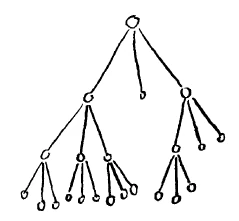
[ 25 ] Well, this was based above all on the mistaken idea that the social organism would ever be divided in this way. It is not meant to be divided that way, any more than the human organism is divided into three separate parts. And yet there are three parts within the human organism: we are, first of all, head-people, chest-people, and metabolic-people. But it is not just the head that is the head-person; rather, the head extends throughout the entire human organism; the entire nervous and sensory system belongs to the head-person. And the heart-being, in turn, is not found solely in the heart; the sense of warmth, for example, extends throughout the entire body, so the whole body is also a heart-being. And we have rhythm everywhere, even in the head system. The systems interpenetrate one another. I can only explain this abstractly for now, but the corporations of spiritual life will simply be present there as well, just as economic corporations are. However, these spiritual corporations will have their organizations within the economic sphere of the entire social organism, and what they do there will not be able to influence the organization of the spiritual sphere of the threefold organism.
[ 26 ] Today, however, there are many reasons to hold misleading views on these matters; such views have been encountered time and again, even among university professors. These university professors, after all, should at least be deeply immersed in spiritual life. But when one says to them that it should go without saying that those who are deeply immersed in intellectual life form a community with their peers in order to manage intellectual life itself—Klopstock, after all, spoke of a “republic of scholars”—one often hears a university professor say: “No, [I don’t want that], because then the person who really matters wouldn’t be an official at the Ministry of Culture, but my colleague; no, I’d rather have the official at the Ministry of Culture than my colleague.”
[ 27 ] The point is that we should not incorporate any of what existed in the past—namely, the three estates: the teaching estate, the military estate, and the productive estate—into today’s social conditions; rather, we must be clear that people today do not live divided into three distinct groups [by estate]. [We must be clear] that the human being is fully embedded in all three parts of the social organism. Then it will also be possible to understand how everyone who must be active in spiritual life or in political life is nevertheless embedded in economic life and must be supported by economic life. So what matters is that people are embedded in the entire social organism.