Rhythms in the Cosmos and in the Human Being
GA 350
22 September 1923, Dornach
Translate the original German text into any language:
Versions Available:
Rhythms in the Cosmos and in the Human Being, tr. SOL
16. Die Bedeutung von Eiweiß, Fetten, Kohlehydraten und Salzen für die Ernährung — Wirkung der Kartoffelnahrung — Gegner der Anthroposophie
16. The Importance of Protein, Fats, Carbohydrates, and Salts in Nutrition — The Effects of a Potato-Based Diet — Opponents of Anthroposophy
[ 1 ] Nun, meine Herren, liegt heute etwas vor?
[ 1 ] Well, gentlemen, is there anything on the agenda today?
[ 2 ] Fragesteller: In bezug auf Ernährung, Ich möchte fragen, ob in der Ernährung durch die Kartoffel in andern Ländern eine Beziehung besteht, also ein Zusammenhang in anderer Beziehung als, sagen wir, für die Europäer.
[ 2 ] Questioner: Regarding nutrition, I would like to ask whether there is a connection between potatoes and nutrition in other countries—that is, a connection different from, say, that for Europeans.
[ 3 ] Dr. Steiner: Wollen wir die ganze Frage von der Ernährung, von der Beziehung der Ernährung zur geistigen Welt, heute noch einmal besprechen. Sie wissen ja, daß die Kartoffel erst in der neueren Zeit eingeführt worden ist. Das habe ich Ihnen gesagt, daß im früheren Europa die Kartoffelernährung nicht vorhanden war, sondern daß dazumal die Völker sich in einer anderen Weise, wesentlich von anderen Produkten, ernährten. Nun können wir natürlich diese Frage nicht entscheiden, ohne daß wir die Beziehung der geistigen Welt zur Ernährung überhaupt betrachten.
[ 3 ] Dr. Steiner: Let’s discuss the whole question of nutrition—and the relationship between nutrition and the spiritual world—once again today. As you know, the potato was only introduced in more recent times. I have told you that in early Europe, a potato-based diet did not exist, but that at that time, people nourished themselves in a different way, primarily from other foods. Now, of course, we cannot resolve this question without first considering the relationship between the spiritual world and nutrition in general.
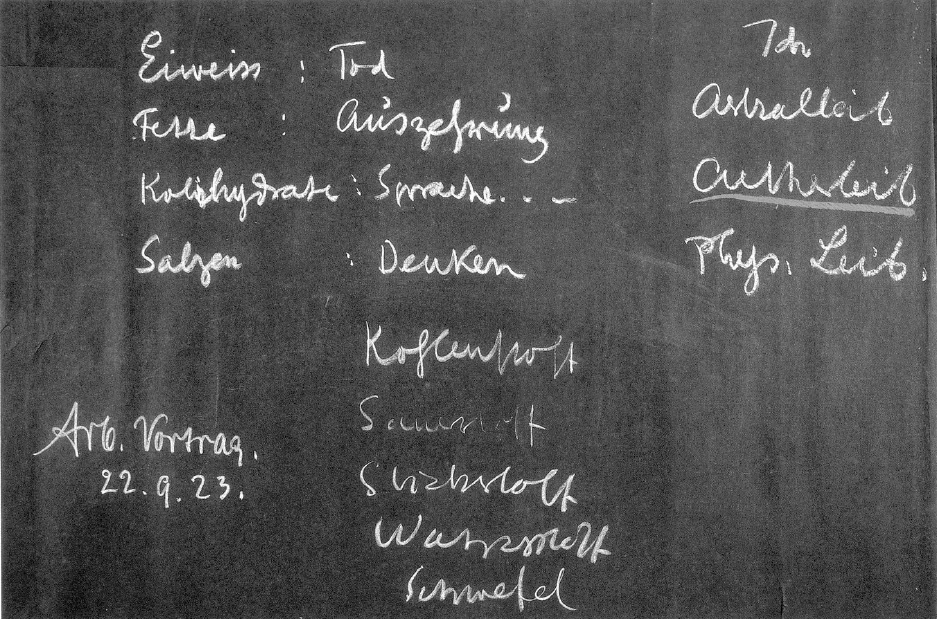
[ 4 ] Sie werden sich erinnern — ich habe ja diese Dinge schon einmal angedeutet —, der Mensch lebt eigentlich von viererlei Produkten: von Eiweiß, das er eigentlich mit allen seinen Nahrungsmitteln in sich aufnimmt, das in einer, ich möchte sagen, charakteristischen, in einer besonders bezeichnenden Form ja im Hühnerei enthalten ist, das aber in allen Nahrungsmitteln mit enthalten ist. Also das ist das erste, das Eiweiß. Dann nimmt der Mensch auch Fette auf, nicht nur, indem er direkt tierisches Fett genießt, sondern Fett ist wiederum in allem enthalten. Sie wissen, es werden auch andere Produkte zu fetthaltigen Nahrungsmitteln umgestaltet, wie zum Beispiel die Milch zum Käse umgestaltet wird und so weiter. Das dritte Nahrungsmittel, das sind diejenigen Produkte, die wir als Kohlehydrate bezeichnen, und das ist all dasjenige, was wir aus dem Pflanzenreiche aufnehmen, natürlich auch mit aufnehmen aus den anderen Nahrungsmitteln, aber was wesentlich enthalten ist eben in solchen Nahrungsmitteln wie Weizen, Roggen, Linsen, Bohnen, aber auch in der Kartoffel, und in der Kartoffel in ganz vorherrschendem Maße. Das letzte, was der Mensch nötig hat zum Leben, was er gewöhnlich nur als einen Zusatz betrachtet, was aber zum Leben ganz besonders auch notwendig ist, das sind die Salze. Nun, wir nehmen ja unsere Salze zunächst in Form des Kochsalzes auf, aber wiederum enthalten alle Nahrungsmittel Salze. So daß wir also sagen können: Die menschliche Nahrung muß, damit der Mensch leben kann, aus Eiweiß, Fetten, Kohlehydraten und aus Salzen bestehen.
[ 4 ] You will recall—I have already hinted at these things before—that human beings actually live on four kinds of nutrients: protein, which they actually consume through all their foods; this is contained, I would say, in a characteristic, particularly significant form in the chicken egg, but it is present in all foods. So that is the first one: protein. Then humans also consume fats, not only by directly eating animal fat, but fat is, in turn, contained in everything. As you know, other products are also transformed into fatty foods, such as milk being turned into cheese, and so on. The third type of food consists of the products we call carbohydrates, which are everything we obtain from the plant kingdom—though we naturally also consume them in other foods—but which are primarily found in foods such as wheat, rye, lentils, beans, and also in potatoes, and in potatoes to a particularly significant extent. The last thing humans need to live—which is usually regarded merely as a supplement but is in fact particularly essential for life—is salts. Now, we primarily consume our salts in the form of table salt, but again, all foods contain salts. So we can say: In order for a person to live, human nutrition must consist of protein, fats, carbohydrates, and salts.
[ 5 ] Nun will ich Ihnen beschreiben, was denn eigentlich diese verschiedenen Nahrungsmittel, die wir dadurch, daß wir gemischte Nahrung genießen, eben in verschiedener Form bekommen, für den Menschen bedeuten. Nehmen wir da zuallererst die Salze.
[ 5 ] Now I would like to describe to you what these various foods—which we obtain in different forms by eating a varied diet—actually mean for human beings. Let’s start with salts.
[ 6 ] Die Salze, die sind eigentlich für den Menschen, wenn sie auch nur in geringen Mengen aufgenommen werden, ein außerordentlich wichtiges Nahrungsmittel, nicht bloß ein Genußmittel. Wir salzen nicht bloß unsere Speisen deshalb, daß wir etwa, sagen wir, angenehme Säuerlichkeit haben im Geschmacke, sondern wir salzen unsere Speisen aus dem Grunde, damit wir überhaupt denken können. Die Salze müssen als Nahrungsmittel bis in das Gehirn kommen, damit wir überhaupt denken können, Also die Salze hängen am meisten zusammen mit demjenigen, was unser Denken ist. Wenn jemand zum Beispiel so krank ist — denn das ist schon eine Krankheit —, daß er alles dasjenige, was in der Nahrung Salz ist, im Magen oder im Darm ablagert und nicht mit dem Blut ins Gehirn schickt, dann wird er schwachsinnig, dumm. Das ist dasjenige, auf das man eben aufmerksam machen muß.
[ 6 ] Salts are, in fact, an extraordinarily important foodstuff for humans—even when consumed in only small quantities—and not merely a luxury item. We do not salt our food merely to achieve, say, a pleasant tanginess in the taste, but rather we salt our food so that we can think at all. As a nutrient, salt must reach the brain for us to be able to think at all. Thus, salt is most closely connected to the very process of thinking. If, for example, someone is so ill—for this is indeed an illness—that they deposit all the salt in their food in the stomach or intestines rather than sending it to the brain via the blood, then they become mentally deficient, stupid. This is precisely what we must draw attention to.
[ 7 ] Nicht wahr, man muß sich klar sein darüber: Geist ist vorhanden, aber der Geist muß auf der Erde, damit er wirken kann, in den Stoffen wirken. Und man muß daher gerade, wenn man Geisteswissenschaft betreibt, die Wirkung des Geistes in dem Stoff kennen. Sonst wäre es ja so, wie wenn einer sagen würde: Maschinen machen, das ist etwas Materielles; wir aber sind geistige Leute, wir wollen nichts Materielles, wir wollen also nicht erst Eisen kaufen, Stahl, sondern wir wollen Maschinen erschaffen aus dem Geist heraus. — Das ist natürlich Unsinn. Man muß erst den Stoff dazu haben. So braucht der schaffende Geist in der Natur überall den Stoff. Und ist er gehindert, den Stoff zu verwenden, lagert sich also das Salz, statt daß es durch das Blut zum Gehirn dringt, im Magen und in den Gedärmen ab, dann wird der Mensch dumm.
[ 7 ] Isn't it true that we must be clear about this: Spirit exists, but in order for it to be effective on Earth, it must work within matter. And that is precisely why, when one engages in spiritual science, one must understand the effect of the spirit within matter. Otherwise, it would be as if someone were to say: Building machines is something material; but we are spiritual people—we want nothing material—so we don’t want to start by buying iron or steel; rather, we want to create machines out of the spirit itself. — That is, of course, nonsense. One must first have the material to work with. Thus, the creative spirit needs material everywhere in nature. And if it is prevented from using the material—if, for example, salt is deposited in the stomach and intestines instead of being carried through the blood to the brain—then the person becomes stupid.
[ 8 ] Allerdings, so einfach ist wiederum die Sache nicht. Der Mensch kann das Salz nicht unmittelbar so brauchen, wie es draußen in der Natur ist. Wenn Sie also — man könnte das sogar — ein Löchelchen ins Gehirn machen würden und würden einem da Salze einträufeln ins Gehirn, so würde das nichts nützen, denn das Salz muß schon in den Magen hineinkommen, weil, wenn das Salz in den Magen und in die Därme kommt — beachten Sie nur einmal, daß das Salz ja schon auf der Zunge aufgelöst wird —, es noch mehr, ganz fein aufgelöst wird, immer feiner und feiner wird. Es kommt durch das, was der Mensch mit dem Salz macht, das Salz überhaupt schon in einem vergeistigten Zustand ins Gehirn. Also so einfach, daß wir das Salz direkt ins Gehirn bringen könnten, ist die Sache nicht. Aber wer nicht imstande ist, die Wirkungen des Salzes im Gehirn zu haben, der wird dumm.
[ 8 ] However, it’s not quite that simple. Humans cannot directly use salt as it occurs in nature. So if you were to—and one could even do this—make a tiny hole in the brain and drip salts into it, it wouldn’t do any good, because the salt has to enter the stomach first; for when the salt enters the stomach and the intestines—just consider that the salt is already dissolved on the tongue— it dissolves even further, becoming finer and finer. It is through what a person does with the salt that the salt actually reaches the brain in a spiritualized state. So it’s not as simple as just bringing the salt directly into the brain. But anyone who is unable to experience the effects of salt in the brain will become stupid.
[ 9 ] Nun betrachten wir die Kohlehydrate. Das ist also das, was wir in Erbsen, Bohnen, Weizen, Roggen oder in Kartoffeln vorzugsweise da genießen. Die Kohlehydrate tragen insbesondere dazu bei, daß wir als Mensch die menschliche Gestalt haben. Wenn wir keine Kohlehydrate essen würden, so würden wir alle möglichen Verzerrungen der menschlichen Gestalt haben. Wir würden meinetwillen so sein, daß sich die Nase nicht ordentlich ausbilden würde, die Ohren nicht ordentlich ausbilden würden. Wir hätten nicht diese menschliche Gestalt, die wir haben. Die Kohlehydrate, die wirken dazu, daß wir gewissermaßen äußerlich als Mensch gezeichnet werden. Überallhin wirken sie, daß wir überall gezeichnet werden als Mensch. Und wenn der Mensch so organisiert ist, daß er die Kohlehydrate nicht ins Gehirn hineinbringt, sondern wenn sie sich wiederum ablagern in den Gedärmen und im Magen, dann verfällt der Mensch. Dann sieht man, wie der Mensch allmählich zusammenfällt, wie er in sich zusammensinkt, wie er schwach wird, wie er gewissermaßen seine Gestalt nicht mehr aufrechterhalten kann. Also die Kohlehydrate tragen das ihrige dazu bei, daß wir überhaupt die richtige menschliche Gestalt haben.
[ 9 ] Now let’s consider carbohydrates. These are what we primarily enjoy in peas, beans, wheat, rye, or potatoes. Carbohydrates play a particularly important role in giving us our human form. If we didn’t eat carbohydrates, we would have all sorts of deformities in our human form. For my part, we would be such that our noses wouldn’t develop properly, and our ears wouldn’t develop properly. We would not have the human form that we do. Carbohydrates are what enable us, so to speak, to be outwardly defined as human beings. They work everywhere to ensure that we are defined as human beings in every respect. And if a person is organized in such a way that carbohydrates are not transported to the brain but instead accumulate in the intestines and stomach, then that person deteriorates. Then you see how a person gradually collapses, how they shrink inward, how they grow weak, how they can no longer, so to speak, maintain their form. So carbohydrates play their part in ensuring that we have the proper human form in the first place.
[ 10 ] Sie sehen also, wir müssen eigentlich überall die richtigen Nahrungsmittel hineinbringen. Die Salze, die wirken vorzugsweise da vorn auf das Gehirn. Die Kohlehydrate, die wirken mehr da rückwärts auf das Gehirn, auf diese Schichten da. Und namentlich würde bei dem Menschen, der zu wenig Kohlehydrate verdauen kann, der sie nicht in diese Schichten des Gehirns hineinbringen würde, sich sehr bald auch das herausstellen, daß er immerfort heiser ist, daß er nicht rein und klar sprechen kann. Wenn Sie einen Menschen hören, der früher ganz ordentlich hat reden können, aber nun plötzlich eine heisere Sprache kriegt, da können Sie sich sagen: bei dem ist in der Verdauung etwas nicht richtig. Er kann nicht in der richtigen Weise Kohlehydrate verdauen, sie kommen nicht an die richtige Stelle des Gehirns. Dadurch ist seine Atmung nicht mehr in Ordnung und auch seine Sprache nicht. So daß wir sagen können: Die Salze wirken vorzugsweise auf das Denken. Die Kohlehydrate wirken zum Beispiel auf die Sprache und alles, was damit zusammenhängt. Es ist also notwendig, daß wir diese Kohlehydrate haben.
[ 10 ] So you see, we really need to incorporate the right foods into every part of the body. The salts primarily affect the front part of the brain. The carbohydrates affect the back part of the brain, those layers there. And specifically, in a person who cannot digest enough carbohydrates—who cannot get them into those layers of the brain—it would very soon become apparent that they are constantly hoarse and cannot speak clearly and distinctly. If you hear someone who used to be able to speak quite clearly but has suddenly developed a hoarse voice, you can conclude that something is wrong with their digestion. They cannot digest carbohydrates properly; they do not reach the right part of the brain. As a result, their breathing is no longer normal, nor is their speech. So we can say: The salts act primarily on thinking. Carbohydrates, for example, affect speech and everything related to it. It is therefore necessary that we have these carbohydrates.
[ 11 ] Nun, die Fette, Ja, sehen Sie, meine Herren, die Kohlehydrate, die wirken für unsere Gestalt, aber sie haben eigentlich so die Absicht, uns zu einer bloßen Gestalt zu machen. Sie polstern uns nicht aus. Wir müssen auch ausgepolstert werden. Und das machen die Fette. Die Fette bewirken also, daß da, wo die Kohlehydrate die Gestalt aufbauen, gleichsam den Plan in die Luft hineinzeichnen, daß da auch wiederum das Material hineinkommt vom Fett. Also das Fett dient dazu, daß wir in der richtigen Weise Material in uns haben. Nur kommt das beim Fett in einer ganz besonderen Weise zum Ausdruck.
[ 11 ] Well, fats—yes, you see, gentlemen—carbohydrates do shape our bodies, but their real purpose is to turn us into mere shapes. They don’t pad us out. We also need to be padded out. And that’s what fats do. So fats ensure that where carbohydrates build the body—as it were, sketching the blueprint into the air—the material from the fat is also incorporated there. In other words, fat serves to ensure that we have the right kind of material within us. It’s just that this is expressed in a very special way when it comes to fat.
[ 12 ] Sehen Sie, ich habe Ihnen früher gesagt, daß der Mensch ein Ich hat, einen Astralleib, einen Ätherleib und einen physischen Leib. Natürlich, das Fett lagert sich ab im physischen Leibe, aber das Allerwichtigste, damit sich das Fett ablagern kann und lebendig bleibt — denn wir müssen ja lebendiges Fett in uns haben —, das ist der Ätherleib. Dieser Ätherleib, der ist das Wichtigste für die Fettablagerung. Aber der Astralleib wiederum, der ist das Wichtigste für die Empfindung.
[ 12 ] You see, I told you earlier that human beings have an “I,” an astral body, an etheric body, and a physical body. Of course, fat is stored in the physical body, but the most important factor in enabling fat to be stored and remain alive—because we must, after all, have living fat within us—is the etheric body. This etheric body is the most important factor for fat storage. But the astral body, in turn, is the most important factor for sensation.
[ 13 ] Jetzt denken Sie einmal, wenn einer wach ist, da ist sein astralischer Leib in ihm drinnen, wenn er schläft, ist der astralische Leib draußen. Wenn nun der Mensch wach ist und der Astralleib in dem Ätherleib drinnen arbeitet, da wird das Fett fortwährend verarbeitet, und es wird durch das Fett alles im Körper geschmiert. Wenn der Mensch schläft, der Astralleib also draußen ist, wird das Fett nicht verarbeitet, sondern es lagert sich ab. Beim Wachen wird das Fett fortwährend zum Schmieren benützt, beim Schlafen abgelagert. Wir brauchen beides, abgelagertes Fett und solches Fett, das den Körper einschmiert.
[ 13 ] Now just think about it: when a person is awake, their astral body is inside them; when they sleep, the astral body is outside. When a person is awake and the astral body is working inside the etheric body, fat is constantly being processed, and everything in the body is lubricated by this fat. When a person sleeps—that is, when the astral body is outside—the fat is not processed but is deposited. While awake, fat is constantly used for lubrication; while asleep, it is deposited. We need both: stored fat and fat that lubricates the body.
[ 14 ] Wenn einer nun aber fortwährend schläft — früher war das häufiger, jetzt wird es immer seltener; ein Rentier zum Beispiel, nicht wahr, der tut gar nichts —, da lagert sich das Fett auch am Tage ab, beim sogenannten Wachen, das aber eigentlich ein Schlafen ist: es kommt der Schmerbauch und es kommt eben überall viel abgelagertes Fett! Also Sie sehen, die richtige Ablagerung von Fett hängt davon ab, daß der Mensch tatsächlich sein Fett auch lebendig verbraucht, denn es wird ja immer erzeugt. Wenn einer nun gerade so viel ißt, als er verbraucht, so ist das das Richtige. Wenn einer aber fortwährend ißt und nichts verbraucht, so kommt eben der Schmerbauch.
[ 14 ] But if someone sleeps constantly—which used to be more common, but is now becoming increasingly rare; a reindeer, for example—it does absolutely nothing—then fat accumulates even during the day, during so-called “waking,” which is actually a form of sleep: you end up with a potbelly, and fat accumulates everywhere! So you see, proper fat metabolism depends on a person actually burning off their fat while active, because it’s constantly being produced. If someone eats exactly as much as they burn, that’s ideal. But if someone eats constantly and doesn’t burn anything off, that’s when the potbelly appears.
[ 15 ] Das, was ich Ihnen da sage, das wissen instinktiv die Landwirte sehr gut, denn die brauchen das bei den Schweinen. Wenn sie die Fettschweine erzeugen, da muß das herbeigeführt werden, daß diese Tiere eigentlich ihren inneren Körper gar nicht mehr schmieren, sondern alles, was sie genießen, ablagern. Und so muß die Lebensweise dieser Tiere entsprechend eingerichtet werden.
[ 15 ] What I’m telling you here is something farmers know very well instinctively, because they need it when raising pigs. When they raise fattening pigs, they have to ensure that these animals no longer lubricate their internal organs at all, but instead store everything they consume. And so the living conditions of these animals must be arranged accordingly.
[ 16 ] Es kann natürlich auch sein, daß der Mensch nicht imstande ist, ordentlich Fett abzulagern, daß er also krank ist. Rentiers sind in dieser Beziehung gesund; die lagern das Fett ab. Aber es kann auch daran fehlen, daß man die Kohlehydrate nicht ablagert und die Sprache heiser wird. So kann es auch sein, daß die Fette nicht richtig abgelagert werden, einfach mit dem Darmkot weggehen. Dann haben wir zu wenig Fett, können zu wenig schmieren. Oder wenn wir überhaupt zu wenig Nahrungsmittel haben, hungern müssen, können wir zu wenig schmieren. Das Fett ist ja das eigentliche Material, das wir in den Körper hineinlegen. Was geschieht denn mit einem Menschen, der entweder hungern muß oder durch seine Verdauung so eingerichtet ist, daß er das Fett nicht ablagern kann, sondern daß es mit dem Darmkot fortgeht? Ein solcher Mensch, der kein Material in seinem Körper hat, der wird immer geistiger. Aber auf diese Weise geistig zu werden verträgt der Mensch nicht. Da verbrennt der Geist. Er wird also nicht nur immer dürrer und dürrer, sondern es bilden sich Gase in ihm, was zu dem treibt, was man Wahnideen nennt und dergleichen, und es tritt der Zustand auf, der beim Hunger da ist: Hungerwahnsinn. Das zerstört immer, das ist immer eine Zerstörung des Leibes. So daß also, wenn der Mensch zu wenig Fette bekommt, dasjenige auftritt, was man Auszehrung nennen kann, Schwindsucht kann man auch sagen; er schwindet dahin.
[ 16 ] Of course, it may also be that a person is unable to store fat properly—that is, that he or she is ill. Reindeer are healthy in this regard; they do store fat. But it can also be due to a failure to store carbohydrates, causing the voice to become hoarse. It may also be that fats are not stored properly and are simply excreted with the feces. Then we have too little fat and cannot lubricate sufficiently. Or if we have too little food at all and are forced to go hungry, we cannot lubricate sufficiently. Fat is, after all, the actual material we put into our bodies. What happens to a person who either has to go hungry or whose digestive system is such that they cannot store fat, but instead it is excreted with the feces? Such a person, who has no material in their body, becomes increasingly spiritual. But a person cannot endure becoming spiritual in this way. The spirit burns up. So not only does the person become thinner and thinner, but gases form within them, leading to what are called delusions and the like, and the condition associated with starvation sets in: starvation madness. This is always destructive; it is always a destruction of the body. So when a person receives too little fat, what occurs is what can be called emaciation—or consumption, as it is also known—and the person wastes away.
[ 17 ] Nun das Eiweiß. Sehen Sie, das muß ja sozusagen von allem Anfang an da sein. Das Eiweiß ist ja schon vorhanden als Ei, bevor das Wesen entsteht, das menschliche, auch das tierische Wesen. So daß wir sagen können: Das Eiweiß, das ist dasjenige, was den Menschen eigentlich bildet, entwickelt; es ist das Ursprüngliche, das zugrunde liegt. Aus dem Eiweiß muß sich alles übrige im Körper erst herausbilden. Das kann man doch verstehen? So daß man also folgendes sagen kann: Das Eiweiß muß überhaupt vom Anfang an da sein, damit der Mensch entstehen kann. Die Mutter bildet das Eiweiß in der Gebärmutter aus in Form eines kleinen Klümpchens. Das Ei wird befruchtet, und durch die Befruchtung wird dann dieses Eiweiß fähig, durch die Dinge, die ich Ihnen geschildert habe, zum Menschen gestaltet zu werden. Aber der Mensch braucht natürlich fortwährend Eiweiß. Daher muß in seiner Nahrung fortwährend Eiweiß enthalten sein. Wenn er zu wenig Eiweiß hat oder wenn er das Eiweiß nicht ordentlich verdauen kann, dann muß er am Eiweißmangel nicht nur ausgezehrt werden — was ihn ja auch allmählich tötet —, aber würde der Mensch in einem Augenblicke seines Lebens überhaupt kein richtiges Eiweiß haben, so müßte er gleich sterben. Geradeso wie das Eiweiß zum Entstehen notwendig ist, so ist das Eiweiß auch notwendig, daß der Mensch überhaupt lebt. So daß wir sagen könnten: Derjenige, der Eiweiß überhaupt nicht verdauen kann, bei dem würde der Tod eintreten.
[ 17 ] Now, the protein. You see, it has to be there, so to speak, from the very beginning. The protein is already present in the egg before the being comes into existence—whether human or animal. So we can say: Protein is what actually forms and develops the human being; it is the original substance that lies at the foundation. Everything else in the body must first develop from the protein. That’s easy to understand, isn’t it? So we can say the following: Protein must be present from the very beginning for a human being to develop. The mother forms the protein in the womb in the form of a small clump. The egg is fertilized, and through fertilization, this protein then becomes capable of being shaped into a human being through the processes I have described to you. But of course, a human being needs protein continuously. Therefore, their diet must constantly contain protein. If they have too little protein or if they cannot digest it properly, not only will they waste away from protein deficiency—which, of course, gradually kills them—but if a human being were to have absolutely no proper protein at any single moment in their life, they would die immediately. Just as protein is necessary for development, so too is it necessary for human life itself. So we could say: Death would ensue for anyone who is completely unable to digest protein.
[ 18 ] Jetzt schauen wir uns einmal die einzelnen Nahrungsmittel an. Wenn wir die Salze anschauen, so werden wir vorzugsweise an den Vorderteil des Kopfes gewiesen. Da drinnen lagern sich die Salze ab. Etwas weiter hinten, da lagern sich die Kohlehydrate ab, und die bewirken, daß wir die menschliche Gestalt haben. Dann lagern sich noch weiter hinten die Fette ab und füllen von da aus den Körper aus, denn die Fette gehen nicht etwa unmittelbar herein in den Körper, sondern gehen vom Blut in den Kopf, und da werden sie erst für den Körper ausgeschlachtet. Alles geht durch den Kopf, auch das Eiweiß.
[ 18 ] Now let’s take a look at the individual foods. When we look at the salts, we are directed primarily to the front part of the head. That is where the salts are deposited. A little further back, the carbohydrates are deposited, and they are what give us our human form. Then, even further back, the fats are deposited and fill out the body from there, because the fats do not enter the body directly, but rather travel from the blood to the head, where they are first processed for the body. Everything passes through the head, including protein.
[ 19 ] Nun ist aber ein großer Unterschied in bezug auf die Kohlehydrate. Wenn Sie sich so etwas wie Linsen, Bohnen, Erbsen, Roggen, Weizen anschauen, so können Sie sagen: dabei werden die Kohlehydrate aus den Früchten gewonnen. Denn das, was wir im Weizen haben aus der Erde, das ist ja die Frucht. Wenn wir Linsen haben, das ist auch die Frucht. Und Früchte haben das Eigentümliche, daß sie schon im Magen und in den Därmen verarbeitet werden und nur die Kräfte nach dem Kopf schicken. Daß Linsen, Bohnen im Gedärm verarbeitet werden, das wissen ja alle aus den eigentümlichen Zuständen, die gerade beim Genuß von Linsen und Bohnen kommen können. Das alles, Korn, Weizen, Linsen, Bohnen, wird in den Gedärmen verarbeitet. Also die Früchte haben hauptsächlich die Eigentümlichkeit, daß sie schon in den Gedärmen ordentlich verarbeitet werden.
[ 19 ] But there is a big difference when it comes to carbohydrates. If you look at foods like lentils, beans, peas, rye, and wheat, you can say that the carbohydrates in them are derived from the fruits. Because what we get from the earth in wheat is, after all, the fruit. When we have lentils, that is also the fruit. And fruits have the distinctive characteristic that they are already processed in the stomach and intestines and send only their vital forces to the head. Everyone knows that lentils and beans are processed in the intestines from the peculiar sensations that can occur precisely when eating lentils and beans. All of these—grain, wheat, lentils, beans—are processed in the intestines. So fruits are characterized primarily by the fact that they are properly processed right in the intestines.
[ 20 ] Aber bei den Kartoffeln können wir ja nicht die Früchte genießen. Wenn wir das, was bei der Kartoffel die Früchte sind, essen würden, so würden wir ja sogar einen Giftstoff bekommen, einen verderblichen Giftstoff. Also bei der Kartoffel ist das so, daß sie uns nicht gestattet, in derselben Weise aufgegessen zu werden wie Linsen, Bohnen, Erbsen und so weiter oder die Feldfrüchte, Roggen, Weizen. Nun, was genießen wir denn bei der Kartoffel? Ja, das, was unten ist: die Knolle. Und die Knollen, die sind nun dasjenige bei allen Pflanzen, Wurzeln und so weiter, was in den Gedärmen am allerwenigsten verarbeitet wird. Die Früchte werden in den Gedärmen verarbeitet. Das kann man aber bei der Kartoffel nicht essen, was dort die Früchte sind. Man ißt die Knolle; die ist nicht eine richtige Wurzel, sondern ein verdickter Stengel. Nun wird die Kartoffel also gegessen, kommt in den Magen, in die Gedärme. Da kann sie nicht gleich verarbeitet werden, sondern sie geht jetzt durch das Blut unverarbeitet herauf. Statt daß nun, wenn sie hier in ihre Schichte des Gehirns kommt, sie da schon so fein kommen würde wie Roggen und Weizen und gleich hinuntergeschickt werden würde in den Körper, muß erst hier im Gehirn die Verarbeitung geschehen. So daß also, wenn wir richtiges Roggen- oder Weizenbrot essen, wir das im Magen und in den Gedärmen ordentlich verdauen und wir unserem Kopf nicht mehr zumuten, daß der nun erst die Verdauung besorgen soll, sondern der kann schon die Verbreitung im Körper bewirken. Wenn wir dagegen Kartoffelbrot oder Kartoffeln überhaupt genießen, dann stellt sich das heraus, daß der Kopf erst zu der Verdauung der Kartoffel dienen muß.
[ 20 ] But with potatoes, we can’t actually enjoy the fruit. If we were to eat what constitutes the fruit of the potato, we would actually ingest a toxin—a harmful toxin. So with the potato, the situation is such that it does not allow us to eat it in the same way as lentils, beans, peas, and so on, or as field crops like rye and wheat. Well, what is it, then, that we enjoy about the potato? Yes, what’s at the bottom: the tuber. And tubers—which are found in all plants, roots, and so on—are the parts that are processed the least in the intestines. The fruits are processed in the intestines. But with the potato, you can’t eat what constitutes its fruit. You eat the tuber; it’s not a true root, but a thickened stem. So when the potato is eaten, it enters the stomach and then the intestines. It cannot be processed immediately there, but instead passes into the bloodstream unprocessed. Instead of arriving in the brain’s layers as finely broken down as rye and wheat—and being sent straight down into the body—it must first be processed here in the brain. So when we eat real rye or wheat bread, we digest it properly in the stomach and intestines, and we no longer expect our brain to take care of digestion—instead, it can focus on distributing the nutrients throughout the body. If, on the other hand, we eat potato bread or potatoes in general, it turns out that the brain must first be used to digest the potatoes.
[ 21 ] Wenn aber der Kopf erst zur Verdauung der Kartoffel verwendet werden muß, dann kann er nicht mehr denken, denn zum Denken muß er die Kräfte frei haben; da muß ihm der Unterleib die Kräfte der Verdauung abnehmen. So daß also, wenn der Mensch die Kartoffel zu viel genießt — was also immer mehr und mehr von dem Zeitpunkte an der Fall war, als die Kartoffel eingeführt wurde und in Europa eine Bedeutung erlangte —, der Kopf immer mehr und mehr für das eigentliche Denken ausgeschaltet wird, und der Mensch verliert immer mehr und mehr die Fähigkeit, mit seinem Mittelkopf zu denken; er denkt dann nur mehr mit dem Vorderkopf. Aber dieser Vorderkopf, der von den Salzen abhängt, der führt immer mehr und mehr dazu, daß man eigentlich bloß ein materialistischer Verstandesmensch wird. Das richtige Geistige kann ja der Vorderkopf gar nicht denken. Gerade durch den Vorderkopf wird man ein richtiger Verstandesmensch. Die Sache ist daher diese, daß in der Tat das innere Denken in Europa zurückgegangen ist von dem Moment an, wo die Kartoffelnahrung Platz griff.
[ 21 ] But if the brain must first be used to digest the potato, then it can no longer think, for thinking requires that its energy be free; the abdomen must therefore take over the work of digestion. So that when a person consumes too many potatoes—which has been increasingly the case ever since the potato was introduced and gained prominence in Europe—the head becomes increasingly disabled for actual thinking, and the person increasingly loses the ability to think with the middle head; he then thinks only with the front head. But this frontal part of the head, which depends on salts, leads more and more to a person becoming, in essence, merely a materialistic, intellectual being. The frontal part of the head is, after all, incapable of thinking in a truly spiritual way. It is precisely through the front of the head that one becomes a true intellectual. The fact is, therefore, that inner thinking in Europe has indeed declined from the moment when the potato diet took hold.
[ 22 ] Nun müssen wir uns klar sein darüber, daß der Mensch nicht nur aus den Kräften, die auf der Erde sind, aufgebaut wird. Das habe ich Ihnen ja fortwährend gesagt, daß der Mensch aus der ganzen Umgebung aufgebaut wird, daß der Mensch ein Geschöpf von Sonne, Mond und den Sternen ist. Wenn der Mensch nun Kartoffeln ißt, dann verwendet er seinen Mittelkopf nur dazu, um diese Kartoffeln zu verdauen. Da schließt er sich ab von der Umwelt, da erkennt er die Umwelt nicht mehr an. Da erklärt er: Das ist alles Wischiwaschi, was da gesagt wird von der Welt, daß da eine Geistigkeit von der Welt herunterkommt. — Und so kann man sagen: Es ist eigentlich der übermäßige Kartoffelgenuß zum großen Teil auch wiederum das, was in der neueren Zeit zum Materialismus getrieben hat.
[ 22 ] Now we must be clear about the fact that human beings are not composed solely of the forces that exist on Earth. I have told you time and again that human beings are composed of their entire environment, that human beings are creatures of the sun, the moon, and the stars. Now, when a person eats potatoes, he uses his middle head solely to digest those potatoes. In doing so, they shut themselves off from the environment; they no longer acknowledge it. They declare: “It’s all nonsense, what the world says—that a spiritual quality descends from the world.” — And so one can say: It is actually, to a large extent, this excessive consumption of potatoes that has, in recent times, driven people toward materialism.
[ 23 ] Natürlich ist die Sache ja so, daß vorzugsweise diejenigen, die nun nicht genügend Mittel haben, auf die Kartoffel angewiesen sind, weil die Kartoffel eine Zeitlang billig war, und diejenigen, welche wohlhabend sind, die können sich mehr dasjenige, was auf den Vorderkopf wirkt, kaufen, können also mehr die Speisen würzen und salzen. Die Würzen wirken ebenso auf den Vorderkopf wie die Salze. Und die Folge davon ist, daß das nur Verstandesmenschen werden, und die anderen sich leicht von den Verstandesmenschen alles vormachen lassen, weil sie ja ihren Kopf nicht mehr zum Denken benützen können. So hat schon die Kartoffel einen ganz besonderen Bezug zum Geist überhaupt. Sie hat also eigentlich den Geist materialistisch gemacht.
[ 23 ] Of course, the reality is that it is primarily those who lack sufficient means who rely on potatoes, because potatoes were cheap for a while, whereas those who are well-off can afford to buy more of what stimulates the frontal lobe—that is, they can season and salt their food more generously. Spices affect the frontal lobe just as much as salt does. And the result of this is that only rational people emerge, while the others easily allow themselves to be led astray by the rational people, because they can no longer use their heads for thinking. Thus, the potato already has a very special connection to the spirit in general. It has, in fact, made the spirit materialistic.
[ 24 ] Wenn wir nun diese Gliederung des Menschen betrachten, so müssen wir sagen: Der physische Leib des Menschen nimmt zunächst seinen Ursprung aus dem Eiweiß, Dieses Eiweiß hängt mit Geburt und Tod des physischen Menschen zusammen. Der Ätherleib hat sein hauptsächlichstes Feld in den Fetten. Der Astralleib, der hat sein hauptsächlichstes Feld in den Kohlehydraten, und erst das Ich hat sein Feld in den Salzen.
[ 24 ] When we consider this structure of the human being, we must say: The physical body of the human being originates primarily from protein. This protein is connected to the birth and death of the physical human being. The etheric body has its primary field in fats. The astral body has its primary field in carbohydrates, and only the “I” has its field in salts.
[ 25 ] So können wir sagen: Dasjenige, was im Menschen das Empfindungsvermögen ist — es ist ja nicht der physische Leib, wenn ich auf meine Hand schlage und dann empfinde, denn sonst müßte alles, was physisch ist, empfinden —, es ist der astralische Leib. Ich schiebe das Fleisch zurück, den Muskel zurück, dadurch wird das Fleisch im Muskel aus dem astralischen Leib herausgeschoben und ich empfinde im astralischen Leib. Alles, was innerlich Empfindung ist, ist im astralischen Leib. Der astralische Leib ist aber angewiesen darauf, daß er richtig arbeiten kann. Ich habe Ihnen gesagt: Wenn der astralische Leib auch bei Tag schläft und nicht richtig arbeiten kann, dann lagert sich der Schmerbauch ab, das Fett. — Oder, das ist auch der Fall, wenn der Mensch bloß intellektualistisch mit dem Kopf arbeitet, Verstandesmensch wird, es lagert sich sogar auch das Fett ab. Aber der astralische Leib, der ja zum Beispiel auch in der Sprache wirkt, der braucht die Kohlehydrate nicht bloß im Kopfe oben, nicht bloß da, er braucht die Kohlehydrate im ganzen Körper. Der astralische Leib muß die Beine bewegen, der astralische Leib muß die Hände bewegen, er braucht die Kohlehydrate im ganzen Körper. Wenn ich ihm Roggen oder Weizen als Kohlehydrate gebe, da gehen die Kräfte in den ganzen Körper. Wenn ich ihm bloß Kartoffeln gebe, bleiben die Kräfte da oben im Kopf sitzen und der Mensch wird ausgemergelt, schwach, und sein astralischer Leib kann nicht ordentlich arbeiten. So daß gerade das, was im Menschen geistig ist, matt und immer schläfriger wird, wenn er nicht in der Lage ist, Kohlehydrate, die ihn durchdringen, in sich hineinzubringen. Das ist eben bei der reinen Kartoffelnahrung nicht möglich, weil sie im Kopfe so viel zu tun macht, daß der Körper nichts mehr übrig behält.
[ 25 ] So we can say: That which constitutes the capacity for sensation in a human being—it is certainly not the physical body, for if I strike my hand and then feel something, then everything that is physical would have to be capable of sensation—it is the astral body. I push the flesh back, the muscle back; in doing so, the flesh within the muscle is pushed out of the astral body, and I feel within the astral body. Everything that is inner sensation is in the astral body. But the astral body depends on being able to function properly. I have told you: If the astral body sleeps even during the day and cannot function properly, then fat accumulates in the abdomen. — Or, this is also the case when a person works purely intellectually with the head, becoming a “rationalist”; fat even accumulates then. But the astral body—which, for example, is also active in speech—does not need carbohydrates just in the head up top, not just there; it needs carbohydrates throughout the entire body. The astral body must move the legs; the astral body must move the hands; it needs carbohydrates throughout the entire body. If I give it rye or wheat as carbohydrates, the energy flows throughout the entire body. If I give it only potatoes, the energy remains stuck up in the head, and the person becomes emaciated and weak, and their astral body cannot function properly. So that precisely what is spiritual in a person becomes listless and increasingly drowsy if they are unable to take in carbohydrates that permeate their entire being. This is simply not possible with a diet consisting solely of potatoes, because they keep the mind so busy that the body has nothing left.
[ 26 ] Man kann schon sagen: Was tut die Wissenschaft? — Nun, die Wissenschaft, die untersucht, wieviel im Eiweiß drinnen enthalten ist von Kohlenstoff, Sauerstoff, Stickstoff, Wasserstoff, Schwefel und ähnlichen Dingen noch, aber das sind die hauptsächlichsten. Nun kriegt die Wissenschaft heraus: Im Eiweiß ist so und so viel Kohlenstoff, so und so viel Wasserstoff drinnen in Prozenten, im Fett sind andere Prozente drinnen, in den Kohlehydraten andere Prozente. Aber die Wissenschaft hat gar keine Idee davon, was diese Stoffe als solche für eine Bedeutung haben. Sie kennt nur die Prozente der Bestandteile. Aber damit kann man gar nichts ausmachen. Es sind eben einfach die Bestandteile in der Kartoffel ganz anders drinnen als im Roggen und Weizen, und man muß wissen, daß, wenn man eine Blüte oder eine Frucht ißt, diese in den Gedärmen verarbeitet wird, während, wenn man eine Wurzel ißt, diese im Kopf verarbeitet wird.
[ 26 ] One might well ask: What does science do? — Well, science investigates how much carbon, oxygen, nitrogen, hydrogen, sulfur, and other similar elements are contained in protein—though those are the main ones. Now science determines: Protein contains such-and-such a percentage of carbon, such-and-such a percentage of hydrogen; fat contains different percentages, and carbohydrates contain yet other percentages. But science has absolutely no idea what significance these substances have in and of themselves. It knows only the percentages of the components. But that tells us absolutely nothing. It’s simply that the constituents in a potato are quite different from those in rye and wheat, and one must understand that when you eat a flower or a fruit, it is processed in the intestines, whereas when you eat a root, it is processed in the head.
[ 27 ] Anders kann man die Sache auch nicht in der Medizin anwenden. Derjenige, der richtig medizinisch denken kann, der weiß, daß wenn er einen Tee aus den Blüten oder Samen, aus den Früchten macht, dieser Tee vorzugsweise in den Gedärmen wirkt; wenn er aber eine Abkochung aus der Wurzel macht und sie teeartig präsentiert, kann man auf Kopfkrankheiten heilend wirken. Wenn wir Wurzeln essen, wirkt das eben auf den Kopf, und zwar wirkt es so auf den Kopf, daß es materiell auf den Kopf wirkt. Das ist das ganz besonders Wichtige.
[ 27 ] There is no other way to apply this principle in medicine. Anyone who can think medically knows that if they make a tea from the flowers, seeds, or fruits, that tea acts primarily on the intestines; but if they make a decoction from the root and serve it like tea, it can have a healing effect on ailments of the head. When we eat roots, they affect the head—and they do so in such a way that they have a physical effect on the head. That is what is particularly important.
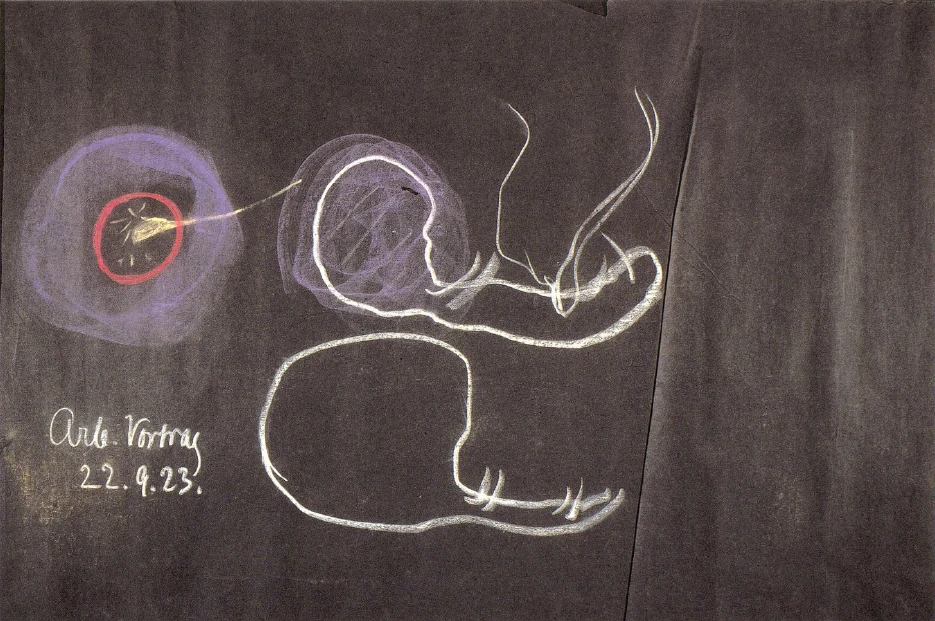
[ 28 ] Wir können nun aber weitergehen und können sagen: Ja, aber wenn nun der Mensch nicht nur durch die Kartoffelnahrung gewissermaßen ausgemergelt wird, daß er nicht mehr seine Hände und Füße bewegen kann, sondern wenn er so ausgemergelt wird, daß auch diejenigen Dinge nicht mehr regsam sind, die zu der Fortpflanzung beitragen, dann wird die Sache noch schlimmer. — Nehmen wir also an, die Kartoffelnahrung nimmt so überhand, daß das in die weiblichen Fortpflanzungsorgane hineinwirkt, daß die matt und abgelähmt werden. Ja, meine Herren, der Mensch kommt eben nicht bloß von seinen Vorfahren her, sondern er kommt aus der geistigen Welt mit dem geistig-seelischen Teil seines Wesens her, und das verbindet sich mit demjenigen, was aus den Vorfahren kommt. Nun betrachten wir einmal, wie die Sache ist. Ich will es recht groß, etwas vergrößert aufzeichnen.
[ 28 ] But we can now go further and say: Yes, but if a person is not only emaciated, so to speak, by a potato-based diet to the point that he can no longer move his hands and feet, but if he is so emaciated that even those functions that contribute to reproduction are no longer active, then the situation becomes even worse. — Let us assume, then, that a potato-based diet becomes so prevalent that it affects the female reproductive organs, causing them to become weak and sluggish. Yes, gentlemen, human beings do not come merely from their ancestors; rather, they come from the spiritual world with the spiritual-soul aspect of their being, and this unites with what comes from their ancestors. Now let us consider how this works. I want to draw it quite large, somewhat enlarged.
[ 29 ] Wir können sagen: Der Mensch entsteht aus der weiblichen Eizelle. Das ist also sehr vergrößert gezeichnet. Da herein dringt der männliche Samen. Dann bilden sich allerlei sternförmige Figuren da drinnen. Zellen spalten sich, bilden dann nach und nach den menschlichen Körper. Aber kein menschlicher Körper kann gebildet werden, wenn sich nicht verbindet mit dem, was da geschieht, das Geistig-Seelische, das aus der geistigen Welt herkommt.
[ 29 ] We can say: A human being arises from the female egg cell. This is depicted on a very large scale. The male sperm penetrates it. Then all kinds of star-shaped figures form inside. Cells divide and gradually form the human body. But no human body can be formed unless the spiritual-soul aspect, which comes from the spiritual world, is connected to what is happening there.
[ 30 ] Wenn nun die Sache so liegt, daß die Mutter oder der Vater zuviel Kartoffelnahrung genossen haben, dann bilden sie schon einen solchen Menschenkeim aus, der darauf veranlagt ist, daß der Kopf viel arbeiten muß. Wenn Sie daher einen Menschenkeim anschauen von jemand, der ordentlich mit Roggenbrot und so weiter genährt ist, wo Vater und Mutter eine richtige Nahrung genießen, da ist dieser Menschenkeim etwa so (es wird gezeichnet). Wenn Sie aber einen Menschenkeim ansehen, wo bei den Eltern zuviel Kartoffelnahrung war, ja, da geschieht folgendes. Sehen Sie, das andere ist ja im Menschenkeim sehr wenig ausgebildet, vorzugsweise ist die runde Kugel des Kopfes ausgebildet; das ist im Embryo, im Menschenkeim die Hauptsache, das ist also vorzugsweise ausgebildet. Da muß nun das Geistig-Seelische hereinkommen in den Kopf. Und wenn das Geistig-Seelische in den Kopf hereinkommt, dann muß es mit dem Kopf arbeiten. Noch im Leibe der Mutter arbeitet das Geistig-Seelische des Menschen vorzugsweise am Kopfe.
[ 30 ] If, then, the mother or father has consumed too many potatoes, they will form a human embryo that is predisposed to having to use its mind a great deal. So if you look at a human embryo from someone who has been properly nourished with rye bread and so on—where the father and mother have a proper diet—that human embryo looks something like this (a drawing is made). But if you look at a human embryo where the parents ate too many potatoes, well, the following happens. You see, the other part is very underdeveloped in the human embryo; the round sphere of the head is the most developed part; that is the main feature in the embryo, so it is the most developed. Now the spiritual-soul aspect must enter the head. And when the spiritual-soul aspect enters the head, it must work with the head. Even while still in the mother’s womb, the human spirit and soul work primarily on the head.
[ 31 ] Wenn nun dieses Geistig-Seelische im Kopfe dasjenige findet, was bei der Ernährung der Mutter von Roggen und Weizen kommt, dann kann das Geistig-Seelische ordentlich arbeiten. Denn die Blüten, in denen ja der Roggen und Weizen und so weiter entstehen, die werden ja auch aus der Erde herausgestreckt, und da geht das Geistige schon bei der Pflanze heran, da ist das Geistige verwandt. Wenn daher das GeistigSeelische im Mutterleibe auf dasjenige auftrifft, was von Früchten kommt, so kann es leicht arbeiten. Trifft aber das Geistige im Mutterleibe auf einen Kindeskopf, der vorzugsweise durch die Kartoffelnahrung gebildet wird, da kann es nicht heran. Nicht wahr, die Kartoffel geht hinunter in die Erde, sie ist sogar von der Erde bedeckt; man gräbt sie aus der Erde aus, sie wächst in der Finsternis, sie hat ‘keine Verwandtschaft zum Geistigen. Der Mensch kommt herunter aus der geistigen Welt, findet einen Kopf vor, der eigentlich aus der Finsternis heraus gebildet ist. Da kann er nicht heran, der Geist, und die Folge davon ist, daß der Embryo nachher so aussieht (es wird gezeichnet) — ich zeichne es etwas karikiert —: ein riesiger Wasserkopf wird geboren. Denn wenn der Geist nicht herankommt, dann wächst das Physische; der Wasserkopf bildet sich aus. Wenn der Geist herankommen kann, dann dämpft er das Wasser, dann arbeitet der Geist in der Materie und der Kopf wird ordentlich ausgebildet. So daß Sie sagen können: Diese riesigen Wasserköpfe, die oftmals bei den Embryonen bemerkbar sind, die kommen durch die mangelhafte Ernährung, vorzugsweise wieder durch die Kartoffel, zustande. — Und so haben Sie das, daß nicht nur der Mensch selber ausgemergelt wird, sondern daß der Mensch so geboren wird, daß sein Geistig-Seelisches gar nicht richtig im physischen Leib drinnen ist.
[ 31 ] When this spiritual-soul aspect in the head finds what comes from the mother’s diet of rye and wheat, then the spiritual-soul aspect can function properly. For the flowers—in which, after all, rye, wheat, and so on develop—are also drawn up from the earth, and the spiritual element is already present in the plant; there, the spiritual is related to it. Therefore, when the spiritual-soul aspect in the womb encounters what comes from fruits, it can work easily. But if the spiritual encounters a child’s head in the womb that is formed primarily through potato-based nutrition, it cannot approach it. After all, the potato goes down into the earth; it is even covered by the earth; one digs it out of the earth; it grows in darkness; it has no connection to the spiritual. The human being descends from the spiritual world and finds a head that is actually formed out of darkness. The spirit cannot reach it, and the result is that the embryo later looks like this (it is drawn)—I’m drawing it somewhat caricatured—: a giant hydrocephalic head is born. For if the spirit cannot reach it, then the physical grows; the hydrocephalus develops. If the spirit can reach it, then it moderates the water; the spirit works within the matter, and the head develops properly. So you can say: These huge hydrocephalic heads, which are often noticeable in embryos, result from poor nutrition—primarily from potatoes once again. — And so you have a situation where not only is the person themselves emaciated, but the person is born in such a way that their spiritual-soul aspect is not properly integrated into the physical body.
[ 32 ] Aber sehen Sie, meine Herren, die Sache ist so: Der Mensch besteht allerdings aus physischem Leib, Ätherleib, Astralleib und Ich; die sind aber nicht in jedem Lebensalter gleich geartet. Beim Kind bis zum siebenten Jahre, da ist der Ätherleib, Astralleib und das Ich so, daß sie erst wieder recht untertauchen müssen; die müssen erst ganz hinein in den physischen Leib. Wenn der Ätherleib ganz hineinkommt in den physischen Leib, kommen die zweiten Zähne. Wenn der astralische Leib ganz hineinkommt in den physischen Leib, dann kommt die Geschlechtsreife. Wenn daher ein solcher Kopf vorhanden ist, wenn also das Geistig-Seelische durch die Kartoffelnahrung nicht ordentlich in den physischen Menschen im Mutterleib hinein kann, dann wird auch dasjenige gestört, was im vierzehnten, fünfzehnten Lebensjahre mit dem Menschen geschehen soll. Der Mensch geht dann überhaupt durch sein ganzes Leben so, als wenn er seinen Körper gar nicht hätte, als wenn der schlapp an ihm wäre. So daß also die Menschen unter dem Einfluß der Kartoffelnahrung schon nicht stark genug für das Leben geboren worden sind.
[ 32 ] But you see, gentlemen, the matter is this: Human beings do indeed consist of a physical body, an etheric body, an astral body, and the “I”; however, these are not of the same nature at every stage of life. In a child up to the age of seven, the etheric body, astral body, and I are in such a state that they must first sink back in; they must first enter fully into the physical body. When the etheric body enters fully into the physical body, the second set of teeth comes in. When the astral body enters fully into the physical body, sexual maturity sets in. Therefore, if such a condition exists—that is, if the spiritual-soul aspect cannot properly enter the physical human being in the womb due to a potato-based diet—then what is supposed to happen to the person at the age of fourteen or fifteen is also disrupted. The person then goes through life as if they did not have a body at all, as if it were limp and lifeless. Thus, people under the influence of a potato-based diet are not born strong enough for life to begin with.
[ 33 ] Sehen Sie, meine Herren, das sind ungeheuer wichtige Dinge. Sie müssen sich nur sagen: Ja, wirklich, die sozialen Verhältnisse hängen noch von vielen anderen Dingen ab als von jenen, die man heute gewöhnlich deklamiert. Die sozialen Verhältnisse hängen auch davon ab, daß man die Felder ordentlich benützt, daß man also die Kartoffel nicht mehr anbaut, als die Menschen zu ihrem Starkwerden vertragen können. Man muß also auch wirkliche, richtige Naturwissenschaft treiben können, wenn man Sozialwissenschaft treibt. Das ist durchaus nötig. Bloß davon zu reden: Mehrwert, Kapital und so weiter, das nützt allein nichts. Denn nehmen Sie einmal an, dem Kommunismus gelänge es, alles Kapital auszurotten, er würde alles selber verwalten. Ja, wenn er von den Bürgerlichen nur eine Wissenschaft gelernt hat, die nicht in der richtigen Weise die Felder zu verwerten weiß, wenn er nicht weiß, daß es schädlicher ist, den Magen mit Kartoffeln anzufüllen als mit Roggen und Weizen, dann hilft alles nichts. Das ist es, was man bedenken muß. So daß wir nicht das fortwährende Herumreden von dem oder jenem brauchen, sondern eine wirkliche Wissenschaft, die einsieht, wie der Geist wirken kann in der Materie.
[ 33 ] You see, gentlemen, these are matters of immense importance. You need only tell yourselves: Yes, indeed, social conditions depend on many other factors besides those that are commonly touted today. Social conditions also depend on the fields being used properly—that is, on not growing more potatoes than people can consume to sustain themselves. So, if one is to study the social sciences, one must also be able to engage in genuine, proper natural science. That is absolutely necessary. Merely talking about surplus value, capital, and so on is of no use in and of itself. For suppose, for a moment, that communism succeeded in eradicating all capital and took over the administration of everything itself. Well, if it has learned only one thing from the bourgeoisie—a science that does not know how to utilize the fields properly—if it does not know that it is more harmful to fill the stomach with potatoes than with rye and wheat, then none of this will help. That is what we must bear in mind. So we do not need the endless talk about this or that, but a true science that understands how the spirit can act upon matter.
[ 34 ] Sehen Sie, daher kommt es ja, daß sozusagen die Anthroposophie fortwährend, ohne daß sie es will, einen Krieg gegen zwei Fronten führen muß. Warum? Nun, da sind die Wissenschafter von heute, die beschäftigen sich nur mit der Materie, aber nur mit den Prozenten von der Materie, wieviel Kohlenstoff, Sauerstoff, Stickstoff, Wasserstoff im Eiweiß und so weiter enthalten sind. Dadurch lernt man aber gar nichts über die Materie. Die materielle Wissenschaft kennt gerade die Materie nicht, weil man die Materie erst kennenlernt, wenn man weiß, wie der Geist drinnen arbeitet. Hilft es denn, wenn einer sagt: Ich will eine Uhr kennenlernen; gut, ich will mir die Uhr klarzumachen versuchen. Die Uhr ist aus Silber. Das Silber, das in meiner Uhr ist, das ist in dem Silberbergwerk von da und da gewonnen worden, Dieses Silber ist dann mit Zügen nach der und der Stadt geführt worden. Da ist es abgeliefert worden an die und die Kaufleute und so weiter. Weiter ist in dieser Uhr ein Porzellanzifferblatt. Das Porzellan ist dort und dort gewonnen worden, in die und die Stadt gekommen und so weiter. — Er weiß gar nichts von der Uhr! Man weiß erst etwas von der Uhr, wenn man weiß, was der Uhrmacher daran getan hat. Und es ist gar nicht einmal wichtig, um zu verstehen, warum eine Uhr geht, daß man weiß, wie das Silber gewonnen wird in den Bergwerken; aber wichtig ist, daß man weiß, wie die Uhr geht, wie der Uhrmacher daran gearbeitet hat, die Räder zurecht gemacht hat und so weiter.
[ 34 ] You see, that is why anthroposophy, so to speak, must constantly wage a war on two fronts without even wanting to. Why? Well, there are today’s scientists, who concern themselves only with matter—but only with the percentages of matter, such as how much carbon, oxygen, nitrogen, and hydrogen are contained in protein, and so on. But that teaches us absolutely nothing about matter. Material science does not actually know matter, because one only comes to know matter when one understands how the spirit works within it. Does it help, for example, when someone says: “I want to understand a watch; well, I’ll try to figure out how the watch works.” “The watch is made of silver. The silver in my watch was mined in such-and-such a silver mine. This silver was then transported by train to such-and-such a city. There it was delivered to such-and-such merchants, and so on. Furthermore, this watch has a porcelain dial. The porcelain was produced in such-and-such a place, brought to such-and-such a city, and so on.” — He doesn’t know anything about the watch at all! You only know something about the watch once you know what the watchmaker did to it. And it isn’t even important, in order to understand why a watch runs, to know how the silver is mined; but what is important is to know how the watch runs, how the watchmaker worked on it, adjusted the gears, and so on.
[ 35 ] So ist es eigentlich im Grunde genommen höchst gleichgültig für die Gesundheit und Krankheit des Menschen, abstrakt zu wissen, aus wieviel Kohlenstoff, Sauerstoff, Stickstoff, Wasserstoff, Eiweiß, Fett, Kohlehydraten und Salzen die Nahrungsmittel bestehen, sondern für die Gesundheit und Krankheit des Menschen ist es im Grunde genommen wichtig zu wissen, wie es speziell mit der Kartoffel ist: sie nährt die Menschen geistig ebensowenig, wie sie sie physisch ernährt. Im Grunde ist das ganz unnötig, was darüber geschrieben ist; man muß die anderen Zwecke wissen. Für die anderen Zwecke kann man ja wissen, wie es ist mit Silberminen und so weiter, aber um die Gesundheit und Krankheit des Menschen zu verstehen, ist diese Wissenschaft unwichtig. Doch sie merkt gar nicht, was ihr fehlt. Wenn also Anthroposophie kommt und hinzufügen will, was ihr fehlt, dann bekämpft man sie. Und so entstand die eine Kampffront nach dem Materialismus hin. Dort wird gesagt: Nun, diese Anthroposophie will alles phantastisch erklären. — Die Wissenschaft wirft der Anthroposophie ihren Geist vor. Das ist die eine Front.
[ 35 ] So, strictly speaking, it is actually of the utmost indifference to human health and illness to know, in the abstract, how much carbon, oxygen, nitrogen, hydrogen, protein, fat, carbohydrates, and salts food consists of; rather, for human health and illness, it is fundamentally important to know specifically what the situation is with the potato: it nourishes people spiritually just as little as it nourishes them physically. Basically, what has been written about this is completely unnecessary; one must know the other purposes. For those other purposes, one can certainly know about silver mines and so on, but this science is unimportant for understanding human health and illness. Yet it does not even realize what it is lacking. So when anthroposophy comes along and seeks to add what is missing, it is opposed. And thus one front of opposition emerged, aligned with materialism. There it is said: “Well, this anthroposophy wants to explain everything in fantastical terms.” — Science accuses anthroposophy of being too “spiritual.” That is one front.
[ 36 ] Die andere Front, meine Herren, die kommt von der Theologie, von den Vertretern der Religion und so weiter. Auf der Seite redet man dem Menschen viel davon, wie die Seele in den Himmel kommt. Und man redet ja allerdings davon, daß man durch Beten und Sakramente und so weiter in den Himmel kommt. Nun schön. Aber wenn einer in der physischen Welt so drinnensteht, daß er überhaupt seinen Körper gar nicht richtig hat, also in der physischen Welt gar nicht in die richtige Beziehung zum Erdenleben kommt, dann findet er sich nach dem Tode außerordentlich schwer zurecht. Das sagen ihm die Leute nicht. Es ist durchaus notwendig, daß man ein lebenspraktischer Mensch wird und weiß, wie man die Materie ergreifen muß. So daß man sagen kann: Ja, Religion, Theologie reden heute den Leuten von allerlei, aber das alles reicht nicht hin, um den Menschen wirklich im irdischen Leben so stark zu machen, daß er dann auch durch solche Vorbereitung — denn durch alles das, was kenntnisloses Beten ist zum Beispiel, wird ja der Mensch gerade abgelenkt von dem, was er wissen soll für sein gesundes Leben — sich später zurechtfindet. Sie werden kaum von der Kanzel jemals verkündigen gehört haben, wie man es halten muß, damit der Mensch stark wird, mit der Kartoffel- oder mit der Weizennahrung! Wenigstens werden Sie nicht gefunden haben, daß die meisten Pastoren und Priester einen großen Wert darauf legen, von der Kanzel herunter den Menschen zu verkündigen, wie es sich mit der Roggen- und Weizennahrung in bezug auf seine Gesundheit verhält. Das betrachten sie als eine Nebensache, weil sie sagen: Das ist etwas Unheiliges! Heilig ist nur, wenn man betet oder über das Evangelium und ähnliche Dinge redet. — Aber das göttliche Wirken ist nicht nur da, wo man Gebete gesprochen hat, oder wo über das Evangelium geredet wird, sondern in der ganzen Natur; das Geistige wirkt auch da drinnen. Wenn der Mensch die Geistigkeit nicht einläßt in seinen Kopf, weil er ihn durch die Kartoffel zu stark in Anspruch nimmt, so ist es so, daß der Mensch beten kann. Sehr schön. Wenn er aber zuviel Kartoffeln ißt, so hat sein Gebet keinen Zweck mehr, denn er wird wiederum abgeleitet vom Geistigen. Aber das merken die Leute wiederum nicht. Ebenso merken sie es nicht, daß Gott die Erde nicht als einen Kloß gefunden und aus ihr dann die Dinge gemacht hat, sondern daß tatsächlich bis ins einzelne hinein das göttliche Wirken überall drinnen ist und gesucht werden muß. Aber wenn man das tut, nennen einen die Theologen und Religionsleute Materialisten! Und so wird man von denjenigen, die Wissenschafter sind, phantastischer Spiritualist genannt; von denjenigen, die Theologen sind, wird man Materialist genannt. An dieser Art kann sich ja schon zeigen, wie wertvoll die Dinge sind. Gerade so wertvoll wie es 1908 war, als die Anthroposophie bekämpft worden ist, indem man gesagt hat: Die Anthroposophie ist jesuitisch. — Dazumal hat man behauptet, die Anthroposophen werden eigentlich von ihren Führern dem Jesuitismus ausgeliefert. Mittlerweile hat sich das Blatt gewendet. Heute sagen die Jesuiten, die Anthroposophen würden an die Freimaurer ausgeliefert. Sehen Sie, so kommt das immer zustande! Aber um das handelt es sich nicht, sondern darum, daß man wirklich eine Wissenschaft gewinnt, die ebensogut sagen kann, warum im Mutterleibe ein Wasserkopf entsteht statt eines richtig ausgebildeten Kopfes.
[ 36 ] The other front, gentlemen, comes from theology, from the representatives of religion, and so on. On that side, people talk a lot about how the soul goes to heaven. And they certainly talk about how one goes to heaven through prayer, the sacraments, and so on. All right. But if someone is so deeply entrenched in the physical world that they don’t even have a proper grasp of their own body—that is, if they don’t establish the right relationship to earthly life in the physical world—then they will find it extremely difficult to find their bearings after death. People don’t tell them that. It is absolutely necessary to become a practical person in life and to know how to deal with the material world. So that one can say: Yes, religion and theology talk to people about all sorts of things today, but none of that is enough to truly make a person strong enough in earthly life so that they can later find their way—through such preparation, for instance, since all that uninformed prayer, for example, actually distracts a person from what they need to know for a healthy life. You will hardly ever have heard it proclaimed from the pulpit how one must conduct oneself so that a person becomes strong—whether through a diet of potatoes or wheat! At the very least, you will not have found that most pastors and priests place great importance on proclaiming to people from the pulpit how rye and wheat affect their health. They regard this as a trivial matter, because they say: “That is something unholy!” Only prayer or speaking about the Gospel and similar things is holy. — But the divine working is not only present where prayers have been said or where the Gospel is discussed, but throughout all of nature; the spiritual is at work there as well. If a person does not allow the spiritual to enter his mind because he overburdens it with potatoes, then it is true that he can pray. Very well. But if he eats too many potatoes, his prayer serves no purpose anymore, for he is once again distracted from the spiritual. But people don’t realize this either. Nor do they realize that God did not find the earth as a lump of matter and then fashion things from it, but that, in fact, divine activity is present everywhere, down to the smallest detail, and must be sought out. But if you do that, theologians and religious people call you a materialist! And so one is called a fanciful spiritualist by those who are scientists; by those who are theologians, one is called a materialist. This very situation already shows just how valuable these things are. Just as valuable as they were in 1908, when anthroposophy was attacked with the claim: “Anthroposophy is Jesuitical.” — Back then, it was claimed that the anthroposophists were actually being led into Jesuitism by their leaders. In the meantime, the tables have turned. Today, the Jesuits say that the anthroposophists are being led into Freemasonry. You see, that’s how it always happens! But that’s not the point; the point is that we are truly gaining a science that can just as well explain why hydrocephalus develops in the womb instead of a properly formed head.
[ 37 ] Nun, meine Herren, Sie werden sagen: Es gehen doch nicht alle Leute mit einem Wasserkopf herum. — Gewiß nicht, denn natürlich wirken da wiederum die anderen Kräfte dagegen, und der Kopf ist dann, wenn er geboren wird, nicht mehr so groß wie im Embryo, aber er ist nicht mehr fähig, etwas anderes aufzunehmen, wenn er geboren ist, als Kartoffeln und Wasser. Er kann sogar klein werden dabei und kann doch ein Wasserkopf sein. Aber das Wesentliche ist, daß seit der Einführung der Kartoffelnahrung die Köpfe im Mutterleib immer viel zu groß sind. Nachher werden sie zusammengeschoben, aber gerade das Zusammenschieben vor der Geburt, das wirkt auf sie dann schädigend, weil sie nicht imstande sind, dann Richtiges aufzunehmen, sondern einzig und allein das Materialistische. Beim geborenen Menschen sieht man den Wasserkopf nicht mehr bloß an der Größe. Gewiß, der eigentliche Wasserkopf ist von der Größe abhängig, aber es handelt sich vorzugsweise darum, ob in der richtigen Weise Wasser wirkt oder etwas anderes wirken kann. Und das ist ebenso wichtig zu wissen wie alles übrige, was auf der einen Seite durch Wissenschaft oder auf der anderen Seite durch Theologie und Religion in die Menschheit kommt. Aber es ist schon notwendig, daß man gerade ordentlich auf die Sache hinschaut.
[ 37 ] Well, gentlemen, you might say: Surely not everyone walks around with a water on the brain. — Certainly not, because, of course, other forces counteract this, and by the time the baby is born, the head is no longer as large as it was in the embryo; but once born, it is no longer capable of absorbing anything other than potatoes and water. It can even shrink in the process and still be a water head. But the essential point is that, since the introduction of a potato-based diet, the heads in the womb have always been much too large. Later they are compressed, but it is precisely this compression before birth that has a damaging effect on them, because they are then unable to absorb what is right, but only and exclusively the materialistic. In a born human being, hydrocephalus is no longer evident merely from the size. Certainly, actual hydrocephalus depends on size, but the primary issue is whether water is acting in the right way or whether something else can act instead. And this is just as important to know as everything else that comes to humanity—on the one hand through science, and on the other through theology and religion. But it is indeed necessary to look closely at the matter.
[ 38 ] Sehen Sie, wie wird denn eigentlich die Anthroposophie behandelt? Da ist vor einiger Zeit in Berlin eine Art Kongreß derjenigen Leute abgehalten worden, die sich «nichtanthroposophische Kenner der Anthroposophie» nennen. Sie behaupten, sie seien keine Anthroposophen, aber sie würden die Anthroposophie kennen. Nun, da hat besonders ein Mensch geredet, der einmal hier war, aber abgefallen ist, ein gewisser Dr. Gösch. Dieser Dr. Gösch hat vor Pastoren, Lizentiaten, Professoren geredet. Und jetzt, nicht wahr, jetzt machen die Leute überall Vorträge gegen Anthroposophie von dem, was da dieser Dr. Gösch den Leuten erzählt hat. Sie werden nun sagen: Da haben eben diese Leute, Lizentiaten, Professoren aus dem, was ihnen der Dr. Gösch gesagt hat, die Überzeugung gewonnen, daß die Anthroposophie sehr schädlich ist. — Aber bitte, meine Herren, beachten Sie folgendes: Was ist ungefähr im Denken eines heutigen Pastoren, Professors, Lizentiaten drinnen, und hören Sie dann, was der Dr. Gösch den Leuten gesagt hat. Der hat gesagt: Die Anthroposophie, die ist deshalb besonders schädlich, weil die Anthroposophen betrogen werden — denn Frau Dr. Steiner und der Dr. Steiner, die haben eigentlich vor, von der Erde ein Stück abzuspalten, es von derErde abzutrennen und einen eigenenPlanetenzu bilden, und mit all den Anthroposophen zusammen im Weltenall also eine solche Planetenwelten-Kolonie zu begründen! — Das hat dieser Dr. Gösch den erleuchteten Leuten vorgeredet! Nun können Sie sich denken, daß keiner von denen an das ja wirklich glaubt, aber er tut so, als ob er durch diese Rede überzeugt worden wäre von der Schädlichkeit der Anthroposophie.
[ 38 ] Look, how is anthroposophy actually treated? Some time ago, a sort of congress was held in Berlin by people who call themselves “non-anthroposophical experts on anthroposophy.” They claim they are not anthroposophists, but that they are familiar with anthroposophy. Well, one person in particular spoke there—a man who was once here but has fallen away—a certain Dr. Gösch. This Dr. Gösch spoke before pastors, licentiates, and professors. And now, don’t you see, people everywhere are giving lectures against anthroposophy based on what this Dr. Gösch told them. You will now say: These people—licentiates and professors—have simply come to the conviction, based on what Dr. Gösch told them, that anthroposophy is very harmful. — But please, gentlemen, consider the following: What is generally in the minds of today’s pastors, professors, and licentiates, and then listen to what Dr. Gösch told people. He said: “Anthroposophy is particularly harmful because the anthroposophists are being deceived — because Dr. Steiner and her husband actually intend to split off a piece of the Earth, separate it from the Earth, and form their own planet, and thus establish such a planetary colony in the cosmos together with all the anthroposophists! — That is what this Dr. Gösch told these enlightened people! Now you can imagine that none of them really believes that, but he acts as if this speech had convinced him of the harmfulness of anthroposophy.
[ 39 ] Nun denken Sie, was für eine Verrücktheit darinnen steckt! Aber dieselben erleuchteten Leute, die sitzen ja nicht nur bei dieser Versammlung, sondern am nächsten oder folgenden Tag, da sitzen sie bei allerlei anderen Versammlungen, wo über allerlei Schicksale entschieden wird. Da sind sie natürlich nicht gescheiter als bei den anderen Versammlungen. Das muß man bedenken, was für Leute eigentlich heute die Welt regieren! Also seien Sie sich klar darüber, daß die Gegnerschaft gegen Anthroposophie eine wirkliche Gegnerschaft gegen die Wahrheit ist. Man will es nicht an den Tag kommen lassen, was in diesen Dingen eigentlich steckt, was alles herauskommt an Dingen über den Menschen. Man sagt: Die Anthroposophie, die ist etwas Geheimnisvolles. — Ja, meine Herren, wie soll sie denn etwas anderes sein, als etwas Geheimnisvolles? Selbstverständlich ist sie etwas Geheimnisvolles, aber sie ist nichts Geheimnisvolleres als es etwas Geheimnisvolles ist, wenn einem einer etwas gestohlen hat und versteckt hat; da ist das, bis man es aufgefunden hat, geheimnisvoll. So ist auch die Anthroposophie geheimnisvoll, weil die Wissenschaft und das andere geistige Leben diese Dinge versteckt hat; deshalb ist natürlich die Anthroposophie heute etwas so Geheimnisvolles. Aber es hört ja auf, geheimnisvoll zu sein in dem Moment, wo man es gefunden hat! Sie will gar nichts Geheimnistuerisches sein, aber dasjenige, was die anderen versteckt haben, will sie gerade ans Licht bringen.
[ 39 ] Now just think what sheer madness lies in all this! But these same enlightened people—they’re not just sitting in this assembly; the next day or the day after, they’re sitting in all sorts of other assemblies where decisions are made about all manner of destinies. Of course, they’re no wiser there than they are in the other assemblies. One must consider what kind of people are actually governing the world today! So be clear about this: opposition to anthroposophy is truly opposition to the truth. They do not want to let it come to light what these matters actually entail, what all kinds of truths about human beings are revealed. People say: “Anthroposophy is something mysterious.” — Yes, gentlemen, how could it be anything other than mysterious? Of course it is mysterious, but it is no more mysterious than something is mysterious when someone has stolen something from you and hidden it; until you find it, it remains a mystery. In the same way, anthroposophy is mysterious because science and the rest of spiritual life have hidden these things; that is why, naturally, anthroposophy is such a mysterious thing today. But it ceases to be mysterious the moment you have found it! It does not want to be secretive at all, but rather it wants to bring to light precisely what others have hidden.
[ 40 ] Ich muß jetzt nach Wien fahren und werde es Ihnen dann sagen lassen, wenn wir fortsetzen können.
[ 40 ] I have to go to Vienna now, and I'll let you know when we can continue.