Rhythms in the Cosmos and in the Human Being
GA 350
22 September 1923, Dornach
Translated by Steiner Online Library
16. The Importance of Protein, Fats, Carbohydrates, and Salts in Nutrition — The Effects of a Potato-Based Diet — Opponents of Anthroposophy
[ 1 ] Well, gentlemen, is there anything on the agenda today?
[ 2 ] Questioner: Regarding nutrition, I would like to ask whether there is a connection between potatoes and nutrition in other countries—that is, a connection different from, say, that for Europeans.
[ 3 ] Dr. Steiner: Let’s discuss the whole question of nutrition—and the relationship between nutrition and the spiritual world—once again today. As you know, the potato was only introduced in more recent times. I have told you that in early Europe, a potato-based diet did not exist, but that at that time, people nourished themselves in a different way, primarily from other foods. Now, of course, we cannot resolve this question without first considering the relationship between the spiritual world and nutrition in general.
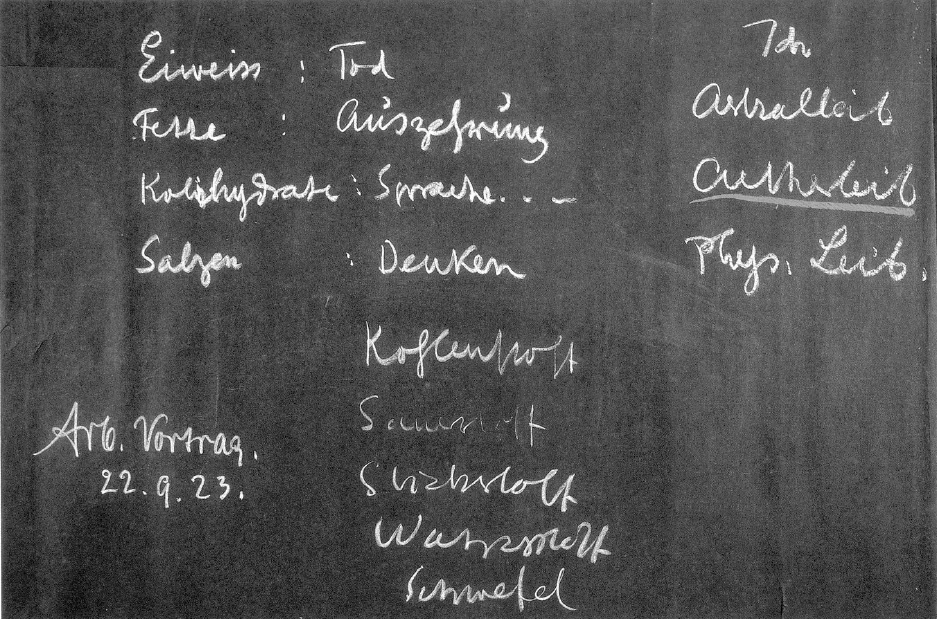
[ 4 ] You will recall—I have already hinted at these things before—that human beings actually live on four kinds of nutrients: protein, which they actually consume through all their foods; this is contained, I would say, in a characteristic, particularly significant form in the chicken egg, but it is present in all foods. So that is the first one: protein. Then humans also consume fats, not only by directly eating animal fat, but fat is, in turn, contained in everything. As you know, other products are also transformed into fatty foods, such as milk being turned into cheese, and so on. The third type of food consists of the products we call carbohydrates, which are everything we obtain from the plant kingdom—though we naturally also consume them in other foods—but which are primarily found in foods such as wheat, rye, lentils, beans, and also in potatoes, and in potatoes to a particularly significant extent. The last thing humans need to live—which is usually regarded merely as a supplement but is in fact particularly essential for life—is salts. Now, we primarily consume our salts in the form of table salt, but again, all foods contain salts. So we can say: In order for a person to live, human nutrition must consist of protein, fats, carbohydrates, and salts.
[ 5 ] Now I would like to describe to you what these various foods—which we obtain in different forms by eating a varied diet—actually mean for human beings. Let’s start with salts.
[ 6 ] Salts are, in fact, an extraordinarily important foodstuff for humans—even when consumed in only small quantities—and not merely a luxury item. We do not salt our food merely to achieve, say, a pleasant tanginess in the taste, but rather we salt our food so that we can think at all. As a nutrient, salt must reach the brain for us to be able to think at all. Thus, salt is most closely connected to the very process of thinking. If, for example, someone is so ill—for this is indeed an illness—that they deposit all the salt in their food in the stomach or intestines rather than sending it to the brain via the blood, then they become mentally deficient, stupid. This is precisely what we must draw attention to.
[ 7 ] Isn't it true that we must be clear about this: Spirit exists, but in order for it to be effective on Earth, it must work within matter. And that is precisely why, when one engages in spiritual science, one must understand the effect of the spirit within matter. Otherwise, it would be as if someone were to say: Building machines is something material; but we are spiritual people—we want nothing material—so we don’t want to start by buying iron or steel; rather, we want to create machines out of the spirit itself. — That is, of course, nonsense. One must first have the material to work with. Thus, the creative spirit needs material everywhere in nature. And if it is prevented from using the material—if, for example, salt is deposited in the stomach and intestines instead of being carried through the blood to the brain—then the person becomes stupid.
[ 8 ] However, it’s not quite that simple. Humans cannot directly use salt as it occurs in nature. So if you were to—and one could even do this—make a tiny hole in the brain and drip salts into it, it wouldn’t do any good, because the salt has to enter the stomach first; for when the salt enters the stomach and the intestines—just consider that the salt is already dissolved on the tongue— it dissolves even further, becoming finer and finer. It is through what a person does with the salt that the salt actually reaches the brain in a spiritualized state. So it’s not as simple as just bringing the salt directly into the brain. But anyone who is unable to experience the effects of salt in the brain will become stupid.
[ 9 ] Now let’s consider carbohydrates. These are what we primarily enjoy in peas, beans, wheat, rye, or potatoes. Carbohydrates play a particularly important role in giving us our human form. If we didn’t eat carbohydrates, we would have all sorts of deformities in our human form. For my part, we would be such that our noses wouldn’t develop properly, and our ears wouldn’t develop properly. We would not have the human form that we do. Carbohydrates are what enable us, so to speak, to be outwardly defined as human beings. They work everywhere to ensure that we are defined as human beings in every respect. And if a person is organized in such a way that carbohydrates are not transported to the brain but instead accumulate in the intestines and stomach, then that person deteriorates. Then you see how a person gradually collapses, how they shrink inward, how they grow weak, how they can no longer, so to speak, maintain their form. So carbohydrates play their part in ensuring that we have the proper human form in the first place.
[ 10 ] So you see, we really need to incorporate the right foods into every part of the body. The salts primarily affect the front part of the brain. The carbohydrates affect the back part of the brain, those layers there. And specifically, in a person who cannot digest enough carbohydrates—who cannot get them into those layers of the brain—it would very soon become apparent that they are constantly hoarse and cannot speak clearly and distinctly. If you hear someone who used to be able to speak quite clearly but has suddenly developed a hoarse voice, you can conclude that something is wrong with their digestion. They cannot digest carbohydrates properly; they do not reach the right part of the brain. As a result, their breathing is no longer normal, nor is their speech. So we can say: The salts act primarily on thinking. Carbohydrates, for example, affect speech and everything related to it. It is therefore necessary that we have these carbohydrates.
[ 11 ] Well, fats—yes, you see, gentlemen—carbohydrates do shape our bodies, but their real purpose is to turn us into mere shapes. They don’t pad us out. We also need to be padded out. And that’s what fats do. So fats ensure that where carbohydrates build the body—as it were, sketching the blueprint into the air—the material from the fat is also incorporated there. In other words, fat serves to ensure that we have the right kind of material within us. It’s just that this is expressed in a very special way when it comes to fat.
[ 12 ] You see, I told you earlier that human beings have an “I,” an astral body, an etheric body, and a physical body. Of course, fat is stored in the physical body, but the most important factor in enabling fat to be stored and remain alive—because we must, after all, have living fat within us—is the etheric body. This etheric body is the most important factor for fat storage. But the astral body, in turn, is the most important factor for sensation.
[ 13 ] Now just think about it: when a person is awake, their astral body is inside them; when they sleep, the astral body is outside. When a person is awake and the astral body is working inside the etheric body, fat is constantly being processed, and everything in the body is lubricated by this fat. When a person sleeps—that is, when the astral body is outside—the fat is not processed but is deposited. While awake, fat is constantly used for lubrication; while asleep, it is deposited. We need both: stored fat and fat that lubricates the body.
[ 14 ] But if someone sleeps constantly—which used to be more common, but is now becoming increasingly rare; a reindeer, for example—it does absolutely nothing—then fat accumulates even during the day, during so-called “waking,” which is actually a form of sleep: you end up with a potbelly, and fat accumulates everywhere! So you see, proper fat metabolism depends on a person actually burning off their fat while active, because it’s constantly being produced. If someone eats exactly as much as they burn, that’s ideal. But if someone eats constantly and doesn’t burn anything off, that’s when the potbelly appears.
[ 15 ] What I’m telling you here is something farmers know very well instinctively, because they need it when raising pigs. When they raise fattening pigs, they have to ensure that these animals no longer lubricate their internal organs at all, but instead store everything they consume. And so the living conditions of these animals must be arranged accordingly.
[ 16 ] Of course, it may also be that a person is unable to store fat properly—that is, that he or she is ill. Reindeer are healthy in this regard; they do store fat. But it can also be due to a failure to store carbohydrates, causing the voice to become hoarse. It may also be that fats are not stored properly and are simply excreted with the feces. Then we have too little fat and cannot lubricate sufficiently. Or if we have too little food at all and are forced to go hungry, we cannot lubricate sufficiently. Fat is, after all, the actual material we put into our bodies. What happens to a person who either has to go hungry or whose digestive system is such that they cannot store fat, but instead it is excreted with the feces? Such a person, who has no material in their body, becomes increasingly spiritual. But a person cannot endure becoming spiritual in this way. The spirit burns up. So not only does the person become thinner and thinner, but gases form within them, leading to what are called delusions and the like, and the condition associated with starvation sets in: starvation madness. This is always destructive; it is always a destruction of the body. So when a person receives too little fat, what occurs is what can be called emaciation—or consumption, as it is also known—and the person wastes away.
[ 17 ] Now, the protein. You see, it has to be there, so to speak, from the very beginning. The protein is already present in the egg before the being comes into existence—whether human or animal. So we can say: Protein is what actually forms and develops the human being; it is the original substance that lies at the foundation. Everything else in the body must first develop from the protein. That’s easy to understand, isn’t it? So we can say the following: Protein must be present from the very beginning for a human being to develop. The mother forms the protein in the womb in the form of a small clump. The egg is fertilized, and through fertilization, this protein then becomes capable of being shaped into a human being through the processes I have described to you. But of course, a human being needs protein continuously. Therefore, their diet must constantly contain protein. If they have too little protein or if they cannot digest it properly, not only will they waste away from protein deficiency—which, of course, gradually kills them—but if a human being were to have absolutely no proper protein at any single moment in their life, they would die immediately. Just as protein is necessary for development, so too is it necessary for human life itself. So we could say: Death would ensue for anyone who is completely unable to digest protein.
[ 18 ] Now let’s take a look at the individual foods. When we look at the salts, we are directed primarily to the front part of the head. That is where the salts are deposited. A little further back, the carbohydrates are deposited, and they are what give us our human form. Then, even further back, the fats are deposited and fill out the body from there, because the fats do not enter the body directly, but rather travel from the blood to the head, where they are first processed for the body. Everything passes through the head, including protein.
[ 19 ] But there is a big difference when it comes to carbohydrates. If you look at foods like lentils, beans, peas, rye, and wheat, you can say that the carbohydrates in them are derived from the fruits. Because what we get from the earth in wheat is, after all, the fruit. When we have lentils, that is also the fruit. And fruits have the distinctive characteristic that they are already processed in the stomach and intestines and send only their vital forces to the head. Everyone knows that lentils and beans are processed in the intestines from the peculiar sensations that can occur precisely when eating lentils and beans. All of these—grain, wheat, lentils, beans—are processed in the intestines. So fruits are characterized primarily by the fact that they are properly processed right in the intestines.
[ 20 ] But with potatoes, we can’t actually enjoy the fruit. If we were to eat what constitutes the fruit of the potato, we would actually ingest a toxin—a harmful toxin. So with the potato, the situation is such that it does not allow us to eat it in the same way as lentils, beans, peas, and so on, or as field crops like rye and wheat. Well, what is it, then, that we enjoy about the potato? Yes, what’s at the bottom: the tuber. And tubers—which are found in all plants, roots, and so on—are the parts that are processed the least in the intestines. The fruits are processed in the intestines. But with the potato, you can’t eat what constitutes its fruit. You eat the tuber; it’s not a true root, but a thickened stem. So when the potato is eaten, it enters the stomach and then the intestines. It cannot be processed immediately there, but instead passes into the bloodstream unprocessed. Instead of arriving in the brain’s layers as finely broken down as rye and wheat—and being sent straight down into the body—it must first be processed here in the brain. So when we eat real rye or wheat bread, we digest it properly in the stomach and intestines, and we no longer expect our brain to take care of digestion—instead, it can focus on distributing the nutrients throughout the body. If, on the other hand, we eat potato bread or potatoes in general, it turns out that the brain must first be used to digest the potatoes.
[ 21 ] But if the brain must first be used to digest the potato, then it can no longer think, for thinking requires that its energy be free; the abdomen must therefore take over the work of digestion. So that when a person consumes too many potatoes—which has been increasingly the case ever since the potato was introduced and gained prominence in Europe—the head becomes increasingly disabled for actual thinking, and the person increasingly loses the ability to think with the middle head; he then thinks only with the front head. But this frontal part of the head, which depends on salts, leads more and more to a person becoming, in essence, merely a materialistic, intellectual being. The frontal part of the head is, after all, incapable of thinking in a truly spiritual way. It is precisely through the front of the head that one becomes a true intellectual. The fact is, therefore, that inner thinking in Europe has indeed declined from the moment when the potato diet took hold.
[ 22 ] Now we must be clear about the fact that human beings are not composed solely of the forces that exist on Earth. I have told you time and again that human beings are composed of their entire environment, that human beings are creatures of the sun, the moon, and the stars. Now, when a person eats potatoes, he uses his middle head solely to digest those potatoes. In doing so, they shut themselves off from the environment; they no longer acknowledge it. They declare: “It’s all nonsense, what the world says—that a spiritual quality descends from the world.” — And so one can say: It is actually, to a large extent, this excessive consumption of potatoes that has, in recent times, driven people toward materialism.
[ 23 ] Of course, the reality is that it is primarily those who lack sufficient means who rely on potatoes, because potatoes were cheap for a while, whereas those who are well-off can afford to buy more of what stimulates the frontal lobe—that is, they can season and salt their food more generously. Spices affect the frontal lobe just as much as salt does. And the result of this is that only rational people emerge, while the others easily allow themselves to be led astray by the rational people, because they can no longer use their heads for thinking. Thus, the potato already has a very special connection to the spirit in general. It has, in fact, made the spirit materialistic.
[ 24 ] When we consider this structure of the human being, we must say: The physical body of the human being originates primarily from protein. This protein is connected to the birth and death of the physical human being. The etheric body has its primary field in fats. The astral body has its primary field in carbohydrates, and only the “I” has its field in salts.
[ 25 ] So we can say: That which constitutes the capacity for sensation in a human being—it is certainly not the physical body, for if I strike my hand and then feel something, then everything that is physical would have to be capable of sensation—it is the astral body. I push the flesh back, the muscle back; in doing so, the flesh within the muscle is pushed out of the astral body, and I feel within the astral body. Everything that is inner sensation is in the astral body. But the astral body depends on being able to function properly. I have told you: If the astral body sleeps even during the day and cannot function properly, then fat accumulates in the abdomen. — Or, this is also the case when a person works purely intellectually with the head, becoming a “rationalist”; fat even accumulates then. But the astral body—which, for example, is also active in speech—does not need carbohydrates just in the head up top, not just there; it needs carbohydrates throughout the entire body. The astral body must move the legs; the astral body must move the hands; it needs carbohydrates throughout the entire body. If I give it rye or wheat as carbohydrates, the energy flows throughout the entire body. If I give it only potatoes, the energy remains stuck up in the head, and the person becomes emaciated and weak, and their astral body cannot function properly. So that precisely what is spiritual in a person becomes listless and increasingly drowsy if they are unable to take in carbohydrates that permeate their entire being. This is simply not possible with a diet consisting solely of potatoes, because they keep the mind so busy that the body has nothing left.
[ 26 ] One might well ask: What does science do? — Well, science investigates how much carbon, oxygen, nitrogen, hydrogen, sulfur, and other similar elements are contained in protein—though those are the main ones. Now science determines: Protein contains such-and-such a percentage of carbon, such-and-such a percentage of hydrogen; fat contains different percentages, and carbohydrates contain yet other percentages. But science has absolutely no idea what significance these substances have in and of themselves. It knows only the percentages of the components. But that tells us absolutely nothing. It’s simply that the constituents in a potato are quite different from those in rye and wheat, and one must understand that when you eat a flower or a fruit, it is processed in the intestines, whereas when you eat a root, it is processed in the head.
[ 27 ] There is no other way to apply this principle in medicine. Anyone who can think medically knows that if they make a tea from the flowers, seeds, or fruits, that tea acts primarily on the intestines; but if they make a decoction from the root and serve it like tea, it can have a healing effect on ailments of the head. When we eat roots, they affect the head—and they do so in such a way that they have a physical effect on the head. That is what is particularly important.
[ 28 ] But we can now go further and say: Yes, but if a person is not only emaciated, so to speak, by a potato-based diet to the point that he can no longer move his hands and feet, but if he is so emaciated that even those functions that contribute to reproduction are no longer active, then the situation becomes even worse. — Let us assume, then, that a potato-based diet becomes so prevalent that it affects the female reproductive organs, causing them to become weak and sluggish. Yes, gentlemen, human beings do not come merely from their ancestors; rather, they come from the spiritual world with the spiritual-soul aspect of their being, and this unites with what comes from their ancestors. Now let us consider how this works. I want to draw it quite large, somewhat enlarged.
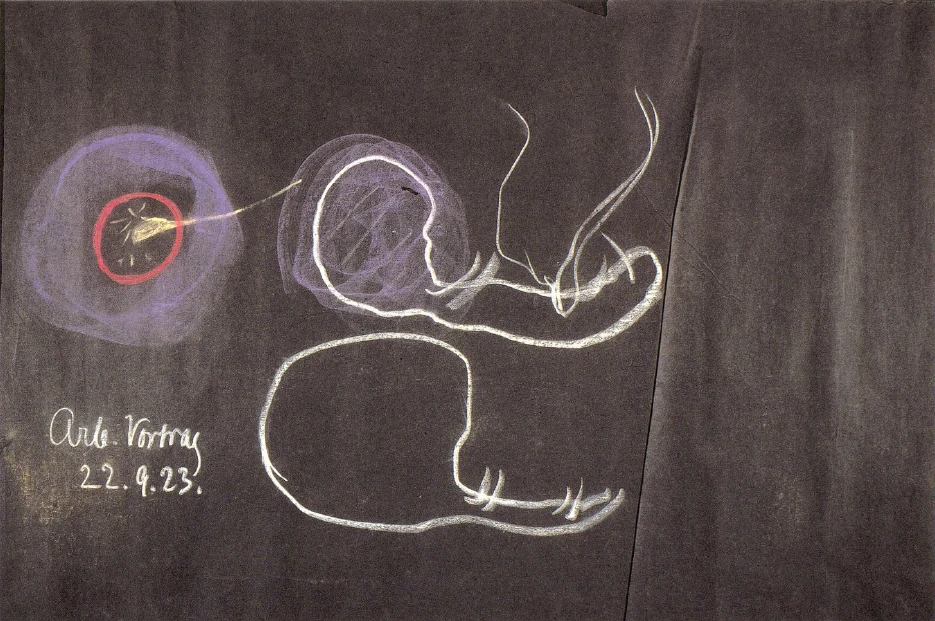
[ 29 ] We can say: A human being arises from the female egg cell. This is depicted on a very large scale. The male sperm penetrates it. Then all kinds of star-shaped figures form inside. Cells divide and gradually form the human body. But no human body can be formed unless the spiritual-soul aspect, which comes from the spiritual world, is connected to what is happening there.
[ 30 ] If, then, the mother or father has consumed too many potatoes, they will form a human embryo that is predisposed to having to use its mind a great deal. So if you look at a human embryo from someone who has been properly nourished with rye bread and so on—where the father and mother have a proper diet—that human embryo looks something like this (a drawing is made). But if you look at a human embryo where the parents ate too many potatoes, well, the following happens. You see, the other part is very underdeveloped in the human embryo; the round sphere of the head is the most developed part; that is the main feature in the embryo, so it is the most developed. Now the spiritual-soul aspect must enter the head. And when the spiritual-soul aspect enters the head, it must work with the head. Even while still in the mother’s womb, the human spirit and soul work primarily on the head.
[ 31 ] When this spiritual-soul aspect in the head finds what comes from the mother’s diet of rye and wheat, then the spiritual-soul aspect can function properly. For the flowers—in which, after all, rye, wheat, and so on develop—are also drawn up from the earth, and the spiritual element is already present in the plant; there, the spiritual is related to it. Therefore, when the spiritual-soul aspect in the womb encounters what comes from fruits, it can work easily. But if the spiritual encounters a child’s head in the womb that is formed primarily through potato-based nutrition, it cannot approach it. After all, the potato goes down into the earth; it is even covered by the earth; one digs it out of the earth; it grows in darkness; it has no connection to the spiritual. The human being descends from the spiritual world and finds a head that is actually formed out of darkness. The spirit cannot reach it, and the result is that the embryo later looks like this (it is drawn)—I’m drawing it somewhat caricatured—: a giant hydrocephalic head is born. For if the spirit cannot reach it, then the physical grows; the hydrocephalus develops. If the spirit can reach it, then it moderates the water; the spirit works within the matter, and the head develops properly. So you can say: These huge hydrocephalic heads, which are often noticeable in embryos, result from poor nutrition—primarily from potatoes once again. — And so you have a situation where not only is the person themselves emaciated, but the person is born in such a way that their spiritual-soul aspect is not properly integrated into the physical body.
[ 32 ] But you see, gentlemen, the matter is this: Human beings do indeed consist of a physical body, an etheric body, an astral body, and the “I”; however, these are not of the same nature at every stage of life. In a child up to the age of seven, the etheric body, astral body, and I are in such a state that they must first sink back in; they must first enter fully into the physical body. When the etheric body enters fully into the physical body, the second set of teeth comes in. When the astral body enters fully into the physical body, sexual maturity sets in. Therefore, if such a condition exists—that is, if the spiritual-soul aspect cannot properly enter the physical human being in the womb due to a potato-based diet—then what is supposed to happen to the person at the age of fourteen or fifteen is also disrupted. The person then goes through life as if they did not have a body at all, as if it were limp and lifeless. Thus, people under the influence of a potato-based diet are not born strong enough for life to begin with.
[ 33 ] You see, gentlemen, these are matters of immense importance. You need only tell yourselves: Yes, indeed, social conditions depend on many other factors besides those that are commonly touted today. Social conditions also depend on the fields being used properly—that is, on not growing more potatoes than people can consume to sustain themselves. So, if one is to study the social sciences, one must also be able to engage in genuine, proper natural science. That is absolutely necessary. Merely talking about surplus value, capital, and so on is of no use in and of itself. For suppose, for a moment, that communism succeeded in eradicating all capital and took over the administration of everything itself. Well, if it has learned only one thing from the bourgeoisie—a science that does not know how to utilize the fields properly—if it does not know that it is more harmful to fill the stomach with potatoes than with rye and wheat, then none of this will help. That is what we must bear in mind. So we do not need the endless talk about this or that, but a true science that understands how the spirit can act upon matter.
[ 34 ] You see, that is why anthroposophy, so to speak, must constantly wage a war on two fronts without even wanting to. Why? Well, there are today’s scientists, who concern themselves only with matter—but only with the percentages of matter, such as how much carbon, oxygen, nitrogen, and hydrogen are contained in protein, and so on. But that teaches us absolutely nothing about matter. Material science does not actually know matter, because one only comes to know matter when one understands how the spirit works within it. Does it help, for example, when someone says: “I want to understand a watch; well, I’ll try to figure out how the watch works.” “The watch is made of silver. The silver in my watch was mined in such-and-such a silver mine. This silver was then transported by train to such-and-such a city. There it was delivered to such-and-such merchants, and so on. Furthermore, this watch has a porcelain dial. The porcelain was produced in such-and-such a place, brought to such-and-such a city, and so on.” — He doesn’t know anything about the watch at all! You only know something about the watch once you know what the watchmaker did to it. And it isn’t even important, in order to understand why a watch runs, to know how the silver is mined; but what is important is to know how the watch runs, how the watchmaker worked on it, adjusted the gears, and so on.
[ 35 ] So, strictly speaking, it is actually of the utmost indifference to human health and illness to know, in the abstract, how much carbon, oxygen, nitrogen, hydrogen, protein, fat, carbohydrates, and salts food consists of; rather, for human health and illness, it is fundamentally important to know specifically what the situation is with the potato: it nourishes people spiritually just as little as it nourishes them physically. Basically, what has been written about this is completely unnecessary; one must know the other purposes. For those other purposes, one can certainly know about silver mines and so on, but this science is unimportant for understanding human health and illness. Yet it does not even realize what it is lacking. So when anthroposophy comes along and seeks to add what is missing, it is opposed. And thus one front of opposition emerged, aligned with materialism. There it is said: “Well, this anthroposophy wants to explain everything in fantastical terms.” — Science accuses anthroposophy of being too “spiritual.” That is one front.
[ 36 ] The other front, gentlemen, comes from theology, from the representatives of religion, and so on. On that side, people talk a lot about how the soul goes to heaven. And they certainly talk about how one goes to heaven through prayer, the sacraments, and so on. All right. But if someone is so deeply entrenched in the physical world that they don’t even have a proper grasp of their own body—that is, if they don’t establish the right relationship to earthly life in the physical world—then they will find it extremely difficult to find their bearings after death. People don’t tell them that. It is absolutely necessary to become a practical person in life and to know how to deal with the material world. So that one can say: Yes, religion and theology talk to people about all sorts of things today, but none of that is enough to truly make a person strong enough in earthly life so that they can later find their way—through such preparation, for instance, since all that uninformed prayer, for example, actually distracts a person from what they need to know for a healthy life. You will hardly ever have heard it proclaimed from the pulpit how one must conduct oneself so that a person becomes strong—whether through a diet of potatoes or wheat! At the very least, you will not have found that most pastors and priests place great importance on proclaiming to people from the pulpit how rye and wheat affect their health. They regard this as a trivial matter, because they say: “That is something unholy!” Only prayer or speaking about the Gospel and similar things is holy. — But the divine working is not only present where prayers have been said or where the Gospel is discussed, but throughout all of nature; the spiritual is at work there as well. If a person does not allow the spiritual to enter his mind because he overburdens it with potatoes, then it is true that he can pray. Very well. But if he eats too many potatoes, his prayer serves no purpose anymore, for he is once again distracted from the spiritual. But people don’t realize this either. Nor do they realize that God did not find the earth as a lump of matter and then fashion things from it, but that, in fact, divine activity is present everywhere, down to the smallest detail, and must be sought out. But if you do that, theologians and religious people call you a materialist! And so one is called a fanciful spiritualist by those who are scientists; by those who are theologians, one is called a materialist. This very situation already shows just how valuable these things are. Just as valuable as they were in 1908, when anthroposophy was attacked with the claim: “Anthroposophy is Jesuitical.” — Back then, it was claimed that the anthroposophists were actually being led into Jesuitism by their leaders. In the meantime, the tables have turned. Today, the Jesuits say that the anthroposophists are being led into Freemasonry. You see, that’s how it always happens! But that’s not the point; the point is that we are truly gaining a science that can just as well explain why hydrocephalus develops in the womb instead of a properly formed head.
[ 37 ] Well, gentlemen, you might say: Surely not everyone walks around with a water on the brain. — Certainly not, because, of course, other forces counteract this, and by the time the baby is born, the head is no longer as large as it was in the embryo; but once born, it is no longer capable of absorbing anything other than potatoes and water. It can even shrink in the process and still be a water head. But the essential point is that, since the introduction of a potato-based diet, the heads in the womb have always been much too large. Later they are compressed, but it is precisely this compression before birth that has a damaging effect on them, because they are then unable to absorb what is right, but only and exclusively the materialistic. In a born human being, hydrocephalus is no longer evident merely from the size. Certainly, actual hydrocephalus depends on size, but the primary issue is whether water is acting in the right way or whether something else can act instead. And this is just as important to know as everything else that comes to humanity—on the one hand through science, and on the other through theology and religion. But it is indeed necessary to look closely at the matter.
[ 38 ] Look, how is anthroposophy actually treated? Some time ago, a sort of congress was held in Berlin by people who call themselves “non-anthroposophical experts on anthroposophy.” They claim they are not anthroposophists, but that they are familiar with anthroposophy. Well, one person in particular spoke there—a man who was once here but has fallen away—a certain Dr. Gösch. This Dr. Gösch spoke before pastors, licentiates, and professors. And now, don’t you see, people everywhere are giving lectures against anthroposophy based on what this Dr. Gösch told them. You will now say: These people—licentiates and professors—have simply come to the conviction, based on what Dr. Gösch told them, that anthroposophy is very harmful. — But please, gentlemen, consider the following: What is generally in the minds of today’s pastors, professors, and licentiates, and then listen to what Dr. Gösch told people. He said: “Anthroposophy is particularly harmful because the anthroposophists are being deceived — because Dr. Steiner and her husband actually intend to split off a piece of the Earth, separate it from the Earth, and form their own planet, and thus establish such a planetary colony in the cosmos together with all the anthroposophists! — That is what this Dr. Gösch told these enlightened people! Now you can imagine that none of them really believes that, but he acts as if this speech had convinced him of the harmfulness of anthroposophy.
[ 39 ] Now just think what sheer madness lies in all this! But these same enlightened people—they’re not just sitting in this assembly; the next day or the day after, they’re sitting in all sorts of other assemblies where decisions are made about all manner of destinies. Of course, they’re no wiser there than they are in the other assemblies. One must consider what kind of people are actually governing the world today! So be clear about this: opposition to anthroposophy is truly opposition to the truth. They do not want to let it come to light what these matters actually entail, what all kinds of truths about human beings are revealed. People say: “Anthroposophy is something mysterious.” — Yes, gentlemen, how could it be anything other than mysterious? Of course it is mysterious, but it is no more mysterious than something is mysterious when someone has stolen something from you and hidden it; until you find it, it remains a mystery. In the same way, anthroposophy is mysterious because science and the rest of spiritual life have hidden these things; that is why, naturally, anthroposophy is such a mysterious thing today. But it ceases to be mysterious the moment you have found it! It does not want to be secretive at all, but rather it wants to bring to light precisely what others have hidden.
[ 40 ] I have to go to Vienna now, and I'll let you know when we can continue.