

Rhythms in the Cosmos and in the Human Being
GA 350
10 September 1923, Dornach
Translated by Steiner Online Library
15. Druidic Wisdom — The Cult of Mithras — Catholic Worship — Freemasonry — The Christian Community
[ 1 ] Gentlemen, during this long period when we were unable to hold lectures, have you perhaps come up with any specific questions you would like to discuss?
[ 2 ] Questioner: I would like to ask whether today’s religion, with its practices, still has any connection to the spiritual world, and how the various religions of different peoples relate to one another?
[ 3 ] Dr. Steiner: Yes, gentlemen, it is interesting to consider what actually gives rise to a cult and what a cult seeks.
[ 4 ] On this occasion, perhaps I may take a moment to share something with you that is currently relevant to us, as it ties in with the recent trip to England that I have just returned from. The course in Penmaenmawr was, after all, ideally suited to be held near an ancient place of worship—namely, on the west coast of England, in Wales, where there is an island off the coast called Anglesey, and where ancient places of worship can still be found all over the surrounding mountains. They have fallen into disrepair, and today they can only be seen—I would say—in ruins; yet if one is familiar with anthroposophy, one can certainly discern what they actually signified in that very place.
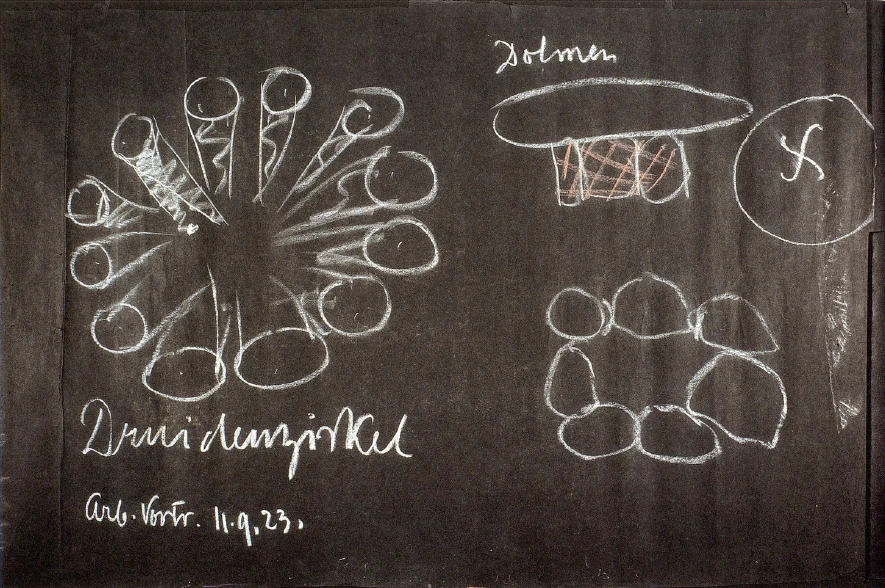
[ 5 ] You see, it would be just like going out here to these mountains and finding such places of worship up there. You find them, so to speak, all over the mountains—mainly where the mountain has a sort of plateau at the top, where there’s a hollow or a plain that’s slightly more sunken than the rest. That’s where these ancient ritual sites used to stand. Today they’re just a pile of rubble, but you can still see quite clearly what they looked like. The smaller ones consist of stones that were probably once carried to that spot by the ice, but were also dragged to the exact location where they were to be used. These stones were arranged to form a sort of square, placed side by side like this (see the following drawing). When I look at it from the side, it looks like this: There’s a capstone that covers the whole thing up there. Those are the small ones. The large ritual sites, on the other hand, consist of stones of a similar type (drawing below), arranged in a circle all around—exactly twelve of them. This is a cult that was likely practiced there during its heyday three to four millennia before our time, at a time when the population there was sparse—a very thin population—and at a time, moreover, when there was hardly anything else besides some farming and livestock raising. Among this population, reading and writing were completely unknown during the heyday when this cult was practiced. So reading and writing—no one even imagined that such a thing could exist!
[ 6 ] Now one might ask what this cult actually meant. Let me be very clear: Reading and writing did not exist back then. — Now, as you know, if one wants to grow crops—for example—in the most favorable way, so that they grow and thrive properly, one must sow them at different times and tend to them in various ways at different times. And with livestock, one must also take different times into account for breeding and so on. This depends on the relationship between the Earth and the entire cosmic environment, which I have often told you about. Well, today people have their farmers’ almanacs; they look them up, they know what day of the year it is, and people then forget that this does not depend on human whim. You can’t set the days however you want; rather, you have to set them according to the movement of the stars, the position of the moon, and so on. Well, today, calendar makers calculate this based on ancient traditions. There are calculations that allow one to determine when this or that day falls. These calculations are based on the fact that people once determined these dates according to the position of the sun. One could still determine them by the sun’s position today, but people who generally go by such things do not rely on the position of the sun or the stars, but simply on what is calculated—on the calendar. Well, that was unthinkable back then, because reading and writing didn’t exist at all. Such things didn’t come about until later. So that takes us back, as I said, three to four thousand years before the present day. And the history of reading and writing in these regions goes back barely more than two to three thousand years. These are very ancient conditions, and the reading and writing that existed back then was, of course, nothing compared to today’s standards—it’s hardly something one can really speak of in any meaningful way. In any case, the majority of the population was unfamiliar with it.
[ 7 ] When you look at a circle like this high up on the mountain, you might think: The sun seems to move—we know, of course, that it stands still, but isn’t it true that we can talk about it this way, since that’s how things appear anyway?—so the sun moves in a circle through space. As a result, it always casts a different shadow from these stones, and you can follow that shadow throughout the day. You could say: When the sun rises in the morning, the shadow is here; now it moves a little further, so the shadow is there, and so on. — But the shadow also changes over the course of a year, because the sun rises at a different point each time. That’s why the shadow changes. It looked like this in March, and a little later it looked like that. And the wisdom of the scholar or priest—call him what you will—the druid priest who was stationed there at that time to observe these things, lay in his ability to interpret this shadow, so that he could know: If the shadow falls, say, on this spot here, then this or that must be done in the fields in the spring. — He could tell the people that. He could tell by the position of the sun. Or if the shadow fell, say, on this spot, then the bull had to be led around, the animals had to be mated, because that had to happen on a specific day of the year. So the priest read from these signs what had to happen throughout the year.
[ 8 ] As a result, however, life as a whole was actually determined by the passage of the sun. Today, as I told you, people don’t even realize that they do this themselves, because they find this information in the calendar. But back then, one had to go to the sources oneself; one had to, so to speak, glean this information from the universe itself.
[ 9 ] At a very specific time—let’s say, for example, in the fall—it was precisely determined what was to be done with the fields; based on the information provided by these people, the so-called Bull Festival was also set for a specific time of year. The bull was then paraded around; otherwise, it was kept away from the livestock and so on. The ancient festivals were also organized according to these customs, which are certainly connected to such practices. — Today, such an arrangement is called a druid circle. This one here (referring to the drawing) is a dolmen or kromlech. What is peculiar about it is that the stones are arranged and covered on top in such a way that there is shade inside.
[ 10 ] Well, you see, gentlemen, people know roughly that sunlight is sometimes stronger and sometimes weaker because they can feel it in the way they sweat or shiver. But what people don’t know is that shadows vary just as much as light does. Depending on how the light varies, the shadow varies as well. But people today have lost the habit of discerning the variations in shadows. The ancients, however, first acquired the ability to discern the differences in shadows. And within the shadow, one sees the spiritual. The sun’s rays have not only a physical aspect but also a spiritual one. And within that, the Druid priest observed the spirituality of the sun’s rays, which in turn determined whether it was better to cultivate this or that plant in a particular country, for that depends on the spirituality carried down from the sun to the earth. Furthermore, the effects of the moon could be observed exceptionally well within this shadow. The effects of the moon, for example, have a major influence specifically on the mating of livestock, and this was used to determine the mating season. Thus, the entire year was actually divided according to these solar observations.
[ 11 ] If one were to dig beneath such a cromlech, one would also find that it served, incidentally, as a burial site. These structures were erected specifically in places where people were also buried. This, in turn, signifies that even though a person has left their body, that body has a different composition than anything else. The soul, the spirit, has dwelt in the body throughout one’s entire lifetime. When the body disintegrates, it possesses forces different from those found in the rest of the mountainous region. And it was precisely these forces, as they flowed upward, that enabled one to see clearly even in the shade. These people were simply familiar with forces of nature quite different from those known later on.
[ 12 ] And when you come across certain hilltop sites—which, by the way, are more widespread across the country; I saw this in Ilkley, where the first course took place during the trip to England—where you see individual stones high up, but in such a way that the location is well chosen—from such heights one could look out over the entire countryside—then you find such symbols, swastikas, swastikas—with which so much mischief is being caused in Germany today. This swastika is worn by people who no longer have any idea that it was once a symbol intended to indicate to those coming from afar: There are people who understand these things; they see not only with their physical eyes but also with their spiritual eyes—I have described these spiritual eyes as lotus flowers in my book *How Does One Gain Knowledge of the Higher Worlds?*—and they wanted to draw attention to this: We can see with these lotus flowers.
[ 13 ] Here, then, you see a cultural tradition that essentially consisted of people seeking to bring the spiritual elements from the surrounding world down to Earth to shape their social and living conditions. You can still see this reflected in the surroundings today, which is why this area is so extraordinarily interesting. These were already the last of such places of worship, for they are the ones from which people retreated to the west coast, because people then came from the east who spread writing in ancient times. This earliest form of writing is called runes. The letters were formed by arranging sticks together—quite different from how writing is done today. And it was then that what is now described as Norse mythology first emerged: Wotan, Thor, and so on. That came later, and it arose as a result of the writing system being transplanted there.
[ 14 ] When I speak of the shadow here, there’s no need to be so terribly surprised by it, because the animal can already see something in the shadow. You only need to pay attention to how strangely a horse behaves when it stands somewhere along a street in the evening where it is lit, and it looks at its shadow on a wall. You just have to know this: the animal—the horse—does not see its shadow the way we see it. Our eyes are positioned so that we look straight ahead, whereas a horse’s eyes are positioned so that it looks to the side. This means that it does not see the shadow as such at all, but it perceives the spiritual aspect within the shadow. Of course, people say: “The horse is afraid of its shadow.” — But the truth is that it does not see the shadow at all; rather, it perceives the spiritual aspect within the shadow. And so these primitive people, too, perceived differences in the shadow throughout the year, just as one perceives differences in the heat of the sun and in the cold. This is a cult that was practiced there. And as I describe it to you, you can already see that such cults, which arose in ancient times, were necessary. They existed because they were needed. They replaced everything that could later be read, for at the same time they constituted humanity’s communion with the gods. People prayed less, but they communicated that which then flowed into life—that which has a connection to and meaning for life.
[ 15 ] Now, another cult that you can still find in many places in its remnants, particularly in Central Europe. There you will find such places of worship, and you will find certain depictions. These depictions show a bull, and atop the bull sits a sort of rider wearing a so-called Phrygian cap—a kind of revolutionary cap. This was later adopted from there. And then, at the bottom of the same image, you see a sort of scorpion that is biting right into the bull’s genitals. You also see the figure sitting atop the bull thrusting a sword into the bull’s front. And so, when this is depicted—with the bull (as drawn), the horseman above, the scorpion here, and the thrusting sword—you see the starry sky forming above it all. The starry sky spreads out above. These, in turn, are the so-called Mithraic cults. The first, then, are the Druidic cults; and what I am now describing are the Mithraic cults. While the Druidic cults are found on the western coasts—we do find them in other regions as well, but I was just telling you about the area where I have now been able to investigate them myself—these cults extend from Asia all along the Danube, that is, through what is now southern Russia, Bulgaria, Hungary, Bavaria, the regions of the Odenwald, the Black Forest, and so on. These cults—the Mithraic cults—were once widespread there. And this signified something very specific. For you see, why did people place a bull there in the first place? That is the question we must ask ourselves first.
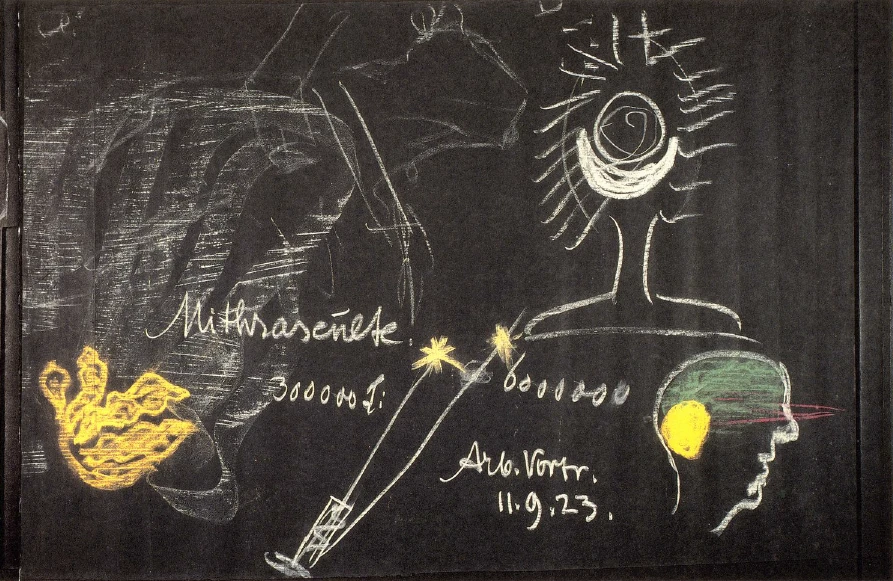
[ 16 ] I told you: In the spring, the sun rises in a specific constellation—actually, in the constellation of Pisces. — Astronomers still point to the constellation of Aries. But that is wrong; in reality, it is the constellation of Pisces. For a long time—two thousand years—the sun rose in the constellation of Aries; even earlier, it rose in the constellation of Taurus. And people used to say: The sun always rises in the constellation of Taurus in the spring, when growth begins. — And they correctly associated what lives within the human body—not in the head, but in the rest of the body, specifically that which is connected to growth—with the fact that the sun’s rays change and that the constellation of Taurus lies behind them. And that is why they said: If we want to depict the animalistic human, we must draw the bull, and the actual human, who is ruled by his head, sits atop it. — So that the bull represents the lower, animalistic human, and the one sitting up there wearing the Phrygian cap represents the higher human. But the whole thing is actually just one human being: the lower human and the higher human.
[ 17 ] And now people said to themselves: Oh, how terrible it is when the lower human being is in control, when a person gives in completely to their animal instincts, when a person follows only their passions that arise from the gut, from sexuality, and so on! The higher human being must rule over the lower human being. — That is why they expressed it this way: The one riding there holds the sword and thrusts it into the lower man’s groin. — That is to say, the lower man must be made small in comparison to the higher man. Furthermore, there is the scorpion, which bites into the genitals to show: If the lower self is not made small by the higher self, if it is not mastered, then the lower self also harms itself, as the forces of nature overwhelm it and destroy it. — So this entire human destiny, the interplay between the lower and higher self, was expressed in this image.
[ 18 ] Above it was the starry sky. It is very significant that the starry sky stretched out there. In spring, the sun rises at a specific point; at that time, it rose in the constellation of Taurus. But it moves forward a little bit every day. This advance occurs in two ways. First, the vernal equinox advances. Next spring, the sun rises a little farther away from the point where it rose the previous year, so that three thousand years ago the sun rose in Aries, and even earlier in Taurus. Today, it rises in Pisces in the spring. As a result, it gradually completes a full cycle. Over the course of 25,920 years, the sun completes a full cycle. But it also moves through the zodiac every year, so that the sun does not rise at the vernal equinox the very next day—it rises there only on March 21—but the next day it rises slightly shifted from that point, and so on. Throughout the entire year, it also moves through the zodiac, passing through all the zodiac signs.
[ 19 ] Now, those who were to serve the cult of Mithras had to observe when the lower human being—the animalistic human—is more difficult to control: when the sun is in the constellation of Taurus, that is, when it particularly stimulates the forces of growth. However, when the sun rises, say, in the constellation of Virgo—that is, in October, closer to December at that time—the lower human being did not exert such a strong influence, so the need to exercise control was not as great. The general population had no sense of these things, but those who observed the Mithraic cult had to know them. And so those who served this Mithraic cult could say: “Now it is difficult to control the lower human; now it is spring; now it is easier—now is a specific time in winter.” — And so, in the Mithras cult, human beings themselves were used to learn about the seasons once again, as well as the entire course of the sun and moon through the constellations. Among the Druids, the external signs—the shadows—were used more; here, in the Mithras cult, the effect on human beings was used more. And so this Mithras cult, too, was thoroughly connected with life.
[ 20 ] There were, in fact, a wide variety of cults. Of course, one must be clear about this: if one wants to observe such things as were observed among the Druids, one needs very specific regions of the earth. — You can still see that today. If you live there in Wales—the course lasted fourteen days there—you constantly experience rapid shifts between, I would say, brief downpours and sunshine. This changes by the hour, so that the air is quite different from what it is here; it is increasingly saturated with moisture. When you have an atmosphere like the one there, where the Druids were, then you can make such observations. In the regions where the cult of Mithras spread, such observations would not have been possible because the climate was different. There, the observations had to be drawn more from within the human being. People there were more sensitive to such things. And so, depending on the different regions, the cults were simply different. This cult of Mithras was widespread in the Danube regions, in Bavaria, and all the way up here into Switzerland—though perhaps less so here, although it was certainly present in earlier times as well. Well, this cult of Mithras remained widespread long after Christianity had already taken hold in these regions. The last remnants were still to be found even during the time when Christianity was spreading, particularly in the Danube regions, for example. There, one can still find these images today, preserved inside caves and rock caverns. For these observances and cults were practiced inside rock caverns. There, one did not need the light of the sun from outside, but rather the peace and quiet inside the rock cave. The spiritual influences of the sun and the stars also penetrate there.
[ 21 ] Now that I have mentioned these two cults, you can surely grasp the essence of cults in general. There were a wide variety of cults. Black people still have their cults today; these are simpler and more primitive, but they also demonstrate in a straightforward way how people sought to understand the spiritual environment of the universe. Then, at a certain point in time—this period, in turn, dates back about one and a half to two millennia—something emerged, as it were, from the wide variety of cults, particularly those in Asia and Africa; these cults had, in a sense, fused together. They took one element from this cult, another from that cult, and from the fusion of the most diverse cults—namely the Egyptian and Persian cults—the cult emerged that you know today as the Catholic cult. It is a fusion of all these elements. You can see how it has been fused together if, for example, you look at the altar. You don’t have to look very far; even today you can see that the altar resembles a tombstone. Even though there is no corpse beneath it, its form is still similar to that of a tombstone. Just as people in ancient times knew that forces emanate from the corpse, this was preserved in its form.
[ 22 ] What is remarkable about Catholic churches is that they allude to the relationship with the sun and the moon. You are surely familiar from Catholic churches with what is placed on the altar on particularly festive occasions (drawing $ 282): the monstrance, the so-called Santissimum. Yes, gentlemen, this is nothing other than a sun, and at the center of the sun is the Host, conceived as the sun, and down here is the moon, a sign that this cult dates back to a time when people wanted to observe the sun and the moon directly, just as I have shown you in the case of the Druidic cult. Only people have forgotten this. As scripture and everything associated with it spread, they no longer looked to the great natural world. Instead, they looked into a book—and after all, the Gospel is also just a book. But the memory is still preserved in the symbol of the sun and moon, which stands in the Sanctissimum, in the monstrance on the altar.
[ 23 ] And so, through every single detail—especially in the Catholic liturgy—one can demonstrate how it traces back to the ancient cults, which still maintained a connection to the vast universe. This, of course, has been completely forgotten. The fact is that in the first three or four centuries A.D., people everywhere still knew a great deal about this true meaning of worship, for it was then that the current form of worship took shape and spread from Rome, having been compiled from a wide variety of individual cults. But in this region, for example—and particularly in the Danube countries—the cult of Mithras was still known. It was evident that this cult had a connection to the universe. Therefore, in a very systematic manner during the first centuries, whatever remained of the ancient cults was eradicated, and only those cults remained that no longer revealed their relationship to the universe. And so, isn’t it true, people today look at Catholic worship, and great importance is placed on the fact that one does not—precisely does not—understand it, that one does not realize that it once referred to the sun and the moon. For in ancient times, religion and science were one, and art was part of that.
[ 24 ] Of course, there came a time when people said to themselves: “Well, what’s the point of all this? It’s all for nothing! The holidays, the times when this or that is supposed to happen—you can just read about them in the calendar!” “That’s all for nothing,” people said. And then came the iconoclasm, the destruction of images; then came Protestantism, the evangelical principle that turned against the cult. One now understands why, on the one hand, the entire people once stood up for the cult and later turned against it, when one reflects on this course of events. In the era I told you about, when the Druidic cult reigned—yes, gentlemen, the kind of enthusiasm that is sometimes stirred up today, say, for this or that movement, is nothing compared to the great enthusiasm that prevailed among the people for their Druidic cult back then! They would all have let themselves be stoned and beheaded for this Druidic cult. But why? Because they knew: One cannot live at all without properly knowing exactly what is happening in the universe; one cannot celebrate the Festival of the Bull at the right time; one cannot sow one’s wheat and rye at the right time.
[ 25 ] Later, this was simply glossed over, and as a result, people said: “Yes, surely a thing must have a purpose in life!” — and set out to oppose it. The fact that humanity behaves so differently toward these things at different times can only be understood from the fact that such events have taken place, that the matter has been completely forgotten, and that today one can only see what actually happened in these so-called symbols. Where symbols exist, only the faintest understanding remains, for the simple reason that where reality exists, symbols are unnecessary. When one sets up an altar, as the Druids did, to actually observe the sun, one does not place an image of the sun there!
[ 26 ] Yes, that is what has led, for example, to certain religions—other than Catholicism—surviving to this day with great rigidity.
[ 27 ] You see, this Druidic cult was purely a cult of agriculture and livestock farming at its peak, because life consisted of farming and raising livestock. Later, in regions where farming and livestock raising had previously been the sole occupations—where this cult was therefore particularly justified—what eventually became more of a craft began to emerge. When the Druidic cult was at its peak, everything revolved around farming and livestock raising, and people clothed themselves in animal skins and so on. As for crafts—there were no machines—it was naturally still the case that what one person made depended on the others. When he had time, he would make for himself whatever he needed to wear or use, for example, a knife from a hard stone that he worked on, and so on. The seasons for farming and livestock raising were important; he wanted to learn from his gods when he should take the necessary measures. But then craftsmanship became more important. Now, gentlemen, craftsmanship, of course, has no such close connection to the starry sky as farming and livestock raising do. On the other hand, however, the customs had remained, and so a kind of cult was established for craftsmanship as well, one that was again derived from those ancient cults that had a connection to the heavens. And one of the cults that has remained the most rigid is Freemasonry. Yet it consists entirely of symbols. In reality, people no longer even know what these symbols refer to. Especially once people began constructing architectural works, they applied the practices they were accustomed to in this cult to the building of works of art. And in architecture, if one wishes to proceed with great precision, it does indeed make a certain amount of sense. If one truly wants to build, one models the architectural forms on what the stars express and so on. And that is how the Masonic cult developed. But when the Masonic cult took shape, people simply no longer knew what the individual symbols meant. And so today the Masonic cult consists entirely of symbols, and people have no idea what the symbols refer to; they spout the most confused nonsense about these things. One could certainly say: The more widespread the cults have become, the less people understand about them. — And so, of the cults that are most widespread today, understanding has actually been lost the most everywhere.
[ 28 ] But isn’t it true that those old people needed religion for their lives in the outer world? If one wants to have a cult again today—and we are, after all, in the process of renewing Christianity; in Germany there are already individual churches under the leadership of Dr. Rittelmeyer—yes, if one sets out to establish a cult today, it must have a somewhat different meaning than the ancient cults. For the ancient cults were effective, and today we simply know—based on calculation—when a day falls, when March 21 is, and so on, from ordinary astronomy. The ancients could not do that. In ancient times, they had to point to this shadow, as I have described to you. But today something else is necessary. Today, what is necessary is for people to be able to come to understand, at all, something of what exists in the spiritual universe. No astronomy, nothing tells people today anything about what is happening in the universe!
[ 29 ] This is where people fall into the greatest errors. For example, they point telescopes out into the starry sky. Now they see a star in a certain direction. Well, gentlemen, I turn the telescope, and there I see another star in a different direction. And on the other hand, it is calculated that the stars are so far away that they can no longer be seen clearly at all, but are measured only in light-years, based on how quickly the light beam travels. One calculates how far the light beam travels in one year. That is a distance that is even harder to express in numbers than paying for a midday meal in Germany today using German currency. That’s hard enough to express! But to express how fast a beam of light moves—what a vast distance it travels in a year—that number runs into enormous billions. That’s why we don’t actually talk about it in those terms; instead, we simply say: A star is so far away that its light would take so many light-years to reach us. Yes, gentlemen, now I point my telescope in that direction, look through it, and see the star. Let’s say it takes 300,000 light-years for that light to reach us; that’s how long it takes. The other star, however, may be much farther away; it might take 600,000 light-years. Then I look in that direction, but I don’t see the star’s current appearance at all—only a past one. And when I look there, what I see isn’t actually what’s there right now. The star appears to me nonetheless, but I see only what it used to be, because the light took 300,000 years to reach us. So I’m seeing an object that isn’t actually there at all—it took 300,000 years for it to become visible to me!
[ 30 ] So you see, when you look around through a telescope, you don’t actually see the true form of the starry sky! That’s one thing. The other is this: People believe that wherever they see stars, there is something there. But the truth is this: there is nothing there; precisely where you see stars, that is where the ether ends! This does not apply to the sun and the moon—it applies somewhat to the sun, not at all to the moon—but it does apply to the stars: there is absolutely nothing there! There is a hole in the universe. It is remarkable how anthroposophy and real science actually converge in this regard. When we founded our institutes in Stuttgart, I said: One of our first tasks is to prove that where there is a star, there is absolutely nothing—that nothingness shines there. Because there is something all around it, one sees a kind of light where there is nothing. — Well, isn’t it true that we are actually poor people with our research institutes, and the Americans are rich? Since that time, news has come from America that even conventional science has already concluded that there is actually nothing where stars are.
[ 31 ] Anthroposophy, in particular, works with the most advanced science. It’s just that through anthroposophy, one can judge things better. Isn’t that right? I’m telling you these things because I want you to see that, in fact, people today know next to nothing about the universe. They misjudge everything in the universe. And where does that come from?
[ 32 ] You see, gentlemen, this stems from a very specific $ache. Just imagine: There is a human head, and there is the brain. When a person perceives something external—for example, through the eye—he perceives that external thing and needs the brain to do so, in order to have that perception. But inside the brain there is a small brain, right at the back (see drawing). It is structured quite differently from the large brain. This small brain has a very peculiar structure. If you cut it open, it looks as if it were composed of layers. So it sits back there inside.
[ 33 ] This small brain does not perceive anything from the outside. The large brain—which I have colored green in this drawing—is what we need to take in external, earthly impressions. The small brain does not perceive anything from the outside. But when a person delves inward—when they proceed as I have described in my books—then this small brain begins to be particularly active, and one senses inwardly how this small brain seems to grow larger and larger, as if it were actually growing. It grows in this way, and one feels as if one were gradually standing beneath a tree. That is why the people of the East depict the Buddha under the Bodhi tree. He still recognized this cerebellum as an organ of perception. This is being rediscovered today. This cerebellum begins to become active when one delves inwardly into one’s humanity. But then one does not perceive the external, material world, but rather the spiritual. There, one begins to perceive the spiritual once more with the cerebellum, and within the spiritual, to perceive laws and so on. These must be incorporated into a form of worship today. It is precisely the innermost part of the human being that must be incorporated into a form of worship today, because it is through this innermost part—in the small brain, separate from the large brain—that the human being has the path and the organ that lead out into the spiritual world.
[ 34 ] So today, at best, we can only start from the beginning again—figuring out how to build a cult from within the human being. Then this cult will contain inner truths. Just as the Druidic cult provided the knowledge of when to crown the bull, when to hold the bull festival, and when to lead the bull through the community so that procreation might be regulated in the proper way, so will we know—precisely when we establish a cult in this manner, one that develops the spiritual perception sustained by the cerebellum— what one must do in social human life. Before that, one will only speculate, will only come up with all sorts of ideas, will do it the way they do in Russia. When one admits that one must first know in a spiritual way what is to happen within humanity—because it flows from the universe—only then will one have a true social science, which in turn will be willed by the cosmic environment.
[ 35 ] That is how one must learn to think. And as soon as one sees something like the scattered, shattered rocks lying around today—so that one can only tell from the traces what once was—as on the island of Anglesey or in the other coastal towns there, in Penmaenmawr, where the course was held—yes, when one encounters such things, then one sees: Much has been lost in humanity that is, however, necessary, and today we need new insights, especially in the spiritual realm. We must work with these new insights.
[ 36 ] That is what I wanted to say in response to your question. I believe you can see from this how a cult was just as necessary as a knife needed for survival, and how the futility of the cult later led precisely to its eradication and then to its continuation without anyone really understanding it anymore.
[ 37 ] I’ll let you know next week when I’ll be able to hold the next class—I have to go back to Stuttgart again these days, but I’ll be back in the next few days.