

Rhythms in the Cosmos and in the Human Being
GA 350
28 July 1923, Dornach
Translated by Steiner Online Library
14. Lung Knowing and Kidney Knowing
[ 1 ] Good morning, gentlemen! Well, have any more questions come to mind? — If not, then I would like to present something else to you that follows on from what I said earlier, so that you can see how, from all sides, so to speak, one can find evidence that the human physical organism—that is, the human physical body—is permeated by the soul. Today let us consider the circulation of blood in the human being from a certain point of view. As you know, the human body is traversed by the blood that flows through the veins. The blood flows from the lungs—where there are blood vessels and where it takes up oxygen during respiration—to the heart; from the heart to the rest of the body, it remains red the entire time; as it passes through the body, it takes on a bluish tint; it then returns to the heart and the lungs as blue blood, is turned red again by the oxygen, and thus the blood circulates, so to speak, throughout the entire body.
[ 2 ] Let’s stick to the idea that blood circulates through the body, flowing through it. Let’s now visualize a very simple circulation of a liquid. Imagine we have a round tube (drawing on p. 252). To make this as clear as possible, let’s fill this round tube with a red liquid. Of course, if we have such an external tube, then—if we want to set this liquid in motion—we must have some kind of pump somewhere. So let’s imagine we have some kind of pump here (arrow) that sets this red liquid in motion. If I leave the top open, the liquid will naturally squirt out. But I don’t want that to happen, so I’ll attach a tube to the top. And now I’ll set this liquid in motion so that it swirls around and keeps circulating continuously. You can picture that, right? — The liquid is being circulated. Now imagine: If the liquid is being circulated here by a pump, then some liquid will rise up at this point (at the top). But when we circulate it, it’s only a little bit. If I apply a strong force to the pump, the liquid here will rise a little higher; if I apply only a weak force, it will rise less. So I can measure the pressure within this swirling liquid based on the height of the liquid.
[ 3 ] You see, I can do something similar with human blood. If I insert a small tube like this into a vein somewhere, the blood flows up a short distance. So I can insert a tube into any vein—but not into all of them. Imagine I have an artery—say, in my arm—into which I insert this ampoule-like tube; the blood flows a short distance from the artery into the tube, passes through it, and flows into it. This tube is such that, depending on the person, the blood level inside it is either higher or lower. There are people in whom the blood level in the tube rises very high, while in others it rises less high. It follows, then, that people have different blood pressures, for this is the pressure being exerted, as shown by the level in the tube. So isn’t it true that when the blood presses a little harder against the arteries, the blood level in the tube rises higher, and when it presses more weakly, it rises less high?
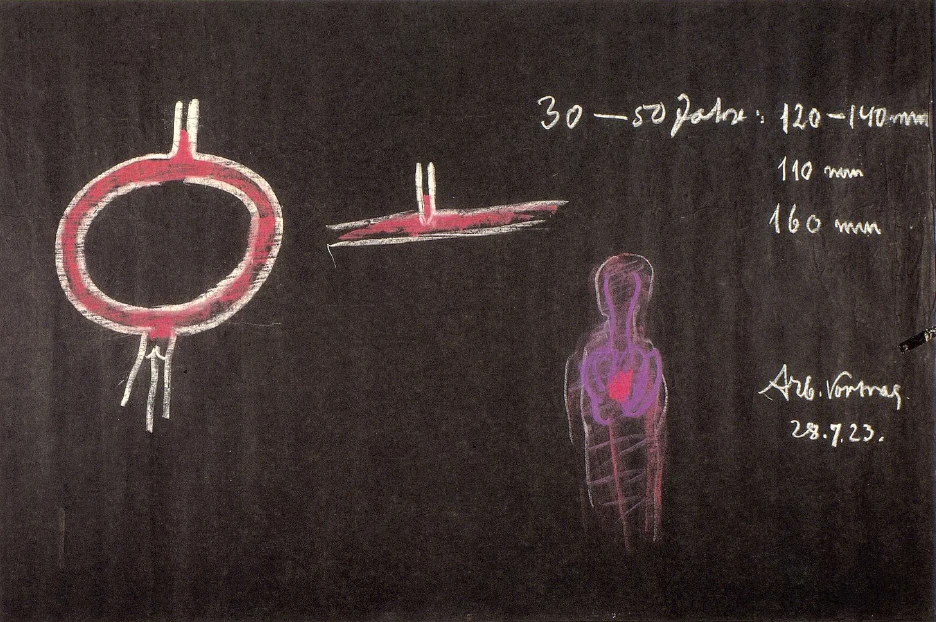
[ 4 ] Materialists now imagine that humans also need such a pump to circulate the blood. But what I have drawn for you is, after all, only an external device. In reality, humans do not have such a pump anywhere in their bodies, and the heart is not a pump either. Humans do not have a pump; rather, the blood moves through something entirely different. Let’s make that clear to ourselves today. But first, let’s make it clear that this column of blood, through which we measure blood pressure, varies in height. In a healthy person, it always has a certain height; let’s say, for the sake of argument, that in a healthy person between the ages of thirty and fifty, this fluid is approximately 120 to 140 mm high. If this column of fluid, when measured by such an instrument—which we can call a manometer—is, for example, only 110 mm high, then the person is ill. If it were 160 mm, the person would also be ill. If it is 160 mm, their blood pressure is too high; the blood is exerting too much pressure inside their body. If it is only 110 mm, their blood pressure is too low; the blood is exerting too little pressure. So you can see from this that we always need a certain level of blood pressure in our bodies. The blood must exert a certain amount of pressure. So we are completely filled with our blood pressure. If we climb a fairly high mountain, the air outside becomes thinner, and because the outside air becomes thinner, the pressure from within becomes very strong. Then the blood spurts out through our pores. That is altitude sickness. So you see, we have to go about in the world with a very specific blood pressure.
[ 5 ] Let’s first take a look at people who have low blood pressure. People with low blood pressure become extremely weak, tired, and pale, and their digestion suffers greatly. Such people become listless internally and are unable to properly carry out their bodily functions, causing them to gradually decline. So, low blood pressure makes people tired, weak, and sick.
[ 6 ] Now let’s look at people who have high blood pressure. Sometimes very peculiar symptoms occur. You see, if you take something like this—which you insert into the skin—it has to be pointed at the front—and if you apply it and your blood pressure becomes too high, then you can be certain that, little by little, the kidneys of a person with high blood pressure will become dysfunctional. The kidneys’ blood vessels—that is, their arteries, everything inside the kidneys—begin to develop abnormally. They become calcified, they swell, they degenerate, as they say. They no longer have the shape they’re supposed to have. So when you remove the kidneys from people who had high blood pressure after they die, those kidneys look like completely degenerated kidneys.
[ 7 ] Now the question arises: Where does all this come from? — It is precisely this connection between blood pressure and kidney disease that is completely unclear to people with a materialistic way of thinking. We must be clear about this: It is precisely within the pressure we have within us—this blood pressure—that our astral body lives, the one I have told you about as the supersensible body of the human being. It is not at all true that the astral body lives in some substance or material; rather, it lives in a force—in blood pressure—and the astral body is healthy when we have the correct blood pressure, which in middle age is 120 to 140 mm. When we have the correct blood pressure, our astral body enters our physical body upon waking and feels at ease. It can expand in all directions. So if the correct blood pressure is present in the body—approximately 120 mm—then the astral body expands properly within the blood pressure, and upon waking, the astral body can enter all parts of the physical body. And while we are awake, with this so-called normal blood pressure, the entire astral body is spread out everywhere.
[ 8 ] You see, it is the astral body that ensures our organs always have the correct form and shape. Gentlemen, if we were to sleep all the time—that is, if the astral body were always outside the body, as it is during sleep—then our organs would very soon become flabby. We would not have properly functioning organs. We need the astral body to stimulate the etheric body so that our organs remain healthy and always retain their proper form. The astral body must therefore always maintain the proper blood pressure so that it can expand.
[ 9 ] Let’s suppose that in a room a person enters, there were not air but carbon dioxide. When that person entered, they would collapse; they would be unable to breathe. In a body like that, where blood pressure is not normal, the astral body and the “I” cannot live. They have to leave the body again and again when the person falls asleep. Let’s assume the blood pressure is too low. If the blood pressure is too low, then the astral body does not properly enter the physical body upon waking. Then there is little astral activity within it; the person feels something like a constant, mild fainting sensation in their body. So when blood pressure is too low, a person always feels something like a slight faintness, and as a result, they become weak and their organs cannot be properly regenerated, for they must, after all, be regenerated constantly. I have told you: Every seven years, the organs must be regenerated. — For this to happen, the astral body must always be able to function.
[ 10 ] Let's say blood pressure is too high. Yes, if blood pressure is too high, what happens then? You see, I once told you that if the air had a different mixture of oxygen and nitrogen, our lives would be in trouble. The air is 79 percent nitrogen, and the rest is essentially oxygen. So there is little oxygen in the air. If there were more oxygen in the air, we’d be old people by the time we were twenty. We’d age quickly. In the same way, it depends on the astral body whether the physical body ages early or late. When blood pressure is too high, the astral body feels at home inside the physical body. Blood pressure is precisely its element. That’s where it settles in very deeply. And what is the result? The result is that by the age of thirty we already have kidneys that we should actually not have until we’re seventy. Because of the high blood pressure, we’re living too fast. Since the kidneys are such sensitive organs, we develop degenerated kidneys prematurely. The process of aging, after all, consists of the organs becoming increasingly calcified. Now, if blood pressure is too high, the sensitive organs calcify too early, and kidney disease of the kind that occurs with high blood pressure is actually a sign that a person has aged prematurely—that is, that they have already caused these sensitive kidneys to become, even in their youth, what they are supposed to be only in old age.
[ 11 ] Well, you see, gentlemen, this entire explanation I have given you shows that human beings, within their physical bodies, possess something akin to a spiritual aspect—which I call the astral body—that leaves the body at night. And so one can also say: Human beings live within the forces that develop within their bodies. They live within those forces, not within the substance, not within the matter.
[ 12 ] One can therefore see everywhere how materialistic science is completely powerless in the face of a phenomenon such as the one I have just explained to you. It fails to grasp what is really at stake. Everywhere in the books you will find: With high blood pressure, there is always a risk that the person in question has kidney disease. But as for how these two are actually connected—as the books state—we cannot explain it. — In reality, however, this means nothing other than: We do not want to acknowledge that there is anything supersensory, anything spiritual, anything psychological within the human being. We do not want that.
[ 13 ] But without that, one simply cannot explain things. And that is what actually causes people today to find themselves, in essence, in a situation before the whole world where they are at a loss. For in fact, gentlemen, the external events occurring today—the rampant misery in the world, which will become much, much worse in the near future because people are absolutely unwilling to take in anything spiritual with their thoughts—for one must first understand the matter—this misery stems precisely from the fact that people simply do not want to engage with the reality of things. And one cannot know anything about reality unless one engages with the spiritual. It has come to pass, in the course of the 19th century, that people have in fact been educated only in external matters. No attention whatsoever has been paid to whether they might have grasped anything of the soul or of the spiritual. And so people go about today with absolutely no idea of how the spiritual and the soul are actually present in the world.
[ 14 ] You see, gentlemen, something extraordinarily important has happened as a result. Once a great deal of time has passed and people have, through the force of circumstances, brought themselves to view things from a spiritual perspective once again, then these people in the future will say: Yes, at the beginning of the 20th century, something tremendously important took place in human history. — Everything that can be told today about old wars is nothing compared to what has actually taken place among us. It is sometimes quite unbelievable how people do not even realize that all these wars recorded in history books are actually trifles compared to what has taken place from 1914 to the present. What has taken place in history is nothing significant compared to what has taken place among people in the time in which we live. And you see, in order to understand what this is all about, one must look deeply into what is truly real. But people today do not do that.
[ 15 ] For example, I pointed out to you that the potato didn’t arrive in Europe until a certain time. Yes, if you ask today, “What do people eat most?”—potatoes! And if you see hunger beginning anywhere, the first thing people think about is how to get potatoes. Today, people actually take potatoes for granted, as if they’d always been around. Yes, gentlemen, if you had lived five centuries ago, you wouldn’t have eaten any potatoes at all in Europe, because they didn’t exist back then! You would have eaten something completely different. But if you know that everything depends on the spiritual, then you also know that eating potatoes—or not eating them—depends on the spiritual. And just as it is with the potato, so it is with many other things. So much has changed in the last few centuries in human history, and all this talk of theories—it’s all completely worthless. For no matter how beautiful the theories one might propose—Rousseau’s theories, Marxist theories, Lenin’s theories, whatever you like—they are all merely contrived ideas that are of no use if one lacks knowledge. Ideas only have value if one knows what to do with them. All these gentlemen who put forward these beautiful ideas were, in reality, thoroughly ignorant. And that is the hallmark of the present age: that people are, in fact, thoroughly ignorant. They want to present theories to people about how the Earth will be transformed into a paradise, yet they don’t even know what happens to the human body when a person eats potatoes. That is what weighs so heavily on one’s heart today—that people have no desire at all to know anything. Of course, the masses cannot do this, because they’ve been led to believe: “What the professors know at the universities is already the right thing.” — And so they establish adult education centers and now want to know what everyone else knows. But it is precisely those who ought to know something—those who devote themselves to knowledge by profession—who, in reality, know absolutely nothing. And that is why people talk about all sorts of things today, but in reality, they know nothing at all.
[ 16 ] Well, of course it’s not just the potato; there are many other factors, but I’m only citing the potato because it’s such a striking example. So much has happened over the past few centuries—all of which, I would say, came to a head at the beginning of the 20th century—so that an immense amount has taken place. And today we want to point out something that happened then and that is extraordinarily significant.
[ 17 ] You see, gentlemen, I’m going to point out something to you that you might laugh at at first, but the story is actually quite serious. Isn’t it true that when a young badger goes to university or some other institution of higher learning these days, he’s taken to the laboratory? Then he has to study there—he also spends a lot of time goofing off in between—but isn’t that right, he has to study because he’ll be tested. You can probably imagine roughly how that goes. But if we go back to those people I described to you last time—let’s say, the ancient Indians—you remember what I wrote down for you there. In Asia—there, these young people who were to be educated were not led into a laboratory or a clinic; instead, they were instructed that, above all, they must patiently examine their inner selves. They had to sit down, cross their legs, keep their gaze fixed on the tip of their nose, not look out into the world, but always look at the tip of their nose. Well, gentlemen, what was the result of this? Of course, this was already during the time when the whole thing was in decline. But such people still exist even today in Europe; they want to become particularly wise inwardly and imitate this practice. That gets you nowhere today. But these older people—they simply did this once. In doing so, they shut themselves off from the entire outside world, because, after all, you can’t see very much from the tip of a person’s nose. All you do is practice squinting when you’re always looking at the tip of your nose. And if you don’t walk but instead completely relieve the weight on your legs, then you don’t have that sense of heaviness within you either. So these people eliminated the heaviness, shut out all sensory impressions, plugged their ears tightly, and surrendered themselves completely to their own bodies. That was the point: not to look at the tip of their nose—which isn’t all that interesting, after all—but to shut themselves off from the outside world. As a result, however, they entered into a completely different way of breathing. What was different about these people was their breathing, their lungs. But because these people stimulated their lungs through such a procedure, inner images arose within them. Through this, they actually gained a certain knowledge and were then able to tell people how things really are. People already knew, for example, what happens to a plant—as I’ve told you—precisely because they performed this procedure. Today, the young badgers at the university would be grateful if they were made to sit there along the wall and constantly stare at the tip of their noses. Today, people would consider that nonsense. But isn’t it true that whether I conduct experiments in the field or on human subjects, the only difference is that when I conduct experiments in the laboratory, I get to know the material; when I conduct experiments on human subjects, I get to know the human being. Those ancient people already knew human beings better than people today do. But what did these people emphasize in particular? That the lungs engage in a different kind of activity than they normally do in everyday life. For them, this was merely a means of inducing a specific activity in the lungs. And the lungs, in turn, stimulated the brain. So, in those ancient times, the lungs were actually the source from which all the beautiful knowledge of primordial wisdom sprang.
[ 18 ] One could certainly say: If the lungs are inside a person (see drawing), and the heart is located between the lungs, then in those ancient times, knowledge of the lungs ascended into the head. That is, after all, the secret of knowledge—that the human head can actually do nothing at all. The head doesn’t really know much about the world; it knows only what is inside. Gentlemen, if we had only our heads—no eyes, no ears, just a head closed on all sides—then we would know a great deal about ourselves, but nothing about the outside world. And the most important thing that enters us from the outside world is the air. The air stimulates the mind—not only through our noses, but also in very small quantities through our eyes and ears, entering from everywhere. It is the air that sets the mind in motion. So one can say: If we go back very, very far into those millennia I told you about last time—six thousand, eight thousand years—people practiced their breathing intensely in order to attain knowledge. They knew they had to force the air into their heads in a different way; only then would they gain knowledge.
[ 19 ] Today, people know only this much: When they take a breath of air, it revitalizes them. — But these ancient people knew: When they inhaled the air in a particular way—when they looked at the tip of their nose—the nasal muscles would contract, the air would be drawn in in a very special way, and then knowledge would dawn in their minds.
[ 20 ] But you see, that’s how it remained well into the Middle Ages, indeed right up to modern times. Four hundred years after the birth of Christ, people stopped knowing anything at all. Knowledge disappeared. But they still had memories preserved in books. That is precisely the difference between ancient times and the periods beginning around the 8th and 9th centuries B.C.: In ancient times, people had their minds as repositories of knowledge, and in later times, they had books as repositories of knowledge. — That is the difference. You see, the ancient schools of learning, which were called the Mysteries, did not place any importance on having all knowledge written down; rather, they educated people in such a way that they could “read” within their own minds. Whatever existed out there in the vast expanse of space, a person could “read” in their mind if they were a true scholar. Their mind was a true book, one might say, but of course not in the same sense as we use the term today for a book; rather, through breathing, the mind had become a source from which wisdom could be drawn.
[ 21 ] Then came the times when people’s minds were no longer worth anything. People still had them, of course, but they were empty, and everything was written down. After all, several centuries before and even at the time of Christ’s birth, there were still a great many written records of the ancient wisdom. These writings were burned by the Church, for they did not want this ancient wisdom—which people had drawn from their own minds—to reach future generations in any way. You see, this ancient wisdom was actually terribly hated by the Church; it was eradicated. Anthroposophy, on the other hand, seeks to restore the mind to human beings so that they are not merely empty vessels. But that is something the Church actually hates terribly. Well, you can see that it doesn’t exactly like it! Gentlemen, human beings themselves are to once again be put in a position to know something that you cannot find in books at all today, because the old knowledge has disappeared and been burned, and the new knowledge that people have written in the books deals only with externalities.
[ 22 ] Well, everything that people believed right up until the 19th century is really just a legacy of the past. It is, if I may put it that way, inspired by the lungs. One might call it “lung knowledge.” The head is stimulated by the lungs, by breathing: “lung knowledge.”
[ 23 ] You see, in the 19th century, people made great scientific discoveries, but they didn’t come up with any new ideas. All the ideas were taken from ancient times. In fact, ideas only existed in humanity’s ancient past. The 19th century made great external discoveries, but it thought only with the old ideas. So that was still the old “lung knowledge.” And it does seem quite amusing that one might say: “Yes, you modern scholar, you look down on the ancient Indian who sits down, crosses his legs, and gazes at the tip of his nose to gain insights into the inner world.” You don’t do that anymore, but you use his thoughts—which have been written down—to discover X-rays and so on! —It’s also true that all of this was discovered using the old ways of thinking.
[ 24 ] Over the course of the 19th century, however, the human lungs have become completely incapable of supplying the head with anything at all. The human lungs underwent a major transformation in the 19th century, and what became far more important than the lungs during that century was what we call the kidneys—those organs that are closely connected to the activity of the heart. In humans, the stimulus has shifted from the lungs to the organs located further down, and as a result, humanity has fallen into such immense confusion.
[ 25 ] You see, in a sense, the spiritual world still takes care of the lungs. When people possessed knowledge through their lungs, they breathed in the air and received the inspiration for that knowledge through the very act of breathing. Today, people rely on the inspiration from the kidneys to gain their knowledge. But the kidneys do not provide the head with anything on their own. One must first make an effort, just as I described to you in How Does One Attain Knowledge of the Higher Worlds?. One must first say: Yes, when people still received stimulation for their heads from the lungs, they were able to attain knowledge because spiritual forces were still flowing into the lungs. Spiritual forces flow into the kidneys only unconsciously, so that people cannot know anything about them unless they undergo such spiritual experiences with full consciousness, as I have described in “How Does One Attain Knowledge of the Higher Worlds?”
[ 26 ] What happens when people are unwilling to go through such things? Well, gentlemen, then the lungs remain in a state where they provide no stimulation, and people become entirely dependent, for the knowledge they can acquire, solely on their abdomen, on their kidneys. And so, precisely in the course of the 20th century—the era in which we live—the transition from “lung knowledge” to “kidney knowledge” has taken place. “Lung knowledge” still possessed a spiritual dimension. “Kidney knowledge,” however, holds no spiritual dimension for human beings unless that dimension is given to them.
[ 27 ] A tremendous change has thus taken place within human beings. This change has occurred over the past two decades that we have lived through. Nothing quite this significant has ever before occurred in human nature—that the entire cognitive apparatus has shifted from the lungs to the kidneys. And because the astral body found nothing in the kidneys, a state of confusion—a materialistic confusion—has now taken hold in everyone’s minds.
[ 28 ] So what would one say if one really wanted to describe, in accordance with reality, why there were so many people in the 20th century who were lost in the world, who had no idea what to do, so that in the end—as people have admitted—we slid into this massive war? What actually happened there? Anyone who wants to find out what happened must describe the period leading up to it a little. You see, gentlemen, in the Middle Ages and later, a tremendous number of people flocked to a certain place of pilgrimage—to Lourdes, or to places modeled after it—because the clergy had convinced them that they would be healed if they went there, if they had the water from Lourdes. Well, only the name has changed; in the 19th century, the clergy convinced people that they had to go to Lourdes to be healed, while in more recent times, doctors have convinced people that they must go to Karlsbad, Marienbad, Wiesbaden, or elsewhere. What has all this actually amounted to? It all basically came down to doctors telling people: “Yes, my dear patients, your renal system isn’t working properly; you must drink as much water from Wiesbaden, Karlsbad, or Marienbad as possible—it all passes through the kidneys, after all!—you must flush it through.” — So that, in fact, the state of health of many people consisted of devoting themselves to their kidney function in the winter, and their kidney function essentially did the thinking for them; in the summer, however, they felt the need—because that really doesn’t work without mental stimulation—to go to Karlsbad, Marienbad, or Wiesbaden, and there they restored their kidney function. Little by little, this story—in which people actually always treated only the lower abdomen—turned into a superstition. Isn’t it true that what really mattered would have been developing an inner interest in mental activity, in mental stimulation? That is what one should have sought, for without any intellectual stimulation at all, the disorders arising in the kidney region cannot be remedied. And the situation in the 20th century was such that all the people who really should have been thinking with their souls were thinking only with their kidneys.
[ 29 ] Gentlemen, a time will come when people will see more clearly, when the few who retain their clarity amid the general confusion will say: What was that, really—this great war at the beginning of the 20th century? It was a kidney disease of humanity!
[ 30 ] You see, what matters is that one truly discovers how things are actually connected in reality. Then one will know how to educate young people; then one will know how utterly impossible it is to teach young people only what is taught to them today. Then we will know that we must use the beautiful years of youth and childhood to teach young people something entirely different. But the nineteenth century took pride in knowing nothing of the soul and the spirit, and the consequence of this was the emergence of this massive kidney disease that still creeps through the world today. So the future will one day ask: What was it that clouded humanity’s judgment at the beginning of the 20th century? An unnoticed kidney disease! — That is what touches one’s heart today. And one can choose between two paths: One can let things continue as they are now; in that case, the doctors will certainly have their hands full one day. People will become less and less capable of thinking sensibly. They will grow ever more tired. They will think less and less about making progress through sound, sensible systems. What has actually flourished to a very great extent today—all this senseless activity—will reach its peak. People will grow weak, and doctors will examine their urine; there they’ll find all sorts of wonderful things in it, won’t they: proteins, sugar, and so on. They’ll only find that kidney function is out of order. For when all these wonderful things are found in the urine, kidney function is out of order. And people will say: “Yes, how strange—never before has the world produced so much sugar and so much protein as it does now!”—But they won’t understand the connection. At most, it might occur to some clever industrialist—some shrewd one—to use all that sugar that’s being produced for industrial purposes. That is one way.
[ 31 ] The other approach is this: Stop talking about all the external institutions for the time being and reform the spiritual life of humanity; above all, reform school life—the spiritual life of humanity—and instill sound spiritual thoughts in people. Then people will discover how to live correctly in the external world. For only when people have sound thoughts can we hope that they will be able to live correctly in the external world.
[ 32 ] But, gentlemen, this cannot, of course, be achieved simply by continuing the activities we have engaged in up to now; rather, it requires a radical shift in thinking. And no external means will make the world a better place today—it can only be achieved by beginning to know something. You see, the materialists imagine that they know so much about matter. But they know nothing at all about matter. That is precisely the strange thing—that the materialists know nothing about matter. The materialists ask: “Where did this misery come from?” Well, this misery came from economic conditions, for example.
[ 33 ] Yes, you see, it’s just like when someone says: Where does poverty come from? Poverty—it comes from pauvrete! —Isn’t that just another word? Economic misery is really just another word for what we have. That’s just beating around the bush, because of course economic misery is caused by people, and people create economic misery through what they are. Today, an enormous number of people simply have the urge to become, let’s say, profiteers. But all of this stems simply from the fact that the lower human organism, which is becoming dominant today, needs spiritual stimulation. The materialist merely tells people: Yes, this lower organism is important! — But it is what one learns in the spiritual realm that first reveals why it is important. And so materialism can certainly measure blood pressure, but it does not know what blood pressure that is too low or too high means—that blood pressure that is too low means the astral body and the “I” are not penetrating deeply enough into the physical body, and blood pressure that is too high means the astral body and the “I” are penetrating too deeply into the physical body.
[ 34 ] And indeed, it is the case today that, over the course of human history, blood pressure has gradually and steadily become too high, and people today suffer from high blood pressure. It is certainly true that when a person wakes up today, they are living with high blood pressure; then, in a sense, this excessively high blood pressure seizes upon the astral body and the ego. The consequence of this—because it seizes upon them—is that the astral body and the ego sink completely into the physical body. However, this must be counteracted by the person receiving spiritual inspiration, so that they truly devote themselves to spiritual matters with some interest.
[ 35 ] This cannot be dismissed simply by studying anthroposophical theories. If one merely studies anthroposophical theories, then that is simply the same way people learned to read in the 19th century—a way of merely committing thoughts to memory in an external manner. That must not be the case. What a person takes in must become something that permeates them from within.
[ 36 ] You see, gentlemen, when you step out of stale air into fresh air, you feel an inner joy. In the same way, you should feel an inner joy and have an inner interest when you step out of all that stuff that is called “knowledge” today and into the fresh air of the soul, which in turn speaks to you of the spiritual. This inner joy, this deep interest—that is what is needed for the spiritual life. And as a person fills themselves with interest, the blood that has become too heavy—for in all people today the blood has indeed become too heavy—is made lighter once more. The kidneys are spiritualized, and the result will be that the world will become a better place when people once again want to know something of what has been taken from them for centuries. This is precisely what must be said again and again—what I must tell you in every possible way—because it is essential that we look the truth in the face and not allow ourselves to be blinded by what is pseudo-science. That is why I wanted to add a few more points today to what I have told you in the previous lectures. There is, of course, still much to be said about these matters, but they will become clearer and clearer.
[ 37 ] Now we have to take a short break in the lecture series. I have to take a trip to England, and I’ll have someone let you know when we can continue.
[ 38 ] But that is precisely what I wanted to make clear to you today, as a conclusion: how the great events in human history are actually connected to what human beings are inwardly, and that this is where we must begin—that humanity must first be enlightened, but enlightened about realities, not about clichés. That is it, then.
[ 39 ] Origins and Significance of Cults: Food-Related Issues