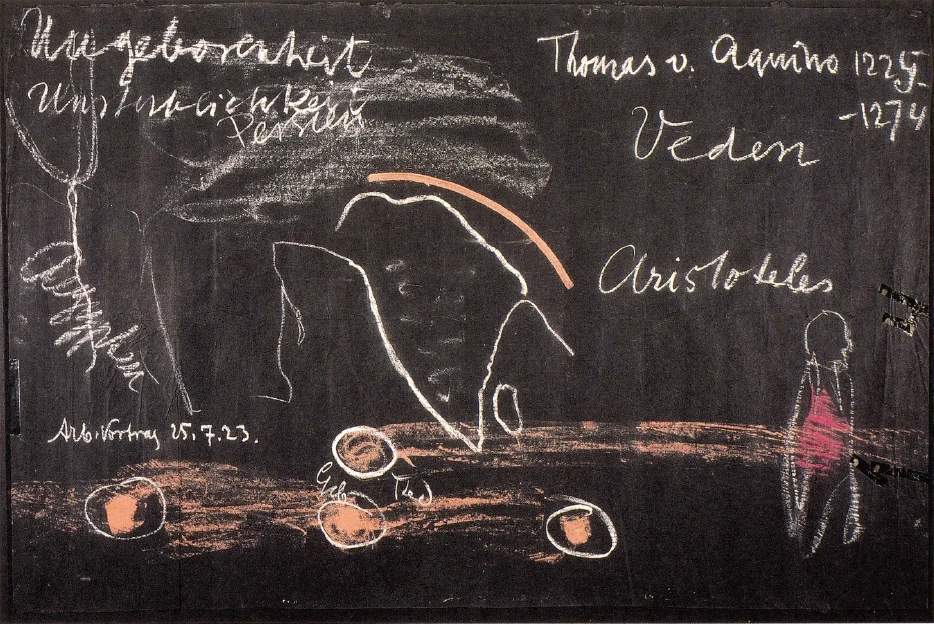
Rhythms in the Cosmos and in the Human Being
GA 350
25 July 1923, Dornach
Translated by Steiner Online Library
13. The Development of Conscience Throughout Human Evolution; Pre-existence and Immortality — The Teachings of Aristotle and the Catholic Church
[ 1 ] Well, gentlemen, if you have anything else on your minds today—or any questions you’d like to ask—please feel free to do so.
[ 2 ] Question: One of the wonderful things about human beings is their conscience. When you’ve done something, you think about it. And even if you no longer think about things that have passed, you still know that you have a conscience. It would be interesting to ask whether the conscience can be “killed” in such a way that one can forget it. Given the state of humanity today, one would actually have to assume that the conscience has been “killed” in a large portion of humanity.
[ 3 ] Dr. Steiner: You see, gentlemen, this is actually a major question, but it is closely related to what we have just discussed in the previous lectures. I have tried to explain to you, step by step, how the human being, who consists of physical matter, also contains an etheric body—that is, a body of a completely different nature that cannot be perceived or seen with the ordinary senses—as well as an astral body and an “I”-organization; we could also call it an “I”-body. The human being has these four parts.
[ 4 ] Now we must imagine what actually happens to a person when they die. As I have told you many times before: When a person sleeps, the physical body and the etheric body remain in bed. The astral body and the I leave; they are then no longer in the physical body or the etheric body. — But when a person dies, the physical body is shed from what the person possesses. It then becomes a truly physical body; the other three parts—the etheric body, the astral body, and the I—then leave. As I told you, the etheric body remains connected to the I and the astral body for a few more days. Then it, too, separates, just as I have described to you, and the human being then lives in what constitutes his I and his astral body. As they continue to live on and on, they dwell in that spiritual world which we actually explore in this earthly life through spiritual science. So that we can say: Now we know something here on Earth about a spiritual world; then we will be within it.
[ 5 ] But after some time, we come back down to Earth again. Just as we journey from birth to death in our earthly life, we pass through a spiritual world and then come down again. We take on the physical body given to us by our parents and so on. That is how we come down from the spiritual world. So before we came here to Earth, we were—let’s say—spiritual beings. We descended from the spiritual world. You see, gentlemen, this is an extraordinarily important fact: that human beings know they descend from the spiritual world with their “I” and their astral body. Otherwise, there is no way to explain why human beings, as they grow up, speak of the spirit at all. If they had never been within the spiritual realm, they would not speak of the spirit at all.
[ 6 ] As you know, people on Earth didn’t used to talk about the afterlife nearly as much as certain people do today, but they did talk a great deal about life before they came down to Earth. In ancient times, people spoke far more about what happened to a person before they took on flesh and blood than about what happened afterward. In ancient times, it was much more important for people to remember that they were souls before they became earthly human beings. Well, I haven’t spoken to you much yet about the evolution of humanity on Earth, but let’s take this opportunity today to talk a little about the evolution of human beings on Earth.
[ 7 ] If we were to go back, say, eight to ten thousand years in time, we would find life here in Europe to be quite wild. Life in Europe is still quite primitive. In contrast, back then—about eight thousand years before our present time—there was an extraordinarily advanced civilization over in Asia. In Asia, as you can see (it’s drawn here), there is a country called India. There is the island of Ceylon; up above is the mighty river, the Ganges; and up there is a mountain range, the Himalayas. In this India—which is over in Asia—and also a bit beyond it, there lived people who, as I said, had a highly developed spiritual life eight thousand years ago. Today I call them Indians. Back then, the word “Indian” didn’t exist yet. But today we call that place India, and that’s why I use that term. Wouldn’t it be true that if we were to go back in time and ask these people, “What do you call yourselves?”—they would say, “We are the Sons of the Gods!”—because they referred to the land where they were before they came to Earth. Back then, they themselves were still gods, for in those days, when people were spiritual, they called themselves gods. If asked, “What do you become when you fall asleep?” they would have replied: “When we are awake, we are human beings; when we fall asleep, we are gods.” — To be a god simply meant to be different from when awake, to be more spiritual.
[ 8 ] So these people had a particularly advanced culture, and for them it wasn’t so important to talk about life after death, but rather about life before one is born—about this life among the gods, as they said.
[ 9 ] You see, there are no external records left from these people. But these people, of course, continued to live on—as you know, there are still Indians today—and much later they wrote great poetic works known as the Vedas. “Veda” is the singular, “Veden” the plural. “Veda” actually means “the Word.” It was said that the Word is a gift of the spirit, and what people wrote in their Vedas was precisely what they still remembered from the other world. In those earlier times, they knew much more, but what can still be studied externally through books today is precisely what is written in the Vedas. This was written much later. But in what is written in the Vedas—which was recorded much later—one can see that these people still knew with certainty: Before human beings descended to Earth, they had been in a spiritual world.
[ 10 ] Well, if we go back about six thousand years before our time, we already find a less highly developed culture here. That is when culture began to decline in India. What scholars still describe today as ancient Indian culture had already declined from its original height. But to the north of that (as shown in the diagram)—that is, in Arabia—a culture develops in the area that would later become Persia. That is why I have called it the proto-Persian culture. A completely different culture develops there. It is quite remarkable. You see, when one goes back to these ancient Indians—who lived two thousand years before the people here—one finds everywhere among them that they actually held the earthly world in very low regard. They always believed they had come into the earthly world from the spiritual world. They knew this very well. They did not value the earthly world at all; they valued the spiritual world. They said they felt like outcasts, and what was on Earth was not particularly important to them at all. And then here, some six thousand years before our time, in the land now called Persia, a certain appreciation for the Earth emerged for the first time. People began to value earthly life. They valued this earthly life to such an extent that they said to themselves: “Yes, the light is very, very precious, but the Earth is also very precious with its darkness.” — And so the view gradually took shape there that the Earth is just as precious, that it struggles with Heaven. And this struggle between Heaven and Earth was developed over two thousand, three thousand years into a view that held special importance for these people.
[ 11 ] Then, if we go back about three or four thousand years, we arrive in a land that stretches from Arabia across to Africa, where the Nile flows: Egypt. The Egyptians—and also those who lived over in Asia, more toward the west, closer to Europe—came to love the earth even more. And that is why, when we go back three or four thousand years, we find that these Egyptians—who were, so to speak, the third type of people—Indians, Persians, Egyptians—these people built those enormous pyramids. But what they did above all else was this: they harnessed the Nile. The Nile, which floods the land every year with its fertile soil, they channeled it so that these floods could benefit them in every direction. To this end, they developed what is known as geometry. They needed it. Geometry and the art of surveying—these were developed there. People grew to love the earth more and more. And you see: to the very extent that people on Earth grew fonder and fonder of the Earth, the less they realized that they had come from a spiritual world. I would say they forgot this more and more because they grew fonder and fonder of the Earth, and to the same extent it became more important for them to tell themselves: “One lives on after death.”
[ 12 ] Certainly, we have seen that life after death is assured for human beings, but in the past, before the Egyptians arrived, people did not think about immortality nearly as much. Why? Because it was a matter of course for them. If they knew that they had come down from a spiritual world and had merely taken on a physical body, then they did not doubt at all that after death they would arrive in a spiritual world. But here in Egypt, where people had already thought less about their existence in the spiritual realm before earthly life, the Egyptians developed this immense fear of dying. This immense fear of dying is actually not much older than three or four thousand years. The Indians and the Persians had no fear of death. So one can actually prove that the Egyptians did indeed have this terrible fear of dying. For, you see, if they hadn’t had this hopeless fear of dying, then the English and others wouldn’t be able to go to Egypt today and display the mummies in their museums! For back then, people were embalmed using all sorts of ointments and substances. They placed the person in the coffin and preserved them exactly as they had appeared in life. People were embalmed and turned into mummies because it was believed that if the body were kept intact, the soul would remain present as long as the body still existed on earth. — The body was preserved so that the soul would not suffer any harm. You see, this is the fear of dying. So the Egyptians sought with all their might to achieve immortality through earthly matter. Yet these Egyptians still possessed an extraordinary amount of knowledge that was later completely lost.
[ 13 ] And the next people who particularly catch our attention are those a little north of Egypt, in Greece—in what is now Greece. But ancient Greece was quite different. You see, the Greeks had by then almost completely forgotten about life before birth. Only a few individuals in particularly advanced schools, known as the Mysteries, still knew about it. But on the whole, in Greek civilization, spiritual life before birth had already been completely forgotten, and the Greeks loved earthly life above all else. And that is why a philosopher emerged in Greece—his name was Aristotle—in the 4th century B.C. As you can see, we are now approaching the Christian era. Aristotle was the first to put forward a view that had not existed before. He proposed the view that when a child is born, not only is the human body born, but the human soul is also born. — So in Greece, the view first emerged that the human soul is born with the body, but is then immortal—that is, it passes through death and continues to live in the spiritual world. However, Aristotle then put forward a peculiar view. Aristotle had, in fact, already forgotten everything that constituted wisdom in ancient times, and he then proposed the view that the soul is born at the same time as the body. But when a person dies, the soul remains in such a state that it has only that one earthly life behind it. Thus, it must eternally look back only on what that one earthly life was.
[ 14 ] Just imagine what a terrible sight that is! So if anyone on earth has done something wrong, he will be unable to make amends for it in any way for all eternity, but must always look back, must always see the image of the wrong he has done. That is Aristotle’s view.
[ 15 ] Then Christianity came along. In the very first centuries, people understood Christianity to some extent. But once the Roman Empire adopted Christianity and it took root in Rome, people there no longer understood it. They didn’t understand it.
[ 16 ] Now, within Christianity in particular, there have always been councils. There, the high-ranking dignitaries of the Church gathered and determined what the great flock of believers must believe. Isn’t that right? That’s how the view took shape: there are shepherds and sheep, and the shepherds then decreed at the councils what the sheep were to believe. — At the eighth of these councils, the shepherds decreed on behalf of the sheep that it was heretical to believe that a human being had lived in the spiritual world before birth. So the old views of Aristotle became Christian church dogma! And as a result, humanity was virtually forced to know nothing, not even to think about the fact that human beings came down from the spiritual world with a soul. It was forbidden to them.
[ 17 ] When materialists today say, “The soul is born with the body and is nothing other than something physical,” this is nothing other than what people have learned from the Church. This is precisely why people today believe they are transcending the Church by being materialists. No, people would never have become materialists if the Church had not abolished the knowledge of the spirit. For it was precisely at this eighth general, ecumenical council in Constantinople that the spirit was abolished by the Church, and this state of affairs persisted throughout the entire Middle Ages. Only now, through spiritual science, must we once again come to realize that human beings, as souls, existed even before they were on Earth. That is what is important; that is what is immensely important.
[ 18 ] Anyone who follows the development of humanity on Earth can see quite clearly: Originally, there was knowledge that human beings exist in a spiritual state before they descend to Earth. — This was only gradually forgotten and later even abolished by a council decision.
[ 19 ] Now we just need to understand what that means. Just imagine: the people who lived up until the time of the Egyptians—that is, in ancient millennia—knew this: Before you walked the earth here, you were in the spiritual world. — Yes, they didn’t just bring down from the spiritual world some general, vague knowledge; rather, they brought down from the spiritual world the awareness that they had lived there with other beings. And from that, they also brought down their moral impulses. “What I am to do on Earth, I can see from the nature of earthly things,” these ancient people said; “as for what else I am to do, I need only remember what was before my birth.” They brought their moral impulses down from the spiritual world. You see, when people in those ancient times were asked, “What is good? What is evil?”—they would say: “Good is whatever the beings among whom I lived before I came to Earth want; evil is whatever they do not want.”—But each individual said this to themselves. Now, gentlemen, this has been forgotten.
[ 20 ] In Greece, something very strange had happened. In Greece, people had forgotten to such an extent that there is a life before birth that Aristotle said: “The soul is born with the physical body.” — So people no longer had any idea at all that they had already lived before birth. But they sensed something within themselves of this life. Isn’t it true that whether one knows something or not has no bearing on reality? I can keep saying: “There’s no table behind me; I don’t see a table” [bumps into the table while stepping back]—but the table is still there, even if I can’t see it. Life before birth remained there after all, and people sensed it within themselves. And in Greece, people began to call this the “conscience.” In Greece, around the 5th century B.C., the word “conscience” first appeared. Before that, the word “conscience” did not exist. So the word “conscience” stems from the fact that people had forgotten prenatal life—life before birth—and they gave a name to what they still sensed of it within themselves. And it has remained that way ever since. People sense their prenatal life within themselves, but they say: “Well, that’s just the way it is; it arises somewhere down there and then shoots up—but they don’t give it any further thought.”
[ 21 ] You see, that was good for the Church. For what could the Church possibly do now? Yes, gentlemen, in the past, when everyone knew that they had lived as souls before descending to Earth, people used to say: “What is moral is what we know from our previous life, from our pre-earthly life.” — Now the Greeks felt only their conscience. And then later came the Church, which took charge of the conscience. Isn’t that right? It took up the matter and said: “You don’t know what you’re supposed to do. The sheep don’t know that—the shepherds do!” — And it laid down rules and administered the conscience.
[ 22 ] You see, it was necessary to abolish the spirit at a council, because then they could control what remained of the spirit in human beings—namely, the conscience. And then the Church said: No, nothing existed in human beings before they were here on earth. The soul is born with the body. Anyone who does not believe this is of the devil. But we, as the Church, know what the spiritual world is like and what human beings are meant to do on earth. — In this way, the Church has taken control of the conscience.
[ 23 ] This can still be demonstrated in detail. You see, this continued to play a role well into the 19th century—sometimes in a truly terrible way. For example, in the 1830s and 1840s, there was a man in Prague named Smetana. This man was the son of a Catholic sexton, who was, of course, a devout Catholic. He believed that one must believe what the Church prescribes; one knows about the spiritual world only what the Church prescribes. Now he had a son. People back then were somewhat ambitious and sent their children to high school. But in the high schools that existed in Prague in the 19th century, one didn’t actually learn very much. Basically, one learned quite little. So the young Smetana was educated at high school. And that was simply the way it was: whoever was supposed to learn anything at all would then become a priest. And so the young Smetana also became a priest. Back then, in Prague and throughout the rest of Austria, secondary schools were staffed with priests as teachers. And so it came to pass that, when he himself had to teach, he read books other than those prescribed to him by the Church as a priest. Yes, this gradually led him to doubt, particularly regarding one dogma. He asked himself: What is this truly dreadful thing—that a person is to be born, spend his life on earth, then die, and now, if he was a bad person, be condemned to eternally witness—the Church, of course, illustrated this with the appropriate imagery—the very deeds he committed as a bad person on earth, without ever having the chance to improve himself!
[ 24 ] Well, you see, this man, Smetana, used to live in a monastery. But when he became a teacher, the monastery began to feel a bit too confining for him; so he moved into a secular apartment and, since there were no anthroposophical books available at the time, read more and more of the works of Hegel, Schelling, and so on, which at least offered something—a glimmer of something rational. He began to have more and more doubts about the so-called eternity of hellish punishment, for according to Aristotle, a wicked person passes through death and must live eternally in his wickedness. From this, however, arose the doctrine of the eternity of hellish punishment, which was then established by the Church through the councils. This doctrine is, of course, not a Christian one; rather, it is that of Aristotle. It is not at all true that this doctrine of hellish punishment is a Christian one; it comes from Aristotle. But that was not clear to people.
[ 25 ] But it became clear to Smetana. So he began teaching something that wasn’t entirely in line with Church doctrine. It was in 1848, to be exact, that he taught something that wasn’t quite right. He first received a severe warning—a lengthy letter written in Latin—in which he was told that he should now return repentantly to the bosom of the Church, for it had caused immense scandal among the shepherds that he was teaching the sheep something not prescribed by the shepherds. He replied to this first letter, written in Latin, saying that he considered it hypocrisy to say anything other than what one is convinced of. Then a second letter in Latin arrived, warning him even more sternly. And when he no longer replied to this one—since it would have served no purpose—it was announced one day in all the churches in Prague that a very important ceremony was to take place, because one of the lost sheep, who had even become a shepherd, had to be expelled from the Church.
[ 26 ] Among those who had to go around everywhere at the time handing out flyers announcing that this important celebration was to take place was the sexton, old Smetana, the father. He had remained a devout Catholic. You can imagine what that meant—that all of Prague had been summoned to condemn Smetana’s son, to excommunicate him from the Church for all eternity, and so on, to condemn him—and the father himself had to carry the flyers around! Yes, the churches in Prague had never been as full as they were on that day. All the churches in Prague were completely full. And from every pulpit it was proclaimed that the apostate Smetana was being excommunicated from the Church.
[ 27 ] The result was—and of course the predisposition to tuberculosis ran in the Smetana family—that first his sister died of grief, then his elderly father died of grief, and shortly thereafter Smetana himself died of grief, of sorrow. But that wasn’t the point, was it? The point was that Smetana no longer preached the doctrine of eternal damnation in hell, as he had understood it.
[ 28 ] All of this is connected to the development of humanity’s concept of conscience. For whatever a person retains from life before coming to Earth lives within them and speaks through them as conscience. And from the perspective of conscience, one can say: Conscience cannot come from the substance of the Earth. — Just imagine, for example, that someone has a terrible craving. Such things have certainly happened before. Then it is the substances in his body—the substances of the earth—that urge and prod him toward this craving. Then his conscience tells him: “But you must fight these cravings.” — Yes, gentlemen, that would be just as absurd as if the conscience still came from the body, as if someone were to walk forward and backward at the same time. It is, after all, nonsensical to say that the conscience comes from the body. The conscience is connected to what we bring down from our pre-earthly life in the spiritual world when we descend to Earth. But as I have described to you, the awareness that the conscience originates in the spiritual world has been lost to people on Earth, and for people like Smetana, whom I told you about earlier, this awareness dawned anew in the 19th century through that terrible notion of hellish punishment. Conscience belongs to the human being himself. The human being carries his conscience within himself. What good would all that conscience one carries within oneself do if, upon passing through death, one were then to see for all eternity what a wretched person one had been? One could do nothing about it there. The fact that one has a conscience would then be meaningless!
[ 29 ] So one can say: If this is the human being (as depicted), then conscience lives within that person. Conscience is what the person has brought with them from the spiritual world into earthly life. Conscience says within them: You shouldn’t have done that, and you shouldn’t have done that. — The earthly human being says: “That is what I want to do; that is what I desire.” — The conscience speaks differently, because the conscience comes from the eternal human being. And then, when the human being has shed the physical body, only then does he realize: “You yourself are, in fact, what has always spoken within your conscience. You simply did not notice this during your earthly life.” Now you have passed through death. Now you have become your own conscience. Your conscience is now your body. Before, you had no conscience. Now you have your conscience, and with it you continue to live after death.
[ 30 ] But one must also attribute a will to the conscience. You see, all the things I have told you have come to pass. The Greeks had forgotten about pre-earthly life. The Church had elevated to dogma the belief that one must not believe in a pre-earthly life. Conscience has been completely misunderstood. All of this had come to pass. And of course, there have always been great scholars. But these great scholars of the Middle Ages were under the impression that a pre-earthly life could not exist. The Church forbids belief in it.
[ 31 ] A man like Thomas Aquinas, who lived from 1225 to 1274, found himself caught in this dilemma. As a Catholic priest, he had to conform to the teachings of the Catholic Church. But he was a great thinker. And in light of what I have told you today, he was thus compelled to say: When a person dies, they have only the vision of their earthly life, for all eternity, never anything else. They gaze upon it. — So what does Thomas Aquinas do? Thomas Aquinas attributes to the person only the intellect for all eternity, but no will. A person must contemplate this after death, but can no longer change anything about it. This is precisely what made Thomas Aquinas one of the greatest Aristotelians of the Middle Ages: he said, “If someone has done something bad on earth, they must contemplate it eternally; if someone has done something good, they will contemplate the good eternally.” — Thus, only cognition, not the will, was attributed to the soul.
[ 32 ] That is simply not true. The truth is that, after death, one does indeed look back on what one was—both good and bad—but one retains the will, the full power of the soul, to change that. Thus, when one looks back on one’s life and sees how it was, one naturally lives in the spiritual world and sees what should have been different. Then the desire to return to the physical world arises spontaneously in order to make the necessary corrections. Of course, mistakes will be made again, but there will always be subsequent lives, and the human being will ultimately achieve the goal of complete human development.
[ 33 ] What Thomas Aquinas was still compelled to do in the Middle Ages—to believe only in knowledge, not in the will—is something that people in the 19th century still suffered from, just like Smetana. This is what led to the emergence in the 19th century of other people who developed a veritable rage against knowledge. All of this still stemmed from the dogma of hellish punishment; it’s just that people didn’t see through it. Schopenhauer, for example, developed a veritable rage against knowledge and attributed everything to the will. Yes, but if one then attributes everything to the will again, then this will is too stupid and foolish. That is why Schopenhauer attributed the entire creation of the world and everything else to the stupid will. And those people who reflected on these matters ended up facing such terrible inner conflicts as Smetana did in Prague. There were many such people; this is merely an excellent example whose struggles have been recorded. There were many such people.
[ 34 ] And so we must be clear about this: Human beings have their conscience as a legacy from their pre-earthly life. It is the spirit that speaks through the conscience. That which we were before we became earthly human beings has been immersed in the flesh and speaks through the conscience. And when we have cast off the body, the soul will continue to speak through the conscience after death—not powerlessly, but with a will of its own, and it will have to make amends and continue to act.
[ 35 ] You see, that is the difference between anthroposophy and everything contained, for example, in Christian dogmatics today. Christian dogmatics is unaware of this inner power of the human soul that is capable of creating; instead, the human being dies and can only eternally contemplate what they have done in that one earthly life, because in that one earthly life the soul is born with the body. So, if one wants to represent this schematically, one must say: If this is a human life on earth (upper diagram, circle), it also begins with the soul, and when the person dies—there is birth, there is death—then their soul life extends into all eternity. I don’t want to go on to the second board with my diagram, because that would be too much—I’d even need a third one! It extends into all eternity: only knowledge, only the intellect—it is meant to gaze forever and ever upon the wickedness of earthly life, because the intellect is born together with the physical aspect of earthly life. The first materialist was actually the one who established this dogma; it was, in fact, Aristotle.
[ 36 ] Well, anthroposophy holds that there is not just a single earthly life, but rather a succession of earthly lives. Human beings always retain something from their previous earthly life—something they do not know precisely, but which resides within them: this is the conscience. Now they shed their physical body, yet they live on in their conscience. There (lower illustration, red on the left) is essentially nothing but conscience until the next birth. Now (middle circle) conscience is present again as a voice that speaks; now (red on the right) it lives in the outer world, it is there once more. — And human beings are, in fact, the ones who always create their own new lives on Earth. Of course, this particularly irritates those schools of thought that refuse to acknowledge anything in the human being, that view everything as if the human being were merely a creature. The human being is not merely a creature; rather, there are creative powers within him. And this is precisely what distinguishes anthroposophy from other worldviews: through its research, anthroposophy reveals that: Yes, these creative powers are within the human being; the human being is also creative. The human being is not merely created; rather, the human being is creative. And among the most creative aspects within the human being is precisely the conscience, for this is what has remained to us as a sacred inheritance from our pre-earthly life—and what we carry forth again when we pass through death.
[ 37 ] That is precisely what modern science still derives from the Church, and it is precisely on this point that one really ought to look very closely. For this is how things went: Over here in Rome, only what was logical on the one hand and materialistic on the other ever made its way here. Modern peoples then adopted that. But in the German language, a remnant of the old has sometimes remained through a completely different path—only it is not readily recognized. This is very curious. In this, one can see how human beings are connected to great historical events.
[ 38 ] If you look today at those countries up there in Asia—Siberia—they are actually regions that are very sparsely populated, but they were once densely populated. Back then, the rivers there were much, much more powerful. Siberia is a land that gradually dried up and rose, and the people then migrated westward, across to Europe. This was caused by the uplift of Siberia. And in this way, many concepts that existed in Asia found their way to Europe by a different route, and these concepts live on in the European languages. Therefore, one must say: The farther west one goes, the less this concept of conscience is present. — But the very word “conscience” shows that the people who coined it had a sense that there is something within the human being. — And what does the word “conscience” actually mean? We have just explained what it signifies: it is the legacy of pre-earthly life, which remains within humanity. But the word “conscience”—what does it mean? Isn’t it true that when one considers earthly life and says to oneself: The events that will take place in two or three years are uncertain and unpredictable, but the fact that human beings have within them a spirit that existed before their earthly existence and will remain after it—that is certain. — And the word “conscience” is precisely connected to this certainty; it is the most certain thing there can be. Thus, the word “conscience” already points to that which is eternal in the human being. It is very significant that “conscience” conveys a different meaning than, for example, “conscience” or similar terms in the West. “Conscience” is that which is “conscious together” on Earth—con-, conscience—that which coalesces from earthly knowledge. But that which lives as conscience within a human being and is designated by the word “conscience” is the most certain thing there can be—something that is not indefinite, but entirely certain. And it is absolutely certain that human beings on Earth not only believe in a life after death—a view held by Aristotle and the faithful of the Church—but also develop a will to shape it better and better, to shape the Earth again and again from the spirit in ever-improving ways, so that the will lives on after death just as knowledge lives on. For Thomas Aquinas, only knowledge lived on. Now we must be clear that the will lives on. You see, gentlemen, it is indeed the case: One certainly does not need someone who, centuries ago in his own time, was a great 249
[ 39 ] It is one thing to disparage a great scholar, such as Thomas Aquinas in the 13th century, simply because he taught what was accepted at that time. But it is quite another matter when Thomas Aquinas taught what was the only thing that could be taught in the 13th century, at that time, than if one were to found a Thomas Society today—as is happening once again right now in Paris—to teach the same things as were taught back then, just as Leo XIII commanded all priests and scholars of the Catholic Church in the 19th century to say only what Thomas Aquinas taught in the 13th century. After all, Thomas himself wouldn’t say that anymore today! And these two things stand in opposition to one another in the world: something like a Thomas Society in Paris, which seeks to lead people back to the past, and anthroposophy, which teaches what is present—that which a contemporary human being is. And above all, when one considers something like the conscience, it is important that this leads one to the eternal within the human being. But one cannot truly understand the eternal unless one also looks to pre-earthly life; if one looks only at what has actually emerged only since the time of the Egyptians as the afterlife, as so-called immortality.
[ 40 ] You see, gentlemen, it was only three or four millennia ago that people began to speak of being immortal—that is, that the soul does not die along with the body. Before that, however, people said that they were not born as a soul, just as the body is born. They had a concept that we would have to call “unbornness” today. That was one side of the coin. And immortality is the other side. Not even languages today have a word other than “immortality”! The word “unbornness” must be revived. Then people will say: Conscience is that part of the human being which is not born and does not die. Only then will it be possible to truly appreciate the conscience. For the conscience has meaning for human beings only if it can be properly appreciated.
[ 41 ] Well, we'll continue on Saturday, gentlemen, at nine o'clock.