

Rhythms in the Cosmos and in the Human Being
GA 350
20 July 1923, Dornach
Translated by Steiner Online Library
12. Human and Cosmic Breathing — The Earth’s Light Breathing — Fertilization in Plants and Humans; the Fertilization of Water by Lightning
[ 1 ] If we take the thoughts we explored last time a step further, we arrive at the following. It was back when I was young—very young, in fact—that a traveling hypnotist caused quite a stir when he performed his shows with people. Now, one need not lavish special praise on such people who present extraordinarily serious matters to the audience in a theatrical manner, and I certainly do not intend to sing a special hymn in praise of Hansen, who, in the 1870s and 1880s—particularly in the 1880s of the last century—gave theatrical performances on a subject that science had not yet addressed at all at that time, about which science knew nothing back then. But at any rate, since then, science has taken up this subject precisely under the influence of Hansen’s theatrical presentations.
[ 2 ] Now I would like to tell you, in particular, about an experiment that Hansen—after it had long been forgotten—performed once again before an astonished audience. He took two chairs, placed them at a certain distance apart (this is illustrated), and then—simply through the influence of his own personality, as they say—hypnotized a person, bringing him into a sleep-like state—but a sleep-like state that is much deeper than ordinary sleep—; then he was able to take this person and position him so that his head was on one chair and his feet on the other. Now, as you know, if this were to happen to a person who was fully conscious, he would simply fall down between the two chairs. This person did not fall down between the two chairs at first, but remained lying there, stiff as a broomstick, exactly where he was. But that was not all. Hansen, who was a rather corpulent, heavy man, then went over and boldly stood upright on the man’s stomach. So there stood the heavy Mr. Hansen. The man didn’t move, but remained lying there like a plank, even though Hansen was standing on top of him.
[ 3 ] So this is something that can certainly be done, something that has been done often since then, and something that science no longer doubts—even though it used to know nothing about it and had to be taught about it by Hansen, who was not exactly a likable person. You see, a person who is in this state is said to be in catalepsy.
[ 4 ] If something happens in such a way that a person can lie there like a wooden plank and someone else can even stand on top of them, and if this occurs temporarily as a result of the influence of another personality, well, then it’s simply an experiment; it’s not all that bad. But we can say that, on a small scale, this state does indeed occur in life. It occurs sometimes. Of course, it then actually only presents itself to those who are able to make medical observations. And it presents itself when people fall prey to a very specific illness known as mental illness.
[ 5 ] For example, there are people who—even though they used to be very determined and capable in their jobs—suddenly find themselves thinking as if all their thoughts had frozen. It can happen that a person used to go to work regularly every morning, say, at eight o’clock. He got up on time and so on. Suddenly, he finds it very comfortable to stay in bed. He always wants to get up, but he can’t muster the will to do so. And even when fear sets in—he has the clock next to him, it’s a certain time—and he has finally gotten up, he still can’t bring himself to eat breakfast, and then again, he can’t bring himself to leave. He eventually finds himself constantly saying to himself: “I can’t do this, I can’t do that”—and ultimately behaves like a stick, unable to make up his mind about anything. And this goes so far that he falls into a kind of state that is also visible in his physical appearance: he is stiff. Whereas he used to move his arms quickly, he now moves them slowly; whereas he used to run like a little spring, he now finds it difficult to take one step after another. His whole being becomes rigid and heavy. This is something that sometimes manifests as an illness in people as early as their youth.
[ 6 ] This is the same condition, only not as severe, and it does not occur all at once but very slowly. Of course, when a person begins to become cataleptic, one cannot simply lay him on two chairs and stand on them or sit on the person in question, but he becomes unable to control his body properly.
[ 7 ] That is one situation. But now Hansen has demonstrated other experiments to the public—experiments that had always been imitated in the past, but which have also come to the attention of the scientific community since that time. Before the amateur and actor Hansen brought them to the scientific community’s attention, the scientific community had not concerned itself with them. These feats consisted of the following: Hansen would have someone from the audience come up. Some foolish people have claimed that he had arranged this in advance, but that is, of course, nonsense. He simply recognized the right individuals from the audience who were suitable for the task. It doesn’t work equally well with everyone; he had developed an eye for who was suitable. So he would have someone come up from the audience, and once again his personal influence would take effect. He would stand there, planting his own legs—which were very thick—firmly on the ground. He had a certain look about him that made one think that when he walked in the front, he’d walk right back out the back—in other words, a piercing gaze, as they say. And he always kept his eyes like this, you see (it is drawn): When he looked at someone, his eyes would open in such a way that the whites remained visible above and below the pupil—they were open like that. Whereas normally the eyelid covers the whites so that the whites above and below the pupil are not visible, with him it was such that his gaze became, as they say, particularly piercing.
[ 8 ] Well, that made a huge impression on the man he had chosen as his victim; the man was already beginning, as they say, to lose consciousness. He lost consciousness, but something very strange happened. Hansen then said, “You can’t move from the ground now. Your feet are bound to the earth!” — The man tried—he couldn’t move, couldn’t take a single step. He simply couldn’t; he remained standing. Then Hansen said to suitable victims, “You must kneel down now!” — The man knelt down. “Look, an angel is appearing up there.” — The man clasped his hands, made a look of utter rapture, and gazed up at the angel. Hansen did all of this with the people he selected as subjects. Of course, he chose people who were somewhat in a daze, but he was able to perform these acts on them and then demonstrated them in front of the entire audience. His acts were not mere tricks—though many people claimed he was a charlatan—but they were things that have since been thoroughly replicated at scientific institutes and are therefore considered valid.
[ 9 ] In addition, he did the following, for example. He took a chair and placed it next to the man who was in such a state that he no longer had any thoughts of his own, but only the thoughts that Hansen put into his head. Then Hansen stood there and said, “Here’s an apple!” — “Aren’t apples wonderful? Apples are delicious.” Then he took a potato, gave it to him, and the man bit into it with great delight and ate the potato as if it were an apple. So Hansen could not only convince people that they were seeing an angel, but also convince them that a potato was an apple and should be eaten as an apple. Then, for example, he took some water and said, “Now I’m giving you a particularly sweet wine!” — Oh, you could see how he was savoring the sweetness! — Hansen conducted experiments like these. That was the other kind of experiment.
[ 10 ] What did he actually do to the person he was standing over? He destroyed that person’s will. That person no longer had any will of their own. With the people he treated as I just described, he merely influenced their thoughts. They had to think exactly as Hansen did; if he said, “That is an apple”—and so on, according to Hansen’s taste—and if he said, “That is an angel”—then they followed Hansen’s thought and saw the angel.
[ 11 ] Yes, you see, Hansen could do all sorts of other things, too. For example, he did the following: He had someone he considered a particularly suitable victim come up from the audience, and he first hypnotized him—that is, he put him in a state where he had no consciousness of his own, so that he absorbed all the thoughts Hansen implanted in him. Then he said: “Ten minutes will now pass. I’ll wake you up in ten minutes.” Then you’ll go over to the man sitting back there in the corner and pull his watch out of his pocket like a thief.” — Then he woke the man up first—meanwhile, Hansen was doing all sorts of other things with everyone else—and the man became restless, stood up, walked over to the man sitting in the corner, and pulled his watch out of his pocket.
[ 12 ] Now, you see, of course, Latin names are used. The Latin language, as I’ve already told you, is always to be used in accordance with logic; and the experiments I described to you first are called hypnotic experiments, while those in which the subject is already awake and then does the same thing afterward—post means “after”—are called posthypnotic experiments. Since then, people have been talking about hypnosis and posthypnosis and know that humans can enter such states.
[ 13 ] These things, however, point deep into human nature, for it is indeed true that, later on, these very posthypnotic phenomena were expanded much further. If you put someone into a deep enough state of hypnosis and tell them, “In three days, you must do such-and-such,” they will do it—provided they have the right personality for it. These experiments have, in fact, been conducted.
[ 14 ] Well, don’t you think that in real life these things don’t occur with such intensity? But, as I’ve shown you with the example of the person who can no longer move, they do occur in a milder form. The other condition also occurs in life. You will have already encountered not only people who are completely paralyzed and don’t know what to do with themselves—that is, who are, in a certain sense, cataleptic—but you will also have met people who suddenly begin—even though they used to be, at heart, quite level-headed individuals—to become very talkative. You simply can’t keep up; thoughts bubble up, and they chatter, chatter, chatter like a spinning wheel. With them, it’s just like with people who mistake a potato for an apple, except that in one case it’s Hansen who exerts the influence, while those who have such rapid thoughts—whose thoughts bubble forth in this way—are dependent on their own gut. For that is the interesting thing: that one’s own gut—I’ve told you a great deal about how the liver and so on think in the gut—thinks much faster than the head. And when a person becomes so weak-minded that they no longer offer the necessary resistance to these thoughts coming from the gut, no longer slow them down enough, then these thoughts bubble out. So they are hypnotized by their own gut.
[ 15 ] That’s the strange thing about life: People have these two opposing organs, the head and the gut. Both think. But one thing is certain: The head thinks slowly, and the gut thinks quickly. The head thinks far too slowly and the gut far too quickly, but as you know: when you mix something very thick with something very thin, you end up with a middle ground. It’s the same with people: the states of the head slow down the states of the gut, and the states of the gut speed up the states of the head, and in this way, they balance each other out.
[ 16 ] You see, the very basis of world events is that opposing states interact with one another. In this regard, what is called “science” today still has an awful lot to learn. I’d like to tell you something right away. Suppose you have a reasonably normal person. If this person lives to be about 72 years old—you can calculate this yourself; I’ve already pointed it out to you once—then he has lived 25,920 days. That’s 72 years. That’s how many days a person normally lives. And if you measure and count a person’s breaths, you’ll find that they take exactly that many breaths per day. So, if a person lives a normal life and their organism hasn’t been destroyed beforehand—because otherwise they couldn’t reach the age of 72; if one doesn’t live to be 72, it means they’ve been destroyed by something—they go through as many days in their lifetime as there are breaths in a day. That is how a person lives. They live in such a way that every day, from sunrise to sunrise, they take 25,920 breaths, and that during a normal life—one that reaches the age of a patriarch—they live 25,920 days.
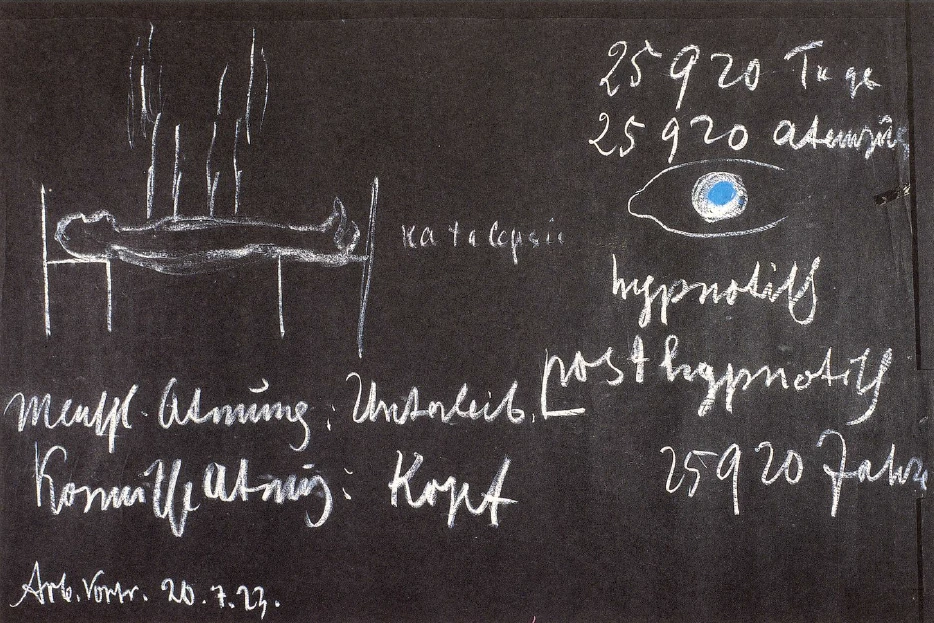
[ 17 ] Yes, what does that mean: We live a normal life that reaches the age of the patriarchs, 25,920 days? What does that mean? — It means that we experience 25,920 cycles of day and night on Earth. We experience this; we can witness it 25,920 times. What does the Earth do as day turns to night? Yes, you see, gentlemen, this is precisely the important point—what Goethe had already sensed and what we can say with absolute certainty today: When day begins to break, the Earth draws the forces of light, the forces of the world, toward itself at the very spot where we are. In the other hemisphere, it’s different—there, it’s the other way around—but it’s the same process. So the Earth and everything within it inhales light; when it is night, it exhales it again. What we do with the air in the brief time between inhaling and exhaling, the Earth does in a single day.
[ 18 ] So you see, the Earth is incredibly much slower than we are—terribly much slower. We take as many breaths in a single day as the Earth does in our entire lifetime. You can see that from this. But if you look more closely, something special becomes apparent in human beings. Humans breathe in such a way that the blood requires breath. The blood is produced in the intestines—that is, in the abdomen; therefore, the lower abdomen needs to breathe quickly. We can therefore say: Human respiration is connected to the lower abdomen, to the belly.
[ 19 ] You see, if one were to examine the head in a truly scientific manner—as our science currently does, albeit only in a superficial way—one would find that the head is actually always striving to suppress breathing somewhat. After all, breathing does extend into the head as well. The head, in fact, wants to breathe in such a way that it takes only one breath a day, and it constantly slows down our breathing. The head wants to breathe only once a day—inhaling and exhaling—while we inhale and exhale in about four seconds. The head actually wants to slow down the breath, to make it much slower. So that we can say: Cosmic breathing is actually carried out by the head; but the breath just keeps rushing up from the body to the head, quickly, and then slowly it moves back down from the head to the body. So if you have a person whose will is being suppressed—who thus becomes rigid—what happens to them? The breathing in the abdomen is off, and the very slow head breathing wants to spread throughout the entire body. Now the guy is lying there and Hansen is standing over him. The head breathing wants to dominate the whole body: he becomes rigid. But when someone chatters and chatters and chatters, then the head breathing no longer works properly, and the rapid body breathing comes up, and he chatters. Then, as they say, you don’t get hypnosis, but a flight of thoughts.
[ 20 ] Now you might say—and really, you can say this: But actually, the world is set up in a foolish way, because since our head breathing isn’t in sync with our body breathing, we’re constantly in danger of becoming fools—either because our body breathing is neglected or because our head breathing is neglected. — So that’s a bad situation. Because of these things, we’re constantly at risk of becoming fools. You might say: “Good grief, what a foolish way the world is set up!” — But I want to tell you something else, gentlemen.
[ 21 ] Consider, for example, the woman. Insofar as the woman is human, it is naturally the case that within her, the faster physical breathing and the slower mental breathing take place. The slower breathing is the cosmic breathing. But the woman performs this only with her mind. With the rest of her body, she performs the rapid physical breathing. These two types of breathing simply occur simultaneously. But suppose the woman becomes pregnant. What happens then? You see, for a certain small area of the body in the uterus, the head breathing is introduced into the body’s other breathing processes by the fertilizing substance that comes from the man. So now, while she is pregnant, the woman has slow head breathing, but also slow breathing in her lower abdomen. Slow head breathing intermingles with the body’s breathing, so that the person now has head breathing twice over. And what develops? The head, first of all. So what, then, has entered the body through fertilization? You see, the cosmic breathing—which we otherwise have only in the head—has entered. The human being takes in the whole world through their breathing process. So conception actually consists in the human being taking in the whole world through their breathing process. What actually happens during human conception is this: whereas the human body normally has only human physical breathing, for nine months the cosmic breathing—which the human being otherwise has only in the head—is implanted there.
[ 22 ] There you see a relationship between human beings and the entire universe. At the very place where a human being comes into being—in the womb—the mother breathes in such a way that a single breath takes the entire day. In this way, the mother slows down the processes there so that she can not only sustain life but also form a new human being. For through what otherwise carries out these slow processes with the head, we live out our entire lifespan of 72 years through our head. If we say that a human being normally lives 72 years, and if we see that it takes nine months for a new human being to come into being, then it is no wonder at all that a new human being is formed in nine months; for the human being lives 72 years—we are, so to speak, merely compressing those 72 years into the act of breathing, and the new human being is formed. But this is something that allows you to look so deeply into the whole of nature that, through it, you can also gain the foundation for a different way of thinking.
[ 23 ] Now look at the earth and the plants growing inside it. So let’s say we have the plant’s root, we have the plant’s stem with the leaves here, and we have the flower up there. If you look at the root, it is completely surrounded by salts deep within the soil. There are salts everywhere (drawing on p. 226). These salts are heavy. So the root is completely immersed in the “Heaviness” depicted in Plate 20. But the nature of this heaviness is quite peculiar. For the heaviness is actually overcome. If you were to take severed human heads, they would, after all, have quite a bit of weight. The human head is heavy. Or if you were to pick up a pig’s head, it is heavy. When you carry the head on your own body, you don’t feel how the head sits there and is heavy, because the heaviness is overcome in the head. In the same way, gravity is overcome in the plant as well. For if the plant were to feel the weight in its leaves, it would not grow upward but would instead bend downward more and more. Yet the plant does grow upward; it overcomes gravity. And by overcoming gravity, it becomes open to the light. The light acts within it, and the light comes from above downward, in opposition to gravity. Thus, the plant rises higher and higher toward the light, growing more and more—whereas it was once rooted in the salts of the earth—now exposed to the sun and its light. As it is exposed to the sun and its light, fertilization takes place within it (see drawing); the ovary with the embryo forms, so that the new plant arises through the action of the light. In the plant, this can be seen very clearly. What I have called “cosmic breathing” in human beings—that which is implanted in humans through fertilization—is brought about in the plant every year by the light, so that the plant grows from heaviness toward the light and thereby toward fertilization.
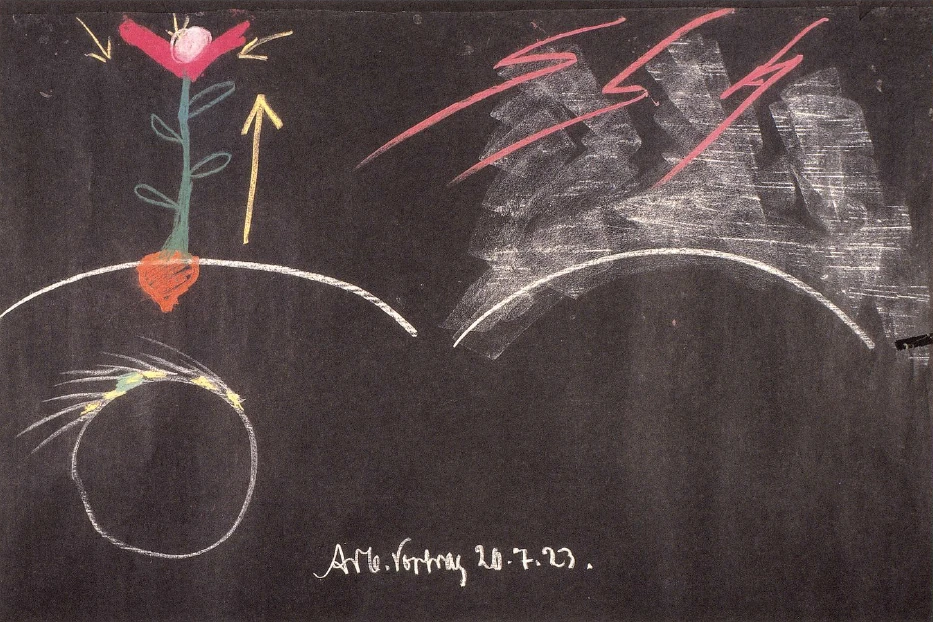
[ 24 ] So we will say: That which in human beings must first be pursued through thought—so that one knows that the cosmic breath is penetrating there, that a small part of the head is forming at a specific point within the human body—we see this happening every year as well when we observe plants. There, the outer world comes from the infinite expanse of the cosmos in the form of light and brings the cosmic into the plant, and the Earth is fertilized by the cosmos through its plant world. This is extraordinarily interesting. When one looks at a plant flower, one can say to oneself: There, the universe—for “cosmos” is synonymous with “universe”—is fertilizing the flower. The other aspect—the pollen grain drifting over and so on—is merely an addition; it is just an addition because, in the physical realm, everything must proceed physically. But in reality, it is the light that comes from the universe and fertilizes the plant flower, laying the seed for the new plant.
[ 25 ] Yes, gentlemen, but can’t you see what’s actually happening there? You can’t see what’s actually happening there because it’s small. But you can sense it! Let’s now look at what’s happening to the plant in a completely different way. Let’s assume this is the earth (see drawing). Don’t look at a plant; instead, look out toward the earth, as if from a distance—perhaps from a mountain, where it’s easiest to see—and watch the fog rise, as they say. There, the fog rises. The mist consists of water. If you were to look at the plant, the process wouldn’t be entirely dissimilar; it would be somewhat similar. If you were to observe a plant like this—you’d just have to sit there for a long time, throughout the entire spring, and keep watching—you would see: First it’s deep down, then it rises, and there it divides toward the leaves. But the fog also disperses as it rises. So there, in the plant, it is only the solid salts that rise up to the flower. Now look down there, toward the earth: There, only the water rises—not solid parts, as when it becomes a plant—but the water rises. When the plant reaches a certain point up there, it is fertilized by the universe. When the water, which rises here in the form of mist, reaches a certain point, it, too, is fertilized by the universe. And what happens then? Yes, gentlemen, there’s a flash of lightning! This doesn’t always happen, but when fertilization occurs and the conditions are as pronounced as in summer—though lightning does occur at other times as well, it’s simply invisible—the water here is fertilized by the universe through light and heat. The same process that occurs in a plant takes place up there and is visible in the lightning. And when the mist is fertilized up above, it falls back down as “fertile” rain. So when you see a cloud of fog rising, it is actually a—albeit very thin—giant plant; it opens its flower up there in the cosmos, is fertilized, contracts, and the fertilized water droplets fall back down in the rainwater.
[ 26 ] Now you have an explanation for lightning. People believe there are things up there like giant Leyden jars or giant electrical devices; but that is a mistake. In reality, the Earth’s water is being fertilized out there so that it can once again carry out its processes on Earth. And what happens in a plant happens only much deeper, because the plant is more solid; these small flashes—which you simply cannot see—always occur up here during flowering, when the right season arrives. But these tiny flashes do indeed lead to fertilization. Thus, in the phenomena of fog and rain, we see the same process that occurs in the plant during fertilization. And this then extends down to the human being, where the cosmic breath—which is otherwise found only in the head—manifests in the human abdomen.
[ 27 ] Now consider a person suffering from catalepsy. What is the case with such a person? Yes, gentlemen, if one were to examine the body of a person with catalepsy, one would find that it has become particularly rich in salt. It has, in fact, come to resemble a plant root, especially in the head. When our head becomes as rich in salt as a plant root, we become sluggish due to the rigidity of the head, which then spreads to the rest of the body. So when you see people who can’t bring themselves to walk, can’t even raise their hands, or can’t get out of bed in the morning—they’ve accumulated too much salt in their heads and have become too much like the root of a plant. If you see people who are always chattering and chattering: they’ve become too much like the flower of a plant. For when one speaks, one is actually only expressing a part of what one knows. But those who are always chattering and chattering actually want to say everything they have. They actually always want to form a whole person, because it’s really their belly that’s speaking. And this belly, when it draws in the world and absorbs it, then becomes the head. But then it happens too quickly—just like with the belly, just like with human breathing.
[ 28 ] So we can say: Hansen made the people he placed on two chairs—and then stood on top of—resemble a plant root in his mind. — There you see the resemblance between the human head and a plant root. One can even make the entire head resemble a plant root. And the people whom he persuaded to eat a potato as if it were an apple—he made them resemble a flower. There you see the resemblance between the “belly person”—that is, the person governed by the lower abdomen—and the flower. What Hansen demonstrated to the scientists is still being done today, but people have still not arrived at the explanation that leads straight into the entire universe.
[ 29 ] So, now we can also answer the question of whether nature is really so foolishly designed that we can become fools—either through incorrect head or abdominal breathing—sometimes becoming cataleptic due to head breathing, and at other times becoming chatty because our thoughts wander and we are unable to exercise our will. Well, to those who consider this extraordinarily foolish and say that if they had been in charge of creating the world, they would have made it somewhat differently—so that we wouldn’t be exposed to the danger of becoming fools in two different ways—one can reply: But if that were not the case—if we could not also generate head breathing within the human abdomen, which arises when we become rigid—then human beings could not come into being at all; fertilization could not take place; there would be no human beings on Earth!
[ 30 ] So you see, the danger that we might become idiots is tied to the very fact that we can come into existence at all. If nature had somehow intended not to let humans come into existence, well, then—don’t you think—there would be no need for idiots to come into existence either. But since humans had to come into existence in the first place, the danger that fools might come into existence must also exist. So one thing is connected to the other. There’s absolutely no reason to rail against nature once you see how things are connected. Someone might even say: “Good grief, how stupid that 2 times 2 equals 4! — I wish it were 6; then I’d have more.” — But that’s not possible! And likewise, it’s not possible for humans to exist on Earth at all without the risk that they might become fools. You just have to see these things clearly. Then you’ll be able to see things correctly in every situation.
[ 31 ] People will say, when looking at a flash of lightning: Is the lightning only up there? — Oh no, it is present throughout the entire summer, as the plants are fertilized, across the meadows, across the forests—everywhere there is this lower lightning. And ultimately, it is a lightning that is always at work within us. Inwardly, we are completely permeated by the same phenomena that we sometimes see when lightning flashes, and our thoughts are a flash within us. Of course, what once appears as a powerful flash of lightning passes very faintly through our thinking. But now you will also be able to say to yourself: It does make sense to say that when I look at the lightning, the thoughts of the world appear to me, because that is the same as what is within me. — One must simply view these things not superstitiously, but scientifically.
[ 32 ] You see, it is interesting, after all, that at the end of the 19th century, science had reached a point where it completely ignored such important matters—to the extent that a charlatan, a con artist like Hansen, had to come along and show people these things. Only then did science begin to pay attention to these matters. From this, however, you can see that science in the last third of the 19th century was not nearly as advanced as people always claim. Certainly, in the external realms, people made great discoveries back then—they discovered X-rays and so on—but in the realm of the inner human being, there was no demand whatsoever for proper knowledge, and there still isn’t today. That is why our science is not at all applicable to the human realm and does not help humanity in the least. You can build as many universities as you like today: if you go there, what actually works within the human being will not be explained to you. But at the same time, they won’t explain to you what actually happens during plant pollination either. And when it comes to rising mist and falling rain, the phenomenon is explained as if it were not much different from cooking on a stove: that the vapors rise and then fall back down. That is simply not the case; rather, as the vapors rise, they enter a region above where they are fertilized by the universe, and proof that they are fertilized is precisely the lightning. And then one sees the fertilization that otherwise also takes place.
[ 33 ] But the fact is that this is of great significance. Take the year, for example. In a year, there is winter and summer, just as there is day and night in twenty-four hours. And a human lifetime consists of 25,920 days. If you take 25,920 years, you arrive at the time when the Earth did not yet exist, and when it will no longer exist. We are now a little past the midpoint, so the Earth has existed for about 13,000 years; then it will perish again, in about 11,000 years or so. Just as a human lives 25,920 days, the Earth lives 25,920 years, just as it is now. It changes; it was once young, and it is growing old. And it is extremely important to know this: Every year, water must be exposed to the universe; at some point, in some place on Earth, water must be exposed to the universe every year, otherwise the Earth could not survive. The Earth lives through the universe, just as we live through the air. If someone were to take the air away from us on Earth, we could not take our 25,920 breaths in a day. If someone were to take away the sun—that is, the light—the Earth could not live. Thus, the Earth lives through the entire universe, just as we live through the air around us. — So one can rightly say: We walk on Earth; the Earth walks through the universe. We breathe on Earth; the Earth breathes through the universe.
[ 34 ] You see, one could actually create a strange kind of science. You know, the human head is round (he draws a picture) and, if you’re not quite old yet, has hair here. Now there live—well, it’s not exactly desirable, but it does happen—creatures in this forest. Let’s suppose they use the scales here to create a place where the smartest ones always gather and teach the stupid ones; that would be a lice university right on the human head itself. Well, one could certainly imagine that. What would these smart lice teach the stupid ones? They would teach: The head is something lifeless, because we walk all over it. The lifeless scales form. If you dig in a little, you come to the lifeless bones.—The clever lice would explain all of this to the stupid lice at the lice university up there. They would explain the human head in much the same way that we explain the Earth at our universities. These louse professors—forgive me, I mean, of course, the ones on the head—would therefore know nothing about the fact that the human head is alive; they would thus expound a geology of the head and declare the head to be dead. Yes, but, gentlemen, that’s exactly what they do in our schools! There, the Earth is declared to be dead. They know nothing of its breathing. For at this “lice university,” one would never learn that humans breathe; thus, nothing would be taught here about human respiration. Instead, it would be taught: “Humans are dead; the human head is a dead sphere.” — And if head lice did not happen to come into contact with body lice in some way, the head lice would never learn anything about the body at all.
[ 35 ] That is how it is: If the people on Earth do not come into contact with other beings of a higher order, they will never learn that the Earth also sends its waters out into the universe as a physical body and is thus fertilized, breathes, and is fertilized. Yes, we can truly form a conception—from there, from the mind—from the idea of what is presented as science at this “university of the mind”—of what the science of the Earth is really like. For that is indeed what it is really like! And you can see from this that it is indeed necessary to move beyond that which one can recognize as being merely from a limited point of view—one must move beyond it.
[ 36 ] And what emerges is a true spiritual science that proceeds just as scientifically and can therefore also explain these very things that Hansen first brought to science back then.
[ 37 ] Well, gentlemen, we are not yet finished with this question of hypnosis and the other one. I will discuss these matters a bit more next time, because they must be compared with how they relate to ordinary sleep. And what happens when a person sleeps, what happens when a person becomes cataleptic—because during ordinary sleep you cannot lie across two chairs and let someone stomp on you—the difference between sleep and hypnosis, the difference between catalepsy and flight of thought—I will explain these things to you further next Wednesday at nine o’clock.