Rhythms in the Cosmos and in the Human Being
GA 350
18 July 1923, Dornach
Translated by Steiner Online Library
11. Adapting to the Outside World — Nutrition Issues: The Effects of Potatoes, Beets, and Radishes
[ 1 ] After all, there were still quite a few of the questions asked recently that remained unanswered. Just as I recently picked up on a remark made by a scholar about dreams, today I’d like to pick up on something that seems to have caused a contemporary scholar quite a bit of headaches—which will naturally lead us to our discussion—namely, the lizard’s tail. You know that if you have a larger lizard, in particular, and try to grab it by the tail, the tail breaks off. People say: the lizard is brittle. And it’s actually very difficult to catch larger lizards when you grab them by the tail, because the tail is brittle—it breaks off—and the lizard runs off quite quickly without its tail. Scholars’ research aims to determine whether the animal’s tail is actually torn off or whether it is voluntarily shed by the animal. Current science is based on materialism, and thus one considers how the animal has very weak muscles that hold these parts of the tail together, and how it can no longer hold them together when it is caught.
[ 2 ] Now, however, there is a curious fact that people tend to overlook. It is the fact that lizards, once they have been captured and have lived in captivity for a long time, lose this peculiar ability to easily have their tails torn off. Then the tail becomes stronger, and it can’t be torn off so easily; it holds on better. It’s a peculiar phenomenon that lizards easily lose their tails when they’re in the wild, but when they’re in captivity, their tails hold on better. Where does this come from?
[ 3 ] You see, people spend a long time wondering how that could be caused by the small muscles on the tail, whereas the very fact itself makes it very easy to see why the animal’s tail is less likely to be torn off in captivity. This is because the animal will naturally be somewhat afraid when someone tries to catch it in the wild. It’s not an everyday occurrence for it to be caught in the wild. This is the first time it’s happened. A human is approaching it for the first time; it is afraid, and because it is afraid, it becomes so skittish that it loses its tail. Once it gets used to humans in captivity, when people are constantly near it, it is no longer afraid and does not lose its tail.
[ 4 ] So we see how even a very superficial examination leads us to conclude that the lizard’s overwhelming fear plays a significant role here. But now we must go further and say: Yes, this fear that the lizard feels when a person approaches it and tries to catch it is merely something that manifests in the animal when a person catches it—but it is something that is always present within the animal, and it is this fear that holds the animal’s matter together and makes it strong.
[ 5 ] To illustrate this, I will cite a very peculiar phenomenon in human life. You may have heard that people who are very dependent on their emotional life tend to get diarrhea when they feel fear. Anxiety causes diarrhea. And what does that mean? It means that whatever is in the intestines is no longer held together. Yes, what was holding that substance together in the intestines? You see, when fear rises into the soul, it no longer holds the contents of the intestines together; but when fear is down in the intestines, it holds the substance together.
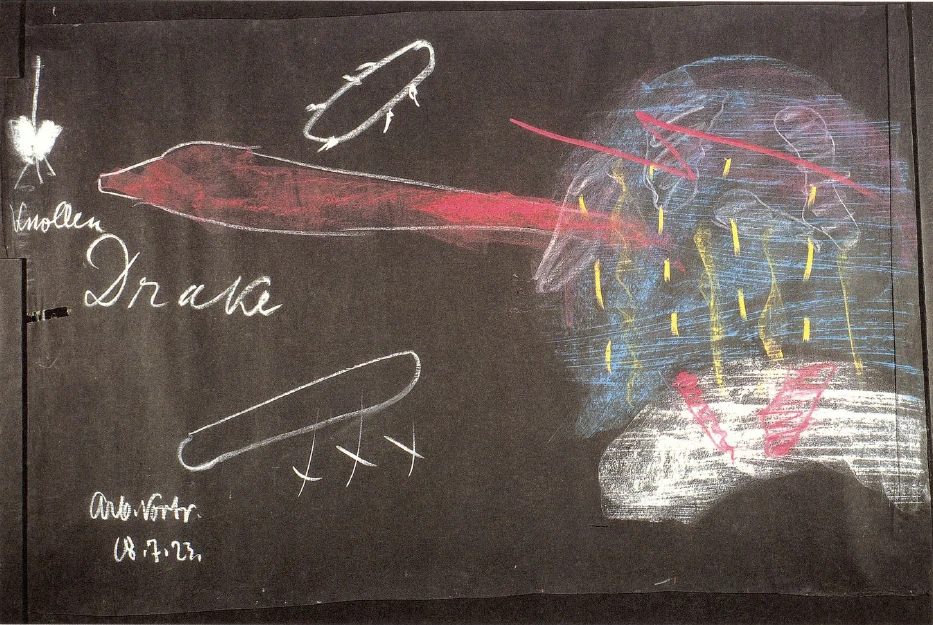
[ 6 ] And so it is with the lizard. When one looks at a lizard (it is drawn), this lizard—just like our own lower abdomen—is constantly filled throughout with fear, that is, with something psychological. And the tail, in particular, is filled with fear. When the animal expels its fear, the tail breaks off, but the fear remains trapped within the animal. The animal does not feel the fear when it is in captivity because it has become accustomed to humans, and the result is that the fear is then able to hold the tail together. Here we see a very specific psychological characteristic that has a certain significance for the animal’s physical constitution.
[ 7 ] We humans also have fear within us. It’s in our big toe, in our legs, in our stomach—fear is everywhere. It just doesn’t dare to rise above the diaphragm; it only comes up when we have nightmares. But fear is within us. — Yet fear serves a good purpose; it holds our organism together. And the bones—that’s where the vast majority of fear resides. The bones are so strong because there is a terribly powerful fear inside them. It is fear that holds the bones together. The moment you feel your bones too strongly, you develop osteomalacia. That is why you will find, in the case of anxious people—those who were already anxious in their youth, when their bones were not yet hard—that their bones are very easily softened, yet they remain anxious; this confirms the point, and one can therefore heal rickety children by driving out their fear through some means, particularly through spiritual means. But it would be entirely wrong to say: “So fear is something psychological within us. We just need to raise our fear to a higher level, and then we could attain higher insights.” — That would not be good, because we would be making ourselves sick both mentally and physically. Rather, we must do something else.
[ 8 ] You see, if we want to gain insights into the spiritual world—I’ve already told you about the other means—we must truly immerse ourselves in the outer world, truly immerse ourselves. Well, how do people immerse themselves in the outer world? You’ve been able to see this wonderfully again over the past few weeks. Haven’t we? We were freezing terribly, and afterward we were sweating terribly. Well, that’s how most people immerse themselves in the world—they feel nothing more than that one moment they’re sweating terribly, and the next they’re freezing terribly. But that is not the only way to immerse oneself in the outer world; rather, it is a matter of developing within oneself a certain ability—so that when it gets cold, one does not merely feel the cold, but rather becomes aware of the cold and experiences a kind of fear, and knows that when it gets warm, this fear subsides. If one cultivates within oneself a certain fear of the snow and a certain sense of well-being in the warm rays of the sun, then this is simply something that leads to higher insight—something that belongs to the other aspect I have described to you. And this is certainly true: Anyone who wishes to gain higher insight must feel something when approaching a red-hot piece of iron, and must feel something when approaching a pebble. When approaching a red-hot piece of iron, they must have the inner feeling: This is something related to your own warmth; it does you good. — But when they take a pebble in their hand, it must feel eerie to them; they must feel a sense of dread.
[ 9 ] Well, gentlemen, this also shows you that anyone who wishes to gain higher insights must not be “nervous,” as they say today; otherwise, if he were to pick up a pebble, he would immediately drop it because it frightens him. One must be courageous and endure the fear. Nor must one act like the mosquito, which takes such delight in the light that it even flies straight into it and meets its death. It is precisely in the insect that flies into the flame that you can see how the flame is related to the spiritual-soul aspect.
[ 10 ] And so we can say: We must cultivate an inner feeling, an inner sense for what exists out there in nature. — What does this lead to? Yes, you see, gentlemen, the Earth first of all has solid rock (drawing on p. 201, light-colored at the bottom). Materialists believe in the Earth’s solid rock, because they can walk on it; it is hard to the touch. Materialists believe in the solid rock. But it is precisely in the face of this solid rock that those who wish to acquire higher knowledge feel a certain apprehension.
[ 11 ] This anxiety is completely absent when a person is in the warmed air. I’ll now draw the warmed air over the solid rock. When a person looks at the warmed air, this anxiety is completely absent, because the warmed air—I’ll depict it as warmed by making it slightly reddish—does not cause anxiety. But it is possible to reach a point where the warm air does make one anxious. This is precisely the case when one tries to cope more and more with what one feels in the presence of the warm air by taking pleasure in it. Just imagine: There’s someone who feels more and more at ease in the warm air. But now the warm air is starting to make him anxious, too! — The more at ease you feel, the more anxious the warm air makes you.
[ 12 ] So if one now gets used to feeling quite comfortable in the warm air—if, so to speak, one becomes more and more accustomed to the warmth—such things are necessary; one must attune oneself to the whole of nature if one wishes to gain spiritual insight—then the whole thing begins to take on a very strange character. Let me make it even clearer to you. Most people try to cool off again when they get warm. Naturally, they know nothing else but that they’d like to feel cooler. But if you endure the warmth, if you remain within it, if you actually perceive the warmth as a feeling of well-being, then what I have schematically drawn here in the air (in yellow) begins to fill itself quite strangely with all sorts of images (bright at the top), and the spiritual world truly begins to emerge—the spiritual world that is otherwise contained in the air, but which people do not feel in the air, do not perceive in the air, because they do not want to endure the warmth of the air.
[ 13 ] Once you have become accustomed to seeing all these spiritual beings that are present in the air—but which humans do not perceive because they cannot bear the warmth of the air—once you have become accustomed to seeing these beings, you will gradually begin to notice something remarkable about solid rock. One begins to realize, in fact, that one says to oneself: Yes, when I grasp a stone with my clumsy hand, it is hard. But when I begin to perceive the spiritual more and more, when I enter more and more into the spiritual, when more and more around me is not only the physical but also the spiritual—yes, then, although I cannot slip into the earth with my physical body of flesh and blood, I can begin to slip into the earth with my astral body, of which I have spoken to you. — That is very interesting: the moment one begins to perceive the spiritual in the air through all the means I have spoken to you about, at that very moment one slips out of one’s body to such an extent that one no longer perceives the stones as an obstacle, but sinks—like a swimmer into water—into the solid earth. You enter it yourself (drawing, red at the bottom). This is extraordinarily interesting. You cannot enter the air as a spirit, because other spirits appear there. Into the earth—which is actually empty for the spirit—you can easily slip in; there you can submerge like a swimmer.
[ 14 ] And, you see, the middle state is the one with the water (blue). The water evaporates upward and comes back down as rain. Up there—as you’ve already seen—lightning often forms (red at the top). The water is between the solid ground and the air. It is less dense than the solid ground, but denser than the air. So, what does that mean? It means something that’s best seen when you look up at a flash of lightning. When it comes to lightning, scholars say: that’s an electric spark. Why do the scholars say it’s an electric spark? Well, you may already know—otherwise I’ll tell you now—that if you take a sealing wax stick and rub it with a leather cloth, a piece of leather, it becomes electrified, and if you then have small scraps of paper, they’ll be attracted to the sealing wax stick. And in this way, you can make all sorts of objects electrically charged by rubbing or by other means. Children are already taught this in school.
[ 15 ] But there is one very specific requirement. Namely, if you’re in a damp classroom, the sealing wax rod won’t become electrically charged—nor will the other objects used in experiments—and you must first wipe everything down thoroughly with a completely dry cloth, because moisture does not generate electricity. Then you can generate electricity. Now the scholars say: Up there are the clouds, which rub against each other and produce the electric spark—the lightning. — Yes, but, gentlemen, any child could object: “But you have to be able to keep moisture out, because if there’s even a little moisture on your apparatus, then electricity won’t be generated!” — Any child could object to that. So such nonsense is being spouted. Of course, there’s absolutely no question of the clouds rubbing against each other up there.
[ 16 ] But consider this: when the water evaporates and rises, it enters more and more into a realm of spirituality, moving away from the spiritless matter down below and penetrating the spirituality above—and it is truly the spirit that generates the electric spark, the lightning. For as we ascend farther and farther, we enter the realm of the spiritual. The Earth has material matter only in its immediate vicinity. Higher up, it is surrounded by the spiritual. So we truly enter into the spiritual there. And so it is that at the very moment when the water vapor rises and enters the realm of the spirit, lightning can arise from the spirit. The water becomes spiritualized up there and comes back down in condensed form. So when observing nature, one must also turn toward the spiritual. And only when one refuses to take the spiritual into account at all does one arrive at all sorts of absurd notions, such as those I mentioned to you regarding the dream of flying, the lizard’s tail, or lightning. One sees everywhere that nature cannot be explained unless one first penetrates into the spiritual realm.
[ 17 ] Now you can also understand this: When a human being stands on Earth, he is actually, from the bottom up, always connected to the spiritual realm below; he can dive into it like a swimmer. So when we step out of our physical body and our etheric body at night with our astral body and our “I,” we are actually entering the solid environment everywhere. We connect with what is solid, for we cannot enter the airy realm, and we do indeed wander about within the solid.
[ 18 ] This wandering through the solid world, however, is of great significance. If, as I told you earlier, we relate to warmth in the right way, then we will come to see the spiritual beings of the air. But when we leave our physical body at night and connect with the earthly realm as a spirit, it may be that when we wake up, we still retain something of what we experienced within the solid substance of the earth. We still have something within us; we have something within our soul.
[ 19 ] Well, that’s something that’s extraordinarily interesting. Because you’ve probably already noticed: When you wake up, it’s very easy to hear sounds. And if you pay close attention as you wake up, you’ll experience something strange—you’ll find yourself saying, “Someone just knocked on my door!” — That’s exactly what’s so strange: When you immerse your soul in the air, you see things; images arise. But when you immerse your soul in the solid, in the material world—just as a swimmer dives underwater—then you experience sounds. And that is precisely what is so extraordinarily important: that all solid matter constantly emits sounds that you simply do not hear because you are not immersed in it. Every solid substance constantly contains sounds within it, and you can still hear them as you wake up, because you are still half immersed in it.
[ 20 ] But these sounds can certainly mean something, and it is certainly true that if, for example, someone has died somewhere in the distance and a person hears something like a knock on the door upon waking, this is connected to the deceased. Now, of course, people are not capable of interpreting these things correctly. Just think about it: None of you would be able to read—that is, interpret the letters on the paper—if you hadn’t learned how. Nor can you interpret this wondrous phenomenon that occurs when you hear sounds upon waking. You don’t have to believe that it is specifically the deceased person at the door, knocking with their fingers. But the deceased, who is still present on earth in the first few days after death, lives within the solid bodies. And this is something that need not seem miraculous to you at all—that sounds arise precisely through the connection with the physical world, as has always been recounted in times when people paid more attention to such matters. The fact that people have premonitions when someone dies in the distance has a positive significance. A person has died. At first, their soul is still bound to the solid earth. This is where the sounds emanating from them arise. The person leaves earthly existence with a sound. Of course, you can hear this just as clearly from afar as you can read from afar what someone in America is reporting. A telegram can be read in America. Such distant effects through the earth’s substance exist; they are present on Earth; they are always there. And in times when people paid attention to such matters, they were fully aware of the connection between the spiritual and the earthly. This is not merely a fairy tale; it is in fact something that was perceived in earlier times. So you see, one enters into very specific realms that are considered superstition today, but which can be proven just as scientifically as other scientific matters.
[ 21 ] But one must also understand these things very precisely. For you see, if people were able to perceive the spiritual world in the air—if, that is, people weren’t quite as whiny as they are today —you know, the more civilized people become, the more whiny they become in a certain sense, and those who, let’s say, have to live in a terrible rush because of their work, who don’t have time to perceive the spiritual world while they’re working—, then the spiritual world that lives in the air would not escape them. But the fact that one would see spiritual beings in the air—that would actually be something quite harmless. Any person could perceive this without further ado, without it posing any danger to them.
[ 22 ] But this hearing—when it takes hold of a person too strongly, and when they become too deeply immersed in a state where all sorts of things become dangerous to them. The fact is this: There are people who gradually enter a state where they hear all kinds of words. All sorts of things are said to them. — These people are on the path to madness. You are never actually in danger by seeing spiritual beings in this way—that is, by looking for them in the air. Why? Well, I must explain this to you using a comparison: If you’re in a boat and fall into the water, you can drown. If someone pulls you back up, you may experience all sorts of things, but you cannot drown. — It is the same when the human soul rises upward and sees all sorts of things. Nothing can happen to it there. If it descends into solid matter, however, it can—I would say—spiritually drown. And this spiritual drowning occurs when people lose their consciousness to such an extent that all sorts of things are told to them inwardly. And that is the worst part. You see, when a person perceives the spiritual externally, well, it is just as if they were walking around in the world; and just as they are not afraid of the chair they see, so too do they gradually cease to be afraid of the externally perceived spiritual—in fact, they even come to enjoy it. But what is heard inwardly—for we do sink into the solid earth with our entire spiritual and soul life—what is heard inwardly, that completely engulfs one. There one drowns inside; there one ceases to be human. That is why one must always regard with a certain vigilance those people who say that all sorts of things are being told to them inwardly. That is always something dangerous. Only those who are already firmly established in the spiritual world and know their way around it truly understand what is actually being said: that it is never particularly high spiritual beings who speak to one, but rather that it is actually always those beings who are of a rather lower order. You see, gentlemen, I have now told you these things quite candidly so that you may see: as human beings, we must truly arrive at a completely different understanding of the external world if we wish to enter the spiritual world.
[ 23 ] Of course, there are people who say: “Yes, why have the spirits made it so difficult for us to get to know them?” — Yes, but just think for a moment what kind of being a human would be if he didn’t have to make any effort at all to enter the spiritual world, if he were always already there! They would be nothing more than a spiritual automaton. It is precisely because they must make an effort that they come into the right relationship with spiritual beings. And it takes the greatest possible inner effort to be able to explore the spiritual world.
[ 24 ] Of course, it is easy to settle in at a laboratory bench and conduct all sorts of experiments; it is easy to dissect corpses and learn all sorts of things, but it truly requires intense inner work to truly enter the spiritual world. Today’s educated world is too lazy for this work. And it is actually always because of this laziness that people say: “I’ve done the exercises from How to Attain Knowledge of the Higher Worlds, but I haven’t seen anything.” — People believe that this should be given to them externally, that they don’t have to work it out for themselves internally. Gentlemen, that is precisely the point: people today want everything served to them on a platter! I have already told you: People today want to film everything; they want to turn everything into a movie so that it comes to them from the outside.
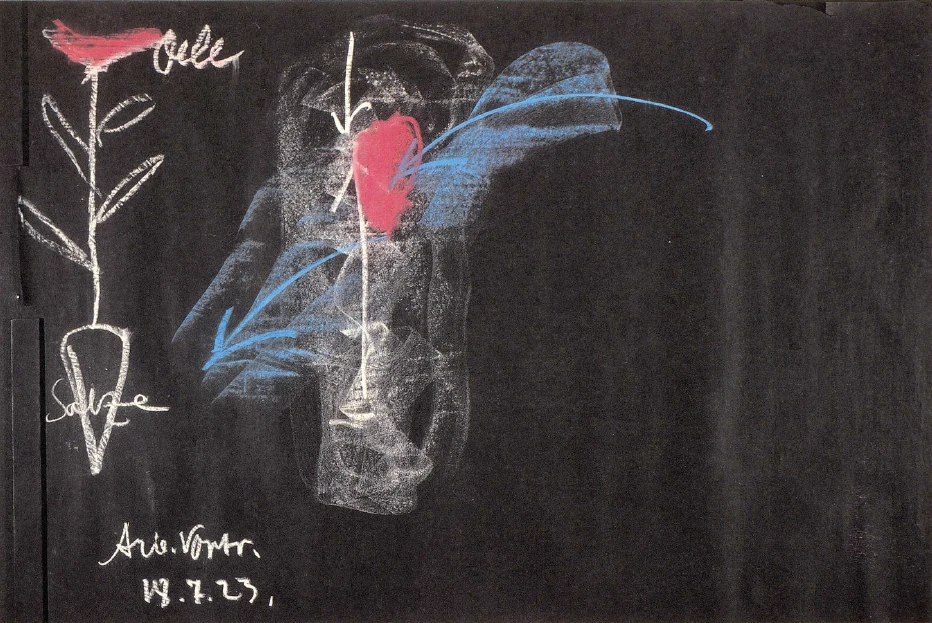
[ 25 ] If one truly wants to make spiritual progress, one must be mindful at all times that, when taking in something from the world, one must work through it. Therefore, those who, in the future, avoid as much as possible having everything “pre-filmed” for them—but instead choose to think things through for themselves when they hear about the world—will make greater spiritual progress. And, you see, I haven’t shown you a film. Of course, there isn’t time for that, but even if there were, I wouldn’t try to demonstrate the matter with a film; instead, I’ve made drawings for you that were created on the spot, so that you could see what I intend with each stroke and think along with me. This is also what must be incorporated into our children’s lessons today: as few finished drawings as possible, and as much as possible of what is emerging in the moment, where the child sees every stroke as it is being made. In this way, the child participates inwardly, and in this way, people are stimulated to inner activity, which then leads them to immerse themselves more deeply in the spiritual realm and, in turn, to gain an understanding of the spiritual. Nor should we present children with complete, ready-made theories, for then they become dogmatic. Rather, what matters is to encourage them to become active on their own. This also frees their entire body.
[ 26 ] Now, since this is also mentioned in one of the questions, I’d like to point out something else. You may have already heard that potatoes were not introduced to Europe until a certain time. After all, people in Europe did not always eat potatoes.
[ 27 ] There was, in fact, a rather peculiar story that happened there once. You see, there’s an encyclopedia that I actually helped compile—though not the entry I’m talking about now. There’s something very funny in there, namely, that it’s widely claimed that a certain Drake introduced the potato to Europe and earned this great distinction. — In Offenburg, which is now occupied by the French, there’s also a Drake monument. Well, I once found it terribly funny when we looked it up in the encyclopedia and it really does say there: A monument was erected to Drake in Offenburg because he was mistakenly reputed to have brought the potato to Europe! — So if someone is supposedly said to have said something, a monument is erected to them in Europe! Well, I don’t want to talk about that, though; rather, I want to talk about the fact that at a certain point in time, the potato was brought to Europe.
[ 28 ] Let’s take a look at the potato. We don’t actually eat the roots of the potato. The roots are actually these little things (a drawing is made). If the potato were here, these little roots would be attached to it. The potato itself is a somewhat thicker stem. So when an ordinary plant grows, it has a root, and then the stem grows. But when the stem thickens, as it does with the potato, a so-called tuber—a tuberous stem—forms. But this is actually a thickened stem, so with the potato we’re not dealing with a root, but with a thickened stem. So, remember this very well: When you eat a potato, you are eating a thickened stem. You derive your nourishment primarily from a thickened stem. — We must now ask ourselves: What significance does it have for human beings that, through the potato—which was brought to Europe—they learn to eat primarily a thickened stem?
[ 29 ] If you look at the entire plant, it consists of the root, the stem, the leaves, and the flower (see illustration). There is something very remarkable about the plant: the root down below becomes very similar to the soil and contains, in particular, a lot of salts, while the flower up above becomes very similar to warm air. It is as if the flower were constantly being cooked by the sun’s heat. The flower therefore contains oils and fats—especially oils. So when we look at a plant, we see the salts settling at the bottom. The root is rich in salts, and the flower is rich in oils.
[ 30 ] Well, the result of this is that when we eat the root, we get a lot of salts into our intestines. These salts find their way up to the brain and stimulate it. So the salts stimulate our brain. And, for example, if someone suffers not from migraine-like headaches but from headaches that feel like they’re filling the entire head, it’s quite beneficial for them to eat roots. You can see, after all, that many roots contain a certain salty sharpness. You can tell this by the taste. But when you eat the flowers, the plant is actually already half-cooked. The oils are already present on the outside; these primarily lubricate the stomach and intestines and have an effect on the lower abdomen. The doctor must also take this into account when prescribing tea. When someone brews tea from the flower, it will never have a strong effect on the head; on the other hand, if they boil the roots and have the patient drink it, it will have a strong effect on the head. So you see, while with humans we must proceed from the abdomen to the head—from the bottom up—with plants we must take the opposite path, from the flower to the roots. The root of the plant is related to the head. The flower of the plant is related to the intestines, and so on. When we consider this, the significance of the potato becomes clear to us, so to speak. For the potato has tubers; these are something that has not quite become a root. So when you eat a lot of potatoes, you are essentially eating plants that have not quite become roots. If you limit yourself to eating potatoes and eat too many of them, you don’t get enough into your head. It stays down in the digestive tract. So it is the case that, by eating potatoes, people in Europe have neglected their heads, their brains. You only see this connection when you study spiritual science. Then you say to yourself: Ever since this potato-based diet has become more and more prevalent in Europe, people’s minds have become less capable.
[ 31 ] And the potato primarily stimulates the tongue and throat. When we go down through the potato plant, we do not go all the way to the root. It is the same with humans: if we do not go all the way up to the head but stop at the tongue and throat, these are particularly stimulated by the potato; and therefore the potato is very palatable as a side dish for people, because it stimulates what lies below the head and leaves the head undisturbed.
[ 32 ] When you eat beets, gentlemen, you get a terrible urge to think a lot. You do this completely unconsciously. When you eat potatoes, you actually get the urge to eat again very soon. Potatoes make you hungry so quickly because they don’t quite reach all the way to the head. Beets fill you up very quickly because—and this is the important part—they actually reach all the way to the head, and the head is the most important thing, since they completely fill it with activity when they truly penetrate the mind. Of course, it’s terribly unpleasant for people to have to think, and that’s why they sometimes prefer potatoes to beets—because potatoes don’t stimulate thinking. It makes you lazy. It doesn’t stimulate thinking; you become lazy in your thinking. Beets, on the other hand, strongly stimulate thinking because they are a true root vegetable; they strongly stimulate thinking, but they do so in a way that actually makes you want to think, and if you don’t want to think, then you don’t like beets. If you need stimulation for thinking, you especially need the salty stimulation provided, for example, by radishes. If someone isn’t very active mentally, this does them good, because it gets their thoughts moving a little when they add radishes to their meals.
[ 33 ] So you see that this strange thing happens: One could say that radishes stimulate thinking. — And you don’t even have to be very active in your thinking yourself; when you eat radishes, thoughts just come—thoughts so strong that they even lead to very powerful dreams. Those who eat a lot of potatoes do not have strong thoughts; instead, they have dreams that weigh them down. And those who are forced to eat potatoes constantly will actually be constantly tired and will constantly want to sleep and dream. Therefore, the types of food that people actually consume have great cultural-historical significance—great historical significance.
[ 34 ] You might say, gentlemen: “Yes, but the fact is that we actually live entirely off that substance!” — And yet that is not true. I have told you many times: We humans have a new body about every seven years. It is constantly renewing itself. The matter that was in our bodies eight or ten years ago is no longer inside us. It’s gone. We’ve cut it away with our nails, trimmed it off with our hair, and it’s been excreted through sweat. It leaves the body. Some of it leaves quite quickly, some slowly, but it leaves.
[ 35 ] Well, how does one actually picture this whole business with human beings? You see, one pictures it roughly like this—I’ll draw a schematic diagram ($. 212, red)—: There is the human being (light). Now, the human being constantly excretes matter and continually takes in new matter (blue arrows). So one imagines it like this: Matter enters through the mouth, and exits again through the anus and urine, and the human being is like a tube. He takes in matter by eating, retains it for a while, and expels it again. — That’s roughly how one thinks the human being is constructed.
[ 36 ] But in real human beings, nothing at all of this earthly matter enters them—absolutely nothing. That is merely an illusion. The fact is this: When we eat, say, potatoes, for example, it is not at all a matter of absorbing anything from the potato; rather, the potato is merely something that stimulates us—stimulates our jaws, throat, and so on. The potato exerts its effect everywhere. And now the force arises within us to expel this potato again, and while we are expelling it, that which builds up our body over the course of seven years comes to meet us from the ether—not from solid matter (light arrows). We do not actually build ourselves up from the substance of the earth. We eat what we eat merely to receive stimulation. In reality, we build ourselves up from what is above. So the whole idea that people have—that food goes in here and comes out there, with something remaining inside in the meantime—is completely wrong; that merely provides a stimulus. A counterforce comes from the ether, and we build our entire body out of the ether. Nothing we possess is built from the substance of the earth. You see, when we push something out and it pushes back, you must not confuse the second push with the initial one. You must not confuse the fact that we need food so that we do not become sluggish in restoring our bodies with the act of taking that food into ourselves.
[ 37 ] The fact is, however, that irregularities can occur. For when we consume too much food, it remains inside us for too long. Then we accumulate unnecessary matter within ourselves, become corpulent, fat, and so on. If we consume too little, we lack stimulation and fail to draw enough of what we need from the spiritual world, from the etheric world.
[ 38 ] But this is something so important, gentlemen, that we are not built up from the earth and its substances at all, but rather from that which is outside the earth! If it is true that the entire body is renewed in seven years, then the heart is also renewed (red). The heart that you carried within you eight years ago is no longer within you; rather, it has been renewed—not from the matter of the earth, but from that which surrounds the earth in the light. Your heart is condensed light! You have, in fact, condensed sunlight into your heart. And the food you have consumed has merely stimulated you to condense the sunlight to that extent. You build up all your organs from the light-permeated environment, and the fact that we eat—that we consume food—merely serves as a stimulus.
[ 39 ] You see, the only thing food gives us is that we have within us something like a kind of inner chair. We sense ourselves; through this, we develop a sense of self in everyday life—the realization that we have physical matter within us, physical substance. We sense ourselves just as you do when you sit down in a chair. There, too, you feel the chair pressing against you. And in the same way, you feel your body constantly pressing against what you have fashioned from the universe. When you sleep, you don’t feel it because you are outside of yourself at that moment. You feel your body; it is a kind of resting bed made for you—harder for some if they are bony, softer for others. It is a kind of resting place into which a person lies down, and one certainly feels the difference between a soft feather bed and a wooden bench! And so a person feels the difference between what is hard and what is soft within them. But that is not the true self; rather, the true self is what sits inside them,
[ 40 ] Next time, I will explain to you how this relates to higher knowledge. For people today who seek knowledge do not concern themselves at all with human activity, but focus solely on what their armchair has to offer them.