Rhythms in the Cosmos and in the Human Being
GA 350
7 July 1923, Dornach
Translated by Steiner Online Library
10. Developing Inner Honesty
[ 1 ] Gentlemen, in my last lecture I explained to you that people today cannot gain any insight, because the kind of thinking we have today is actually not suited for that purpose. In the past, even as far back as, say, a thousand or fifteen hundred years ago, anyone who wanted to learn something first had to train their thinking. People did not believe that they could somehow comprehend the spiritual world using their ordinary way of thinking, and there was a kind of training of the mind. Today, with all the education we have, people are not at all encouraged to train their thinking in any way. Therefore, in reality, they are actually incapable of thinking.
[ 2 ] I'd like to explain this to you first using an example that you may have read about in the newspaper recently.
A common recurring dream is the so-called “flying dream.” We dream of flying, floating, or falling—and very often right after going to bed.
[ 3 ] Well, you’re all familiar with the fact that you’ve flown in your dreams. Now someone who is accustomed only to scientific thinking wants to explain this. You’ll soon see that this kind of thinking gets you absolutely nowhere when it comes to matters like this.
As Dr. Richard Traugott explains in Natur, this dream is caused by a sudden, jerky contraction of the body that actually occurs.
[ 4 ] So, what does this man believe? He believes that when you’re falling asleep, your body twitches. Now I ask you, gentlemen: haven’t you often flinched, even when you were awake? When do you flinch? — I think you flinch when you’re startled, when you experience something that terrifies you or perhaps fills you with fear, something that takes you by complete surprise in that moment. That’s when you flinch. For example, you might also flinch if, say, you’re walking around outside and suddenly see someone you think is from America; when you notice that person, you flinch because you’re surprised. But you would never imagine, when you start to flinch, that you’re flying! It really wouldn’t even occur to you—not even in a dream—that when you flinch, you’d think you’re flying. So you see what kind of confused thoughts one is actually starting from when one thinks that one could get the idea of flying simply by flinching with one’s body. You can see from this: People come up with ideas, but the moment you try to use them to explain anything about human beings, they don’t fit at all. — These ideas work as long as you’re experimenting with inanimate substances in the laboratory, but the moment you’re supposed to explain something, they no longer apply.
[ 5 ] Now let's continue:
The cause of this twitching lies in the different behavior of muscle tension during wakefulness and sleep: When awake, the body’s muscles constantly receive energy from the central nervous system,
[ 6 ] — so he assumes that, when we are awake, electrical currents—flows of energy—are constantly flowing from the nerves into the muscles —
which put the muscles under the tension necessary for maintaining the body's balance and for the smooth coordination of the musculature as a whole; during sleep, this muscle tension largely subsides, and since in the first stage of sleep...
[ 7 ] — that is, right after you fall asleep —
... if the reflex excitability of the spinal cord is increased, the process of muscle relaxation—or rather, the stimulus it exerts on the spinal cord—easily triggers that jerk reflex,
[ 8 ] — so a stimulus is now to be applied to the nervous system in the spinal cord; this stimulus is then supposed to continue to have an effect, causing the muscles to tense more strongly —
that is, the body’s reflexive contraction. Other actual sensations in the organs may have an even more direct effect on the emergence of the sensation of flying,
[ 9 ] Floating in the air, swimming: in particular, the rhythmic, rising and falling movements of the respiratory muscles and the chest—now think about it: when you start gasping for breath and your chest tightens, have you ever had the feeling that you were flying? That’s when you really feel heavy—
as well as, specifically, the absence of the sensations of pressure and resistance from the surface on which we rest, which we experience while awake in all parts of the body that rest on a surface.
[ 10 ] Well, gentlemen, you see, when you walk while awake, you’re standing on a very small surface; you feel as though you’re walking on the soles of your feet. And when you’re sitting while awake, you have a slightly larger surface area than just the soles of your feet. Because even if you add this surface area to the size of the surface area of the soles of your feet, it’s still small compared to the space you occupy when you’re asleep. Now the gentleman says: The surface pressure disappears. Surely there is greater surface pressure when you lie down and have fallen asleep than when you are walking or sitting while awake! So you see how this line of thinking leads one to simply assert nonsense. And that is today’s science of the human being!
[ 11 ] So he means: Electrical currents flow into the nerves. These currents are stronger when you sleep; that’s when the muscles twitch, and then you start to imagine flying—in other words, you believe you’re flying—or the bedding slips away while you sleep! It’s actually hard to believe what’s being said here.
Also, the absence of the sensations of pressure and resistance from the surface, which we experience while awake in all parts of the body that rest on a surface.
[ 12 ] It is hard to believe that a person would not raise the objection that, after all, we rest on a much larger surface while sleeping. But he does not, because modern thinking, when it is not asserting such nonsense, is simply unable to offer any explanations at all.
[ 13 ] Now let us take a moment to clarify a few things—for from this you will see how one comes to an understanding of a higher, spiritual world—and what really happens when a person falls asleep.
[ 14 ] First, I’d like to illustrate this for you in a very figurative way. As you know, this is only an illustration. But suppose you had the physical body of a human being here (drawing on the left). Inside this physical body of the human being is the etheric body, the supersensible body; I’ll draw that in yellow. So it’s in there, filling it out. It is, therefore, invisible.
[ 15 ] These two bodies—the physical body and the etheric body—remain in bed while we sleep. Now, when we are awake, the astral body is still inside these two bodies—I’ll draw that by adding the red line above them—and inside that is also the “I,” the fourth member. I’ll draw that less distinctly (purple). This is what the waking human being is like: physical body, etheric body, astral body, and the “I”; they are nested within one another.
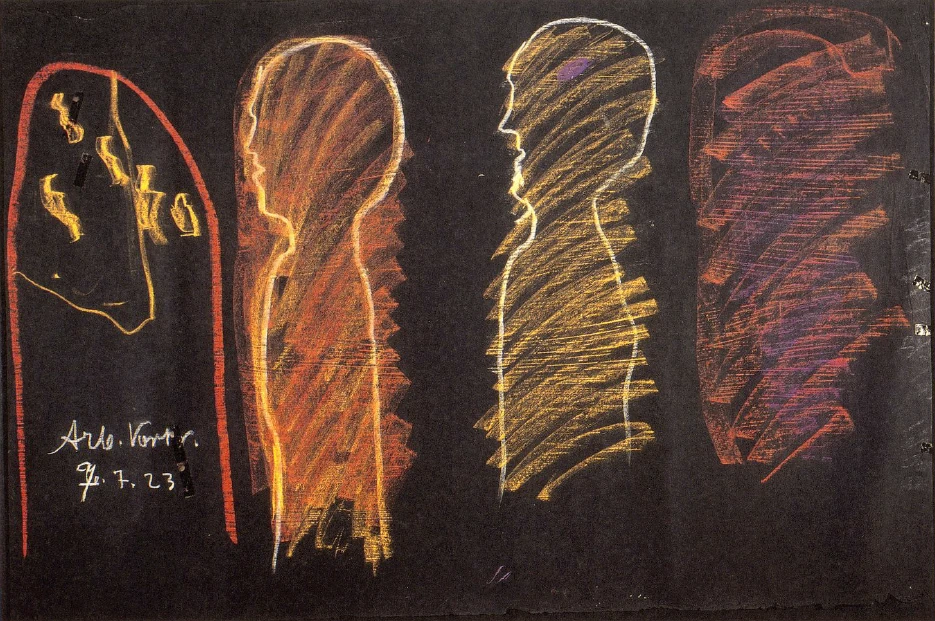
[ 16 ] Let’s now look at the sleeping person. The sleeping person has only the physical body and the etheric body (center) lying in bed. That is what is here in bed. Outside the bed are the astral body—which has left—and the I, the I-body (on the right). What remains lying in bed is like a plant, for a plant also has a physical body and an etheric body. If the plant had no etheric body, it would be a stone. It would not live, nor would it grow. So what remains lying in bed is like a plant. The plant does not think. What is inside the bed—you know this very well—does not think in the sense that thinking is conscious. The thoughts are there inside, as I explained to you recently, even clearer than the thoughts we use when we are conscious, but conscious thoughts are not there. It is just like with the plant.
[ 17 ] But out here, human beings are such that they can no longer sense any boundaries. You can even explain why, when we step out of the body, our consciousness immediately fades. For when you are inside your body, you must make your astral body as large as your physical body. When you step out, the astral body suddenly begins to grow enormous, expanding in all directions, because the physical body no longer restrains it or keeps it small. So that the moment you fall asleep, you step out of your physical body; there you become bigger and bigger.
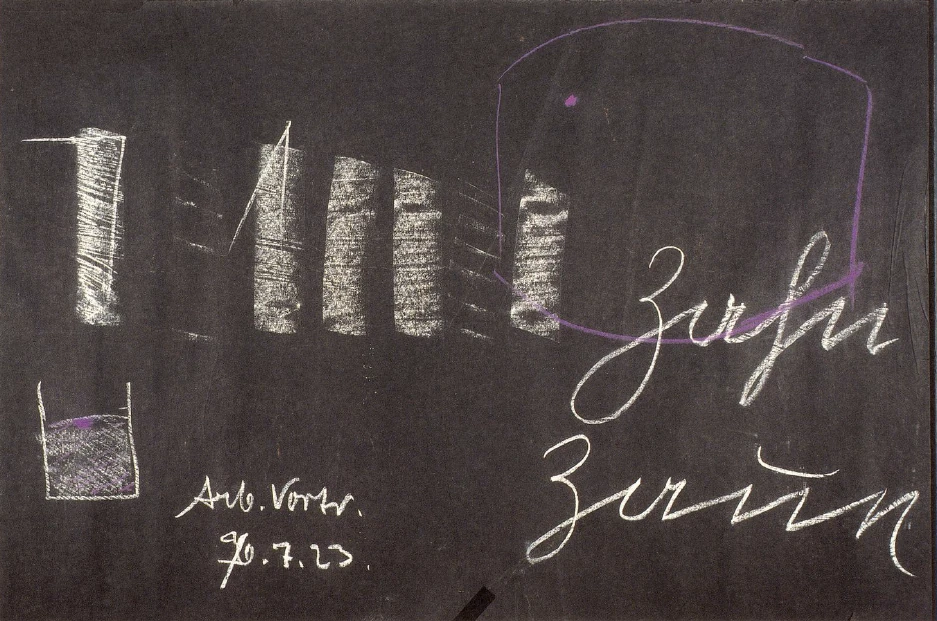
[ 18 ] Now imagine you’re drinking a glass—so there’s no misunderstanding, I’m talking about alcohol here; as you know, this has become a sensitive topic in Switzerland—so let me put it this way: you’re drinking a glass of water with a little raspberry juice. If you put a little raspberry juice into a glass of water, then you’ll have the taste of raspberry juice. But imagine, instead of that glass, you take a container big enough to hold five bottles of water, and you add only as much raspberry juice as you did to the glass earlier, and stir it well—since the raspberry juice has to be diluted in much more water, you’ll notice the raspberry flavor is much weaker. Well, you see, when I was a little boy, I grew up near a wine shop; there was a cellar with a barrel holding four hundred buckets of wine. If you had filled that with water—that is, a barrel containing four hundred buckets of water, not wine—and added just a few drops of raspberry juice and stirred the whole thing together, you could have drunk that water and wouldn’t have tasted a thing of the raspberry juice. That’s obvious. Now, gentlemen, as long as your astral body is as small as your physical body, it is like the raspberry juice in a glass of water: your astral body extends only as far as your physical body does. When you leave your body in sleep, the physical body no longer contracts it; the astral body expands, just as the raspberry juice expands in the four hundred buckets of water. And that is why you no longer have any consciousness within this astral body, for consciousness arises when the astral body contracts.
[ 19 ] Now, however, you will also receive a proper explanation of what is supposed to happen when we fall asleep. As long as we are awake, the astral body is present in our fingers, in our toes; the astral body is present throughout our muscles. When we feel the astral body within our muscles, we have the sensation that we are dependent on the physical body. The physical body is heavy. We feel the heaviness of the physical body. The moment we step out, we leave the physical body and its heaviness behind. In that moment, before consciousness has faded into sleep, we no longer feel heavy. We do not feel as though we are falling, for we are rising; rather, we feel as though we are floating upward. This sense of expansion, this freedom from being bound to the physical body—we experience it as flying or swimming. We can move freely until our consciousness fades and we fall completely asleep.
[ 20 ] So what does the modern natural scientist say? He says: We twitch our muscles. — Well, when we twitch our muscles, we feel them more than we usually do! We’re not imagining that we’re flying; rather, when we twitch, we feel even more bound to our physical body. Just think about it: when someone is standing there in amazement, they open their mouth wide. Why do they open their mouth wide? Because they’re so deeply immersed in their muscles that they can no longer control themselves. So it is precisely this flinching and this “living in the muscles” that is the opposite of what we experience when falling asleep. When falling asleep, we actually step out of our muscles. So it is not a matter of muscle contraction, but rather of the muscles becoming limp. When we lie down on a larger surface, we no longer need to use our muscles to hold our astral body together; they relax. And not because they become more tense, but because they become more limp—since we no longer have to exert any influence on the muscles—we believe ourselves to be free from the muscles, and we float away with our lighter astral body.
[ 21 ] Now, just think about it: I told you last time that you have to learn to think in the opposite way. — Here you can see it: Anyone who thinks the way people are currently accustomed to thinking will, when trying to explain something to another person, end up saying the opposite of what is true. — So one must first accustom oneself to thinking correctly—a way of thinking that can also conceive of the opposite of what exists in the physical realm. People have lost the habit of thinking correctly—of thinking in a way that allows one to enter the spiritual realm through thought.
[ 22 ] Today there are indeed a great many people who speak our language—and our language does include the word “spirit”—but these people can no longer imagine what a spirit is. They can only imagine something physical. And yet—as you have seen—if one wants to imagine the spiritual, one must arrive at something that has no physical properties whatsoever, something that is therefore not visible in the physical world. But people’s thinking today is already so corrupted that they want to see even the spiritual in physical terms. That is why they eventually become spiritualists. You see, the physical body can move a table. People say: If I can move a table, then I exist. If a spirit is to exist, it must also be able to move a table. — Well, then they start doing table-turning, and through table-turning they let the spiritual world be “proven” to them! This is because their thinking is warped and distorted. Thinking is materialistic; it wants to have the spirit present in a physical way as well. Spiritualism is the most materialistic thing there is. One just has to understand that first.
[ 23 ] Now, perhaps some of you might say: “But I was already there when people sat down around the table, started linking their hands together to form a chain, and then tables moved, jumped around, and all sorts of things happened.” — The outward appearance—that’s true: You can sit around a table, form a chain, and under certain circumstances, that can set the table in motion. But you see, that’s just like when I cause a large movement through some other small movement. Just imagine you have a train. The train has a locomotive at the front and the engineer sitting in it. Well, the engineer doesn’t get off the locomotive, go stand at the back, and start pushing, too. He probably wouldn’t be able to get an express train moving quickly that way. You know, the engineer makes only a very small movement, and the express train travels very fast, pulling many cars. Why? Well, because the mechanism is set up correctly. A small physical movement causes a large movement.
[ 24 ] It is just as much a purely physical process when the people around the table form a chain and then begin to make tiny twitches and the like. And lo and behold, these small, tiny twitches are transmitted through matter—which is, in fact, so artfully designed—into large movements. At first, this is a completely ordinary physical process.
[ 25 ] If there happens to be someone among them who has certain thoughts in their subconscious, then those thoughts are transmitted through their twitching fingers. And that’s how you receive answers and can interpret them using the alphabet. But what one receives as answers is always present in the subconscious of someone who is there, even if the answers are incredibly witty. I have already explained to you that when a person delves even a little into the subconscious, they are much more ingenious than they are in their conscious state. This also becomes apparent through table-turning. So the fact that people have become spiritualists is actually proof that materialism is rampant in our time.
[ 26 ] With ordinary thinking, it is impossible to arrive at any explanations that have any relevance to human beings. You see, in that newspaper article I cited today, someone tried to explain a dream—the dream of flying. He explains it in exactly the opposite way it should be explained! But people are no longer able to study such things—which are of the utmost interest. I’ve told you about dreams on several occasions; today I’d like to highlight a few important facts once again.
[ 27 ] Just imagine, gentlemen, that someone is dreaming. He dreams that he is walking across some square in Basel. But suddenly—is that even possible in a dream?—he finds that there is a fence in front of him. The fence has a slat here, another slat there, a slat missing here; then there’s a slat, another one, and another slat missing. Now he continues dreaming; he wants to jump over this fence and impales himself on a slat. That hurts him. Now he wakes up. Yes, now he realizes: “Good grief, you didn’t impale yourself on the slat at all, but you do have a terrible toothache!”—He has a toothache and wakes up with this toothache. His upper teeth have a gap up there, then there’s another gap up here. That’s what he saw as a fence with missing slats. It corresponds exactly to his upper set of teeth with the missing teeth. Then he touches one of his teeth, and that’s the very one that hurts. It’s become hollow and is causing pain. You can really have a dream like that.
[ 28 ] But what actually happened there? After all, the whole event took place while you were awake. You might say to yourself: As long as I was asleep, I was happy—I didn’t feel that ridiculous toothache. Yes, why didn’t you feel the toothache while you were asleep? Because you were out there with your astral body. The physical body and the etheric body don’t feel the toothache. You can tap on a stone as much as you want, chip off a piece—the stone itself doesn’t feel it. You can tear a plant apart, too—it doesn’t feel it because it doesn’t yet have an astral body; it only has an etheric body. You see, some people would surely stop picking roses and other flowers in a meadow if the plants always hissed like snakes because it hurts them! But it doesn’t hurt the plant at all. And a person is like a plant when they’re asleep. So as long as they’re asleep, their tooth doesn’t hurt. Now, when one slips into the body with one’s astral body, one comes into contact with the teeth as one slips in. You see, only when one is fully inside the body does one feel what is causing pain within the body. If one is not yet fully inside, what is causing pain seems like an external object.
[ 29 ] Just imagine, gentlemen, that I light a match here; I can see it burning. If I were inside it, I wouldn’t just see it through my astral body—I would actually feel it as pain. As long as I am not yet fully inside my body, but am just slipping into it, my set of teeth is like an external body; I perceive it as an external body and form a mental image that is similar. Just as I form images of external objects, so too—when I am still half outside—do I form an image of my row of teeth; and because I cannot yet form the correct image—I can only do so through spiritual science—I form the image of a row of fence slats instead of a row of teeth. And because I have gaps inside my row of teeth, the slats are missing in the row of fence posts. You see, as one slips inside, the confusion that arises from not yet being fully inside one’s body leads to a mistake. One mistakes the inner for the outer, because in sleep one is, after all, still outside. There, the inner is the outer.
[ 30 ] Look at what happens there—I’ve actually seen this happen with young children. When you teach them, they don’t yet have a feel for speaking quite correctly. And I’ve really seen it happen before: someone who’s just started writing wrote “fence” or “fences” instead of “tooth,” and then someone told them, “That’s wrong!”—So they got scared while slipping in, not while slipping out, but while slipping in. But this isn’t a flight dream—it’s a fear dream. Just like in a nightmare, the child becomes frightened and turns it into something else—and now the “tooth” has become a “fence.” The child made the mistake. And you’ll always see: it’s precisely through such word associations that the images of the dream come about! Word associations of some kind are always present. And that’s how you can understand what’s actually happening.
[ 31 ] You see, when someone speaks like this—this Richard Traugott, by the way, has already written a great deal about dreams, which is just as nonsensical as what he is now writing about lucid dreaming—and is equipped only with the very ordinary knowledge of the present day, he says the opposite of what is actually true. For he does not understand that, because the astral body is large when it leaves the physical body, he feels like a pilot, and because the astral body is constricted again when it returns, he feels like someone who has to squeeze through. Tensing his muscles is equivalent to a nightmare. The nightmare occurs precisely when the man who wrote the article believes that the dream of flying is about to happen. Even when falling asleep, you’ll only have nightmares if the process of falling asleep doesn’t go quite right. Imagine you’re lying somewhere and you get the feeling that someone is choking you. This happens because you’re in the process of falling asleep, but there’s some restlessness, and now you can’t fall asleep properly. Now try it—sometimes moving out, sometimes moving in. When you try to come back in—which you can’t do yet because you’re still tired—you feel choked because the astral body wants to come back in, is forcing its way in, but can’t quite make it. Once you understand this, you can explain all these things better.
[ 32 ] And this will also lead you to realize that something else is necessary if one wishes to perceive the spiritual world. One must be absolutely clear that the physical body cannot play a part in this. One must be able to live precisely within what the astral body is. If one wishes to perceive the spiritual world, one must therefore achieve something that would otherwise cause one to fall asleep. When one is in ordinary life and slips out of the physical body with one’s astral body, one falls asleep. Yes, you see, that is precisely the story of the wine barrel that I mentioned to you earlier. There, the astral body becomes enormous. Now, if you want to perceive the astral body, you must be able to hold the astral body together through inner strength. Just imagine what happens if, for a moment, I replace the astral body and the human “I” with the drop of raspberry juice again. Let’s look at this quite visually. Here we have the glass of water, and inside it, a drop of raspberry juice. The drop of raspberry juice is now expanding. As long as it’s inside the glass of water, you can still sense it. But suppose—and of course I can’t draw this—it were now a hundred thousand times larger: you wouldn’t see anything of it if I were to illuminate it in proportion to its size. Nor, however, could you sense anything. But imagine if that drop were a real tough guy, and I put it into this wine barrel containing four hundred buckets of wine—excuse me, not wine, water—and that drop of raspberry juice, now that’s a real tough guy, who says to himself: “I won’t let myself be mixed in; I’ll stay the drop of raspberry juice!” — Now there’s the wine barrel or water barrel, and the drop of raspberry juice remains very small. If you were to dip your tongue down, lick through the water, and reach the spot where the drop of raspberry juice has remained small, you would taste the sweetness of that drop. So it has to resist.
[ 33 ] I say he’s a devil of a guy, just to use an expression. The opponents of anthroposophy can be quite amusing at times. A Hamburg newspaper once wrote—after anthroposophy had been vilified from every angle—about who I was, and it claimed that I was actually the devil! So that was meant quite seriously—that the devil had come into the world. I’m just saying that the raspberry juice drop would be a real character in that sense, in that it can remain small even when you put it in water. It’s a different matter with the astral body: if it can remain as small as it is inside the physical body when it comes out. Now one simply has to develop the power to keep the astral body that small. You can do this by developing sharp thinking. I’ve told you that you must develop independent thinking. But independent thinking is stronger than the weak thinking these people have. The first condition is strong thinking. The second condition is the ability to think backward. External physical phenomena proceed forward. If you learn to think backward, you learn to think even more powerfully. And if you also learn what I told you last time—that every part is greater than the whole (which contradicts the physical realm)—then you learn to immerse yourself in a world that is not like the physical realm, but is the opposite of it. Then you learn to immerse yourself in the spiritual world.
[ 34 ] All these factors ensure that the astral body, even though it leaves the physical body, can remain compact and does not dissipate into the general astral sea.
[ 35 ] So this is certainly consistent. But you must also be very clear that all these things must be viewed with the same objectivity and scientific rigor as the phenomena of external physical life. As soon as one starts fantasizing, spiritual science is no longer possible. One simply must not give in to fantasy.
[ 36 ] Suppose, for example, that you have—well, let me put it plainly—pain in your big toe. You feel this pain in your big toe only through your astral body. If you had only your physical body, you would feel no pain. If you had only the etheric body, you wouldn’t feel any pain; otherwise, plants would whimper when you touch them, and flowers would whimper when you touch them. Well, you whimper when you have pain in your big toe—I mean, you might not actually whimper, but you know what I mean. So we wince when we have pain in our big toe. Well, why do we wince? You see, our astral body is spread out over our entire physical body. When we reach the spot with our astral body where something is amiss in our big toe, we transmit that sensation through the astral body all the way up to the brain. Now we form a mental image of our pain.
[ 37 ] But suppose someone has a diseased brain. If someone has a completely healthy brain, there is also a part of that brain that allows them to perceive pain in their big toe. To perceive pain in the big toe, one needs a healthy part of the brain. But let’s suppose this part of the brain were diseased. I have told you: The soul cannot become diseased, the astral body cannot become diseased, but the physical brain can become diseased. — If this part of the brain is diseased, the pain in the big toe cannot be perceived. What does the person do? Yes, gentlemen, a small part of the physical brain is diseased; but, you see, the etheric body of the brain is still present in that area. The etheric part of the brain located there is now not being supported by the physical part. What does the etheric part do? The etheric part turns your big toe into a mountain. It no longer merely perceives the big toe, but turns it into a mountain, and it transforms the pain into a multitude of little spirits—mountain spirits—that dwell inside it. So you see (drawing $. 192): Here you have your big toe; you’ve projected it out into space because you had a diseased brain. And now you swear that there’s a tall mountain standing before you! But it’s really just your big toe. That’s a delusion.
[ 38 ] Gentlemen, one must guard against harboring such delusions if one wishes to penetrate the spiritual world; otherwise, one simply falls into fantasy. How, then, can this be achieved? This, in turn, must first be achieved through training. One must know what can emanate from the physical body when it is ill in some way. Then one will no longer confuse what appears to be the true spirit with what merely arises from the physical body.
[ 39 ] So, when it comes to active thinking, to thinking in reverse, to the kind of thinking I described to you last time—where one thinks in a completely different way than in the physical world—one must also come to know with certainty: This and that originate solely from your physical body. — These are the preparations one must have.
[ 40 ] You see, in the preparation that used to be provided so that people could gain some access to the spiritual world in the old way, there was also a certain art. It was called dialectics. That means: One had to learn to think. Today, if you were to suggest to someone that they should first learn to think—well, they’d pull all your hair out, because everyone believes they already know how to think. But it’s true that, if you go back to earlier times, people actually had to learn a certain way of thinking first. This process of learning to think was called dialectics. One had to think forward and backward; one also had to learn to define concepts correctly.
[ 41 ] And how did that come about? It came about because people learned to think through speaking. I once told you that a child also learns to speak first and then to think, but of course this is childlike at first. Today, people retain this childlike quality throughout their entire lives, but it is no longer of any use for later life. If one continually learns to think through speaking, then with every exhalation and inhalation, one gets the air in and out correctly. For speaking is precisely connected to proper breathing. You breathe the air in and out correctly. A great deal depends on focusing on speaking correctly, because this correct speech also trains you to breathe correctly. Those who can breathe correctly can speak for a long time; those who cannot breathe correctly tire very quickly when speaking at length without pause.
[ 42 ] Through this dialectic, through this art, people have learned to speak correctly and, as a result, to think correctly as well. Today, people are unable to think correctly, because they are constantly bumping into their respiratory organs with their breath. Listen sometimes to any modern scholar when he speaks. Well, first of all, very few actually speak; they mostly read from a text; in doing so, they rely on entirely different things—their eyes and so on—to support themselves. But listen to them when they speak: it usually seems as if they were short of breath and were constantly bumping against their own physical bodies.
[ 43 ] As a result, everything becomes an image of the physical body to you. Whether you have a diseased area here in the brain—causing your big toe to become a mountain inhabited by all sorts of mountain spirits—or whether you constantly bump into your breath while thinking and cannot get it out, it makes no difference: The whole world appears to you as something physical because you are constantly bumping against your physical body with your breath. Where does this materialism actually come from? Materialism stems from the fact that people cannot think properly, cannot exhale properly—that they are bumping against things. That is why they believe the whole world consists only of jolts and pressure. Impact and pressure—that is what they have within themselves, precisely because they did not prepare themselves beforehand through proper thinking. And so one could say: If someone is a materialist today, it is because they cannot step outside of themselves, because they are constantly bumping into themselves internally.
[ 44 ] Let’s take another look at this Mr. Traugott. He should really be saying: “The dream of flying arises because we step outside ourselves and the astral body begins to expand.” — But he doesn’t get to that, because he’s thinking—he’s thinking terribly hard! Well, gentlemen, just imagine: When someone who can’t really think starts to think, what does he do? — First he furrows his brow; then, if that still doesn’t lead to thinking, he slaps his forehead. What is he actually trying to do there? He wants to tense his muscles; he tenses his muscles; and if they aren’t tense enough, he wants to hit them so that they’ll tense up even more. What does Mr. Traugott do when he thinks about the dream? Instead of looking at things as they are, he tenses his own muscles, and then he discovers what he himself is doing: “Muscle tension,” he says, “aha!” The dream is just like muscle tension.—But he’s merely confusing his own thoughts about the dream with reality. You can only learn something from Mr. Traugott—what happens to him when he thinks about things—if you read this story. That’s how it is these days, after all: When you read what people have printed, you find out what they themselves imagine about it. — When you read a newspaper today, you have to tell yourself: You’ll learn very little from the newspaper about what’s actually happening in the world, but you will learn what the gentlemen sitting in the newsroom would like to see happening in the world.
[ 45 ] The same is true of materialistic science. Through it, you do not learn what the world is, but rather what materialistic professors today think about the world. Once you realize this, you will see that anthroposophy does not seek to deceive the world, but rather aims to replace cunning, illusion, and what is sometimes quite deliberately untrue with honesty.
[ 46 ] So you see: honesty—inner honesty—is the fourth quality that must be present in order to enter the spiritual world. If you look at the world this way, you will see that honesty is not very common in the world. No wonder it is not present in science either.
[ 47 ] We have thus examined four characteristics of thinking: thinking clearly, thinking independently, thinking independently of the external world, thinking in a way that is completely different from the physical world, and now thinking honestly. We will examine other characteristics next time.