Rhythms in the Cosmos and in the Human Being
GA 350
30 June 1923, Dornach
Translated by Steiner Online Library
9. Creating Artificial Boredom — The Reversal of the Judgments of the Physical World in the Spiritual World
[ 1 ] We will now continue answering the questions that have been posed. However, you must realize that the answers to these questions are among the most difficult of all. I will try to make it as easy as possible. I have already told you: If you want to find the paths to spiritual insight, you must first be able to cultivate the habit of thinking completely independently. Second, as I have told you, you must be able to think backward. So you must try to think backward about those things in life that unfold in a certain order: first the first, then the second, the third, and so on—you must try to think them through in reverse. So, as I said last time, when I give you a lecture, you should try to start from the end and think your way back toward the beginning. These are the kinds of things that belong to the very first—I would say—fundamental principles.
[ 2 ] But today, in connection with the second question, I’d like to discuss something else as well. As you know, humans can only live within a certain temperature range. Under certain circumstances, humans can tolerate a great deal of heat. When it gets quite hot in the summer, well, they just sweat, but they can still endure it; however, if the temperature were to rise even higher, they would no longer be able to survive. Likewise, humans can endure a certain level of cold, but if the temperature drops below that point, they freeze to death. And you see, the peculiar thing is that precisely between these two temperatures—between the cold at which one begins to freeze and the heat that one can just barely endure—precisely between these two temperatures within which the human body lives, one cannot perceive any spiritual beings. So it is not at all surprising that human beings cannot perceive spiritual beings with their bodies. For it is exactly as I told you last time: the moment one begins to think back, one would start to see spiritual beings. But one falls asleep. Most people fall asleep if they have not previously trained themselves to remain awake. But now for something else. You see, if a person were to ascend beyond the temperature they can barely endure, they could perceive spiritual beings up there at higher temperatures. But they cannot endure it. A person could just as easily perceive spiritual beings if they could make themselves a snow garment and completely wrap themselves in snow; but they would freeze to death in the process. So what seems so improbable to humans is in fact a reality: that spiritual beings withdraw from temperatures that humans, while in their physical bodies, can endure.
[ 3 ] Now, the human body cannot withstand such temperatures, but the soul can. However, as I said, the soul then falls asleep. For the soul does not freeze to death, nor does it burn up—it simply falls asleep.
[ 4 ] Now, there are two ways in which a person can get a sense of what happens when they are exposed to temperatures higher than they can tolerate, and also when they are exposed to temperatures lower than they can tolerate. Let me give you an example. You see, a person experiences higher temperatures than they can tolerate in an internal sense when they come down with a fever. Although they do not reach temperatures high enough to kill them immediately, because the heat is generated from within, they enter a state of fever—a higher temperature than they experience when they do not have a fever. As you know, when a person develops a fever—when they enter this higher temperature—they really begin to speak as if they were not of this earth. For what people ramble on about when they have a fever has no connection to the earth. But if someone were a materialist, they would have to say: “Yes, but those are thoughts that are concocted in the heat of a fever, even if they aren’t true.”
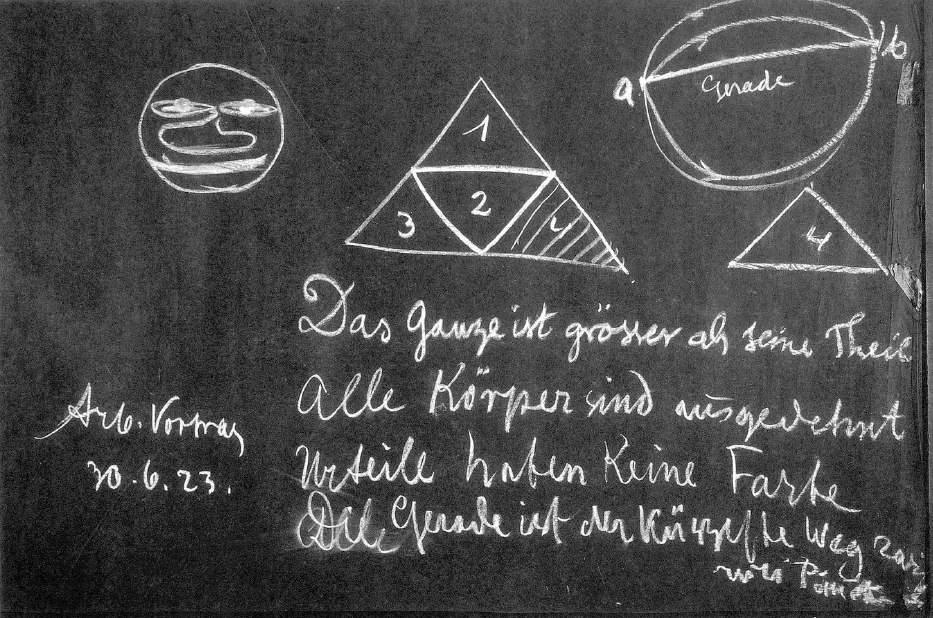
[ 5 ] So, in humans, there is a situation where they enter a state of elevated temperature—initially a fever—during which they might speak deliriously. Now, you see, the soul cannot speak nonsense. No matter how high a fever the soul may have, it cannot speak nonsense. It speaks nonsense because, at a higher temperature, the body is not functioning properly. You can visualize this by thinking of one of those spheres sometimes placed in flower gardens—a mirror in which the surroundings are reflected. If you were to peek inside it, you’d see a face you wouldn’t want to have! (It is sketched on the board.) You wouldn’t want to have a face like that. But you wouldn’t say either: “Good heavens, what a face I’ve ended up with!”—You wouldn’t believe that it was actually your face at all, because it looks so distorted in the sphere. Now, if your soul starts to speak nonsense while you have a fever, you won’t say, “My soul is starting to speak nonsense,” but rather that what your soul is saying becomes nonsense because it’s coming from a sick brain—just as your face looks all smudged and distorted because it’s reflected in such a distorted mirror. So you must also tell yourself: When I have a fever and talk nonsense, the same is true of the soul—it speaks from a sick brain. I don’t actually have a different face when I stand in front of the convex mirror, but everything appears distorted. — In the same way, what the feverish person says appears distorted because it comes from a sick body and a brain that is functioning abnormally. But where does this distorted brain come from? It comes from the fact that the entire blood circulation is proceeding too rapidly. You need only feel your pulse to sense this. So this feverish heat in the head is caused by the blood circulation proceeding too rapidly. The blood circulation generates heat that rises to the head: you have a fever. Your soul appears as if in a distorted mirror.
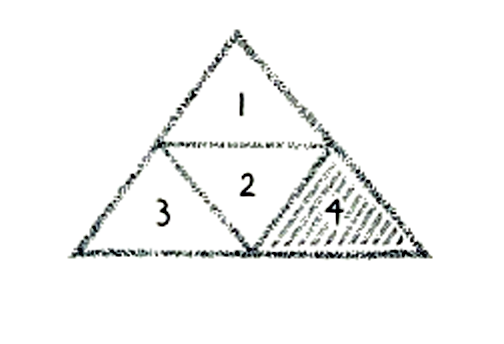
[ 6 ] The opposite state can also occur, but it does not happen simply by lying down in the snow and letting oneself freeze to death, because then one really does freeze to death. The opposite state can, in fact, only arise from the spiritual realm. One must actually do something from the spiritual realm. Now, you see, gentlemen, something very strange happens here. Just imagine: Someone begins to think deeply, pondering even the smallest details. It is better to think about the smallest details than about important matters—about such so-called trifles that most people don’t even want to think about. Let me show you something: If you have a triangle here (see drawing) and you divide this triangle into four equal parts, so that you end up with four such triangles, then you can say: The whole triangle is larger than each of the four small triangles. — I can now generalize this and say that there is a theorem which states: The whole is greater than its parts. (The theorem is written on the board.) — Good grief, if a wealthy stockbroker comes along and you say to him, “Hey, think about this for a moment: the whole is greater than its parts”—he’ll say, “No, that’s way too boring for me!” — And if you go so far as to say to him: “Just think, the blackboard is a solid; it has a certain size; it extends into space. The table is also a solid; it has a certain size; it extends into space”—and I now formulate the statement: “All solids extend into space.” (The sentence is written on the blackboard.) — Just imagine if, at some gathering, you were lectured the entire time about nothing but this one sentence: “All solids are extended”—you’d walk away and say, “That was a dull, boring story!” — And if I were to add something else now and say: “Look, the meadow is green, the rose is red; these objects, then, have colors. Yesterday there was a court hearing where the judge handed down this or that verdict—that has no color. And in another place there was also a court hearing where the judge handed down a verdict—that has no color. Judgments have no color.” — So we have a third sentence. (The sentence is written on the board.) Yes, gentlemen, if someone were to lecture you for an hour on this: “Judgments have no color”—you’d say to yourselves: “I’ve been listening for an hour to ‘Judgments have no color’—but that’s terribly boring, it’s endlessly boring!”
[ 7 ] But why do you find these judgments boring? I wouldn’t have to write these things on the board for you, nor would I have to explain them to you with a certain lightheartedness; instead, I would have to walk in, stiff and brisk like a professor, and say: Gentlemen, today we’re going to discuss the following statement: Judgments have no color—and then I’d have to spend a whole hour proving to you that the statement is correct. The way I showed it to you here is actually quite amusing. But otherwise, I’d have to come in and talk for a whole hour about the statement: “Judgments have no color,” or “All bodies are extended.”—So you could draw a line like this to get from one point to another (it is drawn). One line is straight; the others are all curved. But when you look at them, you’ll immediately say: The straight line is the shortest path; all the others are longer. — Now I can write down this statement for you again: The straight line is the shortest path between two points. — If I were to spend a whole hour talking about this statement, you’d find it boring again.
The whole is greater than the sum of its parts
All objects have volume
Judgments have no color
A straight line is the shortest path between two points
[ 8 ] There is, however, a German professor who says: One can indeed perceive something of the spiritual world; but one can perceive only that which is contained in such propositions. — And then he recites to his students the propositions through which one perceives something of the spiritual world: The whole is greater than its parts. Judgments have no color. Bodies have extension. A straight line is the shortest path between two points, and so on. — That, he says, is the only thing one can know about the spiritual world. Yes, the students are terribly bored by these lectures. But today, people have already come to believe that science is bound to be boring. — That is why the students are, in fact, usually enthusiastic about the very professor who says such things. But that is just a side note.
[ 9 ] The story is this: When one internalizes such judgments, makes such judgments, utters such statements—that the whole is greater than the sum of its parts, that a straight line is the shortest distance between two points—then a chill sets in at the back of one’s mind. That is what is peculiar about it: a chill sets in at the back of one’s mind. And because it grows cold in the back of the mind—because a person begins to feel the chill—he wants to get away from such statements right away. They bore him. That is precisely what is strange: when boredom sets in, it grows cold in the back of the mind. Not the whole person grows cold, but the back of the mind does. The back of the head begins to want to freeze. And it’s not freezing because of the snow or the ice, but because of the soul—because they’re thinking about things that hold no interest for them.
[ 10 ] You see, one can make fun of such propositions; but the fact is that thinking them over and over again with patience—that is, repeatedly subjecting oneself to terrible boredom with patience—is a true path to entering into spiritual insight. It is remarkable: What a person doesn’t want to do is precisely what they must practice. I can tell you: Mathematics is boring for some people, but because it is difficult and requires effort, and because mathematics has the effect of cooling the back of the mind, those who had to study mathematics—precisely because it was so cold and required such effort—find it easiest to enter the spiritual world. And those who overcome themselves and experience such propositions again and again—that is, who artificially cultivate boredom in themselves—are the ones who enter the spiritual world most easily.
[ 11 ] I told you: When you get a fever, your pulse quickens. You get warm, and heat rises into your head, into your brain. You just get caught up in the heat. Then you start talking nonsense. — But when you torment yourself with such thoughts, even though you want to stop thinking altogether, the blood doesn’t flow more vigorously; instead, it stagnates in the back of your head. And because the blood stagnates, salts accumulate there. Salts accumulate. There are two ways in which these salts manifest themselves. Most people get stomachaches from it. And because they notice the stomachache very quickly—they feel discomfort in their stomach when they’re supposed to think such sentences—they soon stop. But if someone continues to think such sentences, as Nietzsche did—who lived as a very great man toward the end of the 19th century and who constantly tormented himself with such sentences in his youth—then many salts are deposited in his head, and Nietzsche suffered continuously from migraines. And now, you see, one must reach the point where one can think such sentences without getting migraines, without salts accumulating—and thus without getting a stomachache either. One must remain a completely healthy person and be able to generate artificial boredom within oneself. So someone who honestly tells you how to enter the spiritual world must say to you: You must first be able to generate artificial boredom within yourself; otherwise, you cannot enter the spiritual world at all. Just take a look at the present age. What does the present age want? The present age wants to constantly drive away boredom. Where don’t people rush off to, just to avoid boredom! They constantly want to amuse themselves. What does it mean to constantly want to amuse oneself? It means running away from the spirit. That’s all it means. And our age wants to amuse itself constantly. Yes, wherever there might be something spiritual, our age immediately runs away from it. It doesn’t realize it; it happens unconsciously. But this desire to amuse oneself is precisely a running away from the spirit. That is simply the way it is. And only those who do not shy away from setting aside amusement entirely for a time and living artificially within such sentences can enter into the spirit. Then, once one has reached the point where one can live artificially within such sentences—where one no longer gets a migraine or a stomachache from it, but can truly endure living within such sentences for many hours—then one has the opportunity to gradually arrive at spiritual vision.
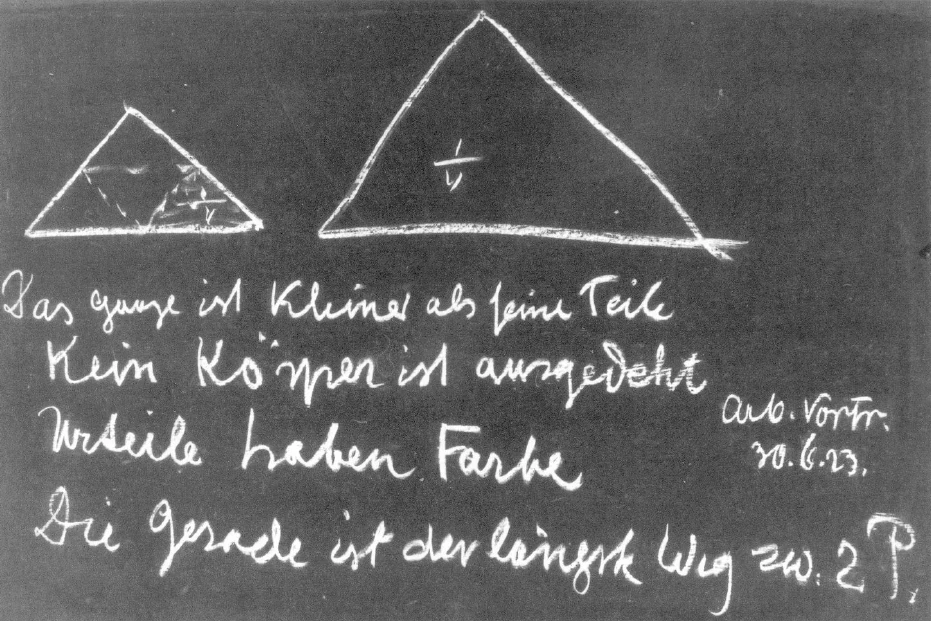
[ 12 ] But there’s still a change that needs to take place. Namely, at a certain point, you realize: Once you’ve lived with such propositions, they begin to turn around. — I think about this for a long time: The large triangle is greater than its parts. When I think about this for a long time, the statement turns around for me. Now it begins to get interesting, because I suddenly gain the following insight: If I have a triangle here and I take a quarter of this triangle and want to remove it, then it begins to grow (it is drawn), and it is no longer true that the whole is greater than its parts. The quarter is suddenly larger. — I see that the quarter is larger, and now I have to say: The whole is smaller than its parts. (The statement is written on the board.)
[ 13 ] Now I have come to understand what the spiritual world is like. From the perspective of the physical world, it actually appears to be the opposite. In the physical world, the whole is always greater than its parts; in the spiritual world, the part is greater than the whole. For example, you cannot recognize a human being unless you know that the part is greater than the whole. Modern science always wants to look at the smallest details. But if you want to recognize the human liver, it is smaller than the human being when you look at it here in the physical realm. If you want to look at it spiritually, however, it grows and grows to gigantic proportions; the liver becomes an entire universe. And if you don’t take that into account, you simply cannot recognize the liver spiritually.
[ 14 ] So you must first have honestly arrived at the statement: The whole is smaller than its part, and the part is larger than the whole. Similarly, if you’ve been thinking long enough about the statement “All bodies are extended”—to the point where you’re already facing the terrible danger of your brain freezing at the back of your head—then all bodies shrink together, cease to be extended, and you finally arrive at the conclusion: “No body is extended.” (The statement is written on the board.)
[ 15 ] And now something really funny—it’s funny for the physical world, but it’s a matter of the utmost seriousness for the spiritual world. You see, you might think there’s nothing more foolish than when I say: A court hearing took place in Buxtehude, a verdict was handed down there, and that verdict has no color. A verdict was also handed down in Trippstrill, and that, too, has no color. — But if you think about that sentence for a long time, then the judgments actually take on color. And just as you can say, “The rose is red”—so you can say, “The judgment from Buxtehude is dirty yellow, and the judgment from Trippstrill is red.” — Well, there may also be some that are a beautiful red, but that rarely happens. You see, you’re growing into the sentence: All judgments that people make have color. — And only now have we reached the point where we become capable of thinking about the spiritual world at all, because it possesses the opposite characteristics of the physical world: judgments have color. (The sentence is written on the blackboard.)
[ 16 ] A straight line is the shortest path between two points—this is so true that it’s presented as one of the very first theorems in geometry. For the physical world, this is as true as it can possibly be. But if you think about it for a while: If someone who is not a physical but a spiritual being wants to get from Village A to Village B, the path will seem incredibly short if they walk in a semicircle (it is drawn)—and you come to the conclusion: Board ı4 The straight line is the longest path between two points. (The statement is written on the board.)
The whole is smaller than its parts
No body has extension
Judgments have color
A straight line is the longest path between two points
[ 17 ] That’s certainly something that makes you want to speak up a bit! The world, however, doesn’t take such things seriously. It says: Well, if someone starts saying that judgments have color, then he’s either feverish or crazy. — But that’s precisely the point: that one approaches these things without one’s physical body, with complete rationality, because the spiritual world simply has the opposite characteristics of the physical world. And one must arrive at this through the simplest of statements, because the simplest statements are the most incredible. Isn’t it true that when someone starts talking interestingly about the spiritual world, people naturally listen, as if they were being told ghost stories? But you don’t listen when someone tells you: “You must first get used to artificially creating boredom within yourself.” — You have to do this artificially. If you bore yourself through external science, nothing will come of it. But artificially, through inner effort, you must be able to achieve boredom without getting a migraine or a stomachache, without involving the body. If the body is involved, you’ll immediately get a migraine or a stomachache. Just listen for a moment to what people say when they hear: “You mustn’t let the professor bore you—that won’t help you; it won’t give you any intellectual thrills—but you just have to gradually overcome the migraines and stomachaches.” — You see, the student is sitting there, and the professor is boring him terribly; he’s actually supposed to get a migraine or a stomachache, but he doesn’t. So it manifests in other organs that hurt less. And actually, people get sick because the physical body goes along with it. If you induce boredom in this very way, as is done in modern science, then you’re simply making people sick. If you give people guidance to freely generate boredom themselves through their own inner strength, and they pass through this boredom, then they gradually enter the spiritual world—which, however, must be grasped by reversing even the very first judgments in the spiritual world. There is already an exceptionally good method by which one can work very effectively on oneself. This is when one experiences something truly, truly boring in the world, and afterward—when it has been so boring that one ran away, that one no longer liked it at all, or was glad when it was over—one begins to reflect on it very, very slowly.
[ 18 ] You see, I myself—I can tell you this—learned an awful lot from it. When I was young, I sat through some terribly boring lectures. Yes, I have to say, before the lecture started, I actually looked forward to the boring lecture, because it took your mind off things just as much as sleeping does in everyday life. So I was genuinely happy: Now you get to sit through a few hours of boring lectures again! — But once the lecture had started and the professor began speaking, I constantly had the impression: “He just keeps talking—he’s even getting in the way of my boredom!” — But afterward, I always thought deeply about every single detail of what he had said. I wasn’t the least bit interested, but I went through every hour from the beginning all over again, went through it thoroughly, and sometimes went through an hour in such a way that it took two hours—thus artificially creating that natural boredom. Gentlemen, you’re about to make a strange discovery. Especially at the end of the 19th century, you could make a very strange discovery. Just imagine: you’ve just come out of a lecture given by a giant rhinoceros—they do exist—and you were terribly bored. Now you could—and this was precisely the case at the end of the 19th century—now you could, as they say, meditate on that boring lecture. So you bring back into your soul everything that bored you terribly. Then suddenly, behind the person who, like a rhinoceros, has lectured you on the most tedious topics, something like a higher human being, like a truly spiritual person, gradually appears. And the lecture halls are transformed for you—this is something that can be understood with complete rationality. And I know many professors from the late 19th century for whom this was the case—but I don’t want this to be talked about too much now, otherwise people will think: that’s something truly terrible—: Behind them always appeared the most witty and spiritual people. Yes, what was that, then?
[ 19 ] It is not true, in fact, that people are inwardly and unconsciously as stupid as they appear to be. They are actually much smarter, and even the stupidest ones are sometimes clever. That can also be turned on its head. But they cannot comprehend their own cleverness. This is, in fact, a terrible mystery, for often what lies behind people is precisely what constitutes their true soul; they cannot grasp this themselves.
[ 20 ] Yes, that is indeed how one enters the spiritual worlds. As you know, at the end of the 19th century, there was a materialistic natural science. People still worship this materialistic natural science today. I must say myself: It has been immensely useful to become acquainted with this materialistic natural science. — From start to finish, this materialistic natural science has always come up with the most tedious statements: If you just pat yourself on the back for having become so clever and finally knowing that humans are descended from apes, as natural science claims—well, then nothing comes of it. But if one contemplates this statement again and again with all one’s inner energy, it eventually transforms into a spiritually true one, and one realizes: Human beings do not descend from apes at all, but from a spiritual being.
[ 21 ] There are, however, all sorts of differences. A boy was once sent to school. For the first time, he heard from his teacher that humans are descended from apes—too early, as it turned out. At home, he said to his father: “Hey, Dad, I heard something today; just think, humans are descended from apes!” — “Oh, really!” said his father indignantly. “You’re a silly boy! That might be true for you, but not for me!” — You see, the story was completely unbelievable to him, too. He simply applied it to the spiritual realm.
[ 22 ] But from everything I’m telling you, you’ll learn that there are two ways to approach the natural sciences. And I can tell you this: If you haven’t studied the natural sciences the way so many did in the 19th century—and even today—but instead of merely parroting everything, think meditatively, think over and over again, think for hours on end, then the situation turns around, and the spiritually correct understanding emerges. And if you have thought long and hard about plants and minerals and have thoroughly reflected on what people tell you today in such a terribly materialistic way, then you will ultimately come to grasp the significance of the zodiac, the significance of the stars, and all the mysteries of the stars. But the surest path is precisely to start from statements such as this: The part is greater than the whole. No body is extended. Judgments have color. The straight line is the longest path between two points. Through this, one has broken free from the physical body. If you go through all of this, you will come to be able to use your etheric body instead of your physical body. You can then begin to think with the etheric body, and the etheric body must think everything in the opposite way from the physical world. For through the etheric body, one gradually enters the spiritual world. But there one still comes to a standstill, and one must accustom oneself to something else. You know, when one reads today, something quite strange can happen. For example, once, when I was in a city in southern Austria—which is no longer part of Austria—I happened to pick up an evening newspaper. This evening paper had an editorial, as they say. It contained a terribly interesting story, told in full detail, a major political story: you read the first column, the second column, the third column—it was all terribly interesting. Then, right at the bottom of the same page, there was a small note. It read: “Unfortunately, we must inform you that everything contained in today’s editorial is based on erroneous information, and not a word of it is true.” Well, you see, that can happen to anyone today. This is the most extreme case, but anyone who reads newspapers today can find themselves, time and again, on any given page, reading something that is simply not true. Only later do they find out that it wasn’t true. You see, I believe most people have already become terribly numb to these matters today; they simply come to regard truth and lies with complete indifference. If one has become so numb in this regard that one accepts truth and lies in the same way, well, then one cannot enter the spiritual world.
[ 23 ] I told you last time: When someone goes mad, only their body becomes ill. The soul does not become ill; it remains healthy. — Today I told you: When someone rambles while running a fever, their thoughts merely become a caricature, but the soul remains sound. — But if you want to enter the spiritual world, you must accustom yourself to feeling a spiritual pain when faced with something false, and to experiencing spiritual joy when faced with something true—so that you can rejoice in the truth as much as if someone were to give you a million—I mean a million francs, not marks! (Laughter.) That is how one must be able to rejoice when one hears a truth, and that is how one must be able to suffer inwardly in one’s soul—not the body, but the soul must be able to suffer when one discovers somewhere that something is a lie—just as the body suffers when it has a terrible illness. Not that the soul should be sick, but the soul must be able to feel pain and joy, just as when the body is sick or feeling perfectly well, or when it experiences pain or joy externally in the physical world. This means one must come to feel the truth in the same way one feels joy, bliss, and pleasure in physical life, and one must come to feel the untrue so painfully—to become so inwardly and spiritually ill from the untrue—just as one otherwise becomes ill solely from the disturbances of one’s body. That is to say, if someone has fed you a load of lies, then you must be able to say—but in a way that is truly accurate: “Good heavens! He’s been feeding me belladonna!”—but this must be true within you. Well, of course, if you look at the world today—take the newspaper industry, for example—it’s constantly feeding you belladonna. If your soul is to remain healthy, you must continually vomit it out spiritually. Of course, since you can’t do without newspapers if you want to enter the spiritual world, you must get into the habit of finding the newspaper distasteful and deriving joy from what you read that is decent—where a person gives of themselves wholeheartedly—but deriving joy from it in the same way you would, for my sake, from something that tastes very good. The truth and the pursuit of truth must taste good to you, and lies—when you become aware of them—must taste bitter and poisonous to you. So that you must not only learn that judgments have a color, but you must also learn to say: “Printing ink today is mostly belladonna juice.”—But you must be able to feel this with complete honesty and sincerity. Then, gentlemen, then you will have attained what is called spiritual transformation.
[ 24 ] People talk about external alchemy and believe that external alchemy can turn copper into gold. Of course, charlatans will still tell you all sorts of things like that today; superstitious people have long believed this. But in the spirit, these things are possible; one must simply believe in the truth of the spirit. One must be able to say to oneself: The printer’s ink used by the printer is materially the same everywhere, whether he has printed a true book or a mendacious newspaper. But in one case, the printer’s ink is truly belladonna juice; in the other, it is as if gold were flowing in liquid form. — In the spirit, things that are the same in the physical world are so very different.
[ 25 ] But when today’s so-called intelligent people come along and you tell them: “Printing ink can be liquid gold or belladonna juice”—then they say: “You mean that figuratively; it’s only meant figuratively.” — Yes, gentlemen, the figurative must indeed become truly spiritual, and one must understand how things become spiritual.
[ 26 ] Let me give you an example, actually from the history of the Social Democratic Party. You may not have witnessed this firsthand, but at one point the Social Democratic Party split into two factions. One faction consisted of those who followed Bernstein and others like him. These were the ones who were happy to make all sorts of compromises with the bourgeoisie. The other group consisted of the radicals, and Bebel stood at the head of the radicals until his death. You’ll at least be familiar with Bebel from his writings. Now, there was once—it was in Dresden—a party meeting, and Bebel became furious with the others and said he was going to bring order to the Social Democratic Party. He gave a very forceful speech and, in the course of that speech, said: “Yes, if such-and-such happens on the part of the other party, then a louse crawls over my liver!”—Now, of course, everyone will say that this is meant figuratively—that a louse crawls over Bebel’s liver—because a louse doesn’t actually crawl over his liver. But why is such an expression used? Bebel, of course, didn’t use it because a louse actually ran across his liver; rather, he had heard it and simply applied it to a situation where one is terribly annoyed. But why is the expression phrased that way? Why can we say that a “louse” runs across the liver?
[ 27 ] Not everyone is like the Jew Itzigsohn, who was always picking lice off his head, and when someone once asked him, “Hey, tell me, my dear Itzigsohn, how is it that you’re so clever and always manage to catch a louse?” — he replied: “It’s no big deal; if I miss, I still end up with one.” — So it’s not the case for everyone that, just because they want to catch a louse and miss, they still end up with one. Rather, it’s usually extremely unpleasant when people get lice; it’s terribly unpleasant for them—it’s a horrible feeling! You should have seen it just once: When I was a tutor, one of the boys I was teaching came home one day; he’d been out, had sat on all sorts of benches in the big city, and gradually started to get eye pain—terrible eye pain. Now we weren’t sure which specialist to call, because this boy had such terrible eye pain. I said: “Let’s try a lice ointment first and rub it into his eyebrows.” — Sure enough, when they checked, he was completely infested with lice, and once the ointment took effect, the watery eyes went away too. Yes, you should have seen the looks on people’s faces—the mother and the aunt—when the boy suddenly had lice! It stirred up such feelings in them that went right to their livers. It made their stomachs churn: Good heavens, our boy has lice! Oh, that’s just terrible! — And then it feels just as intense as if a louse were running across your liver. This expression, “a louse runs across the liver,” comes from the actual sensation people used to feel when someone got lice. Now, in a gathering or a political party, people don’t actually get lice, but they do things that inspire such revulsion—as if, in earlier times or in a certain social class, lice had run across one’s liver. So you see, the way the expression was formed, it could correspond to reality. Later on, such expressions come to be used in such a way that they are applied only to the spiritual realm, to the soul.
[ 28 ] But that has to be brought together artificially, gentlemen. One must be able to feel—not merely based on the clichéd wording, but genuinely and honestly—that here I have a newspaper before me, and most of what’s in it is probably such that the printer’s ink is belladonna juice. — I’d like to know what people would do today if they felt that honestly! Just think for a moment how much belladonna juice has been used to talk about war guilt and war innocence, and how people—simply by belonging to one nation or another, not because the things are true, but because they declare their own nation innocent, declaring it innocent with all manner of untruths—feel a sense of comfort. Yes, how are people today supposed to enter into the Spirit? One must simply make a firm resolution—a very intense resolution—to be completely different from a person of the present day, and yet, of course, one must get along with people. For if one immediately steps onto the podium and starts railing against people, then, of course, nothing can be helped. But one simply has to find a path to the truth, and that is as difficult as I have described to you today.
[ 29 ] Today I’ve had to present you with some difficult topics so that you can see: It’s simply not easy to enter the spiritual world. — We’ll then move on again to topics that will be less taxing for you. But you’ll see: it’s good that we’ve dealt with these difficult topics. When I continue next time, I’ll show you what the entire path into the spiritual world is like.