

Rhythms in the Cosmos and in the Human Being
GA 350
28 June 1923, Dornach
Translated by Steiner Online Library
8. Developing Independent Thinking and Backward Thinking
[ 1 ] There are a few questions that were sent to me last time, and I’ll answer them in a slightly different order than they were asked here. So, the questions are:
[ 2 ] How can one come to perceive the mysteries of the world in terms of one's worldview and outlook on life?
[ 3 ] How far must a person go before finding higher realms on the path of the natural sciences?
[ 4 ] Do the forces in the universe influence all of humanity?
[ 5 ] What is the relationship between plants and humans, and the human body?
[ 6 ] Well, I’d like to structure this—these are, of course, very complicated questions—so that the answer emerges, so to speak, bit by bit. That’s the only way to approach such complex questions. For example, if someone asks, “How does one come to perceive the mysteries of the world?”—that really means, “How does one come to true spiritual science?” — Well, that is something you naturally cannot easily imagine today. For the fact is that when most people hear that there is such a thing as anthroposophy or spiritual science, they think: “Now I, too, will acquire the ability to perceive the spiritual. I’ll probably have it figured out in eight days, and then I’ll surely be able to know all of this for myself.”
[ 7 ] Well, of course, it’s not quite that simple; rather, one must be clear about this: There is, after all, quite a lot involved in ordinary natural science. Even if one wants to make the simplest of observations in natural science, the first step is to learn how to use the instruments. Of course, it’s relatively easy to use a microscope, but to properly investigate something with a microscope, you can’t simply say: “I’ll put a piece of muscle or something like that under the microscope, look inside, and then I’ll know what’s going on in there.” — If you were to do it that way, you wouldn’t see anything at all, of course. The point is that if you want to see something under a microscope, you first have to make fine cuts. So a piece of muscle is of no use at all; rather, you have to use a fine razor blade to make a thin cut, then remove just a tiny bit—sometimes—and make another fine cut, so that you end up with a very thin layer. And even then, most of the time, you still won’t see anything. Because if you place such a very thin—let’s say, a muscle or cell layer—under the microscope and look at it, you usually won’t see a thing. What you have to do is ask yourself: How can I make visible what I can’t see at all under the microscope? — And often you have to stain it with certain dyes, so that you make it visible only by introducing dyes into it. And then you have to be aware that you’ve now altered the specimen somewhat. You also have to know what the object is like when it hasn’t been altered. But these are all still very simple things. Even if you want to observe the stars with a telescope, you first have to learn how to operate the telescope. Of course, that’s even easier. You know there are people who go around setting up telescopes for you on the street. But that alone doesn’t help you much; it only helps if you realize that you’ll also need a microscope and a clock, which you’ll have to learn to use, and so on. — So these are just examples I’m using to illustrate how complicated it is to investigate even the simplest things in the sensory-physical world.
[ 8 ] Now, research into the spiritual world is truly much more difficult. It requires a great deal more preparation. People imagine that this is something one can learn in eight days. That is simply not the case. Rather, a person must first and foremost be mindful that they must first activate something that is already within them. That which is not actually active on a continuous basis must first be brought into activity.
[ 9 ] So that you can see how things really are, I’d like to start by telling you the following. As you know, especially in research that delves into the spiritual world—and even in conventional science—one often has to begin by understanding what is not normal. You only truly come to know things once you have become acquainted with what is not normal. I have already shown you this using specific examples. We must consider this simply because people in the outside world often call those who conduct research in the spiritual world “crazy”—even if they are as normal as can be. So we really must be willing to examine things in this way, so that we ultimately arrive at the truth. Of course, you don’t have to believe that anything can be achieved by looking into the abnormal or the pathological, but you can learn a great deal from it.
[ 10 ] For example, there are people who are considered abnormal—that is, people who are said to be mentally disturbed. What does it actually mean for a person to be mentally disturbed? There is no worse word in the world than “mentally disturbed,” because the mind can never be disturbed. The mind simply cannot be disturbed! Take the following case, for example: If a person, as they say, has been mentally disturbed for twenty years—such things do happen—and then subsequently becomes normal again, what is actually happening there? — Well, it’s true that it can happen that this person claims for twenty years that he is being persecuted by others; he suffers, as they say, from a delusion of persecution. Or it may be that he, let’s say, sees all sorts of ghosts that aren’t there, and so on. So this can go on for twenty years. Well, gentlemen, someone who has been mentally ill in this way for twenty years can certainly recover. But you will always notice one thing: If someone is, as they say, mentally ill for three, five, or twenty years and then recovers, they are no longer quite the same as they were before. Above all, you will notice the following. After they have recovered, they will tell you: “Yes, during the time I was ill, I was able to look into the spiritual world continuously.” — He’ll tell you all sorts of things he perceived in the spiritual world. And if you then examine his accounts in light of the insights into the spiritual world that a fully healthy person would have, you’ll find that while he does say some nonsense, he also says a great deal that is true. So that’s the strange thing: someone can be mentally ill for years, recover, and then tell you that they’ve been inside the spiritual world and experienced this and that. And if you yourself are familiar with the matter as a healthy person, you have to agree with him on many points.
[ 11 ] If you talk to someone while they’re mentally disturbed, they’ll never be able to tell you anything sensible. They’ll just tell you the nonsense they’re experiencing. The fact is, it’s not at all the case that people who have been mentally ill for years actually experienced these things during their so-called mental illness. They didn’t experience anything from the spiritual world at all. But afterward, when they have recovered and can, in a certain sense, look back on the time when they were not well, what they did not actually experience during their illness then appears to them as glimpses into the spiritual world. So, in fact, this awareness—“I have seen a great deal of the spiritual world”—only arises at the moment when people recover.
[ 12 ] You see, there is an extraordinary amount to be learned from this. From this, one can learn that a person has something within them that they did not use at all during the time they were mentally ill. But it was there; it was alive. And where was it? They saw nothing of the external world, for they can tell you: “The sky is red, and the clouds are green”—all sorts of things. He doesn’t see anything clearly in the external world. But this deeper human being within him—whom he cannot use at all during his illness—is in the spiritual world. And when he is once again able to use his brain and look back on what this spiritual human being has experienced, then those spiritual experiences come to him.
[ 13 ] We can see from this that a person, while in the state known as mental illness, lives with their spiritual part right in the spiritual world. That spiritual part is very healthy. So what, then, is sick in a mentally ill person? Well, in a mentally ill person, it is actually the body that is sick, and the body is simply unable to make use of the soul and the spirit. In someone who is said to be mentally ill, there is always something wrong with the body, and if the brain is sick, one naturally cannot think properly. Nor can one feel properly if the liver is sick.
[ 14 ] And so it is that “mentally ill” is actually the worst term one can choose, because “mentally ill” does not mean that the mind is ill; rather, it means that the body is so ill that it cannot make use of the mind, which is always healthy. Above all, you must be clear about the fact that the mind is always healthy. Only the body can become sick and then fail to use the mind properly. If someone has a sick brain, it is just like someone who has a hammer that breaks with every blow. If I say to someone who doesn’t have a hammer, “You’re a lazy guy; you can’t hammer at all”—that’s obviously nonsense. He can hammer just fine, but he doesn’t have a hammer to use. So it’s nonsense to say that someone is mentally ill. The mind is perfectly healthy, but it doesn’t have the body through which it can function.
[ 15 ] What one can learn in this way becomes particularly evident when one reflects on the nature of our thinking. From what I have told you, you will see that although we have a spirit, we need a tool for thinking—the brain. To think in the physical world, one needs the brain. It is no great feat for materialism to claim that one needs the brain. Of course one needs the brain. But such a claim says nothing about the spirit. Furthermore, you can see from this that the true spirit within a human being can withdraw completely. In the case of the mentally ill, the true spirit withdraws completely. And it is important to know this, because only then can one begin to understand that people today—now I am going to tell you something that will astonish you greatly, but it is true—are completely incapable of thinking. They imagine that they can think, but they cannot do so at all. I want to show you why people cannot think.
[ 16 ] You’ll say: Yes, people do go to school; these days, even in elementary school, they’re already learning to think wonderfully well! Certainly, it looks that way. Yet people today can’t think at all. It only looks as if they can think. Isn’t that right? In elementary school, we have elementary school teachers. The elementary school teachers, in turn, have learned something; supposedly, they’ve also learned to think. Those from whom they, in turn, learned are, as they say in Stuttgart, “big-headed people”; that is, they’re terribly wise people by today’s standards. They’ve gone through college. Before they went to college, they attended high school or something similar, and that’s where they learned Latin. If you look around a bit, you’ll be able to say: “Yes, my teacher didn’t know Latin!” — But he, in turn, learned from someone who did know Latin! That’s why what you’ve learned is also dependent on the Latin language, and everything we learn today is dependent on the Latin language. You can see this from the fact that when someone writes you a prescription, they write it in Latin. This dates back to the times when everything was written in Latin. It wasn’t that long ago—thirty or forty years—that everyone attending university was required to write their thesis in Latin.
[ 17 ] So everything we learn today depends on the Latin language. And this came about because in the Middle Ages—if we go back to the 14th and 15th centuries, which wasn’t that long ago—everything was presented in Latin. The first person, for example, to give a lecture in German in Leipzig was a certain Thomasins. That wasn’t so long ago—it was in the 17th century. Lectures were given in Latin everywhere. Anyone who wanted to learn anything had to go through the Latin language, and in the Middle Ages, everything one could learn was taught exclusively in Latin. If you wanted to learn anything else, you first had to learn Latin. You might say: But not in elementary school. — But elementary schools haven’t existed until the 16th century. It was only gradually, as the vernacular began to be used in scholarship, that elementary schools emerged. So what influences our entire way of thinking is the Latin language. All of you, gentlemen, think the way people have learned to think through the Latin language. And even if you cite, for example, the fact that Americans did not learn Latin so early—yes, but today’s Americans are, after all, immigrants from Europe! It all depends on the Latin language.
[ 18 ] The Latin language, however, has a very specific characteristic: it was developed in ancient Rome in such a way that it thinks for itself. It is interesting to note how Latin is taught in high schools. It is taught in such a way that one first learns Latin, and then one learns to think—to think correctly—through Latin sentences. Thus, one’s entire way of thinking becomes dependent on something that is not at all the result of human action, but rather the result of the Latin language itself. Just understand this, gentlemen: this is something very important! So people today who have learned anything do not think for themselves; rather, even if they have never studied Latin, it is the Latin language that does the thinking for them. That is why, strange as it may seem, independent thinking is actually found today only among certain people who have not learned much.
[ 19 ] I’m not saying, of course, that we should go back to illiteracy. We can’t do that. I don’t want any kind of regression; but we have to understand what is. That is why it is so important that we can sometimes go back to what the ordinary person, who has had little education, still knows. They can’t really express it anymore, because people naturally laugh at them. But nevertheless, it is extremely important to realize: People today do not think for themselves; rather, the Latin language thinks within them.
[ 20 ] You see, as long as one cannot think for oneself, one cannot enter the spiritual world at all. Now you have the reason why today’s thinking rebels against all spiritual knowledge: because people, through their Latin-based education, have come to the point where they no longer think for themselves. That is the first thing one must learn: to think for oneself. People today are quite right when they say: “The brain thinks.” — Why does the brain think? Because Latin sentences enter the brain, and the brain thinks entirely automatically in modern people. They are automatons of the Latin language, walking around without thinking for themselves at all.
[ 21 ] Something quite strange has happened recently. I already hinted at it last time, but you may not have noticed it because it’s not that easy to notice. Something quite special has happened recently. After all, we have our physical body within us, as well as our etheric body and the others—but I don’t want to talk about those right now. Now, the brain naturally belongs to the physical body, but the etheric body is also present within the brain, and one can think only with the etheric body. One cannot think with the physical body itself. But one can think with the physical body if it is like in the case of the Latin language: that the brain is used like an automaton when one thinks with the brain. But as long as one thinks only with the brain, one cannot think anything spiritual. One must begin to think with the etheric body—the etheric body that, in the case of someone who is mentally ill, is often not used for many years. One must bring this into inner activity.
[ 22 ] But that is what matters most of all: learning to think for oneself independently. Without the ability to think for oneself independently, one cannot enter the spiritual world. Of course, this requires that one first realize: Good heavens, you never actually learned to think for yourself in your youth! You’ve only learned to think what has been thought for centuries through the use of the Latin language. — And when you understand this correctly, you realize that the very first condition necessary for entering the spiritual world is: Learn to think independently.
[ 23 ] But now comes what I was trying to get at when I said that something strange has been happening lately. The people who thought most exclusively in terms of Latin were, of course, the scholars, and the scholars were the ones who developed physics, for example. They devised physics; they conceived of it entirely in the spirit of the Latin language, using their “physical brain.” When we were little—when I was about the same age as, say, young Erbsmehl—we learned only a form of physics that had been devised with the “Latin brain.” That’s all we learned—what had been conceived with the Latin mind. But since then, gentlemen, an enormous amount has happened. You see, when I was a child, the telephone was just coming into use. It hadn’t existed before. After that came all the other great inventions, which people today take for granted as if they’d always been there. These have only emerged in the very last few decades. As a result, more and more people who haven’t been trained in Latin have entered the world of science. It’s such a curious story. If you trace the development of scientific life over the last few decades, you’ll find that more and more of these technicians are entering the field of science. They haven’t dealt much with Latin. As a result, their thinking hasn’t become so automatic. And this non-automatic way of thinking has then spread to others as well. That’s why physics today is full of concepts and ideas that are breaking down. They’re extremely interesting. Take, for example, Professor Gruner in Bern, who spoke two years ago about the reorientation of physics. He said: “All concepts have changed in recent years.”
[ 24 ] The reason people don’t notice this is simply that when you go to popular lectures today, people are still telling you what people thought twenty years ago! They can’t tell you what people think today, because they themselves aren’t yet capable of thinking for themselves. It’s just like this: if you take the concepts that were still accepted thirty years ago, it’s as if you have a piece of ice that’s melting—the ideas melt away. They’re no longer there when you try to think them through carefully. We simply have to recognize this. It’s like this: If someone studied physics thirty years ago and looks today at how things have turned out, they’d want to tear their hair out because they have to admit to themselves: “Yes, I can’t make head or tail of the concepts I learned!” — That’s just how it is. And where does this come from? Well, it stems precisely from the fact that in recent years, through the evolution of humanity, people have been led to a point where the etheric body is supposed to begin thinking. And they don’t want that; they want to continue thinking with the physical body. But in the physical body, the concepts completely fall apart. And they don’t want to learn to think with the etheric body. They don’t want to learn to think independently.
[ 25 ] Well, you see, the fact is that it became necessary for me to write this book on The Philosophy of Freedom in 1893. This book, The Philosophy of Freedom, is not so important because of what it contains. Of course, what is written in it was something I wanted to convey to the world even back then, but that is not the most important thing; rather, what is important about this book, The Philosophy of Freedom, is that for the first time, it contains thinking that is entirely independent. No one who thinks only in a dependent way can understand this book. Page by page, right from the very beginning, the reader must accustom themselves to returning to their etheric body in order to be able to have thoughts at all like those found in this book. That is why this book is an educational tool—it is a very important educational tool—and as such, it must be understood.
[ 26 ] When the book was published in the 1890s, people had absolutely no idea what to make of it. For them, it was like someone in Europe writing in Chinese that no one could understand. Of course, it was written in German, but it was written in terms of ideas that people were not at all accustomed to, because in this regard, all Latin elements have been deliberately stripped away. For the first time, this was done quite consciously: there should be no thoughts in it that are still influenced by Latin, but only entirely independent thoughts. A “Latinist” is, after all, merely the physical brain. The human etheric body is not a “Latinist.” Therefore, one must first strive to express in a language the kinds of thoughts one has when they arise in the etheric body.
[ 27 ] I want to tell you something else. Of course, people have noticed that concepts have all changed in recent decades. When I was still young, the professor would come in and fill the entire blackboard with writing. You had to learn that, and then you’d do well on the exam. Well, fine! And now, in recent years, people have come to realize what this Gruner said in his inaugural address as rector: All our concepts would no longer make any sense if there were no solid bodies, only liquid ones. — He imagines that the whole world were a liquid body. But then all the concepts would no longer make any sense; then we’d have to think in a completely different way, he says.
[ 28 ] Yes, of course you’d have to think differently if there were no solid body left! Then you wouldn’t be able to make sense of any of the concepts you learned in school. So if, let’s say, you were a fish and suddenly became very intelligent, and it occurred to you that you should attend a human university as a fish, you would learn something there that doesn’t exist at all for a fish, because a fish lives in water. It encounters solid bodies only at the boundary, where it touches them and immediately bounces right back. So if the fish were to start thinking, it would have to have thoughts completely different from those of a human. But humans need such thoughts today, too, because they’ve forgotten the other kinds of thoughts, and they have to say to themselves: “Good grief, if everything were liquid, we’d have to have completely different thoughts.”
[ 29 ] Yes, but gentlemen, haven’t I told you about a state of the Earth when there were no solid bodies yet, when everything was liquid, when even the animals were liquid? I have indeed told you about this state. Don’t you find it incomprehensible that today’s thinking cannot even conceive of such states? It simply cannot conceive of it! So modern thinking cannot make sense of the beginning of the world at all. And, one must say, people today are beginning to think to themselves: Good heavens, if the world were liquid, we would have to have entirely different concepts! — But there are no solid bodies in the spiritual world! So with all the concepts that the Latin language has gradually drilled into people, one cannot enter the spiritual world at all. One must first unlearn these concepts.
[ 30 ] You see, this is a great mystery: In Greek civilization, which preceded Roman civilization—Roman civilization did not emerge until five or six centuries before the birth of Christ, but Greek civilization is much older—in Greek civilization, there was still an understanding of the spiritual. Back then, one could still look into the spiritual world. When Roman civilization arrived with the Latin language, the spirit was gradually eradicated. Now I must say something else that will seem very strange to you, but you will understand it. Who, after all, has made use of the Latin language throughout the centuries, using nothing but Latin? — The Church itself has contributed the most to this! That is precisely the point: the Church, which claims to teach people about the spirit, has in fact contributed the most to driving the spirit out. And in the Middle Ages, all universities were under the Church’s control. Of course, we must be grateful to the Church for having founded the universities in the 13th, 14th, and 15th centuries, but it founded them out of a culture of Latin, and that culture of Latin never has the capacity to reach the spirit. And so it came to pass that people gradually came to have concepts only for solid bodies. Just look at the Romans: The Romans introduced these very dry, sober, unspiritual concepts into the world. That is what led to everything being conceived of in such material terms. What do you think—if the Greeks had described a ritual such as the Lord’s Supper—well, they certainly wouldn’t have described it as if the material elements present there were actually blood and flesh! That stems from materialism. Even the understanding of the Lord’s Supper has become materialistic, because all of this is connected to the Latin language.
[ 31 ] The Latin language is entirely logical. You see, I have worked with many people who were steeped in Latin culture, even though they spoke German. If one wanted to clarify something, one would quickly translate the story into Latin, because in modern times, people think only logically in Latin. But this logical thinking applies only to solid objects. If one wants to enter the spiritual world, one needs fluid concepts.
[ 32 ] Take, for example, the Theosophical Society. It, too, sought to enter the spiritual world. This Theosophical Society also speaks of this: that human beings have a physical body, an etheric body, and so on—but they are materialistic, because they think only: The physical body is dense, the etheric body is somewhat thinner, and the astral body even thinner. — But that’s all just bodies; it will never become spirit, because if you want to enter into the spirit, you have to arrive at concepts that are constantly changing. You see, when I draw, you’ll notice that I take this into account even while drawing. For my own sake, I sketch the physical body; there I try to imitate what a human being is like as a physical being. But when I try to sketch the etheric body, it would never occur to me to draw a figure for you in the same way; instead, I try to depict it like this: The human being also has an etheric body, which expands like this (see drawing). — But you must know: this is not so much the etheric body—not so much, when I sketch it this way, its representation—but rather it is only the representation of a single moment. In the next moment, it is different again. — So if I wanted to draw the etheric body, I would have to sketch it now, quickly erase it, sketch it differently again, erase it again, sketch it again, and erase it again. It is in constant motion. With the concepts people have today, they simply cannot keep up with these movements. That is what you must take into account above all else: that concepts must become flexible. People must first get used to this. That is why it is necessary today to develop completely independent thinking.
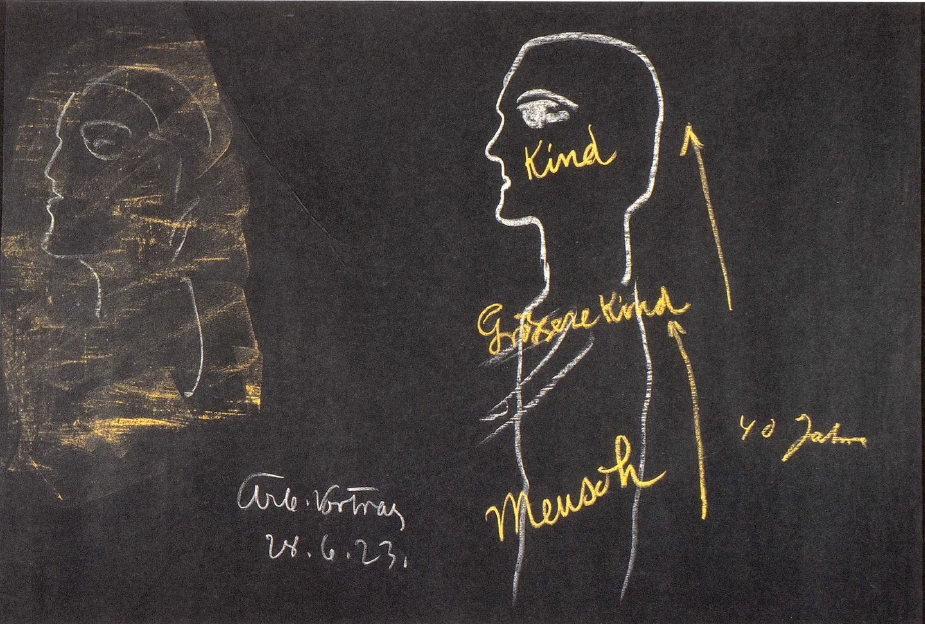
[ 33 ] But that’s not enough, gentlemen. I want to tell you something else. As you know, people develop. Now, people usually don’t pay attention to this development in a person’s life; but when a person is still very young, they do. We know full well that a four-year-old child cannot yet write, do arithmetic, or read, whereas an eight-year-old might be able to. That’s where we see development. But later in life, once we’ve become “established adults,” we’re so full of ourselves that we no longer admit we’re still developing. But we actually develop throughout our entire lives, and it is very peculiar how we develop. You see, our development proceeds as follows: Suppose we have a human being—I’ll sketch him out very schematically—: When the child is very young, all development originates from the head. Once a child has gone through the change of teeth—that is, once they’ve grown older—all development proceeds from the chest. That’s why one must pay such close attention to how children breathe from the ages of seven to fourteen—to ensure they breathe sufficiently and so on. So that is the age of the older child—today we’d actually have to put it differently; children no longer put up with that kind of language; from the age of fourteen onward, we have to refer to them as “young ladies” and “young gentlemen.” So let’s say: that is the age of the older children. And only when a person has reached sexual maturity does development emanate from the whole person, from the limbs. So we can say: Only when a person has reached sexual maturity is the person themselves in full development. — That remains the case. We continue to develop through our twenties and thirties. But, you see, gentlemen—some of you can already observe this in yourselves—as one gets older, certain things begin to decline again. Indeed, many things do decline. Well, that need not be the case if one has embraced a spiritual life, but in normal human life, things do indeed decline as one grows older. It is precisely the task of anthroposophy to ensure that, in the future, people no longer decline with age. But of course, this must also happen slowly and gradually.
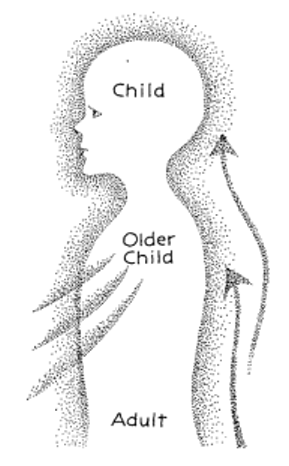
[ 34 ] Now, it is true that there are people whose mental faculties, as they say, decline terribly. But the mind cannot decline; rather, it is once again only the body that declines. It is interesting that it is precisely very intelligent people who often decline terribly in old age. For example, you’ve probably heard that people count Kant among the particularly great sages. But Kant was senile in his old age. His body had deteriorated to such an extent that he could no longer make use of his wise mind. And so it is with many people. It is precisely very intelligent people who have become downright senile in old age. Of course, this is again merely a strong, intense expression of what happens to every human being. Gradually, in old age, one can no longer make use of the physical body. One cannot use it then, for the simple reason that an enormous amount of calcium deposits build up, particularly in the arteries. And the more calcium deposits build up in the arteries, the less one can rely on the physical body. But to the same extent that—let’s say, for example, up to the age of forty—development flows from the head down into the entire body, to that same extent it flows back again. As one moves from one’s forties into one’s fifties, one must once again make greater use of the chest, and in old age, one must once again make greater use of the head. So when one has grown quite old, one must once again make greater use of the head. But in old age, one should not be using the physical head, but rather the finer head—one must use the etheric head up there. But people don’t learn this in a Latin-based education. And it is precisely those who have enjoyed a materialistic Latin-based education in recent decades who have been most exposed to this nonsense about aging.
[ 35 ] In old age, one must return to the stage of childhood. There are, after all, people in whom this occurs very strongly. They become, as they say, mentally weaker and weaker. The mind, however, remains fully intact; it is only the body that grows weaker and weaker. Such people eventually can no longer do what they were able to do at the very beginning. Such things certainly happen. Let’s say a person has grown old. They can no longer do what they were doing most recently. They can only do what they used to do as an older child. Eventually, they can’t even do that anymore; instead, they can only play and understand only those concepts they absorbed while playing. There have even been people who, in their very old age, could understand only what their parents or nannies had told them in the very earliest years of childhood. The expression “In old age, one becomes childlike”—well, there is actually a very good reason for it. One truly does return to childhood.
[ 36 ] But as soon as one has a spiritual life within oneself, this is no misfortune—not at all—but is actually a blessing; for when one is still a child, one can make use of the etheric body. When a child runs around, screams, and does all sorts of things—well, that’s not the physical body doing it—at most only when the child has a stomachache, but even then the stomach pain must first be transmitted to the etheric body and the astral body so that the child moves as a result of the stomachache—but what is actually running around like that is not the physical body. Now one is old and returns once more to the stage of childhood; by then one has gradually become accustomed to no longer running wild, and uses the same etheric body that one used as a child for running wild for something more sensible in old age. So it can be a blessing to return to that state once more.
[ 37 ] There you have the second point. The first thing one must learn in order to enter the spiritual world is to think correctly. We will discuss how to achieve this later; the issues are very complicated. Today, we must first come to understand how this works. The first thing is completely independent thinking. This requires breaking with much of what constitutes modern education, for modern education is, in fact, dependent thinking that stems from Latin. Do not think that the kind of thinking developed today in socialist theories is free thinking! They have all learned from what emerged from Latin; they just didn’t realize it. Isn’t it true that a worker may be able to set this or that goal for himself; but when he begins to think, he thinks entirely in bourgeois terms, and those have emerged from Latin thought. So the first thing one must have is independent thinking.
[ 38 ] The second point, however, is that one must learn not only to live in the present moment, but also to be able to return again and again to the life one led all the way back to childhood. You see, anyone who wants to enter the spiritual world must often resolve: Now you must recall what it was like when you were a twelve-year-old boy. What did you do back then? — And you must imagine this not superficially, merely on the surface, but in every detail. For example, there is nothing more helpful than when you begin to say to yourself: “Yes, back then I was a twelve-year-old boy—I can picture it quite clearly—there was a pile of rocks by the path, and I climbed up on it. Once I tumbled down. There was a hazelnut bush there; I took out my knife, cut off some twigs, and cut my finger.” — To see this, in turn, so clearly—what you yourself did many years ago—is what allows you to realize that you do not actually live solely in the present. When you think in the way we’ve learned today, you’re thinking with your present physical body. But when you go back to who you were at the age of twelve, you cannot think with the physical body you had back then, because it is no longer there—as I’ve told you, the physical body is renewed every seven years—so you must think with your etheric body. That is why you call upon this etheric body when you think back on something that happened when you were twelve or fourteen years old. Through this, you enter into this inner activity.
[ 39 ] And in particular, you can train yourself to think differently from the way you usually do. See, how do you think? We met at nine o’clock today, didn’t we? I started by reading you the slips of paper with the questions on them. Then I offered all sorts of reflections, and we’ve now come to the conclusion that we need to think back to a previous phase of life we went through when we were twelve or fourteen years old. Now, when you get home—perhaps if you find this particularly interesting—you can go over these thoughts again. Well, yes, you can do that. That’s what most people do: they go over it again. But you can do something else. You can ask: What was the last thing he said? The last thing he said was that one should think back to one’s earlier life, all the way back to the age of twelve or fourteen. Even earlier, he spoke about the need for free thinking. Even earlier, he explained how Latin gradually made its way in. Even earlier, he described how a person, after having been mentally unwell for a time, looks back and says they experienced something special. There he explained how the inner person does not become mentally ill, but only the body becomes ill. You see, now you’ve thought through the entire lecture in reverse.
[ 40 ] Yes, gentlemen, things don’t happen in reverse out there! I could, if anything, give you this lecture in reverse right from the start, but you wouldn’t understand it, because one starts at the beginning and builds on it in such a way that one gradually comes to understand it. But once you’ve understood it, you can also think it through in reverse. But the facts don’t unfold backward! That’s when I detach myself from the facts. That’s when I think in such a way that I say: I’m thinking exactly the opposite of how things happen out there—I’m thinking backward. — This requires a certain amount of strength. I have to mobilize my inner energy when I think backward. Just as someone who looks through a telescope must learn to handle the telescope, so too must someone who wants to look into the spiritual world often think backward, think backward again and again. Then one day the time comes when they know: Ah, now I am entering the spiritual world,
[ 41 ] This shows you once again, gentlemen: You have spent your entire lives training your physical body to think forward. If you now begin to think backward, the physical body does not go along with it. Something peculiar happens. That is, in fact, the first piece of advice given to those who keep asking, “How do I enter the spiritual world?”—it’s also in How to Gain Knowledge of the Higher Worlds—namely, that one should tell them: “At least learn, to begin with, to retrace the events of the day; then move on to other things.” Now, of course, people have initially learned to think only with their physical body. That is what they observe. They now try to think backward, but they have only learned to think with the physical body, not with the etheric body. And now the “general strike” of the etheric body begins. Yes, it’s a real general strike! And if people didn’t fall asleep so much while thinking backward, they would know: When I start thinking backward, I should arrive at the spiritual world. — But just at the moment when the vision begins, people fall asleep because the effort is too great for them. So one must have all the good will and all the strength not to fall asleep. To do this, one must have patience. It often takes years; but one must have patience for it.
[ 42 ] Look, if someone could tell you what you unconsciously experience after falling asleep—when you’ve been thinking in reverse—you’d see just how incredibly clever that is! Even the dumbest people start having extraordinarily clever thoughts in their sleep; they just don’t know it.
[ 43 ] That’s what I pointed out to you first: First of all, one must learn to think for oneself. Well, that is possible. I don’t want to say, for example—since I’m not some conceited fool—that only my Philosophy of Freedom serves this purpose, but it was deliberately written to help people develop the habit of independent thinking. So: independent thinking; thinking back very precisely on things that happened when you were ten or twelve years old, or on things you’ve experienced. — With that, we have at least once drawn attention to how one detaches oneself from the physical body, how one enters the spiritual world. And we’ll continue discussing this on Saturday, pursuing it further so that all four of these questions gradually emerge.