

Man and World
How Spirit Works in Nature
GA 351
8 October 1923, Dornach
Translate the original German text into any language:
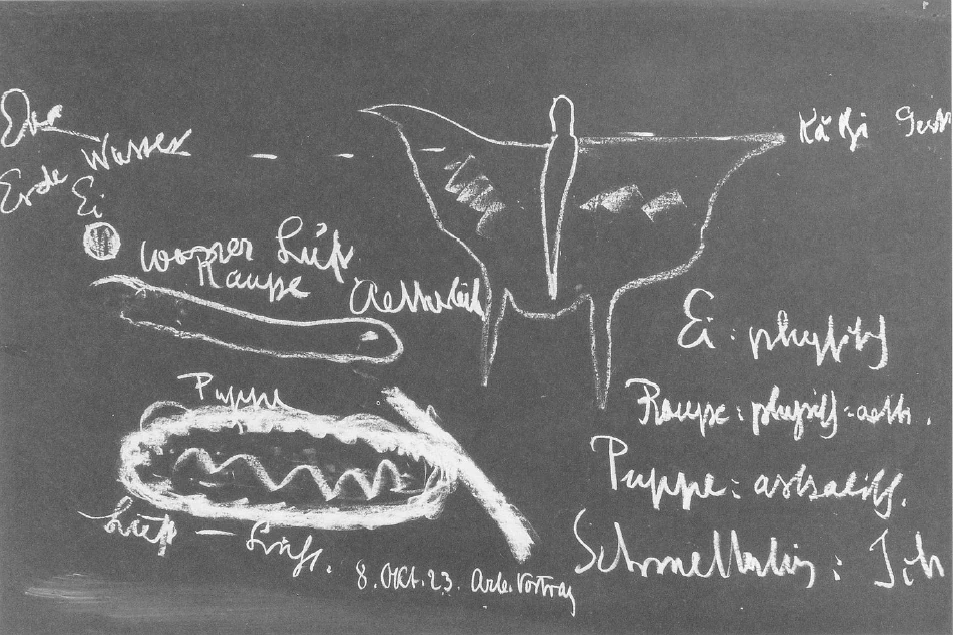
Versions Available:
How Spirit Works in Nature, tr. SOL
1. Das Wesen der Schmetterlinge
1. The Nature of Butterflies
[ 1 ] Guten Morgen, meine Herren! Haben Sie sich irgend etwas ausgedacht, was heute beantwortet werden könnte? Wenn nicht, dann will ich Ihnen heute etwas sagen, was sich ganz gut anschließt an Dinge, die ich schon besprochen habe.
[ 1 ] Good morning, gentlemen! Have you come up with anything that could be addressed today? If not, then I’d like to tell you something today that ties in quite well with things I’ve already discussed.
[ 2 ] Wenn der Mensch so hineinsieht in die Natur - er sieht ja eigentlich ziemlich gedankenlos hinein —, so kommt ihm in dem Momente, wo er anfängt, wirklich über die Naturdinge nachzudenken, ja so viel in den Sinn, was darauf hinweist, daß überall Geist in der Natur, daß überall das Geistige gegenwärtig ist, daß er gar nicht mehr anders kann, als, wenn ich so sagen darf, neugierig zu werden, wie da eigentlich dieser Geist in der Natur wirkt. Ich habe Ihnen ja beim Biberbau, bei ähnlichen Dingen immer wieder zeigen können, wie geistreich alle diese Dinge in der Natur sind. Nun will ich Ihnen heute noch etwas anderes zeigen.
[ 2 ] When a person looks into nature in this way—and in fact, he looks at it rather thoughtlessly— then the moment they begin to truly reflect on the phenomena of nature, so many things come to mind that point to the fact that spirit is present everywhere in nature, that the spiritual is present everywhere—so much so that they simply cannot help but, if I may put it this way, become curious about how this spirit actually works in nature. I have, after all, been able to show you time and again—with the beaver lodge and similar examples—just how spirit-filled all these things in nature are. Now I would like to show you something else today.
[ 3 ] Nicht wahr, der Mensch sieht zunächst, wenn er in einer gewissen Zeit des Sommers in der Natur draußen herumgeht, die schönen flatternden Schmetterlinge mit ihren farbigen Flügeln, die so bunt schillern, und da frägt er nicht weiter: Woher kommt dieses wirklich mannigfaltig bunt schillernde Flattern der Schmetterlinge, die sich so frei bewegen?
[ 3 ] Isn’t it true that when a person walks outdoors in nature at a certain time of summer, they first see the beautiful fluttering butterflies with their colorful wings, shimmering in such a variety of hues, and they don’t ask any further: Where does this truly diverse, colorful, shimmering fluttering of the butterflies, which move so freely, actually come from?
[ 4 ] Es ist dieses von einer großen praktischen Bedeutung. Ich bin sogar davon überzeugt: Wenn wir hier irgendwo auf unserem GoetheanumGrunde neue Versuche machen könnten für die Luftschiffahrt, so würden wir die nicht so anstellen, wie sie heute aus der materialistischen Wissenschaft heraus angestellt werden. Da versucht man es immer mit dem Vogelflug, mit dem Libellenflug, der Wasserjungfer und so weiter. Aber man hat keinen Sinn dafür, die Sache zu versuchen mit dem eigentlichen Schmetterlingsflug. Und dennoch würde die Luftschiffahrt erst auf ihre richtige Gestalt kommen, wenn man die Versuche dafür im Großen anfassen könnte gerade mit dem Schmetterlingsflug. Aber nicht wahr, auf solche Dinge gehen die Leute heute deswegen nicht ein, weil sie die Richtigkeit doch nicht einsehen können. Man kann nämlich solche Dinge in richtiger Weise, selbst für das praktische Leben, doch nur einsehen, wenn man auf das Geistige eingeht.
[ 4 ] This is of great practical importance. I am even convinced that if we could conduct new experiments in air travel here somewhere on the grounds of our Goetheanum, we would not approach them the way they are approached today by materialistic science. There, people always try to model flight after that of birds, dragonflies, damselflies, and so on. But they have no sense of trying to model it after the actual flight of a butterfly. And yet, air travel would only take on its true form if one could undertake large-scale experiments based precisely on butterfly flight. But isn’t it true that people today do not engage with such things precisely because they cannot grasp their validity? For one can only truly understand such things—even for practical life—if one engages with the spiritual.
[ 5 ] Nun will ich Ihnen heute etwas über die Schmetterlinge, etwas, was nicht gerade zur Luftschiffahrt gehört, aber Sie aufklären kann über die Luftschifferei, zeigen. Sehen Sie, solch ein Schmetterling ist ja nicht von vornherein da, sondern der kommt ja, wie Sie wissen, auf eine sehr komplizierte Weise zustande. Zunächst gehen wir davon aus, daß der Schmetterling, wenn es gegen den Herbst zu geht, er also reif geworden ist, ein Ei legt. So daß also das erste, wovon der Schmetterling ausgeht, das ist, daß er ein Ei legt. Aus diesem Ei kommt ja nicht wieder ein Schmetterling heraus. Da kriecht nicht wiederum, sagen wir, der Schmetterling Schwalbenschwanz heraus, der so ausschaut (siehe Zeichnung); der kriecht nicht da heraus, sondern aus diesem Ei kriecht zunächst dasjenige heraus, was man im Volksmund einen «Wurm» nennt; eine Raupe kriecht heraus. Diese Raupe also kriecht aus dem Ei heraus. Hier hat sie ihren Kopf (siehe Zeichnung), hier hinten ist ein Stachel, und die kriecht nun so träg, langsam herum, ist eigentlich äußerlich eine Art von Faulenzer. Aber innerlich ist eine solche Raupe gar keine Faulenzerin, sondern innerlich spinnt sie aus ihrem eigenen Leib heraus Fäden, und aus diesen Fäden macht sie um sich herum eine Hülle. Wenn also das jetzt die Raupe ist (siehe Zeichnung), so spinnt diese Raupe aus sich selbst heraus Fäden und macht um sich herum eine Hülle, die hart ist. Die Raupe verschwindet allmählich im Inneren ganz, löst sich auf in diesen Fäden, macht also um sich herum eine Hülle, die sie irgendwie an einen Baumstamm anhängt, anklebt; sie klebt zuerst den Faden an und verschwindet dann in der Hülle. So daß wir haben: das Ei, die Raupe und hier, das nennt man eine Puppe. Und diese Puppe, die bleibt nun eine Zeitlang hängen. Dann kriegt sie irgendwo ein Loch und der Schmetterling kommt heraus. So daß, bevor ein solcher Schmetterling zustande kommt, vier Sachen notwendig sind: also erstens das Ei, zweitens die Raupe, drittens die Puppe und viertens er selbst. Das Ei, das wird irgendwo abgelegt. Die Raupe kriecht dann herum. Die Puppe bleibt ganz fest und der Schmetterling flattert lustig in der Luft herum. Der kann dann wiederum ein Ei legen und die Geschichte geht im Jahreslauf von neuem los. So ist die Sache.
[ 5 ] Today I’d like to show you something about butterflies—something that isn’t exactly related to airship travel, but that can shed light on the subject of airship travel. You see, a butterfly like this isn’t just there from the start—as you know, it comes into being through a very complicated process. First, let’s assume that as fall approaches—once the butterfly has reached maturity—it lays an egg. So the first thing the butterfly does is lay an egg. A butterfly doesn’t emerge from this egg. It’s not, let’s say, the swallowtail butterfly that looks like this (see drawing) that crawls out; it doesn’t crawl out of there. Instead, what first crawls out of this egg is what is commonly called a “worm”—a caterpillar crawls out. So this caterpillar crawls out of the egg. Here is its head (see drawing), here at the back is a stinger, and it now crawls around so sluggishly, so slowly—outwardly, it’s actually a sort of slacker. But on the inside, such a caterpillar is no slacker at all; rather, it spins threads from its own body, and from these threads it makes a cocoon around itself. So if this is the caterpillar (see drawing), then this caterpillar spins threads from within itself and makes a hard cocoon around itself. The caterpillar gradually disappears completely inside, dissolving into these threads; it thus forms a cocoon around itself, which it somehow attaches to a tree trunk; it first sticks the thread to the trunk and then disappears into the cocoon. So we have: the egg, the caterpillar, and here—this is called a pupa. And this pupa remains attached for a while. Then a hole appears somewhere and the butterfly emerges. So, before such a butterfly comes into being, four things are necessary: first, the egg; second, the caterpillar; third, the chrysalis; and fourth, the butterfly itself. The egg is laid somewhere. The caterpillar then crawls around. The chrysalis stays firmly in place, and the butterfly flutters merrily through the air. It can then lay an egg, and the cycle begins anew as the year goes on. That’s how it works.
[ 6 ] Nun, das schauen sich die Leute an, und das erklären heute die Gelehrten ja so, daß sie einfach beobachten, was sich da durch das Mikroskop ‚oder dergleichen eben beobachten läßt. Aber so einfach ist die Sache nicht. Man muß berücksichtigen, wo das Ei leben kann und wie es lebt, wie die Raupe lebt, wie die Puppe lebt und wie zuletzt der Schmetterling lebt. Das Ei, das braucht vor allen Dingen, wenn es so weit kommen soll, daß die Raupe auskriechen kann, manchmal furchtbar wenig — aber es braucht Feuchtigkeit, in der etwas Salz aufgelöst ist. Kein Ei kann gedeihen, ohne daß es etwas Feuchtigkeit, in der etwas Salz aufgelöst ist, bekommt. Daher muß das Tier, der Schmetterling, diesen Instinkt haben, das Ei irgendwo hinzulegen, wo es Feuchtigkeit bekommen kann, in der etwas Salz enthalten ist. Ohne das geht es also nicht. Es ist das, was ich Ihnen hier für den Schmetterling erzähle, eben geradeso auch für die Biene und so weiter. Es ist für die Biene auch notwendig, daß da, wo die Eier abgelegt werden, etwas durchdringt - wenn es auch wenig ist-, daß Salz hineinkommt. Es beobachten das eben wenige. Es genügt, wenn der Nebel durchgeht; der hat immer etwas Salzfeuchtigkeit. Es kommt einem da die Natur zu Hilfe. Es leuchtet das dem menschlichen Verstand nicht immer ganz ein. Die Natur ist eben viel gescheiter als der Mensch. Aber das Ei muß immer etwas Feuchtigkeit haben, in der etwas Salz drinnen ist. Das ist beim Schmetterling auch so, und dann kriecht also die Raupe heraus. Das Ei braucht also nur diese Feuchtigkeit, in der Salz drinnen ist; es hat keine Augen, es sieht nichts, es lebt im übrigen für sich selbst in einer Welt, die ganz finster ist. In dem Augenblick, wo die Raupe ausgekrochen ist, kommt sie ans Licht heraus, ist also fortwährend im Lichte. Die Raupe hat Sinnesorgane, kommt ans Licht. Jetzt ist es eigentlich ein ganz anderes Wesen geworden, als das Ei es ist. Das Ei hat sich ganz in die Raupe verwandelt. Und daß die Raupe dem Licht ausgesetzt ist, daß sie Sinne hat, das übt einen inneren Eindruck auf die Raupe aus. Solche Dinge kommen bei gewissen Erscheinungen ganz radikal zum Ausdruck. Sie alle haben ja schon diese merkwürdige Erscheinung genossen, daß, wenn Sie irgendwo eine Lampe angezündet haben, allerlei Insekten im Zimmer herumflattern, sich vom Licht der Lampe angezogen fühlen, sich sogar hineinstürzen, so dumm sind, daß sie verbrennen. Woher rührt das? Natürlich kommt das nicht bei dieser Raupe vor, aber der Wille dazu ist bei dieser Raupe auch vorhanden. Die Raupe, die wird nämlich vom Sonnenlicht geradeso, ich möchte sagen, wollüstig angezogen, wie das Insekt, das sich in die Kerzenflamme stürzt; nur kann die Raupe nicht zu der Sonne hinaufkommen. Könnte sie sich vom Boden erheben und hinauffliegen zur Sonne, so würden wir sehr bald gar keine Raupen mehr haben; die würden alle zur Sonne hinauffliegen, alle fortfliegen. Denn das wollen sie, sie sind nur festgehalten von der Schwere der Erde, sie können nicht. So daß, wenn wir eine Raupe anschauen, diese Raupe eigentlich den Willen hat, dem Lichte nachzugehen. Das kann sie nicht. Aber was tut sie?
[ 6 ] Well, people look at this, and scholars today explain it by simply observing what can be seen through a microscope or similar instrument. But it’s not that simple. One must take into account where the egg can live and how it lives, how the caterpillar lives, how the pupa lives, and finally, how the butterfly lives. The egg, above all else, needs—if it is to reach the stage where the caterpillar can hatch—sometimes very little—but it needs moisture in which some salt is dissolved. No egg can thrive without receiving some moisture in which a little salt is dissolved. Therefore, the animal—the butterfly—must have this instinct to lay the egg somewhere where it can obtain moisture containing a little salt. It simply won’t work without that. What I’m telling you here about the butterfly applies just as much to the bee and so on. It is also necessary for the bee that, wherever the eggs are laid, something—even if only a little—penetrates the eggs so that salt gets inside. Few people observe this. It’s enough for the mist to pass through; it always contains some salty moisture. Nature comes to our aid here. This isn’t always entirely clear to the human mind. Nature is simply much wiser than humans. But the egg must always have some moisture that contains a bit of salt. This is also the case with butterflies, and then the caterpillar crawls out. So the egg needs only this moisture containing salt; it has no eyes, it sees nothing, and it lives entirely on its own in a world that is completely dark. The moment the caterpillar crawls out, it emerges into the light and is thus constantly in the light. The caterpillar has sensory organs and comes into the light. Now it has actually become a completely different creature from what the egg was. The egg has completely transformed into the caterpillar. And the fact that the caterpillar is exposed to light, that it has senses, has a profound effect on it. Such things are expressed quite radically in certain phenomena. You have all surely already observed this curious phenomenon: when you turn on a lamp somewhere, all sorts of insects flutter around the room, drawn to the light of the lamp, even rushing into it—so foolish that they burn themselves. Where does this come from? Of course, this does not happen with this caterpillar, but the will to do so is also present in this caterpillar. The caterpillar is, in fact, drawn to sunlight just as—I would say—sensually as the insect that throws itself into a candle flame; only the caterpillar cannot reach the sun. If it could rise from the ground and fly up toward the sun, we would very soon have no caterpillars left at all; they would all fly up toward the sun, all fly away. For that is what they want; they are merely held back by the gravity of the earth—they cannot. So when we look at a caterpillar, this caterpillar actually has the will to follow the light. It cannot do so. But what does it do?
[ 7 ] Denken Sie sich einmal, da ist der Lichtstrahl, da die Raupe (es wird gezeichnet). Jetzt spinnt die Raupe, indem sie kriecht, so wie der Lichtstrahl ist, einen Faden. Die Raupe spinnt ganz nach dem Lichtstrahl den Faden, und wenn der Lichtstrahl in der Nacht nicht da ist, da rollt sie den Faden ein und bei Tag spinnt sie in dem Lichtstrahl den Faden wieder weiter, in der Nacht rollt sie ihn wieder ein. Und daraus entsteht die Hülle rundherum. Die Raupe löst sich ganz im Licht auf, stirbt im Licht, wie das Insekt, das der Flamme zugeht, nur daß sie nicht zur Sonne hinaufkommt, in den Lichtstrahl selber hineingeht; aber sie spinnt ihren eigenen Körper in diese Fäden hinein und macht um sich diesen Kokon, wie man ihn nennt, diese Fäden, die da zusammengesponnen werden. Die Seidenraupe spinnt die Seide nach dem Licht. Wenn Sie also aus irgendeiner Seidenraupe Seide nehmen, so können Sie sich getrost sagen: Was ist das? Das ist gesponnenes Licht!- Da ist in der Richtung der Lichtstrahlen hineingesponnen die Erdenmaterie. Und wenn Sie irgendwo eine Puppe sehen, dann ist das so, daß das lauter gesponnenes Sonnenlicht ist, ringsherum Erdenstoff, der dem Sonnenstrahl nachgesponnen ist.
[ 7 ] Just imagine: there’s a beam of light, and there’s a caterpillar (it’s drawn). Now the caterpillar spins a thread as it crawls, just as the beam of light does. The caterpillar spins the thread entirely in accordance with the beam of light, and when the beam of light is not there at night, it rolls up the thread; during the day, it continues spinning the thread within the beam of light, and at night it rolls it up again. And from this, the cocoon forms all around it. The caterpillar dissolves entirely in the light, dies in the light, like an insect drawn to a flame—except that it does not ascend toward the sun but enters the beam of light itself; yet it weaves its own body into these threads and forms around itself this cocoon, as it is called—these threads that are woven together. The silkworm spins silk toward the light. So if you take silk from any silkworm, you can confidently say to yourself: What is this? It is spun light!—There, spun in the direction of the rays of light, is the earthly matter. And when you see a pupa somewhere, it is nothing but spun sunlight, surrounded by earthly matter that has been spun following the sun’s rays.
[ 8 ] Also so weit sind wir, daß wir jetzt die Puppe haben, ringsherum gesponnenes Licht, und dadurch, daß das gesponnenes Sonnenlicht ist, kommt natürlich etwas anderes zustande, als wenn sich ein Insekt in die Flamme stürzt da verbrennt es die Flamme der Kerze, kann nichts damit machen. Könnte aber dieses Insekt in der Schnelligkeit, mit der es sich in die Flamme stürzt, in der Richtung der Flammenstrahlen einen solchen Kokon herumspinnen, so würde aus dem Feuer der Flamme im Inneren ein neues Tier entstehen. Das wird nur durch die Verbrennung verhindert. Es ist interessant, daß man dadurch erfährt, was eigentlich dieses Insekt will, das in der Nacht im Zimmer herumflattert und sich in die Flamme stürzt: es will sich nämlich fortpflanzen, es will zugrunde gehen, damit es in einer neuen Gestalt wiederkommt. Es täuscht sich nur, weil es nicht so schnell eine Hülle machen kann. Aber die Raupe kann in der Langsamkeit eben diese Hülle machen, hängt diese Hülle auf, und jetzt kann die Kraft der Sonne, die da eingefangen ist, die da eine Gefangene ist, die kann den Schmetterling im Inneren schaffen, und der kann dann als ein Sonnengeschöpf herausfliegen und als ein Sonnengeschöpf sich bewegen.
[ 8 ] So here’s where we are: we now have the doll, with light woven all around it, and since this is woven sunlight, the result is naturally different from when an insect throws itself into the flame—there, it burns the candle’s flame and can do nothing with it. But if this insect, with the speed at which it throws itself into the flame, were to spin such a cocoon around itself in the direction of the flame’s rays, a new creature would emerge from the fire of the flame within. This is prevented only by combustion. It is interesting that this reveals what this insect, fluttering around the room at night and plunging into the flame, actually wants: it wants to reproduce; it wants to perish so that it may return in a new form. It is only mistaken because it cannot create a shell that quickly. But the caterpillar, precisely because of its slowness, can create this shell, hang it up, and now the power of the sun—which is trapped there, which is a prisoner there—can create the butterfly inside, and the butterfly can then fly out as a creature of the sun and move as a creature of the sun.
[ 9 ] Sehen Sie, meine Herren, da kommt man darauf, wie eigentlich die Dinge in der Natur sind. Erstens haben Sie in dem, was ich Ihnen gesagt habe, eine ganz wichtige Idee: Das Insekt, das sich in die Flamme stürzt, will sterben, denkt man sich. Nein, das will nicht sterben, sondern es will in anderer Gestalt wiederkommen. Es will durch die Flamme umgestaltet werden. Und so ist der Tod überall: Der Tod ist nichts, was die Wesen vernichtet, sondern wodurch sie, wenn der Tod richtig eingeleitet wird, nur umgestaltet werden. Erstens sieht man das daraus. Zweitens sieht man aber einen gründlichen Zusammenhang, der zwischen allem in der Natur draußen besteht. Sehen Sie, der Schmetterling ist aus dem Licht geschaffen; aber das Licht mußte erst, indem es die Erdenmaterie in sich aufnahm und einen Kokon machte, in der Puppe zum Faden gemacht werden. Alles das, was entsteht an tierischen Wesenheiten, wird aus dem Licht heraus geschaffen. Auch der Mensch wird aus dem Licht heraus geschaffen durch die Vorgänge, die durch die Befruchtung des weiblichen Eikeimes geschehen, und der schützt im Inneren des Menschen, durch eine Hülle, das Licht. Und in Wahrheit ist es das Licht, das den Menschen im Körper der Mutter schafft, das also die Möglichkeit schafft, daß der Mensch aus dem Lichte heraus entstehen kann. So sieht man also am Schmetterling, daß er aus dem Licht heraus, das erst gefangen worden ist, entsteht.
[ 9 ] You see, gentlemen, this leads us to understand how things actually are in nature. First of all, there is a very important idea in what I have told you: the insect that throws itself into the flame—one might think—wants to die. No, it does not want to die, but rather it wants to return in a different form. It wants to be transformed by the flame. And so it is with death everywhere: Death is not something that destroys beings, but rather, when properly initiated, it merely transforms them. First, we see this from that. Second, however, we see a profound connection that exists between everything in nature out there. You see, the butterfly is created from light; but the light first had to be transformed into a thread within the chrysalis by taking in earthly matter and forming a cocoon. Everything that comes into being among animal beings is created out of light. Human beings, too, are created out of light through the processes that occur upon fertilization of the female germ, and within the human being, this germ protects the light through a covering. And in truth, it is the light that creates the human being within the mother’s body—thus creating the possibility for the human being to come into being from the light. Thus, we see in the butterfly that it comes into being from the light that has first been captured.
[ 10 ] Nun, der Schmetterling, der flattert in vielen Farben herum. Solche Farben sind überhaupt da, wenn man dasjenige, was am meisten vom Lichte beeinflußt werden kann, anschaut. Wenn man also in heiße Gegenden geht, dann sind alle Vögel von wunderbaren Farben, weil da die Sonne die größere Stärke hat. Was tut also das, was da in der Sonne, im gefangenen Licht schafft? Das bringt die Farben hervor, bringt immer Farben hervor. Und so ist es auch beim Schmetterling. Der Schmetterling hat seine Farben durch dasjenige, was das Licht da als ein Gefangener getan hat. Man kann den Schmetterling nur verstehen, wenn man ihn versteht als Schöpfung aus dem ganzen Licht heraus, das ihn in vielen Farben macht.
[ 10 ] Well, the butterfly flutters about in many colors. Such colors are present at all when one looks at whatever is most susceptible to the influence of light. So when one goes to hot regions, all the birds have wonderful colors, because the sun is stronger there. So what is it that creates what is there in the sun, in the light that is held captive? It brings forth the colors—it always brings forth colors. And so it is with the butterfly. The butterfly has its colors because of what the light has done there as if held captive. One can only understand the butterfly if one understands it as a creation born of all the light that makes it appear in many colors.
[ 11 ] Aber das kann die Sonne nicht allein. Die Sache ist so: Wenn wir das Ei anschauen, ist das also in der Feuchtigkeit drinnen, in der Salz ist. Salz ist Erde, Feuchtigkeit ist Wasser. So daß wir sagen können: Das Ei muß gedeihen in Erde und etwas Wasser. - Die Raupe kommt schon ans Licht heraus. Die Raupe kann ihrem ganzen Wesen nach nicht bloß gedeihen in Erde und Wasser, also in aufgelöstem Kalk zum Beispiel und Wasser, sondern die Raupe braucht Feuchtigkeit, also Wasser, aber auch Luft, Feuchtigkeit und Luft. Diese Feuchtigkeit und Luft, die die Raupe braucht, die ist nun nicht bloß wie das, was das Ei physisch braucht, sondern in dieser Feuchtigkeit drinnen lebt dasjenige, was man Äther nennt und was ich Ihnen beim Menschen geschildert habe als den Ätherleib. Die Raupe kriegt einen Ätherleib. Und durch den Ätherleib atmet sie. Durch den Ätherleib nimmt sie dasjenige auf, was jetzt schon geistig in der Luft ist. Das Ei ist noch ganz physisch, die Raupe aber lebt schon im Physisch-Ätherischen. Aber das ist schwer für die Raupe, im Physisch-Ätherischen zu leben. Die Raupe hat viel zuviel schwere Erdenmaterie in sich. Bei der Raupe ist es so: Wenn sie ans Licht kommt, so zeigt sich das eben, daß sie dann aus sich heraus die Lichtstrahlen spinnt in Form ihrer Kokonseide. Die Raupe möchte ans Licht, kann aber nicht; sie hat zuviel Schwerekräfte in sich. Sie ist dem nicht gewachsen, dem sie jetzt ausgesetzt ist. Daher will sie selber aufgehen im Licht, sie will sich ins Licht hineinergießen, sie will im Licht weiterleben. Was tut sie? Ja, sie schließt sich gegen die Erde mit den Sonnenstrahlen ab, sie macht einen Kokon um sich herum. Die Raupe schließt sich in der Puppe von den physischen Erdenkräften ganz ab. Und jetzt hat die Puppe im Inneren, wo der «Wurm» verschwunden ist, astralische Kräfte in sich, nicht mehr Erdenkräfte und nicht mehr ätherische Kräfte, sondern astralische, ganz geistige Kräfte in sich, und diese astralischen Kräfte leben im eingefangenen Licht. Das eingefangene Licht hat immer geistige Kräfte, astralische Kräfte in sich. Und diese astralischen Kräfte, die schaffen den Schmetterling. Der kann jetzt, weil er ganz aus astralischen Kräften besteht, in der Luft herumfliegen, was die Raupe nicht kann; der kann dem Lichte folgen. Er folgt nur dem Lichte, er unterliegt nicht mehr der Schwere. Es ist die Schwere dadurch, daß er sich hingegeben hat, ausgeschaltet. So daß man sagen kann: Er ist zum Ich herangereift. - Ein Ich ist es, in dem wir sozusagen den Schmetterling herumflattern sehen. Wir Menschen haben unser Ich in uns. Der Schmetterling hat es außer sich. Das Ich ist eigentlich Licht. Das färbt ihn.
[ 11 ] But the sun cannot do this on its own. The fact is this: When we look at the egg, it is inside the moisture that contains salt. Salt is earth; moisture is water. So we can say: The egg must thrive in earth and a little water. — The caterpillar is already emerging into the light. By its very nature, the caterpillar cannot thrive merely in earth and water—that is, in dissolved lime, for example, and water—but the caterpillar needs moisture, that is, water, as well as air; moisture and air. This moisture and air that the caterpillar needs is not merely what the egg physically requires; rather, within this moisture lives that which is called ether—and which I have described to you in relation to human beings as the etheric body. The caterpillar develops an etheric body. And through the etheric body it breathes. Through the etheric body it absorbs what is already present spiritually in the air. The egg is still entirely physical, but the caterpillar already lives in the physical-etheric realm. Yet it is difficult for the caterpillar to live in the physical-etheric realm. The caterpillar has far too much heavy earthly matter within it. With the caterpillar, it is like this: when it comes into the light, this is precisely what is revealed—that it then spins the rays of light from within itself in the form of its cocoon silk. The caterpillar wants to reach the light but cannot; it has too many forces of heaviness within itself. It is not up to the task of what it is now facing. Therefore, it wants to dissolve into the light itself; it wants to pour itself into the light; it wants to continue living in the light. What does it do? Yes, it seals itself off from the earth with the sun’s rays; it makes a cocoon around itself. Inside the chrysalis, the caterpillar completely seals itself off from the physical forces of the earth. And now, inside the chrysalis—where the “worm” has disappeared—there are astral forces; no longer earthly forces or etheric forces, but astral, entirely spiritual forces, and these astral forces live within the captured light. Captured light always contains spiritual forces—astral forces. And these astral forces are what create the butterfly. Because it consists entirely of astral forces, it can now fly through the air—something the caterpillar cannot do—and follow the light. It follows only the light; it is no longer subject to heaviness. Through its surrender, the force of gravity has been eliminated. So that one can say: It has matured into the “I.”—It is an “I” within which we see, so to speak, the butterfly fluttering about. We humans have our “I” within us. The butterfly has it outside itself. The “I” is actually light. That is what colors it.
[ 12 ] Wenn Sie das bedenken, dann müssen Sie sich etwas klarmachen. Sie alle sagen immer zu sich: Ich. - Was bedeutet das, wenn Sie zu sich Ich sagen? Sehen Sie, jedesmal, wenn Sie zu sich Ich sagen, glänzt in Ihrem Hirn eine kleine Flamme auf, die nur mit gewöhnlichen Augen nicht gesehen werden kann. Das ist Licht. Sage ich zu mir Ich, so rufe ich das Licht in mir auf. Dieses selbe Licht, das den Schmetterling in Farben färbt, das rufe ich in mir auf, wenn ich zu mir Ich sage. Es ist das wirklich außerordentlich interessant, draußen in der Natur zu beobachten, daß man sich sagen kann: Ich sage zu mir Ich; könnte ich dieses Ich ausstrahlen in alle Welt, so wäre es Licht. Ich habe es nur durch meinen Körper eingesperrt, dieses Ich. Könnte ich es ausstrahlen, so könnte ich mit diesem Licht lauter Schmetterlinge erschaffen. - Das Ich des Menschen hat eben die Macht, lauter Schmetterlinge zu schaffen, überhaupt Insekten und so weiter zu schaffen. Sehen Sie, da stellen sich die Menschen vor, daß alles so einfach ist. Aber in älteren Zeiten, wo man solche Sachen gewußt hat, da haben die Menschen auch in dem Sinne gesprochen. Im ganz alten Judentum, da gab es ein Wort: «Jahve», was dasselbe bedeutet wie «Ich». Dieses Wort, in der hebräischen Sprache Jahve, durfte nur der Priester aussprechen, weil der Priester dazu vorbereitet war, sich zu sagen, was das bedeutet. Denn der Priester sah in dem Momente, wo er Jahve aussprach, überall die Bilder von herumfliegenden Schmetterlingen. Und da wußte er: Hat er das Wort Jahve ausgesprochen so, daß er nichts sah, so hat er es nicht mit der inneren richtigen Herzhaftigkeit ausgesprochen. Er stand aber in der richtigen inneren Herzhaftigkeit, wenn er lauter Schmetterlinge sah. Das hat er aber den anderen Leuten nicht beibringen können, denn die wären verrückt geworden darob; darum hat er sich erst vorbereiten müssen. Aber wahr ist es doch.
[ 12 ] When you think about this, there’s something you need to realize. You all always say to yourselves: “I.”—What does it mean when you say “I” to yourselves? You see, every time you say “I” to yourselves, a small flame flares up in your brain—one that cannot be seen with the naked eye. That is light. When I say “I” to myself, I summon the light within me. This very same light that colors the butterfly—that is what I summon within myself when I say “I” to myself. It is truly fascinating to observe this out in nature, to realize that I can say to myself, “I say ‘I’ to myself”; if I could radiate this ‘I’ out into the whole world, it would be light. I have merely imprisoned this “I” within my body. If I could radiate it, I could create countless butterflies with this light. — The human “I” has the very power to create countless butterflies, and indeed insects and so on. You see, people imagine that everything is so simple. But in ancient times, when such things were known, people spoke in this sense as well. In very ancient Judaism, there was a word: “Yahweh,” which means the same thing as “I.” This word—Yahweh in Hebrew—could only be uttered by the priest, because the priest was prepared to understand what it meant. For the priest, at the very moment he uttered Yahweh, saw images of butterflies fluttering everywhere. And then he knew: If he had spoken the word Yahweh without seeing anything, he had not spoken it with the proper inner sincerity. But he was in the proper inner sincerity when he saw nothing but butterflies. However, he could not teach this to other people, because they would have gone mad over it; that is why he first had to prepare himself. But it is true nonetheless.
[ 13 ] Ja, meine Herren, aber was ist denn das? Denken Sie sich einmal, hier wäre zwischen diesem Pult und dem Punkt, wo ich stehe, eine große Bettdecke mit lauter Flaumfedern drinnen. Die Flaumfedern wären etwas dünn drinnen, und ich stelle mich da hier an und dränge dahin, gehe so dahin, drücke die Flaumfedern zusammen, ich komme nicht ganz bis zu dem Pult hin, sondern muß in der Mitte stehenbleiben, weil ich sie nicht weiter zusammendrücken kann. Ich erreiche das Pult nicht, aber ich verspüre einen Druck, wenn ich mich da anstemme. So wollen Sie das Ich aussprechen, wollen Sie eigentlich lauter Schmetterlinge erzeugen, weil das Ich Licht ist. Aber Sie können das nicht. Statt dessen spüren Sie den Widerstand, wie ich da den Widerstand spüre, wenn ich dem entgegengehe. Und das sind Ihre Gedanken. Darinnen bestehen Ihre Gedanken, daß man nicht lauter Schmetterlinge erschaffen kann durch das Licht. Das Ich denkt Gedanken. Die Gedanken sind eigentlich nur Bilder von der Schmetterlingswelt.
[ 13 ] Yes, gentlemen, but what is this? Just imagine there were a large comforter filled with nothing but down feathers stretched out between this desk and the spot where I’m standing. The down feathers would be somewhat sparse inside, and I stand here and push my way through, walking along like this, compressing the down feathers; I can’t quite reach the desk, but have to stop in the middle because I can’t compress them any further. I can’t reach the desk, but I feel pressure when I push against it. That’s how you want to express the “I”—you actually want to create a whole swarm of butterflies, because the “I” is light. But you can’t do that. Instead, you feel the resistance, just as I feel the resistance when I move toward it. And those are your thoughts. Your thoughts consist of the realization that one cannot create nothing but butterflies through the light. The “I” thinks thoughts. The thoughts are actually just images of the world of butterflies.
[ 14 ] Sehen Sie, das sieht so aus, daß eigentlich heute noch dasselbe einträte, was im alten Judentum eingetreten wäre, wenn einfach ein jeder, der Jahve ausgesprochen hätte, die ganze Schmetterlingswelt gesehen hätte; dann hätten die Leute gesagt: Nun, der ist selbstverständlich verrückt. - Er wäre es auch gewesen, wenn er nicht reif dazu gewesen wäre, die geistigen Sachen anzuschauen! Aber heute sagen die Leute, wenn einer davon redet, daß das Licht Ich ist, und daß das Licht dasselbe ist, was in anderer Weise, wenn es eingesperrt ist, die Schmetterlinge erschaffen kann, was in uns, weil wir ein dazu geeignetes Gehirn haben, die Gedanken schafft statt der Schmetterlinge - heute sagen die Leute wieder: Der ist verrückt! - Aber das ist die Wahrheit. Das ist eben der Unterschied zwischen einer bloßen Verrücktheit und der Wahrheit. So daß man sagen muß: Schauen wir uns den bunten Schmetterling an in der Luft, dann wirkt auf uns dasselbe, wie wenn wir uns so recht in uns fühlen und Ich sagen. Der Schmetterling kann nicht Ich sagen, nicht einmal das höhere Tier, weil das Ich von außen wirkt. Wenn Sie einen Löwen ansehen in seiner semmelfarbenen Gelbheit, dann ist es die semmelfarbene Gelbheit, die vom Ich des Löwen von außen bewirkt wird. Der Löwe wird selber gedacht von der ganzen Natur, die Färbung kommt dadurch zustande. Weil wir von innen heraus denken, bekommen wir nicht von außen die Färbung, sondern wir bekommen die Hautfärbung von innen, die man sehr schwer in der Malerei nachmachen kann. Aber unser Ich färbt eigentlich mit Hilfe des Blutes unseren ganzen Körper zu dieser wunderbaren Menschenfarbe, die man in der Malerei nur nachmachen kann, wenn man alle Farben in der richtigen Weise miteinander mischen kann, richtig mischen kann. Da schafft fortwährend die Natur an dem Wesen, aber sie schafft auf geistige Art. Sehen Sie, ich habe Ihnen hier gesagt: Es muß der Übergang sein von dem Feuchten, das die Luft in sich hält, zu dem Licht. Da ist die Puppe nun in Luft und Licht. Da ist sie in Wasser und Luft als Raupe, hier in Luft und Licht als Puppe, und dann kommt sie immer weiter von dem Licht, das eingefangen ist, zu dem Astralischen, das in ihr wirkt.
[ 14 ] You see, it looks as though the same thing would actually happen today as would have happened in ancient Judaism if simply everyone who uttered the name of Yahweh had seen the entire world of butterflies; then people would have said: Well, he’s obviously crazy. - And he would have been, if he hadn’t been ready to perceive spiritual things! But today, when someone speaks of the light being the “I,” and of the light being the same thing that—when confined—can create butterflies in a different way, and that within us—because we have a brain suited for it—creates thoughts instead of butterflies—today people say again: “He’s crazy!”—But that is the truth. That is precisely the difference between mere madness and the truth. So one must say: When we look at the colorful butterfly in the air, it has the same effect on us as when we feel truly within ourselves and say “I.” The butterfly cannot say “I,” nor can even the higher animal, because the “I” acts from the outside. When you look at a lion in its bread-colored yellowness, it is that bread-colored yellowness that is brought about from the outside by the lion’s “I.” The lion itself is conceived by the whole of nature; that is how the coloring comes about. Because we think from the inside out, we do not receive our coloring from the outside, but rather our skin color comes from within—a color that is very difficult to replicate in painting. But our “I,” with the help of the blood, actually colors our entire body with this wonderful human hue, which can only be imitated in painting if one is able to mix all the colors together in the right way—to mix them correctly. Nature is constantly shaping the being, but it does so in a spiritual way. You see, I have told you here: it must be the transition from the moisture contained in the air to the light. Now the chrysalis is in air and light. There it is in water and air as a caterpillar, here in air and light as a chrysalis, and then it moves ever further from the light that is captured to the astral realm that works within it.
[ 15 ] Sehen Sie noch einmal auf das zurück: Raupe, Puppe. Denken Sie sich einmal, es gäbe ein Tier, das noch nicht in der Lage wäre, aus seinem eigenen Körper heraus Seidenfäden zu spinnen. Nehmen wir an, es gäbe solch eine besondere Art von Raupe, die wollte, wenn sie eben Raupe geworden ist, nun auch ins Licht, aber ihr Körper ist nicht fähig, Fäden zu spinnen, kann es nicht. Sie kann ihren Körper nicht so machen, daß sie ihn nach außen spinnt. Die Raupe spinnt sich wirklich zu Tode. Sie hört ganz auf, ihr ganzer Körper geht auf in dieses Gespinst. Es bleibt nur noch ein totes Gerüst in ihr. Aber nehmen Sie an, Sie hätten solch ein tierisches Wesen, das eben in sich Materie hat, Stoff hat, der nicht gesponnen werden kann. Was tut dieses Wesen, wenn es in dieselbe Lage kommt, wenn es stark dem Licht ausgesetzt ist? Nun, einen Kokon kann es nicht um sich herum spinnen. Was tut es? Es spinnt in sich selber - die Blutadern! Bei diesem Tier, wenn es in die Luft kommt, wird innerlich das Blut so gesponnen, wie die Raupe außen den Kokon spinnt. Wir würden also dann ein Tier bekommen, das, solange es noch mehr im luftwäßrigen Elemente lebte, ein solches Blutgespinst haben würde, das dem wäßrigen Element angepaßt ist. Lebt es eine Zeitlang im Licht, so ändert es sogar die Form der Adern; die werden ganz anders. Es spinnt in seinem eigenen Körper; weil es nichts herausspinnen kann, spinnt es im Inneren des Körpers. Zeichnen wir uns das genau auf. Denken Sie sich, es gibt also ein Tier, das atmet, wie es in der Feuchtigkeit muß, durch Kiemen, bewegt sich in der Feuchtigkeit, im Wasser so, daß es einen Schwanz hat; da gehen seine Blutadern so, daß sie sich in die Kiemen und in den Schwanz hinein erstrecken. So kann das Tier schwimmen im Wasser und auch atmen im Wasser. Der Fisch hat Kiemen. Mit Kiemen kann man im Wasser atmen. Aber denken Sie sich, das Tier tritt öfter heraus an die Luft, geht ans Ufer, oder der Teich selber wird trockener: da ist es mehr dem Licht ausgesetzt, die Feuchtigkeit verliert sich. Es kommt in diese Gegenden, wo es Licht und Luft, nicht Wasser und Luft haben muß. Was tut das Tier?
[ 15 ] Think back to this: caterpillar, chrysalis. Imagine for a moment that there were an animal that was not yet able to spin silk threads from its own body. Let’s suppose there were such a special kind of caterpillar that, having just become a caterpillar, now also wanted to emerge into the light, but its body is incapable of spinning threads—it simply cannot do it. It cannot transform its body in such a way that it spins it outward. The caterpillar literally spins itself to death. It ceases to exist entirely; its whole body is absorbed into this web. All that remains is a dead skeleton inside it. But suppose you had such an animal being that contains within itself matter—substance—that cannot be spun. What does this being do when it finds itself in the same situation, when it is strongly exposed to the light? Well, it cannot spin a cocoon around itself. What does it do? It spins within itself—the blood vessels! In this animal, when it enters the air, the blood is spun internally in the same way that the caterpillar spins the cocoon on the outside. We would then have an animal that, as long as it still lived more in the air-water element, would have such a web of blood adapted to the watery element. If it lives for a time in the light, it even changes the shape of its veins; they become quite different. It spins within its own body; because it cannot spin anything outward, it spins inside the body. Let’s sketch this out precisely. Imagine, then, an animal that breathes—as it must in a moist environment—through gills, and moves through the moisture, in the water, in such a way that it has a tail; its blood vessels run so that they extend into the gills and into the tail. This allows the animal to swim in the water and also to breathe in the water. Fish have gills. With gills, one can breathe in water. But imagine that the animal comes up for air more often, goes to the shore, or the pond itself becomes drier: there it is more exposed to light, and the moisture evaporates. It finds itself in these areas where it needs light and air, not water and air. What does the animal do?
[ 16 ] Ich will Ihnen das jetzt so mit Punkten aufzeichnen: Dieses Tier zieht aus den Kiemen die Adern zurück, die werden immer mehr verkümmert, und es spinnt diese Adern hier ein. Das Tier spinnt seine eigenen Adern, die es zuerst in die Kiemen hinausgeschickt hat, hier ein. Und die Adern, die in den Schwanz gegangen sind, die zieht es zurück: es wachsen hier Füße; dieselben Adern, die in den Schwanz gegangen sind, die gehen in die Füße, ... (unklare Stelle in der Nachschrift), wo sie nun anders gesponnen sind als die in den Schwanz gegangenen. Das können Sie in der Natur beobachten: Das ist eine Kaulquappe, und das ist ein Frosch! Der Frosch ist zuerst eine Kaulquappe mit Schwanz und Kiemen und kann im Wasser leben. Wenn er nun aber an die Luft kommt, so macht er das innerlich, was die Raupe äußerlich macht. Die Kaulquappe, die ein Frosch ist, der im Wasser leben kann, spinnt aus ihrem eigenen Blutnetz ein Netz, das dann innerlich verläuft, und aus dem, was in Adern und Kiemen gegangen ist, wird jetzt eine Lunge. Da waren es Kiemen und indem das Tier es jetzt eingesponnen hat, wird es eine Lunge; da war Schwanz und da werden jetzt Füße, die durch die Blutzirkulation, die sich in die Lunge hineinbegibt und durch diese Schwingung vorher ein eigentliches Herz entwickelt, bewegt werden. Also dieser selbe Weg von Wasser-Luft zu Luft-Licht, der durchgemacht wird von der Raupe zur Puppe, den macht der Frosch durch, der in Luft-Wasser lebt; das aber durchdringt da die Luft, indem er sich herausbegeben muß an Luft-Licht. Luft-Licht ist es, was eine Lunge erschafft und Beine erschafft, während Wasser-Luft Fischschwänze erschafft und Kiemen. Also es ist so, daß da fortwährend nicht nur das wirkt, was im Inneren eines Tieres ist, sondern immer die ganze Weltumgebung.
[ 16 ] I’ll outline this for you point by point: This animal pulls the veins back from its gills—which are becoming increasingly atrophied—and weaves these veins in here. The animal weaves in its own veins, which it had initially sent out into the gills. And the veins that went into the tail—it pulls them back: feet grow here; the same veins that went into the tail now go into the feet, ... (unclear passage in the transcript), where they are now spun differently than those that went into the tail. You can observe this in nature: this is a tadpole, and this is a frog! The frog is first a tadpole with a tail and gills and can live in water. But when it comes up for air, it does internally what the caterpillar does externally. The tadpole—which is a frog capable of living in water—weaves a web from its own blood vessels, a web that now runs internally; and what was once in the veins and gills now becomes a lung. There were gills, and now that the animal has spun them into a web, they become lungs; there was a tail, and now legs form, which are moved by the blood circulation that flows into the lungs and, through this vibration, previously develops into an actual heart. So this same path from water-air to air-light, which is traversed by the caterpillar on its way to the chrysalis, is also traversed by the frog, which lives in air-water; but there it penetrates the air, since it must emerge into air-light. It is air-light that creates lungs and legs, while water-air creates fish tails and gills. So it is the case that not only what is inside an animal is constantly at work, but always the entire surrounding world as well.

[ 17 ] Was tut die Gelehrsamkeit? Was haben wir getan, indem wir das uns vorgestellt haben, wie es ist? Wir haben die Welt uns angeschaut! Wir schauen die Welt an, wie sie ist; wir schauen hinaus in die Natur. Was tut der Gelehrte? Der schaut im allgemeinen wenig die Natur an, wenn er solche Sachen wissen will, sondern der bestellt zunächst beim Optiker ein feines Mikroskop, furchtbar fein. Das wird nun nicht in die Natur hinausgetragen - man könnte ja da nicht viel damit machen! -, sondern in ein abgeschlossenes Zimmer gestellt; da läßt er den Schmetterling Eier legen. Für den im Licht herumflatternden Schmetterling hat der Gelehrte nicht viel Sinn. Das Ei legt er nun auf seine Präparierplatte, und dieses Ei beobachtet er dann durch das Mikroskop (es wird gezeichnet): Da hat er sein Auge, da guckt er hinein, was da mit dem Ei, das er selber zerschneidet, geschieht; wo die Natur gar nichts mehr tut, da macht er selber feine Scheibchen daraus, schaut das an, was er selber erst zerschnitten hat. Da unten auf der Präparierplatte liegen die mit dem Rasiermesser zerschnittenen feinen Blättchen. Darinnen forscht man nach! So sind überhaupt heute viele Forschungen.
[ 17 ] What does scholarship do? What have we done by creating a mental image of how things are? We have looked at the world! We look at the world as it is; we look out into nature. What does the scholar do? Generally speaking, he pays little attention to nature when he wants to know such things; instead, he first orders a fine microscope from the optician—a terribly fine one. This is not taken out into nature—after all, there wouldn’t be much one could do with it there!—but is placed in a closed room; there he lets the butterfly lay its eggs. The scholar has little interest in the butterfly fluttering about in the light. He then places the egg on his dissection tray and observes it through the microscope (he sketches it): There’s his eye, peering in to see what happens to the egg, which he himself cuts open; where nature no longer plays a role, he himself slices it into thin sections, examining what he himself has just cut open. Down there on the dissection tray lie the thin slices cut with a razor. That’s what they’re investigating! That’s how a lot of research is done these days.
[ 18 ] Denken Sie sich eine Universitätsvorlesung. Der Professor bringt so viel Leute, als es überhaupt möglich ist, in sein Kabinett; da läßt er sie immer abwechselnd hineinschauen in das, was er da zerschnitten hat und zeigt ihnen das, was da drinnen ist. Er führt sie natürlich manchmal auf Exkursionen hinaus, aber da sagt er nicht viel über das, was da draußen ist, weil er darüber nicht viel weiß. Seine ganze Wissenschaft wird darauf abgestellt, was er unter dem Versuchsträger sieht, wenn er erst selbst kleine Stückchen herausgeschnitten hat. Zu welcher Weisheit kommt er denn dann? Er kommt auf alles das, was im Schmetterling vorwiegend schon im Ei drinnen liegt, nur auf kleinwinzige Weise. Ja, man kann doch zu nichts anderem kommen, wenn man erst mit dem Rasiermesser zersägt und schneidet und durch das Mikroskop es anschaut! Man vergißt jaalles, was da draußen in Licht und Luft und Wasser wirkt. Man hat ja nur Präpariergläschen, auf die man das Mikroskop richtet. Man kann ja gar nichts erforschen! Man kann nur sagen: Da draußen ist der Schmetterling, aber da drinnen, was ich da anschaue unter meinem Mikroskop, da ist schon der ganze Schmetterling drinnen auf ganz kleinwinzige Weise.
[ 18 ] Imagine a university lecture. The professor crams as many people as humanly possible into his laboratory; there, he lets them take turns peering inside what he has cut open and shows them what’s inside. Of course, he sometimes takes them on field trips, but he doesn’t say much about what’s out there because he doesn’t know much about it. His entire science is based on what he sees under the microscope once he’s cut out small pieces himself. What insights does he gain from this? He discovers everything that is already predominantly present in the butterfly while it’s still in the egg—only in a minuscule form. Yes, you can’t possibly come to any other conclusion if you first saw and cut it up with a razor and then examine it through a microscope! One forgets everything that is at work out there in light, air, and water. All one has are dissection slides to focus the microscope on. One can’t really investigate anything at all! One can only say: Out there is the butterfly, but in here—what I’m looking at under my microscope—the entire butterfly is already present in a very tiny form.
[ 19 ] Heute trauen sich die Leute das schon nicht mehr, aber früher, da hat man gesagt beim Menschen: Da haben wir die Anna; die hat eine Mutter, die heißt Marie. Nun ja, die Anna ist aus der Mutter Marie geboren. Nun schön; aber die ganze Anna besteht ja schon in der Eizelle drinnen, und die Eizelle, die steckte wieder in der Mutter, der Marie drinnen. So daß man also sich vorstellen muß: Da ist die Eizelle der Anna, da die der Marie, da steckt die Anna drinnen; aber die stammt wieder ab von der Gertrud, das ist die Großmutter von der Anna. Nun ja, aber da das Ei der Zelle der Anna in der Zelle der Marie war, so muß die wieder in der Zelle der Gertrud drinnenstecken. Nun ist die Urgroßmutter der Anna die Käthi, und die Zelle von der Anna, Marie und Gertrud stecken schon in der Eizelle der Käthi drinnen und so weiter, und dann bekommen wir eine längere Reihe bis zur ersten Eizelle - das ist die der Eva. Und so haben die Leute gesagt- es war natürlich der bequemste Weg-: Der Mensch, der jetzt lebt, der steckte schon drinnen als ein kleinwinziger Kerl in der Eizelle der Eva. — Man nannte das die Einschachtelungstheorie. Die Theorien, die heute noch existieren, die sind nur etwas unklarer, die getrauen sich nicht mehr zurückzugehen bis zu der Eva, aber sie sind im Geiste ganz dasselbe, sind nämlich gar nicht fortgeschritten: «Der ganze Schmetterling ist schon da drinnen!» Und in diesem Schmetterling hat Licht und Luft und Wasser, die doch da sind, gar nichts mehr zu tun!
[ 19 ] These days, people don't dare to think that way anymore, but back then, when talking about a person, they would say: “There's Anna; she has a mother named Marie.” Well, Anna was born from her mother, Marie. All right; but the whole of Anna already exists inside the egg cell, and that egg cell, in turn, was inside her mother, Marie. So you have to create a mental image of it this way: There’s Anna’s egg cell, there’s Marie’s, and Anna is inside it; but she, in turn, descends from Gertrud, who is Anna’s grandmother. Well, but since Anna’s egg cell was inside Marie’s cell, it must in turn be inside Gertrud’s cell. Now, Anna’s great-grandmother is Käthi, and the cells of Anna, Marie, and Gertrud are already inside Käthi’s egg cell, and so on, and then we get a longer chain all the way back to the first egg cell—that of Eve. And so people said—it was, of course, the easiest way to explain it—that the person living today was already inside Eve’s egg cell as a tiny little guy. —This was called the nesting theory. The theories that still exist today are just a bit less clear; they no longer dare to go all the way back to Eve, but in spirit they are exactly the same—in fact, they haven’t advanced at all: “The whole butterfly is already in there!” And in this butterfly, light, air, and water—which are, after all, present—have absolutely nothing to do with it anymore!
[ 20 ] Wenn man so diesen Wissenschaftsbetrieb ansieht, wie da der Professor die Leute in sein Kabinett hineinführt, wie er ihnen da seine furchtbar gelehrten Sachen, die aber eigentlich gerade Narrheiten sind gegenüber dem Schaffen der Natur, vorführt, so hat man das Gefühl: Ja, es ist doch auch noch Licht und Luft und alles da!- Aus dem entfernt sich der Professor und geht in sein finsteres Kabinett hinein, in dem womöglich ein künstliches Licht gemacht ist, um das Mikroskop nicht zu stören durch das Fensterlicht und so weiter. Und da denkt man sich: Donnerwetter, der bleibt beim Ei stehen, in dem schon alles drinnen ist- und Luft und Licht und alles andere ist von der heutigen Wissenschaft pensioniert! - Es ist in Pension gegangen, tut nichts mehr. Die heutige Wissenschaft kennt nichts mehr von dem Schaffen in Luft und Licht und Wasser, kennt nichts mehr davon. Es ist schon etwas, was furchtbar nagt an unserem sozialen Leben, daß wir eigentlich eine Wissenschaft haben, die die ganze Welt pensioniert, nur noch das sieht, was durch das Mikroskop zu sehen ist, geradeso wie sich der Staat nicht kümmert um einen Pensionär, als daß er ihm die Pension entsprechend auszahlt; er braucht ihn nicht mehr. Nicht anders ist es beim Wissenschafter, als daß er seine Nahrungsmittel daraus nimmt; aber er weiß nicht mehr, wie diese Nahrungsmittel wirken, und er beschäftigt sich nur noch mit dem Mikroskop, mit den Teilen. Die ganze Welt ist eigentlich in der heutigen Wissenschaft ein pensionierter Faulenzer. Das ist schon schrecklich, denn das ganze große Publikum kann ja das nicht überschauen. Das ganze große Publikum sagt: Ach, das sind die Leute, die es verstehen müssen!- Wenn sie noch kleine Kinder sind, denkt man schon daran, sie zu gelehrten Menschen zu machen; man gibt sie in die Schulen, wo sie viel lernen können. Nachher strengen sie sich heute viel an! Ja, bis zum siebenundzwanzigsten, achtundzwanzigsten Jahr muß man lernen: Das, was durch die zustande kommt, muß die Wahrheit sein! - Das kann das große Publikum natürlich nicht beurteilen, läßt sich dann durch «Gelehrte» dieses Zeug vorsagen, weiß nichts davon, daß das ja überhaupt nichts mehr mit der Natur zu tun hat. Das redet von der Natur wie von einer Pensionistin. Und so versumpft unser ganzes Geistesleben. Und in dieser Versumpfung des geistigen Lebens sollen wir jetzt vorwärtskommen! Wir kommen eben einfach nicht vorwärts, weil das große Publikum zu bequem ist, darauf zu hören, was man ihm sagt. Es sagt die Wahrheit ja heute nur die Anthroposophie! Das, was ich Ihnen hier sage, können Sie ja sonst nirgends hören. Es sagt die Wahrheit ja niemand; das große Publikum kümmert sich ja nicht mehr darum. Wenn man sie sagt, so heißt es, man sei verrückt. Es ist ja verrückt, daß das so ist! Aber es wird ja nicht derjenige als verrückt genommen, der wirklich verrückt ist, sondern der, welcher sagt, wie es ist, der wird als verrückt genommen. Es ist wirklich schon so, daß man das vollständig verwechselt.
[ 20 ] When you look at the academic world this way—how the professor leads people into his study, how he presents to them his terribly erudite ideas, which are actually just nonsense compared to the workings of nature—you get the feeling: Yes, there is still light and air and everything there! - The professor then steps away from all that and enters his gloomy study, where an artificial light is likely turned on so that the window light doesn’t interfere with the microscope, and so on. And there you find yourself thinking: Good heavens, he’s stuck on the egg, which already contains everything—and air and light and everything else have been retired by modern science! —It’s been retired; it no longer plays a role. Modern science knows nothing more about the workings of air, light, and water—knows nothing more about them. It’s something that terribly gnaws at our social life: that we actually have a science that has retired the entire world, seeing only what can be seen through the microscope—just as the state doesn’t care about a retiree other than to pay him his pension; it no longer needs him. It is no different with the scientist: he derives his sustenance from it; but he no longer knows how this sustenance works, and he concerns himself only with the microscope, with the particles. In today’s science, the whole world is actually a retired idler. That is truly terrible, because the general public, after all, cannot grasp this. The general public says: “Oh, those are the people who are supposed to understand it!”—Even when they are still small children, people already think about turning them into learned people; they send them to schools where they can learn a great deal. Later on, they work so hard! Yes, until the age of twenty-seven or twenty-eight, one must learn: “What comes about through this must be the truth!”—Of course, the general public cannot judge this; they let “scholars” dictate this stuff to them, unaware that it no longer has anything to do with nature at all. They speak of nature as if it were a pensioner. And so our entire spiritual life is sinking into a quagmire. And in this quagmire of spiritual life, we are now supposed to make progress! We simply cannot make progress because the general public is too complacent to listen to what is said to them. After all, only anthroposophy speaks the truth today! What I am telling you here, you cannot hear anywhere else. No one tells the truth; the general public no longer cares about it. If you do tell it, people say you’re crazy. It’s crazy that this is the case! But it’s not the one who is truly crazy who is considered crazy—rather, the one who tells it like it is is considered crazy. It really is the case that people completely confuse the two.
[ 21 ] Dazu will ich Ihnen noch eine kleine Anekdote erzählen. Da ist einmal eine ärztliche Kommission, die studieren wollte, in ein Irrenhaus an das Tor gekommen, und als sie hineinkamen, stand ein Herr da, der sie empfing, so daß sie sich sagten: Nun ja, das ist der Herr Direktor, der dirigierende Arzt. Sie sagten zu ihm: Lieber Kollege, können Sie uns jetzt nicht in den Irrenzellen herumführen und uns alles erklären? - Und da führte sie dieser Mann, der am Tore stand, herum, erklärte ihnen alles, was in den einzelnen Zellen war, sagte ihnen: Da ist ein Irrsinniger, der hat merkwürdige Erscheinungen, Halluzinationen, gemischt mit epileptischen Krämpfen. Bei der nächsten Zelle erklärte er: Der hat Willensemotionen über das normale Maß hinaus. Das erklärte er sehr genau. Dann kamen sie zu den eigentlich Wahnsinnigen, die sich allerlei fixe Ideen in den Kopf setzten. Sehen Sie, sagte er, das ist einer, den immer Gespenster verfolgen, ein anderer, den immer wiederum Leute verfolgen, nicht Gespenster, aber Menschen. Nun werde ich Sie zu dem Allerverrücktesten führen, den wir haben, sagte er - und da führte er sie zu der Zelle des Allerverrücktesten, und sagte: Der Mann leidet an einer fixen Idee; er meint, er sei der Kaiser von China. Das ist natürlich eine Konsolidierung der Ideen vom Kopf: statt daß diese Ideen bloß in Gedanken bleiben, hat er sie konsolidiert. — Er erklärte das sehr genau und sagte: Aber Sie müssen wissen, meine Herren, daß das ein Unsinn ist, daß der der Kaiser von China ist, denn der bin ich nämlich selber! - Ja, er hatte ihnen alles erklärt, er hatte sie herumgeführt, aber nicht an der Wissenschaft, sondern an der Nase. Aber der war wirklich verrückt. Der andere, sagte er, sei deshalb verrückt, weil er meine, daß er der Kaiser von China sei; er aber, sagte er, er sei der Kaiser von China selber. Es war ein ganz Verrückter, der da die Kommission führte.
[ 21 ] I’d like to tell you a little anecdote about this. Once, a medical commission that wanted to conduct a study arrived at the gate of a mental hospital, and when they entered, a gentleman was standing there to greet them, so they said to one another: “Well, that must be the director, the chief physician.” They said to him: “Dear colleague, could you please show us around the patients’ cells and explain everything to us?”—And so this man, who had been standing at the gate, led them around, explained everything that was in each cell, and told them: “Here is a patient who experiences strange sensations and hallucinations, mixed with epileptic seizures.” At the next cell, he explained: “This one has emotional outbursts beyond the normal range.” He explained this very precisely. Then they came to the truly insane patients, who had all sorts of fixed ideas in their heads. “You see,” he said, “this is one who is constantly haunted by ghosts; another who is constantly being pursued by people—not ghosts, but actual people.” “Now I’ll take you to the craziest one we have,” he said—and with that he led them to the cell of the craziest one, and said: “This man suffers from an obsession; he believes he is the Emperor of China. This, of course, is a consolidation of ideas in his mind: instead of these ideas remaining merely as thoughts, he has consolidated them.” — He explained this very precisely and said: “But you must know, gentlemen, that it’s nonsense to say he’s the Emperor of China, because I myself am the Emperor of China!” — Yes, he had explained everything to them; he had led them around, but not by the hand of science, but by the nose. But that one was truly mad. The other one, he said, was crazy because he thought he was the Emperor of China; but he, he said, was the Emperor of China himself. It was a complete madman who was leading the commission.
[ 22 ] Man kann nicht immer unterscheiden, wenn einer verrückt in der Wissenschaft ist. Sie werden staunen, was für Gescheitheiten Ihnen die Verrückten erzählen, wenn Sie mit ihnen in Berührung kommen. Deshalb hat der Lombroso, der italienische Naturforscher, gesagt, daß ein eigentlicher Unterschied zwischen Genie und Verrücktheit gar nicht vorhanden ist: Genies sind immer ein bißchen verrückt und Verrückte immer ein bißchen Genies. — Sie können das nachlesen in einem Bändchen in der Reclam-Bibliothek, das Büchelchen heißt: «Genie und Irrsinn.»
[ 22 ] It is not always possible to tell when someone is “crazy” in the scientific sense. You’ll be amazed at the clever things the “crazy” people tell you when you come into contact with them. That is why Lombroso, the Italian naturalist, said that there is actually no difference between genius and madness: geniuses are always a little crazy, and mad people are always a little genius. — You can read about this in a small volume in the Reclam Library; the book is titled *Genius and Madness*.
[ 23 ] Natürlich, wenn man nicht verrückt ist, kann man schon unterscheiden zwischen Genie und Irrsinn. Aber wir sind heute geradezu schon so weit gekommen, daß ganze Bücher existieren können, wie das von Lombroso - in deutscher Sprache erschienen in Reclams Universal-Bibliothek -, wo die Wissenschaft selber konstatieren will: Man kann nicht unterscheiden zwischen Genie und Irrsinn. So kann die Geschichte natürlich nicht länger fortgehen, sonst kommt man in eine vollständige Versumpfung des geistigen Lebens hinein. Man muß wiederum die pensionierte Natur anstellen, dann kommt man eben zu dem, wie wirklich das Ei zur Raupe, zur Puppe sich entwickelt, und wie das Licht darinnen gefangen ist, wie in uns das Licht darinnen gefangen ist, der farbige Schmetterling, der herausfliegt.
[ 23 ] Of course, unless you’re crazy, you can tell the difference between genius and insanity. But today we have gone so far that entire books can exist—such as Lombroso’s, published in German in Reclam’s Universal Library—in which science itself seeks to assert: One cannot distinguish between genius and madness. History, of course, cannot continue this way; otherwise, we will end up in a complete morass of intellectual life. We must once again turn to nature itself; then we will see just how the egg truly develops into a caterpillar and then into a chrysalis, and how the light is trapped within it—just as the light is trapped within us—the colorful butterfly that flies out.
[ 24 ] Das ist das, was ich im Anschluß an das, was wir schon besprochen haben, Ihnen habe sagen wollen, damit Sie sehen, daß das Licht schaffenden Geist in sich enthält. Denn der Wurm, die Raupe mußte erst verschwinden, dann konnte der Schmetterling entstehen. Der Schmetterling ist da drinnen, wo die Raupe untergegangen ist. Der Geist schafft. So geht überall zuerst der Stoff unter, verschwindet - dann schafft das Geistige das neue Wesen heraus. So ist es auch bei der Befruchtung des Menschen. Die Befruchtung bedeutet, daß der Stoff zunächst vernichtet wird. Da ist ein bißchen vernichteter Stoff, und da schafft nun der Geist und das Licht im Ich den Menschen. Wenn Sie das ein bißchen durchdenken, werden Sie sich das zusammenfassen können, was ich Ihnen gesagt habe: Man geht nicht blind vor, schaut sich die Kaulquappe an, den Frosch, und weiß, warum der Herz und Lunge hat und Füße, und warum die Kaulquappe noch schwimmen kann im Wasser! Alle diese Dinge schließen sich zusammen. Sie werden schon sehen an den Dingen, die wir immer mehr und mehr hinzunehmen, daß eine wirkliche Wissenschaft, die das versteht, eben nur innerhalb der Anthroposophie entstehen kann.
[ 24 ] This is what I wanted to tell you, following on from what we have already discussed, so that you may see that light contains the creative spirit within itself. For the worm, the caterpillar, had to disappear first; only then could the butterfly emerge. The butterfly is there inside, where the caterpillar perished. The spirit creates. Thus, everywhere, the material perishes first, disappears—then the spiritual brings forth the new being. It is the same with human conception. Conception means that the material is first destroyed. There is a little bit of destroyed matter, and now the spirit and the light in the “I” create the human being. If you think this through a little, you will be able to summarize what I have told you: One does not proceed blindly; one looks at the tadpole, the frog, and knows why it has a heart and lungs and feet, and why the tadpole can still swim in the water! All these things come together. You will see from the things we are taking in more and more that a true science that understands this can arise only within anthroposophy.