

Man and World
How Spirit Works in Nature
GA 351
8 October 1923, Dornach
Translated by Steiner Online Library
1. The Nature of Butterflies
[ 1 ] Good morning, gentlemen! Have you come up with anything that could be addressed today? If not, then I’d like to tell you something today that ties in quite well with things I’ve already discussed.
[ 2 ] When a person looks into nature in this way—and in fact, he looks at it rather thoughtlessly— then the moment they begin to truly reflect on the phenomena of nature, so many things come to mind that point to the fact that spirit is present everywhere in nature, that the spiritual is present everywhere—so much so that they simply cannot help but, if I may put it this way, become curious about how this spirit actually works in nature. I have, after all, been able to show you time and again—with the beaver lodge and similar examples—just how spirit-filled all these things in nature are. Now I would like to show you something else today.
[ 3 ] Isn’t it true that when a person walks outdoors in nature at a certain time of summer, they first see the beautiful fluttering butterflies with their colorful wings, shimmering in such a variety of hues, and they don’t ask any further: Where does this truly diverse, colorful, shimmering fluttering of the butterflies, which move so freely, actually come from?
[ 4 ] This is of great practical importance. I am even convinced that if we could conduct new experiments in air travel here somewhere on the grounds of our Goetheanum, we would not approach them the way they are approached today by materialistic science. There, people always try to model flight after that of birds, dragonflies, damselflies, and so on. But they have no sense of trying to model it after the actual flight of a butterfly. And yet, air travel would only take on its true form if one could undertake large-scale experiments based precisely on butterfly flight. But isn’t it true that people today do not engage with such things precisely because they cannot grasp their validity? For one can only truly understand such things—even for practical life—if one engages with the spiritual.
[ 5 ] Today I’d like to show you something about butterflies—something that isn’t exactly related to airship travel, but that can shed light on the subject of airship travel. You see, a butterfly like this isn’t just there from the start—as you know, it comes into being through a very complicated process. First, let’s assume that as fall approaches—once the butterfly has reached maturity—it lays an egg. So the first thing the butterfly does is lay an egg. A butterfly doesn’t emerge from this egg. It’s not, let’s say, the swallowtail butterfly that looks like this (see drawing) that crawls out; it doesn’t crawl out of there. Instead, what first crawls out of this egg is what is commonly called a “worm”—a caterpillar crawls out. So this caterpillar crawls out of the egg. Here is its head (see drawing), here at the back is a stinger, and it now crawls around so sluggishly, so slowly—outwardly, it’s actually a sort of slacker. But on the inside, such a caterpillar is no slacker at all; rather, it spins threads from its own body, and from these threads it makes a cocoon around itself. So if this is the caterpillar (see drawing), then this caterpillar spins threads from within itself and makes a hard cocoon around itself. The caterpillar gradually disappears completely inside, dissolving into these threads; it thus forms a cocoon around itself, which it somehow attaches to a tree trunk; it first sticks the thread to the trunk and then disappears into the cocoon. So we have: the egg, the caterpillar, and here—this is called a pupa. And this pupa remains attached for a while. Then a hole appears somewhere and the butterfly emerges. So, before such a butterfly comes into being, four things are necessary: first, the egg; second, the caterpillar; third, the chrysalis; and fourth, the butterfly itself. The egg is laid somewhere. The caterpillar then crawls around. The chrysalis stays firmly in place, and the butterfly flutters merrily through the air. It can then lay an egg, and the cycle begins anew as the year goes on. That’s how it works.
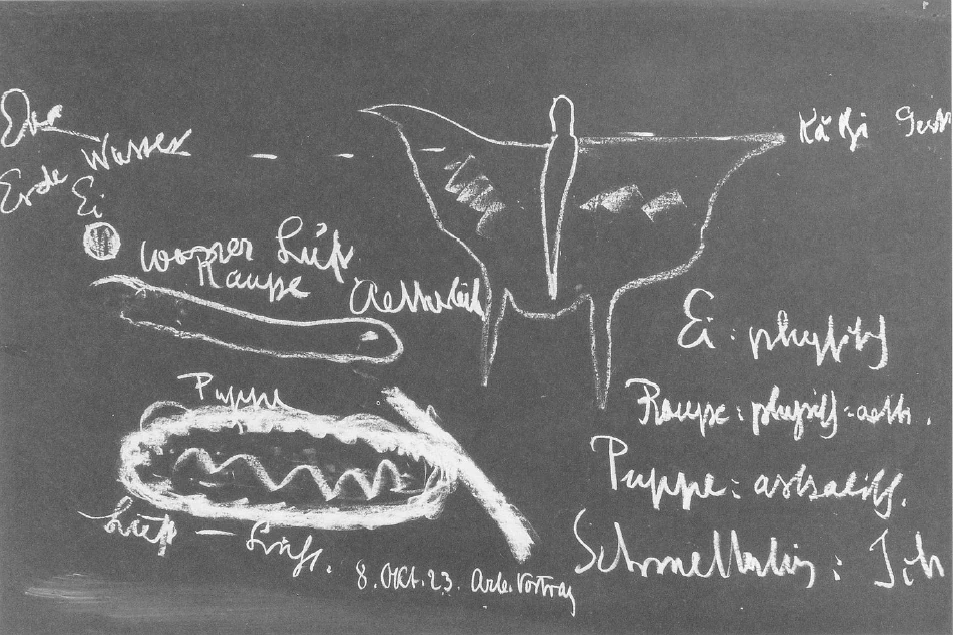
[ 6 ] Well, people look at this, and scholars today explain it by simply observing what can be seen through a microscope or similar instrument. But it’s not that simple. One must take into account where the egg can live and how it lives, how the caterpillar lives, how the pupa lives, and finally, how the butterfly lives. The egg, above all else, needs—if it is to reach the stage where the caterpillar can hatch—sometimes very little—but it needs moisture in which some salt is dissolved. No egg can thrive without receiving some moisture in which a little salt is dissolved. Therefore, the animal—the butterfly—must have this instinct to lay the egg somewhere where it can obtain moisture containing a little salt. It simply won’t work without that. What I’m telling you here about the butterfly applies just as much to the bee and so on. It is also necessary for the bee that, wherever the eggs are laid, something—even if only a little—penetrates the eggs so that salt gets inside. Few people observe this. It’s enough for the mist to pass through; it always contains some salty moisture. Nature comes to our aid here. This isn’t always entirely clear to the human mind. Nature is simply much wiser than humans. But the egg must always have some moisture that contains a bit of salt. This is also the case with butterflies, and then the caterpillar crawls out. So the egg needs only this moisture containing salt; it has no eyes, it sees nothing, and it lives entirely on its own in a world that is completely dark. The moment the caterpillar crawls out, it emerges into the light and is thus constantly in the light. The caterpillar has sensory organs and comes into the light. Now it has actually become a completely different creature from what the egg was. The egg has completely transformed into the caterpillar. And the fact that the caterpillar is exposed to light, that it has senses, has a profound effect on it. Such things are expressed quite radically in certain phenomena. You have all surely already observed this curious phenomenon: when you turn on a lamp somewhere, all sorts of insects flutter around the room, drawn to the light of the lamp, even rushing into it—so foolish that they burn themselves. Where does this come from? Of course, this does not happen with this caterpillar, but the will to do so is also present in this caterpillar. The caterpillar is, in fact, drawn to sunlight just as—I would say—sensually as the insect that throws itself into a candle flame; only the caterpillar cannot reach the sun. If it could rise from the ground and fly up toward the sun, we would very soon have no caterpillars left at all; they would all fly up toward the sun, all fly away. For that is what they want; they are merely held back by the gravity of the earth—they cannot. So when we look at a caterpillar, this caterpillar actually has the will to follow the light. It cannot do so. But what does it do?
[ 7 ] Just imagine: there’s a beam of light, and there’s a caterpillar (it’s drawn). Now the caterpillar spins a thread as it crawls, just as the beam of light does. The caterpillar spins the thread entirely in accordance with the beam of light, and when the beam of light is not there at night, it rolls up the thread; during the day, it continues spinning the thread within the beam of light, and at night it rolls it up again. And from this, the cocoon forms all around it. The caterpillar dissolves entirely in the light, dies in the light, like an insect drawn to a flame—except that it does not ascend toward the sun but enters the beam of light itself; yet it weaves its own body into these threads and forms around itself this cocoon, as it is called—these threads that are woven together. The silkworm spins silk toward the light. So if you take silk from any silkworm, you can confidently say to yourself: What is this? It is spun light!—There, spun in the direction of the rays of light, is the earthly matter. And when you see a pupa somewhere, it is nothing but spun sunlight, surrounded by earthly matter that has been spun following the sun’s rays.
[ 8 ] So here’s where we are: we now have the doll, with light woven all around it, and since this is woven sunlight, the result is naturally different from when an insect throws itself into the flame—there, it burns the candle’s flame and can do nothing with it. But if this insect, with the speed at which it throws itself into the flame, were to spin such a cocoon around itself in the direction of the flame’s rays, a new creature would emerge from the fire of the flame within. This is prevented only by combustion. It is interesting that this reveals what this insect, fluttering around the room at night and plunging into the flame, actually wants: it wants to reproduce; it wants to perish so that it may return in a new form. It is only mistaken because it cannot create a shell that quickly. But the caterpillar, precisely because of its slowness, can create this shell, hang it up, and now the power of the sun—which is trapped there, which is a prisoner there—can create the butterfly inside, and the butterfly can then fly out as a creature of the sun and move as a creature of the sun.
[ 9 ] You see, gentlemen, this leads us to understand how things actually are in nature. First of all, there is a very important idea in what I have told you: the insect that throws itself into the flame—one might think—wants to die. No, it does not want to die, but rather it wants to return in a different form. It wants to be transformed by the flame. And so it is with death everywhere: Death is not something that destroys beings, but rather, when properly initiated, it merely transforms them. First, we see this from that. Second, however, we see a profound connection that exists between everything in nature out there. You see, the butterfly is created from light; but the light first had to be transformed into a thread within the chrysalis by taking in earthly matter and forming a cocoon. Everything that comes into being among animal beings is created out of light. Human beings, too, are created out of light through the processes that occur upon fertilization of the female germ, and within the human being, this germ protects the light through a covering. And in truth, it is the light that creates the human being within the mother’s body—thus creating the possibility for the human being to come into being from the light. Thus, we see in the butterfly that it comes into being from the light that has first been captured.
[ 10 ] Well, the butterfly flutters about in many colors. Such colors are present at all when one looks at whatever is most susceptible to the influence of light. So when one goes to hot regions, all the birds have wonderful colors, because the sun is stronger there. So what is it that creates what is there in the sun, in the light that is held captive? It brings forth the colors—it always brings forth colors. And so it is with the butterfly. The butterfly has its colors because of what the light has done there as if held captive. One can only understand the butterfly if one understands it as a creation born of all the light that makes it appear in many colors.
[ 11 ] But the sun cannot do this on its own. The fact is this: When we look at the egg, it is inside the moisture that contains salt. Salt is earth; moisture is water. So we can say: The egg must thrive in earth and a little water. — The caterpillar is already emerging into the light. By its very nature, the caterpillar cannot thrive merely in earth and water—that is, in dissolved lime, for example, and water—but the caterpillar needs moisture, that is, water, as well as air; moisture and air. This moisture and air that the caterpillar needs is not merely what the egg physically requires; rather, within this moisture lives that which is called ether—and which I have described to you in relation to human beings as the etheric body. The caterpillar develops an etheric body. And through the etheric body it breathes. Through the etheric body it absorbs what is already present spiritually in the air. The egg is still entirely physical, but the caterpillar already lives in the physical-etheric realm. Yet it is difficult for the caterpillar to live in the physical-etheric realm. The caterpillar has far too much heavy earthly matter within it. With the caterpillar, it is like this: when it comes into the light, this is precisely what is revealed—that it then spins the rays of light from within itself in the form of its cocoon silk. The caterpillar wants to reach the light but cannot; it has too many forces of heaviness within itself. It is not up to the task of what it is now facing. Therefore, it wants to dissolve into the light itself; it wants to pour itself into the light; it wants to continue living in the light. What does it do? Yes, it seals itself off from the earth with the sun’s rays; it makes a cocoon around itself. Inside the chrysalis, the caterpillar completely seals itself off from the physical forces of the earth. And now, inside the chrysalis—where the “worm” has disappeared—there are astral forces; no longer earthly forces or etheric forces, but astral, entirely spiritual forces, and these astral forces live within the captured light. Captured light always contains spiritual forces—astral forces. And these astral forces are what create the butterfly. Because it consists entirely of astral forces, it can now fly through the air—something the caterpillar cannot do—and follow the light. It follows only the light; it is no longer subject to heaviness. Through its surrender, the force of gravity has been eliminated. So that one can say: It has matured into the “I.”—It is an “I” within which we see, so to speak, the butterfly fluttering about. We humans have our “I” within us. The butterfly has it outside itself. The “I” is actually light. That is what colors it.
[ 12 ] When you think about this, there’s something you need to realize. You all always say to yourselves: “I.”—What does it mean when you say “I” to yourselves? You see, every time you say “I” to yourselves, a small flame flares up in your brain—one that cannot be seen with the naked eye. That is light. When I say “I” to myself, I summon the light within me. This very same light that colors the butterfly—that is what I summon within myself when I say “I” to myself. It is truly fascinating to observe this out in nature, to realize that I can say to myself, “I say ‘I’ to myself”; if I could radiate this ‘I’ out into the whole world, it would be light. I have merely imprisoned this “I” within my body. If I could radiate it, I could create countless butterflies with this light. — The human “I” has the very power to create countless butterflies, and indeed insects and so on. You see, people imagine that everything is so simple. But in ancient times, when such things were known, people spoke in this sense as well. In very ancient Judaism, there was a word: “Yahweh,” which means the same thing as “I.” This word—Yahweh in Hebrew—could only be uttered by the priest, because the priest was prepared to understand what it meant. For the priest, at the very moment he uttered Yahweh, saw images of butterflies fluttering everywhere. And then he knew: If he had spoken the word Yahweh without seeing anything, he had not spoken it with the proper inner sincerity. But he was in the proper inner sincerity when he saw nothing but butterflies. However, he could not teach this to other people, because they would have gone mad over it; that is why he first had to prepare himself. But it is true nonetheless.
[ 13 ] Yes, gentlemen, but what is this? Just imagine there were a large comforter filled with nothing but down feathers stretched out between this desk and the spot where I’m standing. The down feathers would be somewhat sparse inside, and I stand here and push my way through, walking along like this, compressing the down feathers; I can’t quite reach the desk, but have to stop in the middle because I can’t compress them any further. I can’t reach the desk, but I feel pressure when I push against it. That’s how you want to express the “I”—you actually want to create a whole swarm of butterflies, because the “I” is light. But you can’t do that. Instead, you feel the resistance, just as I feel the resistance when I move toward it. And those are your thoughts. Your thoughts consist of the realization that one cannot create nothing but butterflies through the light. The “I” thinks thoughts. The thoughts are actually just images of the world of butterflies.
[ 14 ] You see, it looks as though the same thing would actually happen today as would have happened in ancient Judaism if simply everyone who uttered the name of Yahweh had seen the entire world of butterflies; then people would have said: Well, he’s obviously crazy. - And he would have been, if he hadn’t been ready to perceive spiritual things! But today, when someone speaks of the light being the “I,” and of the light being the same thing that—when confined—can create butterflies in a different way, and that within us—because we have a brain suited for it—creates thoughts instead of butterflies—today people say again: “He’s crazy!”—But that is the truth. That is precisely the difference between mere madness and the truth. So one must say: When we look at the colorful butterfly in the air, it has the same effect on us as when we feel truly within ourselves and say “I.” The butterfly cannot say “I,” nor can even the higher animal, because the “I” acts from the outside. When you look at a lion in its bread-colored yellowness, it is that bread-colored yellowness that is brought about from the outside by the lion’s “I.” The lion itself is conceived by the whole of nature; that is how the coloring comes about. Because we think from the inside out, we do not receive our coloring from the outside, but rather our skin color comes from within—a color that is very difficult to replicate in painting. But our “I,” with the help of the blood, actually colors our entire body with this wonderful human hue, which can only be imitated in painting if one is able to mix all the colors together in the right way—to mix them correctly. Nature is constantly shaping the being, but it does so in a spiritual way. You see, I have told you here: it must be the transition from the moisture contained in the air to the light. Now the chrysalis is in air and light. There it is in water and air as a caterpillar, here in air and light as a chrysalis, and then it moves ever further from the light that is captured to the astral realm that works within it.
[ 15 ] Think back to this: caterpillar, chrysalis. Imagine for a moment that there were an animal that was not yet able to spin silk threads from its own body. Let’s suppose there were such a special kind of caterpillar that, having just become a caterpillar, now also wanted to emerge into the light, but its body is incapable of spinning threads—it simply cannot do it. It cannot transform its body in such a way that it spins it outward. The caterpillar literally spins itself to death. It ceases to exist entirely; its whole body is absorbed into this web. All that remains is a dead skeleton inside it. But suppose you had such an animal being that contains within itself matter—substance—that cannot be spun. What does this being do when it finds itself in the same situation, when it is strongly exposed to the light? Well, it cannot spin a cocoon around itself. What does it do? It spins within itself—the blood vessels! In this animal, when it enters the air, the blood is spun internally in the same way that the caterpillar spins the cocoon on the outside. We would then have an animal that, as long as it still lived more in the air-water element, would have such a web of blood adapted to the watery element. If it lives for a time in the light, it even changes the shape of its veins; they become quite different. It spins within its own body; because it cannot spin anything outward, it spins inside the body. Let’s sketch this out precisely. Imagine, then, an animal that breathes—as it must in a moist environment—through gills, and moves through the moisture, in the water, in such a way that it has a tail; its blood vessels run so that they extend into the gills and into the tail. This allows the animal to swim in the water and also to breathe in the water. Fish have gills. With gills, one can breathe in water. But imagine that the animal comes up for air more often, goes to the shore, or the pond itself becomes drier: there it is more exposed to light, and the moisture evaporates. It finds itself in these areas where it needs light and air, not water and air. What does the animal do?
[ 16 ] I’ll outline this for you point by point: This animal pulls the veins back from its gills—which are becoming increasingly atrophied—and weaves these veins in here. The animal weaves in its own veins, which it had initially sent out into the gills. And the veins that went into the tail—it pulls them back: feet grow here; the same veins that went into the tail now go into the feet, ... (unclear passage in the transcript), where they are now spun differently than those that went into the tail. You can observe this in nature: this is a tadpole, and this is a frog! The frog is first a tadpole with a tail and gills and can live in water. But when it comes up for air, it does internally what the caterpillar does externally. The tadpole—which is a frog capable of living in water—weaves a web from its own blood vessels, a web that now runs internally; and what was once in the veins and gills now becomes a lung. There were gills, and now that the animal has spun them into a web, they become lungs; there was a tail, and now legs form, which are moved by the blood circulation that flows into the lungs and, through this vibration, previously develops into an actual heart. So this same path from water-air to air-light, which is traversed by the caterpillar on its way to the chrysalis, is also traversed by the frog, which lives in air-water; but there it penetrates the air, since it must emerge into air-light. It is air-light that creates lungs and legs, while water-air creates fish tails and gills. So it is the case that not only what is inside an animal is constantly at work, but always the entire surrounding world as well.

[ 17 ] What does scholarship do? What have we done by creating a mental image of how things are? We have looked at the world! We look at the world as it is; we look out into nature. What does the scholar do? Generally speaking, he pays little attention to nature when he wants to know such things; instead, he first orders a fine microscope from the optician—a terribly fine one. This is not taken out into nature—after all, there wouldn’t be much one could do with it there!—but is placed in a closed room; there he lets the butterfly lay its eggs. The scholar has little interest in the butterfly fluttering about in the light. He then places the egg on his dissection tray and observes it through the microscope (he sketches it): There’s his eye, peering in to see what happens to the egg, which he himself cuts open; where nature no longer plays a role, he himself slices it into thin sections, examining what he himself has just cut open. Down there on the dissection tray lie the thin slices cut with a razor. That’s what they’re investigating! That’s how a lot of research is done these days.
[ 18 ] Imagine a university lecture. The professor crams as many people as humanly possible into his laboratory; there, he lets them take turns peering inside what he has cut open and shows them what’s inside. Of course, he sometimes takes them on field trips, but he doesn’t say much about what’s out there because he doesn’t know much about it. His entire science is based on what he sees under the microscope once he’s cut out small pieces himself. What insights does he gain from this? He discovers everything that is already predominantly present in the butterfly while it’s still in the egg—only in a minuscule form. Yes, you can’t possibly come to any other conclusion if you first saw and cut it up with a razor and then examine it through a microscope! One forgets everything that is at work out there in light, air, and water. All one has are dissection slides to focus the microscope on. One can’t really investigate anything at all! One can only say: Out there is the butterfly, but in here—what I’m looking at under my microscope—the entire butterfly is already present in a very tiny form.
[ 19 ] These days, people don't dare to think that way anymore, but back then, when talking about a person, they would say: “There's Anna; she has a mother named Marie.” Well, Anna was born from her mother, Marie. All right; but the whole of Anna already exists inside the egg cell, and that egg cell, in turn, was inside her mother, Marie. So you have to create a mental image of it this way: There’s Anna’s egg cell, there’s Marie’s, and Anna is inside it; but she, in turn, descends from Gertrud, who is Anna’s grandmother. Well, but since Anna’s egg cell was inside Marie’s cell, it must in turn be inside Gertrud’s cell. Now, Anna’s great-grandmother is Käthi, and the cells of Anna, Marie, and Gertrud are already inside Käthi’s egg cell, and so on, and then we get a longer chain all the way back to the first egg cell—that of Eve. And so people said—it was, of course, the easiest way to explain it—that the person living today was already inside Eve’s egg cell as a tiny little guy. —This was called the nesting theory. The theories that still exist today are just a bit less clear; they no longer dare to go all the way back to Eve, but in spirit they are exactly the same—in fact, they haven’t advanced at all: “The whole butterfly is already in there!” And in this butterfly, light, air, and water—which are, after all, present—have absolutely nothing to do with it anymore!
[ 20 ] When you look at the academic world this way—how the professor leads people into his study, how he presents to them his terribly erudite ideas, which are actually just nonsense compared to the workings of nature—you get the feeling: Yes, there is still light and air and everything there! - The professor then steps away from all that and enters his gloomy study, where an artificial light is likely turned on so that the window light doesn’t interfere with the microscope, and so on. And there you find yourself thinking: Good heavens, he’s stuck on the egg, which already contains everything—and air and light and everything else have been retired by modern science! —It’s been retired; it no longer plays a role. Modern science knows nothing more about the workings of air, light, and water—knows nothing more about them. It’s something that terribly gnaws at our social life: that we actually have a science that has retired the entire world, seeing only what can be seen through the microscope—just as the state doesn’t care about a retiree other than to pay him his pension; it no longer needs him. It is no different with the scientist: he derives his sustenance from it; but he no longer knows how this sustenance works, and he concerns himself only with the microscope, with the particles. In today’s science, the whole world is actually a retired idler. That is truly terrible, because the general public, after all, cannot grasp this. The general public says: “Oh, those are the people who are supposed to understand it!”—Even when they are still small children, people already think about turning them into learned people; they send them to schools where they can learn a great deal. Later on, they work so hard! Yes, until the age of twenty-seven or twenty-eight, one must learn: “What comes about through this must be the truth!”—Of course, the general public cannot judge this; they let “scholars” dictate this stuff to them, unaware that it no longer has anything to do with nature at all. They speak of nature as if it were a pensioner. And so our entire spiritual life is sinking into a quagmire. And in this quagmire of spiritual life, we are now supposed to make progress! We simply cannot make progress because the general public is too complacent to listen to what is said to them. After all, only anthroposophy speaks the truth today! What I am telling you here, you cannot hear anywhere else. No one tells the truth; the general public no longer cares about it. If you do tell it, people say you’re crazy. It’s crazy that this is the case! But it’s not the one who is truly crazy who is considered crazy—rather, the one who tells it like it is is considered crazy. It really is the case that people completely confuse the two.
[ 21 ] I’d like to tell you a little anecdote about this. Once, a medical commission that wanted to conduct a study arrived at the gate of a mental hospital, and when they entered, a gentleman was standing there to greet them, so they said to one another: “Well, that must be the director, the chief physician.” They said to him: “Dear colleague, could you please show us around the patients’ cells and explain everything to us?”—And so this man, who had been standing at the gate, led them around, explained everything that was in each cell, and told them: “Here is a patient who experiences strange sensations and hallucinations, mixed with epileptic seizures.” At the next cell, he explained: “This one has emotional outbursts beyond the normal range.” He explained this very precisely. Then they came to the truly insane patients, who had all sorts of fixed ideas in their heads. “You see,” he said, “this is one who is constantly haunted by ghosts; another who is constantly being pursued by people—not ghosts, but actual people.” “Now I’ll take you to the craziest one we have,” he said—and with that he led them to the cell of the craziest one, and said: “This man suffers from an obsession; he believes he is the Emperor of China. This, of course, is a consolidation of ideas in his mind: instead of these ideas remaining merely as thoughts, he has consolidated them.” — He explained this very precisely and said: “But you must know, gentlemen, that it’s nonsense to say he’s the Emperor of China, because I myself am the Emperor of China!” — Yes, he had explained everything to them; he had led them around, but not by the hand of science, but by the nose. But that one was truly mad. The other one, he said, was crazy because he thought he was the Emperor of China; but he, he said, was the Emperor of China himself. It was a complete madman who was leading the commission.
[ 22 ] It is not always possible to tell when someone is “crazy” in the scientific sense. You’ll be amazed at the clever things the “crazy” people tell you when you come into contact with them. That is why Lombroso, the Italian naturalist, said that there is actually no difference between genius and madness: geniuses are always a little crazy, and mad people are always a little genius. — You can read about this in a small volume in the Reclam Library; the book is titled *Genius and Madness*.
[ 23 ] Of course, unless you’re crazy, you can tell the difference between genius and insanity. But today we have gone so far that entire books can exist—such as Lombroso’s, published in German in Reclam’s Universal Library—in which science itself seeks to assert: One cannot distinguish between genius and madness. History, of course, cannot continue this way; otherwise, we will end up in a complete morass of intellectual life. We must once again turn to nature itself; then we will see just how the egg truly develops into a caterpillar and then into a chrysalis, and how the light is trapped within it—just as the light is trapped within us—the colorful butterfly that flies out.
[ 24 ] This is what I wanted to tell you, following on from what we have already discussed, so that you may see that light contains the creative spirit within itself. For the worm, the caterpillar, had to disappear first; only then could the butterfly emerge. The butterfly is there inside, where the caterpillar perished. The spirit creates. Thus, everywhere, the material perishes first, disappears—then the spiritual brings forth the new being. It is the same with human conception. Conception means that the material is first destroyed. There is a little bit of destroyed matter, and now the spirit and the light in the “I” create the human being. If you think this through a little, you will be able to summarize what I have told you: One does not proceed blindly; one looks at the tadpole, the frog, and knows why it has a heart and lungs and feet, and why the tadpole can still swim in the water! All these things come together. You will see from the things we are taking in more and more that a true science that understands this can arise only within anthroposophy.