

Man and World
How Spirit Works in Nature
GA 351
10 October 1923, Dornach
Translated by Steiner Online Library
2. On Hydrocyanic Acid and Nitrogen, Carbon Dioxide, and Oxygen
Good morning, gentlemen! Have you thought of anything?
Questioner: Doctor, you once said that celestial bodies—such as the Moon—are much larger than they appear. Could you perhaps tell us a little more about that?
[ 1 ] Dr. Steiner: Today I want to tell you something that will make it possible for us to go into even greater detail about these celestial bodies in the next hour. Of course, it is true that, first of all, we must understand what these celestial bodies are and how they relate to the Earth; and on the other hand, we must realize that there is something spiritual present throughout these celestial bodies. Their size, position, and so on—these things, of course, don’t matter much. So today I’d like to lay out a certain foundation for you, starting from the Earth, that will show you how to understand the Sun and the Moon from the Earth’s perspective. It is, of course, the case that the Sun is much larger than the Earth and the Moon is smaller than the Earth. The Moon is, of course, larger than it appears to the eye, but it is smaller than the Earth. And the Sun, as it extends outwards, is larger than the Earth.
[ 2 ] But now, above all, we must first be able to understand what these celestial bodies are composed of—what they actually are. We must ask ourselves what we would find there if we were to travel up there in an airship. In all of this, we must once again take the human being as our starting point. We have discussed time and again how human beings depend on their entire environment: You breathe the air in, and you breathe it out again. When you breathe in the air, you take into your body what is out there in your surroundings. The air outside consists of oxygen and nitrogen. It is itself an airy, gaseous substance. And this oxygen is absolutely essential for our lives. We need oxygen. And we need it in such a way that we breathe it in during the dark of night and, during the day, breathe it in so that the sun’s rays can pass through it. We need all of this. So we can say: We wouldn’t be alive if we didn’t have the oxygen in the air. — But this oxygen in the air is mixed with another gas: nitrogen. So the air contains both oxygen and nitrogen. Now you might ask: Do we need nitrogen, too?
[ 3 ] If there were only nitrogen, you would suffocate. Just imagine if, instead of this room where oxygen is mixed with nitrogen, we were to put all of you in a room where there was nothing but nitrogen: you would all suffocate together! So we could say: Perhaps it would be completely irrelevant to us whether nitrogen is present or not; after all, we could perhaps have oxygen alone. - But here’s the thing: If there were only oxygen, then at most the youngest person sitting there would still be alive—the rest of us would have died long ago. The youngest would still be alive, but he’d have a long, gray beard, white hair, and wrinkles—he’d already be an old man! So if there were only oxygen, we’d all live too quickly. It’s only because oxygen is mixed with much more nitrogen—only 21 percent is oxygen, and almost all the rest is nitrogen—that we live as long as we can as human beings. So if we didn’t have nitrogen, we’d live too fast. We’d only live long enough to reach about sixteen, seventeen, or eighteen years of age, and then we’d already be old men.
[ 4 ] Nitrogen, as it exists in the air, has yet another very special characteristic. You might ask: What would happen if there were a little more or less nitrogen in the air?—Suppose there were less nitrogen in the air than the percentage currently present. Gentlemen, that would be a very curious situation: You would all naturally begin to exhale more nitrogen in the air you breathe out than you normally do, given that there is currently just as much nitrogen in the air as there is right now. So if there were too little nitrogen in the air, you would actually pump nitrogen out of your own bodies to release as much from your own bodies into the air as is currently present. If there were more nitrogen in the air than there is right now, then you would start to hold back the nitrogen you breathe in and exhale less than you do now, so that there would be less nitrogen in the air again. That’s very strange: Humans not only need nitrogen mixed with oxygen in order to breathe properly, but they also need a very specific amount of nitrogen in their environment. It has to be there. So it’s not a matter of having enough nitrogen and oxygen inside us, but rather of having the right amount in our environment. And if there isn’t enough, we put it in ourselves.
[ 5 ] This is something that modern science does not know at all. Modern science completely excludes human beings from the world; it does not realize that human beings can in fact be the masters of the world, if only they are aware of it. So if, for example, it were necessary to establish a colony somewhere where there is too little nitrogen, well, then one could produce enough nitrogen simply by recommending foods to people that allow them to exhale large amounts of nitrogen themselves. So you see how true science immediately becomes practical.
[ 6 ] But there is something else to consider as well. Let’s first look at this nitrogen—not the nitrogen we leave outside, but the nitrogen we constantly breathe in and out. If that were all we had, we would suffocate. In our lungs, we suffocate from the nitrogen. But our kidneys, our digestive organs, our hands and feet—they need the nitrogen; it is carried there by the blood, and there it is necessary. So we can say: When a person stands there (see diagram on p. 36), the nitrogen—which I’ll mark in red here—constantly flows into their arms and hands, into their abdomen, and into their legs and feet. That’s where the nitrogen must be. It must not linger in the lungs; it must only pass through them to make way for the oxygen the lungs need. The lungs can only function if they have oxygen; but the nitrogen continues on, flowing into the arms and hands. So everywhere I’ve marked in red, the nitrogen must enter. And the nitrogen must also be deposited in the heart. Nitrogen must be present everywhere.
[ 7 ] This nitrogen that’s in there—it’s always, I’d say, in harmony with the carbon. Carbon is found in coal, in diamonds, and in graphite. But carbon is also inside us. Only, it’s in a liquid state inside us, floating around. So inside there (see drawing) is the nitrogen, which I’ve marked in red; now I’ll mark the carbon in blue. It’s also everywhere inside, so that the red is everywhere together with the blue—the carbon. This is something very remarkable: You carry within you—in your legs, your feet, your arms and hands, in your stomach, in your liver, in your kidneys, in your spleen, and in your heart—both carbon and nitrogen: nitrogen as it exists in the air, and completely liquid carbon, as if you were dissolving coal and this black substance were floating in the water. You have that inside you.
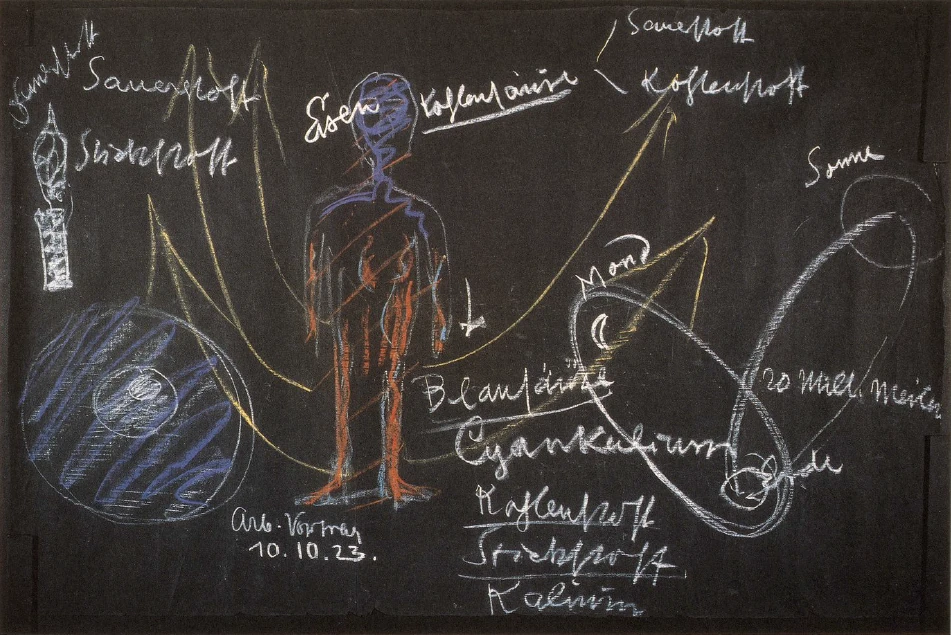
[ 8 ] But this is actually a dangerous situation whenever carbon and nitrogen are present side by side. Whenever carbon and nitrogen are present side by side, there is always a risk—if the right conditions are met—that they will form hydrocyanic acid; for hydrocyanic acid consists of what I have marked in red and blue here in the diagram. So as you go about your business, there is always a risk that hydrocyanic acid will form inside you. So wherever I’ve marked in blue, there is always the danger that hydrocyanic acid will form throughout the entire human body. And because bones contain calcium, the hydrocyanic acid can also combine with the calcium; this creates a cyanide-calcium compound. And that produces cyanide. You know that cyanide is the most technically perfect way to poison oneself. Of course, there is no better means for this than cyanide; it works immediately. But in humans, there is a constant risk of forming hydrocyanic acid and cyanide. This must be so. For if you did not have this capacity within you to form cyanide, then you would not be able to walk or move your arms. The power to move—the movement of your arms and legs—comes from the fact that you are constantly exposed to the danger of producing cyanide.
[ 9 ] Now here is something very subtle: This cyanide constantly seeks to form within us, and we constantly prevent it! This is what our life as active human beings consists of. Even blood circulation depends on our preventing the formation of cyanide. Our movements stem from this resistance to the formation of cyanide. And our will actually stems from the fact that it is constantly compelled to prevent the formation of cyanide and hydrocyanic acid within us.
[ 10 ] Well, gentlemen, cyanide simply does not form; for if it did, we would be poisoned. But at every moment, we have within us the potential for cyanide to form, and we must prevent it. Of course, it’s not much cyanide that’s trying to form there, but over the course of a lifetime, quite a bit would accumulate if it were to form. And this force that lives within the cyanide that’s trying to form—this living force—connects human beings on Earth to the sun. So that what lives in the hydrocyanic acid constantly flows upward from the human being toward the sun. So when you look up at the sun, you can say: I have a connection with the sun; and the force that lives within me to counteract the formation of the hydrocyanic acid that constantly seeks to form in my body—this force—rises from the Earth up to the sun. If you have the Earth here and the Sun here—I must draw them large now—then such streams of cyanide flow continuously from human beings to the Sun, and streams flow back again from the Sun. This dissolved cyanide flows from human beings to the Sun, and from the Sun flows back what the Sun produces from this dissolved cyanide. And this distance is twenty million miles—one mile is calculated as seven and a half kilometers. If a light is now lit on the Sun, we don’t see it until much later, because the light takes so long to reach us. So with a celestial body that is so far away from us, we are connected to it simply by the fact that we radiate this force, which is constantly striving to form cyanide. Specifically, within our bones there is constantly something like a cyanide source, like a wellspring of cyanide.
[ 11 ] If that were not the case, we would be very peculiar people here on Earth. If we did not have this connection to the sun, we would also stare up at the sun and say: Yes, that is a celestial body that has nothing to do with us. - We would see that plants do grow; but these plants could not grow either if this cyanide were not circulating back and forth. So we would stare at the sun and not know what connection it has to human beings. Of course, people today do not know this connection that I have just described to you, but they feel that they belong to the sun. And they feel this very strongly. For when the sun sets—especially in ancient times, when people still lived healthier lives, slept at night and were awake during the day, when it was still like that—then a person senses that they are not absorbing the sun into themselves in the same way. The cyanide is present within them, albeit only in small quantities; then they fall asleep. It is indeed the sun that always wakes people up and lulls them to sleep. It is only because people hold something back that they can commit the folly of continuing to work at night—or rather, not working but continuing to enjoy themselves. But the forces we summon at night also arise through the connection of these forces with the sun. And I would like to say: If hydrocyanic acid is formed anywhere on Earth itself—for example, in certain plants—if, that is, hydrocyanic acid is formed on Earth itself, then this solar force, so to speak, influences the plant in such a way that it brings about what actually always seeks to be brought about in human beings.
[ 12 ] You see, gentlemen, for this to take place—and it must take place, because hydrocyanic acid contains nitrogen—nitrogen in the environment is necessary. And the sun needs nitrogen so that it can have the proper effect on us. We simply could not exist on Earth as human beings if the sun did not have the nitrogen through which it can act on our limbs, our digestive organs, and so on. But with the head—the human head—it is quite different, quite different. You see, in the lungs, nitrogen is of no use; it must pass through the lungs. In the lungs, only oxygen is of any use. And when oxygen passes through the lungs, the portion that then goes to the head must not mix so readily with nitrogen. Rather, the oxygen that goes to the head must combine with carbon. And instead of hydrocyanic acid being formed toward the feet, carbon dioxide is now continually formed toward the head—I’ll highlight this in violet. So, toward the feet, the human body produces hydrocyanic acid; toward the head, it produces carbon dioxide. If we had to breathe carbon dioxide, we would suffocate; but we need it in our heads. You see, gentlemen, this is a very interesting thing: our heads need carbon dioxide.
[ 13 ] Now, I’m sure you’re all familiar with carbonation. I’m sure you’ve all had a fizzy lemonade or sparkling water like that before—the kind with those little bubbles, those gas bubbles. That’s often carbon dioxide, because in carbonated waters, the carbon dioxide is inside and rises in tiny bubbles. Gentlemen, you couldn’t possibly think your head was good for anything at all if such tiny bubbles weren’t constantly rising through your blood within your own body. Just as the bubbles rise in the bottle of fizzy lemonade, so too do tiny, minuscule bubbles continually rise within you toward your head. You wouldn’t be able to use your head for anything if you weren’t such a bottle yourself. Blood accounts for one-thirteenth to one-fourteenth of your own body weight. So you can create a mental image: you are actually such a bottle, filled with blood instead of sparkling water, and there, striving upward—just exactly as with sparkling water, only much smaller—these bubbles float, just like in the soda bottle. The head could not think if these bubbles were not constantly rising within you.
[ 14 ] But this carbon dioxide must not just sit idle in your head. You can easily imagine that, when it comes to your blood, you are like such a bottle, and the bubbles rise up toward your head. Now you have that carbon dioxide right there inside your head—those bubbles, just like in a bottle of sparkling lemonade. If you don’t have enough of it in your head, you fall asleep; so you need it in your head. But this carbon dioxide comes into contact—nowhere else—but in your head, where it interacts with the iron in your blood. Iron is present throughout the blood. But the iron in the blood in the hands can’t do anything with the carbon dioxide; it’s only in the head that the carbon dioxide combines with the iron. And I’d like to say: they “kiss” in the head—the iron and the carbon dioxide become very intimate with one another—and from there, the iron then passes through the veins into the entire bloodstream. The carbon dioxide then carries the iron throughout the entire bloodstream once it has come into contact with it in the head. Iron and carbon dioxide can only have a rendezvous in the head; but afterward, once they’ve had their rendezvous, they can travel throughout the entire bloodstream. Therefore, when a young girl becomes anemic—that is, has too little iron in her blood—it means that too few “rendezvous” are taking place in her head, too few meetings between iron and carbon dioxide. The girl lacks the strength to bring enough iron and carbon dioxide together in her head.
[ 15 ] But you’ve probably already heard of these carbonated waters and even drunk some yourself. Such carbonated waters—called “Eisensäuerlinge”—are particularly healthy. You see, where there are iron-rich mineral waters—and there is indeed a great deal of carbonated water in the earth—nature works in the earth in such a way that what a person forms in their mind is continually formed within the earth as well. Large iron-rich springs exist here and there in the earth. People are sent there when their own minds have become too weak. For every human mind is such an iron-rich spring; even an iron-rich spring—carbonic acid iron—is constantly forming inside it. As many of you as are sitting here, so many springs are you. Only when someone lives in utter squalor throughout the winter does his mind grow weak, and then the carbon dioxide-iron content in his mind grows weak. He feels something that many people feel in the spring; he feels as if his blood is no longer flowing properly—naturally, if he has lived a dissolute life!—he feels weak in the head and must be sent to a carbonated iron bath so that he can receive through his stomach and from there through his head what he should actually be producing himself through a more wholesome life. - Iron-rich springs are not all that rare: there are as many as there are people on Earth! So we have the iron we need in our blood thanks to this carbonated iron.
[ 16 ] We must, however, constantly form this in our own minds. But we must also prevent it the very moment it begins to arise, just as we must prevent hydrocyanic acid. It must only begin to form. You know, chemists today talk only about this: Well, so we can combine iron, carbon, and oxygen to produce ferrous carbonate. That ferrous carbonate must then be present. — But that’s not how it happens in life! Just as there is a difference between a stone and a piece of your liver, so too is there a difference between what the chemist produces in the laboratory as carbonic acid iron and what exists in your head as iron, as carbonic acid iron. It’s alive! That is precisely the difference—that it’s alive. And you see, from this ferrous carbonate that is in your head, currents are constantly flowing up to the moon. Just as the cyanide currents flow toward the sun, so do these currents flow up to the moon and back again—currents that a person develops by having the power within themselves to master the ferrous carbonate.
[ 17 ] Imagine, gentlemen, that you are looking up at the moon. You might say to yourselves: “It has a lot to do with my head.” And it’s the same when you come to any given region—let me say, for example, Sauerbrunn in Hungary or Götsch in Styria, Gießhübl, and so on; I believe there are some in Switzerland as well—when you arrive there, it is a place where, through the earth’s soil, the moon can best influence the Earth, for only there do such waters arise. So there we see how the Earth and human beings on Earth are connected to the Sun and the Moon in this way: the cyanide currents controlled by human beings follow the Sun, while the iron-carbon dioxide currents controlled by human beings follow the Moon.
[ 18 ] If one were reasonable, one would thoroughly investigate all such matters. That is not done today. You just have to consider that the plants on Earth constantly need carbon dioxide. Carbon dioxide is there. We humans and animals exhale carbon dioxide. Carbon dioxide is there! The plants on Earth do not breathe in oxygen, but rather carbon dioxide. They release the oxygen and retain the carbon within themselves. That is why the plant is built upon carbon dioxide. But this entire process develops best in plants when they can grow from carbon dioxide while the full moon is shining, because this is connected to the moon’s power. In contrast, when there is a new moon, this process develops less. And so it is always a fundamental requirement for plants that they be illuminated by the full moon. Growth is dormant during the new moon and develops particularly strongly during the full moon.
[ 19 ] So you’ve even explained the moon’s influence in “old superstitions”! Of course, people observed such things long ago, back when they didn’t yet have science. That’s why you’ll naturally find references throughout the old farmers’ sayings to just how important the full moon is for plant growth. And you see, gentlemen, we shouldn’t just talk about the relationships between the individual celestial bodies—we should start with how these relationships actually manifest themselves here on Earth among human beings. As you have now seen, human beings derive an extraordinary amount from the moon and the sun. It is thanks to the moon that human beings can use their heads. It is thanks to the sun that human beings can use their hearts, legs, and hands. Just as we need the ground beneath our feet so that we can walk on it and not constantly fall down, we need the sun and the moon; for thinking we need the moon, and for walking we need the sun—the sun’s energy. When we walk at night, we walk by means of the stored-up solar energy that we received during the day. We simply need these celestial bodies!
[ 20 ] But now, if you know what I have just said, then you will also be able to ask yourselves: Yes, in earlier times, what was it like back then? I have told you about those earlier times: back then, the Sun, the Moon, and the Earth were all a single body; they only separated over the course of time. So today we have the Sun, the Earth, and the Moon—that is, three bodies—distributed throughout space. In the past, we had the Sun, enormous in size; within it was the Earth, and within the Earth, in turn, was the Moon itself. They were nested one inside the other (drawing on p. 44). So if we go back in the course of evolution, we arrive at a point in time when things were as if you, gentlemen, were very powerful, if we were all very powerful and were now, here in this gathering, to begin packing up the entire Earth, loading it onto a cosmic chariot, and driving quickly to the Moon—we would place the Moon inside the Earth, into the Pacific Ocean—and afterward we would drive the Earth and the Moon, which we had packed up and placed in the Pacific Ocean, upward and swiftly into the Sun: then we would once again have restored the state that once was. Only, all the matter of the Earth and all the matter of the Moon would immediately take on a different form than they have now. But that’s how it used to be! And when that was still the case, there wasn’t air like there is now, but rather there was hydrocyanic acid on Earth. So there was hydrocyanic acid and carbon dioxide everywhere inside the Sun. You will say: But there was no real oxygen; humans cannot live on hydrocyanic acid and carbon dioxide! — Yes, gentlemen, as humans are today, they could not live on that either; but back then, humans did not yet have a physical body. They lived as souls within this formation, within this celestial body, which was the Sun, Earth, and Moon all at once. And if we look at the matter correctly, we simply come back to the fact that the entire composition of the world bodies was different in those days; that when we still lived in the Sun, we naturally did not live on oxygen, but on hydrocyanic acid and carbon dioxide. The Sun, in which we lived, provided us with hydrocyanic acid; the Moon, which was inside the Earth, provided us with carbon dioxide.
[ 21 ] All that remains of all this today is the nitrogen in the air—which, after all, we cannot live on either. It is what remained from hydrocyanic acid. When the Sun and the Earth separated, the Sun’s vast atmosphere of hydrocyanic acid left us with nitrogen. So nitrogen is what remained from the hydrocyanic acid. And oxygen is what remained from carbon dioxide after the Moon broke away. So we can say: Our air—our ordinary air, which consists of nitrogen and oxygen—has not been around forever; it has only existed since the time the Sun separated from the Earth; that is when nitrogen arrived. And since the Moon separated from the Earth, that’s when the oxygen arrived.
[ 22 ] But let's continue! I told you that there's actually only a little oxygen in the air—about 21 percent—and quite a lot of nitrogen—around 78 percent. Well, I also told you: The Sun is big, the Moon is small; we get our oxygen from the Moon, which is why there’s less of it in the air; we get our nitrogen from the Sun, which is why there’s so much of it in the air, because the Sun is much bigger than the Moon. So, you can tell—so to speak—from the nitrogen in the air that the Sun is bigger than the Moon, because we get our nitrogen from the Sun and our oxygen from the Moon.
[ 23 ] But I also told you: Carbon dioxide consists of oxygen and carbon. The carbon found in black coal is there; the oxygen is in the air. Now, I told you that when the Moon separated from the Earth, that’s when the oxygen was formed. But from that carbon dioxide, the carbon that remains in the earth—that is, the coal in the earth—was formed. So think about it: today we mine coal from the earth. What must we conclude if we don’t just burrow into the earth like earthworms, but instead seek to understand how this coal was formed? — Once upon a time, the Moon broke away from the Earth, bestowing oxygen upon the air and coal upon the ground. We really must say: Hey, Moon, you gave us so much when you left the Earth; you didn’t just slip away when you left the Earth; you left us oxygen in the air and coal in the ground! - So the Moon—he’s actually a really nice guy out there in the universe; for when he was still with us, he sustained our souls by constantly producing carbon dioxide himself; that’s what he left us. And out there, it left us carbon, and in the earth, coal. It didn’t slip away like a thief, leaving nothing behind or even taking something with it—rather, it made physical human beings possible in the first place. Before that, there were no physical human beings, but only spiritual human beings in the sun, along with the moon and the earth.
[ 24 ] And even earlier, the Earth and the Sun separated. The Sun supplied the Earth with hydrocyanic acid—actually, cyanide. This is necessary for living a spiritual-soul life, that is, when one does not have a physical body. You have to have hydrocyanic acid in your surroundings—in places where you can’t use it right now—if you’re to live as a physical human being. Hydrocyanic acid immediately dissolves the physical human being. But the Sun is also such a gracious being: it left us nitrogen in the air when it departed back then, when it separated from us; and in the Earth, it left us cyanide and other cyanide compounds. These consist of carbon, nitrogen, and potassium—potassium is a substance that shines as brightly as silver—or calcium. So this Sun left us nitrogen in the air, along with some carbon as well, but that carbon did not turn into coal; rather, it lives in the plants. But it separated out calcium, and that is the source of the limestone mountains, the Jurassic period, and so on. So the fact that we have solid ground at all stems from the fact that the sun was once here with us, then went out into outer space, and left us with the limestone. The moon left us with coal; the sun left us with limestone in the earth. The moon left us with oxygen in the air; the sun left us with nitrogen in the air.
[ 25 ] And so the Earth was formed from the Sun and the Moon. And now that it has been formed, we look up and see the Sun and the Moon. But when all of this was still united—when the Sun, the Moon, and the Earth were one within the other—human beings could only live as soul-spiritual beings; they could not live any other way! Yes, gentlemen, back then human beings were capable of living as soul-spiritual beings despite never having received a physical body, because oxygen, nitrogen, and all that were not present. But now, if we—as we are today on Earth—ingest cyanide, it destroys all our movements and life forces within our bodies. And the terrible thing is that there is always a danger when someone poisons themselves with cyanide: that it takes the soul with it, and instead of the person being able to live on in the soul, they are scattered throughout the entire world—and specifically, scattered in the sunlight.
[ 26 ] If anthroposophical insights were to spread, no one would ever poison themselves with cyanide again. It wouldn’t even occur to them! The fact that cyanide poisonings occur is merely a consequence of the materialistic worldview, because people believe: dead is dead, regardless of whether one dies from cyanide or through inner dissolution. But that is not a matter of indifference! When one dies through inner dissolution, the soul and spirit follow the usual path into the spiritual world; they simply live on. But if you poison yourself with cyanide, the soul intends to go along with every particle of the body, spreading out into the nitrogen and dissolving into the cosmos. That is the true death of the soul and spirit. If people knew that the soul and spirit are the true essence of a human being, they would say: We cannot possibly bring about this terrible explosion—which is then triggered in a subtle way throughout the entire universe—when a person poisons themselves with cyanide. - For every person who poisons themselves with cyanide interferes in an improper way with the current flowing from the Earth to the Sun. And if one had the proper instruments, one would have to see a small explosion in the Sun every time a person poisons themselves with cyanide. And the Sun is diminished as a result. A person corrupts the universe and also the energy that flows from the sun to the Earth when they poison themselves with cyanide. A person truly has an influence on the universe. When a person poisons themselves with cyanide, they are, in effect, ruining the sun! And this is the case with every cyanide poisoning.
[ 27 ] And that is precisely what does not evoke such an artificially created religious mood, but rather what evokes a truly religious mood—the realization that I am part of the universe, and that what I do continually exerts an influence throughout the universe. - That is precisely what people have completely forgotten—that this is the case—and that people have no idea at all: The nitrogen that is in my surroundings was created by the sun; the oxygen that is in my surroundings was created for me by the moon. - And that is why, fundamentally speaking, true science no longer exists today. There is no real science left at all! True science draws upon the other celestial bodies. And so people look up at the stars through their telescopes, doing nothing but calculations, yet they do not know that, for example, there is an intimate connection between every iron particle—of which millions float around in our blood—and everything that takes place on the Moon. And so it is that, for example, a young girl suffering from pallor cannot develop a proper connection to the moon and thereby becomes completely detached from the cosmic order. So that such an anemic young girl, for example, loses her memory—everything related to the head—and as a result, that living connection does not arise—all that which, as I have told you, is supposed to arise between iron and carbon dioxide—none of this is present in the anemic young girl: her head is emptied of thoughts.
[ 28 ] But then again, if a person is unable to properly combat the cyanide that is trying to form in their body, too much calcium is deposited in the bones; the bones become brittle, and little by little the calcium even seeps into the blood vessels: everything in the human being becomes brittle. The human being can no longer develop the proper relationship to the sun. But this must happen. Through what lives in their movements—in which the bones, of course, play an important role—human beings must develop their proper relationship to the sun. And through what lives in their heads, human beings must develop the proper relationship to the moon. Yes, gentlemen, it is indeed true that if a person thinks nothing, is too lazy to think, then the moon gradually stops caring about that person! Then a person becomes dull and stupid. And if a person doesn’t walk at all, if they just lie in bed all the time, then the Sun stops caring about them. Then, in regard to their limbs, a person becomes dull, numb, sluggish, and listless. Whether someone is quite lazy in their movements or quite lazy in their thoughts depends on their
[ 29 ] One’s relationship with the sun and the moon. If you are on good terms with the sun and the moon, then you enjoy thinking, walking around, and working. If one is on bad terms with the Sun and the Moon, then one stops thinking, and one takes no joy in going about one’s business or in working. But human beings are deeply connected to the Sun and the Moon. If you ask one person or another today what they have learned from all that can be learned today —one will tell you how to use a microscope, another will tell you how to use a telescope to observe the Sun and the Moon, how to calculate the angles, how far away they are, that the Sun has sunspots, that it has a corona around it, how the nebulae rise—he’ll tell you all of that.
[ 30 ] If you ask me what the connection between the celestial bodies is, I can tell you the same thing, because I, too, have learned what everyone else has learned. But if this is to become a living science, I must explain it to you in such a way that it ultimately boils down to the fact that human walking and standing are connected to the sun; that is precisely what living science is, and the other is dead science—living science and dead science! This living science and this dead science—that is precisely the difference between the Goetheanum and, let’s say, a modern university. When you go to a modern university, they tell the young medical student that whenever any substance combines with oxygen, it burns. So you have a candle; there are all kinds of fuels, fats, there’s the flame, and these substances combine with the oxygen in the air. And that is combustion—the combination of substances with the oxygen in the air—in other words, combustion. And then the professor goes on to say: There is also combustion taking place inside the human body, because there is carbon inside, oxygen is inhaled, and it combines with the carbon; there is also combustion taking place inside the human body. - And so the professor tells you about the combustion process within humans. But that’s just as much nonsense as if someone were to say: “Man, your liver has gotten terribly bad; I’ll carve one out of wood and implant it in you.” - Yes, that’s a dead liver! But a human being needs a living liver. When you light a candle, you have a dead combustion; but the combustion that takes place inside a human being is a living combustion! The exact same difference that exists between a candle and the living combustion within a human being also exists between a living liver and a liver made of wood. So when the professor says that combustion takes place inside a human being, he isn’t talking about a real human being at all, but about one he’s carved out of wood. That’s all nonsense! The combustion itself is alive inside the human being. And that is the big difference between the combustion that’s on the outside—the dead combustion—and the living one that’s inside the human being. But they view combustion in exactly the same way; they say: on the outside, the fat, the tallow, or something like that burns in the candle, and on the inside, the carbon burns to form carbon dioxide. — It is complete nonsense! It is the same nonsense as saying one might just as well make a liver out of wood or stone. That would be a dead liver! You simply cannot have a combustion in the body that is merely like that of a candle; rather, there is a living combustion within a human being, and it differs from what is otherwise called combustion just as the liver differs from a piece of wood. That is why I distinguish between these terms—combustion and so on—used by conventional natural science; I say this only to explain at the same time that this is a living combustion. Even in the very phrase “combustion takes place in the body,” there is a contradiction, because everyone thinks: The same thing that happens with a candle is taking place in a human being. — Just by uttering these words, one is speaking nonsense.
[ 31 ] Next Saturday, if I'm there, I'll give a lecture; otherwise, on Monday.