

Man and World
How Spirit Works in Nature
GA 351
10 October 1923, Dornach
Translate the original German text into any language:
Versions Available:
How Spirit Works in Nature, tr. SOL
2. Über Blausäure und Stickstoff, Kohlensäure und Sauerstoff
2. On Hydrocyanic Acid and Nitrogen, Carbon Dioxide, and Oxygen
Guten Morgen, meine Herren! Ist Ihnen etwas eingefallen?
Good morning, gentlemen! Have you thought of anything?
Fragesteller: Herr Doktor sagte einmal, daß die Gestirne, zum Beispiel der Mond, viel größer sind, als man sie sieht. Könnte man darüber vielleicht noch etwas hören?
Questioner: Doctor, you once said that celestial bodies—such as the Moon—are much larger than they appear. Could you perhaps tell us a little more about that?
[ 1 ] Dr. Steiner: Ich will Ihnen heute etwas sagen, was möglich macht, daß wir in der nächsten Stunde noch genauer auf diese Himmelskörper eingehen. Natürlich ist es ja so, daß man erstens einmal einsehen muß, was diese Gestirne sind und wie das mit der Erde zusammenhängt; und auf der anderen Seite muß man einsehen, daß überall in diesen Gestirnen etwas Geistiges ist. Die Größe, Lage und so weiter, das macht ja natürlich nicht viel aus. Ich will Ihnen daher heute eine gewisse Grundlage von der Erde aus noch sagen, die Ihnen zeigen wird, wie man von der Erde aus die Sonne begreifen kann und wie man den Mond begreifen kann. Es ist natürlich so, daß die Sonne viel größer ist als die Erde und der Mond kleiner ist als die Erde. Der Mond ist ja natürlich größer als man ihn sieht, aber er ist kleiner als die Erde. Und die Sonne ist, so wie sie draußen ausgebreitet ist, größer als die Erde.
[ 1 ] Dr. Steiner: Today I want to tell you something that will make it possible for us to go into even greater detail about these celestial bodies in the next hour. Of course, it is true that, first of all, we must understand what these celestial bodies are and how they relate to the Earth; and on the other hand, we must realize that there is something spiritual present throughout these celestial bodies. Their size, position, and so on—these things, of course, don’t matter much. So today I’d like to lay out a certain foundation for you, starting from the Earth, that will show you how to understand the Sun and the Moon from the Earth’s perspective. It is, of course, the case that the Sun is much larger than the Earth and the Moon is smaller than the Earth. The Moon is, of course, larger than it appears to the eye, but it is smaller than the Earth. And the Sun, as it extends outwards, is larger than the Earth.
[ 2 ] Aber nun müssen wir vor allen Dingen einmal einsehen können, aus welchen Bestandteilen diese Himmelskörper bestehen, was sie eigentlich sind. Wir müssen uns fragen, was man da antreffen würde, wenn man hinauffahren würde mit einem Luftschiff. Bei alledem muß man nun wiederum vom Menschen ausgehen. Wir haben ja immer wieder besprochen, wie der Mensch von seiner ganzen Umgebung abhängig ist: Sie atmen die Luft ein, Sie atmen die Luft wieder aus. Wenn Sie die Luft einatmen, dann kriegen Sie das in Ihren Körper hinein, was draußen in Ihrer Umgebung ist. Die Luft, die draußen ist, besteht aus Sauerstoff und Stickstoff. Das ist selber ein luftförmiger, ein gasförmiger Körper. Und dieser Sauerstoff, der ist zu unserem Leben unbedingt notwendig. Wir brauchen den Sauerstoff. Und zwar brauchen wir ihn so, daß wir ihn in der Nacht finster einatmen, bei Tag ihn so einatmen, daß die Sonnenstrahlen durchgehen. All das brauchen wir. So daß wir sagen können: Wir würden nicht leben, wenn wir den Sauerstoff der Luft nicht hätten. - Aber dieser Sauerstoff der Luft ist mit einem anderen Gas gemischt: mit dem Stickstoff. So daß man also in der Luft Sauerstoff und Stickstoff hat. Nun könnten Sie sagen: Braucht man auch den Stickstoff?
[ 2 ] But now, above all, we must first be able to understand what these celestial bodies are composed of—what they actually are. We must ask ourselves what we would find there if we were to travel up there in an airship. In all of this, we must once again take the human being as our starting point. We have discussed time and again how human beings depend on their entire environment: You breathe the air in, and you breathe it out again. When you breathe in the air, you take into your body what is out there in your surroundings. The air outside consists of oxygen and nitrogen. It is itself an airy, gaseous substance. And this oxygen is absolutely essential for our lives. We need oxygen. And we need it in such a way that we breathe it in during the dark of night and, during the day, breathe it in so that the sun’s rays can pass through it. We need all of this. So we can say: We wouldn’t be alive if we didn’t have the oxygen in the air. — But this oxygen in the air is mixed with another gas: nitrogen. So the air contains both oxygen and nitrogen. Now you might ask: Do we need nitrogen, too?
[ 3 ] Wenn der Stickstoff allein nur da ist, muß man ersticken. Denken Sie sich einmal, wir brächten Sie alle, statt in dieses Zimmer, wo Sauerstoff mit Stickstoff gemischt ist, in ein Zimmer, wo bloß Stickstoff wäre: Sie würden alle miteinander ersticken! Wir könnten also sagen: Vielleicht könnte es uns höchst gleichgültig sein, ob der Stickstoff da ist oder nicht, wir könnten ja vielleicht den Sauerstoff allein haben. - Dann ist es aber so: Wenn bloß Sauerstoff da wäre, dann würde höchstens der Jüngste, der dort sitzt, noch leben - wir andern alle wären längst gestorben. Der Jüngste würde noch leben, würde aber einen langen Greisenbart haben und weiße Haare und Runzeln, er wäre schon ein Greis! Also wir würden alle, wenn bloß Sauerstoff da wäre, zu schnell leben. Nur dadurch, daß der Sauerstoff mit viel mehr Stickstoff gemischt ist - nur 21 Prozent sind Sauerstoff, das andere fast alles Stickstoff -, dadurch leben wir so lange, wie wir als Menschen leben können. Wenn wir also keinen Stickstoff hätten, so würden wir zu schnell leben. Wir würden nur so lange leben, daß wir etwa sechzehn, siebzehn, achtzehn Jahre alt würden, und dann wären wir schon Greise.
[ 3 ] If there were only nitrogen, you would suffocate. Just imagine if, instead of this room where oxygen is mixed with nitrogen, we were to put all of you in a room where there was nothing but nitrogen: you would all suffocate together! So we could say: Perhaps it would be completely irrelevant to us whether nitrogen is present or not; after all, we could perhaps have oxygen alone. - But here’s the thing: If there were only oxygen, then at most the youngest person sitting there would still be alive—the rest of us would have died long ago. The youngest would still be alive, but he’d have a long, gray beard, white hair, and wrinkles—he’d already be an old man! So if there were only oxygen, we’d all live too quickly. It’s only because oxygen is mixed with much more nitrogen—only 21 percent is oxygen, and almost all the rest is nitrogen—that we live as long as we can as human beings. So if we didn’t have nitrogen, we’d live too fast. We’d only live long enough to reach about sixteen, seventeen, or eighteen years of age, and then we’d already be old men.
[ 4 ] Der Stickstoff, wie er da in der Luft ist, hat aber noch eine ganz besondere Eigentümlichkeit. Sie könnten ja sagen: Wie wäre es denn, wenn nun ein bißchen mehr oder weniger Stickstoff in der Luft wäre? - Nehmen Sie einmal an, es wäre weniger Stickstoff in der Luft als diese Prozente, die eben da drinnen sind. Meine Herren, das wäre eine ganz kuriose Geschichte: Da würden Sie nännlich alle anfangen, in der Luft, die Sie ausatmen, mehr Stickstoff auszuatmen, als Sie sonst ausatmen, wo in der Luft gerade so viel drinnen ist, als eben jetzt drinnen ist. Also wenn zuwenig Stickstoff drinnen wäre, so würden Sie selbst aus Ihrem Körper den Stickstoff herauspumpen, um so viel aus Ihrem eigenen Körper in die Luft hineinzupumpen, als jetzt drinnen ist. Wenn mehr drinnen wäre, als jetzt drinnen ist in der Luft, dann würden Sie anfangen, den Stickstoff, den Sie einatmen, zurückzuhalten und weniger auszuatmen, als Sie jetzt ausatmen, damit in der Luft wieder weniger Stickstoff drinnen ist. Das ist sehr merkwürdig: Der Mensch braucht nicht nur den Stickstoff beigemischt dem Sauerstoff, damit er das Richtige einatmen kann, sondern er braucht in der Umgebung eine ganz bestimmte Menge von Stickstoff. Der muß da sein. Es kommt also nicht darauf an, daß wir in uns genügend Stickstoff und Sauerstoff haben, sondern daß in unserer Umgebung die richtige Menge drinnen ist. Und wenn sie nicht genügend drinnen ist, tun wir sie selber hinein.
[ 4 ] Nitrogen, as it exists in the air, has yet another very special characteristic. You might ask: What would happen if there were a little more or less nitrogen in the air?—Suppose there were less nitrogen in the air than the percentage currently present. Gentlemen, that would be a very curious situation: You would all naturally begin to exhale more nitrogen in the air you breathe out than you normally do, given that there is currently just as much nitrogen in the air as there is right now. So if there were too little nitrogen in the air, you would actually pump nitrogen out of your own bodies to release as much from your own bodies into the air as is currently present. If there were more nitrogen in the air than there is right now, then you would start to hold back the nitrogen you breathe in and exhale less than you do now, so that there would be less nitrogen in the air again. That’s very strange: Humans not only need nitrogen mixed with oxygen in order to breathe properly, but they also need a very specific amount of nitrogen in their environment. It has to be there. So it’s not a matter of having enough nitrogen and oxygen inside us, but rather of having the right amount in our environment. And if there isn’t enough, we put it in ourselves.
[ 5 ] Das ist etwas, was die heutige Wissenschaft gar nicht weiß. Die heutige Wissenschaft schaltet den Menschen ganz aus aus der Welt, weiß nicht, daß der Mensch in Wirklichkeit der Herr der Welt sein kann, wenn er sich dessen nur bewußt ist. Wenn also irgendwo, sagen wir, es darauf ankäme, eine Kolonie zu gründen, wo zu wenig Stickstoff ist, ja, dann könnte man genügend Stickstoff dadurch herstellen, daß man einfach den Menschen solche Nahrungsmittel empfiehlt, durch die sie selber viel Stickstoff ausatmen können. Also Sie sehen, wie eine wirkliche Wissenschaft sogleich praktisch wird.
[ 5 ] This is something that modern science does not know at all. Modern science completely excludes human beings from the world; it does not realize that human beings can in fact be the masters of the world, if only they are aware of it. So if, for example, it were necessary to establish a colony somewhere where there is too little nitrogen, well, then one could produce enough nitrogen simply by recommending foods to people that allow them to exhale large amounts of nitrogen themselves. So you see how true science immediately becomes practical.
[ 6 ] Nun aber kommt ja noch etwas anderes in Betracht. Betrachten wir zunächst diesen Stickstoff, nicht den, den wir draußen lassen, sondern den, den wir auch fortwährend ein- und ausatmen. Wenn wir ihn allein hätten, würden wir ersticken. In unseren Lungen ersticken wir durch den Stickstoff. Aber unsere Nieren, unsere Verdauungsorgane, unsere Hände und Füße, die brauchen den Stickstoff; da wird er durch das Blut hineingeleitet, da ist er notwendig. So daß wir sagen können: Wenn der Mensch da steht (siehe Zeichnung S. 36), so geht fortwährend der Stickstoff, den ich hier rot anzeichnen will, in seine Arme und Hände, in seinen Unterleib hinein, in seine Beine und Füße hinein. Da muß der Stickstoff drinnen sein. In den Lungen darf sich der Stickstoff nicht aufhalten, da darf er nur durchgehen und den Sauerstoff für die Lungen haben. Die Lungen können nur, wenn sie Sauerstoff haben, leben; aber der Stickstoff geht weiter, geht in Arme und Hände. Also überall da, wo ich rot angestrichen habe, muß der Stickstoff hinein. Und auch im Herzen muß er noch abgelagert werden, der Stickstoff. Da muß überall Stickstoff drinnen sein.
[ 6 ] But there is something else to consider as well. Let’s first look at this nitrogen—not the nitrogen we leave outside, but the nitrogen we constantly breathe in and out. If that were all we had, we would suffocate. In our lungs, we suffocate from the nitrogen. But our kidneys, our digestive organs, our hands and feet—they need the nitrogen; it is carried there by the blood, and there it is necessary. So we can say: When a person stands there (see diagram on p. 36), the nitrogen—which I’ll mark in red here—constantly flows into their arms and hands, into their abdomen, and into their legs and feet. That’s where the nitrogen must be. It must not linger in the lungs; it must only pass through them to make way for the oxygen the lungs need. The lungs can only function if they have oxygen; but the nitrogen continues on, flowing into the arms and hands. So everywhere I’ve marked in red, the nitrogen must enter. And the nitrogen must also be deposited in the heart. Nitrogen must be present everywhere.
[ 7 ] Dieser Stickstoff, der da drinnen ist, der geht, ich möchte sagen, immerfort in Brüderlichkeit zusammen mit dem Kohlenstoff. Kohlenstoff ist in der Kohle, im Diamant, ist im Graphit. Der Kohlenstoff ist aber auch in uns. Nur ist er in uns flüssig, schwimmt herum. Da drinnen (siehe Zeichnung) ist also der Stickstoff, den ich rot gezeichnet habe; jetzt will ich den Kohlenstoff blau einzeichnen. Der ist auch überall drinnen, so daß das Rote überall mit dem Blauen, dem Kohlenstoff, zusammen ist. Das ist etwas sehr Merkwürdiges: Sie tragen in Ihrem Inneren, in Ihren Beinen, Ihren Füßen, Ihren Armen und Händen, in Ihrem Magen, in Ihrer Leber, in Ihren Nieren, in Ihrer Milz, in Ihrem Herzen zusammen Kohlenstoff und Stickstoff - Stickstoff, wie er in der Luft ist, und ganz flüssigen Kohlenstoff, wie wenn Sie Kohle auflösen würden und dieses Schwarze im Wasser schwimmen würde. Das haben Sie in sich.
[ 7 ] This nitrogen that’s in there—it’s always, I’d say, in harmony with the carbon. Carbon is found in coal, in diamonds, and in graphite. But carbon is also inside us. Only, it’s in a liquid state inside us, floating around. So inside there (see drawing) is the nitrogen, which I’ve marked in red; now I’ll mark the carbon in blue. It’s also everywhere inside, so that the red is everywhere together with the blue—the carbon. This is something very remarkable: You carry within you—in your legs, your feet, your arms and hands, in your stomach, in your liver, in your kidneys, in your spleen, and in your heart—both carbon and nitrogen: nitrogen as it exists in the air, and completely liquid carbon, as if you were dissolving coal and this black substance were floating in the water. You have that inside you.
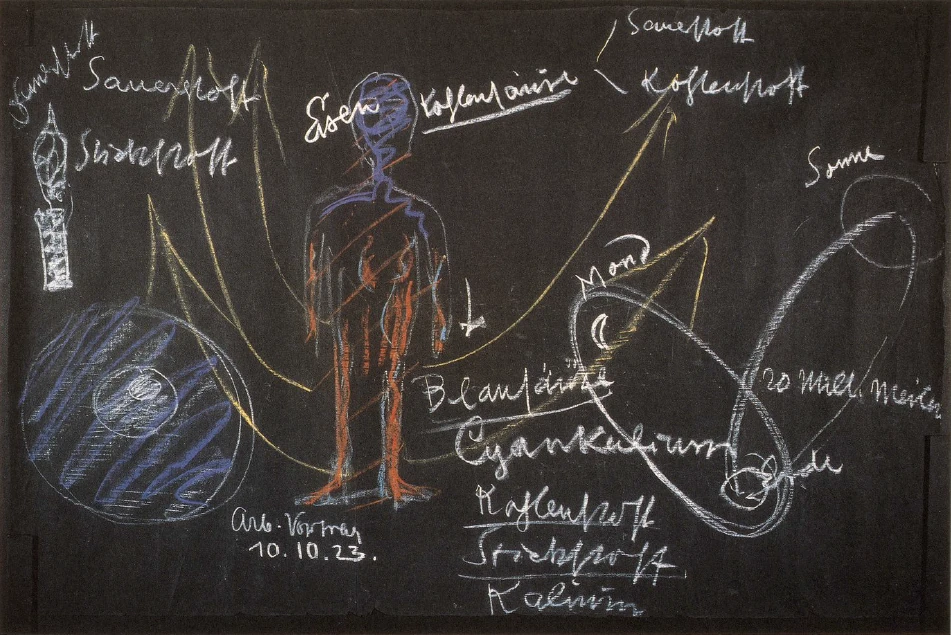
[ 8 ] Aber das ist eigentlich eine gefährliche Geschichte, wenn irgendwo Kohlenstoff und Stickstoff nebeneinander sind. Wenn irgendwo Kohlenstoff und Stickstoff nebeneinander vorhanden sind, so ist immer die Gefahr vorhanden, wenn die richtigen Bedingungen dazu da sind, daß sie Blausäure, Zyansäure bilden; denn Blausäure besteht aus dem, was ich hier rot und blau angezeichnet habe im Schema. So daß Sie also herumgehen und während Sie herumgehen, ist immer die Gefahr vorhanden, daß sich Blausäure in Ihnen bildet. Also überall da, wo ich blau angezeichnet habe, ist immer die Gefahr vorhanden, daß sich durch den ganzen Menschen hindurch Blausäure bildet. Und weil die Knochen Kalk haben, kann sich die Blausäure auch mit dem Kalk verbinden; dann entsteht eine Zyan-Kalziumverbindung. Und dann entsteht Zyankali. Sie wissen, daß man sich mit Zyankali am technisch vollkommensten vergiften kann. Es gibt natürlich kein besseres Mittel als Zyankali dazu; da ist es sofort richtig. Nun ist aber im Menschen fortwährend die Gefahr vorhanden, daß er Blausäure und Zyankali bildet. Dieses muß sein. Denn, wenn Sie diese Anlage nicht in sich hätten, Zyankali zu bilden, dann könnten Sie nicht gehen und Ihre Arme nicht bewegen. Die Kraft, sich zu bewegen, das Bewegen der Arme und Beine, kommt von dem, daß Sie fortwährend der Gefahr ausgesetzt sind, daß Sie Zyankali bilden.
[ 8 ] But this is actually a dangerous situation whenever carbon and nitrogen are present side by side. Whenever carbon and nitrogen are present side by side, there is always a risk—if the right conditions are met—that they will form hydrocyanic acid; for hydrocyanic acid consists of what I have marked in red and blue here in the diagram. So as you go about your business, there is always a risk that hydrocyanic acid will form inside you. So wherever I’ve marked in blue, there is always the danger that hydrocyanic acid will form throughout the entire human body. And because bones contain calcium, the hydrocyanic acid can also combine with the calcium; this creates a cyanide-calcium compound. And that produces cyanide. You know that cyanide is the most technically perfect way to poison oneself. Of course, there is no better means for this than cyanide; it works immediately. But in humans, there is a constant risk of forming hydrocyanic acid and cyanide. This must be so. For if you did not have this capacity within you to form cyanide, then you would not be able to walk or move your arms. The power to move—the movement of your arms and legs—comes from the fact that you are constantly exposed to the danger of producing cyanide.
[ 9 ] Nun ist da etwas sehr Feines: Dieses Zyankali will sich in uns fortwährend bilden und wir verhindern es fortwährend! Darin besteht unser Leben als bewegter Mensch. Sogar die Blutbewegung hängt davon ab, daß wir dieses verhindern, daß sich Zyankali bildet. Von dieser Widerstandskraft gegen die Zyankalibildung rühren unsere Bewegungen her. Und unser Wille rührt eigentlich davon her, daß er fortwährend genötigt ist, die Zyankalibildung und die Blausäurebildung in uns zu verhindern.
[ 9 ] Now here is something very subtle: This cyanide constantly seeks to form within us, and we constantly prevent it! This is what our life as active human beings consists of. Even blood circulation depends on our preventing the formation of cyanide. Our movements stem from this resistance to the formation of cyanide. And our will actually stems from the fact that it is constantly compelled to prevent the formation of cyanide and hydrocyanic acid within us.
[ 10 ] Nun, meine Herren, es bildet sich eben nicht Zyankali; denn wenn es sich bilden würde, würden wir vergiftet werden. Aber in jedem Augenblick haben wir in uns die Möglichkeit, daß sich Zyankali bildet und wires verhindern müssen. Das ist natürlich nicht viel Zyankali, das sich da bilden will, aber es würde im Leben schon etwas zusammenkommen, wenn es sich bilden würde. Und diese Kraft, die da lebt in dem Zyankali, das sich bilden will, diese Kraft, die da lebt, die verbindet den Menschen auf der Erde mit der Sonne. So daß fortwährend das, was in der Blausäure lebt, vom Menschen in die Sonne hinaufströmt. Sie können also sagen, wenn Sie zur Sonne hinaufschauen: Ich habe eine Verbindung mit der Sonne; und die Kraft, die in mir lebt zur Rückbildung des Zyankalis, das sich fortwährend bilden will in meinem Leibe, diese Kraft, die geht von der Erde bis zur Sonne hinauf. Wenn Sie hier die Erde haben und hier die Sonne - ich muß sie jetzt groß zeichnen -, so gehen also von dem Menschen zur Sonne fortwährend solche Zyankaliströme, und von der Sonne gehen Ströme wieder zurück. Es strömt von dem Menschen zur Sonne dieses aufgelöste Zyankali, und von der Sonne strömt wiederum zurück dasjenige, was die Sonne macht aus diesem aufgelösten Zyankali. Und diese Entfernung, die ist zwanzig Millionen Meilen - eine Meile wird als sieben und ein halber Kilometer gerechnet. Wenn jetzt ein Licht angezündet wird auf der Sonne, so sehen wir es erst, weil das Licht so lange braucht, um herzukommen, sehr viel später. Also mit einem Weltenkörper, der so weit von uns entfernt ist, stehen wir einfach dadurch in Verbindung, daß wir diese Kraft ausströmen, die fortwährend bestrebt ist, Zyankali zu bilden. Namentlich in unseren Knochen ist fortwährend etwas wie ein Zyankaliherd, wie ein Quell von Zyankali.
[ 10 ] Well, gentlemen, cyanide simply does not form; for if it did, we would be poisoned. But at every moment, we have within us the potential for cyanide to form, and we must prevent it. Of course, it’s not much cyanide that’s trying to form there, but over the course of a lifetime, quite a bit would accumulate if it were to form. And this force that lives within the cyanide that’s trying to form—this living force—connects human beings on Earth to the sun. So that what lives in the hydrocyanic acid constantly flows upward from the human being toward the sun. So when you look up at the sun, you can say: I have a connection with the sun; and the force that lives within me to counteract the formation of the hydrocyanic acid that constantly seeks to form in my body—this force—rises from the Earth up to the sun. If you have the Earth here and the Sun here—I must draw them large now—then such streams of cyanide flow continuously from human beings to the Sun, and streams flow back again from the Sun. This dissolved cyanide flows from human beings to the Sun, and from the Sun flows back what the Sun produces from this dissolved cyanide. And this distance is twenty million miles—one mile is calculated as seven and a half kilometers. If a light is now lit on the Sun, we don’t see it until much later, because the light takes so long to reach us. So with a celestial body that is so far away from us, we are connected to it simply by the fact that we radiate this force, which is constantly striving to form cyanide. Specifically, within our bones there is constantly something like a cyanide source, like a wellspring of cyanide.
[ 11 ] Wäre das nicht der Fall, dann wären wir auf der Erde ganz eigentümliche Menschen. Würden wir nicht diese Verbindung mit der Sonne haben, dann würden wir auch hinaufstieren zur Sonne und würden sagen: Ja, das ist ein Weltenkörper, der uns gar nichts angeht. - Wir würden sehen, daß zwar Pflanzen wachsen; aber diese Pflanzen könnten auch nicht wachsen, wenn nicht dieses Zyankali hin- und hergehen würde. So würden wir also die Sonne anstieren und wir wüßten nicht, was für einen Bezug sie zum Menschen hat. Diesen Bezug, den ich Ihnen jetzt erzählt habe, den wissen die Menschen heute natürlich auch nicht, aber sie fühlen, daß sie zur Sonne gehören. Und sie fühlen das sehr stark. Denn wenn die Sonne untergeht - namentlich in alten Zeiten, wo die Menschen noch gesünder gelebt haben, bei Nacht geschlafen und bei Tag gewacht haben, da war es noch so —, dann spürt der Mensch, daß er die Sonne nicht so in sich aufnimmt. Da ist das Zyankali nur in ihm, allerdings nur in kleinen Mengen; dann schläft er ein. Es ist in der Tat die Sonne, die den Menschen immer aufweckt und einschläfert. Nur weil sich der Mensch etwas zurückbehält, kann er den Unfug begehen, daß er in der Nacht weiterschafft oder auch nicht schafft, sondern sich weitervergnügt. Aber es kommt auch das, was wir in der Nacht an Kräften aufbringen, durch den Zusammenhang dieser Kräfte mit der Sonne. Und ich möchte sagen: Wenn auf der Erde selber irgendwo Blausäure gebildet wird - zum Beispiel in gewissen Pflanzen wird Blausäure gebildet -, wenn also auf der Erde selber Blausäure gebildet wird, dann kriegt diese Sonnenkraft gewissermaßen die Pflanze dran, daß sie das bewirkt, was eigentlich im Menschen immerfort bewirkt werden will.
[ 11 ] If that were not the case, we would be very peculiar people here on Earth. If we did not have this connection to the sun, we would also stare up at the sun and say: Yes, that is a celestial body that has nothing to do with us. - We would see that plants do grow; but these plants could not grow either if this cyanide were not circulating back and forth. So we would stare at the sun and not know what connection it has to human beings. Of course, people today do not know this connection that I have just described to you, but they feel that they belong to the sun. And they feel this very strongly. For when the sun sets—especially in ancient times, when people still lived healthier lives, slept at night and were awake during the day, when it was still like that—then a person senses that they are not absorbing the sun into themselves in the same way. The cyanide is present within them, albeit only in small quantities; then they fall asleep. It is indeed the sun that always wakes people up and lulls them to sleep. It is only because people hold something back that they can commit the folly of continuing to work at night—or rather, not working but continuing to enjoy themselves. But the forces we summon at night also arise through the connection of these forces with the sun. And I would like to say: If hydrocyanic acid is formed anywhere on Earth itself—for example, in certain plants—if, that is, hydrocyanic acid is formed on Earth itself, then this solar force, so to speak, influences the plant in such a way that it brings about what actually always seeks to be brought about in human beings.
[ 12 ] Sehen Sie, meine Herren, dazu, daß sich das bilden kann - und es muß sich bilden, denn in der Blausäure ist der Stickstoff drinnen -, dazu braucht man den Stickstoff in der Umgebung. Und die Sonne braucht den Stickstoff, damit sie in der richtigen Weise auf uns wirken kann. Wir könnten eben auf Erden als Menschen nicht stehen, wenn die Sonne nicht den Stickstoff hätte, durch den sie auf unsere Gliedmaßen, auf unsere Verdauungsorgane und so weiter wirken kann. Aber beim Kopfe ist das ganz anders, beim menschlichen Kopf, ganz anders. Sehen Sie, in der Lunge, da taugt der Stickstoff nichts; er muß durchgehen durch die Lunge. In der Lunge taugt nur der Sauerstoff etwas. Und wenn der Sauerstoff durch die Lunge durchgeht, dann darf der Teil, der dann zum Kopf geht, nicht so brüderlich zum Stickstoff hingehen. Der Sauerstoff, der zum Kopf hingeht, der muß vielmehr zum Kohlenstoff gehen. Und statt daß Blausäure gebildet wird gegen die Füße zu, wird jetzt gegen den Kopf zu — das will ich violett anstreichen - fortwährend Kohlensäure gebildet. Also gegen die Füße zu bildet der Mensch Blausäure, gegen den Kopf zu bildet er Kohlensäure. In der Kohlensäure würden wir, wenn wir darin atmen müßten, auch ersticken müssen; aber wir brauchen sie in unserem Kopf. Sehen Sie, meine Herren, das ist eine sehr interessante Sache: unser Kopf braucht die Kohlensäure.
[ 12 ] You see, gentlemen, for this to take place—and it must take place, because hydrocyanic acid contains nitrogen—nitrogen in the environment is necessary. And the sun needs nitrogen so that it can have the proper effect on us. We simply could not exist on Earth as human beings if the sun did not have the nitrogen through which it can act on our limbs, our digestive organs, and so on. But with the head—the human head—it is quite different, quite different. You see, in the lungs, nitrogen is of no use; it must pass through the lungs. In the lungs, only oxygen is of any use. And when oxygen passes through the lungs, the portion that then goes to the head must not mix so readily with nitrogen. Rather, the oxygen that goes to the head must combine with carbon. And instead of hydrocyanic acid being formed toward the feet, carbon dioxide is now continually formed toward the head—I’ll highlight this in violet. So, toward the feet, the human body produces hydrocyanic acid; toward the head, it produces carbon dioxide. If we had to breathe carbon dioxide, we would suffocate; but we need it in our heads. You see, gentlemen, this is a very interesting thing: our heads need carbon dioxide.
[ 13 ] Nun kennen Sie ja gewiß alle die Kohlensäure. Sie haben sicher alle schon solch eine Brauselimonade gehabt oder solch ein Wasser, das moussiert: da sind die Perlen drinnen, diese Gasperlen. Das ist oftmals Kohlensäure, denn in kohlensauren Wassern, da ist die Kohlensäure drinnen und steigt in kleinen Perlen auf. Meine Herren, Sie könnten nicht denken, Sie hätten überhaupt Ihren Kopf zu nichts, wenn nicht in Ihrem eigenen Körper fortwährend durch das Blut solche kleine Perlen aufschössen. So wie in der Brauselimonade in der Flasche die Perlen aufschießen, so gehen fortwährend kleinwinzige Perlen in Ihnen nach Ihrem Kopfe hin. Sie könnten Ihren Kopf zu nichts verwenden, wenn Sie nicht selber eine solche Flasche wären. Ein Dreizehntel bis ein Vierzehntel vom Gewicht Ihres eigenen Körpers nimmt das Blut ein. Also Sie können sich vorstellen: Sie sind eigentlich eine solche Flasche, in die statt dem Brausewasser Blut gefüllt ist, und da schwimmen, nach aufwärts strebend, ganz genau so wie beim Brausewasser, nur viel kleiner, diese Perlen, wie in der Limonadeflasche. Der Kopf könnte nicht denken, wenn nicht diese Perlen in Ihnen fortwährend aufsteigen würden.
[ 13 ] Now, I’m sure you’re all familiar with carbonation. I’m sure you’ve all had a fizzy lemonade or sparkling water like that before—the kind with those little bubbles, those gas bubbles. That’s often carbon dioxide, because in carbonated waters, the carbon dioxide is inside and rises in tiny bubbles. Gentlemen, you couldn’t possibly think your head was good for anything at all if such tiny bubbles weren’t constantly rising through your blood within your own body. Just as the bubbles rise in the bottle of fizzy lemonade, so too do tiny, minuscule bubbles continually rise within you toward your head. You wouldn’t be able to use your head for anything if you weren’t such a bottle yourself. Blood accounts for one-thirteenth to one-fourteenth of your own body weight. So you can create a mental image: you are actually such a bottle, filled with blood instead of sparkling water, and there, striving upward—just exactly as with sparkling water, only much smaller—these bubbles float, just like in the soda bottle. The head could not think if these bubbles were not constantly rising within you.
[ 14 ] Nun aber darf diese Kohlensäure nicht untätig sein in Ihrem Kopfe. Sie können sich ganz gut denken, Sie wären in bezug auf Ihr Blut solch eine Flasche, und da stiegen die Perlen auf nach Ihrem Kopfe hin. Nun haben Sie geradeso da drinnen die Kohlensäure in Ihrem Kopfe, diese Blasen, wie bei der Brauselimonadenflasche. Wenn Sie zu wenig im Kopfe haben, schlafen Sie ein; also die brauchen Sie in Ihrem Kopfe. Aber diese Kohlensäure, die kommt in Ihrem Kopfe in Berührung - nirgendwo anders -, aber in Ihrem Kopfe kommt sie in Berührung, in Zusammenhang mit dem Eisen in Ihrem Blut. Das Eisen ist überall im Blut. Aber jenes Eisen, das da in den Händen im Blute ist, das kann mit der Kohlensäure nichts machen; nur im Kopfe kommt die Kohlensäure mit dem Eisen zusammen. Und ich möchte sagen: die küssen sich im Kopfe, werden miteinander sehr intim, das Eisen und die Kohlensäure; und von da aus geht durch die Adern dann das Eisen in das ganze Blut über. Die Kohlensäure, die trägt dann das Eisen ins ganze Blut, wenn es mit ihm in Berührung gekommen ist im Kopfe. Ein Rendezvous können sich Eisen und Kohlensäure nur im Kopfe geben; aber nachher, wenn sie sich das Rendezvous gegeben haben, können sie im ganzen Blute herumspazieren. Wenn daher ein junges Mädchen bleichsüchtig wird, zu wenig Eisen im Blut hat, so bedeutet das, daß in ihrem Kopf zu wenig Rendezvous stattfinden, zu wenig Stelldichein zwischen Eisen und Kohlensäure. Das Mädchen hat nicht die Kraft, genügend Eisen und Kohlensäure im Kopf zusammenkommen zu lassen.
[ 14 ] But this carbon dioxide must not just sit idle in your head. You can easily imagine that, when it comes to your blood, you are like such a bottle, and the bubbles rise up toward your head. Now you have that carbon dioxide right there inside your head—those bubbles, just like in a bottle of sparkling lemonade. If you don’t have enough of it in your head, you fall asleep; so you need it in your head. But this carbon dioxide comes into contact—nowhere else—but in your head, where it interacts with the iron in your blood. Iron is present throughout the blood. But the iron in the blood in the hands can’t do anything with the carbon dioxide; it’s only in the head that the carbon dioxide combines with the iron. And I’d like to say: they “kiss” in the head—the iron and the carbon dioxide become very intimate with one another—and from there, the iron then passes through the veins into the entire bloodstream. The carbon dioxide then carries the iron throughout the entire bloodstream once it has come into contact with it in the head. Iron and carbon dioxide can only have a rendezvous in the head; but afterward, once they’ve had their rendezvous, they can travel throughout the entire bloodstream. Therefore, when a young girl becomes anemic—that is, has too little iron in her blood—it means that too few “rendezvous” are taking place in her head, too few meetings between iron and carbon dioxide. The girl lacks the strength to bring enough iron and carbon dioxide together in her head.
[ 15 ] Nun haben Sie aber wahrscheinlich schon gehört von solchen kohlensauren Wassern und selbst schon welche getrunken. Solche kohlensauren Wasser — Eisensäuerlinge nennt man sie -, die sind besonders gesund. Sehen Sie, da wo Eisensäuerlinge sind - es gibt eben sehr viel kohlensäurehaltiges Wasser in der Erde -, da übt die Natur das in der Erde aus, daß sich in der Erde fortwährend das ausbildet, was der Mensch in seinem Kopfe ausbildet. Große eisenhaltige Quellen sind in der Erde da und dort. Da schickt man dann die Menschen hin, wenn ihr eigener Kopf zu schwach geworden ist. Denn jeder Menschenkopf ist eine solche eisenhaltige Quelle, es bildet sich da drinnen noch fortwährend sogar ein Eisensäuerling, kohlensaures Eisen. So viele Sie hier sitzen, so viele Quellen sind Sie. Nur wenn einer den Winter hindurch ganz schwer lumpt, dann wird sein Kopf schwach, und dann wird der KohlensäureEisengehalt in seinem Kopfe schwach. Er fühlt so etwas, was viele Menschen dann im Frühling fühlen, er fühlt so etwas, wie wenn es in seinem Blut nicht mehr richtig ginge — natürlich, wenn er gelumpt hat! -, er fühlt sich im Kopfe schwach, muß in ein kohlensaures Bad geschickt werden, damit er durch den Magen und von da durch den Kopf bekommt, was er eigentlich selber bilden müßte durch ein solideres Leben. - Die eisenhaltigen Quellen sind gar nicht so selten: es sind so viele, als Menschen sind auf der Erde! Also wir haben das, was wir brauchen an Eisen, in unserem Blute durch dieses kohlensäurehaltige Eisen.
[ 15 ] But you’ve probably already heard of these carbonated waters and even drunk some yourself. Such carbonated waters—called “Eisensäuerlinge”—are particularly healthy. You see, where there are iron-rich mineral waters—and there is indeed a great deal of carbonated water in the earth—nature works in the earth in such a way that what a person forms in their mind is continually formed within the earth as well. Large iron-rich springs exist here and there in the earth. People are sent there when their own minds have become too weak. For every human mind is such an iron-rich spring; even an iron-rich spring—carbonic acid iron—is constantly forming inside it. As many of you as are sitting here, so many springs are you. Only when someone lives in utter squalor throughout the winter does his mind grow weak, and then the carbon dioxide-iron content in his mind grows weak. He feels something that many people feel in the spring; he feels as if his blood is no longer flowing properly—naturally, if he has lived a dissolute life!—he feels weak in the head and must be sent to a carbonated iron bath so that he can receive through his stomach and from there through his head what he should actually be producing himself through a more wholesome life. - Iron-rich springs are not all that rare: there are as many as there are people on Earth! So we have the iron we need in our blood thanks to this carbonated iron.
[ 16 ] Das müssen wir allerdings fortwährend selber bilden in unserem Kopfe. Aber ebenso müssen wir es im Moment, wo es entstehen will, gleich wieder verhindern, so wie wir die Blausäure verhindern müssen. Das darf nur anfangen, sich zu bilden. Wissen Sie, heute reden die Chemiker nur davon: Nun ja, wir können also Eisen und Kohlenstoff und Sauerstoff zusammenbringen, kriegen da kohlensaures Eisen. Das muß dann da sein, dieses kohlensaure Eisen. - Aber so geschieht das nicht im Leben! Geradeso wie ein Unterschied ist zwischen einem Stein und einem Stück Leber von Ihnen, geradeso ist ein Unterschied zwischen dem, was der Chemiker im Laboratorium als kohlensaures Eisen macht und dem, was in Ihrem Kopf als Eisen, als kohlensaures Eisen existiert. Das lebt! Das ist eben der Unterschied, daß das lebt. Und sehen Sie, von diesem kohlensauren Eisen, das in Ihrem Kopfe ist, gehen fortwährend Strömungen hinauf zum Mond. Geradeso wie zur Sonne die Zyankaliströme gehen, so gehen zum Mond hinauf und wieder zurück diese Strömungen, die der Mensch dadurch entwickelt, daß er die Kraft in sich hat, das kohlensaure Eisen zu beherrschen.
[ 16 ] We must, however, constantly form this in our own minds. But we must also prevent it the very moment it begins to arise, just as we must prevent hydrocyanic acid. It must only begin to form. You know, chemists today talk only about this: Well, so we can combine iron, carbon, and oxygen to produce ferrous carbonate. That ferrous carbonate must then be present. — But that’s not how it happens in life! Just as there is a difference between a stone and a piece of your liver, so too is there a difference between what the chemist produces in the laboratory as carbonic acid iron and what exists in your head as iron, as carbonic acid iron. It’s alive! That is precisely the difference—that it’s alive. And you see, from this ferrous carbonate that is in your head, currents are constantly flowing up to the moon. Just as the cyanide currents flow toward the sun, so do these currents flow up to the moon and back again—currents that a person develops by having the power within themselves to master the ferrous carbonate.
[ 17 ] Denken Sie, meine Herren, daß Sie zum Mond hinaufschauen. Da können Sie sich sagen: Er hat viel mit meinem Kopfe zu tun. Und so ist es auch, wenn Sie in irgendeine Gegend kommen - ich will zum Beispiel sagen, Sauerbrunn in Ungarn oder Götsch in der Steiermark, Gießhübl und so weiter; in der Schweiz sind, glaube ich, auch welche -, wenn Sie da hinkommen, so ist das eine Stätte, wo durch das Erdreich der Mond am besten auf die Erde wirken kann, denn nur dort entstehen solche Wasser. So daß wir also da sehen, wie die Erde und der Mensch auf der Erde mit Sonne und Mond zusammenhängen dadurch, daß man darauf kommt: Nach der Sonne gehen die vom Menschen beherrschten Zyankaliströmungen, nach dem Monde gehen die vom Menschen beherrschten Eisen-Kohlensäurestrrömungen.
[ 17 ] Imagine, gentlemen, that you are looking up at the moon. You might say to yourselves: “It has a lot to do with my head.” And it’s the same when you come to any given region—let me say, for example, Sauerbrunn in Hungary or Götsch in Styria, Gießhübl, and so on; I believe there are some in Switzerland as well—when you arrive there, it is a place where, through the earth’s soil, the moon can best influence the Earth, for only there do such waters arise. So there we see how the Earth and human beings on Earth are connected to the Sun and the Moon in this way: the cyanide currents controlled by human beings follow the Sun, while the iron-carbon dioxide currents controlled by human beings follow the Moon.
[ 18 ] Wenn man vernünftig wäre, so würde man alle solche Sachen ordentlich untersuchen. Das tut man heute nicht. Sie müssen eben nur bedenken, daß die Pflanzen, die auf der Erde sind, fortwährend Kohlensäure brauchen. Kohlensäure ist da. Wir Menschen und die Tiere atmen Kohlensäure aus. Kohlensäure ist da! Die Pflanzen, die auf der Erde sind, die atmen nicht Sauerstoff, sondern Kohlensäure ein. Den Sauerstoff werfen sie weg, den Kohlenstoff behalten sie in sich. Daher ist die Pflanze auf der Kohlensäure aufgebaut. Aber dieser ganze Vorgang, der entwickelt sich am besten bei der Pflanze so, daß die Pflanze sich herausentwickeln kann aus der Kohlensäure, wenn der Vollmond scheint, weil das mit der Kraft des Mondes zusammenhängt. Dagegen, wenn Neumond ist, entwickelt sich das weniger. Und so ist es für die Pflanze eben immer eine Grundbedingung, daß sie vom Vollmond beschienen werde. Das Wachstum schläft bei Neumond und entwickelt sich besonders stark bei Vollmond.
[ 18 ] If one were reasonable, one would thoroughly investigate all such matters. That is not done today. You just have to consider that the plants on Earth constantly need carbon dioxide. Carbon dioxide is there. We humans and animals exhale carbon dioxide. Carbon dioxide is there! The plants on Earth do not breathe in oxygen, but rather carbon dioxide. They release the oxygen and retain the carbon within themselves. That is why the plant is built upon carbon dioxide. But this entire process develops best in plants when they can grow from carbon dioxide while the full moon is shining, because this is connected to the moon’s power. In contrast, when there is a new moon, this process develops less. And so it is always a fundamental requirement for plants that they be illuminated by the full moon. Growth is dormant during the new moon and develops particularly strongly during the full moon.
[ 19 ] Da haben Sie ja auch im «alten Aberglauben» den Einfluß des Mondes erklärt! Solche Sachen hat man natürlich früher, als die Menschen noch keine Wissenschaft hatten, schon beobachtet. Daher finden Sie natürlich überall in den alten Bauernregeln Andeutungen darauf, wie wichtig der Vollmond für das Pflanzenwachstum ist. Und sehen Sie, meine Herren, man sollte eigentlich nicht nur so reden über die Beziehungen der einzelnen Himmelskörper untereinander, sondern man sollte ausgehen von dem, wie das eigentlich auf der Erde unter den Menschen sich äußert. Der Mensch hat, wie Sie jetzt gesehen haben, vom Mond und von der Sonne außerordentlich viel. Dem Mond verdankt der Mensch das, daß er seinen Kopf gebrauchen kann. Der Sonne verdankt der Mensch, daß er sein Herz und seine Beine und Hände gebrauchen kann. Geradeso wie wir den Boden unter unseren Füßen haben müssen, damit wir darauf herumgehen können, damit wir nicht immer hinunterfallen, müssen wir Sonne und Mond haben, denn zum Denken brauchen wir den Mond, zum Gehen brauchen wir die Sonne, die Sonnenkraft. Wenn wir in der Nacht gehen, so gehen wir durch die aufgespeicherte Sonnenkraft, die wir bei Tag bekommen haben. Wir brauchen eben diese Himmelskörper!
[ 19 ] So you’ve even explained the moon’s influence in “old superstitions”! Of course, people observed such things long ago, back when they didn’t yet have science. That’s why you’ll naturally find references throughout the old farmers’ sayings to just how important the full moon is for plant growth. And you see, gentlemen, we shouldn’t just talk about the relationships between the individual celestial bodies—we should start with how these relationships actually manifest themselves here on Earth among human beings. As you have now seen, human beings derive an extraordinary amount from the moon and the sun. It is thanks to the moon that human beings can use their heads. It is thanks to the sun that human beings can use their hearts, legs, and hands. Just as we need the ground beneath our feet so that we can walk on it and not constantly fall down, we need the sun and the moon; for thinking we need the moon, and for walking we need the sun—the sun’s energy. When we walk at night, we walk by means of the stored-up solar energy that we received during the day. We simply need these celestial bodies!
[ 20 ] Nun aber, wenn Sie das wissen, was ich jetzt gesagt habe, dann werden Sie auch sich sagen können: Ja, in früheren Zeiten, wie war es denn da? Von den früheren Zeiten habe ich Ihnen gesagt, da waren die Sonne und der Mond und die Erde überhaupt ein einziger Körper; die haben sich erst im Laufe der Zeit getrennt. Wir haben das also heute so, daß wir Sonne, Erde und Mond, das heißt drei Körper haben, im Weltenraum verteilt. Früher hatten wir die Sonne, riesig groß; darinnen war die Erde und darinnen in der Erde war wiederum der Mond selber. Die steckten ineinander (Zeichnung S. 44). Wenn wir also in der Entwickelung zurückgehen, so kommen wir zu einem Zeitpunkt, wo die Sache so war, wie wenn Sie, meine Herren, sehr mächtig wären, wir alle sehr mächtig wären und würden jetzt hier in der Versammlung beginnen, die ganze Erde zusammenzupacken, sie auf einen Weltenwagen zu laden, schnell zum Mond hinfahren würden - den Mond, den stecken wir hinein in die Erde, in den Stillen Ozean, und nachher fahren wir mit der Erde und dem Mond, den wir aufgepackt haben in den Stillen Ozean, hinauf und fahren flugs in die Sonne hinein: dann hätten wir wiederum den Zustand herbeigeführt, der einmal war. Nur würden sofort alle Stoffe der Erde und alle Stoffe des Mondes eine andere Gestalt annehmen, als sie jetzt haben. Aber das war einmal so! Und als das noch so war, da gab es nicht eine solche Luft, wie sie jetzt ist, sondern da gab es auf der Erde Blausäure. Da war also überall in der Sonne Blausäure und Kohlensäure darinnen. Da werden Sie sagen: Aber da war ja kein richtiger Sauerstoff; in Blausäure und Kohlensäure, da kann der Mensch nicht leben! — Ja, meine Herren, so wie der Mensch heute ist, könnte er dabei auch nicht leben; aber dazumal hatte der Mensch noch keinen physischen Körper. Da lebte er als Seele in diesem Gebilde, in diesem Himmelskörper, der Sonne und Erde und Mond zugleich war. Und wir kommen einfach, wenn wir die Sache richtig betrachten, darauf zurück, daß die ganze Weltenkörperbeschaffenheit anders war seinerzeit, daß, als wir noch in der Sonne lebten, wir natürlich nicht von Sauerstoff lebten, sondern von Blausäure und Kohlensäure lebten. Blausäure gab uns die Sonne, in der wir ja drinnen lebten; Kohlensäure gab uns der Mond, der in der Erde drinnen war.
[ 20 ] But now, if you know what I have just said, then you will also be able to ask yourselves: Yes, in earlier times, what was it like back then? I have told you about those earlier times: back then, the Sun, the Moon, and the Earth were all a single body; they only separated over the course of time. So today we have the Sun, the Earth, and the Moon—that is, three bodies—distributed throughout space. In the past, we had the Sun, enormous in size; within it was the Earth, and within the Earth, in turn, was the Moon itself. They were nested one inside the other (drawing on p. 44). So if we go back in the course of evolution, we arrive at a point in time when things were as if you, gentlemen, were very powerful, if we were all very powerful and were now, here in this gathering, to begin packing up the entire Earth, loading it onto a cosmic chariot, and driving quickly to the Moon—we would place the Moon inside the Earth, into the Pacific Ocean—and afterward we would drive the Earth and the Moon, which we had packed up and placed in the Pacific Ocean, upward and swiftly into the Sun: then we would once again have restored the state that once was. Only, all the matter of the Earth and all the matter of the Moon would immediately take on a different form than they have now. But that’s how it used to be! And when that was still the case, there wasn’t air like there is now, but rather there was hydrocyanic acid on Earth. So there was hydrocyanic acid and carbon dioxide everywhere inside the Sun. You will say: But there was no real oxygen; humans cannot live on hydrocyanic acid and carbon dioxide! — Yes, gentlemen, as humans are today, they could not live on that either; but back then, humans did not yet have a physical body. They lived as souls within this formation, within this celestial body, which was the Sun, Earth, and Moon all at once. And if we look at the matter correctly, we simply come back to the fact that the entire composition of the world bodies was different in those days; that when we still lived in the Sun, we naturally did not live on oxygen, but on hydrocyanic acid and carbon dioxide. The Sun, in which we lived, provided us with hydrocyanic acid; the Moon, which was inside the Earth, provided us with carbon dioxide.
[ 21 ] Heute ist von all dem nur zurückgeblieben, daß in der Luft der Stickstoff ist, von dem wir ja auch nicht leben können. Der ist von der Blausäure zurückgeblieben. Die riesige Blausäureluft der Sonne hat uns, als sich die Sonne und die Erde getrennt haben, zurückgelassen den Stickstoff. Der Stickstoff ist also zurückgeblieben von der Blausäure. Und der Sauerstoff, der ist zurückgeblieben von der Kohlensäure, nachdem der Mond herausgekommen ist. So daß wir sagen können: Unsere Luft, unsere gewöhnliche Luft, die aus Stickstoff und Sauerstoff besteht, die ist ja nicht ewig dagewesen, die ist ja erst seit der Zeit vorhanden, seit sich die Sonne von der Erde getrennt hat; da ist der Stickstoff gekommen. Und seit sich der Mond von der Erde getrennt hat, da ist der Sauerstoff gekommen.
[ 21 ] All that remains of all this today is the nitrogen in the air—which, after all, we cannot live on either. It is what remained from hydrocyanic acid. When the Sun and the Earth separated, the Sun’s vast atmosphere of hydrocyanic acid left us with nitrogen. So nitrogen is what remained from the hydrocyanic acid. And oxygen is what remained from carbon dioxide after the Moon broke away. So we can say: Our air—our ordinary air, which consists of nitrogen and oxygen—has not been around forever; it has only existed since the time the Sun separated from the Earth; that is when nitrogen arrived. And since the Moon separated from the Earth, that’s when the oxygen arrived.
[ 22 ] Nun geht das aber weiter! Ich habe Ihnen gesagt, es ist eigentlich nur ein bißchen Sauerstoff in der Luft, 21 Prozent etwa, und recht viel Stickstoff, rund 78 Prozent. Nun, ich habe Ihnen aber auch gesagt: Die Sonne ist groß, der Mond ist klein; den Sauerstoff haben wir vom Mond, daher ist weniger davon in der Luft; den Stickstoff haben wir von der Sonne, daher ist sehr viel davon in der Luft, weil die Sonne viel größer ist als der Mond. Man sieht es also sozusagen der Luft an ihrem Stickstoff an, daß die Sonne größer ist als der Mond, weil wir den Stickstoff von der Sonne, den Sauerstoff vom Monde haben.
[ 22 ] But let's continue! I told you that there's actually only a little oxygen in the air—about 21 percent—and quite a lot of nitrogen—around 78 percent. Well, I also told you: The Sun is big, the Moon is small; we get our oxygen from the Moon, which is why there’s less of it in the air; we get our nitrogen from the Sun, which is why there’s so much of it in the air, because the Sun is much bigger than the Moon. So, you can tell—so to speak—from the nitrogen in the air that the Sun is bigger than the Moon, because we get our nitrogen from the Sun and our oxygen from the Moon.
[ 23 ] Weiter aber habe ich Ihnen gesagt: Die Kohlensäure, die besteht aus Sauerstoff und Kohlenstoff. Der Kohlenstoff, der in der schwarzen Steinkohle ist, der ist da; der Sauerstoff ist in der Luft. Nun habe ich Ihnen gesagt, als der Mond herausgegangen ist von der Erde, da ist der Sauerstoff entstanden. Aber aus der Kohlensäure ist ja dann der Kohlenstoff, der in der Erde bleibt, das ist die Steinkohle in der Erde, entstanden. Also denken Sie, wir graben heute die Steinkohle aus der Erde heraus. Was müssen wir uns denn sagen, wenn wir nicht bloß wie die Regenwürmer in der Erde bohren, sondern uns aufklären darüber, wie diese Steinkohle entstanden ist? — Einmal ist der Mond aus der Erde herausgegangen, hat der Luft den Sauerstoff geschenkt und dem Erdboden die Kohle. Wir müssen eigentlich wirklich sagen: Du, Mond, du hast uns reichlich beschenkt, als du die Erde verlassen hast; du hast dich nicht bloß gedrückt, als du die Erde verlassen hast; du hast uns zurückgelassen in der Luft den Sauerstoff und in der Erde die Steinkohle! - Also der Mond, der ist eigentlich ein ganz feiner Kerl im Weltenall draußen; denn als er noch bei uns war, da hat er unsere Seelen unterhalten dadurch, daß er selber immer Kohlensäure entwickelte; das hat er uns zurückgelassen. Und draußen hat er uns den Kohlenstoff zurückgelassen und in der Erde die Steinkohle. Er drückte sich nicht so wie ein Dieb, daß er nichts zurückließ oder gar noch mitnimmt, sondern er hat den physischen Menschen erst möglich gemacht. Vorher gab es keinen physischen Menschen, sondern nur einen geistigen Menschen in der Sonne mit Mond und Erde.
[ 23 ] But I also told you: Carbon dioxide consists of oxygen and carbon. The carbon found in black coal is there; the oxygen is in the air. Now, I told you that when the Moon separated from the Earth, that’s when the oxygen was formed. But from that carbon dioxide, the carbon that remains in the earth—that is, the coal in the earth—was formed. So think about it: today we mine coal from the earth. What must we conclude if we don’t just burrow into the earth like earthworms, but instead seek to understand how this coal was formed? — Once upon a time, the Moon broke away from the Earth, bestowing oxygen upon the air and coal upon the ground. We really must say: Hey, Moon, you gave us so much when you left the Earth; you didn’t just slip away when you left the Earth; you left us oxygen in the air and coal in the ground! - So the Moon—he’s actually a really nice guy out there in the universe; for when he was still with us, he sustained our souls by constantly producing carbon dioxide himself; that’s what he left us. And out there, it left us carbon, and in the earth, coal. It didn’t slip away like a thief, leaving nothing behind or even taking something with it—rather, it made physical human beings possible in the first place. Before that, there were no physical human beings, but only spiritual human beings in the sun, along with the moon and the earth.
[ 24 ] Und noch früher haben sich Erde und Sonne getrennt. Die Sonne hat die Erde versorgt mit Blausäure, eigentlich mit Zyankali. Das braucht man, um seelisch-geistig zu leben, also wenn man nicht den physischen Körper hat. Man muß die Blausäure in der Umgebung haben, da wo man sie gerade nicht brauchen kann, wenn man als physischer Mensch leben soll. Den physischen Menschen löst die Blausäure gleich auf. Aber die Sonne ist auch solch eine feine Person: die hat uns zurückgelassen in der Luft den Stickstoff, als sie damals weg ist, sich getrennt hat; und in der Erde hat sie uns zurückgelassen das Zyankali und andere Zyanverbindungen. Diese bestehen aus Kohlenstoff, Stickstoff und Kalium - Kalium ist ein Stoff, der so fein glänzt wie das Silber - oder auch Kalzium. Diese Sonne also, die hat in der Luft uns den Stickstoff zurückgelassen, auch etwas Kohlenstoff noch, aber der ist nicht zur Steinkohle geworden, sondern der lebt in den Pflanzen, dieser Kohlenstoff; aber Kalzium hat sie abgesondert und davon kommen die Kalkberge, der Jura und so weiter. Daß wir also überhaupt einen festen Erdboden haben, das rührt ja davon her, daß die Sonne einmal bei uns war und hinausgegangen ist in den Weltenraum und uns den Kalk zurückgelassen hat. Der Mond hat uns die Steinkohle zurückgelassen, die Sonne hat uns den Kalk zurückgelassen in der Erde. Der Mond hat uns in der Luft den Sauerstoff gelassen, die Sonne hat uns in der Luft den Stickstoff gelassen.
[ 24 ] And even earlier, the Earth and the Sun separated. The Sun supplied the Earth with hydrocyanic acid—actually, cyanide. This is necessary for living a spiritual-soul life, that is, when one does not have a physical body. You have to have hydrocyanic acid in your surroundings—in places where you can’t use it right now—if you’re to live as a physical human being. Hydrocyanic acid immediately dissolves the physical human being. But the Sun is also such a gracious being: it left us nitrogen in the air when it departed back then, when it separated from us; and in the Earth, it left us cyanide and other cyanide compounds. These consist of carbon, nitrogen, and potassium—potassium is a substance that shines as brightly as silver—or calcium. So this Sun left us nitrogen in the air, along with some carbon as well, but that carbon did not turn into coal; rather, it lives in the plants. But it separated out calcium, and that is the source of the limestone mountains, the Jurassic period, and so on. So the fact that we have solid ground at all stems from the fact that the sun was once here with us, then went out into outer space, and left us with the limestone. The moon left us with coal; the sun left us with limestone in the earth. The moon left us with oxygen in the air; the sun left us with nitrogen in the air.
[ 25 ] Und so ist die Erde aus Sonne und Mond heraus gebildet. Und nachdem sie herausgebildet ist, schauen wir hinauf und sehen Sonne und Mond. Aber als eben das alles noch beieinander war, als Sonne, Mond und Erde ineinander waren, da konnte der Mensch nur als seelisch-geistiges Wesen leben, konnte nicht anders leben! Ja, meine Herren, damals war der Mensch fähig, trotzdem zu leben als seelisch-geistiges Wesen, trotzdem er niemals einen physischen Körper bekommen hat, weil Sauerstoff und Stickstoff und das alles nicht da war. Aber nun, wenn wir heute, so wie wir nun einmal sind auf der Erde, Zyankali in uns hineinbringen, dann vernichtet das in unserem Körper alle unsere Bewegungen und Lebenskräfte. Und das Schlimme ist, daß immer Gefahr vorhanden ist, wenn einer sich mit Zyankali vergiftet, daß das die Seele mitnimmt und der Mensch, statt daß er in der Seele weiterleben könnte, überhaupt in der ganzen Welt verteilt wird und namentlich im Sonnenlicht verteilt wird.
[ 25 ] And so the Earth was formed from the Sun and the Moon. And now that it has been formed, we look up and see the Sun and the Moon. But when all of this was still united—when the Sun, the Moon, and the Earth were one within the other—human beings could only live as soul-spiritual beings; they could not live any other way! Yes, gentlemen, back then human beings were capable of living as soul-spiritual beings despite never having received a physical body, because oxygen, nitrogen, and all that were not present. But now, if we—as we are today on Earth—ingest cyanide, it destroys all our movements and life forces within our bodies. And the terrible thing is that there is always a danger when someone poisons themselves with cyanide: that it takes the soul with it, and instead of the person being able to live on in the soul, they are scattered throughout the entire world—and specifically, scattered in the sunlight.
[ 26 ] Wenn anthroposophische Erkenntnisse sich verbreiten würden, so würde sich kein Mensch mehr mit Zyankali vergiften. Es würde ihm gar nicht einfallen! Daß Vergiftungen mit Zyankali eintreten, das ist nur die Folge der materialistischen Weltanschauung, weil die Menschen glauben: tot ist tot, ganz gleichgültig, ob man durch Zyankali den Tod erleidet oder durch die innere Auflösung. Das ist aber nicht gleichgültig! Wenn man durch die innere Auflösung den Tod erleidet, dann haben Seele und Geist den gewöhnlichen Weg zu gehen in die geistige Welt hinein; sie leben eben weiter. Wenn Sie aber durch Zyankali sich vergiften, dann hat die Seele die Absicht, überall mit jedem Körperteilchen mitzugehen, und namentlich sich auszubreiten im Stickstoff und sich aufzulösen im Weltenall. Das ist der wirkliche Tod von Seele und Geist. Wenn nun die Menschen wissen würden, daß Seele und Geist der eigentliche Mensch ist, dann würden sie sagen: Wir können unmöglich diese furchtbare Explosion hervorrufen, die dann hervorgerufen wird in feiner Weise im ganzen Weltenall, wenn ein Mensch sich vergiftet mit Zyankali. - Denn jeder Mensch, der sich mit Zyankali vergiftet, der schaltet sich ein auf eine unrichtige Weise in den Strom, der von der Erde zur Sonne geht. Und man müßte, wenn man die richtigen Instrumente hätte, jedesmal, wenn sich ein Mensch durch Zyankali vergiftet, in der Sonne eine kleine Explosion sehen. Und die Sonne wird schlechter dadurch. Der Mensch verdirbt das Weltenall und auch die Kraft, die von der Sonne zur Erde strömt, wenn er sich vergiftet mit Zyankali. Der Mensch hat wirklich Einfluß auf das Weltenall. Wenn sich der Mensch mit Zyankali vergiftet, dann ist das so, daß er eigentlich die Sonne ruiniert! Und so ist es bei jeder Zyankalivergiftung.
[ 26 ] If anthroposophical insights were to spread, no one would ever poison themselves with cyanide again. It wouldn’t even occur to them! The fact that cyanide poisonings occur is merely a consequence of the materialistic worldview, because people believe: dead is dead, regardless of whether one dies from cyanide or through inner dissolution. But that is not a matter of indifference! When one dies through inner dissolution, the soul and spirit follow the usual path into the spiritual world; they simply live on. But if you poison yourself with cyanide, the soul intends to go along with every particle of the body, spreading out into the nitrogen and dissolving into the cosmos. That is the true death of the soul and spirit. If people knew that the soul and spirit are the true essence of a human being, they would say: We cannot possibly bring about this terrible explosion—which is then triggered in a subtle way throughout the entire universe—when a person poisons themselves with cyanide. - For every person who poisons themselves with cyanide interferes in an improper way with the current flowing from the Earth to the Sun. And if one had the proper instruments, one would have to see a small explosion in the Sun every time a person poisons themselves with cyanide. And the Sun is diminished as a result. A person corrupts the universe and also the energy that flows from the sun to the Earth when they poison themselves with cyanide. A person truly has an influence on the universe. When a person poisons themselves with cyanide, they are, in effect, ruining the sun! And this is the case with every cyanide poisoning.
[ 27 ] Und das ist schon etwas, was nicht eine solche künstlich erzeugte religiöse Stimmung hervorruft, sondern was die wirklich religiöse Stimmung hervorruft, daß der Mensch weiß: Ich gehöre dem Weltenall an, und was ich tue, ruft fortwährend Einflüsse im Weltenall hervor. - Das ist es eben, daß das von den Menschen ganz vergessen worden ist, daß das so ist und daß die Menschen gar nicht wissen: Der Stickstoff, der da in meiner Umgebung ist, den hat die Sonne geschaffen; der Sauerstoff, der da in meiner Umgebung ist, den hat mir der Mond geschaffen. - Und daher ist eine wirkliche Wissenschaft im Grunde genommen heute gar nicht mehr da. Es ist ja gar keine wirkliche Wissenschaft mehr da! Die wirkliche Wissenschaft nimmt die anderen Weltenkörper zu Hilfe. Und so sehen die Menschen durch ihre Fernrohre auf die Sterne hinauf, rechnen bloß, wissen aber nicht, daß zum Beispiel zwischen jedem Eisenteilchen, wovon Millionen in unserem Blute herumschwimmen, zwischen jedem Eisenteilchen in unserem Blute und all dem, was im Mond vorgeht, ein inniger Zusammenhang ist. Und so ist es schon, daß zum Beispiel ein bleichsüchtiges junges Mädchen ja keine richtige Beziehung zum Mond entwickeln kann und dadurch ganz herauskommt aus dem Weltenzusammenhang. So daß ein solches bleichsüchtiges junges Mädchen zum Beispiel das Gedächtnis verliert, alles, was sich auf den Kopf bezieht, und daß dadurch nicht jene lebendige Beziehung entsteht, alles das, was, wie ich Ihnen gesagt habe, zwischen Eisen und Kohlensäure entstehen soll - das alles ist nicht vorhanden beim bleichsüchtigen jungen Mädchen: der Kopf wird von Gedanken leer.
[ 27 ] And that is precisely what does not evoke such an artificially created religious mood, but rather what evokes a truly religious mood—the realization that I am part of the universe, and that what I do continually exerts an influence throughout the universe. - That is precisely what people have completely forgotten—that this is the case—and that people have no idea at all: The nitrogen that is in my surroundings was created by the sun; the oxygen that is in my surroundings was created for me by the moon. - And that is why, fundamentally speaking, true science no longer exists today. There is no real science left at all! True science draws upon the other celestial bodies. And so people look up at the stars through their telescopes, doing nothing but calculations, yet they do not know that, for example, there is an intimate connection between every iron particle—of which millions float around in our blood—and everything that takes place on the Moon. And so it is that, for example, a young girl suffering from pallor cannot develop a proper connection to the moon and thereby becomes completely detached from the cosmic order. So that such an anemic young girl, for example, loses her memory—everything related to the head—and as a result, that living connection does not arise—all that which, as I have told you, is supposed to arise between iron and carbon dioxide—none of this is present in the anemic young girl: her head is emptied of thoughts.
[ 28 ] Aber wiederum, wenn der Mensch nicht imstande ist, das richtig zu bekämpfen, was da an Zyankali in seinem Körper entstehen will, dann wird zu viel Kalk abgelagert in den Knochen; die Knochen werden brüchig und nach und nach schiebt sich sogar der Kalk in die Blutadern hinein: alles im Menschen wird brüchig. Der Mensch kann nicht mehr das richtige Verhältnis zur Sonne entwickeln. Das muß aber sein. Der Mensch muß durch dasjenige, was in seinen Bewegungen lebt, woran ja die Knochen ihren wichtigen Anteil haben, seine richtige Beziehung zur Sonne entwickeln. Und der Mensch muß durch dasjenige, was in seinem Kopfe lebt, die richtige Beziehung zum Mond entwickeln. Ja, meine Herren, es ist schon so, daß wenn der Mensch nichts denkt, zu faul ist zum Denken, dann kümmert sich der Mond nach und nach nicht um den Menschen! Dann wird der Mensch dumpf, dumm. Und wenn der Mensch gar nicht geht, sich fortwährend ins Bett legt, dann kümmert sich die Sonne nicht um den Menschen. Dann wird der Mensch in bezug auf seine Gliedmaßen dumpf und stumpf und träge und lässig. Ob einer recht faul ist in Bewegungen oder ob einer recht faul ist in Gedanken, das hängt von seiner
[ 28 ] But then again, if a person is unable to properly combat the cyanide that is trying to form in their body, too much calcium is deposited in the bones; the bones become brittle, and little by little the calcium even seeps into the blood vessels: everything in the human being becomes brittle. The human being can no longer develop the proper relationship to the sun. But this must happen. Through what lives in their movements—in which the bones, of course, play an important role—human beings must develop their proper relationship to the sun. And through what lives in their heads, human beings must develop the proper relationship to the moon. Yes, gentlemen, it is indeed true that if a person thinks nothing, is too lazy to think, then the moon gradually stops caring about that person! Then a person becomes dull and stupid. And if a person doesn’t walk at all, if they just lie in bed all the time, then the Sun stops caring about them. Then, in regard to their limbs, a person becomes dull, numb, sluggish, and listless. Whether someone is quite lazy in their movements or quite lazy in their thoughts depends on their
[ 29 ] Beziehung zu Sonne und Mond ab. Ist man mit Sonne und Mond gut Freund, dann denkt man gern und geht gern herum und arbeitet gern. Ist man mit Sonne und Mond schlecht zu sprechen, dann hört man auf zu denken, und dann hat man auch keine Freude am Herumgehen und am Arbeiten. Aber der Mensch hängt schon ganz innig zusammen mit Sonne und Mond. Wenn Sie den einen oder anderen heute fragen nach dem, was er gelernt hat von all dem, was man heute lernen kann - der eine sagt einem, wie man mit dem Mikroskop arbeitet, der andere erzählt einem, wie man mit dem Teleskop, dem Fernrohr zu Sonne und Mond schaut, wie man die Winkel berechnet, wie viel da an Entfernungen sind, daß die Sonne Sonnenflecken hat, daß sie eine Korona um sich hat, wie die Nebel aufsteigen -, das alles erzählt er einem.
[ 29 ] One’s relationship with the sun and the moon. If you are on good terms with the sun and the moon, then you enjoy thinking, walking around, and working. If one is on bad terms with the Sun and the Moon, then one stops thinking, and one takes no joy in going about one’s business or in working. But human beings are deeply connected to the Sun and the Moon. If you ask one person or another today what they have learned from all that can be learned today —one will tell you how to use a microscope, another will tell you how to use a telescope to observe the Sun and the Moon, how to calculate the angles, how far away they are, that the Sun has sunspots, that it has a corona around it, how the nebulae rise—he’ll tell you all of that.
[ 30 ] Wenn Sie mich fragen, was der Zusammenhang zwischen den Himmelskörpern ist, dann kann ich Ihnen dasselbe sagen, weil ich zwar auch das gelernt habe, was die anderen gelernt haben. Aber wenn eine lebendige Wissenschaft daraus werden soll, so muß ich es Ihnen so erzählen, daß es zuletzt darauf hinauskommt, daß das menschliche Gehen und Stehen mit der Sonne zusammenhängt; das ist eben lebendige Wissenschaft und das andere ist tote Wissenschaft, lebendige Wissenschaft und tote Wissenschaft! Diese lebendige Wissenschaft und diese tote Wissenschaft, das ist eben der Unterschied zwischen dem Goetheanum und, sagen wir, einer heutigen Universität. Wenn Sie an eine heutige Universität kommen, so erzählt man dem jungen Mediziner, wenn sich irgendein Körper mit dem Sauerstoff verbindet, so verbrennt er. Sie haben also eine Kerze; da ist allerlei Brennstoff, Fette, da haben Sie die Flamme und da verbinden sich diese Stoffe mit dem Sauerstoff der Luft. Und das ist die Verbrennung, Verbindung von Stoffen mit dem Sauerstoff der Luft, also Verbrennung. Und dann geht der Professor über dazu, daß er sagt: Im Menschen ist auch eine Verbrennung drinnen, denn da ist der Kohlenstoff drinnen, der Sauerstoff wird eingeatmet, verbindet sich mit dem Kohlenstoff; im Menschen ist auch eine Verbrennung drinnen. - Und so erzählt Ihnen der Herr Professor von der Verbrennung im Menschen. Aber das ist geradeso ein Unsinn, wie wenn einer sagt: Kerl, deine Leber ist furchtbar schlecht geworden, ich schneide dir eine aus Holz und setze sie dir ein. - Ja, das ist eine tote Leber! Der Mensch braucht aber eine lebendige Leber. Wenn Sie eine Kerze anzünden, haben Sie eine tote Verbrennung; die Verbrennung, die im Menschen drinnen ist, ist aber eine lebendige Verbrennung! Gerade derselbe Unterschied wie zwischen Kerze und der lebendigen Verbrennung im Menschen, ist auch zwischen einer lebendigen Leber und einer Leber aus Holz. Wenn also der Professor erzählt, im Menschen findet eine Verbrennung statt, so erzählt er überhaupt nicht vom wirklichen Menschen, sondern von einem, den er aus Holz geschnitzt hat. Das ist ja alles Unsinn! Die Verbrennung selber ist lebendig im Menschen. Und das ist der große Unterschied zwischen der Verbrennung, die draußen ist, der toten Verbrennung, und der lebendigen, die im Menschen drinnen ist. Aber die betrachten die Verbrennung ganz gleich, die sagen: draußen verbrennt das Fett, der Talg oder so irgend etwas in der Kerze, und drinnen verbrennt der Kohlenstoff zu Kohlensäure. - Es ist ein ganz kompletter Unsinn! Es ist derselbe Unsinn, wie wenn man sagt, man könnte ebensogut eine Leber aus Holz oder Stein machen. Das wäre eine tote Leber! Man kann eben im Körper nicht eine solche Verbrennung bloß haben wie bei einer Kerze, sondern eine lebendige Verbrennung ist da im Menschen und sie unterscheidet sich von dem, was man sonst Verbrennung nennt, eben geradeso wie sich die Leber von einem Stück Holz unterscheidet. Daher unterscheide ich diese Ausdrücke, die die gewöhnliche Naturwissenschaft gebraucht von Verbrennung und so weiter; ich sage es nur, indem ich zugleich erkläre, daß das eine lebendige Verbrennung ist. Schon in dem Wort, wenn man sagt, in dem Körper findet eine Verbrennung statt, in dem Wort liegt ein Unsinn, weil jeder denkt: Dasselbe wie bei der Kerze geht im Menschen vor sich. - Schon wenn man die Worte ausspricht, redet man einen Unsinn.
[ 30 ] If you ask me what the connection between the celestial bodies is, I can tell you the same thing, because I, too, have learned what everyone else has learned. But if this is to become a living science, I must explain it to you in such a way that it ultimately boils down to the fact that human walking and standing are connected to the sun; that is precisely what living science is, and the other is dead science—living science and dead science! This living science and this dead science—that is precisely the difference between the Goetheanum and, let’s say, a modern university. When you go to a modern university, they tell the young medical student that whenever any substance combines with oxygen, it burns. So you have a candle; there are all kinds of fuels, fats, there’s the flame, and these substances combine with the oxygen in the air. And that is combustion—the combination of substances with the oxygen in the air—in other words, combustion. And then the professor goes on to say: There is also combustion taking place inside the human body, because there is carbon inside, oxygen is inhaled, and it combines with the carbon; there is also combustion taking place inside the human body. - And so the professor tells you about the combustion process within humans. But that’s just as much nonsense as if someone were to say: “Man, your liver has gotten terribly bad; I’ll carve one out of wood and implant it in you.” - Yes, that’s a dead liver! But a human being needs a living liver. When you light a candle, you have a dead combustion; but the combustion that takes place inside a human being is a living combustion! The exact same difference that exists between a candle and the living combustion within a human being also exists between a living liver and a liver made of wood. So when the professor says that combustion takes place inside a human being, he isn’t talking about a real human being at all, but about one he’s carved out of wood. That’s all nonsense! The combustion itself is alive inside the human being. And that is the big difference between the combustion that’s on the outside—the dead combustion—and the living one that’s inside the human being. But they view combustion in exactly the same way; they say: on the outside, the fat, the tallow, or something like that burns in the candle, and on the inside, the carbon burns to form carbon dioxide. — It is complete nonsense! It is the same nonsense as saying one might just as well make a liver out of wood or stone. That would be a dead liver! You simply cannot have a combustion in the body that is merely like that of a candle; rather, there is a living combustion within a human being, and it differs from what is otherwise called combustion just as the liver differs from a piece of wood. That is why I distinguish between these terms—combustion and so on—used by conventional natural science; I say this only to explain at the same time that this is a living combustion. Even in the very phrase “combustion takes place in the body,” there is a contradiction, because everyone thinks: The same thing that happens with a candle is taking place in a human being. — Just by uttering these words, one is speaking nonsense.
[ 31 ] Am nächsten Samstag, wenn ich da bin, halte ich einen Vortrag; sonst am Montag.
[ 31 ] Next Saturday, if I'm there, I'll give a lecture; otherwise, on Monday.